Your coworker just bought a house. Um, you know this because they won't stop talking about it. They show you pictures of their new kitchen during lunch break, like it's their firstborn child, the granite countertops, the open floor plan, the half-finished basement they're going to turn into a home gym someday.
They use words like equity and investment uh with this smug confidence that makes you want to throw your sandwich at them and you smile. You congratulate them. Um, but inside there's this gnawing feeling, that quiet voice asking, "Why haven't I done this yet?
What's wrong with me? " Nothing is wrong with you. What's wrong is that you've been sold a lie so pervasive, so deeply embedded in the American psyche that questioning it feels like heresy.
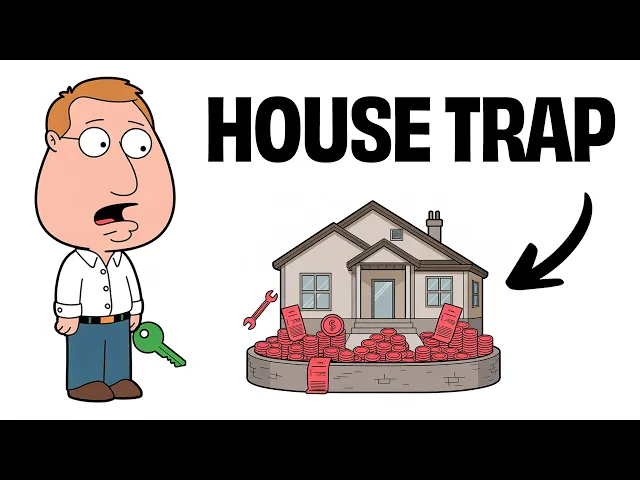
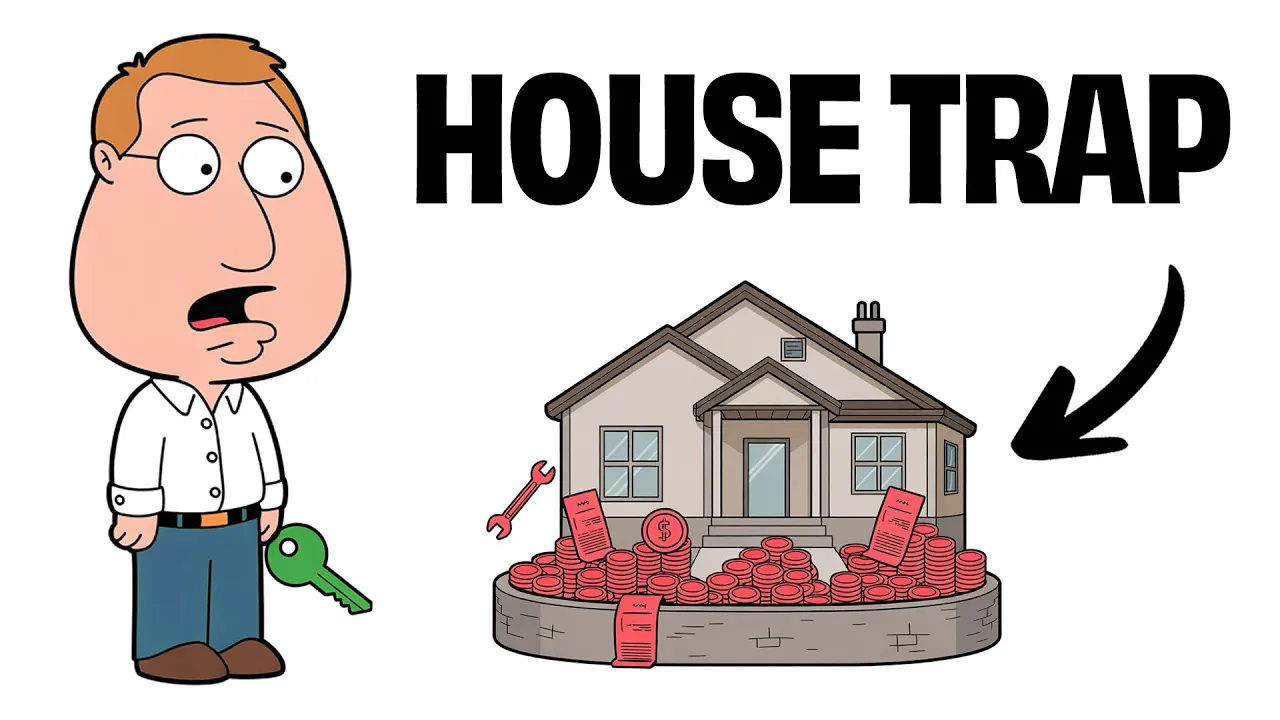
The lie is simple. Renting is throwing money away, and buying a house is building wealth. My name is Nick and today we're going to mathematically destroy that lie because once you see the actual numbers, you'll realize that for most people in 2026, buying a house isn't an investment.
It's a trap disguised as adulting. Let's start with the phrase everyone loves to throw around. Rent is just throwing money away.
You've heard it from your parents, your uncle at Thanksgiving, that guy at the gym who definitely shouldn't be giving financial advice. The logic seems airtight. When you rent, you pay money every month and get nothing back.
When you own, you're building equity. You're investing in your future. Except that framing is so dishonest, it should be criminal.
Here's what they don't tell you. When you own a house, you are also throwing money away. Lots of it.
You're just throwing it in different directions, so it's harder to see. Let's break down where your mortgage payment actually goes because most people have no idea. Say you buy a $400,000 house with a $350,000 mortgage at 7% interest over 30 years.
Your monthly payment is roughly $2,330. Sounds manageable, right? But here's the part that will make you nauseous.
In year 1, you're paying about $2,000 per month in interest. only $330 is going toward the principal, the actual house you supposedly own. That means $24,000 of your annual housing cost is pure interest, gone, evaporated, thrown directly into the bank's vault.
But wait, there's more. Property taxes on a $400,000 house average around $4,000 to $6,000 per year, depending on your state. That's another $400 to $500 per month you're not getting back.
Homeowners insurance, add $150 to $300 monthly. Maintenance, the rule of thumb is 1% of your home's value annually. So that's $4,000 a year or about $333 per month.
And if you put down less than 20% tack on PMI, another $200 to $300 monthly. Let's add it up. Um, your $2,330 mortgage payment just became a $3,500 to $4,000 per month reality when you factor in everything you actually pay.
And here's the kicker. Um, out of that $4,000, only about $330 is building equity in year 1. The other $3,670 thrown away into interest, taxes, insurance, and repairs.
So, when someone tells you renting is throwing money away, what they really mean is renting is honestly throwing money away, while owning is throwing money away while pretending you're not. The difference is that when you rent, you know exactly what you're paying. When you own, the system has convinced you that bleeding $3,670 per month is somehow superior because $330 of it sticks.
That's less than 10% efficiency. If your car only converted 10% of its gas into forward motion, you'd call it broken. But when a house does it, we call it the American dream.
Now, let's talk about opportunity cost because this is where the math gets truly brutal. Let's compare two people. Person A rents for $2,000 per month.
Person B buys and pays $4,000 per month in total housing costs. Person B is spending $2,000 more every month. What happens if person A takes that extra $2,000 and invests it over 30 years?
Assuming a conservative 7% annual return, that $2,000 per month becomes roughly $2. 4 million. Meanwhile, person B's $400,000 house, assuming 3% annual appreciation, is worth about $970,000.
But person B still owes the bank for 30 years of interest payments totaling over $480,000. Net result, person B has a paidoff house worth $970,000 after spending $480,000 in interest plus $150,000 in maintenance. Person A has $2.
4 million in liquid investments. The renter won by a lot. And they didn't have to fix a single leaky faucet or replace a single water heater to do it.
But here's the critical assumption. Person A actually has to invest that $2,000 difference. If they're just spending it on Door Dash and impulse buys, this math falls apart.
The house acts as forced savings for person B. It's a savings account you can't rate at 2 a. m.
when you're drunk and thinking about buying a jet ski. That's the real reason people build wealth through home ownership. Not because houses are magic, but because they impose discipline.
So why does everyone still insist buying is better? Because the people giving you advice profit when you buy. Real estate agents make commission on the sale price, not your long-term happiness.
Mortgage brokers get paid when you sign. The bank makes a fortune on 30 years of interest. Your parents bought their house in 1987 for $90,000 and it's worth $400,000 now.
So, they genuinely believe it was a great investment. They forget to mention they paid $120,000 in interest and $60,000 in maintenance over those decades. Nobody has an incentive to tell you the truth, which is that in most markets in 2026, buying only makes sense if you're planning to stay for a decade and you have enough income cushion that the hidden costs won't drown you.
But what about people who actually can afford to buy? They exist. Let's look at them.
Because even they're not immune to the trap. Meet the Johnson's, a dual income couple pulling in $180,000 a year. They're solidly upper middle class.
They bought that $400,000 house we've been discussing. On paper, they're living the dream. In reality, they're drowning.
Let me show you exactly what their life looks like monthtomonth because this is where theory meets the concrete wall of reality. The Johnson's take home about $11,000 per month after taxes, retirement contributions, and health insurance premiums. Sounds comfortable until you start subtracting.
The mortgage, property tax, insurance, and maintenance fund each $3,200. Two car payments because they both commute. That's $850.
Car insurance for two vehicles in a metro area, $280. Gas, because suburban sprawl means everything is a 20inut drive, $350. Student loans from the degrees they needed to qualify for those jobs, $750.
Daycare for one kid because both need to work to afford the house, $1,400. Groceries for three people trying to eat reasonably healthy, $900. Utilities for a larger house, electricity, water, gas, internet, cell phones, $520.
We're at $8,250. And we haven't touched clothing, medical co-pays, or the psychological need to occasionally pretend you have a life. They have $2,750 left for everything else.
Emergency fund. They're trying, but the HVAC died last year and wiped it out. Saving for their kids' college.
Not happening. Taking a vacation that doesn't involve sleeping on someone's couch. Maybe every third year if nothing breaks.
The Johnson's are making nearly double the median household income. And they feel broke. Because they are broke.
They've built a prison out of mortgage payments and convinced themselves the bars are equity. Here's what nobody tells you about equity. It's not real money until you sell.
And you can't sell because you need somewhere to live. It's Schroinger's wealth simultaneously existing and not existing until you're willing to become homeless to access it. The Johnson's have maybe $60,000 in equity after 5 years of payments.
That sounds impressive until you realize they paid $80,000 in interest to get it. They paid the bank $80,000 to borrow money so they could earn $60,000. That's a negative return.
A savings account would have been better. But let's say something goes wrong. One of them loses their job.
Suddenly, they're missing $5,000 a month in income. They have exactly eight weeks before they start missing mortgage payments. eight weeks before the entire structure collapses.
The house isn't an asset providing security. It's a liability demanding constant feeding. Miss three payments and the bank doesn't care about your equity.
They take the house, keep everything you paid, and you're out on the street with destroyed credit. The renter in this scenario, they downsize to a cheaper apartment, tighten the budget, and survive. They have flexibility.
The homeowner has an anchor chained to their leg while the ship is sinking. This is the part where someone in the comments will say, "But my house doubled in value in 10 years. " Congratulations.
So did rent. So did stocks. So did literally every asset class because we printed money and created inflation.
Your house didn't outperform. It matched the market while demanding you fix the roof and that doubling in value. You can't spend it.
You can take out a home equity line of credit, which is just another word for going back into debt using your house as collateral. You haven't won. You've just unlocked a new way to owe money.
The real question nobody wants to ask is this. If buying a house is such an obviously superior financial decision, why do banks need to offer you 30-year loans to make it possible? If it was genuinely affordable, you'd pay cash or pay it off in 5 years.
The fact that the standard mortgage is three decades long is proof that houses are not priced at levels normal humans can actually afford. We've normalized generational debt. Your grandparents might have had a 15-year mortgage.
You're signing up for 30 years and your kids will probably need 40-year mortgages or perpetual renting. The system isn't broken. It's working exactly as designed.
It's a wealth extraction machine and you're the input. So, what's the actual solution for the 80% of people who can't comfortably afford a $400,000 house? Stop trying.
Seriously, reject the premise. You're not failing by renting. You're refusing to participate in a rigged game.
Let me tell you what winning actually looks like in 2026. Winning is renting a place you can afford for 25% of your take-home pay instead of 40%. Winning is having $20,000 in the bank instead of $20,000 in equity you can't access.
Winning is sleeping through the night instead of lying awake calculating whether you can afford new tires this month or next. Rent the apartment. Invest the difference between what you'd pay in total housing costs and what you actually pay in rent.
Build a portfolio of index funds that you can access in an emergency without begging a bank for permission. create actual financial security instead of the illusion of it. And when someone tells you you're throwing money away on rent, ask them how much they paid in interest last year.
Ask them how much they spent on maintenance. Ask them if they've calculated their actual return versus if they invested that down payment in 2020. Watch them get uncomfortable because nobody actually runs those numbers.
They just repeat what they were told. The math is screaming the answer. Most people just don't want to hear it because it contradicts the story we've been sold since childhood.
But you're smarter than that. You're doing the actual calculation instead of following the script. And that's how you win.
Not by buying the house that bankrupts you, but by building wealth quietly while everyone else is house poor and pretending they're not. Here's the math that'll actually set you free. You take that $50,000 you didn't dump into a down payment.
You invest it in a boring S&P 500 index fund. Historically, that returns about 10% annually. In 30 years, without adding another dollar, that $50,000 could grow to around $872,000.
But you're not just sitting on that initial investment. Remember, you're also saving the difference between what homeowners pay in total housing costs versus what you pay in rent. Let's be conservative.
Say you're saving $500 a month by renting instead of owning. When you factor in maintenance, insurance, property taxes, and PMI, that's $6,000 a year. You invest that, too.
After 30 years, that stream of investments turns into an additional $1. 1 million. Your total nearly $2 million.
Meanwhile, your friend who bought the $500,000 house, their house might be worth $1. 2 2 million after 30 years of appreciation. Sounds good until you realize they paid $595,000 in interest alone on their mortgage.
They spent $150,000 on maintenance. They paid $180,000 in property taxes, their actual profit after selling, maybe $275,000 if they're lucky. You have $2 million in liquid assets.
They have $275,000 trapped in a house they have to sell to access. You won by a factor of seven. But nobody talks about this because the real estate industrial complex would collapse if people did the honest math.
The psychological grip of home ownership runs deeper than money, though. We've been programmed since childhood. Every sitcom shows a family in a house.
Every movie about success features someone buying their dream home. The message is clear. Adults own homes.
Children rent apartments. This narrative is so embedded that rejecting it feels like rejecting adulthood itself. Your parents will worry about you.
Your friends will subtly imply you're not doing as well as them. Society will treat you like you're stuck in some transitional phase even when you're 40. But here's what they're not seeing.
You have options. When your job offers you a position in another city, you can take it. You give 30 days notice and leave.
The homeowner, they're anchored. They have to sell in a down market or become an accidental landlord. Um, when the neighborhood starts declining, you can move.
The homeowner is trapped watching their investment deteriorate. When you lose your job, you can downsize to a cheaper place immediately. The homeowner has to keep making that $4,367 payment or lose everything.
Liquidity is freedom. Equity is prison with better PR. The final piece people miss is opportunity cost.
That $500,000 house doesn't just cost $500,000. It costs every single thing you couldn't do because you bought the house. It's the business you couldn't start because your capital was locked in your foundation.
It's the career risk you couldn't take because you had to make the mortgage. It's the year abroad you couldn't spend because you were tethered to property. When you rent, your money stays flexible.
You can deploy it toward opportunities as they arise. The homeowner's money is fossilized. It's concrete, drywall, and wood.
It doesn't respond to market conditions. It doesn't pivot. It just sits there demanding more money for upkeep.
Some of you are still resistant. You're thinking about your uncle who bought in 1995 and made a fortune. Sure, people who bought houses when they cost two times annual income instead of six times did fine.
But that world doesn't exist anymore. You're not your uncle. You're playing a different game with different rules.
And pretending the old playbook still works is how you end up drowning. The real flex in 2026 isn't owning property. It's having options.
Um, walk into any room of successful homeowners and watch how they talk. They brag about their equity and their square footage, but listen closer. They're complaining about the special assessment.
They're stressed about the HVAC. They're worried about the market. They're not free.
They're just heavily leveraged you, the renter with $200,000 in index funds. Um, you're sleeping fine. You're not worried about hail damage or foundation cracks.
You're not comparing contractor quotes. You're compounding wealth while they're compounding anxiety. This isn't about giving up on home ownership forever.
Maybe in 10 years the market corrects. Maybe your income triples. Maybe you move somewhere housing is actually affordable.
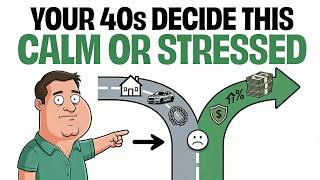
But right now, today, forcing yourself into a $500,000 mortgage you can't afford isn't building wealth to it's building a very expensive trap decorated to look like success. Run your real numbers. Calculate what you'd actually pay in total housing costs.
Compare that to your rent plus investing the difference. Be honest about your income stability and your actual expenses. And if the math says renting wins, then rent.
Not because you failed, but because you refuse to fail by following advice designed for someone else's economy. Wealth isn't about what you own. It's about what you keep, what you control, and whether you can breathe without checking your account first.
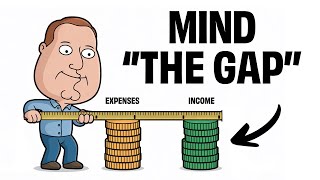
So, here's your actual homework, and it's simpler than you think. Pull up a spreadsheet tonight. Column A, what you currently pay in rent, plus, what you could invest with the difference if you didn't buy.
Column B, the real total monthly cost of owning that house you've been eyeing. Not just the mortgage, but everything we talked about. Run it forward 10 years, then 20.
Watch which number is bigger. That's not opinion. That's just arithmetic.
being honest with you when everyone else won't be. You're going to feel pressure. Your mom will ask when you're buying.
Your coworker will keep showing you their Ring doorbell footage like it's cinema. Let them. You're not playing their game anymore.
You're playing the one where you actually win, which means having money that moves when you need it to move instead of money that sits in walls demanding more money to keep existing. The housing market will keep pretending prices make sense. Real estate agents will keep telling you it's always a good time to buy.
Banks will keep approving mortgages that shouldn't exist, but you're different now. You've seen the math they don't want you to see. You know the actual cost of that American dream they're selling.
And you know it costs way more than they're advertising. Rent the place that doesn't make you anxious. Build the portfolio that actually compounds.
Sleep without wondering if you can afford the roof when it fails. That's not giving up. That's winning a game most people don't even realize they're losing until they're 50 and still making payments on a house that owns them more than they own it.
Real wealth is being able to say no to things that look like opportunities but calculate out as traps. You just learned how to say no. Now go use it.