Translate subtitles with www. deepsubtitles. com Something's happened again, so here's another video from my vacation.
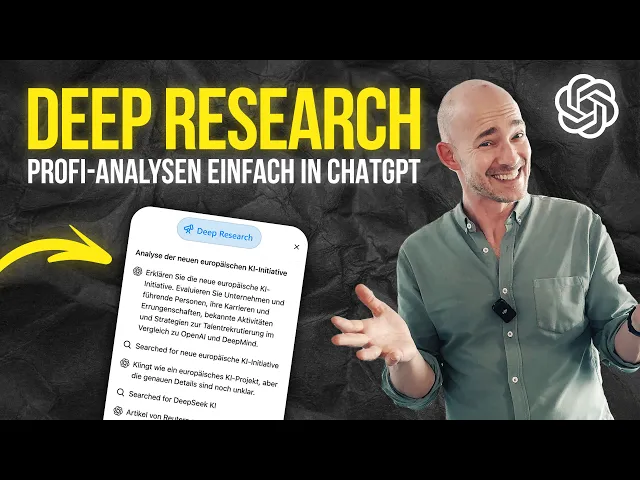
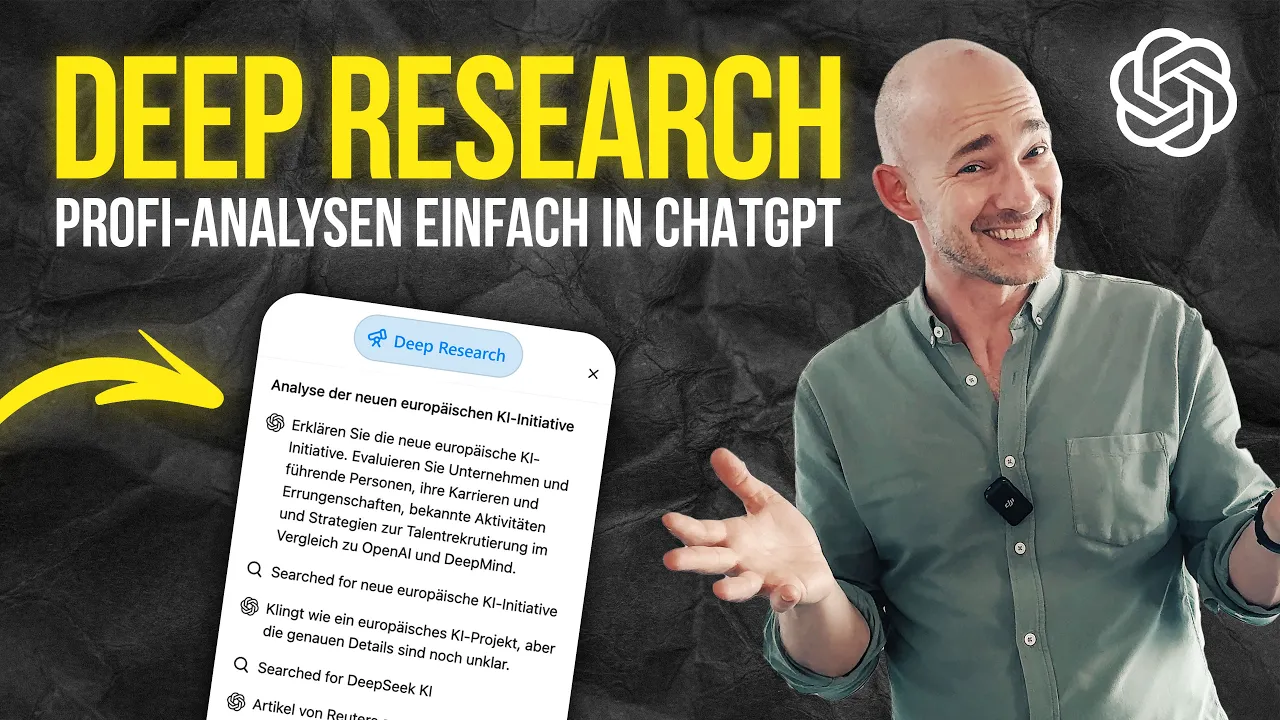
It doesn't stop. There is a new model of OpenAI and more importantly, there's a new feature of OpenAI called Deep Research. No, you didn't hear wrong, not Deep Seek, Deep Research.
We're still talking about Deep Seek, but it's much more exciting what's happening here right now and that's why we're getting into it today into the topic of an agent who will do the research work for you, Next Level. So, for all of you who are saying, I've never heard of this before, I can reassure you, I woke up this morning and thought, this can't be true. I woke up this morning and thought, this can't be true, there's another update from OpenAI because the AI news just keeps coming.
It's called deep research. They presented it with a team from Japan who were there. Why is that so interesting and what is it?
Well, it's not a new model, but it uses a new model from OpenAI. But that's actually the case. Deep Research is an agent.
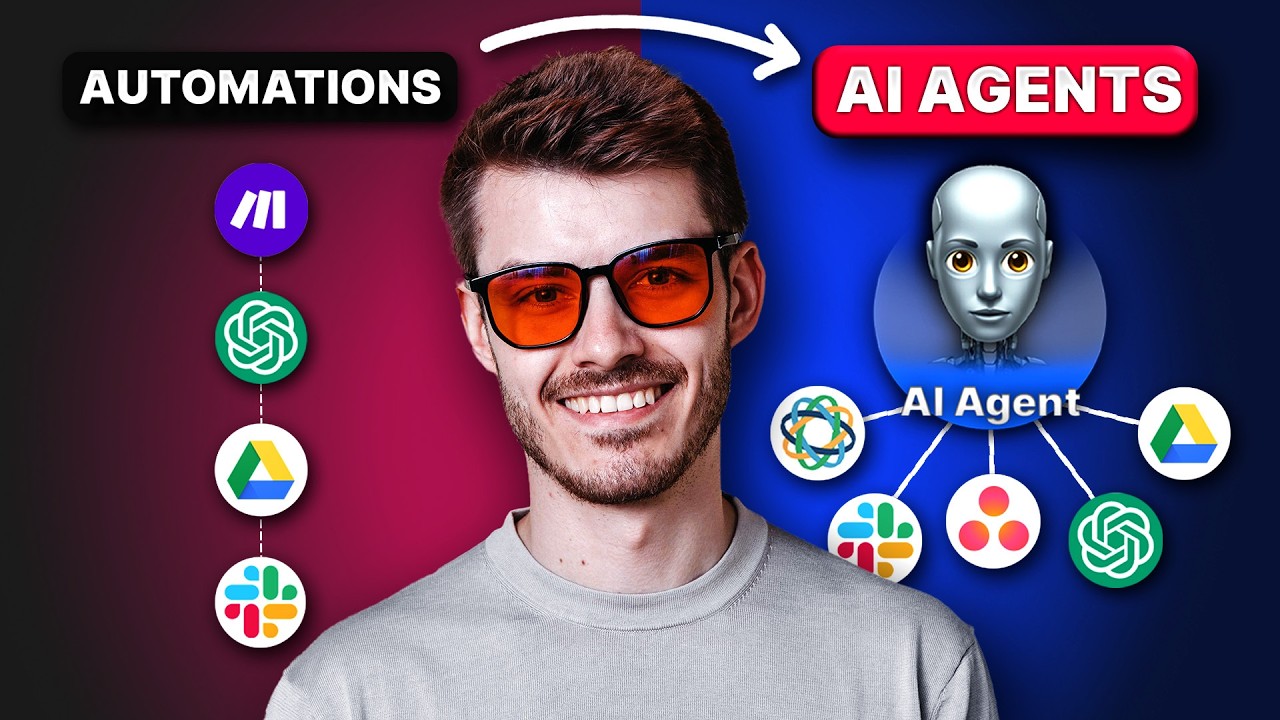
The one I shared with you before, the operators or other agents, an AI, that can take on tasks for you that require several steps, in other words, that can do things. This AI here can do very specific research on the research. Now you're saying, but Operator and Perplexity could do that too, so why is that so special?
And that's exactly what we're going to take a look at now. That's pretty cool. What exactly does this thing do when you sit in front of it?
And that's relatively important to understand. The holy grail of AI is when an AI doesn't respond immediately, but instead answers immediately, but has time to think. This is called reasoning, which is also what is currently making the rounds in the press with the various models.
The OpenAI reasoning model or family of reasoning models are the O1 and O3 models. But what is now Deep Research is doing is, the model has got a longer latency, so it has got more time to reason, because the more it will reason, the more time it can reason and the longer it can reason. research and the longer it can think and the more it can revise these results, the better the results.
So imagine you give someone a search task and say, watch out, let's research everything you can find on the Internet. In other words, the tool works autonomously over a longer period of up to 30 minutes and that's a lot for an AI across various pages and sources. These are PDFs, images, tables, data and so on.
That's what Deep Research does and you can see the steps it takes as it works. it takes. So you can sort of see all the thinking steps and write yourself a really really long, really good, really, really good report.
That's what Deep Research does. In the presentation, you explained that Deep Research is based on O3, the O3 family. Why?
Because they have a really, really deep reasoning possible. What happens in the background, and this is not entirely unimportant, is that the model, or rather the agent, in this case accesses the O3 model, i. e.
the OpenAI model, which is really good at reasoning and is not yet freely available. There are currently only O3-mini and O3-mini-high. I'll do that at another time.
The O family, i. e. O1 and O3, are the ones that can think through several steps.
can think through. And O3 is particularly good at noticing and also getting better at noticing, okay, I've found something here, how do I categorize it, how do I deal with it. Doing that very, very quickly and perhaps doing different research as a result.
research differently. And that's what's special. And OpenAI has actually made the model particularly the model to Internet research, in other words to the research that is still traditionally done, and done a relatively large number of things to optimize it perfectly.
And I think that's really remarkable, because I think that's a trend that we're going to see, that models are being fine-tuned to do certain things. That's why I'm not going crazy about this deep-sea hype, which is totally right and wonderful, but we will see a variety of models that are designed to be fine-tuned for certain tasks. We see one such task here, that is, with Deep Research we are dealing with a product, an agent, that I will definitely use on a daily basis.
Two use cases that I tried out myself. We're still on vacation, but we actually worked on a new Blackboat product here last week. worked on.
This is part of our Blackboat Academy, where we have been offering AI training for some time now, but there will be more. but there will be more. And because there are so many different ones, I wanted to have a look at one of the specific training courses.
A special one, we call the working title AI-Elite, i. e. people who really want to be next-level AI.
Before I forget, speaking of the AI elite, we're also training AI officers at Blackboat, together with HÄRTING, and there are now new dates because they were fully booked. were fully booked, you can find them on AI-Officer. io.
These are the trainings and certifications that are needed, because the EU requires from the end of February, that companies take measures if they want to use AI. With the voucher code YOUTUBE150 you get 150 Euro discount on the registration. Now it goes on.
I wanted to do more in-depth research during the training. Perplexity came to the border, I didn't have enough time, we wanted to go down to the beach anyway. I sent the thing off now and had a completely finished report in 30 minutes, which went much, much deeper, covered more sources and also came back with better questions, where I said, okay, maybe maybe I'll tweak it in a different direction.
So very classic product research, which is typically like this, I have an initial idea and I would always take I would always take O1, for example, to brainstorm my idea and say, here, this is what my company does and so on, now I brainstorm the idea and then I would formulate a research question and then I give it to Deep Research and feed the report back into my O1 brainstorming chat. That's my first use case. So, because this is an internal case for us, I can't show you the details, but you can see a few examples here that OpenAI has also presented and I can definitely tell you that if you try it out for yourself, you'll get a really long report.
really long report. So it's a real, genuine report that you would normally get and not a short response. That means your prompt has to be good too, which is why you're asked for clarification.
The second case I have is more strategic. So let's say you have a company and you have a business case and you want to take things to the next level for this year to the next level and you say, gosh, what could be critical issues in my industry and maybe you don't have an idea, then you take O1, simply O1 and say, here's my business case, everything I've calculated this year, what is the most critical question in my industry that I should work on. You take that over to Deep Research, ask that question, get feedback for clarifying questions and then generate a report on it.
I already like the examples that OpenAI gave with, hey, I want to buy a new camera, for example, you can do a research on everything you find and you really get a report. This is of course for people who say, hey, for me this is super important for me to research in detail, but what you can do strategically with it, and that's just the beginning, that's clearly next level for me. Now we're talking about real, strategic work where you can say, okay, I can really do something with this.
And remember, it's not a completely new model, but rather - and this is the crucial point - a model has been fine-tuned for this purpose and I think that's a big, big trend this year and I also imagine, and that was one of the last sentences you said was one of the last sentences you said, that it could also be used for our own data at some point. own data. And, of course, I immediately have in my head that I'm thinking, wow, what if we can connect this to a CRM database at some point?
a CRM database, perhaps to our files and the like, things that already work with search, but suddenly a Reasoning tool, a task that I have traditionally given to someone, where I have said, here, make a record, what could our new pitch look like? or I think about a campaign for all customers who have bought this and that and then go through it. Remember, it happens completely autonomously.
How do I get there now? And you already know the game, the whole thing is very compute-intensive, which means OpenAI typically starts with the Pro users and then rolls out to Plus and Teams and Enterprise. It's worth it if you say, hey, I want the latest, greatest product and stick with it, and it's, no, not a comparison with cheaper models.
This is a new product, so agents are always combined features of a great product. So Pro-Account, then you can use and try out Deep Research just like Operator, which I shared. This was my first look at Deep Research.
I'd be interested to know what you think of the extremely rapid development, that has already taken on such a pace that even I say, boah, it's all really quite fast now, especially as these agents can already do some pretty crazy things. And you know me, I'm always Tech-positive, I'm always looking ahead, but it feels like this is the exponential curve we're sitting on now and I think it's pretty awesome. I would definitely be interested.
I'm definitely pleased that you're here to discuss this with me, because we'll be doing this again in a few days' time. again in a few days and I'll be back with the next topic. A lot has happened again, you've heard that, and I'm going to make a video about it.
make a video about it. So thank you for watching, and I'll see you in a few days.