All right, founders. It is time for another pitch deck critique and review. And this time, we've got a real cool one.
I'm super excited to present this. This is an AI agent pitch deck. And we are talking about being in preede for this.
They are trying to raise 500k. And the reason I'm so excited is because this deck is getting VC meetings. We are talking about a deck that is successful.
And there are many reasons that we're going to go through this. I'm going to get a little nitpicky and share some of the things that I'd like to see. But disclaimer, I've been working with this founder back and forth to refine this deck.
And it's almost near perfect in my estimation. And there's a reason that I want to share this with you today so we can all learn together. If you're a founder out there and you want your own pitch deck critiqued and reviewed, stay till the end of the video.
I'm going to give you instructions. If you're part of startups. com, thank you so much.
You don't have to wait. Just contact me and I'll make sure that you get a pitch deck review. My name is Ed Kang.
If we've already met before, use the chapter markers to skip right to the pitch deck critique and review. I made it as easy as possible for you. You are welcome.
If we haven't met before, I'm a seventime funded founder with two exits. And that's just a fancy way of saying I've failed a bunch of times to your benefit because I like to use this channel videos like this to help founders of all stages, but especially early stage founders raising early stage capital avoid some of the catastrophic mistakes that I've made during my day. Not to say you're not going to make mistakes, but I'm going to try to make your life a little bit easier because it's tough enough as it is.
And as mentioned, I'm the chief strategy officer for startups. com. If you're part of startups.
com, thank you so much for your support. Leave a like, comment, and subscribe while you're here. and let me know what you're thinking.
If you like this type of content, what else you want to see? In the meantime, let's jump into this pitch deck critique and review. Here's the cover page, and I want to highlight three important elements.
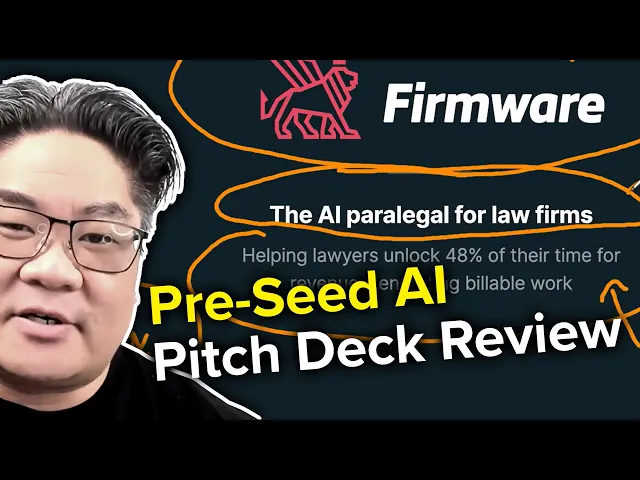
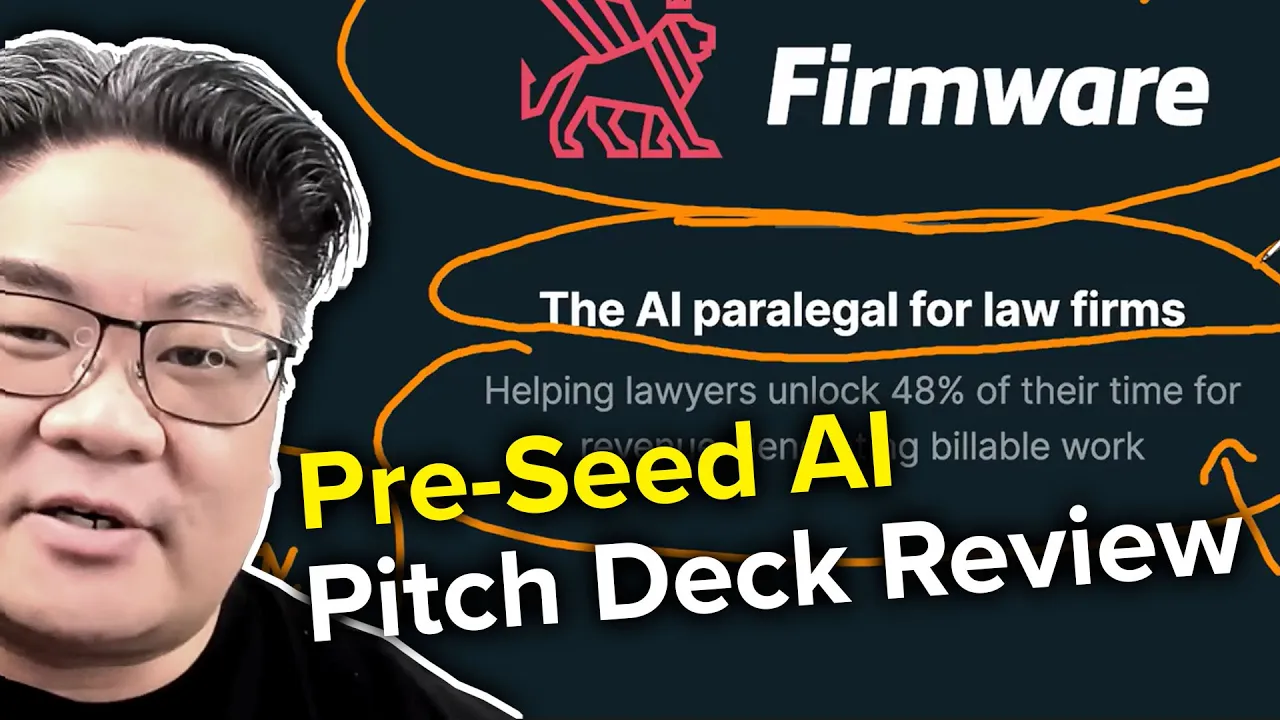
First, you have the nice start design, the logo of the company. Then, you have the description line that is not buzzy or full of hype or it's not a marketing slogan. It's just very straightforward in what this company does and what the investor needs to expect.
You don't need to have kitschy marketing slogans underneath there. However, this one also added a purpose statement, something just to add a little more flare to this cover. This to me is optional.
However, if you've got a good one, put it in there. And it needs to be straightforward. No hype.
Get rid of the hype or any internal language, jargon, technical. It says right here, helping lawyers unlock 48% of the time for revenue generating billable work. So, we got the logo.
We've got the tagline on what we're going to expect to see when we jump into this deck as well as a purpose statement at the bottom. Fantastic cover slide. Here's the problem statement.
Now, notice it says problem small in the top left corner. That's always a good thing. In the US, 1.
3 million lawyers waste 48% of their time on non-billable activities like form filling, template drafting, and document summarization costing the industry $200 billion per year. We've got a citation down at the bottom. Always helps to put that in there.
But remember, I am always looking for size, scope, and severity of the problem in one stark summary sentence that helps me understand. Notice that there are no bullets, no bullet points, nothing extra on this slide. It is just a clean slide, one sentence right at the top.
And if you want to talk about size, scope, and severity, we have the size of the problem, which starts off with the who has the problem. So, it's 1. 3 million lawyers.
All right, I got an idea. Now, the scope of the problem, what are they doing? What causes the issue?
Well, they're spending 48% of their time on non-billable activities like form filling, template drafting, document summarization. That's the scope of the problem. What's the severity?
Well, it's costing the industry $200 billion per year in those non-billable hours. That is a great problem statement, and we're able to boil it down in one sentence. If you cannot boil down your problem statement in to one sentence, it's already too complicated.
This is just the ad for the ad. It's going to get me into the rest of the deck. Now, let's look at the solution statement.
Firmware is an AI parallegal agent that automates form filling, template drafting, and document summarization, unlocking 48% of lawyers time for revenue generating billable opportunities or work. In other words, it's the reverse of the problem. You've solved the problem one step at a time.
If you want to take a look at it, here it is. The problem, it said the issue was non-billable activities like form filling, template drafting, and document summarization. Therefore, in the solution, we have it automates form filling, template drafting, and document summarization.
That's all you have to do. Say this over and over again. Your problem has to connect with the solution statement.
If your problem is something is manual, slow, and super expensive, then your solution has to say that we are automated, we're fast, and we are 10x cheaper. Or better yet, put an exact price point. We charge 10% of the cost or this is how much money you're going to make instead of losing.
That's a straightforward solution statement. So make sure that the two connect because so many times founders just go completely off the mark and they say problem is one thing and then we're solving something completely different. They're not connected.
Therefore you have to say a problem that you are going to solve or your solution actually has to solve the problem in a way that the investor understands that you are connected. And I'm not just telling you this is not my personal preference. These are investors that have told me straight out the biggest pet peeve that they have right away is that the problem and the solution do not align.
The other great thing about this problem statement is that I know exactly what it is. So many founders get right into these are the benefits and they make the promises. They'd say, "Our solution automates form filling, template drafting, and document summarization, but you haven't told me what you're actually building.
Is it an app? Is it an AI? Is it a decentralized autonomous organization?
We need to know as investors. " And then I look for what is the differentiation, the special sauce. Well, it's going to unlock 48% of the time.
That's the result. That's the special sauce leads to the result that we're promising for revenue generating billable work. I am now reinforcing this is what it's all about.
And here's what happens is an investor looks at that and says would a lawyer want to buy this? Well, yeah. If a lawyer could be promised that you could save 48% of all that drudgerous time that you're not billing for and actually do revenue generating billable work, who wouldn't sign up for that?
And therefore the size scope and severity problem have been solved enough to create a huge financial opportunity that the investor can envision in their minds. And so many founders say I can't put numbers to my opportunity or the severity of the problem. That is not true.
If you can't do that, you don't have a total addressable market. You can't show the investor that we can make a whole bunch of money. So learn to extrapolate and learn to come up with those clear numbers.
The problem statement said we're losing 200 billion and now we're solving that. Your 48% time to do billable work and now lawyer can imagine what that would mean for them. Here's the market side.
Our total market is over 3. 9 billion. The initial focus is lawyers already using case management because they're attempting to use software to solve their problems representing a 2 billion opportunity.
We've got the full TAM right here and the math is here. This is a bottomup TAM. How do I know?
All lawyers 1. 3 million. and we've established charging them an average $1,600 per year.
Then we got the SAM. So now I want to understand why we're focusing on this segment of the market because this is your beach head. This is where you're going to start and we're saying we're going to target lawyers using case management.
Why? Because they're attempting to use their software to solve their problems. Meaning they're already using software.
So they're going to use an AI agent. Now I'm not here to be the gatekeeper of whether this is going to work or not. The investor is going to poke holes and challenge you on it.
But at least you've got some type of thoughtful consideration to say, "Hey, here's why I'm doing what I'm doing. " And you can convince the investor saying, "This is a really great idea to establish that beach head. " Instead of saying, "We're just going to target our entire market.
" Well, nobody believes you're actually going to reach all of your TAM and your SOM here is what we're realistically going to do with 100K lawyers and showing that okay, based on this 300 million as a percentage of the total TAM, I can believe this is actually possible and that's what a good market slide will do. Highlighting once again summary sentence up at the top. If I don't look at any of this right here, I know exactly what the market is and what we're doing.
But Tam Sam is being used to show that you know the math. You can do it. You're thoughtful.
The only other slight improvement that we could do on this slide is to use visual representations, the bubbles if you want. And not everybody wants that, but that's just a slight nitpicky thing that you could expand into visualizing your slides a little bit better to be more conducive. But to me, that's not a dealbreaker here whatsoever.
Great market slide. How it works? Look at the summary sentence up at the top.
We develop proprietary workflows specific to lawyers to prompt the most up-to-date LLM so lawyers can delegate their work. Why is this summary sentence so powerful? It's because this is what customers want.
It's based on the customers. You are demonstrating to the investor. You know what customers want.
Now, we got a simple four-step process. Upload raw tempest. Speak request.
Firmway does work. Review and approve. Lawyer.
Moving on to billable work. That's the happy ending. And we've got a little bit of screenshot showing that it exists.
Now, let me be transparent and tell you how I've asked for this slide to be slightly improved. I want to see an example, which we got a little bit down here. But if we could go 1 2 3 across and show these boxes of how we're moving from step to step, then we could say, all right, what are we saying to them?
We're saying we need to draft a lawsuit. And normally, this would be done manually. Instead, we're going to upload the raw template, whatever it is, call it from the library, and we're going to say, "Drft a lawsuit for Elena Martinez case using my rear end templates.
" Then I just want to show maybe a little bubble saying that based on all this, it goes to whatever LLM proprietary thing to prompt and then it spits out a result that can be reviewed and approved. It's just a little bit of tweak. All the raw materials are there, but showing just straightforward instead of doing things manual.
This is literally how easy it is. That would be an interesting way to change a slide. So again, for me, this slide is a solid B+.
We can get it to an A minus with just a little bit of tweaking and making things more conducive so investors can see right away what they're looking at. Here's the business model. To me, this is a pristine slide.
We're just saying straight out, we're charging a B2B SAS subscription model. Straightforward. And we've got the different unit economics there and an explanation for each one underneath there.
That's all we need. We don't need to see all these future revenues. And maybe you can put that in there if you think it's important, but this is really straightforward.
Again, this is my beach head of how I'm going to make the money. And then we've got a little bit of extra showing that we can make another source of revenue. And you are at a preede stage.
Don't worry about complicating your revenue model. Let me just reinforce this for just one moment. I think founders feel insecure saying, "Oh, there's so many ways that we're going to make revenue that show you don't have a conviction in the first way you're going to make revenue.
" As an investor, I would rather see you dominate one form of revenue. In fact, I don't even see all these tiers. It can get complicated because one of the weaknesses that founders fall into is they don't battle test their assumptions.
If you're not out there and you can't get an assumption battle tested, then I would not worry about it. I would just say we're doing a subscription model and we're starting off right here at $50 a month. If you have one of the startups where unit economics is important, then you can share the margin that you're going to be able to make.
But I'd rather see you dominate one type of revenue model before expanding. So, if you've got like six different types of revenue models or as a founder, you say, "But Ed, I can't simplify my slide because I got so many ways that I'm going to make revenue. " Then the investor is going to think, well, then you're going to have a real hard time dominating or making revenue to begin with because your focus is going to be split.
Therefore, you're going to be spending my investment money in multiple ways trying to figure that out unless it's battle tested. If you're already doing it or you've already got users, customers saying yes, I will pay this membership price plus transaction fees plus upgrade fees plus installation fees, consulting work, then sure, you're going to explain that and it's going to come out. But in the meantime, don't over complicate your business model and how you're going to make money.
Go to market slide. This is one of the best slides in the deck. It's got a summary headline at the top.
Secured first customer. Right away, you should know why this startup is getting VC meetings because we've already got a secured customer and explains how they got that secured customer and now we're putting out an investment thesis or a hypothesis on what we're going to do to go out and get more customers based on realworld data and experience. There's experience behind this that allows us to calculate and therefore you are a more thoughtful founder.
This founder is demonstrating that they have thought things through. Now, truth be told, in the beginning, this slide didn't look like this. It had a YouTube strategy, which I fully endorsed YouTube, but I asked, "How do we know that these lawyers are watching YouTube?
" We couldn't find any data. And so, I went back to the founder and I said, "How did you get your first paying customer? " Cuz I knew they had paying customer and that's really big.
And this founder explained to me, "This is how I did it. " And I said, "Wow, then that's the way you need to communicate on the slide because that's going to be so much more powerful. " And I can tell you, I've shown this to other investors, other adviserss, other founders, and they love this slide.
This is a slide that has a strategy, not a laundry list of all these tactics, hoping that we're going to work and hoping that investor gives us money to go figure out competitors. Once again, summary sentence right at the top. Firmware is addressing the 63% of lawyers who find legal tech too complex with an agent, not another tool.
We're explaining, hey, here's how we're different. And we mentioned the other main competitors right here and just did a little summary sentence. And guess what?
I don't have to read the rest of this deck. If all I do is read this, then that's fantastic. And if I do not read this, then it doesn't matter to me.
That's the reason summary sentences are so important. But now we got visual representation. And on these dimensions, this is what customers want.
Voice control, research, client intake, case management, and we got checks and we've got dashes saying this doesn't do it right there. Straightforward competitive slide. I dig it and I know the founder has been very thoughtful about researching these competitors.
Not saying we don't have any competitors that do this in our space. Just very straightforward. No, we acknowledge that these competitors do it, but here's how we're different.
Here's the team slide. Once again, summary sentence up at the top. 100,000 EOS hackathon winner with two years experience building for lawyers.
Remember, I want to know, do you have experience with the problem? Do you have domain expertise with the problem? Or do you have founder credibility with the problem?
These are all things that we're looking at. And if you put this in a top sentence right there, that's pretty much what I want to see. I want to see that because it entices me to read the rest.
And we got Kobe. Here's our founder. And he's got these bullet points that are relevant to saying, I am the founder and I know how to win this.
And he's got a really great story that he tells investors about how he won that hackathon when he really shouldn't have or someone would say there's no way you can win that hackathon with that technique. Great story. So, this is a formidable founder right there.
And that's the reason we're getting VC meetings because remember, investors invest in founders, not companies. On top of which, we've got this co-founder right here. And look at all the credentials that relate to it.
And here, met the founder 10 years ago. So, we're talking about chemistry in there. That's absolutely fantastic.
Great team. One more thing, KBY is technical and that's a good thing right here. That really helps.
And now we've got COO upon funding. But it's not just the COO. It's a COO with all these experiences that contribute to why this person would make a great co-founder.
Traction. If you pay attention to any slide, this is the slide that I want you to pay attention. This is a three star slide.
Three of three. First paying customer one week after launch. We've got three things that we want in terms of traction.
I want to know the state of the product. I want to know customers validation. What do you have?
and I want to know growth or metrics in terms of momentum. That's super important. And these days right now when it comes to AI, getting the first paying customer says a lot these days, especially in the AI washing, everybody building AI rappers and AI companies have made it so easy.
These LLM hubs are saying, "Hey, build apps on top of us. " It's absolutely crazy and insane what you can do now. Super exciting.
But everybody now can build a pretty much crazy demo. Development is half of the equation. And right now investors are saying it's the half that matters the least.
Distribution is the thing that nobody else can figure out. People are struggling getting distribution out there. And therefore I know investors general partners of early stage funds they invest in preede pre-revenue are now saying go out and get a paying customer or at least a customer that intends to pay and tell us what you are learning and that automatically eliminates like gosh 90% of the startups out there because how many founders and startups do I know that are out there trying to build AI agents but don't have customers don't have founder market fit and what's so important about this founder and why he's getting VC meetings is because he spent two years selling to this market and he can prove it.
He's got the receipts to show for it and therefore can say in one week after launch that's the momentum I was able to get a paying customer and as an investor I'd be saying what did that customer say to you? What did you learn from them? Which is a demographic that we're going to really push into?
How are you going to get more of those customers? We have so much more to talk about because this founder went and got one customer. the product's not even fully done yet.
The founder tells me all the time, "I didn't get to as much coding as I'd like to because I've been doing all this outreach to investors. " Which, by the way, is what happens. Prepare yourself to spend full-time in the thankless insufferable process of talking to investors.
But once you get that going, then you can get back to building your product, which you should be doing 50/50. But even before the product was done, managed to go get a sale, that is pretty spectacular. That's an exceptional thing showing the founder is exceptional.
And you out there, you have to be willing to do the same. pick up the phone, do founder le sales, get a customer, and show the investor that you know how to do that. So when they give you money, it's not going to go into all these digital campaigns where you're just create advertising debt for yourself and you waste all that money.
You know how to make money without any money. Investors are going to be very interested in what you are building. So once again, I can't stress enough one week after launch, first paying customer.
That is customer validation and that is traction. Now, here's the thing with this one. investors are asking for a roadmap and that's going to be a great conversation that he's having in terms of the state of the product which we're going to keep building upon.
But we say here's our first paying customer and now we got eight users since launch in March 17th 2025. Momentum, momentum, momentum. Notice how it's just one paying customer.
That's not a lot. We're not, you know, having millions of dollars in revenue or millions of customers, but that is way better at the early stages because early stage investors are going to say, "Man, if you could do this with one customer, you can do it with millions of customers. I need to get my money in now before," that's where the FOMO comes in before this founder goes and repeats it for a million customers and now my money is not worth as much.
Or this founder might not even need my money at that point in time. And here's the funding. $500,000 to reach 120k ARR in 4 months.
So, it's I'm raising X amount of dollars to reach Y milestone in Z time frame and we've got use of funds right there. A simple clean slide and I'm pretty sure this founder is going to raise. I don't know how many meetings it's going to take in this environment, but the founder is going to raise.
Notice on all the slides how sparse they are and how straightforward and to the point, highlighting the founder strengths. Remember, this is a teaser introductory deck. This deck is not designed to get an investment decision.
It is designed to take the next steps. And as I keep repeating over and over again, the next steps are being taken. VCs are saying, "Great, we got your deck.
We want to look through the rest of your stuff. We want more of a presentation. Here are the things that we want you to prepare for us.
You didn't have to put that all in the deck because the investor is going to ask for it. " And that's the beauty of a great screener introduction deck. It is sparse.
It is clean. It is direct to the point. And it's like sharpening that tip of the arrow.
So, it can get through any armor. it can get through any whatever resistance that you're going to experience in cutting through all the noise of all the other pitch decks that go to the investor. As promised, if you're a founder out there and you want your deck critiqued and reviewed, send me a message on this video and let me know what you are trying to build and I will give you more directions on what to do next.
I need a process because I'm being inundated with pitch deck review requests and we have to stack them and we need a process to make sure that although we do these reviews for free out there. Now, if you're part of startups. com, you don't have to wait for the all of this right away.
We'll get that done for you. But for everybody else, not part of startups. com, this is not me telling you to join starups.
com. It's saying I will do a pitch deck critique and review, but there's a process that you have to undergo so that I can make these videos as valuable as possible. We're not doing the same thing over and over again for everybody out there.
So, you help the founder community at large and that's our trade. I will work for you as an adviser and work on your pitch deck if you help me help all the founders out there with this free video so we can make the founder startup ecosystem a better place overall. That's my heart.
That's my goal. Thank you so much. Watch some of the other videos that are going to be on the screen.
I appreciate you once again. Your comments are totally cherished. All right.
Let me know what you're thinking. Thanks for hanging out here with me, spending your time.