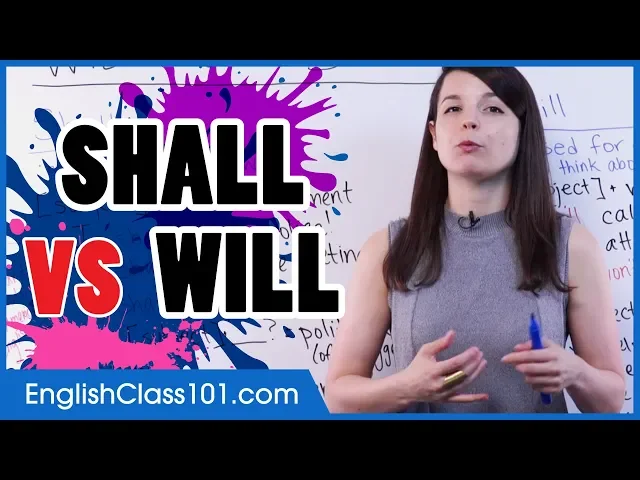
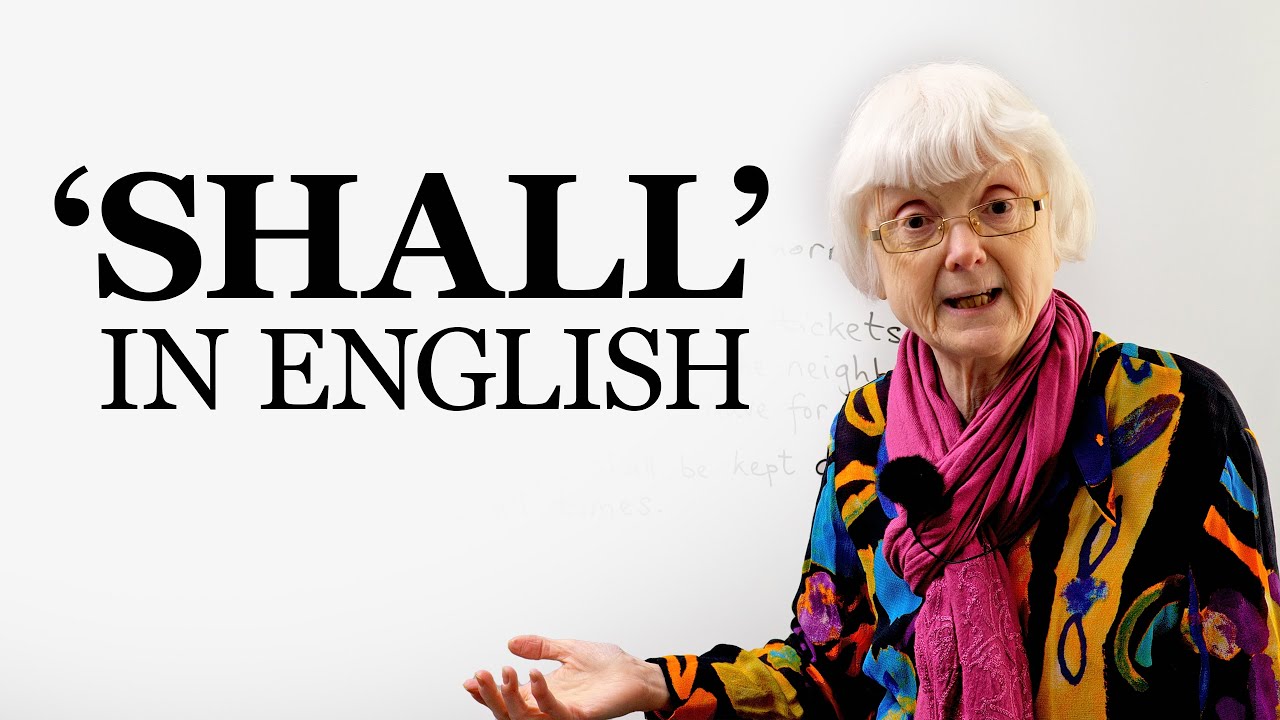
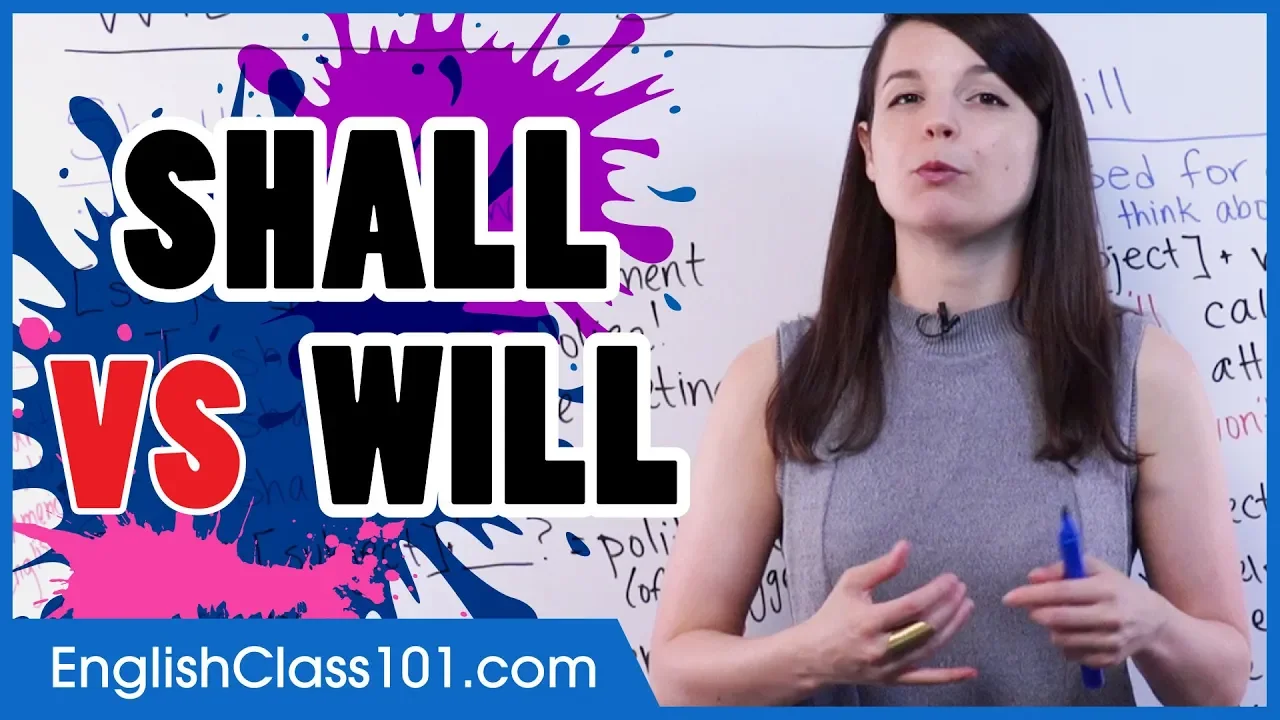
want to speak real english from your first lesson sign up for your free lifetime account at englishclass101.com hi everybody my name is alicia in this lesson i'm going to talk about some differences between shall and will let's get started with shall shall before i start shall is going to sound more formal than will there are some cases where you can use shall and will to make the same kind of grammatical structure and when you use shall in those cases it's going to sound more formal than will we don't tend to use shall so much in
american english it's not incorrect but just remember that you're going to sound perhaps too polite sometimes if you use shall so with that in mind let's take a look at the first pattern i want to talk about first pattern is subject plus shall so subject plus shall plus some other information so not a question when you use this subject first followed by shall that's the basic structure for making a statement a statement so you're not asking for any information you're just stating something let's look at some examples here i shall call the police i shall
call the police so this is a statement in this case maybe someone is shouting this i shall call the police so this is a decision this person has probably just made and they're stating it loudly but politely in this case i shall call the police let's look at the next example he shall attend the meeting he shall attend the meeting again a statement it sounds polite because shall has been used and we're probably sharing this information with like the meeting planner for example or someone related to the meeting he shall attend the meeting so it
sounds polite a simple statement let's look at this one this actually this is a famous movie quote you shall not pass if any of you are fans of lord of the rings maybe you know this famous line you shall not pass is a famous line that uses the negative form here you shall not pass so pass means like continue across a road in this case so you shall not pass me you shall not pass this point in other words so shall not again this is used in the negative form you might hear in some cases
shant but shant is not used in american english shand is the contracted form of shall and not shant but we don't use this in american english and it's fairly rare to see in american english media you may see this more in british english or british english related media or in media that features maybe old-fashioned style english but for this one you shall not pass this is okay because the character is kind of like is a fantasy character and they're speaking in a more formal um and more formal manner so you shall not pass is okay
here and again this is uh said in a situation where a character is making a decision in that moment so in that situation the character has made like a decision uh just then and they're saying it but they're using this kind of polite expression you shall not pass so keep in mind these are all kind of like statements we make in the conversation or in a moment in a specific moment we didn't maybe think about it so much before speaking okay let's look then at the opposite here so this first set of example sentences was
about subject plus shall this order but let's reverse that here to do shall plus the subject so when you use this kind of pattern you'll be making a question so these are polite sounding questions they are offers or suggestions that kind of thing for example a very common expression is shall we shall we you'll notice there's no verb here there's no shall we what shall we dance is a common one or shall we get a drink is another one but you might hear just this shall we this means like shall we move into the next
room or shall we enter the event space shall we go somewhere this is used when the next step when the action is very clear this from this list of example sentences this is perhaps the most common use of shao in american english today shall we so it's kind of a nice polite friendly invitation to do something it's like you're making an offer to do the next thing shall we so that's quite common but the next a couple of examples perhaps are a little bit different here's one shall i clean up the kitchen shall i clean
up the kitchen this is an offer so in this case i i'm offering to clean up the kitchen shall i clean up the kitchen that's quite a polite offer because i've used shell to give the offer in other cases i might say do you want me to clean up the kitchen or perhaps just should i clean up the kitchen is a more natural and kind of common way to express the same thing if you use shall it's not incorrect but it just sounds quite formal let's continue to our last example sentence shall we bring drinks
shall we bring drinks like to a party for example shall we bring drinks you're making an offer again or maybe you can make like suggestions for a party like shall we do this or shall we go to this location so you might hear patterns like this used in planning events this is an this one is more of an offer than a suggest uh yeah more of an offer than a suggestion but you might hear this used to make polite suggestions as well shall we go to that restaurant shall we invite this person or that person
so making suggestions kind of but again quite formal here in most cases we'll just use should in modern american english okay the final point about this is here uh so when we're making uh these kind of question patterns it's quite strange to use you as the subject here because we're making like an offer or a suggestion so when you say shall you it sounds really strange because you're making an offer for something the other person you think maybe should do which is very strange when we make offers the offers come from ourselves like we choose
to make an offer so if you're making an offer or trying to make a sentence that's like suggesting something from someone else it sounds very strange so don't use you here shall you do something don't use that pattern when you're making these kinds of questions try to use like shall we shall i for example so you're making an offer or like um you're making a suggestion from yourself okay let's move along now to will so will has quite a few different uses uh the ones i'm going to talk about here are to compare with shall
first we use will for decisions that we make in the moment as we talked about over here with shell a little bit and we use it to think about uncertain things in the future so this is a very broad introduction to will but for this lesson i want to focus here so first let's compare we talked about using shall with this pattern a subject plus will in this case makes a statement so again subject comes first then will or won't as we'll see for example i'll call the police we saw this same sentence over here
with i shall call the police this sounds quite formal i'll call the police sounds much more natural i'll call the police so this sounds like something we decided in the moment and it sounds like uh it's not a polite situation either i'll call the police this is probably much more commonly used in american english here he'll attend the meeting he'll attend the meeting same sentence as we saw over here he shall attend the meeting sounds much more casual or much more natural when we use will so he'll attend the meeting again we have this contracted
form he will becomes heal i will becomes i'll he'll attend the meeting so again passing information during a conversation he'll attend the meeting here you won't pass the test so i changed this one a little bit it sounds a little bit better to use you won't pass the test here specifically what will you pass or not pass i've used the negative you won't pass the test so in this case the speaker maybe heard some information about someone studying habits or they have a very negative opinion of the listener for some reason and they say you
won't pass the test or maybe they're talking about how difficult the test is as well there are a few situations but you won't pass the test so this is a negative example it's a simple statement so as i've done with these two positive sentences i've used the contracted negative won't will not here so when you're talking specifically when you're using when you're speaking not necessarily when you're writing use the contracted form so you're going to sound more natural you're going to sound more friendly if you're using this contracted form in speech if you're using i
will he will she will it sounds really stiff and unnatural so when you're speaking use this form when you're writing casually you can use this form as well if you're writing something like a thesis paper or something more formal i would recommend not contracting so go ahead and use the i will he will she will when it's appropriate so try to use this i know it takes a little bit of time to practice and to get used to especially if the l sound is difficult to say but try to use this in your speech okay
let's go on then to the other version the other the other sentence pattern we talked about the opposite the reverse here where will comes first followed by our subject and then some kind of question phrase so we use this to make requests that's one where we use you typically i'll show you in just a moment we use this pattern when we're thinking out loud we're thinking about something we're going to do something in the future and we use this to talk about future state inquiries so i'll show you some examples of this let's begin with
the first type a request using you will you help me with my homework will you help me with my homework this is a simple request i've used you here will you help me so we typically use you here because we use will like when we're making decisions in the moment during the conversation so when you use will you you're probably speaking to someone in that moment perhaps less common is will he or will she do something it sounds maybe okay in a few situations but we tend to use a request pattern like this when the
listener is there with us participating in the conversation with us if you're using will he or will she do something it could perhaps be okay um but we tend to use this more again when everybody in in the conversation is there we can use will you to make the request um let's continue on though to this next pattern first let's read this uh will i have time for a break today well i have time for a break today this is one example of a situation where it's okay to use i in a sentence like this
in a question like this this is an example of what i mentioned here thinking aloud thinking out loud so these are questions that we ask ourselves about our future so will i have time for a break today is something a person might think or might say to themselves say quietly to themselves they're thinking about their schedule for the day will i have time for a break today will i have time to go to the bank today so you're thinking about something you need to do or you want to do but you're not sure about it
we use this however for things that are not very near future actions so for example i would not say will i talk about won't later in this lesson that doesn't make sense because i know already i'm going to talk about this point later so it doesn't make sense we use this for actions that are not so close to us in the future and that we're not certain about yet so here will i have time for a break today maybe this person is really busy or maybe there are a lot of other things that are happening
that they need to take care of so will i have time for a break today is a good example of that we're unsure okay one more will he be at the meeting will he be at the meeting this is an example of a future state inquiry so a future state question we're asking for information about some future state a future status in this case will he be at the meeting will he be at the meeting so you're asking for information about someone's state in the future this is an example where it's okay to use going
to as well is he going to be at the meeting will he be at the meeting those questions are fine both of those are okay to use there's really not a difference between the two so you can use this to talk about these future states all right then let's progress to the last point here i talked about using will to make questions but it's also important to talk about won't won't so again the contracted form will not when we make questions though we use won't so please use won't when you make questions here won't plus
your subject and the rest of your question phrase this is something we use to make a confirmation question so a confirmation question is a question we use to check information we think something like point a and we want to check is it point a and the speaker or the listener rather has a chance to fix our error so examples first won't you be late for your meeting won't you be late for your meeting so maybe the listener is very busy and they're taking a long lunch for example and the speaker says won't you be late
for your meeting like if you take a longer lunch so the speaker thinks the listener is going to be late and so they ask this confirmation question not will you but won't you so that's sort of like showing the speaker has a little bit of doubt about the situation and they're asking for confirmation so the listener could say for example oh right i need to go so yes i will i will be late i need to go now like checking the time or no my meeting time got changed for example so this gives the listener
the chance to like tell the speaker about any updates let's look at one more example won't this policy change cause problems so again the speaker here is saying i'm not sure but i think that this change is going to cause some problems right that's another way of phrasing this uh this kind of question so when you hear questions that begin with won't you're probably hearing a confirmation question someone is trying to check information so this is a quick introduction to using will and shall in some similar situations as i said try to remember that shall
sounds much more formal than will this one i pointed out earlier shall we is probably the most common use of shall in english today at least in american english in these other cases we tend to use will more to talk about these sorts of in the conversation decisions so i hope that this helped you if you have any questions or comments or if you want to practice making a sentence please feel free to do so in the comment section of this video of course if you like the video please don't forget to give it a
thumbs up subscribe to the channel if you haven't already and check us out at englishclass101.com for some other things that can help you with your english studies thanks very much for watching this lesson and i will see you again soon bye [Music]