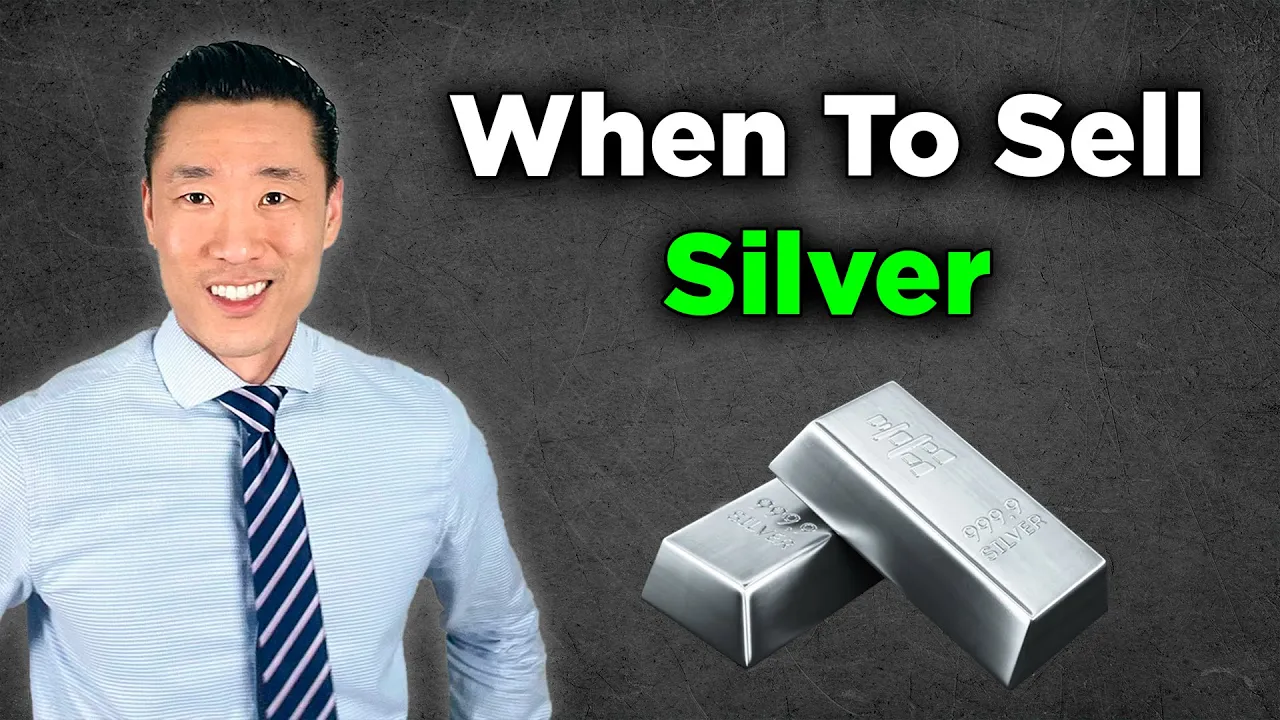
In today's video, I want to give you my exit strategy on when I plan on selling my silver. But first, I just want to say congratulations. Congratulations to everyone that made a killing on silver.
So, ever since I made that video about 7 months ago, the price of silver has nearly tripled. And I swear to you, people have been messaging me saying that with the money that they made from silver, it was enough to pay off their credit card debt, to get out of the hole. It was enough money, enough gains to pay off their student loans, to pay off their auto loans, to own their car just free and clear.
Other people have been telling me that they made enough money from silver that they now feel much more comfortable in retirement. And to that, I say congratulations and I'm so happy for you. Now, first of all, I just want to say this.
If you want to sell some or all of your silver now and lock in your profits, then I understand. I think that's absolutely fine. And everyone's circumstances and objectives are different.
And there's nothing wrong with locking in profits. Like, don't let anyone tell you otherwise. But in today's video, I'm going to tell you what I'm going to do.
Let me give you a quick recap of what happened, which ties in with where we're going. So, I made this video 7 months ago. I stated my case with research why I'm buying silver.
This is a 5-year chart of the price of silver. And when I released that video, the price of silver was at $33 a troy ounce. And today, at the time of making this video, the price of silver is currently around $90 a troy ounce.
And I read some comments, people saying, "Brian, you didn't give us enough time as a warning to buy silver. I was saving up money to make a purchase. " But actually, that is not true.
The reason why I say that is because in 2024, I made this video called the Great Meltup. And I said that the stock market is going to go to record highs because of what the Federal Reserve and the government are doing. It's a 10-minute video.
And at 9 minutes and 42 seconds in the video, I explicitly said that you should buy silver. I didn't say, "Oh, maybe you should think about buying silver. " No, I said you should buy silver.
And I even said the same thing in 2023. Anyone can confirm that. Now, here's my exit strategy.
In order to know when to sell your silver, you need to price your silver in gold. It's called the gold to silver ratio, the gsr. So, you're simply comparing how cheap or expensive silver is compared to gold.
So, for example, if the price of 1 ounce of gold is $3,300 and the price of 1 oz of silver is $33, then you take the price of gold as the numerator and then you take the price of silver as the denominator and then you just divide it. It's very easy. In this example, the gsr is 100.
Essentially, the gsr is telling you, is silver cheap or expensive compared to gold? Okay. So, why am I comparing the price of silver to the price of gold rather than comparing the price of silver to US dollars?
It's because why would I measure the price of silver against the US dollar, which is a fiat currency that is backed by nothing? You might as well compare it against monopoly money. So, listen, I'm not ranting here.
I'm just telling you this so that you can understand my logic. You see, if you want to analyze historical data, whether silver is cheap or expensive, then I have no choice but to compare silver to gold, not silver to US dollars. Because if you ask me, is silver cheap or expensive historically speaking adjusted for inflation?
Then the answer is nobody knows exactly. Because what are you using as the rate of inflation in your historical analysis? We don't know.
Nobody knows the real historical rate of inflation over the past 30 years, the past 50 years, etc. The rate of inflation from the CPI reports provided by the governments is a complete lie. It's referred to as the CP lie.
So basically what I'm saying is that I want precise factual data for historical analysis to see whether silver is cheap or expensive. Here's the gold to silver ratio, the GSR over the past 30 years. When the GSR is in the 60 to 80 range, historically speaking, that is normal.
It doesn't look cheap or expensive relative to gold. And if you noticed, it fluctuates. It goes up, it goes down, up and down.
And the theme is very simple. Buy low, sell high, make a lot of money, and enjoy your life. When I made that video last year about buying silver, I saw this.
The GSR was above 100. And that's why I said that this is an asymmetric bets. The risk-to-reward was just so lopsided in our favor.
In my video from last year, I said that once the GSR gets to 50, represented by that green line, I'm going to start selling. On January 14th, the GSR fell slightly below 50. And I sold 25% of my silver on the stock markets, my SLV.
And I just want you to know that on my Patreon sites, I notified the community immediately. So, I always post what I'm going to do before I do it. So, we are now 25% out of our original position in our SLV position.
We locked in the gains and because it tripled by selling 25% of the position, we almost recouped the original investment amount, which means that the remaining portion of our silver is close to being a free roll. Now, if the GSR continues to fall, then I'm going to continue offloading more of my position. If the GSR rises to a certain point then I will buy back that silver.
Now I want to clarify these extremely important points. So the first thing is I mean a lot of people are asking this. This is a very good question but won't silver keep going up.
Listen I am not selling because I think silver is going to crash tomorrow. No I am in the process of selling because my thesis has partially played out and because relative values matter. It means silver has already outperformed, volatility is increasing, and risk is no longer asymmetrically in our favor.
Historically, when the gold to silver ratio compresses quickly, silver often overshoots and then underperforms gold in the following phase. That doesn't mean that silver crashes. It means that gold tends to become the better vehicle.
The second thing that you have to know is that gold and silver move together. So generally speaking gold and silver are going to move in the same direction. Right now as I told you the gold to silver ratio the gsr is at 50 right but if the price of gold doubles and the price [snorts] of silver doubles as well then the gsr is still going to remain at 50.
So maybe silver does hit 100 or 150 or 300. But if the gsr doesn't go down I may not sell my remaining silver that I have. Again, I'm not going to sell based on a dollar price.
I'm going to sell using the GSR as my primary indicator, which is why I cannot tell you to sell at X amount of dollars. And that's exactly what I said in my original video. And I just want to tell you this that buy and hold, like that strategy, it sounds so simple.
It sounds so easy, but it's it's not as easy as it sounds not to execute it because people get uncomfortable when they're up a lot of money with unrealized gains. And I know a lot of people holding silver got nervous when silver hit 50 a troy ounce 60 80 and so on. But I didn't because I set my target based on the gsr.
The third thing is that you must stay invested. That's just my opinion especially in this type of environment. Okay.
So I sold 25% of my silver, right? But what I'm doing is a rotation. It's not a liquidation.
I am staying invested. I'm simply selling my silver and reallocating that money. I'm not going to sell my silver and stay in cash and hope and wait around for a crash that may never come.
I'm telling you, we are in the middle of the great meltup. The government is telling us that the purchasing power of our dollars is being devalued at a rate of 2. 7% a year.
I call BS. Like, it's not 2. 7%.
Like, who are you kidding? If I stick my cash into an interestbearing account and I earn 3. 5% then I will be losing money to inflation and I do not want to lose money.
Okay. So, can the markets crash? Sure, it's possible.
But then again, they they may just keep going up. The Federal Reserve is printing money. They're lowering interest rates.
And why should I fight the Fed? All I know is that if I'm a long-term investor and I stay invested, then market prices are just going to keep going up thanks to financial asset inflation. The fourth thing is dollar cost averaging.
When I buy a stock or a position, I like to dollar cost average in. I typically like to do so in about two to four increments. So, generally in about three batches.
So, for example, if silver is at $33 an ounce, then okay, I'm like, okay, I like it. I'm going to buy some. If silver drops to 30 an ounce, then I'll buy some more.
If it drops to $27 an ounce, then I'll buy some more. That'll be my third batch. By doing this, I know I know that I'm not going to get the best price, but then again, I know that I'm not going to get the worst price either.
I'm just interested in getting it generally correct. I'm not trying to time the market perfectly and stress out about it. So, it's going to be the same thing when I'm selling.
I want to sell in increments. I want a dollar cost average out. So, I know that I'm not going to get the best price, but then again, I know that I'm not going to get a terrible price.
I'm just trying to smooth it out and get it generally correct. And that's what I'm doing by already offloading 25% of my position. I still have 75% to offload.
Number five, what about my physical silver? So, in addition to the silver that I own on the stock market, I own physical silver. Now this is very important.
I am not selling my physical silver yet. My rule is very simple. Paper silver gets sold first.
Physical silver gets sold last. If I eventually sell my physical silver, it will only be after I'm completely out of paper on the stock markets. If those circumstances do arise, then I'll probably keep some physical silver, you know, just in case the country goes to crap faster than my timeline predicts.
Number six, would I buy silver again? And my answer is absolutely. If the gold to silver ratio justifies it, then I would rebuild the position.
So, this is not an emotional attachment. This is capital allocation. Now, I want to share with you my final thoughts and I want to be absolutely clear about this.
I am still bullish on precious metals. I am still protecting against currency debasement and I'm still positioned for long-term monetary change. So, I am simply reducing volatility, locking in asymmetric gains and repositioning.
So, that's not bearish, that's discipline. And I just want to end by saying come visit my Patreon site to see what I'm doing with gold, silver, and stocks. It's a good place to learn.
It's a good place to ask questions. It's a good place to stay ahead of the curve and make money. So, I'm going to leave a link for you down below.
Thank you so much. Please subscribe and I wish you a very nice day.