Did you know 60% Indians don't understand AI or how to use it and only one in three Indians have tried using any generative AI tool and there are three main problems preventing generative AI adoption. Number one is people not knowing how or where to access AI tools. Number two is not knowing how to use these tools effectively.
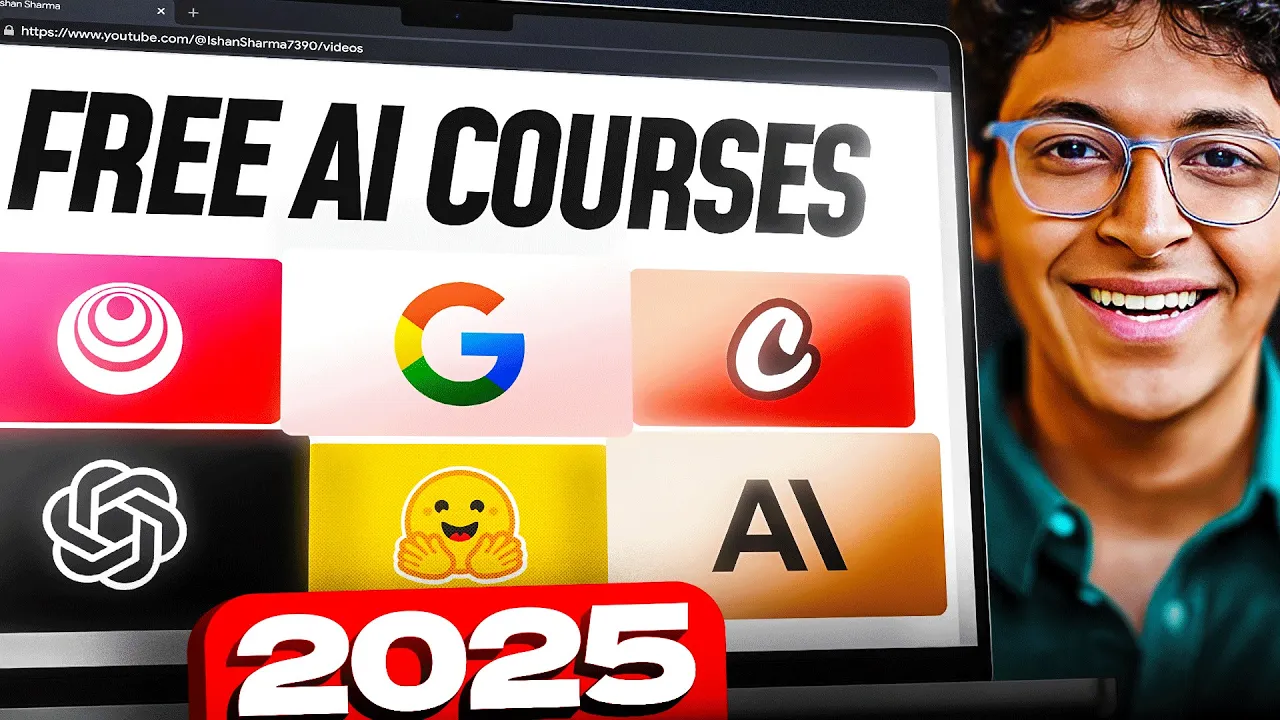
And number three, it just looks too complicated to use or learn. While most people are not able to use AI tools, if you want to stand out and start mastering AI, this video will help you get started. Hi everyone, I'm Ishan Sharma and today I'm going to share with you not one, not two, not three, but 10 amazing free AI courses that you can get started with to upskill and stay ahead of the curve with generative AI in India.
If that sounds interesting, hit the like button and subscribe and let's get started with generative AI. Now all of these courses will be in the description. So go have a look at them.
But let's start with the first one and this is from deep learning AI called AI for everyone. You simply have to click on this enroll for free button and then click on audit this course and that is how you'll be able to use this course for completely free. Now Andrew NG does an excellent job of explaining to you the basics of AI so you understand what is AI, what are the important concepts in it.
So for example, what is data terminology of AI? What makes an AI company? Machine learning and what it can or cannot do.
Examples of what machine learning can do or cannot do. This is the basic. Then you learn about how to build simple AI projects, right?
Then you learn about using AI in your own company. If you're working in a corporate job or if you just want to use AI in your life, this is a excellent course to get started with it. And then you learn about AI and society.
Over 18 lakh people have enrolled in this course and I think it's perfect for people who have no idea about AI. You don't have to be from a maths background. You don't have to be from a science background.
You just have to be curious. And if you can do that, you can take up this course and get started with the basics of AI. But now that you have that sorted, let's move on to the next part, which is understanding prompting.
Here's a free course by OpenAI themselves on Chad GPT prompt engineering for developers. I think this course is excellent once you understand the basics of AI. Now it's time to use AI tools and know how to use them effectively.
And the most important concept is understanding prompt engineering. How should you design a prompt? What are the key elements of a great prompt?
This is what you will learn in this short one and a half hour long course. So if you go down, you'll learn about summarizing. You'll learn about inferring.
You'll learn about transforming text. You'll learn about expanding text. You will get a better understanding of how large language models work.
How do they work on completion of text? And you will also learn about the best practices for prompt engineering. So this is a great hands-on course by OpenAI themselves on Chad GPT prompt engineering.
Course number three will help you learn a very important concept in the world of generative AI and that is vibe coding. Ve coding is this idea that you don't need to know how to actually write code. You just need to describe what you want to build and tools like Replet will build it for you in seconds.
And this course called VIP coding 101 with replet is a great starting point because when you go down you will basically learn how does replet work. How can you build any tool any app any website using replet and what are the important prompts to keep in mind. You'll learn how to use the replet coding agent.
How to create specific prompts. How to keep your projects tidy. How do you focus on debugging?
And you'll also learn about the five skill framework in VIP coding which is very important if you want to build great software which anyone can use around the world. So you learn about using frameworks, checkpoints, debugging, providing context and more. So this is a great starting point.
I think wipe coding is a skill that everyone should know today because with it you can build anything you want if you can describe what you want to build and replet and other AI agents will build it for you in seconds. So this is how it works and you will also build a head-to-head national park ranking app at the end of this course using Replate itself. Now we are living in the age of AI but most CS degrees are still stuck teaching outdated topics from a decade ago.
A recent study from 2024 shows that 60% of Gen Z professionals were either quitting or were let go from their job within the first year because they weren't job ready. That's where NIAT steps in as a new age tech college started in Hyderabad but now available in 10 plus cities across India including Delhi, Pune, Bangalore and more. And it's not like your typical engineering college.
Instead of the road learning and theoryheavy lectures, NIAT follows a corporate B techch model. Meaning students spend most of their time building real world projects and get trained by 1200 plus mentors from top companies like Google, Amazon and Microsoft. They even start working on the cutting edge technology like drones, autonomous vehicles and genai right from their first year.
And NIT is big on entrepreneurship too. Students don't just learn how to code, they learn how to build their idea and pitch it to real investors. The founders are IIT alumni with experience of working in companies like Amazon and ISRO and know exactly what skills are needed in today's tech industry.
So if you're serious about building a future proof career in tech, check out NIAT with the link in the description. Now if you want to learn about AI agents and how to build them from scratch, this is a amazing course to check out called MultiAI agent Systems with Crew AI. Basically, you will learn how to use crew AI to create different AI agents, right?
So you learn about role playing, you learn about memory, you learn about tools, you learn about focus, you learn about building guard rails. Basically all the concepts which are important for you to build AI agent systems. And by the end of this course, you'll get to build a agent yourself which can tailor rums, which can do some researching, which can automate customer support inquiries, which can do customer outreach campaigns and much more.
Excellent course to go through to learn the basics of AI agents and how to start building them using Crew AI. Next up, we have another important concept in the world of large language models and AI agents and that is MCP, model context protocol. Now, this is a new recent concept created by Anthropic that allows AI agents to interact with different tools effectively.
MCP is basically a standard way for any AI agent to interact with any service, any external system. Now you will learn about how to build a MCP server yourself and how to use it with AI agents to make agents more effective and faster. So you'll learn to make a chatbot MCP compatible.
You learn to deploy an MCP server. You learn to connect your chatbot to MCP server and other open-source servers. And you'll learn all of this in about 1 hour 30 minutes by anthropic themselves.
Exceptional course to learn about the basic building blocks of MCP and how to move ahead with it for building better AI apps yourself. Now if you want to start building AI applications of your own, this is an amazing course to get started with called as building systems with the chat GPT API. Now OpenAI has built this course in which you will learn how to use the chat GPT API and how you can build any app you want with it.
After you've taken the prompt engineering course by OpenAI, you will now be able to use the chat GPT API to automate complex workflows and you'll also end up building a customer service chatbot using all the techniques from this course. a great starting point if you want to learn the basics of building AI apps on top of the chat GPT API itself. And since we're talking about OpenAI itself, there is another course for 1 hour 24 minutes which talks about reasoning with O1.
So O1 is this new reasoning model that OpenAI has come up with. And with this course, you'll learn how does a reasoning model work. How is it different from a normal GPT4 or GPT40 model?
And you will also learn how to write specific prompts that will best utilize O1's capabilities and what is it best used for. Right? So you'll understand the four principles of prompting.
You will learn how to use O1 to plan and handle any action that you want it to execute. So you'll learn how to plan in sequence, balancing the trade-off between intelligence and cost and things like that. You will basically also learn this technique called meta prompting in which you basically use 01 to improve your prompts.
So you send a prompt, O1 will improve the prompt and will give you the prompt in return which you can then iteratively use and basically you will be able to create a better prompt and get a better answer in result. That was open. Now if you want to use Google's suite of AI tools which is Gemini and other tools, this is a great starting point.
So they have this course called generative AI explorer Vert. ex AI. Vertex AI is a very interesting platform.
is like a playground that Google has built, Vert. x AI that enables anyone to use Gemini to build any app that they want. So this is basically what it looks like.
Try it in console and now you would have access to Vort. ex and you can pretty much build anything you want with it. Right?
So you have all of these actions and basically this course will teach you how to use Vert. Ex AI to build any AI app you want powered by Gemini model itself. So that's essentially how it works.
It has these three labs. Introduction to Gemini 2. 5 Pro.
You click on this lab and it teaches you the basics of all of these topics. So you can go through these. You can click on next and you can learn the basics of how Gemini works and how to build any app using Vert.
ex AI. Now there are hundreds and thousands of open-source generative AI models that you can use to build anything that you want and most of them are accessible through hugging face. So hugging face has this amazing course that you can use which teaches you the basics of using open-source models to build AI apps on top of it.
That is essentially how it works. And with this course you'll understand the basics of NLP. You'll learn the basics of large language models and you will learn how to use any of these open-source models and build apps on top of it.
So this is the course right here and you can keep accessing the next model module right here. So you learn about transformers, what can they do, how transformers work, solving task with transformers, you learn about inference with LLMs, bias and limitations and there will be a certification exam as well. Then you learn about other concepts, right?
Right. So you learn about tokenizer library, you learn about data set library, you learn about sharing models and tokenizers. A lot of interesting stuff that you can learn from just this one free course available right here on hugging face.
Now, if you're enjoying this video, make sure that you hit the like button because this next practical guide is going to blow your mind. Now, if you want to build AI agents yourself, OpenAI has this amazing guide that will blow your mind because here you will learn what is an agent, why and when should you build an agent, agent design foundations, like if you want to build an agent, what should it look like, what should be the structure, architecture of it, and you learn the guardrails and conclusion. This 34 page PDF is a great starting point if you want to learn the basics of agents from OpenAI itself.
So you learn about the introduction, you will learn about what is an agent. Agents are systems that independently accomplish tasks on your behalf and it goes in depth about it. Now what you can do is simply go on to notebook LM and create a new task and upload this PDF right here.
So I'll do this and now I can basically turn this PDF using notebook LM into a guided course for me to follow. What that means is I can basically get a mind map from it. I can get a audio overview from it.
I can get a briefing dock from it. This is what the mind map would look like. So what is an agent?
I can learn all about it. How to build, when to build an agent, agent design foundations, orchestration. I'll also learn about guardrails and all of this through notebook LM itself using the PDF by OpenAI.
How cool is that? And these are the 10 courses you can take to upskill in AI in 2025 and stay ahead of the curve. Make sure that you go through each of these links in the description of this video and start upskilling today itself.
It's not too late. We are just getting started. Most people in India don't even know about AI tools or how to use them.
And that is your golden opportunity. Start learning today. I wish you all the very best.
Let me know if you have any questions in the comment section below. I'll see you in the next video. Also, check out NAT with the link in the description.
I'll see you in the next one. Bye-bye.