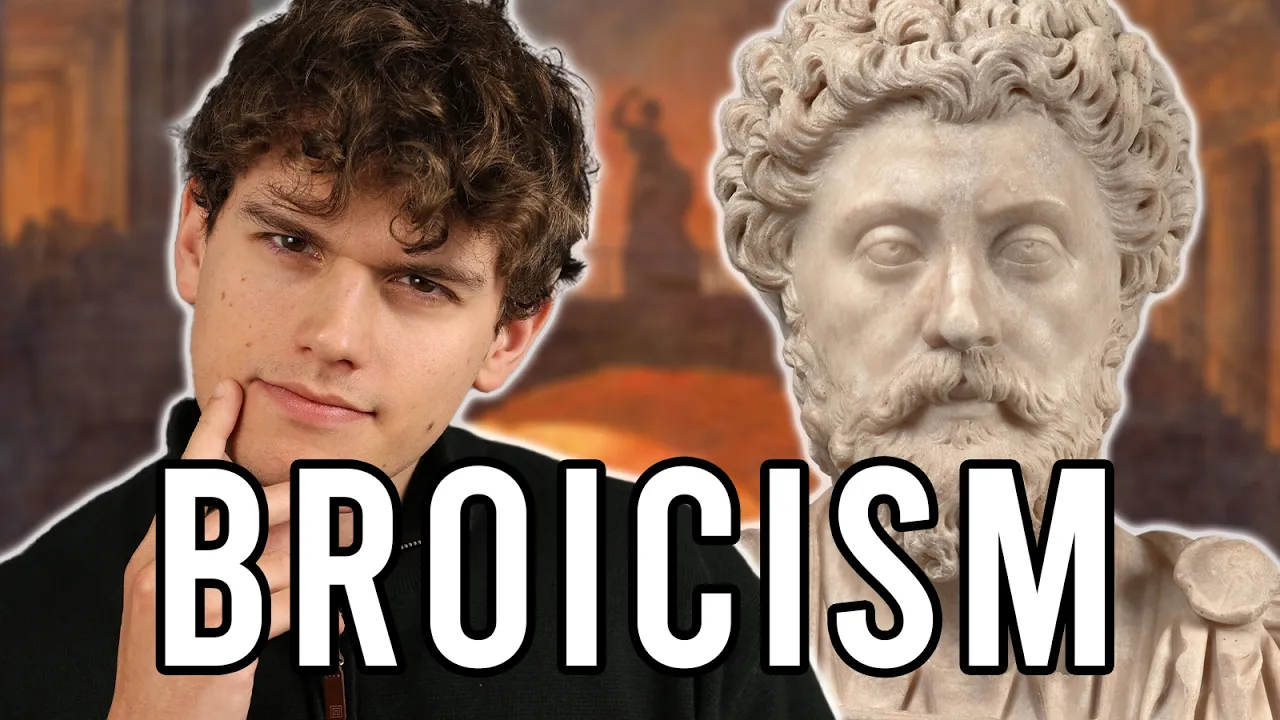
This video is sponsored by Squarespace. More about them in just a moment. Stoicism is probably the most popular non-religious philosophy in the world.
It has millions of adherence and holds a prime place in contemporary philosophical discourse. Broadly speaking, I like this. I enjoy it when people get into philosophy.
And this channel is, after all, a pop philosophy channel. Nonetheless, this form of stoicism that has seeped into popular discourse today has vital differences with how the ancient stoics presented their philosophy. And I think it is important to recognize this so that we have a clear idea of our own intellectual history as well as seeing how modern stoicism might go wrong.
I'm going to use the term broicism to refer to popular modern stoicism in the broad sense just because it's a very catchy name, but I do mean something wider than simply bros doing stoicism. However, I want to kick off on a positive note. So, let's first see the upsides of broicism.
My name is Joe Folly and this is unsolicited advice. one in defense of broicism. In the midst of all the condemnation of broicism as a dumbed down or perverted version of stoicism, I think it's important to state what it gets right and potentially where the whole notion of getting stoicism right becomes a little bit spurious.
I would argue that there is much about modern broism that many ancient stoics might agree with as well as much with which they would take significant issue. Firstly, it's important to recognize that stoicism is not a neat set of propositions in the same way that some modern philosophies are. While you can say that utilitarians are just people who believe that what is good is what produces the greatest net pleasure, you can't quite do the same thing for Stoics.
Ancient schools of philosophy were more often loose networks of associations between particular teachers and particular students rather than strictly defined frameworks. As a result, different stoics disagree on even some of the core principles of stoicism. And so there is considerable difficulty in defining who exactly counts as a true stoic.
For example, while almost all ancient stoics thought that stoic virtue was the sole route to happiness and that a true stoic could be joyful even under torture, this was not universally held. The stoic penus thought that some baseline material comforts were necessary to be happy. Yet he is still uncontroversially considered a stoic despite this being more of an Aristotilian notion.
Likewise, while some stoics thought that you truly could attain sagehood and really could become totally blissful regardless of your physical state, others thought this was simply a good ideal to strive for rather than an achievable aspiration. Early stoic thinkers even disagreed on their picture of the soul with some arguing for a one-part model and others a tripartite one. These fundamental disagreements are pretty noteworthy and it reminds us that any attempt to define true stoicism is always going to be ahistorical.
It does not reflect the actual way stoic thought developed, changed and differed over time. We also see differences in the emphasis placed on different areas of stoic thought by different teachers. Whereas Epictitus is very concerned with freedom, Mark Curelius focuses more on interconnectedness and Senica discusses death more than either of them.
We also know that the first Stoics were heavily influenced by the cynic school of philosophy whereas thinkers of the next generation tended to soften these aspects with the idea of preferred indifference issuing the vows of poverty that characterize the cynic movement. And there are undeniable ways that broism does reflect some genuine aspects of stoic thought. The idea of taking radical responsibility for your thoughts and behavior does correspond to much of what Epictitus said in his discourses.
Epictitus famously emphasize the divide between the internal mind and the external world and said that while we cannot control the latter, we could control the former. This is not unlike some of the ideas put forward by the broics. And considering that this is perhaps the most important and recognizable component of Epictitus' practical ethics, this is not an inconsiderate thing.
Likewise, the idea that we should not be ruled by emotion definitely does find evidence within stoic texts. Though, as we will see later, the devil is very much in the details here. To quote Epictitus directly, "It would be lovelier still if you could secure happiness, free of emotion, poised and dependent on no one except yourself.
" Eagle-eyed viewers will note that the fact that happiness is conjoined with being free of emotion indicates that the Stoic use of the term emotion is probably going to be slightly different from our own. But I'm getting ahead of myself. Nonetheless, many stoics did suggest we should take a more detached view of our emotions than many of us will intuitively have today.
Senica's stoic ideal, Kato the Younger, was his idol precisely because of his ability to bear hardship with equinimity and to not be carried away into despair. In this sense, the Stoics were suspicious of emotional excess, and the broics are as well, although again in very different ways that we will definitely be getting into later. Also, if we try and give the broics a bit more credit, we could point to other historical thinkers who have selectively drawn from Stoic teachings and then mix them in with other philosophies or their own ideas.
For example, the ancient Roman writer and politician Cicero, who comprises some of our earliest accounts of Stoic thought, was not himself a Stoic. He regarded Stoic physics and stoic logic with quite a lot of suspicion. But he had considerably more sympathy for the practical side of Stoic ethics.
And this did influence the development of his own philosophy. Picking and choosing which stoic ideas to take on board and which to disregard is not that unusual and it is how many thinkers throughout history have used stoic philosophy. We can see this picking and choosing approach to stoicism in nature, deontia, botheus and a hell of a lot more.
Using your critical reasoning to arbitrate between aspects of a system that you want to adopt and which you want to leave behind is arguably a huge part of philosophy and specifically philosophical engagement with ideas. If we never critically analyze the ideas that we heard and ascertained which ones held water and which we wanted to disregard, then we would not be doing philosophy but becoming disciples. My issues with broicism is not necessarily just that it picks and chooses different aspects of stoic thoughts, but that it often presents itself as specifically a continuation of ancient stoicism.
And I think that is unfounded. As we will see, I think that broism leaves out some of the most interesting and fruitful aspects of stoicism in the process of its construction. Lastly, it is perhaps unsurprising that any public or popular face of modern stoicism would not remain true to its ancient counterpart.
After all, there were differences in the way that helenic stoics and Roman stoics approached the philosophy with Greek thinkers in general placing more emphasis on stoic logic and grammar and Roman thinkers generally trending towards duty and incorporating stoic thought into a broader picture of Romanness. It's not necessarily shocking that stoicism would adapt itself to the wider culture it interacts with, as almost any philosophy or set of ideas does. Italian romanticism, for instance, looks rather different from French or German romanticism, even though they share some core themes.
Like any philosophy, we can critique the way that modern stoicism operates. But we shouldn't pretend that this is not a perfectly normal way that ideas change and find roots in different cultures. The fact that modern stoicism and broicism is to my eyes excessively concerned with the individual over others and with external success over enacted virtue is partly an artifact of how we culturally and generally are more concerned with individuality and materialism.
Broicism is not just an outcrop of stoicism but an outcrop of our wider contemporary contexts and its flaws are not unique to it but more often than not are reflected in our wider attitudes and approaches to life. Put a pin in this point as I will definitely be coming back to it at the end of the video. But with all of that out of the way, let's discuss what broism might be missing.
Because in some ways, broism just skims over some of the most important foundations of Stoic philosophy. And I think that's definitely worth exploring. But before moving on, I want to take a quick moment to thank our very kind sponsors, Squarespace.
If you're looking to build a website, then you know it can be a real hassle. First, you have to find a domain name and then construct the entire website. And there's always the underlying fear that you're messing up and creating something that just looks unprofessional.
But this is where Squarespace comes into play. They compress all of that complexity and headache into a single platform and use ready-made templates to take all of that pain out of website building. They also have a feature called blueprint AI, which uses AI tools to help you make design choices, which is really handy.
If, like me, you are not technologically gifted at all and don't have the mind of a graphic designer. Head to squarespace. com/unsolited advice and use the code unsolicited advice to get 10% off your first purchase of a domain name or a website.
Anyway, back to the video. Two, the wide web of stoic thought. One major thing that I notice in almost all popular contemporary presentations of stoicism is that it is seen as a means to some other end.
A stoic attitude is presented as the path to external success in its various guises, be they romance, money or status. It is not uncommon to find stoicism sold as the way to be impressive. Classic pictures of stoicism like being calm, collected, and self-disciplined are instrumentalized to achieve worldly accomplishments.
There's nothing inherently wrong with that. If you want to become more disciplined so you can achieve some external goal, then more power to you as far as I'm concerned. It's just that this is a totally different order of priorities than the one advanced by the Stoics.
Apart from a few exceptions like the aforementioned Penatius, the Stoics held that virtue was in itself sufficient for udeimmonia or human flourishing. That is, they thought that a sufficiently virtuous person would find happiness even in the most dire of situations. Virtue was thus not considered a means to an end, but an end in itself.
The four cardinal stoic virtues, courage, wisdom, temperance, and justice were considered intrinsically good. External success on the other hand is considered a preferred indifferent and not properly good or bad in and of itself. Stoics are only meant to desire them in as much as they are means to the end of becoming more virtuous.
This is in some ways the most distinctive part of stoic ethics as compared with its contemporaries. While the Epicurans aimed at pleasure as the highest good, and the parapotetics, which I almost always mispronounce, thought that udeimmonia had external and internal components, the Stoics held that virtue itself was their end goal. Although ancient Stoics were fans of improving their lives in the sense of making themselves more sage-like, they also thought that stoicism was capital G good.
They thought it was the most ethical way to live. In some ways, the fact that it benefited their experience of the world from a firstperson perspective was just a very pleasant side effect. Stoic ethics is heavily based on the stoic view of reality itself.
To start roughly from the beginning and to oversimplify things considerably, the Stoics held that the world is composed of two principles. The active principle which comprised reason, structure, and divine fire and matter which was acted upon and structured by this reason. reason including the famous logos was thought to govern the cosmos and as a result truly everything did happen for a reason.
This is what underpins the stoic notion of indifference towards external events. Those events were by definition in line with universal reason and thus providence and fate. They hold that we too have access to this reason through our reasonable and rational faculties and as a result we can internally align ourselves with providence or alternatively we can try to rebel against it.
The stoics just thought that we would do best to align ourselves with it and thus align our internal reason with the external reason of the universe. An analogy from the stoic thinker Creus can be helpful here. He compares the effect of events on us to a cylinder being pushed down a hill.
How the cylinder falls will partly be a result of the effect of the push, but also the shape and the internal constitution of the cylinder. Allying ourselves with the universe, or following nature, as it's sometimes put, would mean ensuring that we fall most in line with our reason, which is that little divine spark of logos inside each of us. This is why the Stoics praise reason over the passions.
They consider reason to be divine logic and it's the faculty that allows us to align ourselves with the universe and they consider stoic virtues to be downstream of this reason. In a sense, stoicism is a pantheist doctrine. They conceive of the universe as a thinking morally legislating thing that shares our own rational nature.
And both what is good and what is conducive to human flourishing is what aligns with this universal nature. The closest comparison with a modern philosophy would be acting in accordance with God's will on many religions. But whereas the classic monotheistic god is an agent, the stoic logos is often more vaguely defined with some considering it more agential and characterful and some seemingly conceiving of it as an impersonal force.
This forms a key difference between the stoics and the broics because this is an intensely teological picture and traditional stoic arguments have this teology working in the background. Now, of course, most non-religious people today do not subscribe to a teological worldview, and so they would need to reconstruct stoicism in non-teological terms. There have been quite a few modern attempts at this, most notably Lawrence Becker's a new stoicism.
However, his recasting of Stoic ethics in terms of practical normative reasoning is highly sophisticated. It takes up hundreds of pages and even then I personally doubt that it recaptures the uncompromising ethical normativity of ancient stoicism. But anyway, I'm getting distracted.
My broader point is this. Stoic ethics is embedded in a broader structure comprising ontology, logic, epistemology, and more. And when divorced from this framework, it can quickly cease to resemble stoicism at all.
When it's repurposed to ends that are antithetical to stoicism, it is doubtful whether the label stoicism is appropriate. It would be like a would-be Christian saying, "I don't go in for all of that God stuff, but I quite like the parable of the good Samaritan. " This person is not a Christian in any meaningful sense of the word.
They are an atheist who likes aspects of Christian thought. In some ways, broism is quite similar to this. Broics often talk about particular stoic teachings like withholding judgment from events and attempting to be courageous, but they tend to ignore the philosophical underpinning behind this.
The practices of stoicism were serving an overall goal of cultivating virtue in line with the universal logos. Whereas modern broism tends to repurpose these practices for their own ends, which are largely to do with worldly success. It's pretty difficult to find academic sources on broism.
So, I'm just going off what I've personally watched for this video, but the main goals of broics tend to be business success or monetary success, becoming attractive, and achieving social gains. They may be using Stoic methods, but these are not stoic purposes. Again, I'm not saying that there is anything inherently wrong with desiring any of these things, but this is not an incidental disagreement with Stoicism.
It is a central one. A key part of stoic philosophy was specifically devaluing this sort of materialist success. In early stoicism, this was even more stark with some more cynicleaning stoics like Aristo suggesting that we should follow Dioynes of syninnop and spurn material wealth entirely.
Even though later stoic thinkers like Senica sometimes became successful, they were still clear that this was not good or bad in and of itself and that a stoic should be able to live without material luxury if need be. Senica used to undergo periods of voluntary poverty to show that his peace of mind was not in any way dependent on these external things. Epictitus compares the rich man who is emotionally reliant on his riches to a slave suggesting that just as the slave is owned by their master, the rich man is owned by his possessions.
And Epictitus would know, having himself been a slave for many, many years. For such thinkers, stoicism was never the tool by which material success is achieved. But any material success should be used to facilitate one's development as a stoic.
Broicism treats stoicism as an arrow and external success as the target. The ancient stoics did precisely the opposite of this. And this is part of a wider theme.
Modern broism often separates certain aspects of stoic philosophy from its overall structure. Whereas the ancient stoics conceived of it largely as an inseparable whole. For example, stoic ethics came with a strict system of logic and epistemology that would help the stoic see the world as it actually existed.
Stoic epistemology taught that reality made impressions on us through our senses and that we could use our reason to agree with or reject these impressions. The Stoics recommended that we scrutinize our impressions brutally to see if they promoted justified beliefs or if they were deceiving us in some way. Early Stoics and many later ones thought that to be virtuous just was to know certain things and to think about the world in a certain way.
For them, if we truly knew in the deepest possible sense that the world was ordered according to divine providence and that we were totally responsible for our rational faculties and the virtue was all that mattered, then we would achieve the tranquility of the sage. It's just that in practice basically no one ever reaches this level of full enacted knowledge. Remember this picture as we'll be coming back to it in the next section when we deal with the stoic and broic treatments of emotion.
Furthermore, there is a pretty stark emphasis on the individual as an isolated agent in broicism that contrasts pretty heavily with many ancient stoic writings. While it's true that the Stoics thought that you can only control your own feelings and your own mind and that the external world itself was beyond your reach, that does not mean that you should never act to affect the external world in certain ways. Likewise, simply because the Stoics held that we are all responsible for our own emotions and our own reactions does not mean that we can relinquish all of our care for other people, declaring that it's just their problem if they're upset.
As pointed out by Jack Vishnik in his analysis of Stoic duty, stoicism held that we all had extensive obligations towards one another and that there were appropriate and highly inappropriate ways that we can behave with other people. The grounding for this is the divine reason inside all of us. And just as we recognize that it is valuable within ourselves, so too it is valuable within other people.
Thus, especially according to the founder of stoicism, Zeno, we actually owe one another quite a lot. This is pretty at odds with the focus on specifically individual achievement that's often found in broicism. Eagle-eyed or batared viewers might notice the similarity between this type of reasoning and the Canian Foundation for Ethics 2,000 years later.
And Jack Vishik does talk about that as well. Similarly, an ofted feature of Stoicism in the modern day, especially early stoicism, is cosmopolitanism or the belief in a world community. This was a key part of Zeno's thinking that he inherited from cynicism and it is an explicitly anti-individualistic stoic precept.
The stoic conception of ethics is to become personally virtuous. But developing this virtue is totally inseparable from our duties to other people. Virtue, personal happiness and your obligations to others are all threads in the same knot.
By attempting to extricate personal happiness from the mix and by making virtue subordinate to external success, broicism unravels this knot. Again, in itself, this isn't necessarily bad. It just doesn't much resemble ancient stoicism.
It is something quite different, and I will leave it up to you to decide if it is better or worse or what its strengths and weaknesses are. And now I want to hone in on an aspect of broicism that has come under quite significant fire. Its approach to the messy world of human emotion.
If you want to help me make more videos like this, then please consider signing up to my Patreon for occasional exclusive content, including most recently my full interview with Alex O' Conor. Three, stoicism and emotion. The modern image that we have of a stoic is less tranquil and more emotionless.
They are the kind of people you might want to have around in a crisis and yet they also do not allow themselves to feel. This is echoed in a lot of modern rhetoric around broism where feeling itself is sometimes demonized as bad. As I said at the beginning, there are shadows of this attitude in ancient stoicism as well, but their approach to emotion is much more nuanced than we often give it credit for.
And it once again ties back into their wider picture of the world. Stoics considered feelings to be particular kinds of impressions. And in line with the previous section, they thus held that feelings came upon us involuntarily in much the same way that when I look at my desk, I can't simply opt out of perceiving it.
However, these initial reactions were not generally what stoic thinkers meant when they said emotion or the everfeared passions. They are more like protoeotional impulses that are then turned over to the rational faculty in order to be asented to or rejected. If they are asented to then they do become fully developed emotions and if they are not then they are gently dispensed with.
For example, imagine that I am walking along one day and I trip and graze my leg. A proposition is immediately forced upon me. Namely, I have grazed my leg and that is bad.
That automatic evaluation of and that is bad is what stoics mean when they talk about this involuntary protohealing. Next, the thought is turned over to my rational faculty and I can judge it. A classic stoic style judgment would be to say something like to graze my leg is not necessarily bad.
It does not make me less virtuous nor is it out of line with divine reason. Moreover, I can't go back and ungraze my leg. It's out of my control.
So, it's best to not judge it as bad and move on with my life. I thus use my reason to reject the characterization of my grazed leg as bad and the distress is somewhat alleviated. The first thing to note here is that the stoic response partly relies on their broader metaphysical picture of the universe, not just on the idea that I should not react to pain.
And secondly, the Stoic does not say to repress the feeling, but to address it directly and learn to understand it. It involves challenging our automatic reaction to situations rather than simply assuming that all emotional reactions are inherently awful. As pointed out by Margaret Graver in her book on stoic conceptions of emotion, Stoic philosophers did not tend to say that all emotional reactions are bad.
Instead, like everything else, they judged them on whether they were in line with reason or not. Reasonable emotional reactions included joy at virtue and goodwill towards others, but also appropriate types of pain. For example, just as stoic thinkers held that it was right to be happy at virtue, they held it was also right to be disturbed by vice.
Epictitus uses the term idos to mean the guilt that someone feels at having done wrong or desiring to do wrong. This is an unpleasant emotion, but Epictitus also thought it was an appropriate one if people were to become more virtuous. I think the confusion comes about because the figure of the stoic sage is not meant to feel these negative emotions.
But this is not because they are repressed, but because the sage is supposed to have extinguished all vice within themselves and so no longer has anything that would rightly distress them. Stoics also don't deny that people can feel sad or upset at external circumstances. They just think that in theory these could be overcome with a sufficiently virtuous character and a completely internalized knowledge of the world.
Again, their point is not that we should never feel things, but they want us to approach those feelings with a critical eye grounded in stoic ethics and stoic metaphysics. We can see again how unmoring stoicism from its broader philosophical context can turn a nuanced treatment of emotion, feeling, judgment, and reason into a simple denigration of emotion regardless of circumstances. Additionally, the stoic consideration of emotion doesn't come from nowhere.
It's part of their wider framework where virtue is the sole and only good and the route to udeimmonia. It's not that unpleasant emotions are inherently or intrinsically bad, but that they don't think there is much to get upset about apart from vice and that there's not much to rejoice about besides virtue. And they thought that attaining peace involved recognizing this philosophical viewpoint as true.
This was again a point of disagreement they found with the Epicurans and the followers of Aristotle's philosophy. This marks another difference between many popular bros and classic stoicism. Broicism often presents itself as simply not caring or not giving a but what Stoics actually argued for was caring about particular things and not caring about other particular things.
They cared incredibly deeply about virtue and vice but thought that the rest of reality was of far lesser concern and that a true stoic sage would not be affected by this external reality. But importantly, Stoics were extremely invested in issues of virtue and vice since they considered virtue the sole good worth striving for. Once we realize this, we find that stoicism is not uncaring but consciously caring and caring about those things, clear thinking, wisdom, moderation, and self-nowledge that they think incorporate the whole of human experience rather than merely to sacrifice the affects at the altar of cold rationality.
Because for most stoics, reason was anything but cold. It was intimately concerned with the inner workings of our feelings and tirelessly striving to bring out the spark of virtue and logos that lay within every human being. While the Stoics did decry the passions, they often use this term to mean out of control, excessive or untempered emotions.
They explicitly considered our initial proto feelings as something to be unashamed of and asked how we could guide those impulses in the direction of wisdom. Again, this more caring, tender side of stoicism often comes out in their idols. A key figure that almost all stoics looked up to was Socrates and specifically the way that Socrates dealt with his imminent death.
When Socrates's friends were mourning his incoming demise, Socrates did not admonish them harshly, but turned to them with a smile and gently explained why he was not afraid of death and why they should not be either. Socrates's approach to his friend's emotional distress was not to judge them or tell them to get a grip or grab them by the shoulders and shake them, but rather to argue that their fear of death stemmed from a false worldview and that as soon as the correct one was learned and internalized, their distress would lessen. Although Socrates believed in the immortal soul and the Stoics were materialists, the general process is still instructive.
The idea is not to condemn emotions themselves, but to realize when they reflect a false philosophy and to ease them with wisdom rather than with curses or insults. The Stoics did think that we should not be carried away by emotions, and this has led many to consider them repressive. But it's not like we endorse people's unfettered emotional outbursts today.
When someone loses their temper, we do tend to criticize them for it and view it as a failing in character. In some ways, the Stoic view is far more compassionate and patient than our own since they would view the angry person as suffering from a flawed view of reality and then aim to introduce them to a different path. To suggest that the Stoic way of dividing emotions and emotionally charged behavior into appropriate and inappropriate camps is somehow radically more emotionally restrictive than our own views is just to blind ourselves to the moral categories and ethical judgments we use when we evaluate emotions.
It's just that we don't tend to notice our own divisions since we are highly accustomed to them. Nonetheless, much of this stoic patience with feeling and emotion and the acknowledgement that achieving equinimity and tranquility is a long process of learning, cultivation, and effort gets lost in popular presentations. Instead, we are often left with the simple idea that emotions or passions should not control us.
This is not wrong, but it's a bit like boiling down Titanic to a film about a big boat or Pride and Prejudice to just people going to one another's houses and talking. By viewing things in this way, you miss out on much of what's on offer and caricature the subject matter in the process. But despite all of these critiques, I do think that we should be careful about condemning or mocking broism wholesale.
Because as I said at the beginning of the video, the way that broism simplifies stoicism down into something that's not quite recognizable as the original thing is hardly unique. And there is a danger that we put people off studying philosophy entirely with our reactions. Four, snobbery, learning, and popularization.
It is pretty well known that as a set of beliefs or ideas becomes more popular, they will inevitably get watered down. This framework was first introduced by Rodney Stark and William Bainbridge and has found considerable academic support in the field of religious studies. Religious movements that start off as strict sets with rigidly followed practices must make certain alterations to accommodate new adherence and just adapt to being a larger group of people.
To draw from Pope Benedict the 16th's essays on charity and biblical history, the first 12 apostles held everything, even material possessions in common. But this couldn't be maintained if Christianity was to become a global phenomenon. You can even argue that stoicism itself went through this process.
Whereas Zeno, Aristo and a few other early stoics maintained strict aesthetic practices, this became less and less popular as time went on and especially as stoicism migrated to Rome. As it stands, stoicism is maybe the most popular philosophy in the world that's not a major world religion. And that's going to come with a certain break from Stoic tradition and a certain watering down of its core precepts.
Additionally, when we consider the audience of popular stoic or broic authors today, they are not necessarily people with prior interest in philosophy, but people with practical problems. This is again not out of line with ancient stoicism. Large sections of Epictitus' discourses concern people who've come to him with everyday issues, hoping that a stoic worldview would be able to help them.
In these conversations, Epictitus did often lead with the more practical parts of Stoicism, leaving the ontology or logic or more abstract areas to more in-depth students. To begin teaching stoicism with how it can improve your life is by no means a bad idea. And outside of an academic setting, I don't think that introducing stoicism as a complex web of ideas involving metaphysics, epistemology, logic, ethics, and teology would be particularly appealing.
As someone who really loves philosophy and chooses to spend most of my time reading, learning, and writing about it, I'm also quite wary of a kind of academic snobbery that can arise about these subjects. Just because I am interested in the different ways you can translate the word Cathacon in Stoic texts and whether or not the Stoic conception of duty influence later deontological thinkers or the similarity between stoic logical systems and 19th century propositional calculus does not mean that someone more interested in the broader strokes of stoic ideas is doing something wrong. I don't think it's very helpful for online philosophy to turn into flurries of accusations of not being a true fan of various different thinkers or philosophical schools.
I'm reminded of something that a very senior member of my faculty at university once told a slightly intellectually arrogant student and I can remember it almost word for word. This is what he said. Listen, there is always more to learn about something and almost always someone who knows a lot more than you about any given topic.
Whenever you catch yourself sneering at someone who knows less than you, remember all of the people that know more than you. And this should red address the balance. Personally, I think that many of us would do well to bear this idea in mind.
On any given topic, we are along a continuum of knowledge. And on almost every subject, we are not going to be near the top of that continuum. My knowledge of stoicism is basically nothing compared to someone like John Cers.
I can't read ancient Greek or Latin, and I'm largely relying on translations and the work of people who know far far more than me about the subject. I also think that much of the focus on individual and external success in broism is just because of how much we value those things in wider society. It's unsurprising that a whole host of philosophical movements be they Buddhist, stoic, existentialist or nitian are now tuned towards these aims in popular discourse.
It's sort of the same effect that the prosperity gospel has had on areas of contemporary Christianity. In the haze of critique leveled at Bricks, we can forget that their misinterpretations of Stoic thought are largely reflections of what we collectively speaking have told people to value and to measure themselves against. And broism can be a very good potential foot in the door both for stoic philosophy and for philosophy more generally.
I know a good few people who began their study into stoicism with the more broic tinged forums online and who now do see virtue as the ultimate aim of all of their endeavors and do think carefully about what their stoic duties might be towards other people. I even know a couple of people for whom broism was the start of their whole love affair with philosophy more generally and who now largely focus on entirely different areas of the subject. So I would suggest that in approaching broism there are a few key things to bear in mind.
The first is just to recognize how different it is to classical ancient stoicism and that perhaps the most significant of these differences is the order of priorities between virtue and external ends with broics tending to view virtue as a means to an end and Stoics viewing it as an end in itself. The second is to consider the stoic emphasis on understanding emotional states rather than simply dismissing them. And the third is to remember that while being a stoic is an individual project, stoicism itself is not just a self-directed philosophy and also includes duties and obligations towards others and that it conceives of other people as valuable shards of the divine logos that it holds in such high regard.
Because if thinkers like Epictitus, Marcus Aurelius, Zeno, Senica, Crescipus and more truly are correct, then this will not only allow Broicism to become more similar to its ancient counterparts, but will also further the aim of becoming tranquil, equinimous, peaceful, and kind in a world of chaos, confusion, and disorientation. And I want to leave you with one final observation. If you peruse the pages of Marcus Aurelius's meditations, you'll notice he devotes basically the entire first chapter not to his own accomplishments, but to other people's.
He takes the time to thank each significant figure in his life who has aided him on his path to virtue. And he ends it by recognizing the interconnectedness of the world and the patience, gentleness, and forgiveness that he owes to others. How much less he would be remembered if he had opened by boasting of his own individual achievement instead.
But if you want to explore more ideas about popular discourse and philosophy, then check out my latest video on the importance of narrative and story for making sense of the world. I hope you enjoyed this video and have a wonderful day.