“Nothing short of apocalyptic-” “-five tropical cyclones-” “-four million acres have already-” “-half the planet-” “-the end of the world as we know it-” [Title: I Hope It Ends With A Monster] I hope it doesn’t end at all. Doomsday would probably be a huge bummer. .
. you and everyone you know annihilated — every human achievement, every memory, every cone of gelato erased. But if we’re choosing apocalypses out of a lineup, if the world… is going to end, I think a monster might be our kindest method of exit.
Nearly every mythology has a creature whose job it is to wipe things clean come Armageddon — it’s strangely universal. “Big monster! ” And I’d argue that’s because, ironically, it’s the gentlest ending we can imagine.
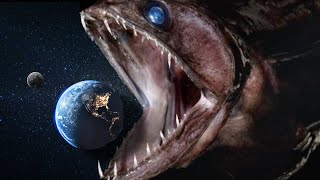
I’d like to prove this with a banana. Specifically, this banana, from the channel Yeti Dynamics. A computer simulated, moon-sized hunk of potassium, the object appears downright apocalyptic, particularly when it blots out the sun.
I’m reminded of a passage from W. B. Yeats’s poem “The Second Coming” of all things, in which a colossal beast threatens to plunge civilization into darkness.
Yeats’s monster is as close to an archetypal herald of doomsday as one can get, a demon with “a gaze blank and pitiless as the sun” — fear personified. Because, it would be scary… right? To be snuffed out by some malicious giant, to witness destruction on a scale beyond the boundaries of anything glimpsed before?
Though not actively malevolent, a banana that size colliding with the Earth would still obliterate humanity, kicking off a Yeatsian end-of-days — and, silliness aside, that should be a frightening concept. And yet when I gaze upon the Great Banana, or even a more traditional apocalyptic colossus, I find I’m rarely as scared as I should be. Enormous threats are, theoretically, more horrifying than small ones.
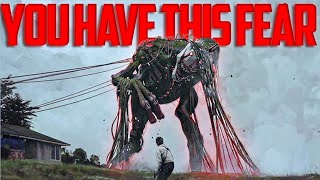
Yet past a certain blockbuster-threshold of destruction, I think that devastation can start to feel like entertainment. Look no further than the rise of online shorts depicting absurdly-vast creatures wreaking havoc. Animated to mimic something shot on a phone, these clips are usually posted with the caption “What would you do in this situation?
” — the joke of course being, that there’s nothing you could do. And I think ‘joke’ is the right word: like the banana simulation, these shorts seem like they’re meant to be more fun than frightening. And they are fun, because while, yes, a giant monster destroying everything would be horrific… if a threat is so big that there’s nothing you can do, you might as well watch the show.
We’re culturally-well-acclimated to seeing world-ending dangers as Hollywood spectacle. Just look at the legacy of a character like Galactus, a supervillain who helped establish the trope of a ‘Planet Eater’ in pop-culture. Galactus is the apocalypse at its most gloriously over-the-top, his very inception the result of writer Stan Lee gleefully pushing the boundaries of scale: “I said to Jack, ‘make him the biggest guy you can draw.
’” When viewing entities with this magnitude of destructive power, individual lives lost become impossible for audiences to quantify. When threats are this massive, the camera pulled this far back, humanity disappears, in the same way that crowds in a disaster movie become faceless cannon-fodder. It is exceedingly difficult to remember the human cost of a large-scale apocalypse.
It is exceedingly difficult to remember the individual. The film “Beasts of the Southern Wild” offers a uniquely personal perspective on not one, but two ‘ends of the world. ’ The first ending is all-too familiar — out-of-control flooding leveling entire communities, destroying housing, displacing families.
. . The second ending is a little less familiar: giant pig monsters, once frozen in ice, are seemingly coming to smash civilization to pieces.
Both disasters loom large in the mind of our protagonist, a six-year-old girl living in the Louisiana bayou. How could they not? To her these calamities are not headlines: as part of a community living south of a protective levee, for her the floodwaters are literally at her doorstep, each day bringing another catastrophe, another symptom of a world out of balance.
In his book “Hurricane Lizards and Plastic Squid,” biologist Thor Hanson states that “when consequences seem distant… the human brain is perfectly capable of simultaneously understanding and ignoring abstract threats. ” He’s citing George Marshall there, a writer famed for his research into how humans are, psychologically, extremely poorly equipped to handle our current climatological crisis. Because if a problem seems too large or too gradual to be imminently solvable, our brains will just sort of… shut down our fear response.
We might feel a gnawing, nonspecific dread about the state of things, sure, but it’s hard to fully process an issue both massive and removed. What are we supposed to do in this situation? Of course, it’s harder to forget a threat when it’s flattening your home.
Though there’s an argument to be made that the more literal monsters of “Beasts of the Southern Wild” are an abstraction, an attempt by the protagonist to understand the tragedy surrounding her, there is ultimately nothing abstract about the disaster she faces. When the film was shot on location in 2011, real flooding frequently interrupted the production… flooding which has since become precipitously worse. Is it surprising, then, that a child encountering such a calamity might imagine a different sort of ending, one equally colossal and destructive, but at least a little more theatrical… a little quicker?
When compared to a slower exit, to an apocalypse that appears on the news every night yet one is helpless to avert, is it so irrational to dream of a monster? [Carol Gasps] The show “Carol and the End of the World” perfectly captures the apocalyptic anxieties of our current era through two devices. There’s Carol… and there’s the end of the — “Hurtling towards earth, unclear but we believe — does your dog know it’s the end of the world?
— every second is precious now —” The end of the world part is self-explanatory. An ominous rogue planet is hurtling towards earth, and while not a traditional monster, the object promises an ending of similar bombast and swiftness. What isn’t self-explanatory… is Carol’s reaction to the planet, because with just seven months and fourteen days remaining, Carol — an ostensibly normal middle-aged-woman — isn’t up to a whole lot.
And she knows she should be — everyone else is up to… what you’d expect when time is a dwindling resource, living the lives they’ve always wanted, because why would you spend a second doing anything you don’t enjoy if there are only so many seconds left? But Carol isn’t changing her routines. She is still folding her laundry, still trying to schedule doctor’s appointments, still sending checks regarding her expired credit card statement.
When I first watched this show, a part of me wanted to shout at Carol, to ask ‘what are you doing, don’t you know that time is fleeting, that the end is coming and these moments are all you get? ’ …and a part of me understood completely. Because we’re all Carol, to an extent.
We’re all, in the digital age, aware on some level that any number of looming catastrophes might cut things short — and yet it’s extremely hard to hold onto that fear, to use it to break from routines, to do anything but stay the course while trying to ignore our ever-present dread. What else can we do? One of the more pointed aspects of “Carol and the End of the World” is a company, openly called ‘The Distraction,’ where Carol and others like her do menial office tasks, for the benefit of seemingly… absolutely no one.
But at least when busy and overworked… it’s harder to remember what’s hanging overhead. The devastating impact of “Carol and the End of the World” can be best understood in conversation with the equally devastating “Melancholia” …a film about another rogue planet, identical both in appearance, and trajectory. Much of the actual plot, however, revolves around a different sort of impending disaster — a wedding between lead character, Justine, and a man who appears to make her… profoundly unhappy.
For the first part of the film, most people aren’t aware of the coming planet, but it’s implied Justine has a unique cognizance of Melancholia’s trajectory — so why, with doomsday on the horizon, would she attempt to stay on a course that’s causing her misery? “I thought you really wanted this. ” “But I do.
” …There are unseen layers to Justine’s sadness, the title ‘Melancholia’ referring to both the name of the incoming stellar object, and to melancholic depression, a mental condition that Justine is living with. It is ambiguous how much of Justine’s melancholy comes from external circumstances and how much comes from within — but still, it seems inarguable that the approaching wedding is a source of despair, and yet a part of her still seeks to go through with it, as if she still has all the time in the world. The truth both “Melancholia” and “Carol and the End of the World” confront.
. . is that we’re not very good at living our lives like they have an ending.
Because even if nothing goes wrong planetarily, our time here is fleeting, that’s how it works — but knowing that rarely seems to help. Everyone in “Carol and the End of the World” could have, of course, been living like each moment mattered all along, just like how Justine could have called off the wedding ages ago, but even with the end in sight, choosing to actively change trajectory, to break from routine, can feel… impossible. Trying to live a life while waiting for the apocalypse… almost seems worse than the event itself.
And though with most rogue planets in fiction, the moment of impact is instantaneous — before that comes this nightmarish limbo, a period of protracted dread rarely experienced with conventional doomsday monsters: who mercifully tend to get right down to business. Perhaps the most notable exception to this is Unicron from the Transformers franchise, a Galactus-inspired world-eater that merges the most harrowing aspects of rogue planets and rampaging beasts. A living stellar object, Unicron often doesn’t slay its victims in the initial collision.
Instead they are slowly digested within the planet’s intestines, the very boundaries of their bodies gradually broken-down. It’s a concept that seems the worst of both worlds, both sudden and agonizingly drawn-out, a paradoxical form of doomsday that could surely only exist within the boundaries of fiction. “The blast shock passes in a matter of seconds.
You cannot sense the presence of nuclear radiation effects. ” Atomic annihilation is the kind of ending that’s difficult to encompass with a single metaphor. Like many apocalypses, it is frequently represented with a monster — either a fiery behemoth standing tall as a mushroom cloud, or a mutated human: a victim of lingering radiation.
Both of these models capture… an element of what makes a nuclear detonation so monstrous, but I think monsters alone fall short when trying to convey the horror of an ending both instantaneous and gradual, an ending where it’s almost better to be caught in the blast than to suffer through what follows. “I wouldn’t worry nearly as much about the atom bomb if it were to kill you right out. What scares me is that awful gas that deforms you.
” Both aspects of a nuclear apocalypse are illustrated in the 1986 animated film “When the Wind Blows. ” Based on the graphic novel of the same name, the narrative involves an elderly couple in the English countryside who learn that global nuclear war is only days away. And yet at first, neither seems particularly worried — they’re worried about scraping the paint on the doors they use to build their pitiful fallout shelter; they’re worried about not having enough custard — but not about the bombs themselves.
They refuse to change their habits, because they have unwavering faith that the information contained in their government-issued pamphlets will protect them. It’s an outlook emblematic of Cold War attitudes that one must only follow procedure, and the end of the world can be gently sidestepped. “Do the right thing if the atomic bomb explodes.
Duck and cover! That’s the first thing to do. ” The couple’s optimism isn’t entirely unfounded.
They both lived through the bombing campaigns of World War II as children, so a few more bombs don’t seem worth making a fuss over. Even after the detonation comes — and it does come — the couple thinks they must be in the clear after surviving the initial blast. What they don’t realize, what they can’t imagine… is that a nuclear blast is more than an explosion, a flash in the pan — fallout is an invisible hell, a plague that creeps into rain and groundwater, that cannot be outsmarted by simply ducking and covering.
“It’ll take more than a few bombs to get me down. ” The confidence of the couple in “When the Wind Blows” that everything will work out, even after the sky turns dark and the nation falls silent, speaks to a larger disconnect between how we perceive apocalypses, and what an apocalypse actually looks like. Earlier, I spoke of crowds in disaster movies, how they cease to be individuals — but separate from those crowds are always the protagonists.
The chosen few who, when doomsday comes, will hop in their cars and escape what the rest of humanity cannot. I think it’s hard, when imagining the apocalypse, not to picture yourself as one of these sole survivors, someone who is, somehow, canny enough to stay ahead of Armageddon. These sorts of fantasies ignore, of course, that most everyone sees themselves in this way, that in the face of any real disaster roads will become clogged with countless people with the same idea, that some calamities simply can’t be hightailed away from.
…I think most of us know that on some level, but still, it’s hard to truly accept that the end of the world will also apply to you. “We better clean up this broken glass and all this debris. All in all, I’d say we’ve been very lucky around here.
” I don’t think it’s a spoiler to say that “When the Wind Blows” does not end with the couple driving away to safety. Radiation isn’t the kind of ending you can escape post-exposure, or outwit with a few minor precautions. It is not the sort of problem that can be solved by not thinking about it.
And yet… [translated] “The mass destruction unceasingly claimed by the media hasn’t occurred. ” The same year that “When the Wind Blows” was released, a very real nuclear disaster struck Eastern Europe. If there’s one throughline that emerges in Svetlana Alexievich’s book “Voices from Chernobyl,” a collection of interviews from survivors of the catastrophic nuclear plant meltdown, it’s that government officials consistently downplayed the risks of radioactive exposure.
“No one said anything about radiation,” one survivor recalls, “The doctors kept telling [people] they'd been poisoned by gas. ” There is a sense, in these interviews, of the profound disconnect between what people were seeing, and what they were being told they should see. In a scenario that darkly reflects George Marshall’s writings on the human ability to ignore abstract threats… when faced with a massive, unwieldly problem, authorities decided to outwardly pretend the fallout simply wasn’t happening.
“The radiation level is being constantly monitored. ” Despite attempts at coverup, we now know that there is a monster — still living — at the heart of Chernobyl. It’s called the ‘Elephant's Foot,’ a gargantuan mass of melted corium so radioactive that at the time of discovery just standing next to it for five minutes proved lethal.
And if this creeping mass were to ever hit groundwater… the resulting explosion would kickstart a new disaster, likely even more destructive than the first. Today, the ‘Elephant's Foot,’ now solidified in concrete and steadily dropping in radioactivity, doesn’t seem like it’s going anywhere. But it’s still surprising to me that the solution has been to just… leave it there.
Then again, isn’t that usually humanity’s solution when it comes to large-scale threats — to ignore them, and then, if that doesn’t work, say there’s nothing we can do? In Gareth Edwards’s 2010 film “Monsters,” giant alien squids are spreading across the globe, and yet people are treating the situation… like they would any other far-off disaster. They’re acting as if there’s nothing to worry about.
Though we, the audience, can tell the creatures are capturing city after city, that the zone of infection is rapidly growing, very few characters seem to be panicking. “It’s fine, this town isn’t going to get hit for another two days. ” And despite our track-record of ignoring dangers, a part of me wants to believe that if actual, honest-to-God monsters showed up humanity wouldn’t continue on with a business-as-usual approach.
And there’s a part of me that understands what the director means when he calls this film “the world’s most realistic monster movie. People aren’t running and screaming — life goes on, it’s kind of normal. ” There is — almost reassuringly — a fair bit of running and screaming in “Cloverfield,” another monster flick, from the same era, also attempting to be….
quote-unquote ‘realistic. ’ In 2008, this meant shooting the whole thing in found-footage-style shaky-cam — a stylistic approach that in a way makes the film feel like the ancestor of the ‘What would you do in this situation’ clips of today. Like those videos, “Cloverfield” strives for a kind of point-of-view-immersion, to the point where the film was advertised less like a movie, and more like an event you could choose to live through.
“In a way the film is an experience. The experience of what it would be like if you were there when this monster attack occurred. ” But is “Cloverfield” believable as a ‘real incident?
’ In a strange way, I hope so. Because I think this scenario, horrifying as it appears, is actually preferable to the one in ‘Monsters. ’ At least here everyone is taking the creature seriously, everyone is screaming — but they’re all screaming together.
No one in the crowds is saying ‘it’s not that big a deal’ or ‘we should still go to work tomorrow. ’ I can’t say that recent experiences have given me… an abundance of hope in humanity’s ability to handle, or even learn from, global crises. In his article “Why We Don’t Remember Pandemics,” Mark Honigsbaum writes that despite high death tolls, disease is one of those sizable yet removed threats we have difficulty fully processing.
Though it leaves visible scars in the population, illness is ultimately… an invisible vector, and therefore easier to overlook and ignore. During the height of the pandemic, I saw a lot of people posting about how even if, say, zombies were rising up, a lot of employers would still ask us to come into work, and — yeah, I can see that. At which point, a part of me would rather they just hurry it along.
“When you think you’re going to get eaten and your first thought is ‘Great I don’t have to go to work tomorrow? ’ – What the **** is this world? What have they done to us?
” Has the world ending with a monster always seemed like a… relatively less terrible form of apocalypse? After all, it’s not like the… ancient Norse were aware of the atomic bomb, so their monster-filled prophecy of Ragnarök was probably just the scariest ending they could imagine. It probably wasn’t seen as a mercy, right?
…I’m genuinely not sure. Biblical accounts of beasts heralding the end-times are often framed through more explicit language of punishment, and I think many people therefore apply retribution models to other doomsday monsters. But I wonder if some ancient peoples saw monsters more as… ‘bananas in the sky.
’ That is to say: exits so grand and immediate they lend themselves to disassociation. Because it’s not like our ancestors weren’t aware of other kinds of endings — plagues, societal collapse, natural disasters — there have always been slower, more mundane ways for our stories to conclude. And yet, over and over again, monsters have been the method that cultures have put their faith in — as if we have some innate understanding that these beasts will make for the best finale… The director of “Monsters” spoke explicitly about this instinct for monstrous endings when he made his next film… about a figure that looms slightly larger.
“Godzilla is back, with a big new Hollywood reboot. ” “I’m at the new Godzilla’s LA premier. ” In Gareth Edwards’s 2014 reimagining of Godzilla, the big G-man is no longer a direct metaphor for atomic annihilation.
Instead, he’s a creature implied to have existed since time immemorial, a monster that it seems has always been there, ready to violently right the scales of the natural order when the time comes. In portraying Godzilla, Edwards has stated he drew upon our predisposition for doomsday monsters — the idea that somewhere, in the minds of humans, is the expectation that a large beast will one day arrive and spell our doom. “There’s something deep in our DNA.
There was always this threat that an animal was gonna come. And now we live in the modern world and our huts have got bigger, like thirty stories high, so our nightmares get thirty stories high. ” …I won’t claim that there’s sufficient evidence to claim our instinct for doomsday monsters is molecularly-encoded.
But there is, at least for me, an undeniable sense of inevitability to the imagery of Godzilla — to any giant monster, really — towering over the horizon. “It taps into something. It just feels right.
‘Of course, Godzilla was going to come. Deep down I knew he was always coming. ’” Inevitability is one of the few words, I think, that speaks to the impact of the monsters in ‘Creatures of the End Time.
’ The creation of filmmaker Christian Szczerba, this video and its companion, ‘Creatures of the Fog,’ are, once again, shot in the handheld, ‘what would you do in this situation’ format — except the feeling of raw dread they conjure turns them… into something else entirely. Watching these recordings is an exercise in sheer, silent terror. Yet though far from comforting, there is also a strange sense that you’re witnessing… something that was always going to happen, like this is the natural decomposition process of Earth itself.
In contrast to your typical apocalyptic sky, flocks of birds appear in both videos. In fact, the final shot of ‘Creatures of the End Time’ is a shimmering flock of… something — a sight both unsettling and undeniably beautiful. And you’re left to wonder: ‘is this ending really so bad?
’ I found myself asking the same question while playing through Strange Shift Studio’s ‘Chasing the Unseen’ — a game in which you explore a vast, ruined landscape inhabited only by yourself, and immense, awe-inspiring creatures. The actual gameplay of ‘Chasing the Unseen’ is surprisingly slow. The obvious parallel one could make is to the experience of beating “Shadow of the Colossus,” a title with an equally desolate world, and equally imposing behemoths — but “Shadow of the Colossus” is punctuated with moments of thrilling action — where you take your sword and drive it into a Colossi’s head.
“Chasing the Unseen” offers no such climactic beats… there is very little to do except reflect on the state of the world. An overtly abstract game, it’s difficult to say definitively that the story takes place after some calamity. But that was how I interpreted the shattered landscape — and if that’s the case, then surely these monsters are the culprits, the beasts who broke the world.
But unlike in “Shadow of the Colossus,” these creatures never attack you. They simply exist. The same is in fact true of the “Creatures of the Fog and End Times,” they look menacing — but we never really see them destroying anything.
There is, at times, a sense in both pieces that these monsters are more like… the cleaning crew, here to usher out a world that’s already dying. And even if these creatures are, in fact, the source of the apocalypse, if the exit they offer is so gentle, so tranquil one can barely discern why the lights are dimming — is that such a bad way to go? Hideaki Anno’s “Evangelion” series is, in some ways, the ultimate summation of whether it’s better for things to end with a monster… whether, if such an exit is on the table, the world should even be saved.
Okay, I say that, but “Evangelion” is so endlessly interpretable, so dense as a text, that making any judgement on ‘what it all means’ feels. . .
all right, let’s just start with what we do know. Spoilers ahead. “Evangelion” primarily follows the perspective of Shinji, an adolescent boy conscripted to fight against monsters that, seemingly, seek to cause the apocalypse.
But drafted into a war he doesn’t understand, facing violence he can’t process, Shinji isn’t sure that existence is worth fighting for. He is, to put it bluntly, an extremely troubled kid. Shinji, like most characters in “Evangelion,” lacks the support structures needed to endure the trauma of the world around him, and deprived of human connection, he struggles to see the value of humanity at all.
Shinji’s task for most of the series is to pilot a colossal EVA unit, a horrific war-machine just as bestial as the invading creatures called Angels that it battles against. But the ultimate herald of the apocalypse is Shinji’s friend Rei, who, in the film that caps off the original series, ascends to a form of monstrous godhood. The reason all this happens is… so complicated, we don’t — it’s a whole thing — it’s a whole thing.
But what’s important is that Rei, seemingly, isn’t ending the world out of malice… but out of mercy. Her decision actually borrows a preexisting plan by a secret society of humans to end suffering through something called the Human Instrumentality Project. In abstract, the goal of said project is to erase our ability to hurt each other, to wage war, to make any mistakes at all, by becoming a single, unified collective.
In practice… it means everyone turns into orange goo. And Shinji… doesn’t seem entirely against this plan. “Evangelion” is one of the only pieces of media I’ve seen where the protagonist, at least semi-willingly, works with the monster to end the world, with the feeling that maybe this is better for everyone, that maybe the kindest exit for humanity is that we all become soup.
No longer will we be separate, no longer will we drop bombs or poison our planet or cause any of the other, terrible endings we might have closed the book with. What should we do in this situation? Nothing.
We’re all goo now. We can finally stop worrying. Except.
That’s not where the story ends. Despite everything he’s been through, all the suffering that others have caused and he has caused for others, Shinji, ultimately, rejects this easy exit. Though the human condition is one of agonizing uncertainties, he decides that humanity is still worth the gamble.
And so, the monster crumbles away. I’ve heard people describe this series as nihilist, and though it is, undeniably, at times extremely dark and pessimistic — I’m not sure that label makes sense for a story that concludes with the assertion that the best ending is the one where the world keeps turning. I honestly find this finale extremely uplifting.
Then again. There is that final, final, section, where reawakening from the goo, Shinji finds the world still, in many respects, a place of ruin. Where actions still have consequences.
Where the struggle never ends. Maybe the true appeal of a monster… is that it takes away the burden of accountability. When bombs fall, seas rise, contagion spreads, all those things are, at least on some level, the fault of humanity, and that’s not a fun concept.
But if, like, a wolf eats the sun… I mean, that’s just bad luck. Unfortunately, or I should say, fortunately… I think it’s reasonably unlikely that’s where things are heading. The kind of ending we’ll get probably is going to be up to us, and that — kind of sucks, to be perfectly honest.
Because the problems we’re facing are unwieldy. systemic issues. The idea that there are things we can do in this situation, is important to hold on to.
I said at the beginning of the video that I hope it doesn’t end at all, and genuinely, I mean that. But I think it’s understandable if, on occasion, we take a moment to imagine some great beast wiping the pressure away. And then, we keep going.
And as always, thanks for watching. If you enjoyed this entry, consider lending your support by liking, subscribing, and hitting the notification icon to stay up to date on all things Curious, it helps me out a lot. See you in the next video.