The discovery of the neutron in 1932 by James Chadwick was a monumental step in nuclear research. Not only was it a newly discovered particle in the atomic nucleus, but it was also immediately recognized as a tool that could help physicists and chemists around the world to conduct much more extensive research on elements on the periodic table. Due to the neutron's neutral electric charge, it is not affected by the electrical charge of the atomic nucleus, making the neutron a high demand source for atom bombardment.
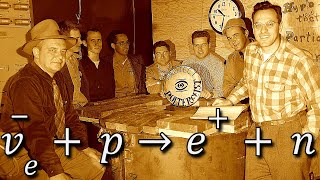
Chadwick obtained neutrons by means of bombarding the element burillium with alpha particles produced from the radioactive element palonium. This method was picked up and used heavily in the coming years, most notably by a team of physicists in Rome, headed by Enrico Fermy, known as the Via Pennispano boys. This team used neutron bombardment as a means to work their way up the periodic table, observing what it does to each element and also trying to determine which elements they could induce radioactivity in.
By the time they got to uranium, though, they encountered quite a troubling issue. The uranium was just as radioactive as its products, making it difficult to deduce a radioactive product of a neutron collision from the radioactive uranium itself. To try and work around this issue, Fermy and his crew instead tried to manually find traces of product elements in their experiments as opposed to detecting their radiation levels.
They ended up concluding that they found traces of a new element with atomic number 93 that had similar characteristics to manganese and published these results in 1934. However, Fermy noted that a much more detailed experimentation was required with uranium and these results were to be taken with a grain of salt. Further experimentation would take place in the next few years on uranium and results obtained from German chemists and Fritz Strasmon and interpreted by Austrian Swedish physicist Liisa Mitner led to a much different conclusion than that of the Vapennis Berna boys.
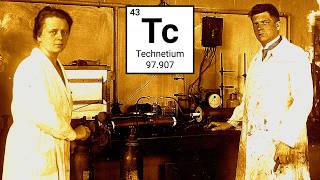
The element that they had discovered wasn't one with atomic number 93 but rather 43 and that heavy nuclei were in fact being split apart. Lisa Mitner was born in 1878 in Vienna, Austria. She had an innate interest in science, but was pushed at an early age to study topics that would be more useful for a later career as a school teacher.
Despite this familial pressure, Liisa took an intensive course to qualify for admission into the University of Vienna in 1897. She was the second woman to earn her PhD in physics there, doing so in 1905. She went to Berlin the very next year to get right in the thick of scientific innovation.
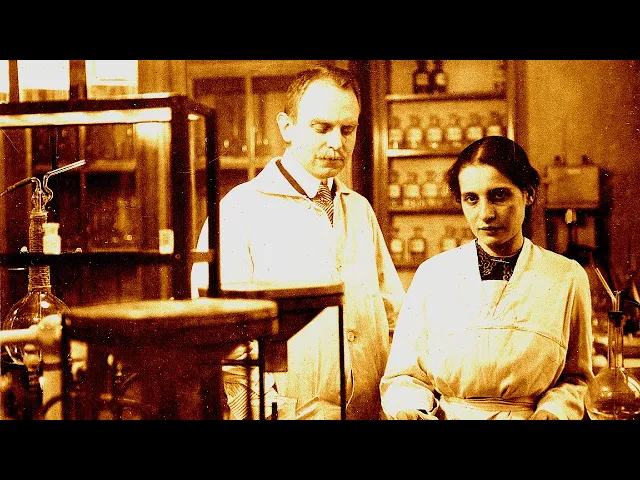
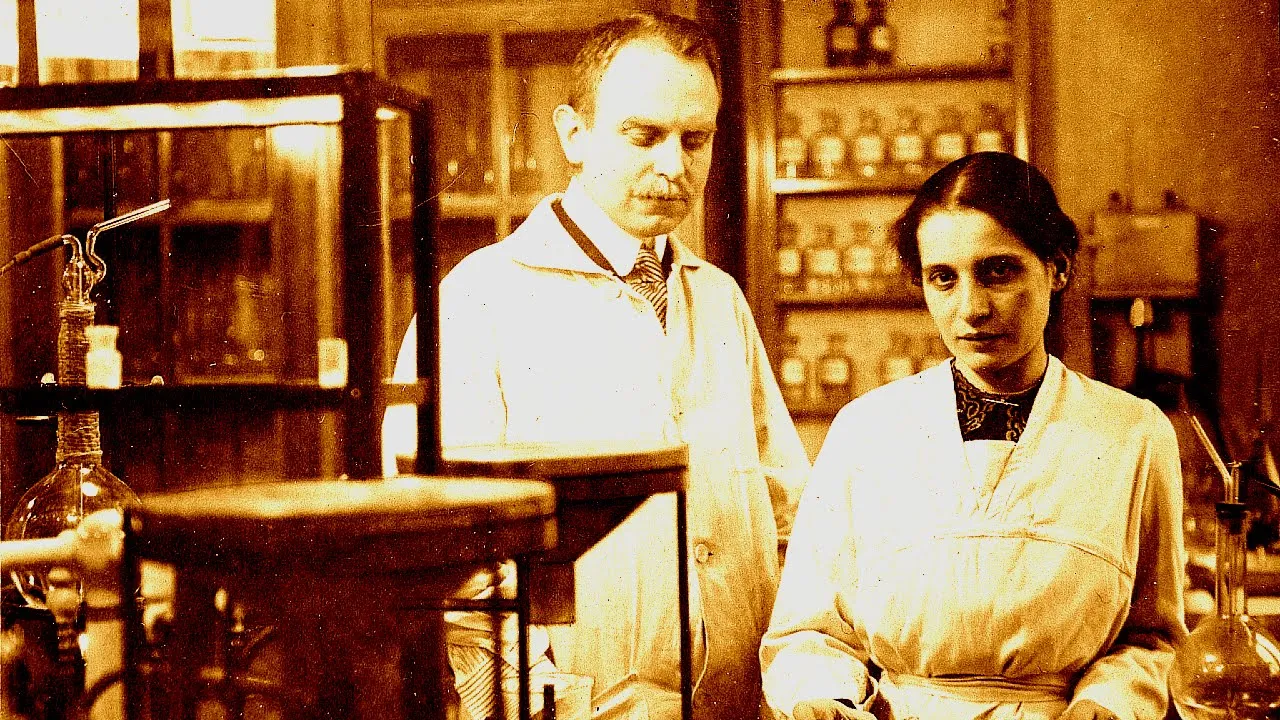
She attended lectures from Max Plunk but was however denied access to scientific laboratories there. She eventually found a place in 1907 in the makeshift lab of Otto Han who was her age and was more willing to work with her and he took her in as his assistant. Otto was only one year younger than Liisa but had achieved much more success by the time the two had first met.
He was the son of a businessman and also faced familial pressure. His was to become an architect. However, he became inspired by chemistry while taking classes at the University of Marberg.
After obtaining his PhD in 1901, he worked as an assistant to esteemed chemist William Ramsay at the University College London. After their collaboration, Ramsay put in a good word for Otto and he then spent a year as an assistant to Ernest Rutherford at McGill University. Having garnered an impressive resume, he returned to Berlin in 1906 and became an assistant to esteemed chemist Emil Fischer.
He obtained his license to teach the very next year, setting up his own makeshift lab and met Lisa Mitner later that year. The two then started a collaboration that would last the rest of their careers. Otto Han and Lisa Mitner collaborated on many research projects together, publishing notable papers together as early as 1914.
However, obstacles such as the First World War and the rise of the Nazi party in Germany delayed much of their progress. This came to a head in 1938 when Austria was incorporated into Germany and Liisa became a potential target given her Jewish lineage. She had no choice but to flee Germany and found refuge in Sweden where she continued to correspond with Otto.
Otto himself refused to join the Nazi party and resigned from his directorship of the Kaiservillehelm Institute of Physical Chemistry and Electrochemistry in 1933 in passive protest. Liisa then persuaded Otto to hire a new assistant and he did so in 1935 hiring a fellow passive protester Fritz Strasmon who was struggling to find work in Germany due to the same issues. The two began experimenting together with neutron bombardment immediately.
It was at this stage in 1938 with Otto and Fritz in a lab of their own and Lisa corresponding from Sweden when they made their breakthrough discovery of nuclear vision. Han and Strasmon had been investigating further in detail the experiments made earlier by Fermy and his crew using lithium and burillium as neutron sources. Their initial goal was to like Fermy discover more elements heavier than uranium elements they labeled transuranic.
To do this they placed a thin sample of uranium 1 mm from a collecting surface. After collisions with neutrons, the resulting products would collect on the surface and after bombardment concluded, the surface would be placed in a line of sight of a Geiger Mueller counter to detect the kinds of radiation it produced. Han and Strasmon, though, due to lack of funding, had very small sample sizes to work with.
So, tracking a radioactive substance by its weight was nearly impossible. To counter this, Han plotted the decay of the uranium sample as a curve based on how many forms of radiation were detected in the Geiger Müller counter and also by how frequently they were detected. The two chemists also used a variety of chemical reactions to isolate uranium and its daughter elements from one another to study what kinds of elements were being created.
They were attempting to isolate a bit of radium from their collecting surface when they realized that the usual isolation process they used was not working. After careful experimentation, they realized that this product wasn't radium at all, but rather a radioactive version of barerium, an element that very closely resembles radium, both physically and chemically, but is far lighter with an atomic number of 56 as compared to an atomic number of 88 for radium. Han and Strasmon were astounded by the results and had no idea how to interpret them.
Otto therefore sent this information to Liisa in Sweden who alongside her nephew Otto FR came up with a theoretical explanation for this phenomenon. They used Neils Boore's liquid drop model of the nucleus to explain and work through their calculations comparing the atoms in the nucleus to water molecules in a droplet of water. According to this model, for heavy elements, the electrostatic repulsion between the protons gets so great that the atom becomes unstable and easy to break apart.
Mitner and FR therefore proposed that bombardment by the neutron had in fact split the uranium nucleus almost perfectly in half and that was why they were seeing radioactive barium in their results. Ottofr coined the term nuclear fision inspired by the biological term binary vision which describes cell division. Fr who was in Copenhagen at the time and collaborating with Liisa via telephone immediately told Boore who was also in Copenhagen and Boore immediately went to America to share the news.
Han and Strasmon published a paper on their findings in December of 1938 with no mention given to Mitner and Fr. and Mitner and Frublished an article of their own in nature the very next year. Although all four scientists had major contributions to the discovery of nuclear fision, only Otto Han won the Nobel Prize in chemistry for this achievement, doing so in 1944 for his discovery of the fision of heavy nuclei.
Regardless, all four scientists played a pivotal role in this discovery, and their attempt to find transeuranic elements led to an accidental discovery that would forever change the course of human history. If you enjoyed this video, please consider liking and subscribing. Click here if you want to see more scientific progress made during this time period.
Thank you for watching, and I will see you in the next video.