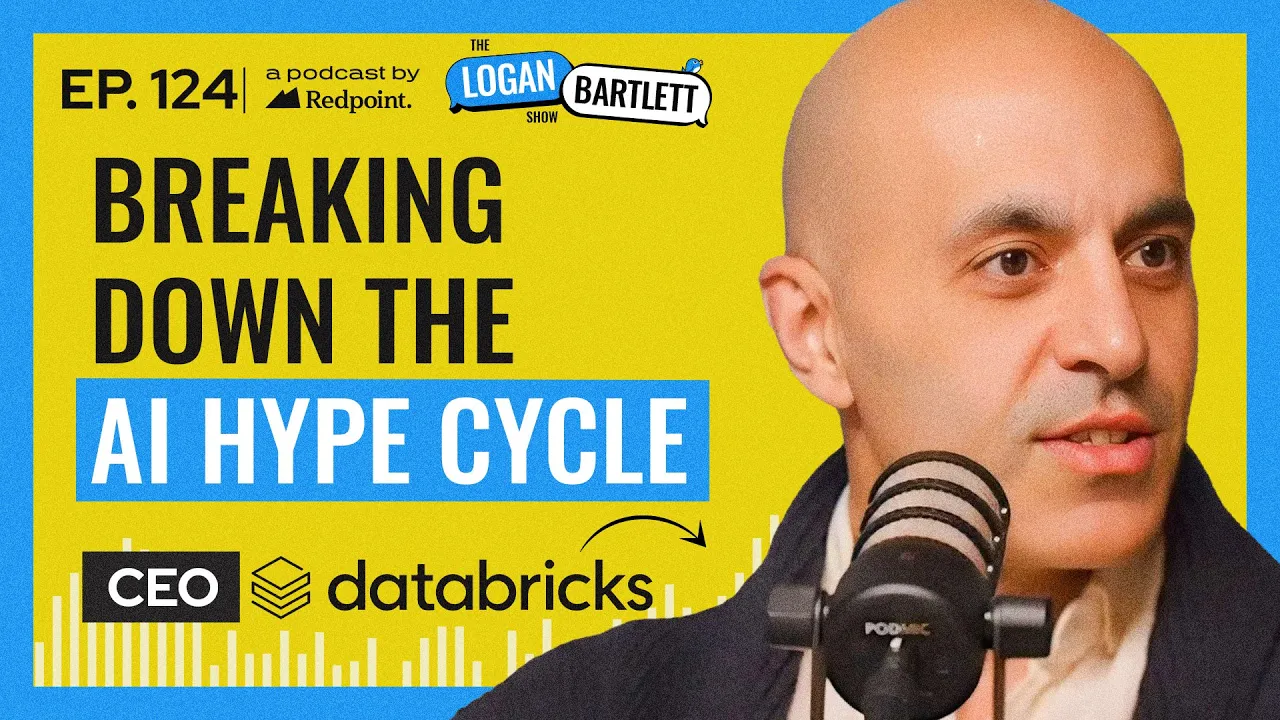
People are like look we're going to really crack the code and come up with that like super AGI I don't see that happening because the next model is more expensive and requires even more people have to be even more careful about it I would believe that if you would say hey gbt 5 will cost $1 and it's going to take 1 seconds to create we're not headed in that direction it's the opposite welcome to the Logan Bartlet Show on this episode what you're going to hear is a conversation I have with Ali Gody Ali is
the co-founder and CEO of datab bricks a business valued at over $50 billion datab brick sits in the center of the artificial intelligence Revolution that we're seeing today Alie and I talk about the state of AI as well as what he's seeing going on at the ground level his view on the Federation of models that he sees coming as well as what he sees for the future of AI over The course of the next couple years we also go into the founding of data bricks his journey to becoming ultimately the CEO as well as the
different operating principles that he runs the company with today a really fun conversation that you're here with Ali now OE thanks for doing this of course my so so you've been doing artificial intelligence since 2013 with data bricks with data bricks yeah before that we were at Berkeley we were doing also AI When did you actually start I think 2009 we started participating early 20091 um spark when it was originally created was to participate in the Netflix competition which was hey they gave you all these movies and you had to do recommendations and they would
you know think give it million dollars a half a million dollars to the winner so we got the highest score on that together with another team so you're 15 years in now yeah it obviously it was Considered somewhat Niche and maybe academic initially and then obviously we're in a very different point today I'm curious uh as you as chat gbt happened and uh that moment where it seemingly went from Enterprise and business use to sort of mainstream consumer adoption did that change your perspective on artificial intelligence in any way not really I think that uh
it kind of changed I think from 2013 145 I just didn't understand why people don't Really get into AI uh you know in 2014 I remember having this debate with many of the people at the company that I wanted to call it AI they said no that's like not authentic which you call it machine learning it's ML and I said look once this stuff goes mainstream you know mainstream it's not going to be called ml right they're like no but that's not accurate AI is Robotics and uh I just never could understand why it's not
much bigger of a deal it was kind of a little Bit esoteric uh machine learning AI uh and in you know 2022 November there it just made all the sense but then the magnitude of how much it sort of just shook everybody up that was kind of a shock it was surprising to you was there points that you looked back on actually in those 15 years that were actually maybe groundbreaking to you that you're but but not to the mainstream yeah I mean like when we started people weren't really using machine learning for other Things
than attech it was really ad placement you know clicked through you know clicked click streams for logs to place ads and so on so I would say 20145 when we said really large Enterprises started using this stuff for more interesting things like Expedia how they listed the hotels that how you ranked the listing of the hotels gave them a huge Revenue uplift it was kind of a game changer uh regeneron found a sort of um so they found the marker in the Genetic DNA for a disease and they were developing drugs so you could start
seeing like wow this has really big impact on a lot of these companies that was a big deal uh but then I would say 201819 we started seeing the natural language processing breakthroughs coming you know with gpt2 and so on it was already pretty pretty amazing so it was pretty clear that the touring test would be broken soon in a couple years or so so uh so you know there been many of Them but yeah who would have anticipated that the whole world would like kind of wake up in this way and this would be
like front news every day uh you know yeah hard to believe I I've heard you compare the chat GPD moment to the iPhone moment can you you compare that analogy and what the implications are for apps and maybe how Enterprises or users should think about artificial intelligence yeah I mean when the iPhone came out everybody realized kind of what The smartphone Revolution would be and what happened immediately was that every company on the planet said we have to build lots of apps we have to build our own iPhone apps um and so there was this
play activity all the companies building apps but you know did the apps really make sense a lot of the apps that they built you know I I kind of joke about it and I say it's kind of like building flashlight application for your iPhone uh but then a couple years later the IPhone just has the flashlight built in and I think 2023 was one of those years that everybody wanted to say hey I own AI at our company I am the AI leader I am the geni so there were a lot of chat Bots that
were built and you know they'll be just like there's an app for that in 2007 or8 there's going to be an AI company for that that just does that um so um you know for instance people building chat bot for HR documentation you can ask you know what's your policy On paternity leave or maternity leave um and companies building that but doesn't make sense that a company builds that for themselves it makes more sense that there is a SAS app for that and everybody just buys that and a little bit we're in this moment where
there's a lot of like Hey we're going to build our own flashlight app or whatever chat app for everything and now we're seeing slowly the companies being built and the apps being built that are going to Specialize and we're all going to just leverage them I think we're like in the first Innings of that so so to take that analogy a step further do you think that they ultimate will be disintermediation between the End customer and maybe the HRS system where a native AI business sort of takes in that natural language interface and no longer
would work day or ADP or whoever it is on the back end sort of serve as the interface to the user could be I think that this Dynamic Is playing out that in this AI era uh data is extremely important like so why shouldn't everybody build their own chat app well you know you should really ask yourself what's your competitive Advantage as a company what is it you can do uniquely that no one else in your industry can do everybody can call open AI llm so you're just calling you know GPT 4 or five or
six that's not going to help um so what does you have typically it comes back to the data or some Customer relationship but typically data you must have some data advantage that nobody else has um so that's what it's going to come down to um the big companies the incumbents they have that data Advantage right they have customers and they're collecting a lot of data uh so the question is can they leverage that data advantage and incorporate the AI and do the Innovation that's needed on the other hand we've seen in these waves before that
you'll have these Smart founding teams that are just completely disrupted thinking about things differently and they'll rise and they'll do things in a way that the big companies are just their sleep at the wheel and they're not going to do I think we're going to see both I think we're going to see some we're going to see a lot of company startups that fail just like in 99 when the internet was about to come uh but we're also going to see a few that become the next Google Facebook and so on but I think we're
also going to see some incumbents that actually figure out how to leverage the data that they have and do the Investments needed to crack the code on this we're going to see both of those how exactly that you know fleshes out I I would probably bet more on the startups to be honest than the big ones interesting they move too slow the big ones move too slow and you know if you have like a killer app uh you can get The data fly will probably collecting data on it and grow the usage and then you'll
have enough data advantage to be able to do that and if the big guys are not paying attention um they'll move too fast and before you know it it's too late to react where do you think we are in the hype cycle of AI right now I think uh I think that we're going to see there's I don't think like Hey we're in Thro of disillusionment I think it's you know frankly I think it's like somewhere At the top and we're going to see that you know soon we're going to see more and more companies
not doing so well and I think there's going to be a narrative that hey this AI thing was complete you know it was over promised there's nothing there the quality of the models aren't there they just don't work this stuff doesn't work it wasn't worth it all these companies and so on so I think we're kind of going in towards that very very soon uh but then I think right After that is you know when we actually going to see those very companies start coming out with these applications that are completely gamechanging for Humanity yeah
the good news is crypto's back so uh people bounce back and forth between one and the other I'm curious as we recorded this I guess early November of 24 there's been a bunch of reports about scaling laws and maybe the limitations that we're reaching some of the outer ends and diminishing returns on that do You have any opinion on where we are with scaling laws right now yeah I mean we actually put out a research paper uh you know my co-founder mat zarya uh it's it's about compound AI systems we call it and it was
actually put out probably six months ago or maybe even more and it kind of predicts this uh which um what it basically says is that to really eek out that last quality bit now and really like move up the L we really need to build these agent systems where we have Many parts many components that work together and in particular it's going to be really important that we can evaluate the quality of that whole AI system on the particular task you want to do like just to take that silly example that I gave HR docs
Q&A how well do you answer you know questions from employees on HR documentation not how well do you pass the bar exam or medical exam general intelligence not that but this specific only once we have this evaluation we can Start building these agentic systems where we can start doing hill climb so keep improving the quality for that specific task so we call these compound AI systems and these these will also leverage a lot of tools and in they will also leverage classic machine learning because classic machine learning has much better numeracy it's much better dealing
with numbers and so on calculators things like nature forecasting and so on um so that's what We call compound thei system and the and the beauty of those uh is that you can when you run them and they get something wrong you can debug which agent got it wrong where was the reasoning step that was broken and you can then improve it you can get better and better and you can do this hill climbing and keep increasing the quality of the model uh or the the AI system scaling laws you pre-bake this gigantic models you
wait six months and the model comes out and Maybe it's bad at predicting something maybe it's it's numeracy is not good and you can't even know why it's not good there's no way for us to know hey why did it get this thing wrong I don't know you do a bunch of Matrix multiply a bunch of attention layers something plops out it's inaccurate I don't know let's go train a bigger one with more data um so it just seems much easier to do this now more agentic workflows at inference time so it makes a lot
of Sense I think there's going to be a lot of innovation and it's nothing you know I think everybody's now focused on this do you think there's an implication for like do do you think that results in a Federation of model types and different capabilities that people are uh effectively good for yeah I think you will build AI systems that are very very good at the particular task we see it all the time our customers uh they typically want to do the same thing Again and again and again like they have massive data like they
have database with SEC filings right and or they're an insurance company and they have all these insurance documents and they want to repetitively again and again on massive amounts of data repetitively do the same task again and again and again so then for them it it comes down to can I what's the highest quality I can do on this specific task I don't need to be good at AGI artificial general Intelligence how can I do this again and again really really well and can you give me the lowest cost for that cuz I'm going to
do this at scale it's going to cost me a lot of money so then it makes sense to specialize a system that's really really good at that you know having a generic gigantic model just way too costly and actually it won't do as well even though it's really smart it won't do as well at that particular task repetitive task that you want to do so We see this all the time like one of the surprising things on data bricks is you know we have models of all kinds of sizes you can use llama 4005 billion
parameters but in aggregate we get more revenue from Tiny models and that was surprising to me because you know per model you make much more on a bigger model uses much more gpus and so on but customers want to take the big models dis still the smallest possible that can get good enough quality and just use That because that saves them money and actually in aggregate we make more money on that so yes I think we're going to see that and you see that in life also like you know are all the tasks that humans
are doing all the jobs that are happening our day do you need teren tow for every task you know are you getting the smartest person possible on the planet doing them or many of the jobs are repetitive and some things you know it's good enough and you want to pay This particular price for it so it makes sense that you have a smaller model that's specialized what do you think about the concept of like General reasoning or the path to to maybe not AGI but but um a more holistic understanding and reasoning that sort of
underpins these distinct models do you think we're we're approaching a step function in that or do you think that that we've reached some certain plateau in it and now it's about the data and The different functional areas I mean look the scaling laws it's like on a logarithmic uh scale so moving to the right we are going to move to the right and yes that means that we're going to get improved intelligence but you know the next THX is not going to be as you know it's not going to yield as much as the previous
THX plus you know um one of our researchers put this out you know over the last 11 years um you know we've had 100 million times Improvement in Compute that we've thrown at the problem we're not going to be able to get the same over the next few years we're going to improve it but not as much you know there's just not going to be enough uh energy compute to throw at it and we're not going to have enough data like you know llama was trained on 15 trillion tokens what's that 10x the size of
the web are we you know are we going to 100x THX the amount of data that can do that uh getting that high quality data it Seems just it gets exceedingly expensive um it's much easier to build these compound thei systems these agentic systems where you can actually debug and get really good at the task so yeah I think there is going to be a Slowdown um I also think that a lot of those things where people are like look we're going to really crack the code and come up with that like super AGI that
kind of would require some kind of um you know recursive Self-improvement loop I don't see that happening because the next model is more expensive and requires even more people you have to be even more careful about it I would believe that if you would say hey gbt 5 will cost you know $1 and it's going to take one second to create if we were headed in that direction then you could see like okay well then it can spawn off and we can just apply a genetic algorithm do lots of them and pick the best and
so on but we're not Headed in that direction it's the opposite it's like we're going to do a very specialized data center we're going to build a model over one year period of time we're going to be very careful lots of humans involved uh so um I have I don't have a crystal wall but my guess is that for many more years we need humans in the loop and we need the stuff to be verifiable like we can't just just like we saw with cars or with you know uh You know autopilots in in in
airplanes we want to have a human in the loop that can verify that it's not veering off in the wrong direction and it's just accelerating the work that they do today and I think for that we're going to use more of these agentic systems so it sounds like a lot of lead bullets there's no Silver Bullet that you sort of see on the horizon at this point when you hear people talking about like $50 billion models or you know throwing all This very good for your business I'm sure as people think about this but um
do you think that that all the stuff we were just talking about it means that uh that that's a little pie in the sky and uh and overly ambitious for diminishing returns as people sort of talk about these models at that level of scale well again I don't have a crystal ball and maybe they're right and if they are it's amazing you've been pretty good Historically in predicting some of these things yeah well I think that you know the reasoning that they have makes sense which is like Hey we're freaking creating AGI it's worth any
cost it doesn't matter what it costs and it doesn't matter what dilution and your economic models done I don't care about them because look at what we're creating makes sense to me if you actually achieve it but um you know I would probably more on the skeptical side um You know spending that much money like my I guess I'm too I guess I'm too much of an operator running a company that needs to think about you know uh you know growth rate LTV CAC you know you know so on and so forth operating margin that
I think you know if you got to spend that much money to produce a model and then you have to do inference on that model to you know for it to sort of pay back the Investments that you to train that model and it seems right now The case is that before you've even gotten the money back for how much it cost to train the model it's already commoditized and there's a better version by someone somewhere um so then economically it's just right now not feasible to do that um it seems that for those particular
tasks the cost to create these um you know compound agentic systems that were while and the ROI is there why not do that and it can drive a lot of value and continue doing That and then maybe we'll be surprised on one of these you know Labs come up with that super model but I'm skeptical I think that there's going to be a barrier we got to go through some we got to overcome some big barrier to get to that complete autonomous that can you know just get the accuracy right and it's reliable if we
froze uh model development right now do you think that the existing capabilities that we have in AI is enough To uh catch up at some point with all the tooling and the applications and all that with the excitement and the promise that we're seeing or do you think these incremental gains that we're sort of talking about and the the more Niche sort of specialized models we need to keep making those improvements to to catch up with you know the potential of what we could actually accomplish absolutely I think that uh you know humans are the
longest poll in the 10th Year if no human uses any of this stuff it's absolutely useless you can't even come up with that super you know AI thing if nobody's using it it doesn't matter humans take a very long time to change all all of their behaviors habits processes in these companies and so on just very very hard uh so I think with what just we have now there's huge untapped potential and it's not yet been applied in every workpl place in every function in every process in everything That we're doing and and I think
we can even improve what we have today with those kind of techniques that we discussed so I think like even if we freeze it and we say hey that's it actually we didn't know how to create a single model that's even better this is the best we'll see in the next 20 years I think it's going to be massive implications on the economy and you know and what we can do and so on so I would still be extremely bullish on this um That that's really truly what I believe in is there something that you
see from your seat and and perview that you have that maybe wouldn't be intuitive to the average listener that's you know paying attention to all this stuff but you you're able to see so clearly the same way that you maybe did 10 years ago you're like hey why isn't anyone why does anyone care about this AI thing is there another Insight maybe not at that Quantum but else that you sort of see That you feel like might be mainstream or well understood in a couple years that is underappreciated today yeah I mean I think it's
the fact that you're focusing the task I kind of said it you focus the tasks on the repetitive stuff that today is costing you a lot of money and if you can just get the reliabil up on those specific tasks it's massive Improvement for these organizations and it's pretty game-changing we haven't actually reaped that yet those use cases Are sort of right now being worked on folks are building them they're not in production it hasn't had impact on all the companies that are using this stuff but it's just around the corner it's like guaranteed it's
going to appear uh it will probably take two three years before we see it and then we'll see the impact of it and actually you know I fear or you know suspect that there might be before that we hit the stough of this illusionment and then actually These use cases land and we'll see the companies that are doing that so it's you can see it baking already it's just not in production yet are there use cases that you've seen uh people use data bricks or other know systems for that have gotten you particularly excited back
to the regeneron analogy that you were saying 10 years ago maybe maybe something today that you guys see on the field that is exciting or makes you you know particularly um looking Forward to the future of what could happen in every vertical in every industry we see lots of lots of use cases you know like Financial Services you know there's so many financial advisers FAS out there you know they basically now we generate automatically for one of our customers you know large Bank automatically in advance you know what advice they should give to you they
it's customized they understand everything about you your wealth Situation and so on they can give you customized advice you know it's affects you know thousands of thousands of these folks that are doing that right in Insurance sifting through massive massive amounts of uh documents uh to assess risk right it's like they can do it and by the way one thing that people underestimate is that the models are very fast at reading data they're slow at producing text right they're you know much slower the other Insight I would Say is like you know that surprising is
you know it's probably at least a 10 to one ratio between how much people are using the models to read stuff than to produce so they have when they use data brixs they use us 10 times or 100 times sometimes more or even more to read stuff and then produce very little text or very little data out whereas people have focused on that output that comes out but it's usually much much smaller uh so you know um underwriting is Another one that we're seeing uh there's so many going through all the SC filings and figuring
out what's happening you know extracting signal so figuring out Alpha uh we see it in all the financial sector um so there's so many use cases in health care electronic medical records there just so many of them they're all handwritten uh being able to actually finding structure in that uh it's you know that's a treasure Trove by itself so use cases around that so There's you know hundreds of hundreds of these you see all the time in every industry they just haven't been productionize yet they're not fully being used by the workforce do you think
that readed right uh ratio do you think that stays around that are there any trends that you sort of see as read going up and comparison to WR or you think at some point the the writing and the creation catches up with the reading and summarization I mean hard to see That because uh you know how much are we going to read as humans you know how much we I mean there's only so much and we read slowly right uh whereas having the AI crunch a lot of information um you know so it has that
context makes a lot of sense so if anything that probably increases if we can do that faster uh so that that's that's where the trend is headed we're seeing even more and more of that when we look at our data than when we started as you Councel customers be it big Enterprises or or smaller ones uh about figuring out where Ai and automation can can exist within the organization and how to um continue to dive deeper into that Journey are there any um takeaways or or key points that you keep hitting that that you feel
like hey if you could tell all customers this is how to set up a team or this is how to think about it any Frameworks or Primitives or whatever that you think about first of all you Got to get your data strategy right like a lot of companies now want to sort of skip that step and jump straight to the AI and you know the data teams have been at it trying to get the data of their company organized secured uh you know get it in one place so they can actually get access to it
not in different silos and you know that's has been a journey and it's not finished work um it hasn't that work has not been on the CEO's radar of the Fortune 500 uh that's you know it's been sort of esoteric topic maybe it was uh sort of worrying about it now the CEOs are waking up after chat GPT and they're saying I need AI it's gamechanging I see it now I've used it myself give me AI uh and they're sort of skipping that step so that's it's extremely important that you go back to the basics
uh the data is extremely important so you have to get that in a good place and if you don't have that in a good place you're not Going to actually going to be be able to succeed with AI the second thing is focus the use cases of AI that you want to do on where you have a data Advantage so for your company what is your data advantage and Frankly Speaking oftentimes I find myself talking to customers telling them maybe don't do this project and say why not we're very excited about it we're going to
do this and that we we are ready to go we'll pay you a lot of money for it and it's like Yeah but what's your advantage in this you know there'll be an app for that uh by someone else so let's focus on places where you have a competitive advantage against your competition and it typically has to come back to something you have around the data and you do have it uh so let focus on those use cases because we want our customers to be successful only then long term will be succeed as well so
I would say that's the second thing I say the third is uh There's a lot of people problems in large organizations you know it's there's now many people that are fighting over owning AI in the organization like I'm the person who owns AI at our company and so on uh so figuring out a way so that you can get the strategy aligned in large organizations is I know it's boring but this is the hardest part of a large organization with so many different people running in different directions Having so many ideas of which vendor to
use what kind of models to use what kind of people to hire which project to do uh so as if you can concentrate uh sort of the decision- making to one person in the organization and not have lots of departments have political fights over it it streamlines and moves things faster typically you actually have the head of that department being a change agent person it's someone that doesn't do things that Everyone will love they'll come in and make the difficult decisions streamline the data processing the security around the Privacy around it because everybody's worried about
that and then focus on those use cases that actually matter for that organization this is as important as a technology I care a lot about technology and geek out on that but this is just as important projects will get not funded or they get stuck in security or they go nowhere cuz Different departments are fighting each other so we need to overcome these things as well this is why I'm saying it's going to take a few years before we see the impact of these things as you think about the the landscape and uh the term
that you used earlier to sort of talk about was it compound what was the compound compound data system yeah compound agent systems um how do you think about what areas to potentially pursue um there's a bunch of venture Companies in spaces like inference or evals or whatever it is like as you think about different areas to potentially into for data breaks as a business how do you evaluate uh no pun intended I guess th those those markets to potentially pursue yeah makes sense look it's just for us it makes a lot of sense is you
already have all your data with data bricks you already trust us that it's secure you know that we can handle the security the Privacy so the Question is what's really adjacent to that and for me as a CEO where is it we can actually bring extra value to the customer that they otherwise couldn't get elsewhere typically comes back to data that they have with us already so typically comes with governance around that data uh with guard rails around that data you know you don't want to build uh this actually happened with a customer they had
a chat bot and if you asked it what's the best you know car I Could buy and it this was a car manufacturer it recommended a competitor's car you know uh so how do you put guard rails around that uh you know how do you deal with pii data how do you deal with AI regulation that's coming a lot of this we can standardize in datab bricks so makes sense we can like automatically produce documentation so you're compliant with the regulation that's coming we can put guard rails so that doesn't do those kind of things
and Since we have the data we can create this data loop so that you get this flywheel of when they use the model we create the evals and automatically feed it back to making this model smarter and smarter and doing that it seems we can do that because they already have the data with us so it's just advantageous for us to do that um I think in this space like for startups they should focus on the applications I think applications are going to be where a lot Of value in the AI space is going to
crew in the future we'd love to be their infrastructure so they use us for their data processing for their governance and for their AI uh the applications I mean there's a lot of creativity there's a lot of things that you're seeing happening I can't predict what's going to be the apps that actually going to win in the future it's kind of like in 2000 trying to predict predict Facebook or Twitter no one could have done that No one ever would have said oh you know this is going to be a company that does you know
140 character tweets it's going to be the same thing now so we just want to be that infrastructure for them so they can build their AI systems on top of us and we help them with that data flywheel if we back up a little bit um to the original early days of of spark so we talked about the Netflix competition and that uh I had heard that maybe you tried to actually sell the Technology in the early days and there weren't really any takers can you just go back to that early uh story like what
did you see and what was your path to getting it off the ground into some commercial entity yeah I mean what was really happening is that we were seeing that the Silicon Valley Tech companies were leveraging AI this is 2009 or 10 we were seeing what Facebook was doing uh we were saying what Google was doing and it was very clear that doing AI on the Data is going to be the most important thing and at the time everybody was stuck on doing basic analytics backwards looking call it bi business intelligence which is backwards looking
like how was my Revenue last week and they were excited that they could do that really really fast but we were asking hey what about what's your Revenue going to be next week Ai and there was just not much appetite for that uh at the time and we went around and we Tried to push the technology out because we just wanted to do research but it was very hard to actually get anyone to actually see this you know you might remember the phrase it was the Hadoop Wars Hadoop days it was impossible to get anyone's
attention for that stuff so it was kind of a little bit out of Despair that we we started the company and said look if we don't do it ourselves uh no one El's going to do it I remember actually one of our first Customers uh we said hey this is open source just take it because we don't want to make money on this and I said no you got to charge us for it because we want an Enterprise that's behind this uh and that's kind of when we realized that okay there needs to be like
an Enterprise business no one else is going to do that we probably have to do it ourselves was it an issue of um just just pure Focus for these vendors or was there something from a data structure Standpoint that needed to actually happen to have the market evolved to the point that they actually were able to do a lot of the things that you wanted them to do I think there's these hype cycles that come and everybody's just focused on something so that era was that Hado hype cycle and they were obsessed with it and
we couldn't for the life of us tell us AI is more interesting it's just it's you know you open the newspaper and everything is just about that and it's Happening now too right it's like I think the market works like that and to create a successful company you have to kind of bet on something that's non-consensus at the time and you have to be right about it so um for us it was AI it was the cloud it was open source those were the things that we were excited about but there wasn't much excitement around
that and actually we were told that this is not going to work all the data is going to be on premises Um you know open source you cannot monetize it um and so on and so forth so um I think it's similar now right um were you intellectually I I I had heard a story that you that a customer was going to offer you I don't know if it was seven figures or eight figures or something to build an on-prem version of the product and you rejected it at a point in time that maybe you
could have used this now now less so but at that point in time you definitely could have Used the seven or eight figures or whatever it was did you just see this as an inevitable path you were building toward words and therefore anything but that was a distraction along the way or what was that philosophical decision yeah 100% like our view was we have to have an asymmetric bet on something that no one else believes in and we better be right about it that's the only way so if we're going to go on Prem and
do what everyone else is doing then there are Way bigger sharks that can do them than us and then this is going to fizzle out and it's not going to work so yeah it was a month or so in to my CEO job 2016 that one of the largest banks told me you need to bring this stuff on premise and I said no we're not going to do that and they said well how much how much what say how much would we pay you for said we're not going to do it and it's said five
million I said we're not going to do it and I said 10 I said we're not Going to do it they said 20 I'll give you 20 right now and at the time 2016 you know I guess we ended the year um with 10 million Revenue that year so you know 20 million Revenue was a lot uh but the idea was like if you go on Prem they're much bigger companies so we have to have an asymmetric bet uh that we believe in and we continue double down on uh and then once that bet becomes
true we'll be big enough that it's too hard for others to catch up with us Similar thing as I said is going to happen in this Ai and llm era right now um I think you have to pick something that you think is different uh than the rest of Market uh and then bet on it and then hopefully you're right as um as you reflect on the journey one of the stories that I had heard was um giving a lot of credit to to Ben horror wits in actually turning this into a business can you
tell that story typically I don't allow other VC plugs but I thought It was an interesting one that he actually was uh pushing you guys to think big and turn this into a commercial product yeah I mean look we came out of the research lab we really wanted to raise only two three $400,000 seed and just Cod away for a year or so and he's the one that pushed hard no let's do the series a and I want to be exclusive investor and um you know we were actually not very excited about it but Then
he gave us a price we couldn't refuse and he said no go big and we gave us you know 14 million at the time which is a lot of money uh back then I know it's not much these days uh and he said go go go go go so he really pushed us go aggressive disrupt the market think big uh you know he always was a couple of orders of magnitude bigger sort of vision for data bricks than we ever had like whatever was our biggest grandio vision of data bricks he always was a Couple
of orders of magnitude ahead and was pushing aggressively saying no no no this you're thinking too small like way too small and I think you really truly believed it as well so that kind of set the tone from the early days uh for us cuz the early Founders I don't know if you remember these numbers but you guys bet you remember the actual numberb so so what were the bets for the early well I mean like we were in around the table when we started the company said hey What's like a great outcome for the
company and I think when we went around the table the numbers were something along the lines of like 150 million exit for us or 200 and someone said 250 and so on uh so that's how we were thinking and Ben was immediately like no no no billions for sure we're going to do and then when we got to that you know it was like this is easily going to be a hundred billion doll company and you know now where we are now he's like Definitely trillion is what you need to think about uh and you
know I would also give credit for Mark andreon in one of the meetings I think we early days we said um he said what's your biggest bottleneck I think this was 2017 and said hey we can't hire Engineers we can't get the engineers from Facebook and Google they're just too expensive and he said huh what's so what's so Fang is the problem and I said yeah Fang is the problem and I okay so You just need to add yourself to that list it needs to be Fang DB H and that's it and then he moved
on but after that meeting we're like yeah okay he kind of is right we should actually just offer up and you know hire those people and become like one of those Tech magnets and it changed our mindset actually we went back we changed our compensation we changed how we hire just based on that one comment I'm curious like at a tactical level I mean that's very Aspirational it sounds great uh but but like in changing the compensation or thinking bigger like what did you then go do we literally went back and moved the compensation for
engineering to 9th percenti of the market you know we did the math and we saw how much is it going to cost us are we going to be able to do this is it going to be is it something that we can afford as a company what's the dilution going to be this was a long time ago and actually when we ran the Cals we were surprised that actually we can do this and it's sustainable and it was surprising to us we're data companies we crunched the data and all the numbers um but we we
found is that you know it's really your market cap divided by number of employees that's how Equity Rich you are when you're paying someone equity and these companies had a lot of employees so then it turned out actually we are actually richer than we think if you take our Market cap and divide it by the number of employees uh because that's you know that's not how you're doing financially that's not about your Revenue growth but that's about what you you know what could you offer someone in equity and it turned out that actually it's absolutely
within our reach to do it so let's explore it a little bit and it started working and then we were able to hire the people that we couldn't hire before And they came in and they completely revamped what we were doing with the product we just could increase the feature velocity and The Innovation cycle at data bricks massively and that actually helped us kind of slowly start separating from the pack because in 2017 if you had talked to us you know we would have been one of the startups among hundreds of other ones out there
uh so these small things kind of that they did to push us think really really Big go way bigger and we did that but we always kind of did it judiciously we didn't want to kind of go crazy and you know burn down the bank account we wanted to be careful about it datab bricks was founded in 2013 is that right and for the first couple years you weren't the CEO what were you doing through that the first couple years in the journey and then what was the impetus for you to step in and become
the CEO yeah I was uh you know running Product and Engineering uh which I loved and actually in that phase it made a lot of sense because you know what do you do the first two three years of a company when we start a startup you want to get product Market fit build something that just works uh so that was the focus for us just how do we get one customer that wants to use this and then how do we get a customer that wants to repeatedly use it and then how do we get a
customer that repeatedly uses and pays us for it And um so that was the first two three years of the focus the technology that we had innovated with with spark exploded in 2015 and um you know at that point we felt like we had succeeded but we just didn't have any monetization so we went through it difficult time in 15 we had to figure out okay if we can't monetize maybe there is nothing here uh and the company kind of went through a little bit of um sort of introspection and then We said okay let's
kind of do a little bit of reset of some of the things and rethink some of the stuff and start a new in 2016 so like M CEO in 2016 and we made a bunch of changes that actually started helping us with monetization initially were you the interim CEO or were you the CEO and they were still talking to other uh potential outside candidates well I thought I was well first of all I heard through the grap fine that they're interviewing people so I found out okay they're actually interviewing other EXN folks so that's were
you the CEO at the time or but they were like hey do you want to be the CEO I was like sure and then I found out okay they're actually interviewing other people all right they didn't tell me about that but then eventually I was like okay I think I am C the CEO they've announced it to the company I am the CEO I'm running it but then I kind of you know my compensation didn't change and I Learned kind of soon that hey I'm actually interim CEO I didn't know that you didn't have the
title until yeah so then it's it's turned out no no no actually it was just a test period and then eventually I would say after one year um I kind of think they really kind of like okay no we're going to go with him for so the first when you came in in 2016 there were three things that you kind of focused on uh in it sounds like monetization was one of them as well but Uh can you talk through what those three were I think it was upleveling the management team sort of changing the
focus of the the customer type and the monetization yeah Enterprise sales total pivot into Enterprise B2B we were plg I know it's still hot everybody wants to build plg companies but we learned a hard way after two three years that plg doesn't work um might work for very few companies it's a great thing we still do Plg uh but if you guess what if you want to sell a data platform where you want to manage the most sensitive data of a large organization uh you need to get the Buy in of that organization nobody's going
to just swipe a credit card and start giving their data to you and you're going to succeed so plg just won't work in that model um in B2B in general it's hard if you want to have big contracts with large Enterprises plg probably don't work does not work Um so um so number one going all in on Enterprise sales uh we had tried earlier to just be this plg product Le growth uh the second thing is upleveling the management so we up leveled all the exact team like every person on the exact team was new
so I basically got a new exact team um that had much more experience they knew what they were doing and a little bit went more with uh experience over just hey we're just going to be smart phds that can figure This out on our own we went instead with you know someone who's done sales for 20 30 years or someone has done marketing at scale at Oracle knows how marketing is done and so on so that really helped also with the execution because I would say we were really weak on goto Market we were great
at product Innovation research uh so those really helped and then a change to how we actually innovate in open source just open sourcing everything in giving it away is Not going to work so we need proprietary secret s sauce that we're not just giving away to the hyperscalers so that was critical also in changing and that's difficult to do if you're a pure open source company you come from Academia it's it's it's difficult to get all your employees to be all in on that uh but it was the only way to succeed we wouldn't have
been around if we hadn't done that pivot did you have those views as your running product and you sort of came in Prepared to do that or was there some point of introspection that ultimately led to those conclusions yeah I think 15 we were not doing super well and in 15 it was sort of like okay we trying plg it's clearly not working right yeah we don't want to do Enterprise B2B because we're not excellent at it we don't have experience in it but you know uh we ended 2015 with 1.6 million Revenue 2015 so
if we only have 1.5 1.6 million revenue From what we could glean from blogs and whatnot and Enterprise salesperson can sell a million dollars a million and a half of software that's just one AE why don't we hire three of them and try it out what do we have to lose so that kind of emerged in 2015 the other thing was it was very clear that no matter what what we did in the Innovation cycle side the hyperscalers immediately had the same thing they would just pick that and in fact they would add a little
bit Stuff on top of it and then they had the the whole platform the whole Cloud so they were always the good enough vendor so the customers were like well you're great you have great Innovation but I can also get it from the hyperscaler I'm going to try that first because I already have a contract with these folks I got security approvals I've already paid them a bunch of money try that first and if it's not good enough I'll come back to you so pretty clear that we Have to be able to articulate then yeah
you can go over there but you won't get XYZ if you go over there like we have XYZ that they don't have and so if you couldn't articulate that then there was nothing you could give your sellers to sell um and then you know it was the experience that we were lacking so I think through throughout the hardships of 2015 kind of made it pretty clear that we have to try something new and these three directions seem to be pretty Viable I mean the one that stands out the most as like potentially a one-way door
is the the licensing or monetization shift and it's very different than the the culture I would say of the people that are very uh open- Source purists in some way was that was that a debated decision in a very meaningful way or was it just kind of declarative hey guys we have to do this to be able to build a business I think when I took over I was just a little bit More forceful in what needs to be done but it was big debate internally and I made it pretty clear I think I I
used the analogy and I said hey we have a gun and it has one bullet left in it we not going to do thousand things we have like one bullet left we better aim it really clearly and we better hit the target if we don't we're done here and so I made it pretty clear that this is existential the things that we're going to do and um and I think when I kind of got people to Wake up because you know in the startup days you're excited you're doing stuff and but if nobody makes it
clear to you that hey we're actually GNA go out of business in a couple years it's not all great just because we have a big valuation I think people got in line and and started thinking about okay what are the ways we can actually do this did they quickly start showing up in the the business or did it take a few quarters no I I think pretty soon the engineers Started thinking and I made it very clear to them is that this is great that you built this it's literally available now also on the hyperscalers
cloud so what's the differentiation literally and I made it very viscerally clear to them and I shared it we had a extreme transparency culture and make it really clear so get them to buy and let them understand themselves that we can't win we're guaranteed going to lose if we continue this way um and you know they Kind of soon got it that we want to be successful here so they start coming up with innovations that we're going to this maybe we don't need to open source now as you think about expanding into new products uh
I've heard you actually will set up uh different teams for each product as it gets going what have you learned about product management and organization as uh as you can to scale and iterate on these different product areas yeah I think that when you build a Product zero to one you kind of have to do the same thing that you did in the original kind of first two three years of the company um so there's a lot of processes in any company once you're over50 50 employees let alone thousands um so you got to cut
that and say look for new products you don't need to satisfy all the security stuff you don't need to have all the processes have a small core team that iterates really really quickly uh figure out first of All who's the sort of Innovator type that you have in those early startups put them on the project these are people that are not necessarily good at when the company scales and they're leading mature products you have to have one such anchor person that you put everything around and you put them in charge they start building that product
product uh and then you let them iterate really quickly so get them off the iteration cycle that the big company Goes on but get them on this much quicker smaller one and you know encourage them to just iterate inner Dev Loop outer Dev Loop that's super super fast and just focus on getting users and getting product Market fit once that happens you can kind of move it back into the Mother Ship uh so you know ideally even do it outside of the whole product if you can so we have a product right now called Genie
which lets you just you ask in English questions and it Can answer immediately produces it understands all the semantics of your data we call it data intelligence so it understands your data and it then programs and ask the questions and give you just straight up the answer but to know that it's not hallucinating you can actually see how it coded it up and behind the scenes and so on that product we actually just built it completely outside of data's codebase and it didn't satisfy any of this stuff we didn't Build on anything we just iterated
it quickly just do that outside of the norm like a startup almost and then only when we saw that the results are really good and people like it we went through the kind of painful process of okay let's rewrite it let's move it into the mothership so it's almost like an acquisition at that point happens and you have to integrate it into the whole system and make it secure and so on so you'll give people autonomy to make the Decisions on not not the shared Primitives necessarily or if you guys are using some type of
I don't know single sign on or whatever Cloud structure underneath you'll get people full autonomy to do it and then you'll come back and reconcile it once it actually finds product Market fit literally do it outside in a separate repository do it in a g separate GitHub repository outside of the big system and do it you know iterate very quickly is The most important thing because that's what you're doing as a startup as a startup you operate three to four times I've seen it we've done Acquisitions and if you measure it the startups move three
to four times faster than you know a company like datab brick and I think we move very fast and we're very Innovative but still it takes us three four times longer why is it it's the security processes it's the legal sign off it's making sure that it works on All the clouds in of the environments and the biggest thing that slows you down is that you have thousands of thousands of customers that you can't regress um so you got to unshackle the new products otherwise you're just going to move too slowly and that's what you're
we're seeing honestly the really really big companies they operate that way it takes them too long that's why you have startups in the ecosystem so you have to kind of go back and Reproduce the kind of environment that you had when you had a small startup I I'm curious uh so so now you're coming up on I guess N9 years-ish at the CEO job is that right um as you reflect on like your leadership style today you sort of seem like the canonical leader of of data bricks and it's like the job that you've always
done I assume leadership style has kind of evolved in some ways over the course of of this period of time are there anything that You wish you could anything you could wish you could go back and tell your earlier self taking the CEO job for the first time or maybe your earliest founder self when you sort of stepping into the seat yeah I mean I think that you would want to grow leaders earlier on like build trust with few leaders that you groom and continue doing that because what you find nine 10 years later and
I have a lot of awesome co-founders that are still active and They run a company where it's almost a partnership where we run it together uh but it's not that many people like you know even though we're almost 8,000 employees how many people are there that are really can really help you build the business together it's it's hard to find those leaders that build you trust uh with them and you know grow the company with so I would just invest more in that much more actively and always be Lookout on the lookout for those kind
of people In the company know we were just busy executing and we didn't pay attention too much to that maybe so that's one thing I would do differently um the second thing I would do differently is um when these trade-off decisions come up and it's really hard to decide do we do do we go on Prem or not or whatever it is um bet make a bet that you know is much more for the future don't worry so much about you know the implications that it has on our finances or on the Revenue and don't
like don't let short-termism creep in in easy to say now but in the early days when you're it's far from clear that you're going to be successful as a company and you know the VCS are asking you how's it going you have your board meetings they're looking for your Revenue targets they they are super obsessed saying how's that is it hockey sticking is it going up what's it looking at how do you compare with others in the industry Continue making the bets on the future and don't get carried away on those numbers uh that's another
advice I would give because we took many shortcuts that backfired um they were not wor doing we kind of knew it that this was a shortcut but it was like it was worth it cuz you know this going to bring so much revenue if we just take this shortcut I would have avoided many of those shortcuts now um you know uh air on the side of the future than the present now of course Maybe it's path dependent and I'm saying it just because we're where we are if we had done the things that I'm saying
we should do we wouldn't have succeeded but uh I still kind of on balance feel like we could have been more futuristic in our bets than we were I get the feeling you you focus on um empowering individual leaders within your organization and having them um deputized to make the best decisions for the organization rather than uh you Serving as a central hub for for each department is that a fair character I think it's both I think I also micromanaged them okay maybe they would disagree yeah yeah they would probably not say Hey how do
you think about that tension between um uh you know a central figure that's able to make definitive decisions that sort of sit across an organization versus more decentralization and empowerment at an individual level yeah I mean you get More clarity if it's one person and it's more consistent and you know that's great the disadvantage is that it slows things down and it bottlenecks things uh and it's maybe less empowering so you have to strike a balance and you have to do it in places like you know you build trust over time you figure out which
are the parts which you can completely delegate and they're going to do an excellent job and you know they're Probably better than you at it so don't pretend that you're better than them uh and what are the are areas where you really need to deep dive uh and then there are some areas that there's things that only you can do as a CEO like you know it's it's literally tiebreaking uh it might sound silly but over time overlapping product areas appear and you get leaders that are kind of building similarish things and the vent diagram
intersects and if you leave it to them No matter how many times you tell them you know figure out how to unify this do one we're not going to have two similar offerings they're not going to be able to do it them on their own so you got to step in and push so that you got to use the CEO card judiciously I think that matters a lot and you can make build a much simpler product so I think if you want really simple unified product that makes sense one person uh makes much much more
sense you just have to watch Out for bottlenecking things and slowing things down why is the willingness to say the same thing over and over again important part of the CEO's job in your mind because I think people are not paying attention to what you're saying like you know we all have busy lives we're paying attention to our own life you know I didn't even notice this thing that you said I wasn't even there or maybe you said it I didn't really rock it I was on my phone and I had actually Fire that day
and I was having other issues that I was dealing with so I didn't really I didn't really internalize it I didn't really get it so it's many many times you tell someone something for a third time and then only then you notice that they are like you know and then they repeat it back to you as if it's like they came up with it that's great um I think it's just you got to repeat it but what I try to do is figure out a way to repeat it in Different ways don't repeat it the
same way all the time it gets boring and old challenge yourself and come up with a new angle find a customer that says the same thing that you want to say uh or use case that's a little bit different use different slides make new slides um and you'll be surprised because you know people didn't really get it the first time they'll say oh this was completely awesome what you just said now even though you're like well that's literally What I said like a month ago but I just refurbished it a little bit so I think
it's super important being truth seeking I think is one of your values is that right um how do you implement that in practice or how does that be manifest itself as a cultural um cultural practice for you guys make sure in the hiring process that you test folks on Truth seeking you know it's not that hard actually to ask someone you know tell me what's your biggest screw up you Know tell me when you really made a mistake who did you really not hire well why did you make that mistake how was it and so
on push them push them push them to you see you know until they get uncomfortable do they start come up with lots of excuses well I really actually didn't want to hire this person but I my boss made me hire them and that was a bad H I knew it but yeah that was a mistake I made but technically my boss's mistake so like you know keep pushing Them and you can in the interview process actually sus out if someone is TR seeking and honest or whether they're trying to a little bit you know make
it look much nicer um you know so that's that's number one number two don't promote the people in the company that are not trth seeking like at least if you made the mistake of hiring them in then at least make sure you don't promote them so in the promotions of the company make sure that you're really Evaluating the cultural values like really do it it's easy to have the culture values but are you evaluating the promotion I have a rockstar Rockstar is doing great they move the needle on the business should they get the promotion
or not you don't want to be the person say well wait a minute can we like look at if they were truth seeking oh they're not let's not promote them it's like are you out of your mind this person had huge impact on the company Yeah but they're not truth seeking but you have if you mean it if you want that to be the culture you have to actually do that uh in the promotion and then of course if it's extreme case we might have to part ways you have to do that as well you
can't have people around that don't fit the culture um so that's what I would say you spend 30 to 40% of your time on on hiring is that right one of the things you said is that you um when You're hiring Executives you'll you'll just find reasons to keep in touch and find bunch of different touch points can you maybe talk through that as a philosophy or how you go about doing it yeah I think actually the bigger philosophy is that I don't believe in interviews uh because I think some people interview well and they
might not be good at all and some people interview really poorly but it might be excellent so I actually just think it's a very Noisy um Channel you can't there's not that much value in it uh so then what can you do um one of the things this is the one that you mentioned but there are other ones that we use as well is I try to actually have them do the job and I think we think oh you know in programming we can do that ask them to program this thing and then if they
do it well but we can't do it for any other job and I disagree with that just if you're hiring someone for head of Marketing work with them to fix something that's broken in marketing right now whatever it is if it's a Personnel problem or if it's the web page which the product marketing positioning work with them call them call them you know in the evening call them you know in the morning ask them go through it like work with them basically make them do the job as if they were already an employee in the
company and you will have a very good sense of Culturally how they are you know are you in the same wavelength can they actually do a good job at this the kind of stuff especially pick the things that are not working right now in your company because that's those are the things you would give them to fix when they come in and if they could fix those things they're clearly a good hire uh so I'd rather do that then coming in in an interview and just asking them you know the you know the gotcha questions
that They might have practiced you know tell me your own weakness what's your biggest weakness and so on um so that's that's one of the big things that uh we do the other is back doors and I believe you should do the back doors up front so don't go through a lot of firms especially recruiting firms they will do run you through a cycle they have you meet all these people and then at the end they want to just check the box by way they'll even do the references for You uh which is a big
mistake I think you should references up front I already know who you're hiring uh so that the first time I meet the person I already know a lot about them I've already asked and I've also found this thing that if you do five to 10 back doors on people their bosses previous bosses say you actually kind of know the person better in some regards not in their full entirety better than they know themselves cuz you know all the things They went through and you know the perspective of three four people that saw that happen to
them in the previous job they might not actually fully comprehend what everybody thought about that situation of course they have a unique perspective so I think that back doors are extremely important um you know and then others just look at their trajectory of work you know where were they have they seen great have they done something Stellar are they hopping Around a lot um you know those are the three things that we kind of emphasize in hiring what are your techniques on the back door references uh are there are there specific questions you like to
ask or ways that no one likes to talk poorly about someone they know so how do you sort of drill in to make sure you're getting the actual high quality information it really depends on who you're talking to and they're all different you can tell immediately some People are not just going to tell you the truth this is going to be you know they're going to just say good things or they don't want to say anything so you know that's that so you just move on and end the call uh but uh and I guess
I'm revealing my uh you know uh recipe here so it will never work again but um I think that if you can find the former person that you know opens up I think one thing that I like to grill them on is really really ranking of how good the Person is and don't ask you know score from one to 10 and they say 10 really ask them like does it rank number one number two how many have you and then want go really deep who did you who's number one who's number two on your list
by the way you go after those as well of course and then it really ask them you know go through scenarios like it's just the follow-up questions like what what did they do well tell me something that went wrong give me a scenario what was That scenario really push the boundary you got kind of almost to the point that they become uncomfortable so many times I've done it so far that you know they call back and say like you know this is you know what's going on here uh but yeah you want to but you'll
find when you're doing the back doors that okay that guy and that gal they're like super forthcoming that's a straight shooter they're going to tell you the whole thing and others are not front door References the references that the candidate gives you uh are similar but kind of inverted they you know the vast majority are actually people that the person is going to hire next if it's a manager they're just literally giving you their and that's useful too because you can interview those people you know who they're going to hire next so you can gauge
the quality of the people that they're going to hire but occasionally you find the front door that also tells You the real truth and tells you like really what's going on um and you learn a lot there too uh and when I do these references I'm not looking for hey what's your one fault that I'm going to cancel you know the I'm not going to hire you for it's just to get a complete picture you're going to have fault you're going to have strength you want to understand that full picture uh before we go ahead
and hire you um so that's kind of what we're going for but Yeah for some execs I've done 15 of these back doors before I hired them for from a uh as a leader you've had to ramp up in different functional areas one of which was Enterprise sales I don't think you had experience to it how how did you go about learning in that area and I think you copied maybe best practices or sort of internalized stitch together to build your own model from a bunch of different organizations maybe you can you talk through learning
a new area or Discipline and how you went about it yeah I mean first of all I would just say you know we hired Ron gisco who you know took us from essentially zero to now over two billion AR right B basically three billion AR um and so he's been phenomenal and and what did you see in him or yeah um I thought that he was extremely smart so I thought he's actually different from many of the sales people he is the classical Enterprise B2B sales guy you Know so he's not like the engineer type
that's you know he is the classic archetype of a sales leader you know with all the raw raw and motivational speech and get everybody riled up so it's like he has all that so that's great that's the stuff we didn't understand or have he had the big Enterprise experience because there's all sellers that sell to be to midmarket S&B but he had actually sold to really big gigantic Enterprises so that's also Something we didn't understand anything about like he was thinking very big like when he came in you know he's like we're going to do
a $10 million contract or 100 million we were like this no one's G to ever pay $10 million for datx it was our mindset so that was also useful but um but he also was um you know he was cerebral and he was um extremely smart and went by first principal so there was a compatibility he had an engineering degree so he was Sort of the unicorn of kind of someone who like spoke our language and couldn't understand us and was extremely smart but also had this whole other thing that we we couldn't understand um
so that hire was important we took us a year to hire we went through a lot of candidates and I think we kind of nailed that one it was luck um so that's important um the other thing I would say is in in in the interview process when you're searching like we took us a year to hire A salesperson um take the I've seen people make this mistake take the exact hiring process super seriously um it's a learning process you're basically going to school to learn what head of sales look like so in that talk
to all the top head of sales and Grill them and pay attention and use them also in the interview since I don't believe in interviews as I said use the interviews a little bit of a tutorial for yourself To learn how does excellent sales look like in your organization for your company for your company for your company and you get the after you know talking to 20 people you get a pretty good picture of okay this is kind of it this is what they're doing they all have that all the Stellar ones seem to have
this in common uh this is what it's about and you can go deeper and then in the backd door process you figure out who's who you figure out who are the top People in this industry that you can't hire try to get some time with them as well to just learn from them and build a relationship with them or get them to be advisers so really put yourself in the hey you're going to University to learn um that's that's what that process is you know you're not an expert and Trust the people that are the
best in the industry at that trying to find the number one person and go with them in hiring for data breaks um are there Certain things that you feel you uniquely prioritize or the types of people that succeed within the organization that are is maybe unique to data bricks yeah well so our culture principles have been reverse engineer to exactly answer your question so you didn't start with the principles and went the other way you start started with the people that succeeded and came back succeeded and failed okay we also looked at people that had
perfect CVS That we hired and they bombed out why was that and we went back and said okay we couldn't agree on the hiring bar they were like I've worked with these 10 people they're stellar and we're like no that doesn't look like the our bar that was big issue so raise the bar don't settle we'd rather have more uh you know we'd rather have more false negatives uh than have false positives so we'd rather reject someone that's really great by mistake then hire someone by mistake That's not great and that's painful um we learned
that that way truth seeking a lot of exacts from the big companies had this attitude of um you know uh everything's going great I got this my team's got that we're working on this here's a nice slide deck manage up nothing to look for here um but um that didn't work for us it's like that's what where the TR seeking principle came in we really need to know like what's broken who did you who in your team is Not working out well what's not what are we not doing well where are we not satisfying the
customers so that was the second principles um you know third principle I've done this before I know how it's done this is how much bigger better company's doing it we should do it this way so that was not first principles we needed to know exactly how and why and go from first principles on every decision so um so being first principal became another culture Principal so our culture principles are the recipe for succeeding at data bricks like exec asked me all the time at the end you know before just we shake hands and I hire
them they say hey so do you think I'm going to be successful here what you think is going to be needed I it's like it's super simple I swear to God read the culture principles if you really do those you will be I mean of course the results have to the output has to be great but you will work out Here if any of this stuff doesn't look good to you let's argue about it now because that's that's going to be an issue those are really the principles of the company so our culture principles aren't
like the aspirational cool stuff that you'd like to have on the wall it's literally what worked and didn't work in the past empirically when when um when looking for people within uh or to come in data breaks I think people that have a chip on their shoulder a little bit um Do you is that something you can do you try to tease out in the conversations what are the types of uh things that you'll ask to try to figure that out yeah I mean the people that you know really really really went Against All Odds
really pushed they have grit one of the things that Ron said in the sales uh you know interview that kind of I remember now from 2015 I think November was he said hey if if there's a deal lost you know I want to know like cuz No way anyone else on the planet could have won that deal like I just know it's humanly impossible cuz I will have done everything humanly possible to win that deal so I just want and it was a side comment he was doing with something and it was like clear to
him that this this guy is's going to go over and Beyond and then of course the negotiation with him to hire him was a real pain so that was also reaffirming that okay he's probably going to be great at this job uh you Don't want to of sales that you know terrible at negotiating they own comp for themselves um so you know you want to sus out you know is there something something that the people who have something to prove are they trying to prove to you if they're super content and happy with things you
know then it's probably not going to work it's probably for people that are a little bit broken like all of us are like we are all we have something to prove and we're going To work our ass off going to do everything in our power and um you can sus that out in interviews it's not hard you mentioned work your ass off there I uh that's something that I think has went out of Vogue working hard for a while it's sort of come back in Vogue I'm curious you had said something along the lines I
had here you never met someone successful who didn't work hard can you elaborate on on that point in research in Academia like genius Professors you know who had one amazing Awards you know and that's like you know you can be really really smart in research and maybe you don't need to work hard but all of them that I met they were you know working harder than us and we're like shocked they're there 247 and then in Industry the same thing so I just never ever met someone who's just phoning it in and they're super successful
you find talented people but they're not successful it's it has to go With extremely hard work so we had that from day one at data breaks and we never deviated whether it was in Vogue or not we were super hardworking culture from day one we contined to be and we said look we have lofty goals to achieve them we're going to work extremely hard totally understandable if you don't want to do it because maybe you have family maybe other things you want to do in life that's totally understandable but then probably databook is not for
you so It's been always always true here at at in fact we had um you know our work life balance scores weren't great in surveys and you know I try to be upfront we don't want to actually have terrible work life balance we actually focus on teams that had terrible scores and try to up you know change things and we got actually improvements in those teams but I also was upfront I don't want to be best in class and have the highest work life balance score in the industry That's not we're not going to win
that way um so that it's as simple as that now I Tred to myself also match that so I don't want anyone to work harder than me like so I got to kind of match that myself um but and it has to be sustainable what I mean by that is I've been doing this for decade more uh and I want it to be the same way for the employees so if they're like really burning themselves out and they can't do it for many more years that's not I Don't want them to do that I want
them to be able to do it and it's sustainable uh and then hopefully we can achieve great things together and if they don't that's okay too um no hard feelings um you know or maybe in a period of their life they want to do it but they don't want to do it another that's okay too one of the hardest things are companies deal with and scaling is when the the the people that got you there they're starting to question if they're the ones That can get you there to the next step along the journey sounds
like when you came in you you made that decision as CEO to uplevel a lot of leadership and I'm sure along the way you've you've kept Ron and he's continued to scale in his role but I'm sure there's other functional areas that you've decided to upgrade um how have you gone about making the decision that hey it might be time to part with someone who who's done a great job up to that point but you Might need someone new to take you to the next level I think you have to just be truth secking with
yourself so number one is like when do you know yourself that you know I think we kind of know there's the signals but we just don't want to see the truth we want to ignore it because it's it's so hard because this person helped build the company with you it's so you don't want to kind of admit it to yourself but there's deep inside you know deep deep deep deep Inside so just immediately when that is there just recognize it and face the truth be truth seeking with yourself don't light yourself at least as an
exec okay once you know it yourself now you have to take action I found it easiest if you can explain to the person and get them on board it's not really working don't make it about like just make it like is it working or not is are you winning or not here are you winning or not just focus on that and if they Realize that hey okay I am not winning well let's discuss why then I think everything else becomes much simpler it's like okay but then what do we do about what about you then
so after you know like okay I'm not winning it's not quite working there are many reasons okay let's figure out a way to make this work then you can change steer the conversation towards okay what's the best thing for you your career I want to help you I want you to be successful I Have found that there are new roles for people where they can continue to crush it I have had people that you know they in that role it wasn't working anymore and we found a new person that leads it or you know you
do the layering or whatever but you find a new role for this person and they crush it and they're awesome at it and they'll be happier actually you know after a while goes on they'll be like hey Ali's no longer bugging me you know about it not Working second I'm actually happier when I'm succeeding when I'm winning I'm happier than when I'm constantly it's not working and everything is going you know I'm having a bad day every day so I've actually found that many of those folks you can keep them in the company uh but
you should also part ways if they're like just phoning it in and they're not interested anymore and they're just there for some memory of what happened in the early days when Everything was great it's you better off also parting ways too let's not waste their time and our time maybe zooming back out as we uh as as we wrap um as if someone's listening to this in a couple years time and we're sort of looking forward with your crystal ball that you claim not to have but I think you're pretty good on it um are
there are there elements of um the world around data bricks or what you guys are operating that you you think are on the cusp of Being possible in the next five years just things that get you really excited to get out of bed every day and do this job and just the potential maybe at an industry level not even at a company level that you think we're on the cusp of seeing yeah I think what's going to happen is that we're going to see many of the things that we see today are going to be
rupted and there's going to be a sort of AI app for those things in the future we don't even know what They're going to look like you know but um what are they all need at their core like what did apps need in the last 10 20 30 40 years they needed an Oracle database under the hood you know the joke is like you put all the complex you stuff all the complexity into a database and then do you build workflows and UI on top or the two-tiered or three- tiered model um I think in
the future you need the AI database under the hood and if you have ai database you have all Your transactional data you have all your analytics and AI in there with the model and then you can do wonders on top so I I think we're going to see an ecosystem of these applications in the AI space being built and they all need an AI database under the hood and that's what basically datab is datx is basically AI database we don't call it that we don't Market it that way but essentially it's an AI database under
the hood and you will need that for Every application every company in the planet will need that and you know I hope that we can be the company that powers all of these applications in the future there others also that do that as well um but um that's that's the goal and I think you know we're seeing already the seeds of this happening the seeds of it I guess I'm curious just to elaborate on that like the seeds of this happening are you seeing just particularly exciting use cases or just Customers look there's a lot
look in the same space they need to do massive log processing securely and detect zero day attacks okay sounds that's like kind of what data briak spread and butter is real-time processing of massive Logs with I built in in the observability space same thing you need to observe you know your log processing get you know understand the metrics detect anomalies and so on in the customer 360 space you know cdps and you know understanding What your customers are doing same thing again there it's like you know massive data that you have to collect from many
many different places and then get Telemetry on it it's huge data processing you need to do it in real time you need to do AI to get the insights and doing those so each one of these spaces I think are going to be built on basically a AI database I hope we can be the AI database that powers all of them uh this disruption I think Is going to happen in the next two three four years it's exciting well thank you for doing this likewise thank you for joining this episode of the Logan Bartlett show
with co-founder and CEO of data bricks Ali Gody if you enjoyed this conversation we'd appreciate it if you shared to anyone else that you think might find it interesting as well as subscribe to us on whatever podcast platform you're listening to us on we look forward to Seeing you back here next week with another great guest on the Logan barlot show have a good weekend everyone [Music] [Applause] [Music]