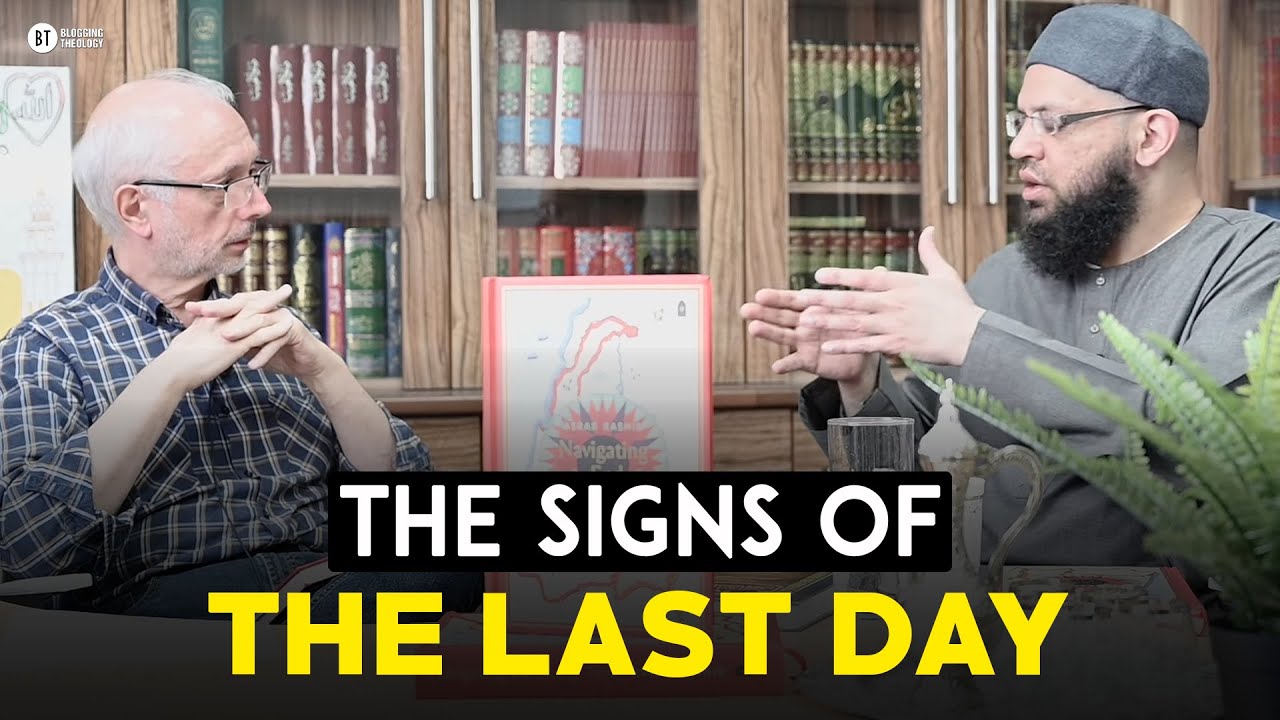
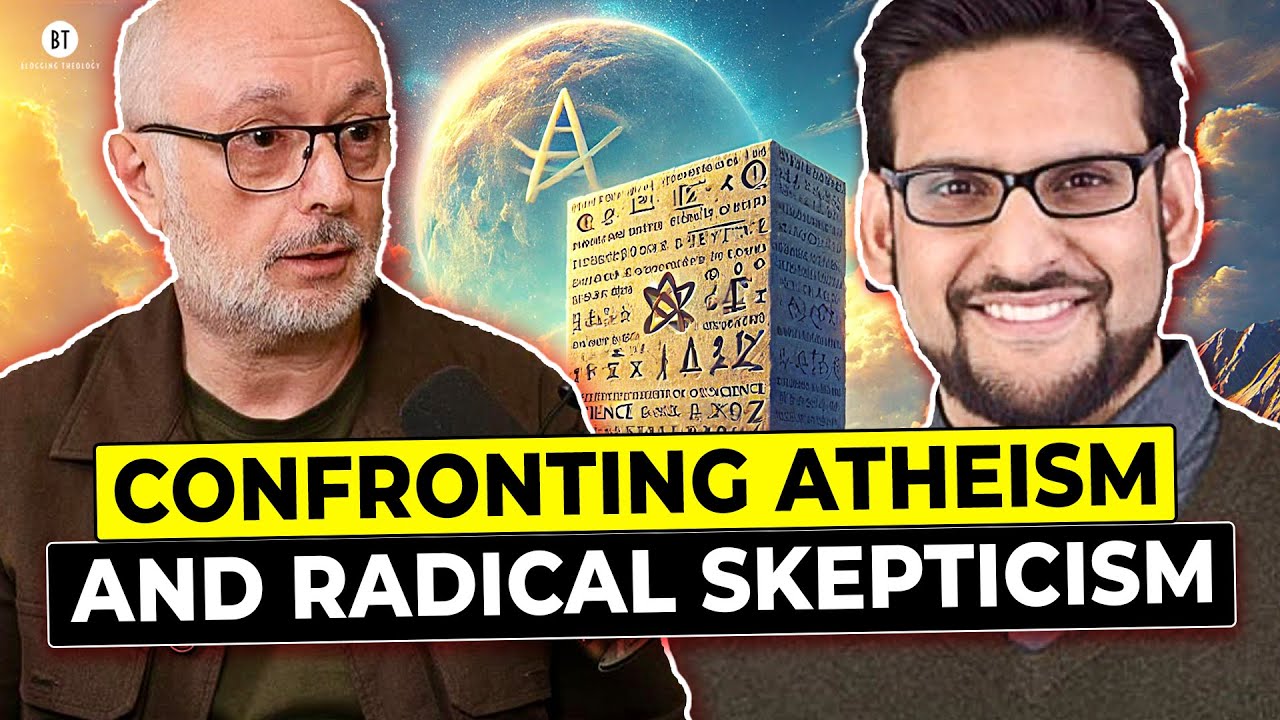
So hello everyone and welcome to Blogging Theology today I'm delighted to talk to Sheikh A zra Rasheed you are most welcome sir good to meet you right we're here in Birmingham in his uh amazing mosque it's a beautiful building Sheikh azra is a scholar Who currently lives here in Birmingham in the United Kingdom he began his studies here and later moving to Damascus to study he's a teacher of Islamic Studies but continues to pursue his knowledge on Islamic Aqeeda and other contemporary issues he's the author of a very well researched and well written book called
this is it Islam answers atheism there you are I do recommend it and he's kindly agreed to discuss themes arising from this book today so Sheikh can I first ask you why did you feel the need to write this book so through multiple engagements with young Muslims within the university campuses and the massage youth across the UK many questions were presented to me doubts regarding Islam debts regarding the Quran that regarding the ahadis of the Prophet sallallahu alaihi the character of the prophet sallallahu alaihi wasallam of course I would respond to these objections sometimes finding
a written response in classical literature sometimes not finding an adequate response the need to formulate a response and over time you can say in my mind the book was devised over a period of time right so the chapters as as they were divided they formulated in my mind how the arguments should be set up so even in a simple presentation someone would ask regarding the problem of evil right Eternal punishment in hell and at that time a decade ago there was not sufficient literature or sufficient media videos or responses from the Muslims with regard to
these things so over time the the book was formulated in my mind and then during the period of lockdown I found ah during the Kobe lockdowns and time sufficient time to simply just just jot down my thoughts so the book is a produce of my thoughts excellent It's a Long gestation period that then covered that covered lockdown period was a catalyst for many people including myself to to begin new projects but um recently I I looked on Google for the uh the top most common atheist arguments and I came across uh these six arguments which
for some people um are good reasons for rejecting faith and you discuss these in considerable detail in your book Islam answers atheism but perhaps we can discuss them now and the first Common objection I've come across is the simple statement that there is no evidence for God's existence and this is seen as a reason for atheism how would you respond to that same that claim would fall into a simple rejection of what we know as al-fitra which is the natural disposition of man if someone was on an airplane that was nose diving they would automatically
refer to a guard that they would say oh God and that entails that there is a natural disposition within All Creatures to what to what we know as robobia Robo beer is that there is someone who has created us and nurtures us at every point of our lives like your journey from London till now that Journey you may have done your necessary steps and but at the same time there is a spiritual aspect to every journey and that's just a simple Journey from London to Birmingham the Journey of life there's a human innate primordial innate
nature within us that tells us with regard to someone overlooking our affairs from childhood to growth in adulthood and to reject that is the very essence of kuffer because linguistically the word kuffer means to cover so the farmer he places a seed into the ground and covers the seed he's referred to as kafir yes and the Knight is referred to as Garfield because the night covers everything so kuffer in by Essence is the covering of our internal nature our have a natural state our fitra secondly the claim that there is no sufficient argument these arguments
you have the Kalam cosmological argument popularized now you have the teleological argument you have the design argument all these various arguments you have the counter arguments what I would say is that the counter arguments have not sufficiently demolished any single valid argument so the the point being that if the arguments have not been sufficiently dismantled a cumulative argument is all of these arguments when you look at them combined would lead to absolute certainty right and that's just in terms of rational thinking so for instance the column cosmological argument has not been sufficiently refuted to the
point that they can say they they've demolished the argument and demonstrated its invalidity that the argument is totally invalid the argument still stands if you add to that the teleological argument the design argument and various other arguments all of these arguments combined would lead to absolute certainty and then you have the the barometer of Richard Dawkins the seven levels of certainty that there is no God he says even he is not on a level seven absolute certainty so he's not absolutely so he has no absolute certainty so he can't prove it with that kind of
uh absolute certainty but you mentioned the clown cosmological argument of course even prominent Christian philosophers in the west like Professor William Lane Craig have been uh the most populous kind of exponent of this in the west but are you ever just to tell us briefly what the Kalam cosmological actually is without going past into all these so the the cosmological argument is simply demonstrating the non-regression of those things which we refer to as are anything that comes into existence after non-existence anything which has an accidental nature you cannot have a continuous regress of anything which
is contingent by Nature right so you reach a point where the cause of everything contingent must be self-sufficient so the cause everything in in the universe is is contingent it's not necessary it's not Eternal because everything that came to be must have a cause is that right everything Nature by observation right everything in the universe is contingent accidental right came into existence they attempt to counter this argument by saying you only observe an aspect of the universe how do you know the rest of the universe is not Eternal which is absurd because I mentioned in
the book also in order to simplify this the universe is either still or moving and both of these are very uh are the very nature of contingent things to be still or to move something Eternal is not described as being moving or being still at the same time or paradoxically both at the same time it cannot be it cannot be moving cannot be still because Stillness and movement is the very nature of contingent things those things which are contained by a void or time and Direction and spatial location anything which is in spatial location contained
by six directions right it cannot be Eternal now but why can't it be Turner why can't you have an infinite regress so you have uh one contingent thing caused by another contingent thing caused by another infinite uh contingent thing add infinitum but you've said that's not possible so why is an infinite regress as it's sometimes called not coherent why is it logically impossible in your view because you could just have an eternal Universe without a cause an ultimate cause perhaps because essentially anything which is a contingent in nature would have to go out of existence
right and that which sustains those things which go out of existence needs to have self-sufficiency if it's not self-sufficient then those things that it produces will go out of existence and the sustainability is totally impossible to sustain such a uh continuous chain would be totally impossible and that's what the Quran cosmological argument demonstrates that the continuation of so Craig he gives examples of an eternal library that he gives a mental uh thought experience thought experience and he demonstrates through thought experiments that it's impossible to have it you can reframe or restructure this argument in many
ways so I've given the seven principles if you remember in the chapter on the third chapter in the book yeah there is the seven principles that uh something Eternal cannot have Contin a contingent nature by Essence because every thing has something additional to itself so you can never conceive of something without an attribute so if I told you to conceive mentally something without an attribute you cannot so if you thought of let's say a Hollow Circle The Hollow Circle still has an attribute of being a circle yeah of being hollow similarly a rock with no
attribute it still will have an attribute so everything has something additional to itself which is contingent and accidental now if it has something additional to itself that additional thing is contingent by Nature if you if you think of it like this and then that contingent nature is non-transferable so you cannot say the circleness of a circle will transfer itself to a square and make the square circle so it's non-transferable and therefore it's essential to that thing and being essential to that thing would entail and by the way they refer to this the atheists when I
debate them they refer to this as mental gymnastics so they say all these mental gymnastics is unnecessary so if we avoid all these mental gymnastics they say by default my position is what is skepticism by default the claim is that the counterclaim to all of these arguments is that the the default state of someone is skepticism so skepticism is the Natural State this is what they claim which is all because it's not it's not obvious to me that skepticism is the default Natural State what why should skepticism be that I'll give you mentioned the fitra
the natural state is the disposition to believe in God and Transcendence and so on all all ancient civilizations Amazonian people and others they all demonstrate that the natural state of man is to believe in a Transcendent God if they like using the word there was a survey done recently at Oxford I seem to remember where the researchers looked at a whole range of different contemporary cultures including very secular cultures like Japan and South Korea and so on and they found that children very young children everywhere had this instinctive belief regardless of how they were brought
up whether they brought up in a secular home or religious home they all they all they all witness to this belief so that this seems to be empirical evidence that is actually an innate disposition and not instilled in children by the society or the upbringing or their parents it's not it's just part of the DNA if you like I don't mean literally DNA I don't know but the the metaphorical DNA of our species we are believing creatures as you say so what they attempt to do now is by dismissing these arguments what they do is
they dismiss all these arguments and they go on to the different position which is uh skepticism is the default position and you need to demonstrate to me that God exists now the problem with this is that it's subjective because you will meet atheists if you say to them if God wrote on in the sky that I God exists through stars for you would you believe they say no it could be a figment of imagination so now convincing a specific individual is subjective to that individual it's a denial of objective truth what in Islamic Kalam they
referred to as nafsulam a real objective reality meaning that which exists so it's claiming skepticism is the natural default step the default state is is a way of avoiding the entire argument so you can present all these arguments and the counter-attack will be uh will be incapable of rendering those arguments uh as faulty but at the same time they will say I'm a skeptic you need to present one evidence that will convince me I often find the atheists are very skeptical very selective in this in their epistemological skepticism so they'll direct their skepticism to towards
God on this question but on other fundamental um a priori beliefs I believe we have prior to experiencing reality like the even existence of the world for example or the existence of other Minds independent of our own minds um they're not skeptical they just take this as given even though it's very difficult to prove that the external World exists other than just pointing at it because it could be an illusion it might just be a product of our own mind how do you prove that it exists separate from just pointing at it and if they
were to employ this skepticism to other cognitive faculties they have and other epistemologies they wouldn't be able to do science they wouldn't be able to go about their daily lives so I think their skepticism is very limited is very selective and focused on one particular thing but in other areas they just trust that reality is that it is they trust that that the universe is ordered they trust that other Minds exist they trust they trust their trust what they do is ad hoc they redesign their arguments every time they encounter something that can violate their
preconceptions so for instance if you remember when I mentioned the underlying materialistic philosophies that underlie new atheism so there was a utilitarianism it's there but the new 80s wouldn't know where to start with utilitarianism where it begins and where it ends selectively choosing different aspects of a philosophy so we as Muslims would be described as realists we believe in so the the Muslim theologians the realities of things are established so we don't fall into the Greek uh you know the the the Greek Skeptics the various schools that they had they had so many different schools
that some of them denied reality material reality that's where it came from ancient Greeks it's not all of them of course I don't think Plato is a skeptic but there were skeptic uh philosophers there in the west I think that's where the the virus if you like began in ancient Greek philosophy too and passed down to David Hume who are going to quote in a minute actually and so you know this is not a it's a peculi western virus I think that goes back to the ancient Greeks yeah very strange the ancient Greek school is
covered in classical Islamic theology where they refute all these various Greek philosophers and the types of schools I've listed those types of schools in chapter three right good but we have to read that to find out more so the next um uh claim made by atheists in my uh six arguments uh which I came across why some people uh think there are good reasons for rejecting faith is this if God created the universe who created God um and on my own Twitter feed I've got atheist who says if God created the universe who created God
then me says if a baker begged a cake then who baked the baker it's kind of a very quick repost but but the questions often asked you know okay God created the universe so who made God and I think there's a a straightforward answer that but what have you said about it classically speaking they respond to that by mentioning the impossibility of what is known as the salsa which is continuous regress so the continuous regress of contingent things is they demonstrate its impossibility and that demonstration is done through thought experiments where they mention various examples
of why a regress of contingents is impossible and therefore it must stop at a point where someone's self-sufficient has closed the chain of events and that's someone self-sufficient must be ascribed with X Y and Z attributes like omniscience and neptuns and all these other attributes secondly the this type of questioning falls into the the fallacies which you will be surprised tend to convince some people one of those fallacies is got capable of creating a boulder so huge that he himself cannot lift the boulder which in itself is uh is a the question is uh what
we refer to as tanakud an internal contradiction in essence the questioner is asking can God make himself powerless can he remove his omnipotence and be unable to lift the boulder that he has created which is absurd it's an absurdity yeah this is like asking the question can you write can you write with the sword the answer is the function of a sword is different to the function of a pen so when you refer to the cause of the universe the cause of the universe must be Eternal self-subsistence in the first place right to claim that
that Eternal self-subsistent cause has a cause is a contradicting question and you just left with the the further question of who created that cause and you haven't really come to the end of it meaning it's a fallacy and then it's a fallacy as you know that we go into the uh the question of the uh the universe when if we say the universe is caused and they say how do you know another Universe Mega Universe they don't create the current Universe you just go back one step into the same question yeah and surprisingly this these
fallacious type of arguments are convincing people um wow okay well the next uh um claim I think is probably the most um common uh I've come across anyway and um there are various ways of putting it so I'll read a quote also from David Hume here um a God who allows so much suffering and death can be nothing but evil this is the claim in other words if God exists and he created the world why would he allow uh so much evil to happen and in his famous book dialogues concerning natural religion published in 1779
David Hume the famous Scottish Enlightenment philosopher he says and I quote epicurus's Old questions are yet unanswered is God willing to prevent evil but not able then he is on impotent is he able but not willing then he is malevolent is he both able and willing whence then is evil unquote so this is a very old when they tend to quote David you if you know from the book itself it's actually a play and that's actually one of the characters a dialogue isn't it yeah whoever the characters are yeah it's actually a dialogue so it's
potentially it's not even the position of human potentially it's it's a character within because the counter response is also given and if you remember in the dialogues one of the characters I think the TST walks out the library in Midway he walks out and then the other two continue their discussion so the question here again the very definition of evil what is evil evil is subjective for a snake the poison in the snake is not evil but for the victim that poison is evil so for the snake the poison is good a one-way street is
bad for the drivers but good for the government so it's subjective and similarly another definition of evil would be what we say which means doing taking things from the property of someone else but if we all belong to Allah then how can there be any evil meaning he takes your life he takes my life right it's it's not an evil being described to Allah similarly if Allah decides to place everyone in Hellfire despite the obedience it cannot be described as being evil because he does what he will that's why the Quran says the do of
what he will so in Contra distinction to Christian theology when they say God is all good and what all good May entail in Islam we have what are the attributes of the Divine actions he can be ascribed with the Opposites so his the one who gives life but he is also al-mumit the one who gives death he is a Rahman but he is also can you translate man the merciful right the one who who punishes right so he can be ascribed with those opposites these are known as sifatula for all the Divine attributes of the
Divine the actions of Allah so that is from the actions of Allah he takes away life but then there is also wisdom in his Divine actions so the wisdom some people may not be able to Fathom the wisdom so they question the Divine actions but for instance if we had no imperfections in our lives and the world was a perfect place at the time of death we would not want to leave this world we would find it difficult to leave because we're leaving a perfect world but when we have interactions with other human beings or
with the world and the life that we live that are distasteful we realize this world is temporary so when we leave Death Becomes easy for us that's just one wisdom but there are multiple wisdoms of Allah like the earthquake that happened in Turkey recently for the children it's a mercy they go back to their lord for The Sinner it's a punishment because he's punished for his sins so the wisdom of Allah is so Diversified that you the human mind can account for some of that wisdom or reach a conclusion with regard to some of that
wisdom and then also within this objection is the claim of free will the human free will or was it with regard to the action of Allah that he is able to stop people from right prevent people from and if he doesn't then he's either impotent or he's evil or something yeah so the response to that would be the full picture right the full pictures will be displayed on the day of judgment right I think it happens is also sometimes says we've got the pixel but we don't have the whole the whole movies no he's only
got a part of the story we don't know the whole holistic realities yes we can't see the Unseen and the uh there's some amazing passages in the Quran that talk about and sometimes Allah brings out the wisdom but for the look for the creation to see and witness I think that this problem mostly is a bigger problem far more bigger problem for Christians now I'm not saying this to be a poem a caller this is just my honest experience I remember the Archbishop of Canterbury um Justin worby been asked about this kind of issue uh
several years ago and and you know he's a very learned man he's a caring man and so on but he didn't have an answer and he said well we just don't know I mean that was that was all he said um and you know you talk about many strands of wisdom in the Islamic perspective and and this kind of uh but very comprehensive way of understanding it but it's largely missing from the Christian response and I think that's where humans coming from he he is if this does represent his view of course and it's Stephen
Fry also yes yes because for them death is just evil but in islammatician it's not because God creates death and this world is temporary and this life is a trial anyway it's not uh not meant to be a Bed of Roses where everything is and also the conception of God in Christianity often you just love he's just a loving God like a benign grandfather who just wants to give us sweets and nice things and blessings all the time that's completely unislamic and you said those there are different um attributes and names of Allah um and
you mentioned the rachman you mentioned the opposite and so on um and so it's a much more credible I think persuasive response and again I'm not saying that because I'm biased but I think it really is a mug what the question comes down to is what we refer to Asia to Allah the Muslim is the one who submits to Allah and recognizes his innate neediness to Allah right which is referred to as obodia rejection of that and covering that is kufar so questioning the the Divine actions the Divine will is the essence of kuffer yeah
but accepting the Divine will is the essence of belief gosh okay well that's fascinating thank you the next one number four is again this is a fascinating question but I think there are some responses Evolution it is claimed has answered the question of where we came from there is no need for ignorant ancient myths anymore I'm quoting here from a typical atheist website so um this is a very common objection I think based on a misunderstanding but could you perhaps address that about Evolution again the placing of evolution Theory as a demonstrable fact that can
never be refuted is false Evolution theory in our epistemology where would we place it would we place it in absolute certainty the answer is no it's a hypothesis that fulfills the explanation of a within a certain framework so adaptation and different aspects of evolution they are scientifically proven meaning observable but the Core Essence is as he refers to as a the creation myth would be the creation of Adam yeah that has not been disproven through any empirical science because as you would know every so often anthropologists or archaeologists when they find some Remains the entire
picture changes by a hundred thousand and two hundred thousand years so it's within our framework our Paradigm of placing knowledge where do we place this type of knowledge it would be it would not be absolute certainty it would it would not be near certainty it would be still in the in the middle area so some things will be deemed as factual provable observable but some things are still here in going through the theoretical stages and even Dawkins himself states that in a hundred years from now the darwinian evolution Theory would be totally unrecognizable meaning then
what would replace the current framework would be unrecognizable in 100 years why because of the advance of Science and that's how science works yeah science undergoes Paradigm shifts yes when it reaches a cumulative uh or a a point of uh change meaning where it needs to shift I think it's a very important point because the the the assumption that we're at now in in our science in in the west however is the is the end of the story we now know it all is here it goes against all our understanding of the history of science
where we as you say we have Paradigm shifts as a expression invented by Thomas Kern the structure of scientific revolutions an amazing work written in the 1980s I think um so we know I've actually got a book at home written by uh professor of physics at King's College in London it was published in 1899 and in this book a very dusty old thick book he confidently asserts this professor of physics that we now know all there is to know about physics this is 1899 but in 1907 a certain man called Einstein came along um there's
a patents clerk in Switzerland and revolutionized a whole of physics introducing general theory relativity and so on so this confidence assertion of this king's college professor was completely mistaken um and the lesson there we need to learn is that this is always changing and so you're quite ironically from you're agreeing um with um the the atheist uh scientist uh earlier um who um said that the future understanding of evolution quantum gravity can be completely different quantum gravity and the research on quantum gravity may even replace relativity now right meaning physicists will know that the new
research being done and yeah what will replace Einstein's relativity so the Quran cannot be reinterpreted in accordance with whatever new discoveries are being made the Quran in our Kalam epistemology we simply designate a place for the the knowledge where does that knowledge fall into is it absolute certainty right if it's absolute certainty it will never disagree with the Quran right the Quran doesn't clash with empirical fact but it isn't the case that we need to know where there is a problem potentially where there isn't so the Quran I may be wrong so correct me if
I I'm wrong doesn't speak to the issue of the evolution or non-evolution of animal species so would that be a big case of it doesn't really that's often no theological significance but it does speak directly as you've already alluded to to the special creation of this original human pair Adam and Eve as we say in English so there are some things that are not an issue whether or not they're true they may or may not be true so Evolution for animal species but there is a red line or ring fence around some things specifically individually
created yeah but we as Muslim theologians would say it's a challenge for scientists to disprove that which they have not lived up to and they will never be able to live up to why because our claim is that the Quran empirical facts that are stated in the Quran categorically meaning they can never be disproven scientifically and the word scientifically what I mean by that is empirically uh factual not theoretically that they fall into so a model may work for a certain criteria it May evolution Works in certain aspects of medicine right Evolution Works in certain
fields of science but then the application of evolution in everything from how uh Communists after the Bolshevik Revolution misused uh The darwinian evolutionary theory how they applied that even to political science had they applied that to our mousey tongue may have applied darwinian Evolution to politics and the Nazis of course uh developed this idea of social Darwinism yes in terms of the the struggle between you know human races and the extermination of some races yes so it can be weaponized even even by the nuts yes and This falls into the deeming science as where science
is now governing humankind and humankind is not governing science the the machine the the construction of a machine that governs humans and humans do not govern science that's the distinction between and I would like to mention Richard Dawkins saying oh the Muslims they do not even have uh they may have one person who has won the uh the uh Nobel Prize the Nobel Peace Prize which is a contradiction Nobel Peace Prize for a man who created dynamite yeah but he was trying to write down for his uh sins by creating a Peace Prize yes yeah
yeah so um as if to say our progress is determined by a creation of a western scientist meaning he will determine for us how intellectually Advanced we are meaning how many Nobel Peace prizes we've been it determines how intellectually Advanced we are when in reality Islam is not a result have our intellectual Endeavors Islam is a revelation it guides us ethically with regard to science how to look at the world post 1945 the the development of nuclear weapons and the the Manhattan Project and how scientists created the nuclear weapons and Einstein was involved in that
even though he may have regretted that after a post 1945 you have uh the world more uh as a machine the world is governed as a machine because of scientists not because of religion so it's a blessing that the caliphate was abolished it's a blessing in disguise it was abolished because we have a world now that has agent orange and Napalm and so many disgusting uh horrific weapons that are utilizing civilian populations all of this the produce of science unguided science unethical science so we will get our ethics from gosh okay let's open a can
of worms okay um the the uh the next question um I think is the most interesting uh not question the the uh the reason some people think uh there are good reasons rejecting faith in one online thread that I read recently the question was posed what is the most convincing argument for atheism and how would you respond to it and someone replied and I quote I don't believe in God I don't have an argument I don't need an argument I don't believe in God end quote now I I've noticed some very intelligent people indeed who
have said exactly that to me in the past that they've not offered any arguments they simply refuse to offer any justifications they said for them God just doesn't exist it's not an issue for them they don't need arguments they claim it just doesn't exist and and this is their reason for atheism and um that that for me is the most curious thing because it means you don't have to in any way give a rational justification for your worldview so it's controversial but how would you respond to that because this goes back to what I mentioned
initially the default state of being a skeptic but also a psychological disorder so so many former Muslims people who become murta they leave the fold of Islam they tend to have emotional issues so right the the multi in the mosque may have beaten them with a stick while they were learning the Quran so they associate that with Islam some people may come from a misogynistic background women who are badly treated by their husbands or their parents and then they associate that with Islam so many of the former Muslims and atheists may have actually emotional deep
emotional issues Sigmund Freud and others may have something to say about that but even though himself but at the same time I would say with regard to this Islam is very simple Islam is presented to people if it does not convince them there is no compulsion in religion if it didn't if we can translate the word adina's religion the religion means to bind people a Deen there is no compulsion in the Deen meaning Islam so like rafiddin there is no argument with such people where the response is given is with regard to what is known
as aggressive new atheism right belligerent new atheism an atheism that has an aggressive approach and uses fallacious arguments against Muslims even against Christians and other peoples of other faiths but mainly against Muslims misconstruing so many basic things of Islam in order to demonstrate to new to new Muslims or to Western Muslims and others as well those who are affected by globalization so now we live in a globalized village people affected by these types of thoughts presenting to them doubts so our response is given to them but if someone just takes the default position I do
not accept God maybe over time they will overcome their emotional issues their psychological issues could you imagine if someone was on a plane that was uh careering down about to to hit the sea the chances are atheist or not they're going to call out despite what they've what I've just said because they're they're fitter will be activated then that extreme emergency they're not just going to sit back no I don't really believe they're gonna they're gonna grasp for anything that will save them from this just instinctively so that that would be a lie their own
claim I would argue um but but what I just wanted to share this and I shared this with you earlier so um there's a fascinating article in the London Times um and I just want to read to you a few extracts on this is a real eye-opener when it comes to atheists and what they actually believe because we've been speaking about the new atheist Richard Dawkins Sam Harris and others and these are hardcore materialists they don't believe in anything other than I don't know the alleged scientifically verifiable that's all they believe in was the scene
but most atheists according to this Times article believe in the Supernatural a study finds I kid you not and I'll read it to you uh so this is in the London Times most atheists and agnostics believe in Supernatural powers and that there are forces of Good and Evil quote unquote even though they do not necessarily believe in God according to a new study the understanding unbelief program led by the University of Kent here in England interviewed thousands of people who identified as atheists and agnostics in six countries Britain the United States Brazil China Denmark and
Japan it's quite a diverse Global array there the report defined atheists as people who quote don't believe in God and agnostics as people who quote don't know whether there is a God and I don't believe there is a way to find out unquote the researchers found that a minority of atheists and agnostics or unbelievers rejected all of the supernatural beliefs which were put to them it found that the majority of people who did not have faith still believed in at least one aspect of the supernatural such as life after death reincarnation or astrology they also
sometimes believe that some events were meant to be and that they that there were forces of Good and Evil almost a third of atheists and around 40 percent of agnostics believe in underlying forces of Good and Evil compared with sixty percent of the general population in total and and this is extraordinary given Sam Harris and all these other atheists 71 of atheists and 92 percent of agnostics held at least one Supernatural belief now a guy calls Lois Lee he's the senior research fellow at the University of Kent's Department of religious studies he said these findings
show once and for all that the public image of the atheist is a simplification at best and a gross caricature at worst end quote and just a very last sentence in the Times article twenty percent of atheists believe in life after death compared to 55 of the general population now what that tells me is that uh when we look at Richard Dawkins and we see his worldview as representing atheism he's not actually representing his constituency of atheists globally because most do believe in supernatural beings but he does say that atheists are like hurting atheists is
like herding wild cats because each atheist has his own point of view yeah but Richard Dawkins um you have the lights of Richard Anthony flew oh yes he's not an atheist who became a beast towards the end that's right if you look at their rhetoric prior with Anthony flu prior to changing his position with regard to Islam right it's more of a cultural baggage that they have so where I quote Richard Dawkins saying he he prefers the church bells to the other yeah a cultural Christian meaning he finds the the Azan reprehensible he doesn't use
that word but distasteful he finds it yeah and Anthony flu refers to Allah has a cosmetic Cosmic Saddam Hussein or he refers to uh Islam as a Marxist an Arab Marxism or an Arab way of colonizing other peoples This Is How They view this love and then when you observe former Muslims the main issue they have with Islam I believe is not the theology with regard to God because if you look at Allah you look at the names and attributes of Allah it's something something that a person can accept wholeheartedly there's no objection there's no
real objection the Divine attributes when you list the Divine attribute his existence is opposition to the contingent his self-subsistency his Oneness the Oneness of Allah is being all-knowing all seeing all these things the main problem they have is Sharia law right because it constrains you as a human so if if someone is living a hedonistic lifestyle a free lifestyle and if they they believe and also they make the mistake of thinking Islam is like Christianity whereas sin takes you out of the fold of Islam so you can be a Muslim but sinful no yeah but
so so many people are under the impression if I become a Muslim uh I well they are obliged to do the following but if they don't they're just sinful they still will not face it Eternal damnation if they drink if they do adultery if they do all the major sins in Islam they will they will still save themselves from Eternal damnation even eventually eventually because Eternal damnation and this is something else because one of the objections is why would God a merciful God punish people eternally the answer is if you look at the punishments in
Hell Eternal punishment is based upon intention Eternal punishment like Christopher Hitchens when he says if I die and I meet God I still and I see God I will not believe in him christovation said that similarly Stephen Fry when he says when he's asked by the interviewer if you if you are brought to the Pearly Gates of Heaven he says I will still demonstrate against God and you know chastise God chastise God for all these people so these people they really those type of atheists despise Allah for being Allah but there are so many people
who fall into atheism because of the restrictions of sharia law and that in itself is something that they need to realize that the restrictions of sharia law are there for your own benefit meaning the prohibition of alcohol we don't drink alcohol because if we became drunk we would become like animals yeah yeah as a cause of numerous diseases in the world uh and I'm sure if it was invented today alcohol it would be uh banned as a Class A drug along with all the other things but because it's been around a long time it's allowed
to continue well the government benefits from the high taxes so this is true like cigarettes also yeah yeah okay the very last uh reason given what some people uh believe for uh for rejecting faith is um again got quite quite a common one um and it's not really an argument for atheism it's slightly different but now those atheists always say there are so many religions and so many different gods why does Islam think it's the only true religion all religions make this claim so it's a kind of skeptical view about all religions making identical claims
therefore we can't believe in any of them they can't see each other out perhaps and that's why we don't believe I suppose well if you if you list all the religions Buddhism it doesn't have a god no Hinduism does it really have a God the answer is no Hinduism is paganism that was scattered across India and then post British Raj they became an organized religion right otherwise in the north of India you have different gods worship to the south of India right you have you know Kalima and all these various Gods who oppose one another
so that really cancels out those two then you have Judaism Christianity and Islam right we won't count Sikhism because Sikhism is a later development from Hinduism and Islam and the The Clash with Islam Judaism would be discounted because it has become a racial religion so even if someone adopted Judaism they will always remain a second class Jew because it's a racial religion so it leaves only the two religions but in terms of Judaism the concept of God or how they believe in God very similar to Islam very similar yes yeah so those two agree on
that yeah but then Christianity is man Worship in essence literally I think in the case of Jesus yes so that cancels out Christianity because man worship is illogical so it only gives Islam and Judaism it's also idolatry because you're worshiping a Christian rather than God yeah yes so it only leaves Islam right and Judaism and between Judaism and Islam Islam is a preservation of the true Message of Islam from the time of before but also Judaism doesn't claim to be a universal religion it's the religion of the people of Israel food for Jews whereas Islam
does claim you know the prophet Muhammad upon Him BP said I've been sent as a mercy to all the worlds in other words it's not limited to a nation or a tribe or a people but for everything and Judaism is a development of post suleimanal Islam so after the kingdom of suleimanal Islam one of the tribes of the 12th Judah the tribe of Judah and with the the tribe the tribe of Aaron they established a judaic religion right which is not the teachings of Moses no it's not so the current Jewish religion we have it's
not the actual teachings of Musa right right so it only leaves Islam right by a process of elimination yeah okay well that that's uh all the questions uh I have we could go on for hours but that's probably enough I I do I do recommend uh this excellent book it does cover so much more than we could possibly cover um you mentioned the Sharia very briefly you talk in the last chapter chapter six of the preservation of the Quran uh you talk about Sharia Lord you had slavery corporal punishment capital punishment for apostates you've got
a sectional homosexuality in Islam the marriage of Lady Aisha polygamy the hijab um uh women inheritance laws wife beating quote unquote women's intellect and Leadership and a great deal more so this is more than just um a rebuttal of atheism you're tackling the kind of objections that most not most people that many people uh would have in the west are based on well you would say I'm sure is misunderstandings about Islam itself so it's a very comprehensive book um and it's actually very well written and quite readable so I I wouldn't normally recommend books unless
they were readable unless it could be really boring but this one is readable so I do recommend that inshallah and thank you very much indeed sheikh for your time it's been an absolute pleasure thank you very much until next time thank you.