Hello and welcome to the video on the questions of the "Living in Germany" test. 1. In Germany, people are allowed to say something openly against the government because... a) freedom of religion applies here. b) people pay taxes. c) people have the right to vote. d) freedom of expression applies here. freedom of expression applies here. 2. In Germany, parents up to the age of 14 can decide whether their child should take part in ... a) history lessons at school . b) participates in religious education. c) participates in political classes. d) participates in language classes. taking part
in religious education. 3. Germany is a constitutional state. What do you mean with that? A) All residents and the state must obey the law. b) The state does not have to obey the law. c) Only Germans have to obey the law. The courts make the laws. All residents and the state must obey the law. 4. Which right is one of the fundamental rights in Germany? a) Owning a gun b) Right of thumb c) Freedom of expression d) Vigilante justice Freedom of expression 5. Elections in Germany are free. What does that mean? a) You may accept
money if you choose a specific candidate for it. b) The voter may not be influenced during the election, nor Be forced to cast a particular vote, and may not suffer any disadvantages as a result of the election. c) Only people who have never been in prison may vote. d) All persons entitled to vote must vote. The voter may not be influenced during the election, nor forced to cast a particular vote, and may not suffer any disadvantages as a result of the election. 6. What is the name of the German constitution? a) People's law b) Federal
law c) German law d) Basic law Basic law 7. Which of the fundamental rights are guaranteed by the German constitution? The right to... a) freedom of belief and conscience b) entertainment C) work d) housing freedom of belief and conscience 8. What is not included in Germany's Basic Law? a) Human dignity is inviolable. b) Everyone should have the same amount of money. c) Everyone is allowed to express their opinion. d) All are equal before the law. Everyone should have the same amount of money. 9. Which basic right only applies to foreigners in Germany? The basic right
to ... a) Protection of the family b) Human dignity c) Asylum d) Freedom of opinion Asylum 10. What is compatible with the German Basic Law? a) caning b) torture C) death penalty d) fine fine 11. What is the constitution of the Federal Republic of Germany called? a) Basic Law b) Federal Constitution c) Code of Laws d) Constitutional Treaty Basic Law 12. A party in the German Bundestag wants to abolish freedom of the press. Is this possible? a) Yes, if more than half of the members of the Bundestag are in favor of it. b) Yes, but
two-thirds of the members of the Bundestag must be in favor of this. c) No, because freedom of the press is a fundamental right. It cannot be abolished. d) No, because only the Federal Council can abolish freedom of the press. No, because freedom of the press is a fundamental right. It cannot be abolished. 13. In Parliament, the term "opposition" means... a) the ruling parties. b) All MPs not belonging to the governing party/parties. c) the group with the most MEPs. d) all parties that were able to reach the 5% hurdle in the last election. All MEPs not
belonging to the governing party/parties. 14. Freedom of opinion in Germany means that I... a) may claim false facts on leaflets. b) can express my opinion in letters to the editor. c) may wear Nazi symbols. d) Speak my mind as long as I don't contradict the government. can express my opinions in letters. 15. What does the German Basic Law prohibit? a) military service b) forced labor c) free choice of occupation d) work abroad forced labor 16. When is freedom of expression restricted in Germany? a) when publicly disseminating false allegations about individuals b ) when expressing opinions
about the Federal Government c ) when discussing religions d) when criticizing the state when publicly disseminating false allegations about individuals residents. B) Citizens' petitions. c) Freedom of assembly for residents. d) Unequal treatment of citizens by the state. Unequal treatment of citizens by the state. 18. What basic right is guaranteed in Article 1 of the Basic Law of the Federal Republic of Germany? a) the inviolability of human dignity b) the right to life c) freedom of religion d) freedom of opinion the inviolability of human dignity 19. What is meant by the right to “freedom of movement”
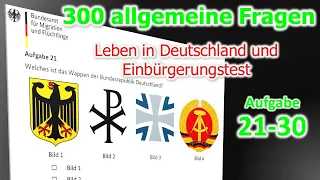
in Germany? a) You can choose your own place of residence. B) You can change your job. c) You can choose another religion. d) One may move in public only lightly clothed. You can choose your own place of residence. 20. A party in Germany aims to establish a dictatorship. She is then … a) tolerant. b) based on the rule of law. c) law-abiding. d) unconstitutional. unconstitutional 21 What is the coat of arms of the Federal Republic of Germany? 1 2 3 or 4 1 22. What kind of government does Germany have? Monarchy Dictatorship Republic Principality Republic
23. In Germany, most employees are … employed by a company or authority. employed in small family businesses. Volunteer for a state. self-employed with his own company. employed by a company or organization. 24. How many federal states does the Federal Republic of Germany have? 14, 15, 16, 17 16 25. Which is not a federal state of the Federal Republic of Germany? North Rhine-Westphalia Alsace-Lorraine Mecklenburg-West Pomerania Saxony-Anhalt Alsace-Lorraine 26. Germany is … a communist republic. a democratic and social federal state. a capitalist and social monarchy. a social and socialist federal state. a democratic and social federal state.
27. Germany is … a socialist state. a Federal State. a dictatorship. a monarchy. a Federal State. 28. Who elects the members of the Bundestag in Germany? The military the economy the people with the right to vote the administration the people with the right to vote 29. Which animal is the heraldic animal of the Federal Republic of Germany? lion eagle bear horse eagle 30. What is not a feature of our democracy? regular elections press censorship freedom of speech various parties press censorship 31. In Germany, the cooperation of parties to form a government is called … Unity.
Coalition. ministry. Fraction. Coalition 32. What is not state violence in Germany? Legislation Government Press Jurisprudence Press 33. Which statement is correct? In Germany ... the state and religious communities are separated from each other. the religious communities form the state. the state is dependent on the religious communities. state and religious communities form a unit. State and religious communities are separated. 34. What is Germany not? a democracy a constitutional state a monarchy a welfare state a monarchy 35. How does the German state finance social security? Church taxes Social security contributions Donations Club contributions Social security contributions 36.
Which measures create social security in Germany? health insurance car insurance building insurance liability insurance Health insurance 37. What is the name of the heads of government in most federal states in Germany? First Minister Prime Minister Senator Prime Minister Prime Minister 38. The Federal Republic of Germany is a democratic and social ... association of states. state. confederation. central state. Federal state 39. What does each German federal state have? its own foreign minister its own currency its own army its own government Its own government 40. What words does the German national anthem begin with? Peoples, hear the
signals... Unity and justice and freedom... Joy beautiful sparks of the gods... Germany united fatherland... Unity and justice and freedom... 41. Why is there more than one party in a democracy? because this represents the different opinions of the citizens so that bribery in politics is limited to prevent political demonstrations to stimulate economic competition because this represents the different opinions of the citizens 42. Who decides a new law in Germany? The government parliament the courts the police parliament 43. When can a party be banned in Germany? if their election campaign is too expensive if they fight against
the constitution if they express criticism of the head of state if their program proposes a new direction if they fight against the constitution 44. Who as a citizen in Germany cannot be directly elected? Members of the EU Parliament the Federal President Members of the Landtag Members of the Bundestag the Federal President 45. Which insurance company does long-term care insurance belong to? Social insurance Accident insurance Household insurance Liability and fire insurance Social insurance 46. The German state has many tasks. What task does it include? He builds streets and schools. He sells groceries and clothes. It provides
all residents with newspapers free of charge. He produces cars and buses. He builds streets and schools. 47. The German state has many tasks. Which task is not included? He pays for vacation trips for all nationals. He pays child support. He supports museums. He encourages athletes. He pays for vacation trips for all nationals. 48. Which organ does not belong to the constitutional organs of Germany? the Bundesrat the Federal President the citizens' assembly the government the citizens' assembly 49. Who determines school policy in Germany? the teachers the federal states the family ministry the universities the federal states
50. The economic system in Germany is called … free central economy. social market economy. controlled central economy. planned economy. social market economy. 51. It is not part of a democratic constitutional state that ... people can express themselves critically about the government. Citizens are allowed to demonstrate peacefully. People being arrested by a private police without reason. someone commits a crime and is arrested as a result. People being arrested by a private police without reason. 52. What does "popular sovereignty" mean? All state power emanates from the … people. Bundestag out. Prussian king. Federal Constitutional Court. people out.
53. What does "rule of law" mean in Germany? The state is right. There are only right parties. Citizens make laws. The State must respect the laws. The State must respect the laws. 54. What is not state violence in Germany? Legislative Judicial Executive Directive Directive 55. What does this picture show? the seat of the Bundestag in Berlin and the Federal Constitutional Court in Karlsruhe the Bundesrat building in Berlin the Federal Chancellery in Berlin the seat of the Bundestag in Berlin 56. Which office is part of the municipal administration in Germany? Parish Office Regulatory Office Tax Office
Foreign Office Regulatory Office 57. Who is usually elected President of the German Bundestag? the oldest member of parliament the prime minister of the largest federal state a member of the largest parliamentary group a former chancellor a member of the largest parliamentary group 58. Who appoints the ministers of the federal government in Germany? the President of the Federal Constitutional Court the Federal President the President of the Bundesrat the President of the Bundestag the Federal President 59. Which parties in Germany became the party “Die Linke” in 2007? CDU and SSW PDS and WASG CSU and FDP Bündnis
90/Die Grünen and SPD PDS and WASG 60. In Germany, the Bundestag and the Bundesrat belong to the … executive. Legislative branch. Directive. judiciary. Legislative 61. What does “popular sovereignty” mean? a. The king rules over the people. b. The Federal Constitutional Court is above the constitution. c. The interest groups exercise sovereignty together with the government. i.e. State power emanates from the people. i.e. State power emanates from the people. 62. When the parliament of a German federal state is elected, it is called... a. local election. b. state election. c. European election. i.e. federal election. b. State election
63. What does not belong to the executive in Germany? a. the police b. the courts c. the tax office d. the ministries b. the courts 64. Today, the Federal Republic of Germany is divided into … a. four occupation zones. b. an eastern state and a western state. c. 16 cantons. i.e. Federal, state and local governments. i.e. Federal, state and local governments. 65. It is not one of the tasks of the German Bundestag to … a. drafting laws. b. control the federal government. c. to elect the chancellor. i.e. to form the Cabinet. i.e. to form the
Cabinet. 66. Who wrote the lyrics to the German national anthem? a. Friedrich von Schiller b. Clemens Brentano c. Johann Wolfgang von Goethe the Elder Heinrich Hoffmann von Fallersleben the Elder Heinrich Hoffmann von Fallersleben 67. What is the primary task of the federal states in Germany? a. defense policy b. foreign policy c. economic policy d. school policy d. School policy 68. Why does the state control the school system in Germany? a. because there are only state schools in Germany b. because all students must have a school-leaving certificate c. because there are different schools in the federal
states d. because it is his task according to the Basic Law d. because it is his task under the Basic Law 69. The Federal Republic of Germany has a three-tier administrative structure. What is the name of the lowest political level? a. councilors b. district administrators c. Municipalities and municipalities d. district offices c. Municipalities and local authorities 70. In 1974, the German Federal President Gustav Heinemann gave Helmut Schmidt the certificate of appointment as German Federal Chancellor. What are the duties of the German Federal President? a. He/She runs the affairs of state. b. He/She controls the ruling
party. c. He/She selects the ministers. i.e. He / She proposes the chancellor for election. proposes the chancellor therein for election 71. Where does the German chancellor stay most often? Most commonly he/she is... a. in Bonn because the Federal Chancellery and the Bundestag are located there. b. in Berlin, because that is where the Federal Chancellery and the Bundestag are located. c. at Schloss Meseberg, the guest house of the federal government, to receive state guests. i.e. at Bellevue Palace, the official residence of the Federal President, to receive state guests. b. in Berlin, because that is where the
Federal Chancellery and the Bundestag are located. 72. What is the name of the current Chancellor of Germany? a. Gerhard Schroeder b. Jürgen Rüttgers C. Klaus Wowereit d. Olaf Scholz the Elder Olaf Scholz 73. The two largest parliamentary groups in the German Bundestag are currently called … a. CDU/CSU and SPD. b. The Left and Alliance 90/The Greens. c. FDP and SPD. i.e. The Left and FDP. a. CDU/CSU and SPD. 74. What is the name of the parliament for all of Germany? a. Federal Assembly b. People's Chamber c. Bundestag d. Federal Court of Justice c. Bundestag 75.
What is the name of Germany's current head of state? a. Frank-Walter Steinmeier b. Norbert Lammert c. Wolfgang Thierse The Younger Edmund Stoiber a. Frank-Walter Steinmeier 76. What does the abbreviation CDU mean in Germany? a. Christian German Union b. Club of German Entrepreneurs c. Christian German environmental protection d. Christian Democratic Union d. Christian Democratic Union 77. What is the Bundeswehr? a. the German police b. a German port c. a German citizens' initiative d. the German army d. the German army 78. What does the abbreviation SPD mean? a. Socialist Party of Germany b. Social Political Party of
Germany C. Social Democratic Party of Germany d. Socially Just Party of Germany c. Social Democratic Party of Germany 79. What does the abbreviation FDP mean in Germany? a. Peaceful Demonstrative Party b. Free Germany Party c. Leading Democratic Party d. Free Democratic Party d. Free Democratic Party 80. Which court in Germany is responsible for interpreting the Basic Law? a. Higher Regional Court b. district court c. Federal Constitutional Court d. administrative court c. Federal Constitutional Court 81. Who elects the Federal Chancellor in Germany? a) the Bundesrat B) the Federal Assembly c) the people d) the Bundestag d)
the Bundestag 82. Who heads the German Federal Cabinet? a) the President of the Bundestag b) the Federal President c) the Federal Chancellor d) the President of the Bundesrat c) the Federal Chancellor 83. Who elects the German Federal Chancellor? a) the people B) the Federal Assembly c) the Bundestag d) the Federal Government c) the Bundestag 84. What is the main task of the German Federal President? He/She... a) rules the country. b) drafts the laws. c) represents the country. d) monitors compliance with the law. c) represents the country. 85. Who makes up the German Bundesrat? A) Members
of the Bundestag b) Ministers of the Federal Government c) Government representatives of the federal states d) Party members c) Government representatives of the federal states 86. Who elects the Federal President in Germany? a) the Federal Assembly b) the Bundesrat c) the Federal Parliament d) the Federal Constitutional Court a) the Federal Assembly 87. Who is the head of state of the Federal Republic of Germany? A) the Federal Chancellor b) the Federal President c) the President of the Bundesrat d) the President of the Bundestag b) the President 88. The parliamentary opposition in the German Bundestag … a)
controls the government. b) decides who becomes Federal Minister. c) determines who sits in the Federal Council. d) proposes the heads of government of the countries. a) controls the government. 89. What do you call the association of members of a party in parliament in Germany? A) association b) council of elders c) faction d) opposition c) faction 90. The German federal states participate in federal legislation through ... a) the Bundesrat. b) the Federal Assembly. c) the Bundestag. d) the federal government. a) the Federal Council. 91. In Germany, a change of government In a federal state can have
an impact on federal policy. Governing becomes … a) more difficult if the majority in the Bundestag changes as a result. b) easier if this means that new parties enter the Bundesrat. c) more difficult if this changes the majority in the Bundesrat. d) easier if it is a rich federal state. c) more difficult if this changes the majority in the Bundesrat. 92. What does the abbreviation CSU mean in Germany? a) Christian Safe Union b) Christian South German Union c) Christian Social Entrepreneurs Association d) Christian Social Union d) Christian Social Union 93. The more “second votes” a
party gets in a federal election, the … a) more seats the party gets in parliament . b) it can have fewer first votes. c) more of the party's direct candidates enter parliament. d) the risk of having to form a coalition is greater. a) the party gets more seats in parliament. 94. From what age can one take part in elections to the German Bundestag in Germany? a) 16 b) 18 c) 21 d) 23 b) 18 95. What applies to most children in Germany? a) Compulsory voting b) Compulsory schooling C) Confidentiality d) Compulsory religion b) Compulsory schooling
96. What must every German citizen over the age of 16 possess? a) a passport b) an identity card c) a social security card d) a driver's license b) an identity card 97. What do you automatically pay in Germany if you have a permanent job? a) Social security b) Social assistance C) Child benefit d) Housing benefit a) Social security 98. If MPs in the German Bundestag change their parliamentary groups, ... a) the government can lose its majority. b) they may no longer take part in the sittings of Parliament. c) the Federal President must give his/her consent
beforehand. d) the voters of these deputies may vote again. a) the government may lose its majority. 99. Who pays for social security in Germany? a) Employers and employees B) Employees only c) All nationals d) Employers only a) Employers and employees 100. What does not belong to statutory social security? a) Statutory pension insurance b) Life insurance c) Unemployment insurance d) Long-term care insurance b) Life insurance 101. Trade unions are interest groups of ... a) young people. b) Employees. C) pensioners. d) Employers. b) Employees. 102. How can one be honored in the Federal Republic of Germany if
one has made a special contribution in the political, economic, cultural, intellectual or social field? With the ... a) federal eagle b) Federal Cross of Merit c) Patriotic Order of Merit d) honorary title "Hero of the German Democratic Republic" b) Federal Cross of Merit 103. What is referred to as a "traffic light coalition" in Germany? The cooperation ... a) the parliamentary groups of the CDU and CSU b) the SPD, FDP and Bündnis 90 / The Greens in one government c) the CSU, Die LINKE and Bündnis 90 / The Greens in one government d) the parliamentary groups
of the CDU and SPD b) SPD, FDP and Bündnis 90/Die Grünen in one government 104. A woman in Germany loses her job. What can not be the reason for this dismissal? a) The woman has been ill for a long time and is unable to work. b) The woman was often late for work. c) The woman does private things during working hours. d) The woman has a child and her boss knows it. d) The woman has a child and her boss knows it. 105. What is the task of election workers in Germany? a) You help old
people to vote in the voting booth. b) You write the voting notices before the election. c) They pass on interim results to the media. D) They count the votes after the end of the election. d) They count the votes after the end of the election. 106. In Germany, volunteer poll workers help with the elections. What is the task of election workers? a) They help children and old people to vote. b) You write cards and letters indicating the polling station. c) They pass on interim results to journalists. d) They count the votes after the end of
the election. d) They count the votes after the end of the election. 107. For how many years is the Bundestag elected in Germany? a) 2 years b) 4 years c) 6 years d) 8 years b) 4 years 108. Anyone who … a) lives in the Federal Republic of Germany and wishes to vote may vote in a Bundestag election in Germany . b) is a citizen of the Federal Republic of Germany and is at least 18 years old. C) has lived in the Federal Republic of Germany for at least 3 years. d) is a citizen of
the Federal Republic of Germany and is at least 21 years old. b) is a citizen of the Federal Republic of Germany and is at least 18 years old. 109. How often are federal elections usually held in Germany? a) every three years b) every four years c) every five years d) every six years b) every four years 110. For how many years is the Bundestag in Germany elected? a) 2 years b) 3 years c) 4 years d) 5 years c) 4 years 111. In Germany you can vote. What does that mean? a) All German citizens may
vote If they have reached the minimum age. b) Only married persons may vote. c) Only persons with a permanent job may vote. d) All residents in Germany must vote. a) All German citizens may vote if they have reached the minimum age. 112. The elections in Germany are ... a) special. b) secret. c) job-related. d) gender dependent. b) secret. 113. Elections in Germany are won by the party that … a) gets the most votes. b) most men voted by majority. c) got the most votes from the workers. d) received the most first votes for their candidate
for chancellor. a) gets the most votes. 114. Participating in democratic elections in Germany is … a) compulsory. b) a right. c) a compulsion. d) a burden. b) a right. 115. What does "active voting rights" mean in Germany? a) One can be elected. b) You have to vote. c) One can choose. d) You have to go to the counting of the votes. c) One can choose. 116. If you are allowed to vote in a federal election in Germany, that means... a) active election campaign. b) active election process. c) active campaigning. d) Active voting rights. d) Active
voting rights. 117. What percentage of the second votes must parties get at least in order to be elected to the German Bundestag? a) 3% b) 4% c) 5% d) 6% c) 5% 118. What is the right to vote in Germany? A) Whoever is allowed to vote must vote. b) Everyone who wants can vote. c) Those who do not vote lose the right to vote. d) Those who are allowed to vote can vote. d) Those who are allowed to vote can vote. 119. Elections in Germany are free. What does that mean? a) All convicted criminals are
not allowed to vote. b) If I want to vote, my employer must give me the time off. c) Every person can freely decide whether to vote and who to vote for. d) I am free to decide where I want to vote. c) Every person can freely decide whether to vote and who to vote for. 120. The electoral system in Germany is a ... a) census suffrage. B) Three-class franchise. c) Majority and proportional representation. d) universal male suffrage. c) Majority and proportional representation. 121. A party wants to be in the German Bundestag. However, it must have
a minimum share of votes. That means... a) 5% hurdle. b) Admission limit. c) Underlying. d) Policy. a) 5% hurdle. 122. What principle are elections in Germany subject to? Elections in Germany are ... a) free, equal, secret. b) open, safe, free. c) closed, equal, safe. d) safe, open, voluntary. a) free, equal, secret. 123. What is the “5% hurdle” in Germany? a) Voting regulations in the Bundestag for small parties b) Attendance check in the Bundestag for votes c) Minimum percentage of votes to get into Parliament d) Attendance check in the Bundesrat for votes c) Minimum percentage of
votes to get into Parliament 124. The Bundestag election in Germany is the election ... a) of the Federal Chancellor. b) the parliaments of the countries. c) of the Parliament for Germany. d) the Federal President. c) of the Parliament for Germany. 125. In a democracy, a function of regular elections is... a) to compel citizens to cast their votes. B) to allow the change of government according to the will of the electoral majority. c) to maintain existing laws in the country. d) empowering the poor. b) to allow the change of government according to the will of the
electoral majority. 126. What do citizens entitled to vote in Germany get before an election? a) An election notification from the municipality b) A voting permit from the Federal President c) A notification from the Federal Assembly d) A notification from the parish office a) An election notification from the municipality 127. Why is there the 5% hurdle in the electoral law of Federal Republic of Germany? They exist because ... a) the programs of many small parties have a lot in common. B) the citizens can lose their orientation with many small parties. c) many small parties make it
difficult to form a government. d) the small parties do not have enough money to pay the politicians. c) many small parties make it difficult to form a government. 128. Members of Parliament who are elected by the citizens are called... a) MPs. b) Chancellors. c) Ambassadors. d) Prime Ministers. a) MPs. 129. In Germany, the people elect ... a) the Federal Chancellor. b) the prime minister of a federal state. c) the Bundestag. D) the Federal President. c) the Bundestag. 130. Which ballot paper would be valid in an election to the German Bundestag? a) 1 b) 2 c)
3 d) 4 a) 1 131. In Germany, a mayor is … a) the head of a school. b) the head of a bank. c) the head of a community. d) the leader of a party. c) the head of a community. 132. Many people in Germany do voluntary work in their free time. What does that mean? a) They work as soldiers. B) You work voluntarily and unpaid in clubs and associations. c) You work in the federal government. d) You work in a hospital and earn money. b) You work voluntarily and unpaid in clubs and associations. 133.
What is allowed in federal and state elections in Germany? a) The husband votes for his wife. b) You can vote by post. c) You can cast your vote by telephone on election day. d) Children from the age of 14 may vote. b) You can vote by post. 134. They want to get rid of the bus route you always take to work. What can you do to get the bus route? a) I am taking part in a citizens' initiative for the maintenance Of the bus route or I am founding an initiative myself. b) I will become
a member of a sports club and train cycling. c) I contact the tax office because, as a taxpayer, I have a right to the bus route. d) I am writing a letter to the forestry office of the municipality. a) I am taking part in a citizens' initiative for the maintenance of the bus route or I am founding an initiative myself. 135. Who do the trade unions in Germany represent? a) Large companies b) Small companies c) Self-employed d) Employees d) Employees 136. You go to the labor court in Germany for ... A) incorrect billing of ancillary
costs. b) unjustified dismissal by your boss. c) Problems with the neighbors. d) Difficulties after a traffic accident. b) unjustified dismissal by your boss. 137. Which court in Germany has jurisdiction in conflicts in the world of work? a) the family court b) the criminal court c) the labor court d) the district court c) the labor court 138. What can I do in Germany if my employer wrongly dismissed me? a) continue to work and be friendly to the boss B) initiate dunning proceedings against the employer c) bring an action for protection against unfair dismissal d) report the
employer to the police c) bring an action for protection against unfair dismissal 139. When is it due in Germany a trial in court? When someone... a) converts to another religion. b) has committed a criminal offense and is charged with it. c) holds a different opinion than that of the government. d) parked his car wrongly and it is towed away. b) has committed a criminal offense and is charged with it. 140. What does a lay judge do in Germany? He / She ... a) decides with judges on guilt and punishment. b) gives legal advice to citizens.
C) issues certificates. d) defends the accused. a) decides with judges on guilt and punishment. 141. Who in Germany advises people on legal issues and represents them in court? a) A lawyer b) A judge c) A lay assessor d) A public prosecutor a) A lawyer 142. What is the main task of a judge in Germany? A judge … a) represents citizens before a court. b) works in a court and passes judgements. c) changes laws. d) looks after young people in court. b) works in a court and passes judgements. 143. A judge in Germany belongs to …
A) the judiciary. b) Executive. c) Operational. d) Legislative. a) Judiciary. 144. In Germany, a judge belongs to … a) the executive power. b) judicial power. c) planning violence. d) legislative power. b) judicial power. 145. In Germany, state authority is shared. For which state authority does a judge work? For the ... a) judiciary b) executive c) press d) legislature a) judiciary 146. What is a procedure before a court called in Germany? a) Program b) Procedure c) Protocol d) Process d) Process 147. What is the work of a judge in Germany? a) Governing Germany b) Administering justice
c) Making plans d) Enacting laws b) Administering justice 148. What is the task of the police in Germany? a) Defending the country b) Wiretapping the citizens c) Passing the laws d) Monitoring compliance with the law d) Monitoring compliance with the law 149. Who can become a judge in Germany? a) All residents over the age of 18 born in Germany b) All German nationals older than 24 and younger than 70 years c) All persons who have lived in Germany for at least 5 years d) Only persons with a law degree b) All Germans Nationals older than
24 and younger than 70 years 150. A court assessor in Germany is ... a) the deputy of the mayor. b) an honorary judge. c) a member of a municipal council. d) a person who studied law. b) an honorary judge. 151. Who built the Wall in Berlin? A) Great Britain b) The GDR c) The Federal Republic of Germany d) The USA b) The GDR 152. When were the National Socialists in power with Adolf Hitler in Germany? a) 1918 to 1923 b) 1932 to 1950 c) 1933 to 1945 d) 1945 to 1989 c) 1933 to 1945 153.
What was it like on May 8, 1945? a) Death of Adolf Hitler b) Start of the construction of the Berlin Wall c) Election of Konrad Adenauer as Federal Chancellor d) End of World War II in Europe d) End of World War II in Europe 154. When did World War II end? A) 1933 b) 1945 c) 1949 d) 1961 b) 1945 155. When were the National Socialists in power in Germany? a) 1888 to 1918 b) 1921 to 1934 c) 1933 to 1945 d) 1949 to 1963 c) 1933 to 1945 156. In what year did Hitler become
Chancellor? a) 1923 b) 1927 c) 1933 d) 1936 c) 1933 157. The National Socialists with Adolf Hitler established in Germany in 1933 ... A) a dictatorship. b) a democratic state. c) a monarchy. d) a principality. a) a dictatorship. 158. The "Third Reich" was a... a) dictatorship. b) democracy. c) monarchy. d) Soviet Republic. a) dictatorship. 159. What did not exist in Germany during the Nazi era? a) Free elections b) Press censorship c) Arbitrary arrests d) Persecution of the Jews a) Free elections 160. Which war lasted from 1939 to 1945? A) The First World War b) The
Second World War c) The Vietnam War d) The Gulf War b) The Second World War 161. What characterized the Nazi state? A policy ... a) of state racism b) freedom of expression c) general freedom of religion d) the development of democracy a) a policy of state racism 162. Klaus Graf Schenk von Stauffenberg became known through ... a) a gold medal at the Olympics Games 1936. b) the construction of the Reichstag building. c) the structure of the Wehrmacht. d) the assassination attempt on Hitler on July 20, 1944. d) the assassination attempt on Hitler on July 20,
1944. 163. in which year did the National Socialists destroy synagogues and Jewish shops in Germany a) 1925 b) 1930 c) 1938 d) 1945 c) 1938 164. What happened in Germany on November 9, 1938? a) The Second World War begins with the attack on Poland. b) The National Socialists lose an election and dissolve the Reichstag. c) Jewish shops and synagogues are destroyed by National Socialists and their supporters. d) Hitler becomes Reich President and has all parties banned c) Jewish shops and synagogues are destroyed by National Socialists and their supporters. 165. What was the name of the
first Chancellor of the Federal Republic of Germany? a) Konrad Adenauer b) Kurt Georg Giesinger C) Helmut Schmidt d) Willy Brandt a) Konrad Adenauer 166. At which demonstrations in Germany did people shout "We are the people"? a) During the 1953 workers' uprising in the GDR b) During the 1968 demonstrations in the Federal Republic of Germany c) At the anti-nuclear demonstrations in 1985 in the Federal Republic of Germany d) At the Monday demonstrations in 1989 in the GDR d) At the Monday demonstrations in 1989 in the GDR 167. Which countries were referred to as "Allied occupying powers"
in Germany after the Second World War? a) Soviet Union, Great Britain, Poland, Sweden b) France, Soviet Union, Italy, Japan c) USA, Soviet Union, Spain, Portugal d) USA, Soviet Union, Great Britain, France d) USA, Soviet Union, Great Britain, France 168. Which country was no "allied occupying power" in Germany? a) USA b) Soviet Union c) France d) Japan d) Japan 169. When was the Federal Republic of Germany founded? a) 1939 b) 1945 c) 1949 d) 1951 c) 1949 170. What was happening in Germany during the National Socialist period? a) the ban on parties b) the right to
free personal development c) freedom of the press d) the protection of human dignity a) the ban on parties 171. Social market economy means that the economy ... a) is controlled solely by supply and demand . b) is planned and controlled by the state Supply and demand are not taken into account. c) depends on demand abroad. D) depends on supply and demand, but the state ensures social balance. d) depends on supply and demand, but the state ensures social balance. 172. In which occupation zone was the GDR founded? in the ... a) American occupation zone b) French
occupation zone c) British occupation zone d) Soviet occupation zone d) in the Soviet occupation zone 173. The Federal Republic of Germany is a founding member of ... a) the North Atlantic Treaty Organization (NATO) b) the United Nations (UN) c) the European Union (EU) d) the Warsaw Pact c) the European Union (EU) 174. When was the GDR founded? a) 1947 b) 1949 c) 1953 d) 1956 b) 1949 175. How many occupation zones were there after the Second World War? a) 3 b) 4 c) 5 d) 6 b) 4 176. How were the occupation zones of Germany
distributed after 1945? a) 1 = Great Britain, 2 = Soviet Union, 3 = France, 4 = USA b ) 1 = Soviet Union, 2 = Great Britain, 3 = USA, 4 = France c) 1 = Great Britain, 2 = Soviet Union, 3 = USA, 4 = France d) 1 = Great Britain, 2 = USA, 3 = Soviet Union, 4 = France c ) 1 = Great Britain, 2 = Soviet Union, 3 = USA, 4 = France 177. Which German city was divided into four sectors after World War II? a) Munich b) Berlin c) Dresden d)
Frankfurt an der Oder b) Berlin 178. From June 1948 to May 1949 the citizens of West Berlin were supplied by an airlift. Which circumstance was responsible for this? a) For France, supplying the population of West Berlin by plane was cheaper. b) The American soldiers were afraid of being attacked during land transport. c) For Britain, supplies were quicker via the airlift. d) The Soviet Union cut off all overland traffic. d) The Soviet Union cut off all overland traffic. 179. How did the Second World War officially end in Europe? a) With the death of Adolf Hitler b)
With the unconditional surrender of Germany c) With the retreat of the Germans from the occupied territories d) With a revolution in Germany b) With the unconditional surrender of Germany 180. The first Chancellor of the Federal Republic of Germany was .. a) Ludwig Erhard b) Willy Brandt c) Konrad Adenauer d) Gerhard Schröder c) Konrad Adenauer 181. What did Willy Brandt want to express when he fell on his knees in 1970 in the former Jewish ghetto in Warsaw? a) He submitted to the former Allies. b) He asked Poland and the Polish Jews for forgiveness. c) He showed
his humility before the Warsaw Pact. d) He said a prayer at the Tomb of the Unknown Soldier. b) He asked Poland and the Polish Jews for forgiveness. 182. Which parties were forcibly united in 1946 to form the SED, the unified party of what later became the GDR? a) KPD and SPD b) SPD and CDU C) CDU and FDP d) KPD and CSU a) KPD and SPD 183. When did the “economic miracle” take place in the Federal Republic of Germany? a) 1940s b) 1950s c) 1970s d) 1980s b) 1950s 184. What did people in Germany call
“Zero Hour” for a very long time? a) This refers to the time after the fall of communism in 1989. b) This marked the beginning of the Second World War. C) This meant the end of the Second World War and the beginning of reconstruction. d) This means the hour in which the clock changes from summer time to winter time. c) This meant the end of the Second World War and the beginning of reconstruction. 185. What did the phrase "iron curtain" stand for? For foreclosure... a) Warsaw Pact vs. West b) Northern Germany vs. Southern Germany c) Nazi
Germany vs. Allies d) Europe vs. USA a) Warsaw Pact vs. West 186. In 1953 there was one in East Germany Uprising, which for a long time was commemorated by a public holiday in the Federal Republic of Germany. When was it? A) May 1st b) June 17th c) July 20th d) November 9th b) June 17th 187. Which German state had a black, red and gold flag with a hammer, compass and wreath of corn? a) Prussia b) Federal Republic of Germany c) "Third Reich" d) GDR d) GDR 188. In what year was the Berlin Wall built? a)
1953 b) 1956 c) 1959 d) 1961 d) 1961 189. When did the GDR build the Berlin Wall? a) 1919 b) 1933 c) 1961 d) 1990 c) 1961 190. What does the abbreviation GDR mean? a) Third German Broadcasting Corporation b) The German Republic c) Third German Republic d) German Democratic Republic d) German Democratic Republic 191. When was the Wall in Berlin opened to everyone? a) 1987 b) 1989 c) 1992 d) 1995 b) 1989 192. Which of today's German federal states used to belong to the territory of the GDR? a) Brandenburg b) Bavaria c) Saarland d) Hesse
a) Brandenburg 193. From 1961 to 1989 Berlin was ... a) without a mayor. b) a separate state. c) divided by a wall. d) only accessible by plane. c) divided by a wall. 194. On October 3rd, Germany celebrates German Day... a) Unity. b) nation. c) federal states. d) cities. a) unit. 195. Which of today's German federal states used to belong to the territory of the GDR? a) Hesse b) Saxony-Anhalt c) North Rhine-Westphalia d) Saarland b) Saxony-Anhalt 196. Why is the time in autumn 1989 called “the turning point” in the GDR? During this time, the GDR changed
politically ... a) from a dictatorship to a democracy. b) from a liberal market economy to socialism. c) from a monarchy to social democracy. d) from a religious state to a communist state. a) from a dictatorship to democracy. 197. Which of today's German federal states used to belong to the territory of the GDR? a) Thuringia b) Hesse c) Bavaria d) Bremen A) Thuringia 197. Which present-day German state used to belong to the territory of the GDR? a) Bavaria b) Lower Saxony c) Saxony d) Baden-Württemberg c) Saxony 199. In the GDR, the abbreviation “Stasi” meant … a)
Parliament. b) the Ministry of State Security. c) a ruling party. d) the Ministry of Public Education. B) the Ministry of State Security. 200. Which of today's German federal states used to belong to the territory of the GDR? a) Hesse b) Schleswig-Holstein c) Mecklenburg-West Pomerania d) Saarland c) Mecklenburg-West Pomerania 201. Which of the following lists only contains federal states that belonged to the prayer of the former GDR? A) Lower Saxony, North Rhine-Westphalia, Hesse, Schleswig-Holstein, Brandenburg B) Mecklenburg-Western Pomerania, Brandenburg, Saxony-Anhalt, Thuringia D) Bavaria, Baden-Württemberg, Rhineland-Palatinate, Thuringia, Saxony D) Saxony, Thuringia, Hesse , Lower Saxony, Brandenburg B) Mecklenburg-Western
Pomerania, Brandenburg, Saxony-Anhalt, Thuringia 202. To whom did the GDR belong in the "Cold War"? A) To the western powers B) To the Warsaw Pact C) To NATO D) To the non-aligned states B) To the Warsaw Pact 203. What was the name of the economic system of the GDR? A) Market economy B) Planned economy C) Supply and demand D) Capitalism B) Planned economy 204. How did the Federal Republic of Germany and the GDR become one state? A) The Federal Republic of Germany occupied the GDR. B) Today's five eastern federal states have joined the Federal Republic of
Germany. C) The western federal states have joined the GDR. D) the GDR has occupied the Federal Republic of Germany. B) Today's five eastern federal states have joined the Federal Republic of Germany. 205. With the accession of the GDR to the Federal Republic of Germany, the new federal states now also belong... A) to the European Union B) to the Warsaw Pact C) to OPEC D) to the European defense community. A) to the European Union. 206. What does the word "Monday Demonstration" mean in Germany in 1989? A) In the Federal Republic, demonstrations were only permitted on Mondays.
B) On Mondays there were demonstrations against the GDR regime. C) Demonstrators met in the Federal Republic of Germany on the first Monday of the month. D) On Mondays there were demonstrations in the GDR against the West B) On Mondays there were demonstrations against the GDR regime. 207. Which military alliance was the GDR a member of? A) In NATO B) in the Confederation of Rhine C) in the Warsaw Pact D) in the European Alliance C) in the Warsaw Pact 208) What was the Stasi? A) The secret service in the "Third Reich" B) A famous German memorial
C) The secret service of the GDR D) A German sports club during World War II C) The secret service of the GDR 209. What was the coat of arms of the German Democratic Republic? A) 1 B) 2 C) 3 D) 4 D) 4 210. What happened on June 17, 1953 in the GDR? A) The ceremonial entry into the Warsaw Packt B) Nationwide strikes and a popular uprising C) The first SED party congress D) Fidel Castro's first visit B) Nationwide strikes and a popular uprising 211. Which politician stands for the Eastern treaties? A) Helmut Kohl B)
Willy Brandt C) Michael Gorbatschow D) Ludwig Erhard B) Willy Brandt 212. What is Germany's full name? A) Federal state of Germany B) Federal states of Germany C) Federal Republic of Germany D) Federal district of Germany C) Federal Republic of Germany 213. How many inhabitants does Germany have? A) 70 million B) 78 million C) 80 million D) 90 million C) 80 million 214. What color is the German flag? A) Black-Red-Gold B) Red-White-Black C) Black-Red-Green D) Black-Yellow-Red A) Black-Red-Gold 215. Who is designated as Chancellor of German Unity? A) Gerhard Schröder B) Helmut Kohl C) Konrad Adenauer D)
Helmut Schmidt B) Helmut Kohl 216. Which symbol can be seen in the plenary hall of the German Bundestag? A) The federal eagle B) The flag of the city of Berlin C) The imperial eagle D) The imperial crown A) The federal eagle 217. When did the German Democratic Republic of the GDR exist? A) 1919 to 1927 B) 1933 to 1945 C) 1945 to 1961 D) 1949 to 1990 D) 1949 to 1990 218. How many federal states were added to the Federal Republic of Germany after reunification in 1990? A) 4 B) 5 C) 6 D) 7 B)
5 219. Germany has had the borders of today since ... A) 1933 B) 1949 C) 1971 D) 1990 D) 1990 220. January 27 is in Germany an official day of remembrance. What does this Day remind you of? A) The end of the Second World War B) The passing of the Basic Law C) The reunification of Germany D) The victims of National Socialism D) The victims of National Socialism 221. Germany is a member of the Schengen Agreement. What does that mean? a) Germans can travel to many European countries without passport control. b) All people can enter
Germany without identity checks. c) Germans can travel to any country without passport control. d) Germans can pay with the euro in every country. a) Germans can travel to many European countries without passport control. 222. Which country is a neighboring country of Germany? a) Hungary b) Portugal c) Spain d) Switzerland d) Switzerland 223. Which country is a neighboring country of Germany? a) Romania b) Bulgaria c) Poland d) Greece c) Poland 224. What does the abbreviation EU mean? a) European companies b) European Union c) Uniform Union d) Euro Union b) European Union 225. In which other country
is there a large German-speaking population? a) Czech Republic b) Norway c) Spain d) Austria d) Austria 226. What is the flag of the European Union? 1 2 3 4 2 227. Which country is a neighboring country of Germany? A) Finland b) Denmark c) Norway d) Sweden b) Denmark 228. What is the general term for the accession of the GDR to the Federal Republic of Germany in 1990? a) NATO eastward expansion b) EU eastward expansion c) German reunification d) European community c) German reunification 229. Which country is a neighboring country of Germany? a) Spain b) Bulgaria
c) Norway d) Luxembourg d) Luxembourg 230. The European Parliament is elected regularly, namely every … a) 5 years b) 6 years c) 7 years d) 8 years a) 5 years 231. What does the term “European integration” mean? a) This means American immigrants in Europe. b) The term means stopping immigration to Europe. c) This means European emigrants in the USA. d) The term means the merger of European states to form the EU. d) The term means the merger of European states to form the EU. 232. Who will be elected in the European elections? a) The European
Commission b) The countries that are allowed to join the EU c) The members of the European Parliament d) The European Constitution c) The members of the European Parliament 233. Which country is a neighboring country of Germany? a) Czech Republic b) Bulgaria c) Greece d) Portugal A) Czech Republic 234. Where is the seat of the European Parliament? a) London b) Paris c) Berlin d) Strasbourg d) Strasbourg 235. French President François Mitterand and German Chancellor Helmut Kohl commemorate the dead of both world wars in Verdun. What objective of the European Union emerges from this meeting? a) Friendship
between England and Germany b) Freedom to travel to all EU countries c) Peace and security in EU countries d) Uniform public holidays in EU countries c) Peace and security in EU countries 236. How many member states has the EU today? A) 21 b) 23 c) 25 d) 27 d) 27 237. 2007 marked the 50th anniversary of the Treaties of Rome. What was the content of the contracts? a) Germany's accession to NATO b) Establishment of the European Economic Community (EEC) c) Germany's obligation to pay reparations d) Determination of the Oder-Neisse line as the eastern border b)
Foundation of the European Economic Community (EEC) 238. Where does the European Parliament work? ? a) Paris, London and The Hague b) Strasbourg, Luxembourg and Brussels c) Rome, Bern and Vienna d) Bonn, Zurich and Milan b) Strasbourg, Luxembourg and Brussels 239. What treaties did the Federal Republic of Germany conclude With other states for the European Economic Community together? a) The Treaties of Hamburg b) The Treaties of Rome c) The Treaties of Paris d) The Treaties of London b) The Treaties of Rome 240. Since when has the euro been used to pay in cash in Germany? a)
1995 b) 1998 c) 2002 d) 2005 c) 2002 241. Ms. Seger gives birth to a child. What does she have to do to receive parental allowance? a) You must write to your health insurance company. b) You must submit an application to the parental allowance office. c) She does not have to do anything because she automatically receives parental allowance. d) You must ask the employment office for permission. B) You must submit an application to the parental allowance office. 242. Who decides whether a child goes to kindergarten in Germany? a) The state b) The federal states c)
The parents / legal guardians d) The schools c) The parents / legal guardians 243. Maik and Sybille want to hold a demonstration on the street where they live in Germany with friends. What do you have to do beforehand? a) You must register the demonstration. b) You don't have to do anything. You can demonstrate anywhere in Germany at any time. c) You can't do anything, because demonstrations are strictly forbidden in Germany. d) Maik and Sybille have to found a new club because only clubs are allowed to demonstrate. a) You must register the demonstration. 244. What school-leaving
qualifications do you normally need to start studying at a university in Germany? a) The Abitur b) A diploma c) The procuration d) A journeyman's examination a) The Abitur 245. Who is not allowed to live together as a couple in Germany? a) Hans (20 years) and Marie (19 years) b) Tom (20 years) and Klaus (45 years) c) Sofie (35 years) and Lisa (40 years) d) Anne (13 years) and Tim (25 years) d) Anne (13 years) and Tim (25 years) 246. At what age does one become an adult in Germany? a) 16 b) 18 c) 19 d)
21 B) 18 247. A woman is pregnant. She is given special protection by the law shortly before and after the birth of her child. What is this protection called? a) parental leave b) maternity leave c) childbirth preparation d) childbirth b) maternity leave 248. The upbringing of children in Germany is primarily a task … a) of the state. b) the parents. c) the grandparents. d) the schools. b) the parents. 249. Who is primarily responsible for raising children in Germany? a) The state b) The parents C) The relatives d) The schools b) The parents 250. In Germany
you have the best chance of finding a well-paid job if you are ... a) Catholic. b) is well educated. c) is a woman. d) is a member of a political party. b) is well educated. 251. If you hit a child in Germany, ... a) it's nobody's business. b) it's only the family's business. c) one cannot be punished for it. d) one can be punished for it. d) one can be punished for it. 252. In Germany ... a) you can only be married to one partner at a time. B) one can have several spouses at the
same time. c) one must not remarry once one has been married. d) A woman must not remarry if her husband has died. a) one may only be married to one partner at a time. 253. Where do you have to register if you move to Germany? a) At the residents' registration office b) At the registry office c) At the regulatory office d) At the trades office a) At the residents' registration office 254. Married couples are allowed to divorce in Germany. In most cases, they have to observe the “year of separation” for this. What does that mean?
a) The divorce process takes a year. b) Husband and wife are married for one year, then divorce is possible. C) Visitation rights for the children are valid for one year. d) Husband and wife lead their own lives separately for at least one year. After that, divorce is possible. d) Husband and wife lead their own lives separately for at least one year. After that, divorce is possible. 255. Parents in Germany who have problems bringing up their children can get help from ... a) the regulatory office. b) School Board. c) youth welfare office. d) Health Department. c)
youth welfare office. 256. A couple would like to open a restaurant in Germany . What does it absolutely need? a) Permission from the police b) Permission from a political party C) Permission from the registration office d) Restaurant permit from the competent authority d) Restaurant permit from the competent authority 257. An adult woman would like to take the Abitur in Germany. She can do that at ... a) a university b) an evening school c) a secondary school d) a private university b) an evening school 258. What is the youth welfare office allowed to do in Germany?
a) It decides which school the child attends. b) It can take a child who is being beaten or starving from the family. c) It pays the child benefit to the parents. d) It checks whether the child attends a kindergarten. B) It can take a child who is being beaten or starving from the family. 259. The careers information center BIZ at the Federal Employment Agency in Germany helps with … a) calculating pensions. b) Search for an apprenticeship. c) tax return. d) health insurance. b) Search for an apprenticeship. 260. At school in Germany, a child has …
a) the right to unlimited free time. b) Freedom of choice for all subjects. c) Entitlement to school fees. d) Compulsory attendance. d) Compulsory attendance. 261. A 30-year-old man would like to do his Abitur in Germany. Where can he do that? At ... a) a university b) an evening school C) a secondary school d) a private university b) an evening school 262. What does the principle of equal treatment mean in Germany? a) No one may e.g. B. be disadvantaged because of a disability. b) You may discriminate against other people if there are sufficient personal reasons for
doing so. c) No one may sue anyone if they have been discriminated against. d) It is law for all to donate money annually to disadvantaged groups. a) No one may e.g. B. be disadvantaged because of a disability. 263. In Germany, young people from the age of 14 are liable to prosecution. This means: young people who are 14 years and older and violate criminal laws ... a) will be punished. b) are treated as adults. c) share the punishment with their parents. d) will not be penalized. A) will be punished. 264. For which festival do people in
Germany wear colorful costumes and masks? a) On Rose Monday b) On May Day c) At the Oktoberfest d) On Pentecost a) On Rose Monday 265. Where do you have to go first in Germany if you want to get married? a) To the residents' registration office b) To the regulatory office c) To the employment agency d) To the registry office d) To the registry office 266. When does the statutory night's rest begin in Germany? a) When the sun goes down b) When the neighbors go to sleep c) At midnight, d) At 10 pm D) At 10
pm 267. A young woman in Germany, 22 years old, lives with her boyfriend. The woman's parents don't like it because they don't like her boyfriend. What can parents do? a) You must respect the decision of the adult daughter. b) You have the right to bring the daughter back to the parental home. c) You can go to the police and report the daughter. d) You are looking for another man for your daughter. a) You must respect the decision of the adult daughter. 268. A young woman wants to get her driver's license. She's afraid of the exam
because their mother tongue is not German. What is right? a) She must have lived in Germany for at least ten years before she can get her driver's license. b) If she cannot speak German, she must not have a driver's license. C) She must get her driver's license in the country where her language is spoken. d) She might be able to do the theory test in her mother tongue. There are more than ten languages to choose from. d) She might be able to do the theory test in her mother tongue. There are more than ten languages
to choose from. 269. In Germany, children from the age of three until they start school are entitled to … a) monthly pocket money. b) a place in a sports club. c) a kindergarten place. d) a holiday pass. c) a kindergarten place. 270. The adult education center in Germany is an institution ... a) for religious education. b) only for young people. C) for further training. d) only for pensioners. c) for further training. 271. What is a Christmas custom in Germany? a) Hide colored eggs b) Decorate a Christmas tree c) Dress up in masks and costumes d)
Put pumpkins in front of the door b) Decorate a Christmas tree 272. Which way of life is not permitted in Germany? a) Husband and wife are divorced and living together with new partners. b) Two women live together. c) A single father lives with his two children. d) A man is married to two women at the same time. d) A man is married to two women at the same time. 273. In Germany, if you have problems bringing up your child, you go ... a) to the doctor. b) to the health department. c) to the registration office.
d) to the youth welfare office. d) to the youth welfare office. 274. You intentionally opened a letter in Germany that was addressed to someone else. What did you not notice? a) The right to remain silent b) The secrecy of letters c) The duty of confidentiality d) Freedom of opinion b) The secrecy of letters 275. What do you need in Germany for a divorce? a) Parental consent b) A doctor's certificate c) Children's consent D) Assistance from a lawyer d) Assistance from a lawyer 276. What should you do if you are informed of your contact person are
treated badly in a German authority? a) I can't do anything. b) I have to put up with this treatment. c) I threaten the person. d) I can complain to the head of the authority. d) I can complain to the head of the authority. 277. A woman who has a two-year-old child applies for a job in Germany. What is an example of discrimination? The only reason she doesn't get the job is because she... a) doesn't speak English. b) has too high salary expectations. c) has no experience in this profession. d) mother is. D) mother is. 278.
A man in a wheelchair has applied for a job as an accountant. What is an example of discrimination? The only reason he doesn't get the job is that he... a) is in a wheelchair. b) has no experience. c) has too high salary expectations. d) does not speak English. a) is in a wheelchair. 279. In most apartment buildings in Germany there are “house rules”. What does such a “house rule” say? She mentions … a) Rules for using public transport. b) all tenants in the building. c) Rules that all residents must adhere to. d) the address of
the nearest public order office. C) Rules that all residents must adhere to. 280. If you want to defend yourself against an incorrect tax assessment in Germany, you don't have to ... a) do anything. b) throw away the notice. c) lodge an objection. d) wait until another decision comes. c) lodge an objection. 281. Two friends want to go to a public swimming pool in Germany. Both have a dark skin color and are therefore not allowed in. What right is violated in this situation? The right to ... a) Freedom of opinion b) Equal treatment c) Freedom of
assembly d) Freedom of movement b) Equal treatment 282. What honorary posts must German citizens take on if they are asked to do so? a) club trainer b) election worker c) library supervisor d) teacher b) election worker 283. What do you do if you receive an incorrect bill from a German authority? a) I leave the bill lying around. b) I lodge an objection with the authority. c) I send the invoice back to the authority. d) I take the invoice to the tax office. b) I lodge an objection with the authority. 284. What you need to be
able to do for work will change very quickly in the future. What can you do? a) It doesn't matter what you learn. b) Adults must continue to learn even after their training. c) Children learn everything That is important in their job at school . You don't have to keep studying after school. d) Everyone has to stop working earlier because everything is changing. b) Adults must continue to learn even after their training. 285. Ms Frost works as a permanent employee in an office. What does she not have to pay from her salary? a) Income tax b)
Unemployment insurance contributions c) Pension and health insurance contributions d) Sales tax d) Sales tax 286. Which organization in a company helps employees with problems with their employer? a) The works council b) The auditor C) The works group d) The works management a) The works council 287. You would like to end your employment with a company in Germany. What do you have to consider? a) Salary payments b) Working hours c) Notice period d) Compulsory insurance c) Notice period 288. Which office in Germany do you usually have to register your dog with? a) At the tax office
b) At the residents’ registration office c) At the municipality (city or municipality) d) At the health authority c) At the municipality (city or municipality) 289. A man with dark skin applies for a job as a Waiter in a restaurant in Germany. What is an example of discrimination? The only reason he doesn't get the job is because... a) his knowledge of German is too poor. b) he has too high salary expectations. c) he has dark skin. d) he has no professional experience. c) he has dark skin. 290. You bought a television in Germany. At home you
unpack the TV, but it doesn't work. The tv is broken. What can they do? a) Write an ad b) Complain about the television c) Exchange the device without being asked d) Extend the guarantee b) Complain about the television 291. Why do you have to write down in your tax return in Germany whether you belong to a church or not? Because ... A) there is a church tax that is linked to income and wage tax. b) which is important for statistics in Germany. c) you have to pay more taxes if you don't belong to a church.
d) the church is responsible for the tax return. a) there is a church tax linked to income and wage tax. 292. The people of Germany live according to the principle of religious tolerance. What does that mean? a) No mosques may be built. b) All people believe in God. c) Anyone can believe whatever they want. d) The state decides which god people believe in. c) Anyone can believe whatever they want. 293. What is a custom at Easter in Germany? a) Put pumpkins in front of the door b) Decorate a Christmas tree c) Paint eggs d) Shoot
rockets into the air c) painting eggs 294. Pentecost is a... a) Christian holiday. b) German day of remembrance. c) international day of mourning. d) Bavarian custom. a) Christian holiday. 295. Which religion shaped European and German culture? a) Hinduism b) Christianity c) Buddhism d) Islam b) Christianity 296. In Germany, the last four weeks before Christmas are called... a) the day of repentance and prayer. b) Thanksgiving. c) the Advent season. d) All Saints Day. c) the Advent season. 297. From which country did most migrants come to Germany? a) Italy b) Poland c) Morocco d) Turkey d) Turkey
298. In the GDR lived mainly migrants from ... a) Vietnam, Poland, Mozambique. b) France, Romania, Somalia. c) Chile, Hungary, Zimbabwe. d) North Korea, Mexico, Egypt. a) Vietnam, Poland, Mozambique. 299. Foreign workers who were recruited by the Federal Republic of Germany in the 1950s and 1960s were called ... a) undeclared workers. b) Temporary workers. c) shift workers. d) Guest workers. d) Guest workers. 300. From which country did the first guest workers come to the Federal Republic of Germany a) Italy b) Spain c) Portugal d) Turkey a) Italy That's it for today. Until next time. Bye.