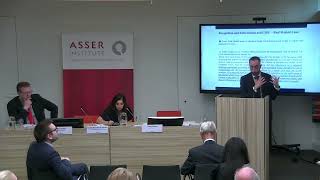
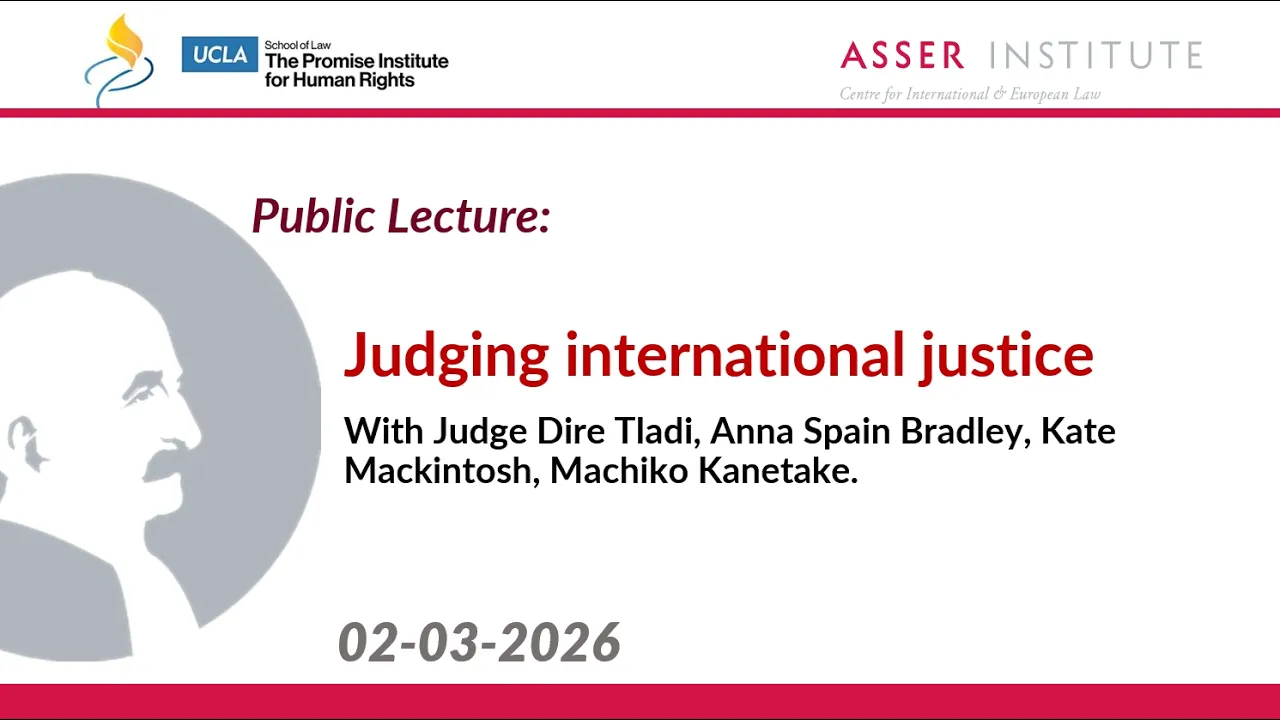
So well good evening um everyone. Uh it's great to see many uh participants including familiar faces on such a beautiful and sunny day in the H. My name is Matiko Ketake and as the academic director of ASA institute I would like to warmly welcome our guests partners and and colleagues.
Um so just uh as a uh reminder um this event is going to be recorded. We will stop recording um after the lecture and the discussion uh came to an end but just to let you know that you might end up in in a recorded um video. Um so today's important event is organized by the promise institute for human rights uh which is a European hub for the UCLA University of California Los Angeles and Promise Institute has been very active uh both in education and research particularly in the domains of human rights uh ecoite and environmental justice more broadly and for instance promise institute has been running quite impressive human rights litigation clinic which benefits a number of of students for many years.
So in many respects uh the promise institute and our aer institute have a lot in common. Uh we would like to create a bridge or many bridges between academic research and practice uh in legal domains including in international law. Uh so we are very grateful for the collaboration with professor Kate Mintosh and professor Anna Spain Batley and we very much look forward to collaborating with you further in disseminating the importance of international law and European law from the H.
Now um talking about the importance of international law uh everyone in this room uh is aware of the fact that resilience of international law has been openly contested and this is clearly problematic for non-hegemonic powers uh in particular players in international relations in particular including uh many European countries whose security I believe is better preserved by upholding international norms and institutions. So in this challenging climate surrounding uh international law, it is probably logical that a very strong attention has been given to the international court of justice and international courts and tribunals more broadly. um in a way as one of the site to ensure the continuity of international law as a framework for governance.
So now to reflect upon how international courts and tribunals can and should engage with complex global challenges, we are extremely delighted uh to have the honorable judge delay. Uh I must say he has many enthusiastic uh followers as you can see from this room. uh both in academic and practitioners uh circles and this is uh not only due to his distinguished career as a professor uh legal advisor, legal council and a member of international law commission just to name a few of the important roles that he assumed.
But this is also because of the breadth of his writing which is clear and to the point. uh and at the same time uh his work also invites us the readers to reflect on broader context including historical context uh surrounding international war. So I very much look forward to learning uh from his lecture and discussion with with Anna that follows and with this uh short welcoming note I give the floor to professor Kate Mintosh to join me with the opening remarks.
Thank you, Matica. And I won't take up much of your time. I just want to welcome everybody on behalf of the Promise Institute for Human Rights at UCLA Law.
My name is Kate Mintosh. As you heard, I'm the executive director of our office here in Europe, which we launched in 2023 to be a location for connecting our students, our research and our faculty with the centers of international law and human rights which are nonetheless still mainly here in Europe. Um, and we've been really delighted to have a collaboration with the ASET Institute from the very beginning and this is another manifestation of that.
So with that I'm just going to hand over to um my colleague Anna Spain Bradley who'll be in conversation with Judge Slatty after his lecture. So um professor Anna Spain Bradley is faculty director of the promise institute. She teaches a range of international law classes at UCLA and a quick plug her latest book on global racism will be uh coming out later this year.
So um thank you Anna. I hand over to you. >> Welcome everyone and good evening.
Now I try in Dutch. Welcome and hur I do. Uh so it is such an honor and pleasure to see all of you here.
uh that all of you took the time to come from your busy days and lives to carve out an hour to spend together and it is my great pleasure to welcome you to the second annual judging international justice lecture. It is brought to you by the Promise Institute for Human Rights at UCLA, which was founded in 2017 with a mission to train the next leaders and generation in innovative, globally inclusive human rights thinking, advocacy, and research. And it was funded by uh in part by a gift from the film The Promise about the Armenian genocide.
Uh we are so delighted to have the partnership with the ASER Institute, Macho Kanake and colleagues here to discuss tonight's theme judging international justice. This theme as we know could not be more necessary or imperative than in this moment. International law, the rule of law, democracy and justice itself indeed are under threat from an array of sources and causes around the world.
The utmost of which are the powerful who act with impunity. It is precisely in moments like these that the public interest in and attention to the causes of international justice and ultimately to the cause of peace itself become paramount. Indeed, the Promise Institute seeks to engage the public and this is the motivation behind the annual lecture series to move education beyond the classroom and to engage in richer public exchange with these themes.
And it is particularly special to be here hosted in the H the city of international justice and home to the H peace conventions of 1899 and 1907 that gave rise to the peace palace down the street uh and where the international court of justice is located and with the international court of justice in mind it is an honor to welcome tonight's distinguished lecturer the honorable dear who has served at the judge as a judge at the ICJ um and is a leading voice on international justice he is called upon in his role to officially adjudicate legal disputes that can be resolved on the basis of international law pursuant to the ICJ's statute and authority. But many of these disputes also include matters central to our shared humanity, including Yuskan's prohibitions on genocide, racial discrimination, and more. And Urga's obligations regarding climate change.
Judge Lahi is a longtime leading voice in this regard. He has published over 50 articles and particularly on the issue of preemptary norms has been field defining. He is also the author of a novel titled blood in the sand of justice published in 2023 and I encourage you all to read it.
uh he currently serves as a distinguished visiting professor at the University of Johannesburg and he as you heard previously served many illustrious and important leadership roles including as member of the UN international law commission and as legal counselor to South Africa's mission to the United Nations. Please join me in giving a very warm welcome to the honorable deed. I am grateful for that very warm introduction.
Um I I had a conversation with Anna and we agreed that I wouldn't speak too long so that there can be plenty of time for questions. Um so let me just start off first of all by by thanking you all for coming um and thanking the organizers for for inviting me to come and speak to you. um today.
You will notice that I'm a bit somber. Um there's I think I think we all understand why. Um so but before I say why, let me also just start with with the normal caveats that is I will try my best and I hope you help me with the questions that you ask um not to say anything that will get me recused from a case.
Um so that means that I will not speak about ongoing cases although I would really like to. I will not speak about potential cases although I would really like to. Um and in fact even with respect to past cases I will be careful not to disclose the content of the deliberation.
A week or two ago, I I I had an exchange with um with Anna and we we well I asked her, you know, what do what exactly do you want me to speak about? And she gave me a couple of options. Um I thought about those options and then I decided, well, I I'll probably because I could hear that she was really interested in in use and omnis.
So I thought I'll probably say something about um the interaction between these two concepts which I think there's a lot to say about how they interact. uh are they friends? Are they enemies?
Are they fnemies and so on. Um but I um the events of the last couple of days have caused me to ask myself the question whether it would be appropriate to speak about such an abstract and theoretical topic at a time that we're facing. Um uh I read this morning that that in two days uh more than 550 people have been killed.
Sir, that's a staggering number. Two days. U so I it certainly caused me to think a little bit about the propriety of of of the topic that I was um that I was speaking about.
On the other hand, um we have to keep perspective a little bit, right? Um we we I've always taken the approach when asked questions about the state of international law and whether international law is dying, dead. Um I've always taken the approach that we we have to see everything in perspective.
um that um the events that uh have put international law and rules of international law under strain um didn't start just a couple of years ago. They certainly didn't start the last two days, right? And they didn't start a couple of weeks ago in in Latin America.
Um they didn't start in 2023 um in October 2023. Uh, you can go back in history. There's always events that cause international law uh or that put international law and the rules of international law under strain.
Um it's no wonder that you have um you have themes you just 10 years ago um the university of in fact two universities in Berlin had a had a mega project on the rise and decline of international law. There was actually the same year there was a book published um in honor of professor Sunn's what is wrong with international law. So these questions keep recurring.
Um you might know there was a there was an article in the Guardian last year which essentially declared international law did. Um and my answers to these questions in fact even in that article my answer was well there's nothing wrong with international law. International law is fine and to the extent that there's anything wrong with the rules it's simply a reflection of us.
Um, but as I say, the the events of the last couple of days have have caused me to wonder whether or not that very idealistic answer that I normally have to this question um is sufficient. Is it is it really enough to simply say international law is okay? It's it's I think um uh maybe it's it's just simply the fact that so many events are taking place in such close proximity to each other, right?
Uh at least temporal proximity. Maybe if if if um um they were not so close together, I wouldn't feel as jaded as I feel um this afternoon um speaking to you. I had a conversation with a friend of mine yesterday um about no was yes no no it was a day before yesterday it was on Saturday because I was particularly jaded um and and she said something this very dear friend of mine she said but dear we we we all have a responsibility to preserve what we can um and so as difficult as a situation is we all have a responsibility to do what we can to remind about the rules to remind to to try to to do what we can to preserve the system um and to preserve the integrity of the system.
So um those thoughts made me think okay I can still speak about Ukloans um even though I am a little bit jaded. Um so I will title my presentation today as the court and by the court here I mean the international court of justice um the court's role in promoting use kogans and era omnis in times of stress for international law. So what is the court's role uh and what role can the court play in promoting these two very important concepts that are significant and important for justice for international justice.
Um but before speaking about kogans and omnis uh more specifically let me let me say something about my view in general about the court's role um which is which is quite limited. uh someone I can't remember if it was Anna spoke in the introduction about the fact that the court is trusted. The court gets all of these cases um and important cases.
I mean I don't want to say boundary delimitation cases are not important but but but politically sensitive cases uh certainly more so than at any time in history. Um, and this may well raise the question, you know, what does this mean? Does it mean that um that the court is trusted?
Does it mean that the court can fulfill um a role in resolving all of these issues? Um, in May 2024, I I I had the occasion to to pen a declaration to uh to the order of the court in South Africa versus Israel. um on prelim on on provisional measures and I ended it with the following paragraph.
I'll quote selectively from that paragraph. Um I said today the court has in explicit terms ordered the state of Israel to halt its offensive in Rafa lepes. The court has also reiterated the urgent call for Hamas to release the hostages.
But the court is only your court. The basic implication of that message of this paragraph, the court and in particular the the the statement the court is only a court is I think self-explanatory. Right?
It is that it is not the function of the court to resolve political issues and conflicts. The function of the court is to make legal determinations, apply law to facts and sometimes that can l to that can lead to resolution of conflicts. But determinations of law and application of law to facts will not without more without something else happening resolve conflicts.
That is the function of others to take decisions of the court if necessary and apply them in a way that will result in a resolution of conflict and addressing the situation. But the court cannot do that. It is not the function of the court.
Right? So if you think about the current situation that we are now faced with, if the situation is brought to the court and the court makes a ruling, that does not mean that the conflict will end. It does not mean that deaths will subside and civilians will be protected.
Right? That's the essence of this message. That's the essence.
Well, that's at least the first implication of this message. There is another implication which I'm afraid many of you might not like. Um, it's a warning.
Uh, and as I say, this particular warning is one that will be met with some hesitance and resistance from justice enthusiasts. And I assume most of us are justice enthusiasts. But it is an important warning, right?
it is that the court not just the court but courts in general um should I'm even afraid to say it I I hope nobody has tomatoes in their bags right nobody has tomatoes or eggs even worse the court should apply the law and leave extraneous things aside politics, narratives and narratives can be good or bad, right? And by narrative I mean that state is a bad state, that state is a good state. The court should leave pressure from civil society aside.
Um I could give you examples. I am tempted to I want to but then I will definitely be be asked to recuse myself. I could give you as examples um the current case that the court is deliberating on.
I could give you which is Gambia versus Myanmar by the way. I could give you as an example a case that the court will soon I think maybe maybe not u consider um which is South Africa Israel. But these would most definitely have me recused.
So I won't instead um I'll give you as examples two advisory opinions from the past um the first one is the nuclear weapons advisory opinion right now it's easy to say I think we can all agree in this room I hope we can all agree in this room that nuclear weapons are bad and that as humanity, as part of humanity, um we should do all that we can to make sure that they don't exist anymore. I think we can agree on that proposition. Yes.
Okay. Maybe not all of us, but I think I hope most of us can at least agree with that proposition. The question then is what would such a proposition mean or would that proposition have meant for the court um in 1996 when it had to render the advisor opinion?
Does that mean that the court because of this moral imperative against nuclear weapons that the court should necessarily decide that the use threat of use of nuclear weapons is unlawful? That's the question and I want you to to to hold that thought. So we all agree that nuclear weapons are bad.
They shouldn't exist. The court is asked a question on the legality of nuclear weapons. Uh I'm sorry, the legality of the use of nuclear weapons.
Does it follow that we all agree that nuclear weapons are bad? That the court should find that the use of nuclear weapons um is unlawful. I can take a more recent example that's the climate change advisory opinion in which again the court was asked to elaborate on um legal principles um and legal rules relating to the protection of the climate system.
Now the climate problem has been described I think one of the uh most used phrases is as an existential threat. So the problem is so deep for humanity that it is an existential threat. And so again I think we can all agree um from a moral perspective um that everything ought to be done to resolve the climate problem.
Yes. But what does that mean for the International Court of Justice faced with the question? Does that mean the court should identify rules, strong rules without exception designed to protect the climate system?
My answer to both of these questions is no. That is not the role of the court. It might seem tempting and from the perspective of shortterm interest and benefit it might seem like a good idea but that is not the function of the court.
The function of the court is to objectively identify the legal rules and make determinations about the legal rules. Right? That is a function of the court.
Because for me and this is where this notion of the court is only a court comes from. For me the court is only a part is only a cog in a system. There is a system and the court is only a one one small cog in that system.
The legitimacy of the court the legitimacy of the court depends on the court knowing its place. The court staying in its lane so to speak. Right?
That for me is um um um uh the function of the court. This is not to say by the way that the court should behave like an ostrich and bury its hand in the sand while the world burns. Absolutely not.
Because the court does and should take context into account. But taking context into account does not mean unfortunately um substituting law for politics and other considerations. Right?
There are ways and we will see a little bit when I speak about use kogans how how um how context and other important factors can be taken into account while staying within one's lane while applying the law um and not going beyond the law. My fear, by the way, is with putting pressure on the court to do the right thing is a fear of legitimacy. The court is made up of 15 people, men and women.
I don't think it's proper for 15 men and women to assume the role of legislature. By the way, all 15 of us have very different ways um of thinking. So, I think it's important to bear that point in mind um um the significance of um um or the importance of this legitimacy.
What makes the International Court of Justice what it is is precisely the legitimacy that it has and the legitimacy that it has is the ability to balance on the one hand context and applying the law. Um and I think use corgans and omnis are a are a provide a good perspective a good lens um from which to assess this balance both of these concepts use kogans and omnis um were essentially inventions so when they were created they were essentially nothing more than inventions and I'll start off with you kogans which was created by um by another institution that I used to be a member of the international law commission Now many of you will know the history. I I won't go into it.
Uh 1950s the LC decided or uh to to codify the rules in the law of treaties. Um and three special repator in succession identified this notion that there are certain rules that are so important um that they cannot be violated by a treaty that a treaty that is inconsistent with those rules um would be invalid. Lau, Fitz Morris and Waldo.
What is really interesting is that at the time these three special reperators identify this concept, it is really a concept without any pedigree. It's had been mentioned of course in a separate opinion here and there of the PCI. Um but the concept itself was in the periphery of intern rather on the periphery of international law but it was widely accepted by the members of the commission.
So here's a concept now you might say or you might know that the reason why it was so easily accepted was because of context right it was in response to certain things. It was in response to a time in history. In fact, in particular, it was in response to the atrocities of the Second World War, right?
So, here you have a um a concept that is created by a body which is not a legislature, right? Which is not a legislative body and it creates it out of nothing. So again, this raises the question whether or not the ILC had stayed in its lane.
Omnis is exactly the same, right? Right. So omnis is is invented by um the international court of justice in 1917 Barcelona traction case.
Very boring case which very few people have read. But almost every international lawyer can tell you what paragraph 33 and 34 of Barcelona traction case say. Why?
Because there the court out of nothing when it was absolutely not necessary when the case had absolutely nothing to do with this concept says by the way there is a distinction between obligations that are omnis that are binding on all and obligations visa v state right and so bilateral obligations to call this an orbit dictim would be very kind because at least orbit dictims have something to do with the case. It's absolutely not necessary for the resolution of the case. But why did the court do this?
Again, it was a response to history. History that has something to do with my own country. It was the court's response to its unpopular decision in 1966, right, where essentially it held that Liberia and Ethiopia did not have standing um uh to take South Africa to task for application of apartheid policies um in Namibia.
Right? So you have the point I want to make is this. You have decisions that are morally defensible, but that which at the time they're given are at least legally suspect.
And yet here I am saying to you that these decisions are an example of the balance I'm talking about where context where the court can take into account context while still staying within its bound with respect to use kogans. It's not really the court. It's the international law commission.
What makes this possible is that the ILC presents this proposal to states and guess what states themselves overwhelmingly accepted this. Right. And so you have a you have the ILC pushing the boundary, pushing the envelope, but it's all still within the framework of international law.
Why? Because the states that legislate accept and embrace the concept. The same with Barcelona traction because remember this is an orbit dictim.
It's not really a decision that's binding. The court refers to this thing, establishes it and puts it into the lexicon of international law, but does nothing more with it until what happens? Until the concept is embraced by the international community of states, right?
When the concept is embraced by the international community of states, we start seeing um constant reference and referral to omnis until in 20 n 2019 2022 um Gambia Myanmar um uh the preliminary objections right then the court for the first time in my view I mean some people will go a bit further back and say um and say it was Belgium Sagal Um but the court for the first time gives effect to my mind to Era ominous obligations having established it in 1970. Why? By the time it gives effect to it the concept has pedigree in international law.
Right? So here for me are two examples of these two concepts that are created out of nothing pushing the envelope but are completely acceptable. And the reason they're completely acceptable is the reason they're completely acceptable is they respect the law making processes and procedures.
It's not the the the the court or the international law commission um it's not the court or the international law commission making law out of nothing. Um it's the court and international law commission putting out their concepts which then become embraced by states and then um um acquire the the necessary uh uh pedigree. We also see this by the way this balance um between context politics narrative civil society influence um um and remaining within the bounds of one's mandate also in the application of um use kogans and omnis by the court um so I will leave aside for the moment the fact that the court has has historically um and famously avoided use kogans.
So much so that that many have thought the court must have some kind of an allergic reaction to use kogans. But that's changing, right? So the court now routinely references you kogans.
But the first time that the court embraced the concept of use kogans and in fact identified a particular norm as having um yuskan's character was in 2006. And that norm that it identified and recognized was gen um the prohibition against genocide which it described as assuredly um a norm of use. But in that case having recognized this principle of justice um you kogans the court also recognize its limitations and that's extremely important from the perspective of this balance because there you might recall um the democratic republic of the Congo um had made the argument that because the norm in question was a norm of yuskans the prohibition of genocide the court had jurisdiction even um Ronda had made a reservation to to article 9 and of course the court there made this distinction between the procedural rules on its jurisdiction and the substantive um character of Yuskan's norm um in particular the prohibition of of uh the provision of of the provision of genocide um this is not a very popular distinction And the court has recently as you know again last last year in in Sudan versus UAE reiterated this distinction that the mere fact that a norm in question is a norm of use does not mean the court would have jurisdiction.
Again I can well understand that many justice enthusiasts would say that just can't be. But the court is staying within its bounds. By the way, in um in UAE um sorry um in Sudan versus UAE, I joined some other judges um in criticizing the court for its decision, but not in criticizing the court for the content of its decision, but for the manner in which it made that decision.
Right. So, so I certainly I personally anyway um accept the distinction that is made by the court. Um it's just that in that particular case um the court made that distinction in a particular way um which was um which is troublesome.
By the way, also I might also add that this distinction between procedure and substance is a is sometimes a distinction that the court takes too far. Um, and one example uh where I think the court gets the balance right between staying within its lane and doing the right thing um is in Germany versus Italy where it draws pretty much the same distinction this time between the procedural rule on immunity on the one hand um and the use character of some of the norms um against which um against which you um um immunity has often been raised. Um I want to raise one more example uh before we start our conversation.
One more example on uh of how the court pushes the envelope pursues justice but does so in a way that is in conformity with the rules of international law. Um, and that's in another genocide case, actually, other genocide cases. Um, in um, Bosnia genocide 2007.
The genocide convention does not contain a provision prohibiting states from committing genocide. That might be a surprise. I see some raised eyebrows.
It's a surprise. But it doesn't. There is no if you read it, it has all kinds of obligations on states including the duty to prevent genocide, the duty to enact legislation, duty to prosecute, but the state itself is not obliged not to commit genocide.
In Bosnia genocide in 2007, the court said, notwithstanding this reference to the duty not to commit genocide, the convention must be read to include that provision. Right? That's a determination in pursuit of justice.
That's a determination. In fact, that particular conclusion by the court drew a lot of criticism from some judges, right? Very strong criticism from jud from judges.
But here again what you see if you read the judgment is you see the court using interpretive tools and so staying within its boundaries to come to a decision um which is um in pursuit of justice. So today um the court has I think about seven cases seven active cases on its docket relating to to uh some other use norm right I think you mentioned four relating to genocide two relating to uh to uh to the provision on racial discrimination uh there's a torture case so it has quite a number of cases um so relating to general genocide. The challenge for the court moving forward is going to be how to constrain itself while finding ways to pursue justice.
Both of these are critically important for the legitimacy of the court. I thank you very much. Can you all hear me?
Wonderful, elegant, wise, powerful. Uh, and I I am going to restrict myself to two questions to judge Lahi so that we have a lot of time to hear from all of you with deep appreciation again for your interest and engagement in this topic. There's much that judge pav has enlightened us about the judicial function of the court and judge I guess um in your professor capacity and this is how we get to uh avoid questions of recusal you know thinking about the work of international justice there's so much about the history that comes into play in every case um and the history that comes into play in international law and we're always trying to find explicit and implicit state consent.
So history gave us 1945 UN charter. History gave us 1965 international convention on the elimination of racial discrimination. Uh in other words, the consent comes in moments.
And could you say something about how you think uh judging does and doesn't take account of history, critical history uh and anything you think about how judging should take account of history? >> Thank you very much. That's a that's an interesting question.
Um so judging takes place at a number of levels. I think it's important to remember this always. Um you have the individual judges um that may to different degrees take into account history.
Their individual contributions then result in judgment. If you read many of the cases, um there is um um there is very often a reference to history in the form of the um but also in the form of context. Um the court in I've just mentioned now um I've just mentioned now um Bosnia genocide.
The court was well aware of the historical moment and I think it's clear from well and here I'm speaking about the historical moment um in which the genocide convention was born um um 1948 as a response to the atrocities um um um of the period before that. The court is well aware of the historical moment. The court is also well aware, it's clear to me that at the time that convention is drafted, it was intended to apply as an instrument um of individual criminal responsibility.
But history also requires an understanding that there are shifts. And I think it is this recognition of shifts and that we are in a different time of history um than the time at which the convention was adopted that the court then um arrives at the at the decision that it arrives at um in 2007. >> All right, I only get one more question.
I better make it a good one. Um so shifts shifts in history and uh you recently wrote in 2025 in a excellent article in the American Journal of International Law uh about reparations and use kogans and you say in that piece uh and I I dare I quote you. You say that uh historical injustices, slavery, genocide, racial discrimination and use kogan seeking to infuse the system of international law with community values and a spirit of justice.
So, I want to speak to the spirit of justice in generational shifts. Uh, last year, Harvard University ran a poll of people aged 18 to 35, and we won't ask people to self-identify. If you consider yourself in that generational group um about trust and found that across sectors and across countries and cultures uh trust in public institutions was down with one exception the United Nations.
Uh so I think the question I have for you is we've talked a lot about in international legal field in general the importance of the international court of justice as a court its judicial function but it also serves a purpose as a me an organ of the United Nations and do you see um in that regard that it could play a a different role in the future regarding public trust? regarding public trust. I mean, I think it can play an important role in the future um with respect to to norm creation um with respect to public trust.
Well, that'll all depend on what kind of decisions come out. And I think this there's two aspects of this and these two aspects are at a tension with each other, but they but there's still two tensions that enemy I think um to the proper response to your question. Um and these are one the extent to which the court is able to be aware of the moment in history to take into account context but at the same time um the ability of the court to stay in its lane.
Um for me these these two are um these two elements are critical for the trust that is in the court to remain and I give you an example. So I spoke about um the nuclear weapons advisory opinion. In fact no well well yes I'll give you two examples since I've already mentioned it.
Let me not um step back. Um, the nuclear weapons advisory opinion is an opinion that was severely criticized for its inability to move forward, for its inability to take into account context. I've criticized.
So even though here I seem to be saying the answer was correct. That's that's that's actually not the view that I've held. Um there's an article in the UCI journal of something UCI journal in which I criticize the decision because I think even there it was possible within the constraints of international law to put forward a uh to put forward a much more uh to put forward a much more uh justice pursuing answer right um um and the court didn't take that opportunity um the other example that I wanted to give which is a slightly different one uh is also something that I mentioned in passing and that's 1966.
Uh I think and and my students um you know my former students in South Africa would often be surprised when I see this. I think that if you were to look at the rules objectively in 1966, keep those tomatoes in your bags. Um, the judgment was probably defensive, but here's the problem.
This is the court had already issued a judgment on preliminary objections. and the judgment on preliminary objections had been widely embraced and accepted. So for the court to now reverse itself, that's the problem.
The problem was not the decision. The problem was the reversal of an earlier decision which was pursuing justice. Um so you see and that significantly undermine um the legitimacy of >> Thank you so much.
Thank you for your generosity.