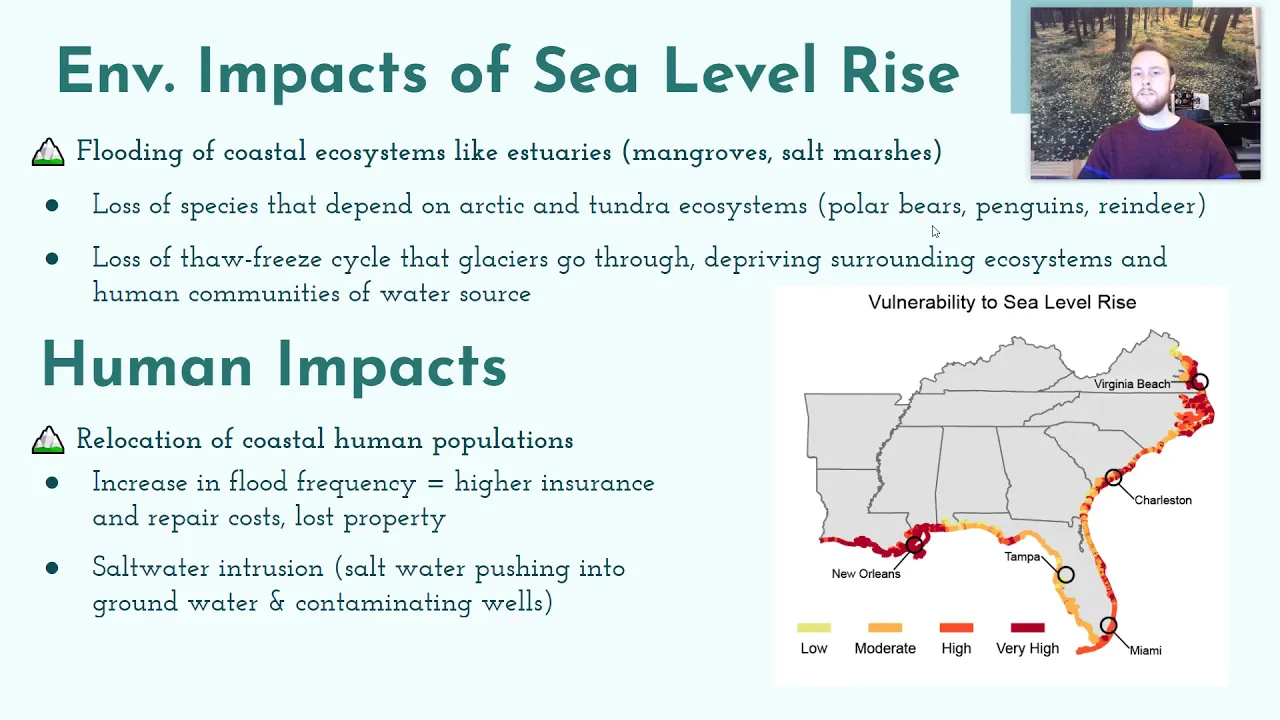
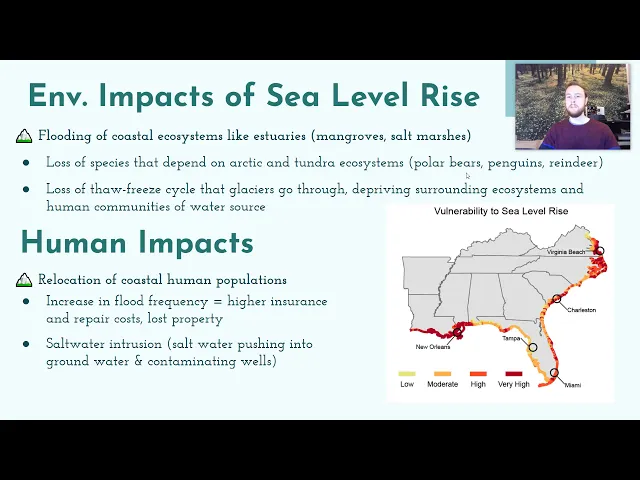
hey everybody it's mr smeeds and welcome to topic 9. 4 which is the increase in greenhouse gases and the environmental effects that this increase has our objective today is to be able to describe both the environmental consequences and the human health effects of increasing greenhouse gases in our atmosphere skill that we'll practice at the interstage video will involve explaining how an environmental concept that's represented visually relates to a broader environmental concept the first issue related to increasing greenhouse gas levels that we have to talk about today is sea level rise and so the first cause for sea level rise is something called thermal expansion so think about when you boil a pot of water on the stove to make macaroni and cheese or something those water molecules are going to start moving around really rapidly so much so that they might rattle the top of the pot and that's because they're expanding and so thermal expansion is the idea that water molecules get further apart from each other when they're heated and what this does is makes all of the water molecules in the ocean as we increase greenhouse gases and lead to global warming makes all of those water molecules get slightly further apart they may not seem like a big deal but each water molecule getting further apart actually leads to perceivable ocean rise so the ocean level will rise due to this effect of thermal expansion the second reason that global warming is going to lead to sea level rise is because of melting polar and glacial ice so as greenhouse gas concentrations in the atmosphere increase temperature rises that's going to lead to the melting of these ice sheets in both glaciers and in the ice caps at the poles what happens then is that water that was previously stored as ice is going to flow into the ocean so if it's at the poles it just flows right into the ocean if it's on land and it's a glacial ice sheet then it might flow into a river first which eventually empties into the ocean and so these two combined effects here of thermal expansion and of melting polar ice caps and glacial ice caps are both ways that by increasing greenhouse gas concentrations in our atmosphere we're going to lead to sea level rise there's a graph courtesy of nasa that can help us visualize and understand this change a little bit better so we have here if we look is zero centimeters being the baseline of our 1993 level and then we are taking these data all the way out to 2018 and what we can see is that when we record global sea level from using satellite imagery we can add in the thermal expansion effect along with the water that's actually added due to primarily melt water in this case and that effect is going to lead to at this point over eight centimeters of global ocean rise compared to 1993 and so that may not seem like a big deal eight centimeters you know it's not even a foot it's not even close to a foot and so you might be thinking why is that a problem well what we'll learn about shortly is that a huge portion of the world's population lives on coastlines and that there's problems that occur in coastal ecosystems and for close to human populations when we start to increase sea level now we'll talk about some of the environmental impacts of rising sea levels and so the first one is that we're going to experience the flooding of coastal ecosystems remember these are estuary ecosystems especially like salt marshes and mangroves these are super productive ecosystems and they're great storm buffers they provide a lot of biodiversity they provide a lot of species that humans fish commercially so they provide income they provide food and this is a problem because when they flood they're converted from this partially land-based partially aquatic you know shallow kind of brine water we call it partially salty water they're converted from that very unique and productive ecosystem into just open ocean so as ocean waters you know move further inland they flood these ecosystems and we lose them another problem is the loss of both polar and arctic and tundra ecosystems so when these ecosystems start to experience warming and the poles are experiencing disproportionate amounts of warming that will be a big topic in our next video why the arctic regions especially are warming at a faster rate than the rest of the world that's going to decrease habitats for these organisms so these are things like polar bears penguins reindeer they're going to lose some of their hunting grounds they're going to lose some lose some of their food sources and so we could see a decrease in biodiversity in these regions another problem is that in many regions the freeze thaw cycle of glaciers is a really vital source of water for the surrounding ecosystems so each winter those glaciers freeze and then each spring there's some thon that's going to release some water into the shiny ecosystems human communities depend on this as well in many regions so here's an example of the change that we see in alaska again another image courtesy of nasa here from it looks like you know 1941 to 2004 so in this short period of time we're losing this glacial cover and remember that's going to deprive this ecosystem oftentimes of this freeze thaw cycle that's going to be an important water source now we'll look at some of the human impacts of sea level rise so the first one is this idea that many coastal communities may have to relocate they may just have to move inland or move somewhere else together so if we look here at a map of the southeast united states we can see different major cities that are at risk of being flooded more frequently or going underwater completely if sea level rise continues now as i mentioned earlier it may not seem like a big deal that sea level has risen eight centimeters over the past 20 years or so that's a problem though in places like new orleans where the city is actually already below sea level and so it's sort of artificially kept on land by a system of levees and dikes and pumps that sort of keep that water out of the city and so each centimeter that the ocean rises higher is another centimeter of wall that has to be built another centimeter a pump infrastructure that the city has to be able to handle and so this is a really big problem for coastal communities it's going to lead not just to them potentially going underwater altogether but increased flood frequency and increased flood severity so remember when a community floods people have to leave temporarily they may be displaced they may have to pay higher insurance costs in the future or may have to pay a lot of money to repair the damaged property property may be lost altogether and so this is a big problem as sea level continues to rise another problem is salt water intrusion so this is another problem that even when sea level is only rising a centimeter or two at a time is an issue because that adds increased pressure on the water table where the salt water can actually intrude or seep into our freshwater ground sources and so wells could be contaminated in these low-lying coastal regions and it's really hard for a community to continue to support agriculture and support human drinking water when their groundwater sources become contaminated with salt water then finally we could see a really significant problem which would be a huge increase in the number of refugees so a refugee is someone who is sort of temporarily displaced from their home community from where they live and then typically it will become a longer term issue because they have a tough time finding a new place to relocate so especially in less developed nations where economic opportunities are not quite as abundant as in developed nations where there's not as much housing infrastructure where there's not as much government assistance these people could not just have to move somewhere else but lose their home altogether and become a refugee and so they would then be in a position where they have to sort of go from place to place trying to find somewhere to settle and that's a really harmful effect you know emotionally socially economically and so becoming a refugee due to sea level rise is another big human health consequence of sea level rise next we'll talk about something called disease vectors so disease vectors are oftentimes insects but they can be any living organism technically that's able to transmit a disease and so fleas and ticks and mosquitoes of course are great examples and some of the diseases that they transmit can be very deadly so we have some examples here malaria the zika virus the west nile virus dengue fever and cholera so these are all diseases that are born by vectors that means they can transmit the disease from human to human or from animal to human the problem with the increase in greenhouse gases in our atmosphere and the warming of our planet is that we're going to extend and increase the range for many vectors so because insects rely on warmer temperatures as colder regions become warmer this is going to enable these disease vectors to spread out from the equator towards the poles these higher and lower latitudes that are typically too cold for these organisms to survive are now warm enough this is going to put new human populations at risk to these diseases that were never at risk before because their regions were just simply too cold to enable these disease vectors to survive so for an example of this issue we can look at this projection here from stanford and this is the current 80s aegypti range now that's a species of mosquito that's capable of transmitting dengue fever zika virus yellow fever among other diseases so it's a really large vector for disease and and one that's very prominent in spreading these diseases what we have here is a map of the world and we can see that the different colors coordinate or translate to the months of the year that these mosquitoes are able to survive in these regions so we can see closer to the equator they're able to survive year round and as we get further away from the equator they're able to survive fewer and fewer months until we get to these higher northern latitudes where they can only really survive one or two months a year so that makes these populations far less vulnerable to these transmittable diseases than these equatorial regions where this disease vector survives year round what i want to call your attention to though is a map that i'm about to overlay here which is a projection again from the university of stanford and it's going to show us what's the projected range of this species of mosquito in the year 2080 and so it's going to fade in slowly and what i want you to notice here is how much higher in these northern latitudes this one to two month range of this species is going to extend with a warmed earth again projected to be in 2080 much warmer due to due to increase in in greenhouse gas emissions and so we can see that the range is extended further north and further south away from the equator one thing that's kind of interesting i want to call your attention to is some of these equatorial regions now have moved out of the 12-month region and so some regions may actually experience less mosquito population and less opportunity for disease transmission via these vectors and that's because some regions may become so hot that we sort of surpass the optimal conditions for this mosquito species so it doesn't mean that every single place on earth will become more hospitable to these vectors but a greater total area of earth's surface will be hospitable to these vectors and it will increase their range now we have two maps that show the projected range and one of them is going to be if the world is able to meet and exceed the paris agreement goals now these were goals that are aimed at limiting global warming in the next century by the year 2100 to below 1. 5 degrees celsius and so what we can see here is that this is going to keep that range in these northern colder latitudes relatively limited when we compare that to business as usual this is if we don't keep global warming under this 1.
5 degree celsius mark that's going to extend the range substantially for these disease vectors and areas of the world that never experience these diseases before may experience them now due to this fact that the disease vectors have increased ranges basically increased areas that they can survive in due to this global warming for practice frq 9. 4 today we're going to look at another map this is a map now of the range of malaria projected by the year 2050. and so i want you to pay attention to the key yellow is the current distribution of the mosquito species that bears malaria then we have green is areas that are going to be unsuitable actually for malaria by the year 2050 and then red would be areas that will become suitable for malaria by the year 2050.





![Complete AP Environmental Science Exam Review Guide [Everything You Need to Pass!]](https://img.youtube.com/vi/9_WrWJ9U0PM/maxresdefault.jpg)