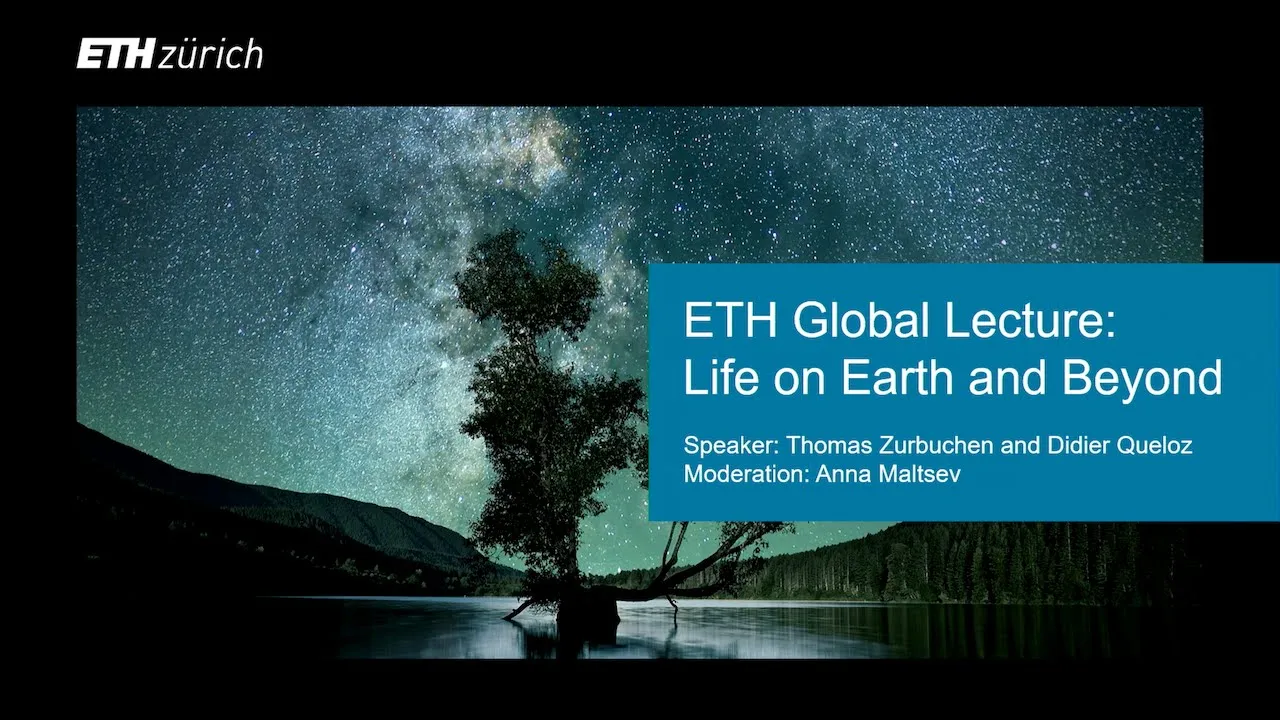
[Music] [Music] all the way good to have a movie to start so ladies and gentlemen welcome to this special event we have been a bit overwhelmed by the number of people who wanted to attend it so we have an online session in another other room also welcome to everyone online and um we have this special lecture on live on earth and Beyond and this is really special because we have two fun fantastic scientist and renowned Personalities in Switzerland and abroad these two personalities have joined eth within the last DJ two years two years and um
one year I don't in principle I shouldn't need to present Thomas so but I will say a few words how we met because I think it is interesting it's joining personalities Mee but also Projects I start with D D I was at w and my staff your Bruner came to me and said there is somebody called D Kell wants to talk to you I said immediately and then he came and he wanted to talk about a project that he was launching in Cambridge on life search for life outside of of the solar system and it
turned out I had my computer I opened my computer and I showed the project that five departments at eth have been putting together Exactly on the same project on the same topic and this is where we started to discuss and at the end after a few meetings uh joined workshops between Cambridge and then uh and eth then it became clear that we should do something together and this is how he joined eth two years ago I'm very happy to have you here uh d and with Thomas a little bit the same same thing happened you
were here to get the Dr honoris Cel and then a few months Before you know at the a t always we give this uh this um uh prices and then he had just announced he was stepping down from his position as science director of NASA and then I as usually very directly I ask him what are you going to do in future we are here for you as well it asked me to wait until January which we did and then we started to resume discussions and also here we had a project uh launched by Vanessa
I asked her to look what we are all doing On in space at eth and it turned out we have so many groups in so many departments working on this but it was not so well known so we wanted to create a new initiative along this line and presenting this probably we could also convince Thomas to join so those are two fantastic recruitments that we could make and we are really excited of having you here at eth DD and Thomas thank you so much now why we have this Event because you know the mission of
eth is very Broad and I put it sometimes in a very simple way but we have four five Focus points it goes from the fundamentals all the way to uh dialogue with society and we have of course here two fantastic personalities that can have the dialogue with Society with you with everyone then we have also the goals to address the global challenges of our time be it on AI be it on Environment energy be it on health personalized Health in turn in turns out does these two person ities and the two program that we are
launching at eth they are addressing each of these different points let's take an example monitoring of Earth of CO2 emission this can be done at scale only using satellites and this is one of the project that uh that uh we are pursuing and that we are also fundraising to together with Thomas uh the fundamentals one of the biggest remaining question how is life has originated is there life outside of the solar system also very big question also as humans to to know the to know the answers so it goes from Curiosity driven research all the
way to impact driven research and this is exactly what we want and I hope you will address this point uh here so I'm delighted to have you both here in Zurich I'm convinced that we have a fantastic opportunity to build something extremely strong around these two initiatives for Switzerland but not only for Switzerland I say the mission of eth when I put it really simple is to serve society and not only the Swiss societies On The World At Large um we will increase our level of cooperation with various universities in Switzerland and I we are
not talking about this but there are people coming All the way from loan here uh welcome to everyone and um I mentioned at the beginning we have two outstanding personalities on stage actually we have three personalities on stage because it will be moderated by Anna malv Anna has been here for 10 years now I it was always fantastic pleasure to to have you working with you uh for all what you are doing you are pushing this communication on these two initiatives so thank you so much now I pass you the word thank you Anna hello
everybody and also from my side a big big huge and warm welcome to all of you here at ehh Zurich and of course also to everybody who's watching wherever you are right now my name is an M thank you for this nice introduction show um I am the SP one of the spokesperson of duri and the editor and chief of the employers magazine and I couldn't be more happy to do the moderation tonight because from my point of view actually there is no more Exciting question on Earth than the origin of all of us right
the thing that connects all all of us no matter where we live no matter how we look like no matter how different our opinions are this is our origin and also of course like life beyond Earth are we alone in this universe it's for me the most most exciting question ever so I'm really happy and that I could um support both of our space stars in the last years um with their communication and now can Discuss with them these amazing questions we're going to get discuss him like for about 1 hour three of us and
then there's going to be half an hour Q&A session so just keep in mind in the end you will have the opportunity to ask questions whatever they might be about life on Earth origin of life life beyond Earth but before we start and I welcome our two space stars um I would like to show you what we actually do already here at eth Zurich um in in the research Of origin of life and life beyond Earth I was walking around a little bit the last weeks and we made a little video trailer um yeah I
hope you like it to me find life on another planet is the most important question we could be working on right now uh in space and frankly also on Earth 30 years ago we found the first planet orbiting under the star that was a momental discovery that kickstarted a new field that we call now exoplanet Research and that's the reason why we have established this center with about 40 Professor here working through different disciplines and we believe that it's just just a matter of time until there will be some answer about the question of why
do we have life in the universe and are we alone in this universe to be [Music] alive we can get to half the temperature of the sun it's like when two planets Collide then you would reach these sorts of temperatures we try to create the conditions during the birth of the planets in our solar system and those around other stars my group and I were looking at uh life that lives deep underground these are very simple organisms that live just by breathing rocks studying these very simple organisms we're learning a lot about how the earliest
life could have Evolved and what life may look like on other planets at Nasa I developed instruments for the detection of signs of life on other planets and moons within our solar system and now as part of eth syc space Masters program I'm excited to share this knowledge with the students so they will hopefully detect life beyond Earth in the near future with my team we find out what we can learn from the James web Space Telescope not only about the Atmospheres of planets but about their deeper interiors that are coupled to these atmospheres this
is very Noel and it's necessary to understand whether there are other worlds that can host life life mission we're developing will allow us to detect dozens of planets that are similar to Earth and then we can search for signs of biological activity and address one of the most fundamental questions of humankind what is life in the universe and how far the Life on Earth is related to life elsewhere so we will really try all what we can to understand this and hopefully that will be useful for humankind it would be very hard to imagine that
there's not life outside of Earth I believe there is but atet time me do not know at eth we can make huge progress to words entering the [Applause] aan thank you very much so and now a big big and warm welcome to our two space Stars DJ K and Thomas turb welcome thank you so amazing to have you here at it to have you here in this discussion it's like a really um huge pleasure so um but before we go and dive deep into the origin of life I would um go and dive a little
deeper um to the or first I need to mention is please take a look at this socks I'm so sorry but both of them have just most amazing Planet socks I've ever seen and it's like I don't have Any and it's like no so I would actually ask would love to ask because Thomas you have always planted socks like why I I I was wondering so many times what what's the story behind the planet socks yeah I always say the most interesting thing about me are my socks yeah but uh no uh what happened you
know in my previous job uh uh what happened is all my suits were new because I never wore suits before and uh it was really quite clear that I needed to be kind of Dressed very formally because any day I could go to Congress so I need to be in a suit and kind of nice tie and so forth so the only place where you had Liberty to kind of show off uh kind of without uh kind of being visible about it are the socks so I threw away all the black socks and every single
pair of socks were new and frankly what happened it created a whole bunch of businesses so basically like like socks I never bought somebody sent it to me it's like thanks It's my business to do space socks and he has a a whole business next to his wife who's an astronomy professor in some University and a Dutch guy who who's doing that and so I have a whole drawer full of socks and I just use them one after the other do you have also a story about your socks or is well my story is very
simple I know I would be sitting next to him so I had to wear my socks as well love it so um let's go deeper a bit into Your interest in not just in space talks but in in space um so I found it so interesting actually your story you're like both Swiss guys right you're almost the same age you grew up in different parts of Switzerland what we can see here now is maybe someone can recognize it it's highly I do you do for sure this is high when you where Thomas tbu who grew
up next to not far from Burn and then we have here a beautiful beautiful part of Geneva where Um you grew up did um and then you both flew around somehow made like huge huge positive impacts in space like you won a Nobel Prize you've beenn Taza been the research head and then you both came back right in this beautiful place here at it zurk met again here and actually during this time you kind of found the same big research goal or maybe also life goal um to to search for the origin of life and
for life beyond Earth so I was wondering how did it start U maybe Thomas how did how did it start for you I mean for me um growing up in a small town uh pretty isolated from industry has huge advantages uh because the sky is very dark so uh what you can do is uh you can look at the sky and uh and see things move what's so interesting about the sky it's actually not the same every night uh and you know you know as you look at it you see things move and if you're
lucky you see transient events that are happening and and you know it Makes you think kind of looking at the sky starts with questions that you then can answer with science for me also uh growing up there kind of felt a little bit confined because of the environment I grew up uh in this kind of uh uh kind of environment that I was in and a public education and Switzerland kind of really started to help me ask those questions and then not just science see uh for me for me uh some of the things that
were really important are questions About history like how do we change our opinion as Humanity uh about something uh you know the opinion that we're the center of the universe and the bosses on it whether they're religious or uh bosses or Kings uh you know how do we get from there uh to a place where we know uh you know that is not the case and for me the tools were signed so I got really excited about this and uh you know I really give all credit to the public education system because uh I Would
there was no that was not discussed at home and so the public education system opened these doors and then you know what I had to do is walk through it you have to walk through open doors that's an important lesson there's a lot of open doors many places but you got to walk through it and uh and actually do the work that it takes on the other side of that door to kind of find the next door and so so I I had the fortunate you know experiences at at Many different locations that's my story
it's one of public education and uh and a dark sky it's a one what what about you well there's a lot of similarity but I think the main incentive that um bring me here is I would say my unusual level of curiosity I'm extremely curious and it never stopped and I was so curious that I didn't really know what to do with that and I went into physics by lack of any way deciding what to do I thought Physics would bring me even more curious so I went into physics and I really literally fall in
love by research I realized I was exactly the level of feed that I needed um um to feel at ease so my level of cuity is a bit annoying because you never stop so I still have the same level of curiosity though by the time you you develop more knowledge you always set the bar Higher and Higher and right now I have this impossible goal to find life so this is because my 's level has reached this level and U and that's why I am and that's reason why I'm I'm still working in kind of
a world which is addressing the questions of how do you search for how do you prepare the future of the knowledge and that's that's it so I could have done other science I guess the fact I was maybe a little more gifted than usual the usual I mean students for Math and and mental pictures um drove me naturally into into physics but um it's Just curiosity driven really sincerely here my for me yeah I think we're all very happy that you didn't choose another one and you're here now um then oh and then um we
have this beautiful three pictures here which you sended to me Thomas when we were discussing about like why is it so important to you and why do we have this big interest um so maybe you can explain us why are why did you choose these ones I think already started uh kind of in Many ways what excites me and the reason I studied physics I also like him had a hard time figuring out what to study and and not because like I just was interested in too many things I read many more history books than
science books uh for a long time and and and for me and still do I read a lot of Psych books too I mean kind of for me it just really I was interested in that but but it's it's a class uh that was focused on the cernic revolution that kind of made Me I want to study Physics and then uh kind of really understanding this story that is in these three pictures of course the all the way to your left you see kind of a toy that Galileo was given sent from Amsterdam it's kind
of two lenses in a tube and kind of when you look through it it looked like something came closer uh to you Galilea of course uh then uh looked pointed that out and started discovering uh the moon and its shadowy parts kind of the Landscapes on The Moon looked at the sun also found spots which by the way you're not supposed to say because the Sun at that moment in time was kind of so often in church used as a sign of God so spots on the sun was no good uh from that perspective but
we also what you also found and you see the note on the right there what you also found is that there if you looked at Jupiter there were other celestial bodies that moved and clearly about Jupiter not not about the Not not about us it's about another body once you realize that you realize wow wow things are really screwed up in a picture in which we're the center of the universe these bodies don't know that the Earth is the center of the universe they're they think Jupiter is you know so so clearly uh you know
so uh the one thing he did that's different than this polish scius called Copernicus what what he did that's different he talked about it and it did not end well for him right You know with all the house arrest some others of course jordano Bruno you know some others ended up one head shorter uh in this case he he had a house arrest and but but remember kind of building a tool kind of using a tool to discover the sky a new is really what I think is some of the coolest things we could be
doing you can't do that like today you can't get these tools from Amsterdam in a gift bag you know you have to invent them yourself whether it's a telescope Or whatever kind of a new type of telescope but we can do that and we should do that uh we just heard professor talk about this in in other ways we should do that that's what my story is relative to that kind of the motivation of hey yeah we can discover the sky and you uh by using some of these new tools beautiful so let's switch over
to the from your origin of interest to the origin of life actually it's the biggest The big Center which you just started about two years ago at eth Zurich with now more than 40 research groups just at eth Z right so I was wondering like where is our stand now now like what what do we know at the moment what is the leading school of thought well I mean it's interesting to go back on the way this this went through that level right now I mean in science when you look back at history talking about
history there are special moment a bit Of Tipping Point something is going a bit different way and and changing the trajectory it doesn't happen always and it's quite often the result of a maybe the technology telescopes maybe a kind of a new tools new mathematical tool or maybe uh we see something that we're not supposed to see and that was unusual and then we opened a new um a new window on the universe so what's happening here is quite interesting because 30 years ago um we came with the first evidence that They Planet orbiting other
styles no it's kind it's common no it's it's amazing right know it's seems so obvious but if you go back 30 years ago that was really not obvious and it seems amazing how so quick we have already captured this reality uh of our world and science is full of this and and this kickstarted kind of a slow momentum here where we started to look for more and more planet and and the piece of luck in a sense that the Universe was kind with us Because they produc so many planet that was within the capability of
all techniques that is still very limited compared what is going to happen in 50 years or 100 years um that we keep finding just so many planets and some of them very small and some of them that not exactly like the Earth but where you can ask yourself well maybe there are some atmosphere what's going on there so all these questions of whether their planet with something going on moved From something that you would see in a Sci-Fi movies and to a real scientific fact it's a reality something we do see and then in parallel
we have seen this moment change into our capability to explore the solar system so again go back in time I mean it was only 50 years ago that people went to the moon and it's nothing 50 years ago and and how many how much probes we have sent and know we have studied the solar system and the level of understanding we have And we still so more we can do and then the question is valid can we look for a sign of life in the solar system that may have been a bit look crazy in
the 70s but attempted but now it becomes really real I mean they are lenders they are sample return and then the chemist the chemist have completely changed a perception we have about life think about just 20 years ago doing the wool DNA SK scan of an human body would take thousands of scientists one year it was A big momentum achievement right now it takes 5 minutes essentially so the capability to study very complex um chemical reactions has multiply many fall and the understanding we have on on the functioning of life so all this goes together
and we reach a level when all these disciplines start to look at each other say oh but maybe I can use my chemistry to look at something on mars or maybe we can look at another planet and so on so on and this is the Beginning of the new level this is the Tipping Point where we are right now we can now set as a goal which is not a dream that's a real goal that we will collect facts and understand how you move on a planet from a planet to a planet with life and
this is where we're sitting and this is what we have established in this place because it happens to have a lot of people that have interest for this topic and have the expertise on some element of this Big jigsa that you have to solve it's a bit of a long answer but that's really where we are right now at this place and that's the main reason why I came back it's not because um I came back to set up the stuff I came back to help setting up something that was already going on here because
people were already working on that so it's really kind of a science into motions and I can tell you it's tough but that's fun you mind if I ask a question I always Wanted to ask you now I have a few Witnesses so so the one thing that was crazy about your discovery that you announced in 1995 uh was that the two planets that you found defied every model that was out there and was Tau about planetary Sciences uh because uh it was different than any planet we had in our own uh uh solar system
that's of course why other groups uh across the Atlantic and others they had data too but they rejected it they didn't even Look at it what gave you the guts to look at it and kind of and just basically say even though every model every model is wrong here the two plans could tell me how that discussion went uh with your with you and your advisor well and this interesting question and that's something that I try to um explain to all my PhD student is the detail matters so when they are things that is a
bit unusual this is where science Start to be fun and uh it's exactly what has happened it not did happen exactly on the front side because at that moment what what what came up out of the data uh clearly was not expected and of course when you have this happening the first things you think about is something is wrong really wrong with and you have this kind of a panic moment there are something really wrong and you don't understand anymore but then it's it's rational thinking so you address The situation Point by Point element by
element and at some point this detail becomes a fact and you cannot put the fact on the carpet the fact has consequences you use the law of physics that you know you apply them and the consequence of this fact there is a planet orbiting that star that I agree was not really the planet everybody was expecting but we had so few planet we had only the planet of the solar system so when you come up with this conclusion We said okay it is a situation we are in there is no other explanation that's really trick
here we have no other way to explain this very solid fact that we have and that's true that essentially nobody believed us for a couple of years it has been really a very difficult time and and even for me as a young scientist just with a PhD that was clearly something that you're not supposed to do and you never do that it's crazy and it take it took I think 10 years for me to Really reach the level when I was start enjoying it in a sense that accomplishments because for a long time and that
was seen as an awkward situation I think I changed complet the game is the space mission Kepler in us that stting to look at I mean millions of stars one million of stars and and no it's 100,000 actually at that time and then and then they they start detecting hundreds of planet and they were all so awkward than the one we had found all These super Earth and Med Neptunes all stuff and and and then at that moment everybody understood yeah there is really something really that doesn't work in no way we and understand the
solar system and that is the the the Tipping Point when a bit like you start to find out that the Earth is not I mean the center of the solar system and then you orbiting the star is oh but it means the solar system is one amongst many and what does it mean and that is a bit the Situ we are in so we started one way but the start was just the beginning of a long series of event that led to the conclusion that well we have completely misinterpreted the situations like people did before
Galilee by setting the the Earth on the center of the system because it's obvious when you look at the at the sun it's moving but it's not that simple yeah I think the uh I just want to uh make one more so I think it was gutsy it was Really gutsy uh uh the one thing I wanted to just add to the searching for life in the solar system you also mentioned there's something that's really interesting to remember and that is that they were there was the Viking missions there two Landers on Mars that actually
really tried uh can of in the what was it 80s or something like that7 '70s '70s uh tried to basically go search for Life on Mars because the obvious place and of course the question Is how would you find life kind of a few scientists came together without any real data other than kind of at kind of thinking that they had did experiments and of course there was no life because you didn't know how to ask the right question so sometimes kind of a leap of the type that you did uh you know really just
broke open the door and and kind of the mo we know the most abundant planets are we have none of in our solar system right kind of uh but but sometimes kind Of you try to do a leap like that you are a little bit less lucky it killed kind of searching for life in the solar system for decades and kind of the the the strategy that open it again was a much more sequential strategy let's first look for water oh there's water everywhere holy cow and then the water below the surface of of these
Moon there's ocean worlds gosh you know and and so so you keep and then you add yourself to it and today we know we Would build really different instruments to go find for Life find Life on Mars than than were built there so it's kind of two different stories kind of converging at that as you said it well a pivot point Tipping Point you called it a Tipping Point of uh of thinking and and really a a beginning of new research yeah and I think a beginning of new research was also started when um when
you launched actually James telescope right one one of your biggest Or the biggest project when you were at Nasa um I just took this is like my favorite picture I know you have another one and I sometimes I think like when I look at the pictures um the photos of James web telescope I always have like so beautiful feelings and sometimes in just my personal Theory I think it's also maybe because we kind of can look a bit back in our origin I don't know but um what do you think oh without a doubt uh
what you're looking at when you look At the stars is your history without a doubt this picture if I me is very fascinating because this is the beginning of the story I mean this is a GL globular clusters uh sorry molecular clusters this is when you have all the all the um all the gas that is going to be used to form then the stars and the planets later on but this is a factory and you make the water so the water is being made into this Machinery here which is not so far from us
we're not Talking about something very far away this is in the Galaxy here this is really the beginning it's big big understanding that you start somewhere you move somewhere else but the water you form here would lead to nothing without the planet so the planet is maybe the detail of a story but it's an essential story if you want to make life so water is good but you need someplace to use the water that's the reason why you need Planet the one thing that I Also see in that thing so so the way I always
talk about it's like a hospital like you said it's kind of where Where Stars die and new stars get born uh that's that's what you know like that's what you're looking at and and uh and you know I always remind people call San said it well we're made out of Stardust kind of every atom in our body is at least a billion years old and then you look at the stuff that the Stars give back to the to the space around them From which new uh planets uh form but new stars form new planets form
and and what we know with the James web since we look at this is this stuff that you see that's brownish there a lot of this is organic material so it's not just single atoms it's not just it is water you're right but it's also much more complex Organics many more complex Organics than I was told in my astrophysics class right uh you know and and and so for me if we look at now primitive bodies as we Call these there's nothing primitive about asteroids about comets you look at these at these bodies so many
they're we're surprised how complex they are chemically which is what you see here so kind of like what you should think about when you look at this this kind of this brownish yellowish things cometary material going to happen right that that's kind of where it all comes together in our world so that's the beginning of the solar system kind of Came from one of those yellow brownish slouches here on on from stars that went to die in our neighborhood and then I have also your favorite um James presco picture maybe I've just in a few
words um because you told it once and and I really liked the explanation in an interview with I don't know the K blood I guess but yeah it doesn't matter what what what can we see in this um beautiful picture I think for me it's just the magnitude of what we See so kind of if you looked at this picture in the sky let me just tell you if you put a grain of sand on your hand stretch it out you could cover it all cover all of it up so it's all behind a grain
of sand uh covered uh on you know grain of sand covering on your stretched out hand so it's basically nothing in the sky that's what you're looking by the way anywhere you look you you see this kind of stuff and so if you went and counted how many galaxies are behind That grain of sand uh the answer is more than 6,000 galaxies uh some of them and there's one of them that made history and I could go find it for you it's a tiny little red dot uh the light from that galaxy has been in
the universe coming to us at the speed of light for 13.1 billion years uh but many other kind of historic G galaxies are there each one of those galaxies by the way has of the order 100 billion stars Perhaps up to 400 billion so kind of the point is what you're looking at is billions kind of thousand billions of Worlds that are there and every one of those stars on the average has a planet or more so kind of just think of that behind a grain of sand that much wonderful nature that's what I see
in that picture how about you wow you see a lot well this is what we call the cosmologic picture so this is this kind of this Message from the very far in time because we have this time travel aspect um this is the moment when there's a lot of question behind that when you form the first Stars when you establish this all this complex chemistry which is made into stars as you said it rightly and that is happening and producing all these element later that will lead to life so it's part of this long chain
of event what I like thinking about this is the beautiful behind all that that is The law of physics are the same when you look back in time at something which happened in 12 10 billion years ago for this picture typically here is uh the same law of physics so there is some kind of kind of magical element in our galaxies because the law physics is such that enable this they enable the Stars they enable the chemistry they enable the molecular chemistry they enable water they enable planet and they enable life they even enable the
consciousness Right now we're using for this discussion so it's all into this universe it's all following the law of physics so potentially all these elements we should be able to understand something out of that so that's why I'm a strong believer that we will find out why there is life because it's embedded into the law of physics I'm not the first one sick and Christian D was the very first one mentioning that uh that it must there is a reason why we should Be able to understand that because there's nothing different uh in term of
physical Behavior just more complicated to deal with that but as it was complicated to understand why the Sun was shining and it took a long time to understand now it's obvious we know why we can just predict what's going to happen but to do that you need to do a lot of equipments that's going to understand what is the atom and how it works so we're going to reach exactly The same level it's this beautiful element of the power of the brain that has the capability to build tools that go much Beyond simply the obvious
element that we can grab with your fingers and with your eyes but we use this brain the brain is just just a fascinating tool it's the most powerful tool we can think about in this universe right now so the universe makes a brain that thinks about itself to think about It that's is so true and the universe makes also some exoplanets and actually um I told you this this afternoon um I I wanted to talk with you I love this picture yeah me too because this exactly what we don't do we don't have pictures I
mean very very very very few planet we have picture and certainly not that kind of picture which is a result picture to get that you need to look at at object in the solar system this is exactly what You can do I mean it will take a long long time to build up such a picture I think I don't know exactly but the size of the telescope certainly would have the size of the Switzerland I guess about to reach this resolution here so so it takes a a long time to make picture but but the
beauty of physics and I keep telling that you don't need to see the Quark or the atom to understand the foundation of the standard model you build an equipment Which is amazingly complex at the sun which is going to understand all the structure works and produce the EGS and you see all that stuff but you see it through the detector we don't need to just see it with your eyes and it's the same everywhere in science there is this layer of amazing complexity we are buil up to translate uh a mental projection we have which
is what we have here it's an artistic projection of a planet with what we do so we never do that but we Detect for sure plan planet either by looking at the motion of the stars or looking at the shadow when the planet goes in front and that's why we know the mass the size and we can use a lot of the tricks here to extract during the shadow event the um the atmosphere and we can compute the density and then we can compare with physical model going on on Earth in the labs uh to
replicate some what we see so this is the beauty of science is this projection so in Aware this is right but this just a mental picture which is which is pain just for for ease of understanding what it is just that you understand I gou first exoplanet and then this came up so I was hoping he's going to tell me how he found this one but well uh it's not so don't trust Google that's maybe the lesson I've learned few days ago so um let's move on to life beyond Earth um and I was wondering
like um many people may know you both or we saw it also in The video you're pretty sure that there is life beyond Earth but when and how did that happen like when did your belief started that we not alone in this universe I was hoping I was hoping we were not alone by the way we still don't know I mean I think we we try to say it there kind of you know you ask us what's our guess and uh I'm guessing it's really hard to imagine that kind of every time we thought there's
something special about us kind of in a cosmic Sense we were wrong I talked about one example where the sun is in the center the you understand oh only one Galaxy many people miss right the we thought until the beginning of the 20th century that there's only one Galaxy our own right and of the the many galaxies I just talked to you about 6,000 in one pictures that beginning of the 20th century uh you know just started the idea there's other galaxies right and so so kind of we just tend to be wrong when We
think we're special uh that that's a good lesson sometimes also standing in line somewhere uh so but uh I'm not good at line well I mean I'm I certainly have the same way than than you teras on this but this my my my rational behind this is is even more simpler in a sense I mean you can think about okay we earn about the numbers galaxies and planet we it's an amazing number so you can simply summarize this as a lottery game so There is a number of Lottery game and you pick and you find
life you don't find now you find you don't find now well that's a statistical perspective um I think the statistical approach is irrelevant in this game because let's imagine you know that some number will be winning you know that in advance because you know this number is going to produce life then it shrink a lot the statistics so we have some ideas of the kind of Chemistry we can look and the condition we can look and then we can summarize this and trying to get it closer to the reality how many of this planet May
OST life what are the condition for life or does it work the chemistry of life life and it turns out that chemistry of life is just chemistry so it may well be that you produce a lot of Life maybe we have life already in the solar system on Venus on Mars on other places but the fact you start the chemistry of life Doesn't mean that you will continue the chemistry of life maybe you start it and it dies I think we sometime forgot that chemistry is just chemistry so nothing protect life to disappear entirely for
this planet is the condition I'm not met anymore but I do think there is so many possible conditions and and the chemistry is robust enough that if the condition are met you should create life whether you would create life that will grow and develop and that will go out on Continent whether you have continent on the planet whether you can reach the level when you can uh have a level of Consciousness and you build rocket and you start to explore uh their other stars that's a completely another question here but of the question is whether
Universe create life I I'm sure by plenty there is tons of places when you make it but it may well be that you don't sustain it very long and that's one of the question We're going to find out and yeah that's a good point let's go a bit more deeper into the detail what do you think on which planetary body not the Earth of course on which other planetary body in our soul system we could find life or there have been life maybe and died already um Thomas um we're looking in many different places as
humanity and you know I think one of our audience members were build an Instrument herself with the team looking some other place it's on the way there it's going to take a few years until it's there uh you know a moon out there uh by Jupiter uh but uh you know the offest place to First Look uh especially for extinct life is Mars it's the aest place to look uh many kind of it's kind of funny you go to conferences kind of the Mars becomes fashionable relative to life and then a little bit less fashionable
and then more we just we Need data just like you know we need data Mar is the obvious place to look uh the other places are these uh ocean worlds and you know the if I had like a billion bucks extra I didn't know what to do with uh or a few billion uh I'd go to uh Enceladus uh you know get it's a it's a place that is not explored enough but we already know that it spurts out water it has Organics in it and there's a lot of things kind of the contact of
the ocean With the Bedrock that really tells us that's interesting Europa is another one so for me for me if I had to bet uh I would my hope is Mars uh but it's much more interesting if the answer is the answer is Europe but this is the More Sample return architecture which is being talked a lot about right now and uh it's because NASA is enormously challenged by it and I'm like I said I should have stayed at the by the way they would have been challenged also I I made some of the mistakes
also but uh but uh uh you know kind of what this reminds you to do this kind of bringing samples back robotically ahead of us bringing people there is really really hard James West Space Telescope was really really hard this is also really really hard but we're in a we're in the process of collecting samples that we would want to bring here to Zurich and some of the best labs and analyze uh kind of their organic content and uh and We know it's organic already we have enough uh science instruments on the on the Rover
to actually uh analyze that but so so for me that's uh exciting do you think there's Life on Mars or used to be life on Mars I think I would agree with what you said there just another element to me which is also interesting is is the question is how the evolution of the planet how do we how much do we understand the evolution of the Planet of the solar system um I think the Earth Is certainly the one we understand the most but when you look back in the pass of the Earth the first
1 and a half billion years not very much so there is kind of a black hole here in what happened early on into the early Earth because of the plague tectonic everything is gone so for that reason Mars is great because Mar is the imprint of the first billion years and possibly with water at that moment but there's another planet I'm fascinated about we Don't talk very much because it's even more challenging I think than Mars is Venus Venus is the closest planet gravity wise it's easy to go to Venus um it's the same mass
and same size than the Earth almost but of course the situation on the surface is completely different here but the Venus question is why Venus is like it is is quite interesting because why do we have such a nice amount of water that stay stable all the evolution of the Earth on Earth And and the water is gone essentially on Venus and then we don't have any more PL tectonic so this is to me a foundation question as well it's not about finding life only but understanding this kind of Lottery game what makes a condition
of a planet um suitable than to think that there may be life going on to me all the question are valid so you can look for simple return and ancient life on on Mars and I think it's a great idea it's a fantastic missions you can look for Other chemistry on other satellite because it's not the same chemistry you would expect you don't have the water you have other other ways to just other solvents over there but that's possible certainly you can test some of the very fascinating chemistry whether you would recognize anything alive is
not sure because if you don't even know what you look at but you can certainly study the chemistry and then we should understand Venus so we have a great program for the Next 100 years here on exploration of solar system so I would I hope that people will will go through there but Venus is challenging him you know what I love about Venus so there's uh four missions being developed uh for Venus you know two by NASA one by Isa and NASA let's not talk about those the fourth one is by a guy who built
a rocket company from New Zealand and he basically is building an instrument all by himself Because he said I want to be part of that amazing exploration I mean the got like I said it's great to build Rockets I built many Peter Beck is his name and he basically Peter basically said I want to be part of that thing so he he self- financed this experment and he know is is getting advice from a bunch of uh scientists and for me I love that because it's so little is known there it you know it does
not take a billion Bucks to make progress massive progress and so for me I just absolutely love that we can do that too we can do that too we don't have to build a billion dollar uh telescope kind of or billion dollar uh experiment to really make progress in some of these areas and just you know I mean you know go with one of those rides that are now 10% of what they used to be to space and then go hang a left to Venus yeah and if we go just a little bit Outside our
soul system um they're also like really really most promising um projects actually this one is a really International huge one with eth Zur in the Le right is zash who can't be here unfortunately he's already with his four kids and wife holidays but um um good for him good for him this is his his project and it's also kind of a really good mix between um Center of of origin and prence of life and e z space but maybe just in a Few sentences um D what what is the Miss life mission yeah this this
is a very interesting um mission for many reasons the first one it's also a jump on technology here which is being discussed instead of having a big telescope you combine many telescopes which is a bit of a strategy which is used for other other science which is detecting gravitational waves which is not telescope in that game but kind of detector um I think this is growing is Is flying different test cope at the same time this is going to be but what is fascinating in this is um the idea of that is about 20 years
old about people have start thinking about that at the beginning it was seen as a crazy idea and righto say well it's challenging but it's a possibility for the future and I'm pretty sure that in 20 years I would become obvious the reason for that and it's good to remember it's technology I think the the progress into science is Very much connected to technology and I come back what we did with Michelle I mean 30 years ago at that moment we had two big jump in technology Optical fibers that became a ailable for astronomy and
then a brand new kind of computer that was called microcomputer Sun microsystem if you remember this that was a complete new technology as well available to lab and you can process the data in a very different way without going to Mainframe and that was The element that made us beating everybody else because we had access to technology and we use it well and we implement it well so I'm really looking forward the progress in this Vision because because this is how it works and in a sense web it's a very old technology because it was
designed 30 years ago if you have to re start something like web I'm pretty sure you would use other component you would start different rocket different rocket Yeah one Europe rocket is great so so so this is really where it fits in so this kind of program is exactly the kind of program that drives the vision and the possibility for the future whether it will be exactly like that I don't really know but what I'm not for sure that kind of mission will be flown one day it's just a matter of time right now but
maybe you have your view on this no I mean my my personal feeling is we should be doing like look I mean I look at it Look at through the lens of Technology what you need for that really good clocks laser communication you need really accurate positioning and flying a spacecraft all this stuff is what people do around here really well needs to be more accurate than this one uh clockwise but uh but uh but you know so the way you do like if somebody says build it today this cost more than your budget for
a few years Joel so let's go talk to Bal but uh you know the bondus r i mean It's not it's not in any way affordable right you know but what we can do is make huge progress I actually think this kind of the accuracy of how we can fly spacecraft and how we position spacecraft is massively increasing right now and uh and it's only two types of spacecraft we need to build and and I think it's absolutely achievable to kind of make massive progress with this perhaps the first thing we do is not an
exoplanet kind of kind of image Something in the outer solar system uh you know and and and and do it there but uh but no we should be making progress that that's what we want our students to think about this kind of idea and really start developing the Technologies for it not just our students our professors too which is is where most of the kind of capacity is of course in a university like this one yeah this we have so much many more um project due to time we won't go too Deep we saw them
some of them in the video and many many more are more to come right um and we have like these two two big centers or one intive one Center um but just shortly what what is the difference or maybe can you just like really shortly did you expl well okay I will be very short well I I have to say there is an amazing group of people here and some of them are in this room and and and without without all these people is not work I think the idea is they Share this Vision that
we can make progress on the region of life and when we have life in Universe on their own expertise and they that it's even better if they try to communicate and work together and know we have a couple of departments that is working together professor in this departments and be triggering a a curriculum a teaching program because we believe that if we learn better to work together it would be even more powerful it's a bit the one Plus one doesn't make two mixes three really the idea here and that's what's behind and and and the
support level is just amazing and uh I think this would have definitely not be possible without this momentum uh Grace fruit I mean Ro Grace I mean this element pushing for this and the support also for sh lightting on that program so I'm delighted to help to setting this up and the copl center since we had like many many newspaper articles and stuff about Eth Zur space in the last year I won't ask you the same question but I was wondering Thomas once we had an interview I don't know if you can remember and then
there was like Henrik um that's that's the hendri co who's responsible for the robots in space at eth Zurich we have many amazing robots who's going to be in space pretty soon hopefully fingers crossed and and then suddenly you asked him like Henrik if I would give you 100 million dollar what Would you do with it and and and hry was a bit overwhelmed it was of course the meaning like with in his research right but I really like the question so I was wondering like Thomas if I would give you $100 million what would
would you do with it of course here with I always wanted a Ferrari well you have 100 then Ferrari for the whole group right no no um look I mean what I would do uh get off with with an injection of money like This by the way I just want to talk about money first uh the one thing I've learned both in startups but also with academic programs is uh the question if I give you all the money first the answer to that question actually is more important than what how much money do you need
because if what people say what do you you need to achieve this goal they say money and then you said if I give you the money what are the first 10 things you're doing and often they Haven't thought about it and so I have not asked anybody for 100 million bucks but if I uh if we got A1 M million dollars what we would do is create initiatives to develop technology kind of Technologies in two or three Arenas my guess is we would go after Technologies of Life detection uh but also of observations in space
and the third one would very much focus on data Technologies relative to uh to earth science because I really believe we have A big disconnect what we have in earth science is almost the opposite problem than we have elsewhere we're really data rich and information poor so we have a lot of data that are coming down terabytes of data and we're not giving it in the hands of farmers we're not giving it into the hands of people who make better decisions with the data they they make more money and help the the the the Earth
they they save money uh with fertilizers for example and get More return so for me it's it's that data mismatch that I would go after so I would like as always if I take money I do three things because one of them will fail for sure and the one of them will be okay and the third one will be a huge success so that's what I would do what about you DD well I think that it's always what I keep telling when people ask me oh what is the level of support that s needs to
be I think science is been is a marathon it's been on a long Range it's a longterm Visions you don't make breakthrough in a day it takes it Tak years to build up you need to build community you need to build knowledge and the typical time scale is a minimum of 10 years so it's not about the pot of money to to boost it is having a continuous flow of money that enable a a growing development when you start a program in the unknown the day after you've learned something and you say oh I've learned
that May Al it means maybe I need to change a little bit so it's impossible to plan something which is breakthrough knowledge of Earth his lifetime because the knowledge is evolving if you do right so the message is always get a constant flow of money so if you if you if you give 100 Millions I would ask for this amount to be spread and organized and also to get a legacy element that to remember the energy and the brain is on the youth so if you don't give them a Chance to achieve and to do
things I mean you're missing opportunity so you should find mechanism when the new generation feel at ease to develop their own creativities and sometimes it's a challenge it's not easy to C with systems and other time it works so I think we should really think about this kind of way to use the money and so far we have done pretty well I must say with a lot of instruments of money but of course if you want to promote some Specific area a little bit of a boost with help definitely yes so I want to I
want to just point out that you hear two careers on different continents did you notice I mean kind of a you're kind of uh with and it's not good or bad but you you have a European career at an American Career right and so so and I think what we can do together is do exactly what you said which create a long-term strategy but that drives action today uh kind of the The one thing that happens with long-term strategies sometimes is that it does not drive action today uh and so basically everybody thinks we're going
to do it later and what I'd like to do is really kind of create a sense of impatience uh not not with the result but with action uh because both I think come I mean I mean that frankly that's what you did that's what impressed me about your story is that you did it with The tools you had you didn't have the fanciest tools you did not have the fanciest tools but you had guts and you did it then that time when everybody said you're wrong and it's not possible and and so for me I
mean that's what I'm taking from your story and kind of for me that little bit of impatience a little bit of kind of a little bit of confidence that you just like why not me don't need to be the best but why not me it's something that I really hope we can Instill kind of in our community in our students especially because uh that's what we need in so many places I just wanted to point that out amazing the next question is actually not for me like some of them um actually I asked around our
researchers and also some journalists wrote us questions so thank you very much to everybody who um gave me some question this one is from Zasha Quan it looks looks a bit weird maybe but it's about Europe so you said also so many times you came also to Switzerland to eth Zurich to put the space research not just here but also in the whole Switzerland and in whole Europe to a new level so I wonder or Sasha F wers and me too um what does Europe need to play a greater role in space science so I
want to just point out that Europe has done many things really really well so if you look at the Earth observing Technologies Europe is is Really leading the world right kind of so kind of you're not going to hear from me is like Europe is is really uh is really behind kind of what what happens in in kind of when it comes to ambitious projects of the type that Sasha wants to do I think uh what we need to figure out kind of coming together better with the community both in Switzerland and Beyond is how
we can of uh take the courage kind of bring the courage and try some of these things Lisa is a really good Project that Europe is doing right now it's going to be so much harder than anything they've ever done and and that's exactly what they should be doing I'm clapping on the sidelines uh as much as I can uh but but but for me kind of in Europe uh you know there's a lot of things that you can read any newspaper you open up people write about Europe and the challenges they have but but
make no mistake uh Europe has a tremendous potential to contribute to That potential that uh that we need to kind of be part of in Switzerland not in some kind of Club of countries but but as a kind of part of the community that is that is that is there uh because the world needs Europe uh very much so uh there's many things that Europe does better than anywhere on Earth and so for me uh we need to do it again take some bets but also kind of figure out how we can make a decision
uh velocity kind of a little bit higher in some of the areas Where where uh where there's tremendous opportunity and it's Europe UPS to lose so due to time we have to move on to the to the last section actually my favorite one or probably um the most important learnings from your lives from the origin of life to to your lives so I was wondering did he um Which experiences or which persons have shaped you the most in your life well I mean when you when you have a car in science you're meeting a lot
of people and and Most of these people you meet they are just extraordinary because there is this kind of common understanding what we're doing we all like what we're doing so I think the environment is extremely stimulating in term of personal life um I think it's it's it's a balance between uh the kind of quietness you need in a sense to think which something you may find uh by doing things walking in the in the mons some being with your family trying to get focus a little bit with The intensity of of research which bit
like a drug spit like an addicted uh activity and it's the right balance to find but behind that there is this strong push um like an artist needs to do art I mean a scientist is curious so he needs to to use this curiosity driven so I always follow my gods feeling and did what I what I did and I never found there will be any limit so in a way I understand and thank you for pointing this I think anything I did uh was Thinking okay maybe this this going to fail or maybe people
think it's going to fail uh but I still do it and this program for Life uh I mean I started that 10 years ago and it was a battle to get through and know it's become much more easy but early on we were very few have been believing into this and it's by growing and growing believing we start pushing the system so I think if you believe into something you should do it that's just obvious me my motto And Thomas what would you say what are the three most important lessons or findings from your life
so far I think the the most important one for me was that you don't have to be successful alone I just really believe kind of then kind of most important things you do whether it's building a company whether it's building a research group uh even building your own career uh there's people by you that that will help you I Mean I I benefited enormously from my mentors and I still can ask for their counsel today so of you don't have to be successful alone and that takes pressure away uh because you just basically say hey
I'll just do my best and I'll ask people uh for help I think the second uh thing which is which is uh kind of tough to say but I would say 80% of good Solutions happen because people don't try so kind of uh the thing we I really hope we we teach here is that trying is Important even if it leads in Failure smart not stupid trying I mean I don't jump out of airplanes that work right you know but so people do but kind of my point is try 80% of good Solutions don't happen
because people don't try and the third one is um if you try to do something new you don't get it right the first time so kind of innovation and iteration always go together so kind of some people call iteration failure um I don't uh iteration is Learning it's about it's about doing that so that's the third one so kind of if you go on your butt it knocks you down you know it's like Ah that's just part of the process especially with research it can be really discouraging you know mostly you find dead ends and
kind of get back up and do it again and so for me uh the same is through in the Innovation game that's the third one did if you could what which advice would you give you're let's say 30 year old self Oh advice oh my God this is always this this is so difficult I think this this this failure element is something which I think is is very profound and certainly it's something that could be an advice I think most of the time I mean we failing and we look very successful right now but we
failed many times and we keep failing I think the idea here is failure is part of the process the failure should not be a short stopper into what we're doing and Sometime it's a message it's difficult to convey and mean is because when you're bright students you're not used to fail and if you be if you want to transition for being a good student to an amazing scientist you have to fail a lot because it's that's the principle of it otherwise you will not be doing the most exciting Sciences so it's part of this process
is being able to deal with failure and whatever happen you're just responsible for the failure it's much More easy because if you treat your failure that way you always learn for something so so that would be my advice I mean don't be shy to fail because this part of the process really and uh learn to fail as well bit like a Joka just have to fail it's part of the process what about you Thomas not sure how old are you on this picture what would I tell you don't wear golden necklaces green hair is also
not very cool no I think what what what I would Tell myself and I think it's something I try to tell students even though you should have an impatience to act at times that should drive you whether it's your curiosity whatever it is kind of things that matter take time and there's a natural patience that you need to have and I did not know that like I made myself crazy uh for a large fraction of my early life because I felt like if I had a year where I didn't get promoted I was failing and
and and for me that kind Of that made it harder than it needed to be because to a certain extent again all important things in life take time and and kind of that it's much more important like you said keep learning like like if I interview somebody uh you know for a job so often I ask what did you learn last week you didn't know uh what did you learn last year that might surprise everybody right get off so so for me I'm much more interested in that answer then Uh uh kind of whether you
know a specific question or a specific answer exactly because if I have a learner somebody who's really curious uh you know is has the Integrity that I don't want other people in my group you know and somebody has uh has of course skills but uh that Curiosity I I interview for and so for me that that's in the long run what makes you successful uh and and so I wish I knew that thank you very much we're a bit um a bit late but now We can come to the question Q&A session it will work
like this yeah you can raise up your hand due to time and because it's fully booked and so many people are here just one question for person so Choose Wisely and uh choose your best question put your hands up and then I'm going to pick you like like when we were at school um and then you can take the microphone press it just once and then you see um the red light and then you can um you can talk and ask Your question and if it's specifically to one person or choose a person please um
I take you the you I'm so yes you sorry following up to the point that you both made I think you have to yeah okay following up to the point you both made what would be something that you think is very important to observe but due to technological but not fundamental physics you currently cannot observe sounds like a question yeah it's I mean you're talking about Something that would be here related to you see Zurich so why is sorry about life about life exactly yeah what would you like to observe oh okay well again that's
what I I I mentioned before is is it's not it's not a one shot there is a different layer it's a steady approach and with possible ways to come back and change so there's a series of question you can ask to yourself the first one is is um we have to realize that we have life everywhere here life is based on The same similar component everywhere on Earth so why so why do you have this way of doing the chemistry that's one of the very specific question people would love to answer schol was engineering of
life and from the chemistry now of course to life to be engineer you need the condition for life to happen well nobody would agree uh because it goes back to the very origin of life on Earth which happened about after 1 billion years after you make earth you make the solar System no much is known about the situation here so then you open another question so what was it and then you can combine the two and say okay how much can you move around this and and change the conditions to have some kind of chemistry
which is maybe the same or not the same or different and then what is impact of this chemistry on the planet then you can maybe try to look for it whether an ancient Trace in the rocks or in the atmosphere whatever frankly in Any of these questions we don't have any answer right now but we have ways to make progress on some of them faster than others and there's a common understanding that none is um I mean absolutely impossible to solve uh they will need a bit of time but we do have the background why
not to make progress so that's really the Main Avenue and there is a long program that we we starting here and uh and kind the time scale I have in mind is 5 to 10 years to Get significant progress into that and then I even made a back with somebody that within the next 10 years we may have the foundation of the chemistry for Orin of life on Earth I mean known at least replicated that would be a major major change and uh into the understanding of life okay you with with the glasses thank you
Anna oh sorry I know question to you M I'm sorry no worries I have a societal Question for you Mr tban so coming back to what you said in the beginning about the scientific revolutions right mentioning Galileo Newton sorry jordano Bruno so of course scientific revolutions always come with the marvelous revolutions for science but they usually lead also to quite a let's say earthquakes in society right so the question is rather so assume you have found life or you know then how would you communicate this how would you bring That to society to minimize the
effects on Society or maximize I really appreciate the question uh so first of all what's really important is to stick to your principles no matter what the question is for for example I feel it's absolutely important to talk about science no matter what you find in the best way you know how and we would do the same and frankly uh kind of in my job at nasau we spend some time talking about it how do we talk in a Differentiated fashion but we talk about everything so if we found life we talk about it tomorrow
assuming that you know it went through peer review and all these things that that we we the the thresholds we put there what would happen though um it's actually hard to predict and kind of for me kind of the the obvious thing the thing I always thought would happen is that kind of what happened in some of these other revolutions that people who were deeply Uh people of Faith would kind of say hey that cannot be because of whatever and that is not what my experience was kind of hanging out around Capitol Hill where there's
a number of people of Faith the person that was the the biggest champion he basically said and you know going know again a person of Faith he basically would say hey it would make the Lord ever so bigger if we found life elsewhere and he he pushed that and we had long Discover it really helped that I knew the Bible from where I grew up like he loved me because like I I could site back I said a verse I said the next one you know so so so so uh so um so for me
I think it's really hard to predict kind of the macroscopic picture because you don't know which way it would go there but I think what's important in science we need to stick to our principles uh so I'm really against uh kind of changing our principle because it's uncomfortable kind of across the Board uh you in the green shirt I have to I have a similar question I think you have to push the button first I have a similar question you assume that we find life but then you also assume that another planets life developed already
why we never had contact to any life what's your assumption in this it's a very common question maybe I can address this one um so um there is here just perspective we need to get This into perspective um let's look at the Earth so the Earth has about 4.7 billion years of time right now since the time it was Earth was established was built um we know that life we have evidence for life at least for the last three billion years so we know life was on this planet in a similar way that it is
right now for three billion years right now how long are we on this planet our species one Million years since how long are we starting affecting and changing this planet in a way that we send signal or we do things on this planet well 10,000 years about time with the agricultures and all this so the time scale here it's massively difference so we have to be careful when we think about life because we tend to see life as Earth us I think we just a detail on life on this planet and it's very likely that
in couple of million years there will be no nothing Left on us here but this planet doesn't care life doesn't care so we have to bring back this evolutions of our species into the evolution of Life as a general term so maybe the fact that we know talking with u uh other Advanced uh level of life because that moment when you mayble to do so it's a very dangerous moment when at the same time you have the power to setep destructions and to destroy the habitat where you living and it's very likely That it's going
to happen just look at what's going around and uh I think the question of talking with the civilization is really a very tiny element here of the global question about life and what is behind so that's my reading into that right now and in a sense it could also be an element of warning for all of us uh the fact that we don't have anybody I think is tell us very much the fate of us if we don't be careful so I tend to turn that into a Lessons learn for species of the risk that
will just be a a very short live compared to the Global Evolution of Life on this planet you I have I have a very simple maybe silly question with a climate change going on do you think we can have solutions to our problems from outside from the Universe I can I can take it so I think my my my take on that is is rather simple Um climate change is a easy problem to solve because we know exactly what's happening I me know exactly how to deal with that but it's complicated to implement because we
are a complex society and you cannot decouple legalistic effect the economics effect the sociology respond the psychology of human body everything goes into that so it's a very complex program to to deal with that in term of how us is going to change this way of Doing but look at the past we have done that very efficiently is one of these gas that would deplete the ozone in a less than 10 years I think the agreement to deal with the ozone was rich because it was about dying really on this planet we would have never
done that within the next 50 to 100 years we be over global warming is a bit more subtle it's much slower and it doesn't go in the right directions but but it makes maybe the push for implementing the solutions more Difficult but the solution is all known so it's not about a solution right now it's how we implemented that maybe be dealing with maybe human psychology and Society organization here the lady with the flower top I hello I have a strange question uh we all know that our bodies consist of some molecules of different types
of cells have you ever thought uh about galaxies and planets like they are uh small part of something bigger of bigger organism Thank you okay I can okay I can take that they well no fine I just there's I want to know your answer I I keep I keep telling there's no okay so um I know a bit what what's behind this is is the idea of when you have a very complex system so you can treat the universe a very complex system something may happen in a way that the system may be aware of
itself on this U I think it's a very nice idea And intellectually you say okay there's a very complex systems and this complex system they are there some organizations and the system can have some awareness of themselves well the challenge here is the idea is nice but how do you translate that into an element of fact that can tell you anything that there is anything real behind that and unfortunately there is nothing really obvious that tells us that this galaxy is alive in a sense as a system and and We can interact back with the
galaxies we have a pretty good understanding of what is in the galaxy to some extent because as you know most of the component of the universe we have no idea what it is and it's dark matter Dark Energy uh it's it's fascinating physics to understand but but the translations into the aliveness of a human body or what bre life into the element of just matter is is something that we have no Way to make this trans stations and and it has been almost some time ago that we have clearly divided the two and then the
the matter of the human soul this element about that but there's a lot of philosophical question you can ask and and you can just think about this and invent words but the reality is we have nothing to say really clever on that right now right now I I just want to point something out uh and and so I I think the thought of Kind of being part of something big is a good thought and uh it's something that's reality when it comes to where you figure out where you came from I think the one uh
mistake we sometimes make is uh the mistake that happened many many times in history where people thought they knew everything there is to know about nature I do not believe that at all I could easily imagine that some of the questions that come from a question like you're asking but need to Be translated into an exp experiment that is reproducible in a way that could lead to another understanding of that or other questions that currently is not achievable so for me for me uh the one thing that I never want to give a feeling for
is that somehow we understand nature fully I I just that that has been the wrong assertion for the last few honored years so kind of and everybody thought and then the guy comes like hey you know guy in burned That couldn't get a job I T Albert Einstein you know got off he said uh you look at the story go ahead just to while you became Professor later that's right so but but you know like he said like but there's other ways to look at it right there's other ways to look at and and for
me and then it opened a whole the the you know you know the beautiful picture with the 6,000 galaxies between the grain of sand you know like the other thing I could have said uh do you See are all these G look totally distorted because of that cluster of galaxies that's general relativity in action it's it's right there a picture of kind of a theory that many people I still get emails on a regular basis people telling me uh general relativity is not correct because I have another idea is like oh it doesn't matter what
your idea is uh kind of we have so many experiments my point is keep looking for kind of uh kind of new ways of looking At this but things that can really be kind of in that sense I totally agree right kind of testable uh reproducible in in a way kind of using the tools of science because there's a lot of mystery still remaining to be discovered I just really want to say that because there's so many young people in the audience um you in the back with the bit crazy hair sorry sorry oh it's
not so crazy hi I recently started to work in the spacecraft exploration meaning like On producing hardware and I feel that every time there is a blocking Point meaning certifications regulations done by Industries being ASA and naasa don't you think that this is a blocking point for Innovation yes and no I mean look I mean let me just tell you most spacecraft that were launched last year were not built that way most spacecraft that were launched last year were built uh with a process That's more iterative much more uh lean in its development process and
I I want to tell you kind of I mean there's many things I was successful at at Nasa the one thing I try to do is for cheap spacecraft as compared to the expensive ones uh to basically reduce the process that is being develop because it's so useless why do I know I build spacecraft myself in space instruments and in literally most of these documents are just have no use and I tried to reduce Those documents I was unable like literally so I'm a strong believer that some of these these things need to come from
organizations outside so kind of for me my wish would be is that some of these things we're talking about in space we can do indep pendal of some of these agencies not because we dislike the agencies it's because we want to use a different proc set of processes show prove that it works then bring it back to the agency and say Here's another way And you know that and that that takes some time but but I totally agree with you we're currently I mean by the way the positive Narrative of this uh kind of this
way of process has created a lot of success but but what happens is process without the reflection of why the process is there becomes a shallow Blocker of innovation and so for me what happens is as the Next Generation comes there's so many process you know people who stand around with notepads and check Off boxes that that's not value ad value ad is really trying to understand kind of use the process question it and and then move forward and so yes most spacecraft last year were buil in a different fashion and we should learn how
to do it here too who else sorry okay you um exactly there was another guy with crazy hair go go ahead who is you Let's say we do find life beyond Earth what will be the next questions you would ask if you had F found if if it was possible to find life beyond Earth do you mind if I kind of I want to use slightly different words than he's been using that but but I want to say exactly the same and you push back if I misinterpret looking for life elsewhere is not a yes
no question it's a new way of interrogating nature kind of asking questions about nature about the history Of planets about the evolution of certain physical and chemical systems in way we've never asked before because it ends up in a different trajectory if there was life elsewhere whole like a whole book of questions like okay so how does it you know what way does it is it similar or different than our life you know like remember the the the kind of print that the blueprint of life is this kind of complex molecular structure that's in every
one of our kind of uh Kind of every every one of ourselves that kind of that that that is is out there and and and also in in in kind of bucks and kind of microbes around right so for me it's like in what way is it to I mean I could there's an infinite number of questions that would have as its consequence a better understanding not only of that but of us see the problem if there's anything I wanted I want us to take away from the story he told us is that the two
planets he Discovered and the subsec work afterward changed the entire understanding of the solar system because it actually helped us understand what's important what's not important there's no way to figure out that it's actually not important that the Rocky are here and the gashes Planet are here what's important is to recognize that the solar system every Stellar system is evolutionary in nature and it's changing over time with instabilities and kind of stable Parts Like that kind of question you cannot figure out in the absence of many Stellar system which what he has done so for
me infinite number of questions but most importantly we would look at us in a new way kind of in a way that frankly by we would have never guessed what questions to ask things that we think are have to be that way don't have to be that way and for the first time we can figure out what's uh what's important what's not important of the things we Know how would you have answered it well I think this is all right what you said I think it's absolutely agree with what you said I just want to
give you two additional element about what let's imagine you did take life okay we agree this is life well there would be two conclusion you would draw if you detect life in the solar system you would realize the condition for the solar system to produce life not only on Earth is met and you will even even start Talking maybe life started somewhere else and moved to Earth it's possible so that would be the first element you get now if you start finding life on another planet you will absolutely have the same kind of rational thinking
that we we had 30 years ago that life is a common element of the universe because if you pick you find one it means there are really zillions of them so that would be the two main consequences now from that what you will do you will suddenly asked The questions does it look exactly the same that this one and how much could you change a bit the conditions for life and and How likely it is for life to evolve the way we have evolve uh but that that is possibly what will happen but we're not
yet at that stage so I think we may have surprises and I would not be surprised to be surprised here in that [Laughter] topic other questions um the woman you Uh with the I don't know just you with with thank you yeah it's me it's you um thank you for this presentation and everything you said it's my first time I heard about your research but it's very interesting and fascinating but I thought um how much impact and interference is research to to our planet to Universe in general so um if we find the life beyond
Earth what Are we do we leave it or we going to stay and interfere with it have you ever thought about it I'm sure you did so if I try to to summarize the question is what the the impact of finding life on those civilizations or should we afraid of this this is what you want to know more like how much we interfere with natural processes natural process well oh I think in a way it's too late we already interfering with the cosmos so the way we are so we already send Zillions of electromagnetic waves
into the cosmos so this is the reality we already interfer in ter of life we have completely changed the nature of this planet because life is born on part of this planet so we have already interfere but I don't feel we interfere because we part of this universe so so I feel life being part of this universe so it's one of the option of this universe so there is no interference at all it is part of the option the possibility so I think The word interfere which means something negative is really valid here which is
part of the of the game here it's part of the possibilities now how far how we would respond to that well it's a very interesting question because life I always say the same so if you look if you imagine a civilization on another Stars looking at us since couple of billion years and they will be aware something is going on on this planet because actually we have this great Oxygenation event that produced so much much oxygen on that planet that there's only one way to produce such oxygen and maintain it on that planet is to
have something alive making it so so it's pretty obvious that something is going on since about two billion years so we extremely visible on this galaxy since two billion years so if a civilization have the means to travel around and they had a lot of time to come already to visit us this is really this so this is A be bear in mind with this element now what it means for us well the knowledge you know it's just a fascinating species a baby born right now will have the same brain that a baby born 10,000
years ago exactly the same there is not a single difference well the knowledge that this baby would capture right now in 20 years would be dramatically different from the one that was 10,000 years ago so we have a capability to capture the knowledge and To make it us so fast so the society is evolving with that of course the exact response to society is complex because there lot of element that bringing it but look at the where you living how easy using cell phone how easy using Transportation or simple it is now to use internet
well you go back 50 years ago that was a complete another game here so so I think we are fast learner because the brain is so plastic so any knowledge we will capture it right away Know what we do with this knowledge that's up to the society to decide you mean if I just take a slightly different T to answering uh uh a question that that that you may have asked kind of as we uh as we go explore different worlds and different kind of areas uh I think the one thing we always want to
be aware of that the tool sets we have right now and the questions we're asking is not the last type of tool sets and questions that should be Asked so we want to leave what we're observing in a way that somebody else after us can come and investigate that's for example what we're doing on Mars today kind of the way we're exploring as an International Community we're actually being really careful do not bring as much uh kind of life from Earth with us because we know that kind of it somebody in the future might get
confused so kind of so the interference that you're talking about uh is kind of When we when we explore something there's a non-zero chance that there is kind of interference in a sense that we're affecting what we're trying to study kind of a profound idea out of quantum theory kind of in a direct fashion but but it's happening elsewhere but I think uh what we want to do when we explore is always be responsible kind of recognizing what I just said is that we may come back with better questions with Better ideas we want to
leave whatever is there in a way that can be studied later on whether that's life or other planetary or kind of world environments that's the same so I think it's a very valid question in that sense so we have just 10 for one more question because we're over time already and who has like a really good one you look like you have a really good one you with the with the glasses um Jano sorry Sorry thank you Anna so there is something about searching for life that you don't agree to the other I actually I
mean so I I I made a joke earlier today and that is that you know POI was a uh you know Nobel prize winning Professor from here and I thought there's a poy principle with us in eth we we never are here together uh which is except if somebody says we need to be on stage together so we I so it's it's kind of interesting there's a Number of things that we disagree on you heard kind of the way we should be uh focusing uh uh you know kind of we have different ways of approaching
that uh I think the one thing you should know I mean kind of when we chat kind of I know we read the same stuff uh he has done uh you know much kind of he's doing really exciting work so so kind of if there's a question in the science Community we're probably aware of it so so so we're not orthogonal in that sense and kind of Once you get kind of deeper in kind of you need more time to really find the disagreements and I look forward to spending that time with them uh especially
uh you know as I learn about uh kind of the plans we we where we overlap where our kind of technology and kind of Science Focus we have on the space side overlaps with him so at this moment in time kind of on the intellectual point of view I haven't found anything that were really Divergent but but that's just because we're both believe in the power of science well I have a slightly different take on that I think there we have to disagree so now you know when it were sent is there's something which is
just fascinating uh I can't go in any country in the world I don't understand the world about what they're talking about because it's speak different languages but as a scientist we will understand because we use the Mathematics and we have the same way of thinking and a fact is a fact I mean it doesn't depend of your where you speak and the education you have and the sociologic background you have a fact is a fact and we are born with that because we just love that stuff and we share the same kind of way of
seeing the reality to the fact and that's the reason why we don't disagree very much because the fact is a fact of course some fact are subject to Disagreement because some of them are a bit ambiguous and pretty sure that they will be claimed for Life detection for that and we may not agree that day he may say yeah it's too optimistic oh no it's not right and that's part of the process but eventually at the end the amount of fact becomes such and we can come back 30 years ago when you have a couple
of Planet it's awkward maybe this guy are not right there's something wrong in the system but when you have Thousands of Planet you have to admit that there is a real fact behind the solar system is really different so that's maybe why you get the feeling that we don't disagree very much but I'm pretty sure if you go to the gritty detail there will a lot of element that will have slightly different take on it so I trust you you have a different opinion on some of the element we're talking about here but I was
not really the purpose here of this high level Discussions so if we give you this feeling that all scientists agree on everything this is a wrong feeling I can you I invite you to come to any scientific meeting you will see by yourself so so I have a deal for you uh we'll get to know each other for another year and we'll find the 10 things we disagree and when Anna is back from her world around trip but she's launching on she's going to do a little kind of intellectual fight up here and figure Out
he's right how about that thank you so much thank you so much if we have still some questions you can post them on social media and maybe you will answer and and maybe not I don't know but you can trust at least what we've learned today try you know trying is better than not trying so um before we come to the end and um we come to another section um like the most important lessons I have learned I feel a bit too young to to say The most important lessons I've learned from life you know
still far away to go but um but the most important lessons I I was able to learn from you and the reason is also like what Jo said I had amazing 10 years here and the coolest the coolest thing ever could happen to me was working with you in the last years well now it's getting really emotional I'm so sorry but yeah you you're going to explore life um in space I'm going to explore Life around the globe and and that's why today is my last day at eth Zurich and um so I'm feel really
blessed that I could work so closely with you and I feel also that I really want to share um at least some of the lessons it would take too long to to share them all but at least a few so I start with you DJ um I don't know if you can remember when we met the first time it was probably not I do so it was it was a zoom call was like the post Corona time and and we had and I had the task like to do the communication for your start and then
we had a zoom call and I was really nervous you know you you never have a like a zoom call with a Nobel Prize winner so I was like I was really nervous I can remember that I puted my computer in a really good direction you know have like no no crazy stuff behind me and even even changed my home office hoodie to some serious stuff okay look at Le bit professional you know and and then we Had this call and and we were laughing for about almost the whole hour and it was so funny
and I I just couldn't believe it like I I couldn't believe it and so I really learned from the beginning on that it is literally possible to be a Noble Prize winner and still be so completely down to earth and so funny such a cool dude um and and it was so beautiful I've never ever imagined this and and it and it stayed the same right and just a few Months later um I had the huge honor and an even bigger pleasure to make the press conference for your start can you remember and it was
in the dome right um on a rooftop and then it was like I can't remember I had some ideas I was again a bit excited you know no PR soon is coming I got big event and and then you said like from the beginning on like do whatever you want you can decide everything just do you know and I was so impressed because I felt like this huge Huge trust and and we knew each other just for a few months and I've never ever felt it from somewhere else like from the beginning on and it
was so beautiful because it gave me so much energy and also so much room for my creativity and and it was and it was a really lovely event afterwards so I really learned from you how important it is to trust your team members and to let them feel that you trust them and leave them room for their ideas and for their Creativity and let them make the decisions as much as you can so thank you very very much um for that can't wait now well Thomas [Applause] Thomas what I've learned from you this a lot
like a lot we spent a lot of time the last two years or the last year actually um I want to pick out just a few things um and and one what was like really really impressive for me it was Um I had also the huge honor to make an event for you um because you came and and then it was like I had a special idea like I wanted to make this event a little bit different than than we usually do for many reasons and I had this idea and you know it's always like
when there are so many different organizations and people involved there are always many people who just I don't know who say why don't we just keep it like we always do it you know and and it Was the same in this time and there were so many people who just wanted to keep it the same and I and I almost gave up actually on on one point because I okay so let's just do it the same and actually you were almost the only one the only person who was like from the beginning on you stand
so much behind my idea and you pushed it through and it gave me so much energy and actually I think this was the reason I I didn't give up and I and we made it two Journalists are still here Christian and Yim who went went to this event we made like a breakfast really early at 7:00 everybody thought nobody will come all media came in the end right and it was so beautiful and so this thought me how important it is to to believe in other ideas to push them and to even try them out
even if so many people are against them because it's always better to try than not to try and even if it's not a success you will learn from it and that Yeah like give people enough space to to tell their ideas and then push them to to make them happen um it was so beautiful and um yeah I think it it was a lesson learned from for my life so don't give up and uh try to keep on the ideas at least you can learn from it if it's not not a success and the other
lesson learned um was like we had so many interviews because yeah yeah maybe some of you read it like the the media interest was huge we had like a marathon Media marathon and besides all the technical um stuff you you explained and what was also really impressive I was writing all the time and actually on one point I was just joining the interviews because I've learned so much every time I was like and but one thing what impressed me really much it's like how you could speak so openly about your weaknesses and about you know
also like difficulties and about your insecurities and all this stuff because I cannot and So I was completely impressed and and I was thought like how how could this be I mean you're you're a man and normally women should be I don't know and you're you're a different generation and stuff um but it's so it's so beautiful and they so sure that it didn't just help me what it did um to to try to be even o more open about um about difficulties about insecurities about different parts in life because everybody has them I think
it can help so many people if they Read it to to trust more in themselves and to I don't know move on even if you have a difficult time and and don't be anxious and and just move on and make the best the best out of it um all right I I won't I won't make it too long but there are just a few things which I learned from you both um I'm almost at the end we're almost done so um and one of the things it's like how important it is um to treat all
people equal and all People the same no matter what function they have no matter how import important they are or not and in all these years like there was not one second when I felt that my opinion is less important than yours even though I'm like far away from Nobel Prize far away from na research head um and it was so beautiful and I know that it's not normal not everywhere unfortunately but you gave me always so much so much respect and so much trust and I really appreciate it a Lot and the other thing
that I learned what you both said that from space our Earth our planet doesn't have borders right and you both like you both try so hard to connect people and to build Bridges and so I think that's also what we should focus on instead of building more borders building more bridges between people between countries disciplines and that's what you're doing and keep doing it and that we should focus more on a on our same vision right To widen our Horizon as Humanity find our origin the source which connects all of us instead of focusing on
the differences right on on the borus and on the difficulties focus on what connects all of us that's what I've learned from you and thank you very very much for this and I promise it's the last one um I was thinking about like we always give a like a giveaway present to the you know to the lecture in our Global lecture But the thing is what I mentioned in the beginning you have the same exactly the same research goal finding the origin of life and finding life beyond Earth but it's not like this you have
also another goal in common I'm not know if you're aware of it um because actually my work with you and my work with you was closer than both of you but from now on it will change but um it's sharing it's like sharing your knowledge and and sharing What you've learned with the Next Generation so um yes that's that's that's your main goal I guess I think um from both of you so I thought it will be much better and fit much better to both of you to give you not a giveaway present but a
I call it a shareway present so um I created something special I know we all like Risk but it would be just too risky to bring it in so um you will find it outside but we can see it here All [Applause] [Music] right and and I invite you all of you you can really eat it it doesn't look at this but it's a cake it is a cake and we will find it outside in the reception so but before we all go to the reception enjoy this nice cake and some drinks I really really
want to also give a big big thank you to the corporate communication team to this community and Outre INF for organization the technical team um of course our president without you nothing would be possible here and thank you so so so much and big big thank you to the best university in the world it Zurich for amazing 10 years thank you for listening thank you for this amazing event thank you for Mak this happening thank you so much thank you so much coming



![Trump humiliates Zelensky, Europe rearms, general strike in Greece [AGAINST THE STREAM]](https://img.youtube.com/vi/Cmb7D1y9nBY/maxresdefault.jpg)