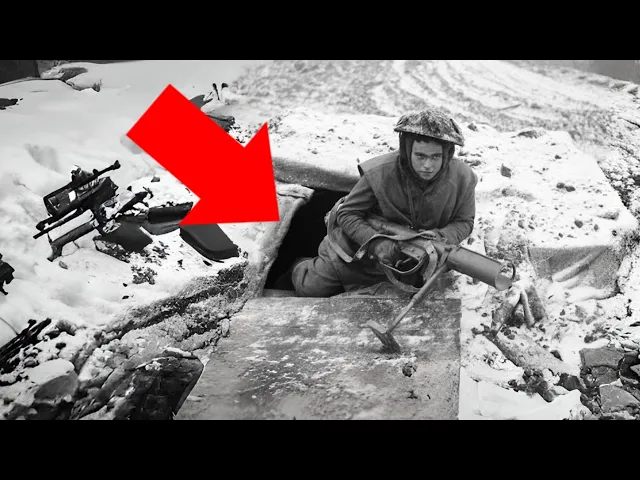
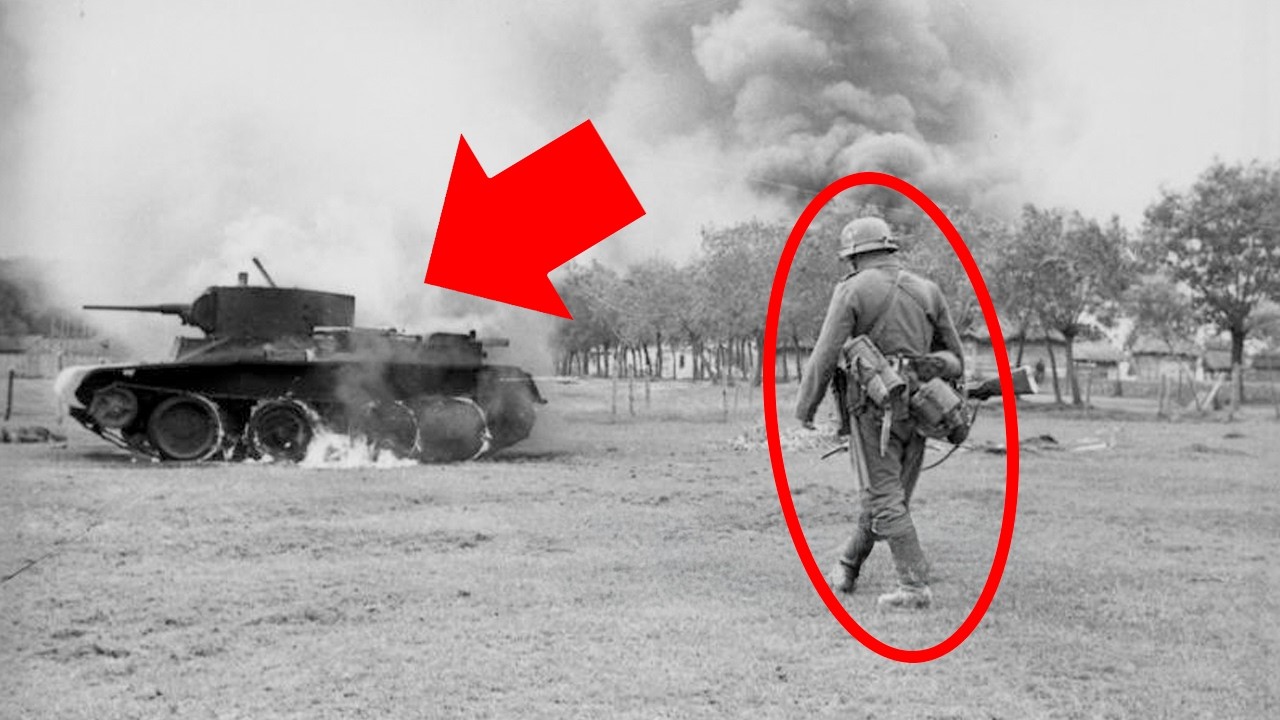
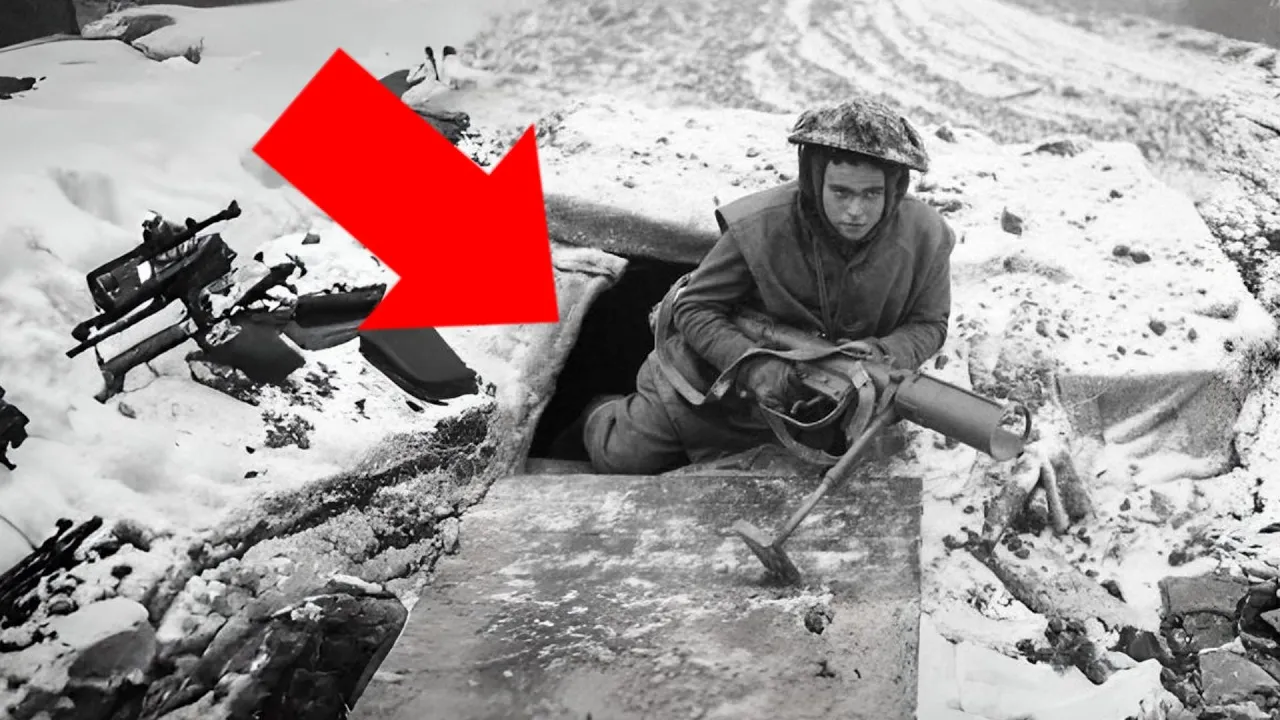
Ernest “Smokey” Smith crawls through the rain-drenched night, his uniform caked with mud. It is October 21, 1944, and the bad-boy private and the rest of the Canadian Seaforth Highlanders have just made it across northern Italy’s treacherous Savio River, its banks close to bursting from the torrential downpour. Now, they have the perilous task of establishing a bridgehead before the German army can counterattack.
Suddenly, Smith feels the earth tremble as three Mark V Panther tanks loom through the misty darkness towards the exposed Canadians. But that’s not all - the Panthers have two self-propelled guns and thirty bloodthirsty soldiers in tow. Smith and two comrades race across an open field through a hail of gunfire to set in position their PIAT anti-tank weapon.
Leaving one man with the PIAT, Smith, and Private James Tennant rush for another, but no sooner do they grab it than Tennant is hit by machine gun fire and crumples to the waterlogged ground. Smith is on his own now, one man against the might of the German war machine. If the enemy realizes they’re facing a single soldier, he’ll surely be annihilated in seconds.
Smith may have been demoted nine times, but now it’s his chance to be a hero. In full view of the enemy, he skids to a halt just thirty feet from the Panther bearing down on him. Smith grits his teeth, and he takes aim with his PIAT.
He knows he only has one chance… Here at Dark Docs, we know the power of a well-told story. But bringing those stories to life through video? That's a battle in itself.
That's where our sponsor InVideo AI comes in – your loyal comrade in video creation. InVideo AI is the world's most used AI video creator, trusted by over 10 million users across 150+ countries. It's not just another editing tool; it's your creative partner that handles the heavy lifting, allowing you to focus on what matters most – presenting compelling narratives.
Just watch this. We typed in some instructions in InVideo AI to create a three-minute video about the Fall of Saigon. Then we gave InVideo AI a few moments to do its thing, and this is what it came up with.
If that’s what InVideo AI is capable of with just a short and simple prompt, just imagine what it could do with more specific ones. Even better, you can input your own script and InVideo will take it from there, producing a finished video by itself. And if you don’t like what it gives you, you can always regenerate with one simple click.
There’s also a handy edit command box where you can give text-based instructions to make alterations to your video. For example, you can change the voiceover to another language or until you find the perfect narrator to tell your story - it could even be you! That’s right - you can tell InVideo AI to generate the voiceover using your own voice.
You can try InVideo AI for free, but if you're serious about video creation, the paid plan is what you need. Starting at just 20 dollars a month, it removes the watermark, gives you access to voice cloning, and unlocks high-quality stock footage. It's like having a full production team at your fingertips, for a fraction of the cost.
Go to the link in the description and use our code DARKDOCS50 to get twice the number of video generation credits in your first month. Try InVideo AI today and start creating your own captivating visual stories! Ernest Alvia Smith was born on May 3, 1914, in New Westminster, British Columbia.
In high school, he showed great promise as a runner; regularly burning up the track and leaving his rivals in a cloud of dust, he earned the nickname “Smokey. ” However, by the time he graduated, the Great Depression was in full swing, and Smith, like many others, struggled to find steady employment. Bouncing between a series of odd jobs, he had plenty of time to earn a reputation as something of a troublemaker.
Little did anyone know that this rough-around-the-edges young man would one day become a national hero. When World War 2 broke out, Smith saw an opportunity for a steady paycheck and an all-expenses-paid trip to Europe. He initially planned to sign up with the Air Force, but on learning he would have to wait six months, he changed his mind, believing the war would likely be over by then.
Instead, on March 5, 1940, at the age of 25, he joined the Canadian Army’s Seaforth Highlanders regiment, knowing they were due for deployment soon; sure enough, within a week, he was on his way across the Atlantic. However, when he donned the Seaforth uniform, which honored the regiment’s Scottish roots with the inclusion of a traditional kilt, his penchant for mischief didn't disappear. In fact, it seemed to intensify.
Training and Early Military Career Smith quickly gained a reputation as a soldier who was as skilled at getting into trouble as he was at fighting. Smith later explained his attitude towards military discipline, saying: [QUOTE] "I didn't take orders. I didn't believe in them.
" Despite his rebellious nature that often left his superiors shaking their heads in frustration, Smith's natural talent as a soldier was undeniable. He showed great promise during his initial training with the Royal Canadian Regiment in Toronto and continued to excel in advanced instruction at Camp Borden, his aptitude for soldiering evident even as his attitude remained a constant source of exasperation for his officers. In July 1943, Smith prepared for his first taste of combat as the 1st Canadian Infantry Division joined the Allies’ amphibious landing near Pachino, Sicily.
Their arrival was nothing short of intense. The rough seas made the approach treacherous, and at one point, it seemed unlikely that Smith and the rest of the troops would make it to shore as their landing craft was tossed around violently by the waves. However, once they hit the beach, there was no time for hesitation.
As soon as the entire unit had landed, they immediately pushed forward into enemy territory, marking the first successful Allied landing of the war and the beginning of the grueling Italian campaign. The fighting in Sicily was brutal, with the Canadians facing seasoned German troops in challenging terrain. Despite the chaos of battle, Smith found himself thriving in the combat environment, demonstrating a cool head under fire and a knack for survival.
His natural talent for soldiering shone through as the Allies pushed north onto the Italian mainland. The Seaforth Highlanders fought their way through increasingly fierce battles, with Smith always in the thick of the action. However, Smith's prowess on the battlefield didn't erase his tendency for insubordination.
His commanding officers found themselves in a constant state of contradiction when it came to Smith. His bravery and combat effectiveness couldn't be ignored, often leading to recommendations for medals and promotions. Yet, his disregard for military discipline off the battlefield resulted in frequent demotions.
In total, he was promoted to corporal nine times, only to be demoted back to private each time for various infractions. As the Allied forces continued moving northward through Italy, the fighting escalated to new levels of ferocity. The German forces, under the command of Field Marshal Albert Kesselring, were determined to make the Allies pay for every inch of ground.
The mountainous terrain of Italy favored the defenders, and the Allied advance was slow and costly. Smith and his fellow Seaforth Highlanders found themselves in the thick of some of the bloodiest fighting of the campaign. They battled their way through places like Ortona, known as "Little Stalingrad" for its brutal urban combat.
The battle was grueling, with combat taking place at extremely close quarters as soldiers were forced to fight block by block, often house to house. The Canadians resorted to a tactic known as "mouse-holing," using explosives to blow holes through walls, allowing them to move from building to building without exposing themselves to enemy fire in the streets. This claustrophobic style of fighting tested the soldiers to their limits, with danger lurking around every corner and behind every wall.
In May 1944, Smith and the Seaforth Highlanders faced one of their toughest challenges yet: breaking through a formidable series of German defenses south of Rome known as the “Hitler Line. ” The line was heavily fortified with concrete bunkers, anti-tank ditches, and extensive minefields. On May 23, the Canadians launched their assault.
As Smith and his fellow Seaforth Highlanders advanced through a maze of bunkers and minefields, a German MG42 machine gun suddenly erupted from a camouflaged position. Its lethal fire pinned Smith's platoon to the ground, the air filling with shouts and the sharp crack of bullets. Assessing the situation quickly, Smith saw his chance.
Inching forward on his belly, grenades in hand, he used every dip in the terrain for cover as bullets whizzed overhead. Reaching a position yards from the bunker, Smith pulled the pin and hurled a grenade. As the explosion rocked the bunker, Smith lobbed two more grenades in quick succession - he wasn’t taking any chances.
As the smoke cleared, the machine gun lay silent. Thanks to Smith’s impressive act of courage, his platoon was able to advance. Following the capture of Rome in June 1944, the Allies continued their push north.
The next major obstacle was the Gothic Line, another series of German fortifications stretching across Italy from coast to coast. The fighting here was some of the toughest of the entire Italian campaign. The terrain was rugged, the weather often miserable, and the German resistance fierce.
Yet Smith continued to distinguish himself, his combat skills and courage earning him grudging respect even from officers who found his behavior exasperating. By October 1944, the Allied advance had reached the Savio River in northern Italy. The Seaforth Highlanders were tasked with establishing a bridgehead across this formidable obstacle.
On the night of October 21, Smith's unit attempted the crossing under nightmarish conditions. The Germans had destroyed all bridges, and relentless rain had turned the ground into a quagmire, causing the river to rise six feet in just five hours. This sudden swell made it impossible to bring tanks or anti-tank guns across to support the infantry, leaving them dangerously exposed as they faced the daunting challenge of securing a foothold on the far bank.
Despite these challenges, Smith and his comrades managed to cross the river and establish a position on the far bank. However, their relief was short-lived. They had barely consolidated their position when the Germans launched a fierce counterattack.
The Canadians faced an overwhelming force consisting of a trio of Mark V Panther tanks, accompanied by two mobile artillery units and approximately 30 foot soldiers. The night that had begun with a daring river crossing was turning into a desperate fight for survival. Smith sprang into action, dashing through enemy fire across an exposed stretch of land with two fellow soldiers to get their PIAT anti-tank gun into position.
One man stayed with the PIAT while Smith and Private James Tennant crossed the road to obtain another. However, moments after acquiring the second PIAT, Tennant was badly wounded by machine-gun fire from one of the German tanks. Isolated and alone, Smith knew it was up to him to halt the enemy's advance.
At a range of just 30 feet, fully exposed to enemy fire, Smith took aim at the Panther. He squeezed the trigger, sending the PIAT round streaking toward its target. The projectile slammed into the tank's flank, disabling it in a thunderous explosion.
As flames engulfed the Panther, ten German Panzergrenadiers leaped from behind its smoldering hulk. They charged toward Smith, their boots squelching in the mud, Schmeissers at the ready. Smith's hands flew to his Tommy gun, yanking it up just as the Germans opened fire.
The night lit up with muzzle flashes as Smith squeezed the trigger, his weapon chattering furiously. Four Germans tumbled mid-stride, their bodies thudding into the sodden earth. The rest, eyes wide with shock, scrambled for cover, abandoning their assault in the face of Smith's ferocious defense.
But the reprieve was brief. The ground shook as another tank lumbered into view, its main gun swiveling towards Smith's position. More enemy infantry swarmed from the shadows, their shouts mixing with the tank's thunderous engine.
Smith's Tommy gun clicked empty. Cursing, he dove into a nearby ditch, fingers scrabbling through the muck until they closed on spare magazines. Reloaded, he popped up again, unleashing a storm of lead that kept the advancing Germans at bay.
For hours, Smith was a whirlwind of action - firing, reloading, adjusting position. He shielded his wounded comrade with his own body, determination etched on his mud-streaked face. His relentless defense gradually wore down the resolve of the Germans, who seemed to believe they were dealing with several Canadian soldiers.
Smith later said: [QUOTE] "They must have figured there was a whole army there because they could have wiped me out in no time if they'd known I was practically all by myself. " As dawn broke, silence finally fell. The bridgehead was secure.
In the growing light, the scale of Smith's feat became clear: one destroyed tank, two knocked-out self-propelled guns, and numerous enemy casualties. Against all odds, one man had held back an army and, in doing so, opened the door for the Canadian advance. When asked if he had considered giving himself up to the Germans, Smith bluntly replied: [QUOTE] “No bloody way.
Wouldn’t even think of it. ” The Aftermath and Recognition Smith's incredible display of courage did not go unnoticed. His actions at the Savio River were deemed so extraordinary that he was recommended for the Victoria Cross, the highest military decoration awarded for courage in the face of the enemy in the British and Commonwealth armed forces.
On December 20, 1944, Smith's Victoria Cross was officially gazetted. The citation praised him for his: [QUOTE] "dogged determination, outstanding devotion to duty, and superb gallantry. " Shortly afterward, Smith was summoned to Buckingham Palace to receive the award from King George VI.
However, with his track record, his superiors were concerned that Smith would get up to his old tricks and miss his flight, so the night before, he was thrown in a Naples jail to keep him out of trouble. Smith later explained: [QUOTE] “They just wanted Smoky to be in the right spot. When I was first locked up, I was thinking, what the hell?
But then they gave me a couple of beers, and I was very happy. ” Having made it to the ceremony in one piece, Smith asked the palace guard what he was supposed to do when the moment came to meet the king. When instructed to bow from the hips, he responded: [QUOTE] “Oh Christ, you think I’m going to do that?
You’re crazy! ” Never one to do what he was told, Smith opted for a simple salute instead. After receiving the medal, he was instructed to keep it out of sight for three days to allow Canadian and British newspapers to break the news simultaneously.
Ever the rebel, Smith spent those three days in a London pub, celebrating heartily. When finally allowed to display his medal, he found he didn't have to buy another drink all day. This prestigious award was the pinnacle of Smith's colorful and courageous military career.
As the only Canadian private to receive the Victoria Cross during World War 2, his achievement seemed particularly fitting given his history of repeated demotions. Smith's recognition stood as a powerful reminder that extraordinary valor can emerge from the most unexpected sources. After receiving his Victoria Cross, Smith returned to the front lines.
Despite his new status as a war hero, he remained the irreverent, tough-as-nails soldier he had always been. He continued to serve with distinction through the final months of the Italian campaign and into the last push through Holland and Germany. As the war in Europe drew to a close, Smith found he had somehow emerged not only alive but a certified hero.
Yet, true to form, Smith maintained his humble, straightforward attitude. When asked if he had any hard feelings towards the German soldiers he had fought against, he replied with characteristic frankness, saying: [QUOTE] "Why should I? They had a job to do, too.
Hope they got more than 60 cents a day. " After the war, Smith initially left the military but re-enlisted in 1950 during the Korean War. Because of his iconic status as a Victoria Cross recipient, he was not put into combat.
He retired from service in 1964 after serving for some time in Vancouver as a recruiting sergeant. Canada's last living Victoria Cross recipient, who had held this unique status since 2000, passed away on August 3, 2005, at 91 years old. This war hero received a full military funeral in Vancouver, befitting his exceptional service.
In a rare honor, he became one of only nine Canadians ever to lie in state in the House of Commons foyer, allowing the nation to pay its final respects. Dark Docs would like to thank InVideo AI for its sponsorship. Remember, you can double your amount of video generation credits in your first month by following the link in the description and using the code DARKDOCS50.
Take your videos to the next level today with InVideo AI!