It's January 2006, the president of Rockstar Games, Sam Houser and his team of lawyers enter the FTC headquarters in Washington, D. C. What he doesn't yet realize is that he's going to spend the next nine hours being exhaustively questioned by government investigators who earlier seized tens of thousands of internal company documents.
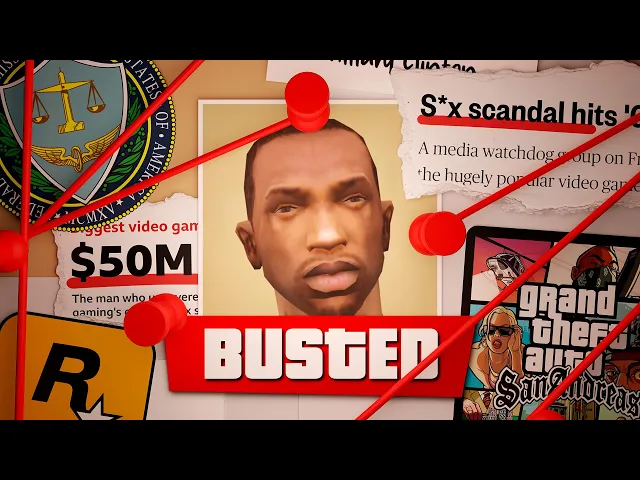
Why Sam Houser is at the Federal Trade Commission in the first place is part of a bigger investigation. An investigation backed by a majority of Congress that would eventually cost Rockstar and Take-Two almost $50 million. Just a year earlier, Rockstar had celebrated the successful launch of San Andreas, a game that pushed all limits.
But there was one small issue. The game was perhaps a little too realistic. "This bill will prohibit the sale of violent and sexually explicit video games.
" "It's a game that's already controversial. " "A resolution that urges the Federal Trade Commission to investigate the video game Grand Theft Auto. " "Keep them out of kids' hands.
" Back to 2004, Rockstar just released their next entry in the GTA series, San Andreas, which quickly became the best-selling game of its time with near-perfect reviews, but it also attracted unwanted attention, which would ultimately change the course of Rockstar's future. In an email sent on July 14th, just a few months before the game's release, Sam Houser sent an approval letter to Jennifer Kolbe, who was the company's operation director at that time. In the email, Sam outlined several examples of graphic content that will appear in San Andreas.
At the time, the sexual content he described was already being developed at Rockstar North as a part of an effort to exceed people's expectations and to include more role-playing elements into the game. He stated that these minigames would only be presented in a humorous way and would fit the overall vibe of the game. He also acknowledged that these additions might be questionable to some people, but considered it normal since the game was targeting a mature audience anyway.
He concluded with, "I know this is a tricky area, but I want to find a way for this to work. " In Sam's eyes, Sex was the final frontier for video games as it was already long normalized in the movie industry. It seemed like the "natural" progression, as he explained to Jennifer.
Adding to it, obscuring it from the world of San Andreas would be a betrayal of the game's vision. She responded to Sam's email with concerns, stating that the ESRB, which is the organization responsible for rating video games in the US, Canada, and Mexico, would likely push the game from its original 17-plus Mature rating to an 18-plus Adults Only rating if Sam proceeded to include the sexual acts, which would result in sales loss as retailers are unwilling to stock Adult Only games. In other places, for example, most of Europe, the game was nonetheless receiving an 18-plus rating due to stricter laws.
This left Sam with a choice, either cut the minigames or risk losing money. He responded with, "The cuts are everywhere. It doesn't feel like we're pushing any boundaries now.
Why bother? " Yet a month later, Sam agreed with Jennifer Colby to make changes to ensure the Mature rating. The sex scenes that are in San Andreas currently are going to be considered graphic.
Jennifer followed up with a list of cuts that had to be made to guarantee the rating. Rockstar's co-founder at the time, Terry Donovan, also demanded alterations that devs had to make to ensure the rating fell in line across all markets. At this point, San Andreas was just weeks away from release, making more cuts meant the game wouldn't hit its release date.
Sam responded shocked by the list of new cuts that had to be made. "Why bother? I really, really do not want to change this stuff.
" An emergency meeting was called to find a solution. Sam was left with no choice but to remove the content from the game before it hit the shelves. However, there was just one problem that wasn't easy to solve.
Completely removing these acts from the game would break the wider functionality of the game's code. An alternative solution was suggested. Instead of removing the content, the team could hide the minigames in the code, making it nearly impossible for the players to access them.
As Sam said, "We locked it away because there was no other way to get the game done on time safely. The impact of yanking something late is too scary. " And so, San Andreas was successfully launched on its intended release date with the mature rating for the PlayStation 2.
No problems arose until its PC launch. Since it's much easier to alter the game code on PC than on consoles, modders went right into the game files looking for anything interesting they could find while also planning the mods to create. This is how a group of modders, including Patrick Wildenborg, discovered several character animations, intrigued by how they were named.
Patrick was just a casual gamer who had become fascinated by the rise of game modifications. With all the mods other people are creating, and with his own software engineering background, it wouldn't be that hard to start creating mods himself. And so he did.
San Andreas didn't release on PC immediately, so Patrick bought a PS2 to play the game and start inspecting the files. As soon as he and his friend group of other modders started looking through the code, Patrick noticed several oddly named animation files referring to sexual acts that weren't linked to any in-game strip club or other suggestive places. Another modder named WaterDuck verified that these were indeed sexual acts by previewing the animations in another software.
After this discovery, they posted their findings on a private modding forum and kept it a secret to the public. However, it wasn't until Patrick dug deeper to find out these animations were not just scrapped content, they were fully functional mini-games. The only issue was that he couldn't test them on the console.
We had no option to try it out on the PS2, so we would never know. The PC version arrived seven months later, and to Patrick's surprise, it still contained the animations and code to make it work. Just a month after the PS2 launch, Sam Hauser emailed the then-game producer Leslie Benzies regarding the PC version to explore any additional content ideas and see how far they can push boundaries.
Benzies agreed and replied, "We will get the stuff back in the way it was. " Now their plan for the PC release was to offer two versions, one with a mature 17-plus rating and one with the 18-plus adults-only rating, while not everyone on the team was happy with it. In another email, Sam wrote, "Yes, we will go to places you other wouldn't even consider.
" Despite this, there were still concerns of an intense backlash if the PC version was pushed too far, and in the end, it was decided to play it safe and ship the version in the same state of the PS2 version. Sam had initially planned to release a patch that would unlock the scenes. He described it as a "unlock the darkness patch," but it obviously never released after the PC launch since Patrick and his friends already managed to unlock the hidden sex minigames themselves shortly after the release on PC, and would later go on to upload these files as a mod for everyone to download on June 9.
They named it the Hot Coffee Mod. Patrick later described how he came up with the name inspired by the in-game dating mechanic. After successfully dating one of the six girlfriends, they would invite CJ in for some "coffee," and a cutscene would play outside the house with some muffled sounds.
The mod would replace this cutscene with an inside shot in the many playable minigames, although characters were fully clothed in all scenarios. Hot Coffee was the first mod for GTA San Andreas, and immediately the most controversial game modification ever. Models like these take a lot of time, and they wouldn't be possible without today's sponsor, RP Grand.
If you're looking to immerse yourself in a vast open-world game on mobile, RP Grand could be something for you. In this world, you can become anything. The possibilities are endless.
Whether you take the business route, join law enforcement, or become the boss of your own world while hanging out with your friends on this giant map, the choice is yours. The game is packed with thousands of unique elements, regular updates, and an active online community ready to help you out. You can even create and grow your own family in the game, or join an existing family from the discovery list.
You can start playing RP Grand for free by downloading it on your smartphone using the link in my description. Also, if you're a new player, don't forget to use my promo code "MMIRP" to receive a free car to start your journey with. On the same day the Hot Coffee mod launched, Sam Houser discovered the mod while browsing on a forum.
At that time, the mod had already racked up a few thousand downloads, and several public figures had already issued a press release condemning the ESRB for not properly rating the game, which only attracted more downloads and more public attention on the matter. In disbelief, Sam called the Rockstar New York headquarters since he wasn't at the office that day, but nobody answered. Perry Donovan instructed the PR team to "lay low" and not answer any phones because it's going to get ugly.
With no one answering, Sam emailed Leslie Benzies asking if the mod would cause any problems since Sam found the mod pretty cool. No one was really sure, until a month later. The news became widespread in the mainstream media and several press releases were issued warning parents of the mod's existence.
Shortly after, the ESRB was notified and launched an investigation to determine if their rules had been violated. Patrick was now getting overwhelmed by the amount of attention this story was getting. The Dutch TV camped outside his house while the American mainstream media were constantly trying to call him.
Patrick said that this hugely affected his family life and had to disable his phone to get some peace. He became concerned about the implications for his family and career, therefore he refused to give any interviews at the time. Even a team of lawyers was put together in case Patrick's company's name would get involved in the drama, but fortunately it never got to that point.
To avoid further media sensation, the site hosting the mod took it offline and Patrick posted a statement on his website, making it clear that the mod was only accessible by altering the game code. None of the scenes were accessible straight from the game and none were created by the modders. The day after Patrick's statement, Rockstar's PR team also broke silence for the first time in a press release, blaming the hot coffee situation on "hackers" who went out of their way to access the hidden content.
This was Rockstar's attempt to avoid larger repercussions by blaming it on the modders instead of holding themselves responsible for not removing the content earlier, even going as far as saying that the employees who worked on these scenes were no longer in the company. Rockstar's refusal to fully address the matter was poorly received by the industry and the modding community. They later admitted that this was the wrong strategy.
In an interview, an employee at the time said that blaming it on the modders was a colossal PR screwup. "It was a complete disaster. We lied.
" Whether modders were at fault or not didn't matter to the ESRB. Following their investigations, they changed the game's rating to 18 plus adults only. This led to Australia banning the sale of the game and America's largest retailers removing it from their shelves with Rockstar recalling copies and suspending production.
After the recalls, Senator Hillary Clinton became involved and politicized the issue by urging for more regulation by introducing an act that aimed to protect children from violent and sexual video games, which later on failed. At this time, the U. S.
House of Representatives voted to launch an FTC investigation after Hillary called for immediate action. The Federal Trade Commission oversees consumer protection and the investigation was launched to determine whether Rockstar intentionally misled the ratings board. "By merely wrapping, rather than removing the adult content, Rockstar knew that it would inevitably be made widely available.
" Finally, on August 11th, Rockstar would release a patch that removed all of the game's controversial content allowing the game to revert back to its M rating. The FTC later invited Sam Hauser to answer questions for nine hours. He recalls this moment as an almost crushing point.
"I felt those people were out to crush us, and if they could have crushed us, they absolutely would have. " The investigation would last a year before concluding that Rockstar and Take-Two were at fault. While the FTC did not find them, they received a warning stating that if they violate the rating rules again, fines will be handed out.
Take-Two and Rockstar agreed and pledged to be more transparent about their ratings in the future. However, several lawsuits dragged on for years and finally settled in 2009 for a little over $20 million. It's estimated that around another $25 million were lost in sales due to the bans and rating change.
The legal issues were finally over for Take-Two and Rockstar and the hot coffee mod controversy was finally behind them after four years. Rockstar Games never directly addressed this controversy. Instead they ended this hectic chapter in a comedic way by adding Easter eggs, one of them being in GTA 4, where they changed the Statue of Liberty to mock Hillary Clinton holding up a coffee cup referencing her involvement in the drama.
Later in 2015, the BBC even made a documentary film about the controversy, with Rockstar criticizing the production and tweeting this. Looking back at these events, Patrick had little regrets publishing the mod, stating that someone else would have found the code anyways. Most felt a sense of injustice regarding how Rockstar got treated.
"Because why would a 17-year-old be allowed to beat up anyone while running over pedestrians, yet the line was drawn as sex. It baffles me how America finds two people making love more damaging than all the violence," said Patrick later. Rockstar would like to forget this chapter.
Hot coffee was a too distressing subject to talk about, yet the code of the minigame reappeared in the trilogy remaster when it released, which led Rockstar to take the game offline for a moment. Dan Houser shared in an interview that hot coffee was draining and upsetting, a tough time in the company. "We never felt like we were being attacked for the content.
We were being attacked for the medium, which felt a little unfair. " Although Rockstar blamed one of their most dedicated fans for the incident, they never held Patrick or anyone personally accountable. Instead, they respected how Patrick handled the situation and media attention.
During the incident, they called him in the middle of the night. Half-awakened by the ringing, Patrick picks up the phone and hears a New York accent speaking on the other line.