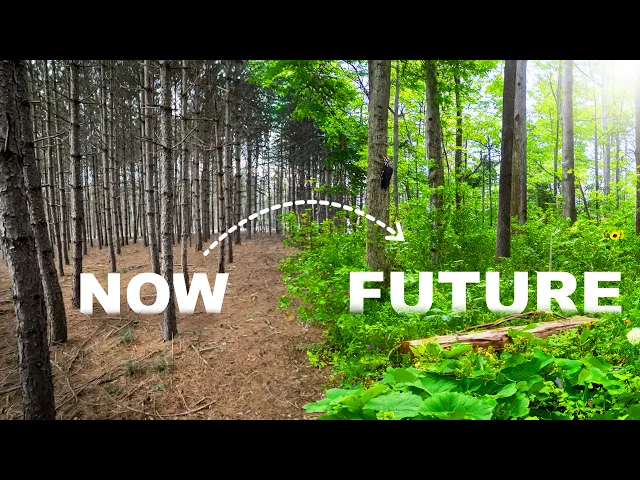
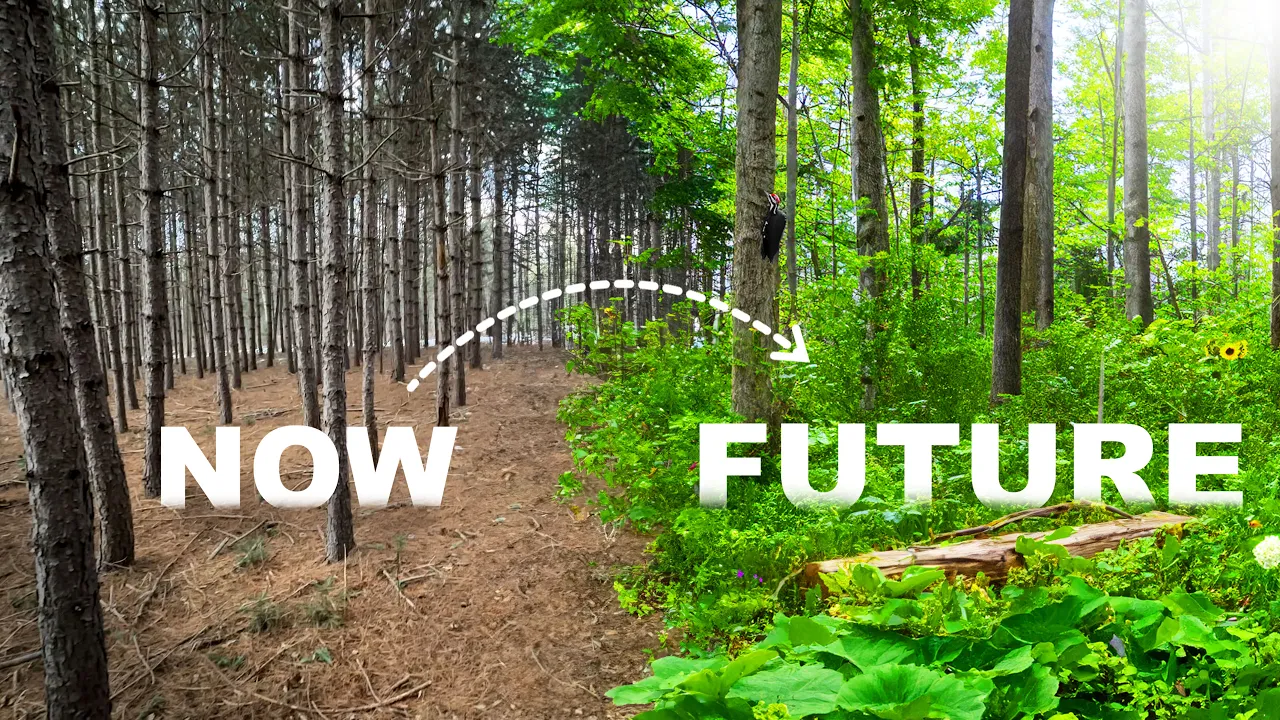
Year 2 has officially begun on The Wildlife Homestead and we're kicking it off with what's probably going to be the biggest project of the year. Converting this planted pine stand into a diverse, wildlife hotspot. Since we moved here last year, I knew that I'd eventually want to do something to improve this two-acre section of forest.
Row after row of pines spaced tightly together, blocking most of the sun from reaching the forest floor doesn't scream "thriving ecosystem". But I wanted to do my due diligence and take the first year to observe what was using this pine stand before I started making any changes. What I found in this first year was a very quiet forest.
There weren't any birds nesting here and the understory vegetation was really lacking. The best growth was along the edges of the forest where some light was getting through, and even at that I think I would consider it pretty sparse. We did have a handful of red squirrels that would hang out in here and the odd bird foraging or passing through.
But when I compared it with the rest of the property and how busy the other patches of forest were, I confirmed what I initially thought - that this planted pine stand would be a broken system. While Red Pine is native to our region and does offer benefits, a dense planting like this lacks the diversity and structure to support more wildlife. I mean, just looking up you can see how weak the crowns are and how little cover they're actually providing.
Now, I will say that this is by design. This area was obviously planted with the intention to harvest the timber and for that purpose this is a great setup. But my goal with this patch and with the property, in general, is to have a healthy productive forest to benefit as much wildlife as possible.
To achieve this, we need diversity and complexity from the canopy to the understory. That means filling this area with native trees, shrubs, grasses, forbs, snags, downed logs, brush piles, and wildlife boxes. Don't get me wrong, a uniform monoculture pine stand does support some species but it's lacking many of these elements.
And I think it's far from the best we could do. So in December, I slowly began to thin the pines to breathe new life into this forest. This is what the area looked like when I started.
You can really see how dense some sections are but there is one spot where a few larger trees were removed some time ago. This allowed enough light in for these poplars and some smaller shrubs to grow in this opening. So the idea is to replicate this in the thicker areas to get more sunlight to the forest floor and stimulate new plant growth.
My goal is to keep the biggest, healthiest Red Pines and remove the rest. Then in the growing season I'll come in and replant the area with productive native trees, shrubs, and wild flowers that we don't already have growing on the property. That way the wildlife will still get the benefits from the pines as they grow taller, thicker crowns and produce more cones.
All while our new plants are establishing and filling in the gaps below. I also want to keep any tree or shrub that isn't a Red Pine, but those are few and far between so no matter what I'll still need to plant more trees. There's four large ones that I'm really excited to keep - two Tamaracks and two Spruces.
We really don't have that many trees of this size and with their wide spreading branches, the pines haven't been able to fill in the space below them. So each of these trees has their own little micro habitat beneath them where some shrubs and forbs have been able to grow. Another element I want to include within this forest is a wildflower meadow.
We do have a good variety of flowers dotted around the property, but we don't have a dedicated area for pollinators. I didn't see any monarch butterflies last year, so I'll include plenty of milkweeds to try to attract our first ones. The meadow was the first area I got started on, and I knew it would require full sunlight for the flowers to thrive so I began by expanding on the existing clearings.
I won't bore you with all of the cutting, it's pretty repetitive work. Just notch, drop, and cut into sections. I'll use the branches to make brush piles and I have a bunch of ideas for ways to use the wood for different wildlife projects that I'll share throughout the series.
But I do want to leave a fair bit of it on the ground to start breaking down and feeding the soil. I'll be honest, doing this work was pretty hard. Not because of the physicality, but because of the birds.
It was an incredible year for seed and cone production on The Wildlife Homestead. I thought our first year was a good year for wintering birds, but I had no idea how low those numbers were. Just as an example, if you watched the older videos one of my targets was an Evening Grosbeak.
When I finally got them last year, there were about a dozen and I was over the moon. But this year, day in and day out we had over 300 of them filling the forest with their loud, burry calls. And they would be mixed in with hundreds of Pine Siskins, Redpolls, Goldfinch, Red and White-winged Crossbills.
At the front of the property we even had over 200 Snow Buntings and they had a pretty sweet setup. They would just hang out on our roof and whenever they felt like it, they would come down to feed on some cracked corn. A lot of these birds weren't feeding in the pine stand unfortunately.
Most of the pines are in a tight race to overtake the ones next to them. And putting energy into cone production instead of growing taller, could mean the difference between life and death. So the majority of them didn't produce cones, but the ones along the edge of the stand and in the open did.
Which tells me once I give the other trees enough space and sunlight, they'll also be able to produce this valuable winter resource for wildlife. Hindsight is 20/20, but if I had known when we moved here that this winter would be so productive, I may have been tempted to start thinning the pine stand in year one. But I can't go back in time, so I tried my best to both thin the pines and take breaks to look for wildlife.
I had a loop that I would do to check on things and the first stop was always right beyond the pine stand where I'd have a small group of Canada Jays that would come to visit me. Chickadees, which we'll see a little later, are known to be curious birds. But in my experience Canada Jays take that curiosity to another level.
Over hundreds of years they've showed they're more than comfortable to live alongside people. Their fearlessness around humans and their willingness to exploit food sources left unattended have given them the nickname "Camp Robbers". Which I think is a testament to their intelligence and their resourcefulness to find food sources in cold Northern climates.
So it only took this trio a few days to figure out that I was the one filling the suet feeders. And from time to time they would visit me to collect the suet tax. While walking the trails I'd also look around for any new tracks.
We had a very mild winter with far less snow than last year. This is a shot of the forest pond at the peak of winter in 2023, you can see how high the snow is on the posts. .
. and this is from our peak this year. Having less snow meant the wildlife didn't depend on our trails as much.
So although we had even more tracks than last year, they were all over the place which made it a little bit more difficult to get trail camera footage. But I'm still happy with the mix of species that we got. Just beyond the forest pond, I would check on the Barred Owl boxes that I built this winter.
It's very unlikely they use them this year, but in Spring when young Barred Owls fledge and search for territories of their own, I'm hoping they claim one of these boxes. I also had another frequent stop nearby to spend some time with a chickadee pair that I've gotten to know since moving here. I finally gave them nicknames Dot and Twoey.
Twoey got its name by being the only Chickadee to always try to grab two seeds at a time. Twoey is also a little more carefree than Dot. Usually Chickadees will grab a seed and fly to a nearby branch to crack it open.
But Twoey has no issues with sitting on my finger and using it as a stick instead. Dot on the other hand is shy. It'll quickly grab a seed and take off.
I came up with the very original name Dot because of the small white dot it has behind its right eye. It's subtle but most Chickadees look almost identical so I'm always searching for tiny differences to distinguish them, whether that's through visual or behavioural differences. My last stop on my breaks would be at the apple trees up front.
I've mentioned several times that one of the elements our property is really lacking is winter fruit. So I wanted to do an experiment this winter to see how much wildlife we can bring in if we keep the apples in the trees instead of harvesting them. And I'm happy to report this was a raging success.
From September to March these trees have been magnets for birds and mammals. They even brought in a new species to The Wildlife Homestead - the stunning Bohemian Waxwing. The apples also kept a pair of Wild Turkeys around for the winter.
These two have been here since the summer and they lived quite peacefully for many months. But with snow accumulating and resources diminishing, and with the breeding season around the corner, I could see the dynamics were starting to shift. It started with a few displays but nothing too serious.
Then a couple of days later it turned into an all out brawl. I've never seen turkeys fighting this close and I doubt I'll ever get a better view than this. This is right outside of my living room window.
At first they tried striking each other with the sharp spurs on their legs. After a bit of back and forth they eventually locked beaks and this part of turkey fighting can be pretty brutal. In this case, one of the turkeys was completely inside the other's beak and it looked like it had a hold of its tongue.
The whole fight lasted about 3 minutes - two of which were with locked beaks. The loser took off into the bushes and was never seen again and the dominant male now patrols our property alone. So this is what my winter looked like.
As I continued to thin the pine stand, I slowly started to see the area take shape. Once the snow melted and I could see the ground I began building a trail system using some of the pine logs. These will rot over time and provide plenty of habitat for insects, salamanders, and fungi.
I left little gaps between the logs for smaller wildlife to move in and out of and it seemed to already pay off because I found the first garter snake of the season moving along these logs. I like to think that this trail will become a little highway for small animals to travel through the new forest. I also collected a lot of the branches to make large brush piles.
Brush piles are probably the quickest and easiest habitat to build, especially for this area that didn't have a lot of cover to begin with. These piles will instantly give refuge to Red Squirrels and birds, and I've already noticed more Sparrows using this forest. I know brush piles are a little unsightly but one thing I've done in the past to improve them is to plant vines at the base of the piles.
Over time the vines will take over and it'll turn a dead brush pile into a living one. And if I plant something like grapes it could also provide some fruit. But I'm thinking I'll start with flowering vines for the hummingbirds and pollinators.
Speaking of, for today's video I'm focusing on the middle section of the pine stand. I still have some cutting to do on either side of it, but I have enough cut in the middle to start working on the wildflower meadow. I plan to both seed and plant plugs in the meadow using a few dozen species native to the Northeast.
But before I can throw any seeds down, I have to deal with this thick layer of pine needles that have collected here over the decades. Our seeds will have the best chance if they have good contact with the soil, so I started raking up all of the branches and needles. None of this will go to waste, I'm keeping them in piles to use as mulch for some of the trees and shrubs that I'll be planting that can tolerate the acidity.
Once the needles were cleared, I measured each section to figure out how much seed I needed. There's three different sections that are intersected by the trails. They each get varying degrees of sunlight, so it'll be interesting to see the species composition in each patch.
The seeds that I'm using I've been collecting over the past few years, so they can be anywhere from 6 months old to 3 years old. Because of that, I'm not too sure how viable some of them are but I won't find out unless I use them. The terrain is mostly flat but there are little mounds that are drier and small depressions that hold more moisture.
So by using many different species and casting a wide net, I'm increasing the odds that something will take. I then mixed the seeds with some sand so they can spread more evenly while using the seed spreader. I wanted to make sure the seeds had good contact with the soil so I did a few passes with a weighted roller to press them firmly into the ground.
I checked the weather forecast before I seeded the meadow so I could time it with the rain. Although I usually don't trust the weather network, seeing ants building mounds around their nest was all I needed to know that a good rain was coming. So the seeds have been spread, pressed, and soaked into the ground.
It's now a waiting game until we get the first ones to germinate. Since the Red Pines cover most of the area around the front of our lot, I figure this series should include everything that's going on from the beginning of our property to just beyond the pines. Because the changes we make to the pine stand will also affect which species we're seeing around the house.
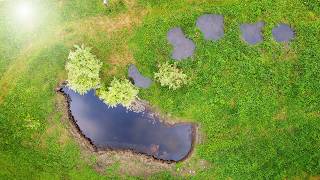
This is just the beginning of this new series, there's still a lot to do. In the next episode, we'll be digging a vernal pool for breeding amphibians, continuing work in the pine stand, and checking in on the first nesting birds of the season.