Since the 1960s, art has made from ecology, not only a subject of revolt, of indignation or concern, but also a medium going so far as shaping entire ecosystems or restoring them. Ecology is the combination of natural environments' sciences with the dynamics of life, political commitment, and culture. Artists can work within it in three ways that will lead them to leave the museum environment, to work in the field.
In this first modality, artists do not leave their natural environment, which is the exhibition space. But it is from this ecosystem that they will produce works, metaphorical or symbolic that will often shed a critical light, on the deteriorating relationships between our civilizations and Earth. The idea of nature carpets came to Piero Gilardi as early as 1964, when he became aware of the pollution of one of the rivers in his hometown, Turin.
Rather than illustrating the problem, he proposes the idea of reproducing a healthy and vital form of nature, except for one paradox, that of making it in polyurethane foam, a material derived from petrochemicals, and dangerous for the environment. With this flexible and colorful material, relatively new at the time, Gilardi made rugs on which visitors were allowed to stretch and to connect with endangered environments. With visionary awareness, the artist took an interest in relatively banal bits of nature, counter to the environmental policies that were obsessed by the protection of exceptional wild spaces.
Today, although these nature carpets can no longer be bought by the meter, and no longer tread with tenderness and fun like in the 1960s, they remain powerful demonstrations of the cultural shaping of nature as we have only recently come to realize it. In his apocalyptic diorama, Tetsumi Kudo also rang the alarm bells warning from the pollution that marked the beginning of the 1970s while criticizing especially, the drift of energy progress, embodied by nuclear power. The subject was then a growing concern in Europe and in Japan, a country still traumatized by the atomic bombings of 1945.
Kudo expresses his environmental angst mixed with anticipation, by grafting realistic replicas of human limbs onto plastic plants. The result, is a tragico-comical undead garden in which plants triumph. This disenchanted and anxiety-provoking overthrow of authority, which reduces the human body to a simple prosthesis is not, however, completely pessimistic because it leads to thinking about a world of alliance and fusion with a denatured nature.
Certainly, it's a "decomposing humanity" as Kudo puts it, but he sees his proposal more as a "little model for our New Ecology" as he would write in 1971. Artists of the 1970s proved to be particularly sensitive to ecological issues, covering all subjects. Hans Haacke, and before dissecting the political-financial ramifications of art institutions that invite him to exhibit, was interested in the environmental context of museums himself.
In Krefeld in 1972, he even uncovered an environmental scandal which he then revealed in a complex installation on the pollution of the Rhine water. This work consisted of a prototype of purification made with coal and sand. It made the water pumped from the river, suitable for goldfish, in a time where it was common to see large quantities of poisoned fish, floating on the surface of the Rhine that year.
Haacke completed this installation with a visual and numerical investigation revealing that the city of Krefeld had just discharged in 1971, 42 million cubic meters of dirty water into the river. And while the system modeled by the artist was not developed on a large scale its exhibition in the museum of this German city, however triggered a series of journalistic investigations and allowed a civic awareness characteristic of ecological works. Serving nature, protecting it, and denunciating its critical situations, is exactly what Brazilian artist Frans Krajcberg has been busy working on both on the ground, in the Brazilian Amazon rainforest as well as in museums.
By making sculptures out of burnt tree trunks or hollow mangroves, Kracjberg wanted to show the diversity and the resilience of life, while denouncing the plundering of natural resources. Reviewed today in the context of massive deforestation that the Amazonian forest is undergoing, this sculpture titled "Ecology Fragment #5", constitutes an even more poignant and truly precursory testimony to this accelerated disappearance of biodiversity. As we have just seen in this selection, installations or sculptures can offer, from within the spaces of art, a critical and sensitive point of view on multiple fields relating to ecology.
This variety of topics and causes fosters very diverse approaches, without imposed ideological or formal canons. There is no artistic movement or trend forming per se since these may be one-off engagements. With this approach, ecology has asserted itself for fifty years as an essential theme in art.
Ecological art, on the other hand, is distinguished by actions undertaken on the ground, which appeared in the 1970s. In this decade of great protest, environmental activism was a mode of action and mobilization for many communities. Works of this period thus borrowed the vocabulary or the gestures of the protest movements to generate impactful images, often showing the artist standing alone like a sentinel of the environment.
Joseph Beuys was one of the pioneers of the genre, in 1971, the year Greenpeace was founded in Vancouver, and while fully dressed, and wearing his famous felt hat, he swam through the muddy waters of a swamp. These ecosystems were then threatened by the possibility of drying up, all over Europe, since they were perceived as nauseating spaces. Yet their ecological function was fundamental, and this is what Joseph Beuys was aware of.
Without an audience, and only captured by the lens of Gianfranco Gorgoni, the artist underwent this performance like a ritual, rather than a well organized militant protest. These images have become the symbols of an artist's body and soul commitment to the environmental cause. Moreover, Joseph Beuys subsequently helped to create the green political party in Germany, going so far as standing for election.
Amidst images and slogans, Ágnes Dénes would also produce, ten years later, her project "Wheatfield a confrontation" which would become a model of its kind. This punchy action was intended to inform the public the deep imbalance existing between environmental issues and economic interests. For four months, the artist and a few volunteers worked tirelessly to make a plot in southern Manhattan fertile and nourishing.
The plot's surface was one hectare, and it was valued at 4. 5 billion dollars at the time. The fruit of the harvest, 500 kilograms, was the equivalent of 158 dollars only, a sum calculated from the price of raw materials set on Wall Street a few streets away.
The pitch for the artist's campaign was to rely on this absurd ratio, in regard to the long efforts that had to be made to grow this grain on the very impoverished soil of the city. The photographs that made the greatest impression showed Ágnes Dénes alone in her field. They have become the symbol of the fight against the financial powers, and still question today, the relationship between nature and ultra-urban areas, as well as the cause and effect links, between ecology and market economy.
This is precisely the kind of equation that is at the center of another performance, more recent this time, which shows the relevance of this type of actions and reactivates a powerful imaginary of the struggle. While the image might appear to be the result of skillful photomontage, Julian Charrière actually traveled to Iceland and surveyed icebergs which he torched for eight hours. This performance, as exhausting and absurd as it is intrepid, demonstrates our contemporary societies' dependence on hydrocarbons, interspersed with a reflection on the devastating effect of human actions, on the deep times of Earth and ice.
Julian Charrière delivers no moral for those who watch him indulge in this sacrilegious gesture, but rather questions the physical distance that separates us less and less from the catastrophe that is happening. This distance, or what art can or cannot do for ecology, is precisely at the heart of the mission that ecological art gives itself. By this label, we designate a pioneering, but still poorly known American movement which developed from the 1960s, and whose ten or so members are still active today.
The group's mode of action is concrete, marked by science more than activism, while seeking to solve specific environmental problems. The couple formed by Helen Mayer Harrison and Newton Harrison thus developed the hyperbolic project of the "Lagoon Cycle", to think about saving a small mangrove crab species from Sri Lanka. For ten years they studied cooperatively with the Scripps Institute of Oceanography in San Diego, the animal's lifestyle, its reproduction habits, its natural and cultural environment, and the geopolitical issues that surround its fishing.
Deployed in seven painting-series, this fresco, more than 100 meters long, is made up of 60 parts of the subject which goes far beyond the zoological question and the Sri Lankan territory alone. With maps, drawings, photographs, diagrams and a hand-written dialogue, the Harrisons crafted a sensitive storytelling that is ultra-detailed that still sets standards in the field today. Their work led to thinking about crab farming on a global scale in a combination of data correlated with perfectly functional systems that are always validated by science.
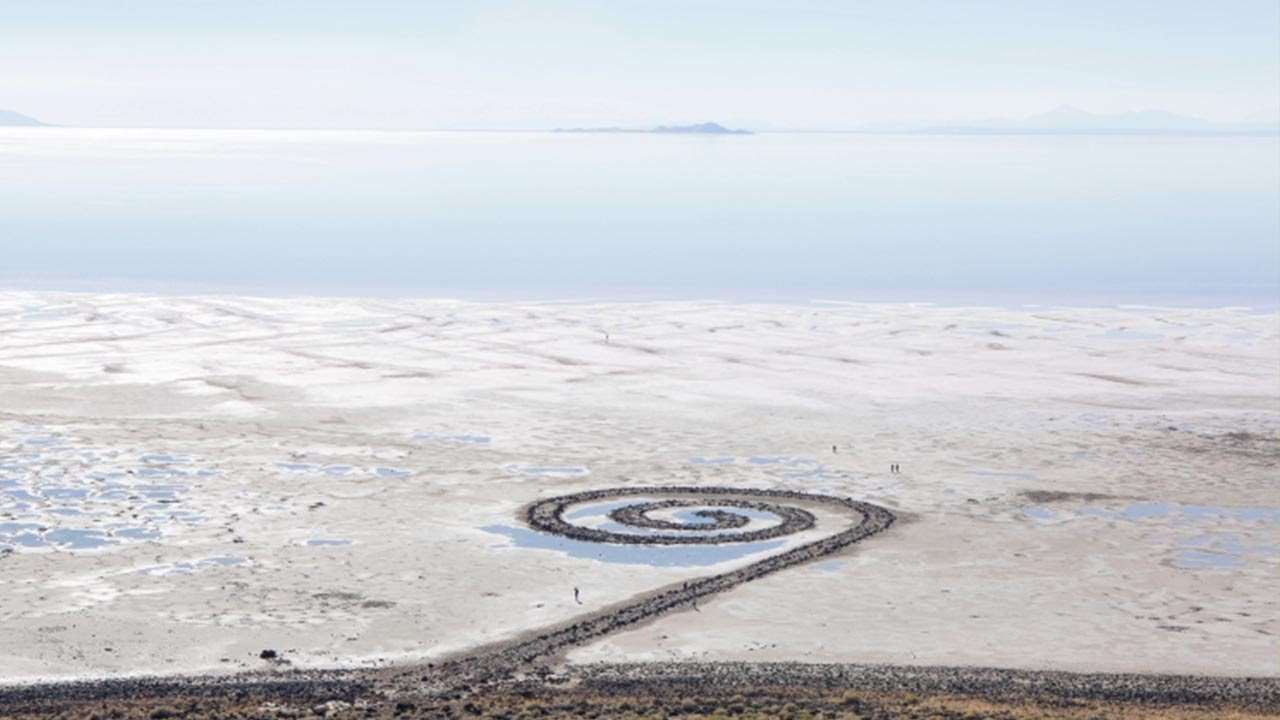
Such expertise, both artistic and ecological, is also recognized in another representative of the ecological art, Patricia Johanson. Her first major project was completed in Dallas in 1986, and constitutes an eloquent demonstration of this art, capable of restoring the ecological health of environments, previously corrupted by urban pollution. Far from being an isolated work of Land Art in the middle of the desert, "Leonhardt Lagoon" is a recreational park situated in the heart of Texas, in addition to being a biodiversity reserve.
The design of the banks and walkways is taken straight from two plants endemic to Texas, and combines environmental utility with viewing platforms for park users. It only took a few years for the place to become a popular stopover for migratory birds, and endemic species. While Johanson's art was exhibited only during the preparatory phases as with this drawing of "Sagittaria Platyphylla", on the ground, it demonstrates everyday, its vitality and concrete action at the service of human and non-human life.
Since these pioneering examples of ecological art, other generations of artists have also developed their expertise by serving communities or ecosystems. Olafur Eliasson acts both from the museum territory with immersive installations and from the ground, with humanitarian and ecological works. In 2003, some two million visitors experienced the "Weather Project" at the Tate Modern in London.
The experience of an artificial half-sun made of tungsten lamps accompanied by London's fog, was that of a proxy meteorology, of a frozen and saturated solar cycle, against nature. It made the beholder oscillate between a feeling of fullness and a loss of reality and connection with the "true" nature outside. The ecological message was metaphorical while being based on climate science.
From this in vitro project, Olafur Eliasson has developed another climatic action this time very concrete. "Little Sun" is a small solar lamp that was marketed as an art duplicate in the West. For each copy sold, another was intended for communities without access to an electricity network.
Thus, a dozen countries on the African continent would benefit from this logistical and artistic support. This project initiated with engineer Frederik Ottesen in 2012 has since grown to have 1. 4 million of these small lamps distributed In order to contribute to the development of knowledge in the communities, while reducing CO2 emissions.
"Little Sun" demonstrated intercontinental solidarity capable of combining humanitarian and ecological action. The approach to ecology in art has therefore expanded since the 1960s, based on a sincere concern for the survival of nature, which has led artists to engage, to protest and then to act, to restore lost alliances and think of practical solutions in order to actively contribute and affirm in this way, the relevance of artistic creation in the ecological field.