The future of education has arrived and it's called Chat GPT. This language model is redefining the way we learn and is already shaking the structures of the educational system. With GPT Chat, say goodbye to long hours of reading and research and forget about paying so much for courses and schools.
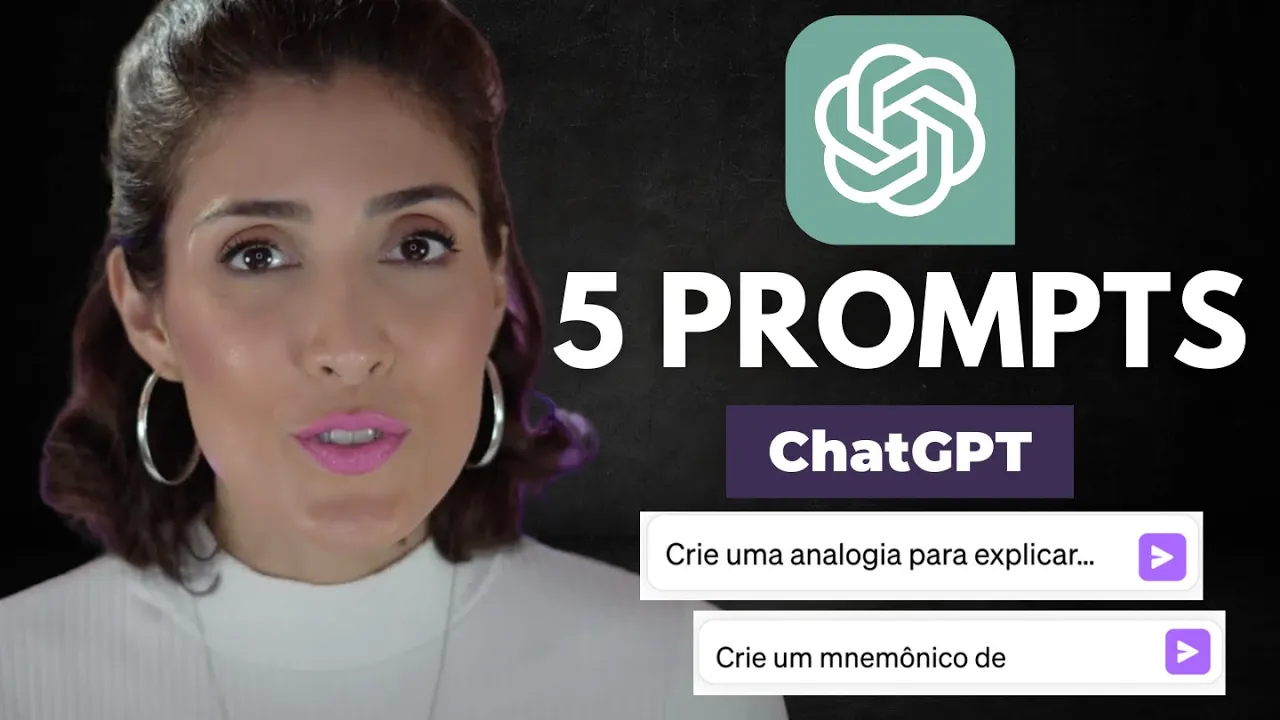
Artificial Intelligence is here to guide us on a more efficient learning journey, with personalized tips and deep insights on exactly the subject you want. And in today's video I'm going to show you 5 powerful prompts to enhance your studies, simplify those complex concepts and help you retain those memorizations that fall on the Enem or entrance exam. Think about it!
It's your own tutor, 24 hours a day and who knows everything about the internet. Ready to discover how to make the most of it? Come with me.
The first prompt will be useful when you get stuck on a concept or some detail of the subject that is difficult to visualize or difficult to understand. So you come here and type. Explain coefficient of restitution for a child.
And, does it need to be 5 years? No, it could be a 10 year old child. And then he comes up with a really good analogy about the rubber ball, the clay ball, and it really makes you understand and visualize this concept better.
So, that is, first prompt, explain something to a 10 year old. And if this explanation of 10 years is too complex, you ask for 5 years, 7 years and understand. A slightly similar prompt would be to ask for an analogy.
So you can ask for an analogy to understand intermolecular forces. So London's strength will be the velcro. You, with a slight pull, can easily separate them.
Now the strength of Polo de Polo. Think of a zipper. It is stronger than Velcro and requires more effort to open.
Now the hydrogen bond. A padlock with a key. A much stronger and more secure closure than a zipper or velcro.
Interesting, isn't it? And this type of analogy helps you to better capture this information, because you have a visual parameter, you have an idea of how these intermolecular forces work, or whatever other subject you are studying. And so you can play with GPT Chat until you understand a concept.
So, is it very difficult? Explain it to a child. Or do you already understand better?
Go for an analogy or ask for another explanation. And so it can be faster and easier than watching multiple videos or reading multiple texts. And to create these prompts I needed to play a lot here, and one that I've been playing with was afferent and deferent nerves.
And you can start by asking a 10- year-old child for an explanation, but then after you see the explanation, if you think, hmm, but even then I think I 'm going to get confused with this name, and now how can I memorize it? And then we enter prompt 3. But let it end here.
And here you discover that afferents bring information to the brain and efferents send it from the brain to the rest of the body. But then you're thinking, wow, I'm going to forget that, I'm going to confuse a with e and now you can ask for help to create a mnemonic that will help you remember afferent and deferent so look at bringing ed closer to distance getting closer to the brain and moving away from the brain he even gave you another scene to remember. So, that is, you can always ask for these mnemonics.
You can create for illnesses, so create a mnemonic. So you can ask for a mnemonic to remember diseases caused by fungi. Let's see what he comes up with.
Here. . .
Children love strawberries, they have curious habits, they prefer to explore. What? And then.
. . Go on.
What do you think? Or should we ask for another one? Every friend of mine has hobbies.
For example, climb. Oh, I liked this one! Every friend of mine has hobbies, for example, climbing.
That doesn't mean you're going to memorize with mnemonics alone, but it's a little help. And now the fourth prompt is a way to use GPT chat. It's often easy to get confused with the question and the GPT chat doesn't understand exactly what you want.
So here I wanted to show you examples of broad, very open-ended questions that don't use the GPT chat properly, to questions that are very targeted straight to the point and that will make better use of the tool. So here, for example, we can ask what is cell or what is evolution or tell me about DNA, what enzymes are, and okay, there's nothing wrong with that, it's not that broad, but you can use what you already know and get straight to the point . So here what are the differences between prokaryotic and eukaryotic cells, then here in ecology what is the difference between beginning and habitat, then the difference between glycolysis and Krebs cycle, then go deeper into the details and so you make the most of your time and learn more , but of course there isn't necessarily a problem here, it's just for you to try to be more direct, so one more example here in chemistry, for example, you can go there and ask what an atom is, but you can go deeper, understand all of this better.
So, for example, what is a chemical bond? This is often very broad, if you are straight forward, what is the difference between an ionic bond and a covalent bond in terms of electron sharing, for example. So, one suggestion is to try asking more direct and specific questions for what you want.
Here questions in physics, for example, how refraction affects the speed and direction of a wave, or what is the difference between conduction and convection in terms of heat transfer. So, the sky is the limit. The next prompt will be to avoid getting confused.
So remember with me the subjects that you are most confused about. So one for me was the amendment laws. So when to use the First or Second Amendment Act?
So you can ask him exactly that. You can ask a more open question like this, or you can say straight away, I get confused between Mendel's first and second laws, what can I do to differentiate? So, oh.
So you don't even have to wait for him to finish, I mean, he's still doing it here. So you can read this entire text or you can just ask to stop generating and ask another way, how to avoid getting confused between these laws. Let's see if the answer will be different.
So you can ask here and ask him to give you a short answer. So you can read and understand. Or you can ask for analogies too, or ask to explain it to the child, which is what we've already seen.
So here's the tip, he took a while, but he did it. If the question involves crossing organisms that differ in only one characteristic, use Mendel's first law. If two or more characteristics are involved, use Mendel's second law.
And finally, the last prompt is for you to talk to GPT to learn languages. So, for you to train a language you want. So, for example, it could be English or, in my case now, Dutch.
So, I can come here and ask to speak to me in Dutch. Suppose we just met and then you specify what you want. So start the conversation.
So let's see what will happen. And then you can respond. to respond.
And now he continues the conversation and you write, write, write. And then you can change his personality, you can tell him to be one way or another and from that you start talking in a more interesting way, this also means you write here. And then I'll make a second video with more prompts for GPT Chat.
Leave a two below, in your language, in the language you are studying, so it could be two, dos, zwei, deux. In the language you are studying, leave a two below and I will know that you want part two of this video. I hope you enjoyed it, that you learned a lot and now of course it all depends on you using and practicing all of this and we learn and get better over time too, so don't worry if at first it's difficult to use these prompts, which will soon You'll soon get the hang of it.
So good studies out there, good use of Chat GPT, keep chasing your dreams, one of the skills that only you have, and we'll see you in the next video. Goodbye!