His [Music] name was Eric. If you met him on the street, you might not notice anything unusual. He carried himself well enough.
He had a decent job. He was polite. And if you asked his friends, they'd probably say he was doing fine.
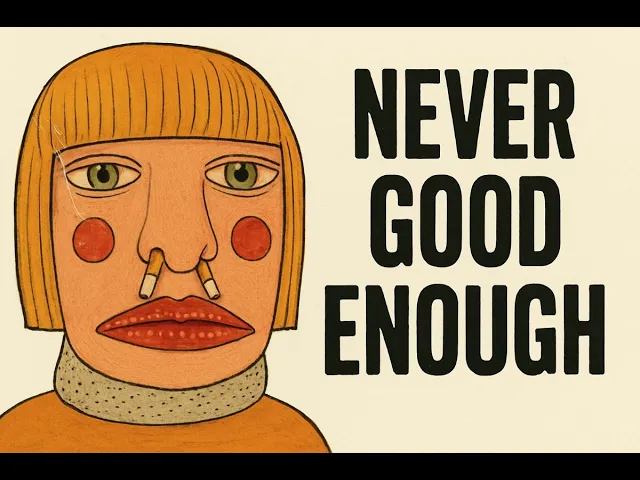
But what people didn't see was the quiet war happening inside his mind every single day. For as long as he could remember, Eric felt like he was always coming up short. Not failing exactly, just never quite enough.
Not enough for his parents who always compared him to his older brother. Not enough for his teachers who said he was bright but lacked discipline. not enough for his partners who seemed to grow distant over time, leaving him wondering if maybe there was something broken inside of him that he couldn't fix.
And the truth is, Eric's story isn't unique. It's painfully common. That noring feeling of inadequacy, of never quite measuring up.
[Music] That feeling of inadequacy is one of the quietest, most pervasive forms of suffering that so many people carry. It doesn't always show on the surface. It hides behind smiles, behind achievements, behind people who seem fine.
But inside it eats away at selfworth like slow acid. You know this feeling, don't you? That restless voice in the back of your mind that whispers, "You should be further ahead by now.
You should be stronger, smarter, better looking, more successful, more confident, more everything. " And no matter how much you achieve, no matter how much external validation you collect, it's never quite enough to silence it. Psychologists call this conditional selfworth.
It's the idea that your value as a person depends on whether you meet certain conditions. Grades, money, approval, appearance, performance. And when those conditions aren't met, you don't just feel disappointment.
You feel like you are the disappointment. Eric knew this feeling intimately. Every compliment rolled off him like rain on glass.
While every criticism cut into him like a blade. Praise felt temporary. Criticism felt permanent.
He could remember a mistake from 10 years ago more vividly than any success he had last week. And here's the part that's so cruel. This mindset doesn't just come from within.
It's cultivated almost engineered by the world we live in. From the moment we're children, we're measured, ranked, graded, and compared. The education system teaches us early.
Your worth is in your report card. Social media reinforces it. Your worth is in your likes and followers.
Consumer culture tells us your worth is in what you buy, how you look, how you perform. And so millions of people grow up like Eric, carrying an invisible yard stick that is always just a little too long. No matter how much progress they make, the line keeps moving.
It's important to understand something here. This isn't just a personal flaw. It's not simply that some people are insecure.
Statistically speaking, rates of low self-esteem and feelings of inadequacy have skyrocketed over the last few decades. Studies show that nearly 85% of people worldwide struggle with some level of low selfworth. Think about that.
8 out of 10 people you pass on the street are silently battling some version of not good enough. Why? Part of the answer lies in how our brains evolved.
Thousands of years ago, belonging to a group was literally a matter of survival. If you were rejected, if you weren't enough to contribute, your chances of survival dropped dramatically. So, the human brain developed a hyper sensitivity to rejection, comparison, and failure.
That wiring is still with us today. But now it's being exploited by modern systems. Schools, corporations, media, algorithms, all designed to make you question whether you're enough.
So you'll work harder, buy more, and stay plugged into the cycle. Eric didn't know all the science. He just knew that every day felt like running a race he could never win.
He would set goals, hit them, and instead of feeling proud, he would immediately move the goalpost further. He believed that if he just worked harder, pushed further, accomplished more, maybe then he would finally feel like enough. But of course, that day never came.
And maybe you know that same cycle yourself. You tell yourself, "If I just lose 10 lbs, then I'll feel confident. But when you lose it, you suddenly want 10 more.
" Or, "If I just get this promotion, then I'll feel successful. " But when you get it, you're already anxious about the next one. This is the treadmill effect.
You're running endlessly, but you never arrive. The pain of never being good enough isn't loud. It's quiet.
It shows up in hesitation before speaking up. In downplaying your achievements when someone compliments you. In apologizing too much.
In secretly resenting others successes because their light feels like a shadow over you. Eric's pain showed up in small ways, too. He would rewrite emails five times before sending them.
Terrified of sounding foolish, he would stay quiet in meetings, even when he had ideas because he thought they weren't smart enough. He would scroll through social media at night, comparing his behind-the-scenes life with everyone else's highlight reel, slowly sinking into that familiar heaviness in his chest. But here's the truth that Eric and so many of us struggle to realize.
The feeling of never being good enough is not proof that you're broken. It's proof that you're human in a system that constantly profits from your doubt. The very industries that feed you comparison are the same ones selling you the products to fix it.
It's not an accident. It's by design. Now, I want to pause here and make something clear.
I'm not saying personal responsibility doesn't matter. Of course, we should strive to grow, to improve, to become better versions of ourselves. Growth is beautiful.
Effort is meaningful. But there's a difference between striving from a place of self-love and striving from a place of self-loathing. The first expands you.
The second empties you. And this is the heart of the pain. When good enough becomes a horizon you can never reach.
Life turns into a perpetual chase. You're never fully present, never able to rest because you're always reaching for that next elusive measure of worth. Think about how exhausting that is.
Imagine carrying a backpack full of rocks everywhere you go. And each rock is a belief like, "I'm not attractive enough. I'm not smart enough.
I'm not successful enough. I'm not confident enough. " Over time, it doesn't matter how strong you are.
The weight will wear you down. Eric didn't even realize how heavy his backpack had become until one day after years of this, he woke up and thought, "I don't even know who I am anymore beyond this endless chase. " And that's the dangerous part.
The pain of never being good enough doesn't just wound your self-esteem. It erodess your sense of self. You start to believe that you are the inadequacy itself.
That you are permanently, fundamentally lacking. But here's something powerful. That belief, as convincing as it feels, is not the truth.
Neuroscience shows us that the brain is highly adaptable. The same neural pathways that reinforce self-criticism can over time be rewired to reinforce self-compassion. It's not easy and it doesn't happen overnight, but it is possible.
And historically across cultures, this struggle has been recognized. Ancient Buddhist philosophy, for instance, teaches that suffering often comes not from who we are, but from the illusions we attach to who we think we must be. Modern psychology echoes this.
Self-worth doesn't have to be conditional. It can be intrinsic. You can learn to see yourself as worthy, not because of your achievements or status, but simply because you exist.
But here's the catch. Recognizing this truth intellectually is one thing. Feeling it in your bones is another.
And that's where the real journey begins. Eric is still on that journey. And in the second part of this story, we're going to go deeper into what that journey looks like.
Why so many of us get stuck in cycles of inadequacy and more importantly, how to begin breaking free. Because here's the reality. The pain of never being good enough may be common, but it doesn't have to be permanent.
So, where do we go from here? If you've ever felt like Eric, if you've ever looked in the mirror and thought, "No matter what I do, it's never enough. " then you already know how heavy that burden is.
The question is not whether the pain is real. It is the question is how we respond to it. The first step is recognition.
You cannot change what you refuse to name. And so much of our suffering around worth comes from silence. We don't talk about it.
We hide it assuming that everyone else has it all figured out. But the truth is so many people are quietly carrying this same feeling. When you name it, when you say, "Yes, I struggle with feeling like I'm not enough.
" You bring the monster out of the shadows. And in the light, it loses some of its power. The second step is perspective.
Remember what we said earlier. This pain isn't just personal. It's cultural.
It's systemic. That means it isn't your weakness or defect. It's a predictable response to living in a society that thrives on comparison and conditional value.
And when you start to see it that way, the shame begins to lift. It stops being I'm broken and starts being the system is broken. That subtle shift can be life-changing.
But recognition alone isn't enough. You need tools, practical ways of retraining your mind and reconnecting with your sense of worth. Modern psychology offers several.
For example, studies show that practicing self-compassion, literally speaking to yourself as you would to a close friend, significantly reduces anxiety, depression, and feelings of inadequacy. Neuroscientists at the University of Wisconsin found that regular self-compassion exercises actually change brain activity in areas related to emotion regulation. In other words, kindness toward yourself isn't just sentimental, it's neurological medicine.
Another practice is what psychologists call reframing. This doesn't mean ignoring challenges or pretending everything is perfect. It means consciously shifting how you interpret events.
For instance, instead of saying, "I failed because I'm not smart enough," you might reframe it as, "Uh, I didn't succeed this time, but I gained knowledge I didn't have before. " This shift sounds small, but over time, it builds resilience instead of shame. But beyond psychology, there's something deeper at stake.
a philosophical truth that many traditions point toward. You don't have to earn your worth. It's not something external.
It's not something given to you by others. It's something that exists by the very fact of your being. Think of it this way.
A newborn child has value even though it hasn't achieved anything. Why? Because worth is inherent, not conditional.
And that truth doesn't vanish just because we grow older. It only gets buried under layers of expectation and comparison. Eric began to understand this slowly.
He started journaling at night, writing down not what he accomplished that day, but who he was in that day. Did he listen to a friend? Did he notice the sunset?
Did he show kindness even in small ways? Those became his quiet markers of value. And though he still battled the old voice of inadequacy, he also began to feel something new.
a whisper of acceptance. And that's the third step. Reorienting your measurement of worth.
Instead of chasing endless external validation, you begin to cultivate internal validation. You learn to define enough on your own terms. This doesn't mean giving up on goals or ambition.
It means refusing to tie your identity to them. You still strive, but from a place of curiosity and growth, not desperation. It's worth noting something here.
This isn't easy. It's not a quick fix. You don't wake up one morning and suddenly feel whole.
Healing from the pain of never being good enough is less like flipping a switch and more like tending a garden. It's daily work. Some days you'll forget.
Some days the old voice will be louder than ever. But over time, with practice, the soil changes, and what grows in it changes, too. Let's get practical for a moment.
If you wanted to start this shift today, what could you actually do? Here are three simple but powerful practices. The enough list.
Every evening, write down three things you did that made you enough today. They don't have to be big. It could be, I called my grandmother, or I got out of bed even when it was hard, or I smiled at a stranger.
Over time, this retrains your brain to notice value in being, not just in achieving. Comparison detox. Choose one day a week to intentionally step away from social media, advertising, or anything that bombards you with comparison.
Give your nervous system a break. Studies show that even short breaks from comparison-driven platforms significantly boost self-esteem and life satisfaction. Self-compassion break.
The next time you catch yourself saying, "I'm not good enough," pause and ask, "Would I say this to someone I love? " If the answer is no, then rephrase it into something kinder. This interrupts the old neural loop and plants the seed of a new one.
These sound simple, but simplicity is powerful when practiced consistently. Now, let's step back again and look at the bigger picture. The pain of never being good enough is not just an individual experience.
It's part of a collective crisis of meaning in the modern world. So many of us are so busy trying to prove ourselves that we forget to be ourselves. We confuse worth with performance and in doing so we trade the depth of life for the appearance of success.
But imagine a world where people lived from a sense of enoughness. Imagine students who pursued learning not out of fear of failure but out of genuine curiosity. Imagine workers who contributed not to prove their worth but because they already knew they had it.
Imagine relationships built not on insecurity and comparison, but on mutual respect and acceptance. That world may feel far away, but it begins in small personal choices. The choice to treat yourself with dignity, to define your own enough, to reject the endless race that never lets you arrive.
Eric is still on his journey like all of us. He hasn't silenced the voice completely, but he's learning to live alongside it differently. He's learning that worth isn't found in perfection, but in presence.
That the question isn't, "Am I good enough yet, but rather, can I allow myself to be enough right now as I am? " And maybe that's the question for you, too. Because the truth is, there will always be another standard you could chase, another comparison you could lose, another reason to feel inadequate that will never end.
But your ability to step out of that chase even for a moment to breathe to say I am enough here now without proving without performing that is where freedom begins. So if you've been carrying the weight of never being good enough consider this maybe the weight was never yours to carry in the first place. Maybe your worth was never something to be earned.
Maybe it was always something to be remembered. And if you can remember that even in glimpses, even in fragments, then the pain begins to soften. The chase begins to slow.
And life in all its imperfect beauty begins to feel a little more like home. Because in the end, you are not your achievements, your failures, or your comparisons. You are not the yard stick or the scorecard.
You are something far deeper, far older, and far more worthy than any of those measures could ever capture. You are enough. You always have been.