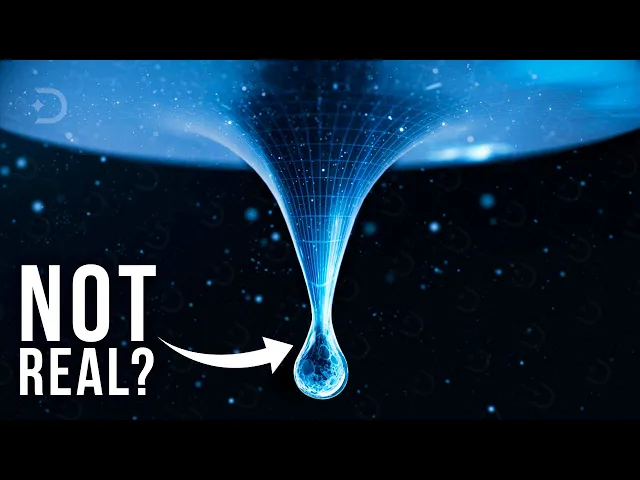
Here’s a black hole. We imagine it as an enormous, super dark region in space that pulls everything toward it. And once something falls inside, it is dragged to the central endpoint called the singularity, where everything gets squished, right?
But what if we told you that’s not exactly how black holes work? So what’s a singularity anyway? And what really is on the other side of the pitch-black curtain?
Get ready to discover a mind-bending world of black holes, where reality is way stranger than any fiction. Black holes are intricate space phenomena. Everything about them is complicated.
When a large star, about 10-20 times more massive than the Sun, exhausts all of its fuel, the balance between gravity and pressure breaks down, and the star collapses in on itself and goes supernova. The problem with our current understanding is that we use different theories to explain phenomena happening on different scales. There’s quantum field theory, which works well to explain intricate behavior of particles, ranging from atoms and down to the tiniest subatomic building blocks of matter.
Apply this theory to astronomical scales, and it’s of no use. For that task, scientists resort to Einstein’s General Relativity. Pick the right theory, and calculations generate correct answers.
But black holes are tricky. At first, they’re astronomical objects – large stars. And then, they quickly shrink to much smaller, sometimes quantum sizes.
For example, in order for the Sun to become a black hole, it would have to be squeezed to the size of just about 1. 8 miles [2. 9 km] in radius.
Theoretically, you can turn any object into a black hole. There’s a formula that tells us how much something has to be squeezed to become one. This threshold is known as the Schwarzschild radius, and if you wonder just how tiny our planet would have to be to turn into a black hole, imagine the entire Earth as a ball with a radius of 0.
35 inches [0. 88 cm]. But what if an object’s radius is 0?
Traditional calculations, both math and physics, become meaningless, and so we call this phenomenon a singularity. But does such a concept truly appear in the physical world? Let’s try to break it down.
Consider this thought experiment: if you wanted to make the simplest version of a black hole, you'd start with tiny bits of matter floating around in space. They don't push against anything, but just hang there. So, they're like small specks of dust floating very close to each other, without moving around much.
But in space, there's gravity, and so it starts pulling it all together, reducing space in between dust particles. Over time, little specks of dust start to squeeze tighter and tighter, eventually reaching a point where their combined mass and gravity grows so intense, space around them starts to compress. And this creates an event horizon – a kind of a boundary that lets things in but doesn't really allow anything to get out.
This type of a black hole is called a Schwarzschild black hole. It has mass, which is just how much stuff went into making it, but it doesn't have any electric charge or spinning motion. Now, think about what happens when you cross the event horizon of such a black hole.
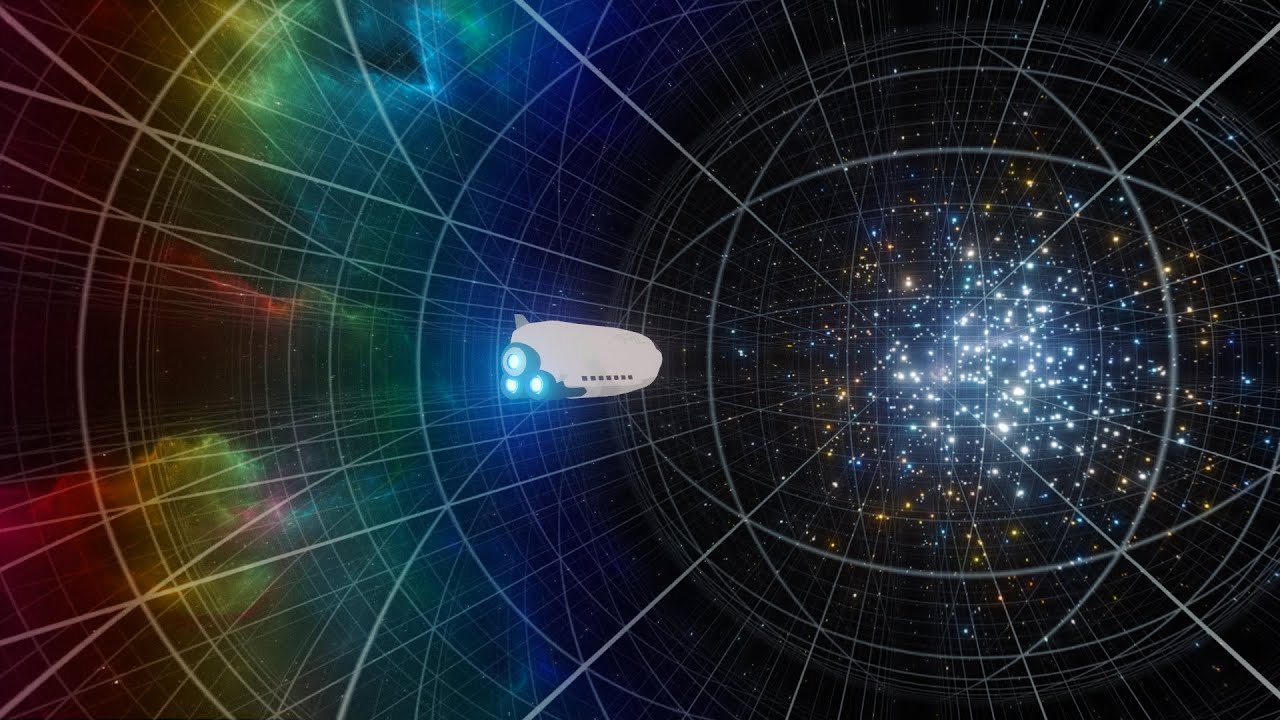
For the sake of experiment, let’s say it’s large enough for you to enter with a spaceship. Once in, you panic, and try to get out by firing thrusters to accelerate back out. Physics says that regardless of the direction the ship is facing, you’ll still be drawn toward the central singularity.
To understand this, imagine a long, narrow corridor with no way out except through a door at the end. Once you step into this corridor, the door shuts behind you, and there's no way to open it again. The corridor has a moving walkway, much like the travelator in an airport, and it's taking you forward at the speed of light.
No matter which way you try to move, either running in the opposite direction of the walkway, or moving sideways – you'll still end up being carried forward by the walkway. Or, at least, this is how scientists thought black holes acted. However, spacetime gets way more complicated when you have a mass which rotates, and so far, we only know about the existence of black holes that have angular momentum, or a spin.
They form from the collapse of rotating massive stars, and as matter collapses, the rotation is conserved, leading to the formation of a spinning black hole. Quantum mechanics was created to explain the strange world of miniature scales. But instead of giving us answers, it led to more uncertainty, like fluctuations in the fabric of spacetime.
And these quantum fluctuations play a significant role when it comes to event horizons surrounding black holes. Now, we've all heard that nothing can escape a black hole. But this is where things get tricky.
Near an event horizon, particles and antiparticles spontaneously pop in and out of existence, annihilating one other almost instantly. But what if one of these particles manages to escape the strong hold of a black hole? The late great Stephen Hawking explained this with his theory of Hawking radiation.
When a particle-antiparticle pair forms near the event horizon, one of them falls into a black hole while the other one escapes. And by doing so, the free particle steals energy from the black hole. If you give it enough time, and we're talking numbers impossible to imagine: 1068 to 10103 years, a black hole would evaporate completely, leaving nothing behind.
But if there’s nothing left behind, where does this infinite singularity go then? In the real universe, infinities do not exist or, at least, we haven’t found any yet. And so when scientists make calculations which lead to an infinity, it means that there’s something wrong with the theory – it’s too simple to be applied to extreme cases.
Imagine a guitar string, gently plucked at its resonant frequency. According to the simplest model of wave behavior, the vibration of the string would grow exponentially over time. In theory, it would vibrate past the moon, the stars, out to infinity, and then back.
But although this is what the model predicts, it's not what happens in reality. The fact that there's an infinity appearing in the model says it's oversimplified, and there are certain limitations. While working perfectly to explain string vibrations when they're small, you still need a better theory to avoid infinities.
So, what does this mean for our understanding of black holes? If singularities aren't real, perhaps, at the center of every black hole lies something entirely different, something beyond what we can fully grasp. But as always, scientists have some ideas.
According to Penrose’s theorem, singularities are inevitable in general relativity. Anything that moves in space, and is only experiencing effects of gravity, should follow a specific path – a so-called geodesic. Basically, it’s the shortest, most efficient path, both spatially and temporally.
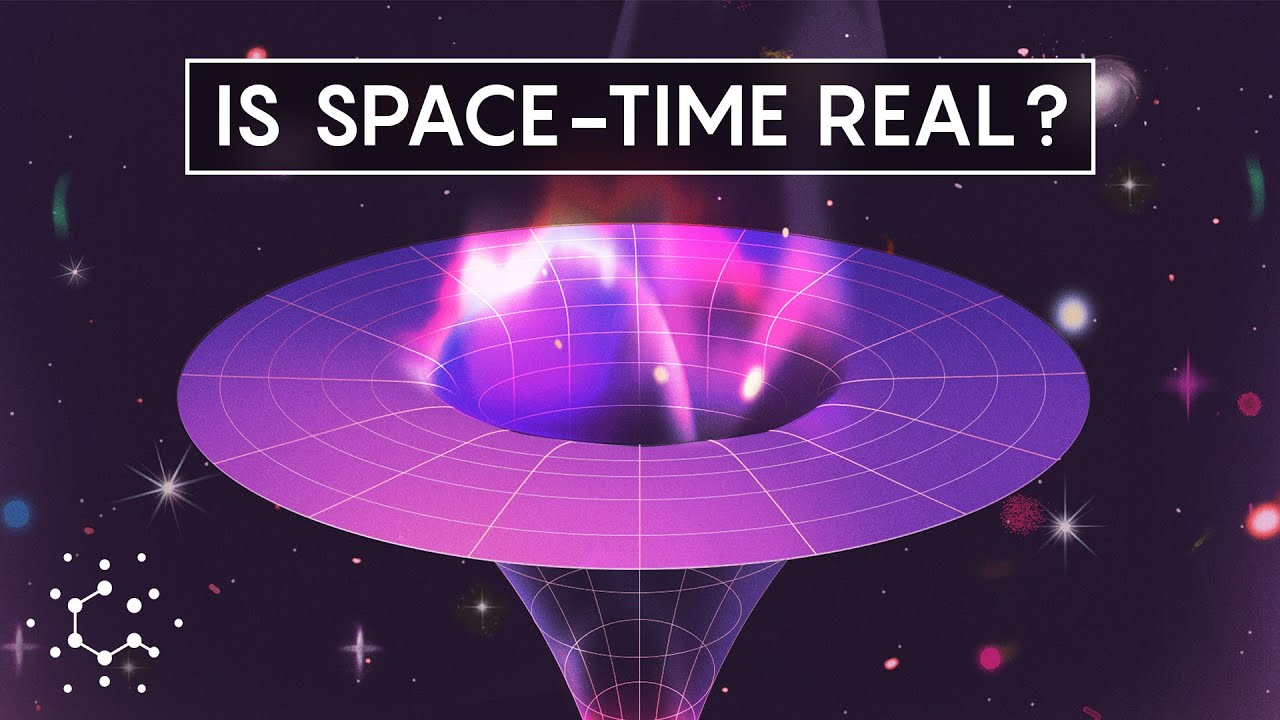
The idea is that all of spacetime is structured like that, the universe is one gigantic fabric, and its form is dictated by these geodesic lines, some of which are straight, and the other – curved. These paths are never-ending, just like a line drawn over a spherical object. But Penrose suggested that geodesics should converge inside black holes, ending at their centers, which means that paths of spacetime itself terminate, and you have a singularity or an infinity.
Stephen Hawking believed that this is how the Big Bang started – as a singularity, or in other words, geodesics that trace back to one single point. Although a recently published paper by Roy Kerr suggests a very different perspective on black holes. Rotation of matter changes everything.
Instead of a single event horizon marking the boundary beyond which nothing can escape, spinning black holes have two distinct horizons: an outer horizon and an inner one. These horizons are like invisible walls, marking the regions where the gravitational pull becomes too strong for even light to break free. Rotating black holes also have something called ergospheres – swirling zones surrounding a black hole where spacetime itself is dragged along by its rotation faster than the speed of light.
If you happened to be there, no matter how hard you’d try to remain stationary, it would be to no avail. In a way, these ergospheres are like whirlpools in spacetime, influencing the movement of nearby objects, which come in contact with each other, producing extremely bright light. Because of how insanely fast things move there, if an object managed to escape an ergosphere, it would leave with much more energy than it entered with.
In theory, this mechanism is the source of nearly limitless energy. Although learning how to extract it seems like an impossible task. And then again, there's still the singularity.
Although it doesn't have a point-like shape, but rather a ring-like structure due to the effect of angular momentum that smoothes it out. Here's a simplified way to visualize this: imagine a drop of paint falling onto a piece of paper. If the paper is stationary, the paint forms a single dot.
But, if you spin the paper fast as the drop falls, the paint spreads out, creating a ring-like shape. And so if matter falls into a black hole along this perplexing path, its path isn't like a simple circle that stays in one plane. Instead, it moves all over the place, kind of like a bee buzzing around in the air.
Over time, the particle's path fills up a three-dimensional shape. So, instead of sticking to a flat path, particles around spinning black holes move in all directions, painting a kind of doughnut shape in space. And particles attracted by a rotating black hole won’t just cross the event horizon, heading straight into the central singularity.
It's not like dropping a stone into a pond where it sinks straight to the bottom. Instead, it's more like tossing a leaf into a strong wind. The wind's swirling motion carries the leaf in all sorts of directions, sometimes pushing it closer to the ground, other times lifting it upward.
Called Kerr black holes, these spinning celestial monsters don’t have real singularities, and matter doesn’t necessarily end up falling inside their central singularities. Instead, past the event horizon, the centrifugal force creates an almost normal spacetime just around ring singularities, where objects can move in different directions, and they might be able to do so for a very long time. So what is this ring singularity then?
Basically, it’s a gravitational field inside a black hole – the product of a spinning object. But here’s a mind-boggling follow-up: a star that collapsed to form this black hole would still be there inside a dark space monster. Chunks and bits of the star follow the paths of geodesics, never ceasing to exist.
And even light would still be present there. Can you imagine a place like that? An almost perpetual centrifuge isolated from the outside universe, but one that has its own small world swirling around, and illuminated by ethereal light.
What do you think about this new perspective on black holes? Share your thoughts in the comments below. We hope you enjoyed the video.
If you’d like more fascinating discoveries about the mysterious world we live in, stay tuned here. Thanks for watching!

![The Insane Science of Neutron Stars [4K]](https://img.youtube.com/vi/qX6h72IyKSo/maxresdefault.jpg)



![Journey to the Andromeda Galaxy [4K]](https://img.youtube.com/vi/-ybiXR2WCFQ/maxresdefault.jpg)