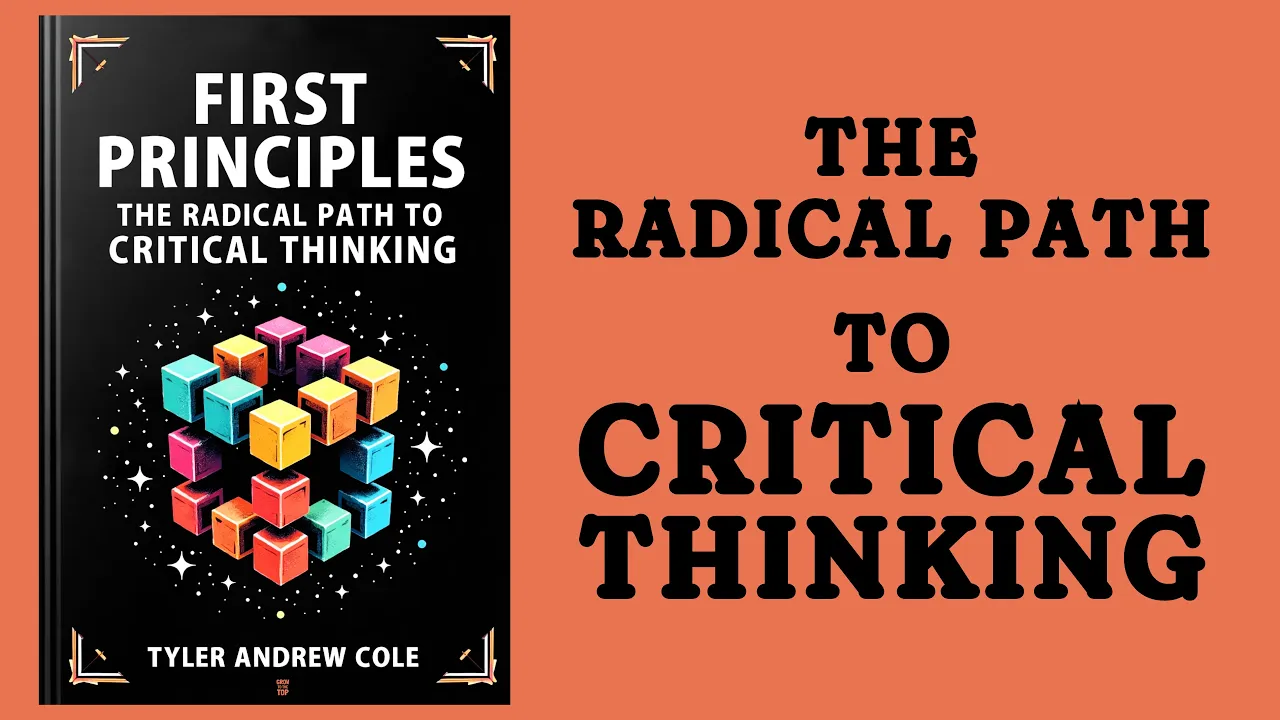
Ever felt overwhelmed by complexity the Audi book first principles the radical path to critical thinking unveils a powerful thinking method that cuts through the noise you'll learn to deconstruct problems challenge assumptions and think independently Master this and you'll solve problems others can't innovate effortlessly and make clearer decisions miss out and you risk staying Trapped in conventional thinking missing opportunities for breakthrough insights are you ready to revolutionize your thinking and unlock your full potential before we go on I invite you to download the free bundle which contains the ebook version of this book and an executive
summary of all the chapters with the key takeaways studies show that engaging with content through multiple formats significantly enhances learning and Retention click on the first link in the description to claim your free bundle now and maximize your learning potential now free but it won't be for long so make sure to grab it while you can chapter 1 opening the mind the essence of first principles in a world brimming with information where solutions to complex problems seem increasingly elusive a powerful tool lies dormant within each of us this tool when harnessed has the potential to
Revolutionize the way we think solve problems and innovate welcome to the world of first principles thinking a radical approach to critical thinking that has shaped the minds of History's Greatest thinkers and innovators as you embark on this journey through first principles the radical path to critical thinking you're about to unlock a transformative way of approaching challenges by the time you finish this book you'll have gained a Solid understanding of first principles thinking allowing you to peel back layers of assumptions that often Cloud our judgment you'll develop the ability to identify and challenge these assumptions in
everyday situations equipping yourself with a mental toolkit for deconstructing even the most complex problems but this is just the beginning as you continue to apply these principles over time you'll notice a Significant enhancement in your critical thinking abilities problems that once seemed insurmountable will become opportunities for innovative solutions your decision-making process will become sharper more efficient efficient and increasingly effective the Ripple effects of this newfound Clarity will extend into every aspect of your life from personal relationships to professional Endeavors at its core first principes Thinking is about stripping away preconceived notions and getting to the
fundamental truths of a matter it's a method of reasoning from the ground up questioning everything until you reach the Bedrock of a problem or idea this approach has been been employed by some of the greatest Minds throughout history from ancient philosophers like Aristotle to modern-day innovators like Elon Musk the significance of first principles thinking lies in its ability to break Through mental barriers and Foster true Innovation by challenging assumptions and approaching problems with a fresh perspective we open ourselves up to possibilities that may have otherwise remained hidden this method of thinking has led to groundbreaking
advancements in science technology and numerous other fields so what's involved in adopting this powerful mindset the Journey Begins with learning to strip away assumptions we'll explore techniques to identify and Challenge the biases that often color our thinking without us even realizing it this process of peeling back layers of preconceived notions is crucial in clearing the path for fresh unbiased perspectives once we've learned to recognize and challenge our assumptions we can approach problems with a clear unbiased mindset this fresh perspective allows us to see challenges in a new light often revealing solutions that were previously obscured
by our own Mental constraints these steps are carefully ordered to build a strong foundation for your journey into first principles Thinking by starting with the basics of identifying and challenging assumptions we create a solid base upon which to build more advanced critical thinking skills this logical progression ensures that you're well equipped to tackle increasingly complex problems As you move through the book The Importance of This foundational understanding cannot be overstated just as a house needs a strong Foundation to withstand the test of time your critical thinking skills need a robust base to tackle the challenges
that lie ahead by mastering these initial steps you'll be preparing yourself for the more advanced concepts and techniques that follow as we conclude this chapter you might be wondering how to put these Concepts into Practice how can you start seeing the world through the lens of first principles the next chapter Embrace inquiry will guide you through the first crucial step in your journey it will challenge you to question everything to dig deeper than you ever have before are you ready to embrace the power of Relentless curiosity before we continue make sure to subscribe to grow
to the top and activate notifications to receive more Self-improvement tips that will supercharge your growth and make sure to give this video a thumbs up and share it with your friends it really helps the channel grow thank you for your support chapter 2 Embrace inquiry as we embark on this chapter imagine standing at the edge of a vast unexplored Wilderness the path ahead is shrouded in mystery promising both challenges and Revelations this is the landscape of inquiry a realm where every step forward Is Guided by an insatiable desire to understand to uncover to know welcome
to the heart of first principles thinking inquiry is more than just asking questions it's a state of mind a Perpetual hunger for knowledge that fuels the engine of critical thinking it's the spark that ignites Innovation and the compass that guides us through the complexity of problem solving but why is inquiry so crucial to First principles thinking the answer lies in Its power to challenge the status quo to peel back layers of assumptions and to reveal the fundamental truths that lie beneath the surface of our understanding consider for a moment the greatest discoveries and Innovations throughout
history from the laws of physics to groundbreaking Technologies each Leap Forward began with a question a moment of curiosity that dared to challenge the accepted Norms this is the essence of inquiry in first principles Thinking it's not just about finding answers but about asking the right questions that lead us to deeper truths continuous questioning is the lifeblood of innovation it's through persistent inquiry that we uncover New Perspectives identify hidden connections and Forge paths to unprecedented solutions by embracing inquiry we open ourselves to a world world of possibilities that remain invisible to those who accept things
at face value but how do we cultivate this Spirit of inquiry it begins with nurturing our innate curiosity that childlike wonder that we often lose touch with as we grow older curiosity is the fertile soil from which meaningful questions Sprout it's about rekindling that sense of awe and fascination with the world around us seeing the extraordinary in the ordinary and never taking anything for granted to nurture a curious mindset start by observing your surroundings with fresh Eyes look for patterns anomalies and connections that you might have overlooked before challenge yourself to learn something new every
day no matter how small engage with diverse perspectives and ideas even those that contradict your own beliefs this constant exposure to new information and viewpoints will fuel your curiosity and Spark questions you never knew you had as you cultivate curiosity you'll find yourself naturally drawn to the art of Asking why this simple question is perhaps the most powerful tool in the inquirer's Arsenal it's the key that unlocks deeper understanding the Chisel that chips away at surface level explanations to reveal the core principles beneath asking why is an art form in itself it's not about asking
for the sake of asking but about probing deeper seeking the underlying reasons and motivations behind actions decisions and Phenomena when you encounter a situation or a problem don't stop at the first explanation keep asking why until you've uncovered the root cause or the fundamental principle at play however persistant questioning can sometimes meet resistance both from others and from within ourselves people may become defensive or irritated when their ideas or methods are constantly questioned you might find yourself hesitant to p P further fearing that You'll appear ignorant or confrontational overcoming this resistance is crucial for embracing
inquiry fully remember that your questions aren't a challenge to others competence but a genuine pursuit of understanding frame your inquiries as a collaborative effort to gain deeper insights rather than a critique when faced with internal resistance remind yourself that the temporary discomfort of not knowing is far outweighed by the Potential for discovery and growth to structure your inquiry process you can employ various questioning Frameworks one such framework is the five wise technique a simple yet powerful method for getting to the root of a problem start with a problem statement and ask why it occurs each
answer forms the basis for the next why question allowing you to dig deeper with each iteration for example let's say a Company is experiencing a high rate of customer complaints the five y's might look like this one why are customers complaining because orders are being delivered late two why are orders being delivered late because the shipping department is underst staffed three why is the shipping Department understaffed because of high turnover rates four why are turnover rates High because of low job satisfaction five why is job Satisfaction low because of inadequate training and support for new
employees by the fifth why we've uncovered a root cause that might not have been apparent initially this technique can be applied to a wide range of problems both personal and professional another useful tool is the fishbone diagram also known as the Ishikawa diagram this visual representation helps identify potential causes for an effect or problem the Problem is written at the head of the fish and potential causes are listed on the bones branching off the spine this method encourages comprehensive thinking about all possible causes of a problem rather than just the ones that are most obvious
to truly Embrace inquiry it's essential to put these Concepts into practice regularly make it a daily Habit to question your assumptions when you catch yourself accepting something as true without evidence pause and ask Yourself why you believe it challenge yourself to find alternative explanations or perspectives engaging in Socratic dialogues with peers can also be an enriching exercise this method involves asking and answering questions to stimulate critical thinking and illuminate ideas find a partner or a group willing to engage in this type of discourse take turns presenting ideas or problems and then question each other Deeply
about the underlying assumptions reasoning and implications as you Embrace inquiry and make it a fun FAL part of your thinking process you'll begin to see remarkable changes in your cognitive abilities at a good level you'll notice improved questioning skills you'll become more Adept at formulating insightful questions that cut to the heart of issues and reveal new angles of approach with excellent progress you'll Experience enhanced problemsolving abilities the questions you ask will naturally lead you to more Innovative and effective Solutions you'll find yourself approaching challenges with a more comprehensive understanding considering factors and possibilities that you
might have overlooked before at the best level you'll achieve Mastery in deconstructing complex issues no problem will seem too daunting or too intricate to tackle You'll have the ability to break down even the most complicated situations into their fundamental components allowing for clearer analysis and more targeted Solutions however the path of inquiry is not without its pitfalls one common mistake is asking leading questions that reflect your own biases or preconceived notions these questions can limit the scope of your inquiry and prevent you from uncovering new insights to avoid this Strive to ask open-ended questions that
don't presuppose a particular answer another Pitfall is becoming overly skeptical or cynical while healthy skepticism is crucial for critical thinking taking it to an extreme can lead to a paralysis of analysis where you're unable to accept any answer as satisfactory balance your questioning with an openness to accept Wells supported conclusions even if they challenge your initial beliefs to Overcome these challenges and improve your inquiry Skills Practice active listening often the key to asking better questions lies in truly hearing and understanding the responses you receive pay attention not just to the words but to the underlying
Concepts and emotions being conveyed additionally cultivate intellectual humility recognize that embracing inquiry means acknowledging that there's always more to learn approach each situation with the mindset Of a learner rather than an expert this attitude will make your questions more genuine and your discoveries more profound as we conclude this exploration of inquiry you've gained insights into the power of questioning and curiosity in first principles thinking you've learned techniques to nurture your inquisitive nature and overcome the resistance that often accompanies persistent questioning you're now equipped with Frameworks to Structure your inquiries and practical exercises to hone your
skills but inquiry is just the beginning of our journey into first principles thinking as you continue to embrace this mindset of constant questioning you'll find yourself naturally progressing to the next crucial step in our exploration what happens when we take our Newfound inquiry skills and apply them with laser-like Focus how can we use questions not just To understand but to challenge the very foundations of our knowledge the next chapter will introduce you to a method of questioning so potent it has the power to unravel even the most deeply held assumptions and reveal truths you never
knew existed chapter 3 use Socratic questioning as we delve deeper into the art of first principles thinking we encounter a method of inquiry so powerful that it has stood the test of Time for over two Millennia this approach named after one of History's Greatest philosophers has the potential to revolutionize the way we think learn and discover welcome to the world of Socratic questioning imagine having a conversation where every response leads to a new revelation where each answer peels back another layer of understanding bringing you closer to the core of Truth this is the essence of
Socratic questioning it's not just about Asking questions it's about asking the right questions in the right way guiding both the questioner and the respondent towards deeper insights and hidden assumptions but why is this method so crucial for first principles thinking the answer lies in its ability to challenge our most basic assumptions and beliefs in our journey to uncover fundamental truths we often find ourselves hindered by preconceptions and unexamined ideas Socratic questioning Serves as a powerful tool to break through these mental barriers allowing us to see beyond the surface and grasp the underlying principles of any
subject or problem at its core Socratic questioning is a form of disciplined inquiry it's not about rapid fire interrogation or trying to prove someone wrong instead it's a collaborative process of exploration where questions are used to stimulate critical thinking and Illuminate ideas this method encourages us to examine our beliefs challenge our assumptions and consider alternative perspectives the benefits of this approach are manifold by engaging in Socratic questioning we develop a more nuanced understanding of complex issues we learn to identify logical inconsistencies in our own thinking and in the arguments of others perhaps most importantly we
cultivate intellectual humility the recognition that our Knowledge is always incomplete and that there's always more to learn so how do we put this powerful method into practice it begins with understanding the different types of Socratic questions we can employ one category is clarification questions these are designed to get to the heart of what someone means when they make a statement or Express an idea for example if someone says democ Y is the best form of government we might ask what do you Mean by best or how would you define democracy in this context another category
is assumption probing questions these questions help uncover the underlying beliefs or presuppositions that inform a person's thinking continuing with our democracy example we might ask what assumptions are you making about human nature when you say democracy is best or are there any circumstances under which another form of government might be Preferable evidence and rationale questions form another crucial category these questions push for justification of claims and explore the reasoning behind conclusions we might ask what evidence supports your view that democracy is best or how did you arrive at this conclusion as we employ these different
types of questions we begin to dig deeper into issues uncovering layers of meaning and understanding that might Otherwise remain hidden this process of deepening understanding is at the heart of Socratic questioning it's not about finding quick answers but about exploring the full complexity of a topic applying Socratic questioning in various contexts can yield fascinating results in a business setting it can help teams challenge assumptions about market trends or customer needs leading to more Innovative strategies in personal relationships it can foster deeper Connection ctions and mutual understanding in education it can transform passive learning into active
Discovery to truly Master this technique practice is essential one effective exercise is to conduct Socratic questioning sessions with a partner or in a small group choose a topic or claim to examine and take turns asking probing questions remember the goal is not to win an argument but to collaboratively explore the topic and uncover new Insights another valuable practice is journaling responses to challenging questions pose a difficult question to yourself then write out your initial response then challenge that response with further questions and continue this process digging deeper with each iteration this exercise can help you
uncover your own hidden assumptions and biases and develop a more nuanced understanding of complex Issues as you continue to practice and refine your Socratic questioning skills you'll begin to see remarkable changes in your thinking processes at a good level you'll experience enhanced critical thinking abilities you'll find yourself naturally questioning claims and assumptions both your own and others leading to more rigorous and well-founded conclusions with excellent progress you'll develop the ability to uncover Hidden Truths you'll become Adept at peeling back layers of superficial understanding to reveal the core principles and insights that lie beneath this skill
is invaluable in problem solving decision making and Innovation at the best level you'll achieve Mastery of disciplined inquiry you'll be able to navigate complex intellectual terrain with ease guiding conversations and investigations towards ever deeper Understanding this Mastery opens up new Realms of Discovery and insight across all areas of life however like any powerful tool Socratic questioning can be misused or misapplied one common Pitfall is turning the questioning process into an interrogation remember the goal is not to put someone on the defensive or to prove them wrong but to collaboratively explore ideas if your questioning starts
to feel aggressive or confrontational Take a step back and reframe your approach another potential issue is getting stuck in an endless loop of questioning without ever reaching any conclusions while it's important to challenge assumptions and dig deep it's equally important to recognize when you've reached a point of diminishing returns sometimes you need to pause the questioning process and synthesize what you've learned to address these issues And improve your questioning skills focus on maintaining a spirit of genuine curiosity and openness approach each questioning session as an opportunity to learn not to demonstrate your own knowledge or
cleverness practice active listening truly engaging with the responses you receive rather than just waiting for your turn to ask the next question it's also helpful to be mindful of the emotional impact of Your questions challenging deeply held beliefs can be uncomfortable or even threatening for some people cultivate empathy and be prepared to adjust your approach if you sense discomfort or resistance as we conclude our exploration of Socratic questioning you've gained insights into a powerful method for uncovering deeper truths and challenging assumptions you've learned about different types of questions to employ and how to apply this
technique In various contexts you're now equipped with practical exercises to hone your skills and an understanding of the potential outcomes and pitfalls of this approach but Socratic questioning is just one piece of the puzzle in our journey towards mastering first principles thinking as power powerful as this method is it's most effective when combined with other cognitive tools what happens when we take the insights gained Through Socratic questioning and apply them to complex systems how can we break down intricate problems into their most basic components the next chapter will introduce you to a technique that will
transform the way you approach complexity revealing order in chaos and simplicity in intricacy chapter 4 deconstruct to understand in our journey through the landscape of first principles thinking we've now Arrived at a pivotal juncture imagine standing before an intricate sprawling tapestry at first glance it's overwhelming a riot of colors patterns and textures that seem to defy comprehension but what if you had the ability to unravel this tapestry thread by thread until you understood not just its appearance but its very essence this is the power of deconstruction in first principles thinking the art of deconstruction is
more than mere Analysis it's a transformative process that allows us to peer beneath the surface of complex Concepts revealing the fundamental building blocks that lie hidden within but why is this so crucial for first principles thinking the answer lies in the nature of complexity itself in our modern world we're constantly confronted with intricate systems multifaceted problems and convoluted ideas these complex ities can be paralyzing leading us to rely on Surface level understanding or predetermined Solutions deconstruction offers us a way out of this paralysis by breaking down complex Concepts into their most basic components we gain
Clarity we begin to see not just the forest but each individual tree and even the leaves and roots that make up those trees this Clarity is the foundation upon which true Innovation and deep understanding are built when we can see the core four elements of a problem or Concept were no longer bound by conventional thinking or existing paradigms we're free to reassemble these elements in new ways potentially discovering Solutions and insights that were previously unimaginable so how do we begin this process of deconstruction it starts with a shift in perspective instead of seeing a problem
or concept as a monolithic whole we must train ourselves to see it as a Collection of interconnected Parts this shift isn't always easy our minds naturally seek patterns and simplifications but with practice we can develop the ability to look Beyond these surface level patterns and delve into the underlying structure one effective method for deconstructing complex Concepts is to ask a series of probing questions what are the essential components of this idea what assumptions underly this problem if we were to Explain this concept to someone with no prior knowledge what basic elements would we need to
convey as we ask these questions we begin to identify the fundamental components of the concept or problem at hand these components are the building blocks the irreducible elements that form the foundation of the larger hole identifying them is a crucial step in the deconstruction process as it allows us to strip away extraneous details and Focus on what's truly essential once we've identified these core El elements we can move on to a more detailed analysis this involves examining each component in isolation understanding its properties and functions but it also requires us to consider how these elements
interact with each other often it's in these interactions that the true complexity of a system lies consider for example a complex Social issue like Urban poverty we might deconstruct this into core elements such as economic opportunities education housing health care and social support systems each of these elements can be examined individually but it's in their interactions how lack of Education affects job opportunities or how inadequate housing impacts Health that we begin to grasp the full complexity of the issue this process of core elements analysis isn't just about understanding The current state of things it's also
a powerful tool for Innovation once we understand the fundamental components of a system and how they interact we can begin to imagine new configurations we can ask ourselves what if we change this element how would that affect the others what entirely new combinations are possible this is where the real magic of deconstruction happens by breaking things down to their Essence we create The opportunity to rebuild them in better more effective ways it's a process of creative destruction and reconstruction that lies at the heart of true innovation consider the example of Elon musk's approach to Rocket
design by deconstructing the concept of a rocket into its most basic principles propulsion structure Fuel and so on his team at SpaceX was able to reimagine Rocket design from the ground up this Led to Innovations like reusable Rockets which have dramatically reduced the cost of space launches to truly Master the art of deconstruction we need to practice it regularly one practical exercise is to take everyday objects or concepts and try to break them down into their most basic components for instance consider a simple chair what are its Essential Elements a seat legs perhaps a back
rest but why these elements what fundamental Principles of physics and human anatomy do they address another valuable exercise is to take a complex problem you're facing and attempt to deconstruct it identify the core elements examine how they interact and then try to reconstruct the problem in a new way you might be surprised at the insights and potential solutions that emerge from this process as you continue to practice deconstruction you'll likely notice significant Improvements in your problem solving abilities at a good level you'll find yourself approaching complex issues with greater confidence armed with the ability to
break them down into manageable Parts with excellent progress you'll develop a clear understanding of even the most intricate systems and Concepts you'll be able to see through surface level complexity to the fundamental principles that lie beneath giving you a deeper more nuanced grasp Of the world around you at the best level you'll be able to derive innovative solutions from fundamental principles by understanding the core elements of a problem and how they interact you'll be able to recombine them in novel ways potentially leading to breakthroughs and Paradigm shifts in your field however like any powerful tool
deconstruction can be misused or misapplied one common Pitfall is Misidentifying core elements it's easy to get caught up in surface level details and mistake them for fundamental components this can lead to a flawed understanding of the system and ineffective Solutions another potential issue is getting lost in the details deconstruction is meant to simplify and clarify not to create more complexity if you find yourself drowning in an ever Expanding list of components it's a sign that you need to step back and refocus on the truly Essential Elements to avoid these pitfalls and improve your deconstruction Skills
Practice maintaining a balance between detail and overview regularly zoom out to consider the bigger picture ensuring that your deconstruction is leading to Greater Clarity rather than confusion it can also be helpful to seek input from others as different perspectives Can often illuminate core elements that you might have overlooked remember the goal of deconstruction is not just to take things apart but to understand them more deeply so that we can put them back together in better ways it's a powerful tool for gaining Clarity fostering Innovation and solving complex problems as we conclude our exploration of deconstruction
you've gained insights into a method that can transform the way You approach complexity you've learned how to break down intricate Concepts into their fundamental components analyze these core elements and their interactions and use this understanding as a springboard for Innovation but deconstruction is just one piece of the puzzle in our journey towards mastering first principles thinking while breaking things down is crucial equally important is how we Perceive and interpret the pieces we've uncovered what if there was a way to make these abstract Concepts concrete to see them in a new light that reveals connections and
patterns previously hidden from view the next chapter will introduce you to a powerful technique that will transform your ability to understand and communicate complex ideas bringing Clarity to chaos and insight to abstraction chapter 5 visualize the problem in our journey through the Landscape of first principles thinking we we've explored the power of inquiry the art of Socratic questioning and the transformative process of deconstruction now we stand at the threshold of a new dimension in our quest for understanding a realm where abstract ideas take tangible form where complexity becomes Clarity and where the invisible becomes visible
imagine having the ability to take the most intricate Concepts the most convoluted problems And transform them into clear comprehensible images picture yourself wielding a tool so powerful that it can untangle the naughtiest of intellectual challenges revealing patterns and connections that were previously hidden from view this is the essence of visualization in first principles thinking but why is visualization so crucial in our journey towards deeper understanding the answer lies in the very nature of human Cognition our brains are wired to process visual information with remark able efficiency we can grasp complex relationships and patterns far more
quickly when they're presented visually than when they're described in words alone by harnessing this innate capacity we can supercharge our ability to understand and communicate complex ideas visualization is more than just a way to prettify our thoughts it's a dynamic interactive process that engages Multiple cognitive faculties simultaneously when we visualize a problem or concept we're not just passively looking at an image we're actively creating and manipulating mental models this process of creation and manipulation can lead to insights and breakthroughs that might never have emerged through linear verbal thinking alone consider for a moment some of
the most revolutionary ideas in human history many of them were born from Visual thinking Einstein's theory of relativity was inspired by visual thought experiments dark Darwin's theory of evolution crystallized when he sketched out the first evolutionary tree these examples illustrate the profound power of visual thinking in generating groundbreaking insights so how can we harness this power in our own thinking it starts with understanding the various tools at our disposal mind maps for instance are excellent for Brainstorming and exploring interconnected ideas they allow us to start with a central concept and Branch out organically cap capturing
relationships and associations as they emerge flowcharts on the other hand are ideal for mapping out processes and decision points they can help us understand the sequence of steps in a complex procedure or visualize the various Pathways that might emerge from a particular decision concept diagrams Offer yet another approach allowing us to represent abstract ideas and their relationships in spatial terms these can be particular useful when dealing with theoretical Concepts or systems thinking but knowing about these tools is just the beginning the real power of visualization emerges when we learn to organize our thoughts visually in
a way that enhances Clarity and communication this involves more than just putting ideas down on paper it's About structuring information in a way that reveals its inherent logic and relationships one effective technique is to start with the core idea or problem at the center then gradually build outwards adding layers of detail and complexity this approach mirrors the process of first principles thinking itself starting with fundamental truths and building up to more complex ideas another powerful technique is to use color size and spatial relationships To convey additional layers of meaning for instance related Concepts can be
grouped by color while the size of elements can indicate their relative importance the spatial Arrangement can show hierarchies or sequences adding yet another dimension of information to your visual representation when applied to problem solving visualization can be transformative by mapping out a complex problem visually we can often see Solutions that weren't apparent when the problem was in a purely verbal or abstract form we can identify bottlenecks in processes spot missing links in logical arguments or recognize patterns that suggest new approaches consider the case of a business facing declining sales by creating a visual map of
their sales process customer journey and Market positioning they might discover inefficiencies or missed opportunities That weren't obvious when looking at spreadsheets and reports alone the visual representation could reveal for instance that their marketing efforts were misaligned with their Target customers decision-making process leading to a strategic realignment that Revitalize their sales to truly Master the art of visualization practice is essential one practical exercise is to create mind maps for your current projects or challenges start with the Central issue or goal then Branch out to explore related ideas resources obstacles and potential Solutions don't worry about perfection
the act of creating the Mind map is often just as valuable as the final product another valuable exer exercise is to use flowcharts to map out your problem solving processes this can help you identify redundant steps decision points that need more clarity or potential shortcuts that could Streamline your approach as you continue to practice and refine your visualization skills you'll likely notice significant improvements in your problem solving abilities at a good level you'll experience improved Clarity in your thinking complex ideas will become easier to grasp and explain and you'll find yourself better able to tackle
intricate problems with excellent progress you'll develop enhanced communication skills You'll be able to convey complex ideas with greater ease and impact using visual aids to support and clarify your verbal explanations this can be particularly valuable in professional settings where the ability to clearly communicate complex Concepts is often crucial at the best level you'll achieve Mastery in visualizing and simplifying complex problems you'll be able to take even the most intricate challenges and Render them in clear insightful visual forms this skill can lead to breakthrough insights and innovative solutions across various domains however like any powerful tool
visualization can be misused or misapplied one common Pitfall is over complicating visual aids in our enthusiasm to capture every detail we can sometimes create visuals that are as confusing as the original problem remember the goal of visualization is to Clarify and simplify not to recreate complexity in visual form another potential issue is becoming too reliant on a particular visual format while mind maps might be your go-to tool they're not always the best choice for every situation it's important to develop flexibility in your visual thinking choosing the right type of visualization for each specific problem or
concept to avoid these pitfalls and improve your visualization Skills Practice Simplifying your visuals challenge yourself to convey the essential information with as few elements as possible this doesn't mean oversimplifying complex ideas but rather finding the clearest most elegant way to represent them visually it can also be helpful to get feedback on your visuals from others what's clear to you might not be immediately apparent to someone else by sharing your visualizations and Incorporating feedback you can refine your ability to create truly effective visual aids as we conclude our exploration of visualization you've gained insights into a
powerful method for understanding and communicating complex ideas you've learned about different visual tools and techniques and how to apply them to problem solving and idea generation you're now equipped with practical exercises to hone your skills and an Understanding of the the potential outcomes and pitfalls of this approach but visualization is just one facet of the multi-dimensional approach that is first principles thinking as powerful as this method is it's most effective when combined with other cognitive tools what happens when we take the insights gained through visualization and apply them to our own thought processes how can
we use these techniques not just to understand External problems but to challenge and refine our own mental model models the next chapter will introduce you to a method that will turn your critical lens inward revealing the hidden assumptions and biases that shape your thinking in ways you might never have imagined chapter six challenge mental models as we journey deeper into the realm of first principles thinking we encounter a landscape that is both familiar and Treacherous it's a Terrain we navigate every day yet one that often leads us astray without our knowing this is the domain
of mental models the invisible architects of our thoughts and decisions imagine for a moment that your mind is a vast Library every book every shelf every categorization system represents a way of understanding the world these are your mental models they're the shortcuts your brain uses to make sense of the complex reality around You but what if some of these books contain outdated information what if the categorization system itself is flawed this is the challenge we face when we seek to think from first principles why is challenging our mental models so crucial for first principles thinking
the answer lies in the nature of innovation and objectivity our mental models while useful for navigating daily life can become invisible cages that limit our Thinking they can lead us to overlook crucial information jump to unwarranted conclusions or dismiss potentially ground breaking ideas simply because they don't fit our existing Frameworks by learning to challenge these mental models we open ourselves up to new possibilities we create space for objective analysis and Innovative thinking it's like cleaning the lenses through which we view the world allowing Us to see with greater Clarity and depth but how do we
begin to identify these mental models after all they're often so ingrained in our thinking that we're not even aware of their existence the process starts with self-reflection and a willingness to question our own assumptions it requires us to pause and ask ourselves why do I believe what I believe what evidence supports my viewpoint are there alternative explanations I haven't Considered one powerful technique for identifying mental models is to pay attention to our gut reactions when we encounter an idea that immediately strikes us as wrong or impossible that's often a sign that it's conflicting with one
of our mental models instead of dismissing the idea outright we can use this moment of discomfort as an opportunity for exploration what underlying assumption is being challenged where did this assumption Come from another approach is to seek out diverse perspectives by exposing ourselves to viewpoints that differ from our own we can start to see the outlines of our mental models more clearly it's in the contrast between different ways of thinking that our own biases and assumptions often become most apparent of course identifying our mental models is just the first step the real challenge lies in
overcoming the cognitive biases that these models can Create one common bias is confirmation bias our tendency to seek out information that confirms our existing beliefs while ignoring or dismissing contradictory evidence to combat this we can deliberately seek out information that challenges our viewpoints it's not comfortable but it's essential for developing a more objective understanding of the world another powerful strategy is to practice steel Manning the opposite of Straw Manning instead of attacking the weakest version of an opposing argument we try to construct the strongest possible version of it this not only helps us understand other
perspectives more deeply but it also challenges us to question our own positions more rigorously embracing open-mindedness is crucial in this process it doesn't mean accepting every idea as equally valid but rather approaching new information with Curiosity rather than defensiveness it's about being willing to change our minds when presented with compelling evidence even if it contradicts our long-held beliefs the importance of diverse perspectives cannot be overstated in this context Innovation often occurs at the intersection of different fields and viewpoints by exposing ourselves to a wide range of ideas and experiences we increase the likelihood of making
novel connections and generating truly Innovative solutions to put these Concepts into practice try this exercise choose a strongly held belief and spend some time trying to argue against it research opposing viewpoints and try to understand them as deeply as possible the goal isn't necessarily to change your mind but to expand your understanding understanding and challenge your assumptions another valuable exercise is to regularly expose yourself to ideas Outside your usual sphere read books from different cultures or disciplines engage in conversations with people whose life experiences are vastly different from your own each of these interactions is
an opportunity to identify and challenge your mental models as you continue to practice challenging your mental models you'll likely notice significant changes in your thinking at a good level you'll develop increased awareness of your Biases you'll start to catch yourself when you're making assumptions and be able to pause and question them with excellent progress you'll achieve enhanced objectivity you'll be able to analyze situations from multiple perspectives weighing evidence more fairly and coming to more balanced conclusions this skill is invaluable in both personal and professional context allowing you to make better decisions And communicate more effectively
with others at the best level you'll Master the art of innovative problem solving by freeing yourself from the constraints of rigid mental models you'll be able to approach challenges with fresh eyes and generate truly novel Solutions this is where the real power of first principles thinking shines through however challenging mental models is not without its pitfalls one common issue is the resistance we often Feel when our deeply held beliefs are challenged this discomfort can lead us to double down on our existing views rather than remaining open to new information to overcome this it's important to
cultivate a growth mindset a belief that our intelligence and abilities can be developed through effort and learning another potential problem is falling into the Trap of relativism the idea that all viewpoints are equally valid while it's important To consider diverse perspectives critical thinking still requires us to evaluate ideas based on evidence and logical reasoning the goal is not to abandon all judgment but to make our judgments more informed and less biased to address these challenges and improve your ability to challenge mental models practice self-compassion recognize that changing long-held beliefs is difficult and often uncomfortable celebrate
the moments when You're able to shift your perspective no matter how small remember that the goal is progress not Perfection it can also be helpful to create a supportive environment for open-minded thinking surround yourself with people who value intellectual curiosity and respectful debate engage in discussions where the goal is mutual understanding rather than winning an argument as we conclude our exploration of challenging mental models you've Gained insights into the invisible Frameworks that shape your thinking you've learned techniques for identifying and questioning your assumptions strategies for overcoming cognitive biases and the importance of embracing diverse perspectives
you're now equipped with practical exercises to expand your thinking and an understanding of the potential outcomes and pitfalls of this approach but challenging mental models Is just one piece of the puzzle in our journey towards mastering first principles thinking as as powerful as this approach is it's most effective when combined with a systematic method for refining and improving our ideas what happens when we take our newly challenged assumptions and subject them to a rigorous process of iteration and refinement how can we use the insights gained from questioning our mental models to build more robust innovative
Solutions the next chapter will introduce you to a technique that will transform the way you approach problem solving turning Initial Ideas into groundbreaking Innovations through a process of continuous Improvement and adaptation chapter 7 iterate on core principles in our journey through the landscape of first principles thinking we've explored the power of inquiry challenged our mental models and learned to deconstruct complex problems now we Stand at the threshold of a new dimension in our quest for understanding a realm where ideas are not static but living evolving entities welcome to the world of iteration imagine for a
moment that you're a sculptor standing before a block of marble you have a vision of the Masterpiece hidden within but you know that this Vision will only be realized through a process of constant refinement each chisel strike brings you closer to Your goal but also reveals new possibilities new challenges this is the essence of iteration in first principles thinking but why is iteration so crucial in our journey towards deeper understanding and more effective problem solving the answer lies in the very nature of complex problems and innovative solutions rarely if ever do we arrive at the
perfect solution on our first attempt even when we think we've grasped The fundamental principles of a problem our initial Solutions are often rough approximations limited by our current understanding and perspective iteration allows us to Define these Initial Ideas testing them against reality and adjusting them based on new information and insights it's a process of continuous Improvement where each cycle brings us closer to the core truths we seek by iterating on core principles we ensure That our Solutions remain aligned with the fundamental truths we've uncovered even as they evolve and improve so how does this iterative
process work in practice at its heart iteration in problem solving is a cycle of creation testing and refinement we start with our initial understanding of the problem and our first attempt at a solution then we put this solution to the test observing how it performs in real world conditions based on these observations we refine Our solution adjusting it to better align with the core principles we've identified this cycle of creation testing and refinement brings numerous benefits it allows us to learn from our mistakes and successes continuously improving our understanding of the problem and our approach
to solving it it helps us to identify blind spots in our thinking and uncover hidden assumptions that might be limiting our Effectiveness perhaps most importantly It keeps us humble reminding us that there's always room for improvement always more to learn but how do we ensure that our iterations are truly bringing us closer to the core principles rather than leading us astray this is where the concept of testing core elements comes into play in each iteration we need to validate our Solutions against the fundamental truths we've identified are we still addressing the root cause of the
problem are our Solutions consistent with the basic principles we've uncovered one powerful technique for this validation is to create learning cycles and feedback loops these are structured ways of gathering and interpreting information about how our Solutions are performed form in they might involve collecting data seeking feedback from users or stakeholders or conducting experiments to test specific aspects of our solution for example if we're developing a new Educational program based on first principles of learning we might create feedback loops that measure not just test scores but also student engagement long-term retention of information and ability to
apply Concepts in new contexts each of these me metrics provides insight into how well our program aligns with core principles of effective learning as we go through these iterative Cycles it's crucial to maintain a mindset of adaptability and Flexibility the goal is not to defend our Initial Ideas at all costs but to let them evolve and improve based on what we learn this requires a certain humility and openness to change qualities that are essential for True Innovation continuous innovation and improving movement are the Hallmarks of effective iteration each cycle should bring us not just incremental
refinements but also the potential for breakthrough insights By consistently returning to our core principles and testing our Solutions against them we create the conditions for these breakthroughs to occur to put these Concepts into practice try implementing iterative Cycles in your current projects start by clearly articulating the core principles you're working from then create a plan for regular check-ins where you'll assess your progress and gather feedback at each of these check-ins ask yourself how Well is our current approach aligning with our core principles what have we learned that might change our understanding of the problem or
suggest new approaches another valuable exercise is to practice rapid prototyping and testing of ideas instead of trying to perfect a solution before testing it create quick rough versions that capture the essence of your idea test these prototypes gather feedback and use what You learn to inform your next iteration this approach allows you to learn and improve quickly without getting bogged down in unnecessary details as you continue to practice and refine your iterative approach you'll likely notice significant improvements in your problem solving abilities at a good level you'll start to see incremental improvements in your Solutions
your ideas will become more refined more effective with each Iteration with excellent progress you'll achieve significant advancements in your Solutions you'll be able to tackle more complex problems developing Innovative approaches that go beyond incremental improvements to create real breakthroughs at the best level you'll Master the art of iterative problem solving you'll be able to navigate complex evolving challenges with ease continuously refining your approach based on new information and insights This Mastery allows you to stay at the Forefront of innovation in your field consistently developing solutions that are both grounded in fundamental principles and adapted to
real world complexities however like any powerful approach iteration can have its pitfalls one common issue is stagnation getting stuck in a cycle of minor tweaks without making real progress this can happen when we become too attached to our current approach or lose sight of our Core principles to overcome this it's important to regularly step back and reassess your entire approach are you still asking the right questions have you uncovered new core principles that should be guiding your work sometimes the most powerful iterations involve reimagining the problem itself not just refining your current solution another potential
challenge is maintaining momentum and enthusiasm Through multiple iterations it's easy to become discouraged if progress seems slow or if setbacks occur to address this celebrate small wins along the way recognize that each iteration even if it doesn't lead to a breakthrough is a valuable learning opportunity that brings you closer to your goal as we conclude our exploration of iteration you've gained insights into a powerful method for continuous Improvement and Innovation you've learned about the Iterative process techniques for testing and validating Solutions and strategies for adapting and improving your approach over time you're now equipped with
practical exercises to implement iteration in your own work and an understanding of the potential outcomes and pitfalls of this approach but iteration is just one piece of the puzzle in our journey towards mastering first principles thinking as powerful as this method is it's most effective when Com combined with a broader perspective that allows us to see beyond our immediate context what happens when we take the insights gained through iteration and apply them to entirely new domains how can we Leverage The Power of first principles thinking to not just solve problems smile but to reimagine entire
fields of endeavor the next chapter will introduce you to a mindset that will expand your horizons allowing you to see connections and possibilities That others Miss and to start new territories in the landscape of ideas chapter 8 develop independent thinking as we venture deeper into the realm of first principles thinking we find ourselves standing at the edge of a vast Uncharted Territory this is a place where the familiar landmarks of conventional wisdom fade away and we're left with nothing but our own intellect to guide us welcome to the domain of independent thinking imagine for a
Moment that you're an explorer in an Undiscovered land there are no maps to guide you no well-worn paths to follow every step you take is into the unknown every decision a leap of faith based on your own observations and reasoning this is the essence of independent thinking in the context of first principles but why is developing this capacity for independent thought so crucial in our journey the answer lies in the very nature of innovation and Originality true breakthroughs I ideas that reshape our understanding of the world rarely come from following the crowd they emerge when
individuals dare to think differently to question the status quo and to forge their own path based on fundamental truths independent thinking is the fuel that powers the engine of first principles reasoning it gives us the courage to challenge assumptions the creativity to imagine new possibilities And the confidence to stand by our conclusions even when they diverge from popular opinion without it we risk becoming mere Echoes of others thoughts unable to contribute anything truly original to the world so how do we begin to cultivate this vital skill the journey starts with developing self-reliance the ability to
trust in our own judgment and Analysis this doesn't mean dismissing all external Input but rather developing the discernment to evaluate information critically and form our own conclusions building this self-reliance is a gradual process it begins with small steps making decisions without constantly seeking approval forming opinions before Consulting others taking responsibility for the outcomes of our choices each of these actions strengthens our confidence in our own judgment creating a positive feedback loop that enhances our capacity For independent thought one powerful technique for developing independent analysis skills is to practice thinking aloud when faced with a problem
or decision verbalize your thought process walk yourself through your reasoning questioning each step along the way this not only helps clarify your thinking but also makes you more aware of the assumptions and logic you're using as we become more comfortable with Independent analysis we open the door to truly original thought this is where the magic of first principles thinking really shines by starting from fundamental truths rather than conventional wisdom we can arrive at Solutions and ideas that are genuinely Innovative fostering original thought requires creating an environment that nurtures creativity this might mean setting aside dedicated
time for free thinking Exercises where you allow your mind to wander and make unexpected connections it could involve exposing yourself to diverse ideas and experiences providing new raw material for your brain to work with the key is to give yourself permission to think differently to entertain ideas that might seem outlandish at first glance the benefits of developing unique first principles based Solutions can be profound these Solutions tend to be more Robust more adaptable and often more elegant than those derived from conventional thinking they have the potential to solve problems that have long been considered intractable
or to open up entirely new fields of possibility of course independent thinking isn't just about creativity it's also about rigorous critical analysis as we develop our capacity for independent thought we naturally strengthen our critical Thinking skills we become more Adept at spotting logical fallacies identifying hidden assumptions and evaluating evidence objectively this enhanced critical analysis plays a crucial role in problem solving it allows us to dissect complex issues more effective L to see past surface level symptoms to underlying causes when combined with the creativity fostered by independent thinking it enables us to not just solve problems
But to reframe them in ways that lead to breakthrough solutions to put these Concepts into practice try incorporating some practical exercises into your daily routine one powerful technique is to keep a thought Journal each day spend some time writing down your thoughts and insights on a particular ular topic or problem don't censor yourself or worry about being right the goal is to practice articulating your own ideas and following your own train of thought Another valuable exercise is to engage in Solo problemsolving challenges choose a complex problem it could be a real issue you're facing or
a hypothetical scenario and give yourself a set amount of time to work on it alone resist the urge to Google Solutions or ask for advice in instead rely on your own knowledge and reasoning to develop potential approaches even if you don't arrive at a perfect solution the process itself will strengthen your independent Thinking muscles as you continue to develop your capacity for independent thought you'll likely notice significant changes in your approach to problems and decisions at a good level you'll experience increased self-reliance you'll find yourself more confident in your own judgment less swayed by popular
opinion or peer pressure with excellent progress you'll see enhanced creativity and innovation In your thinking you'll be able to generate novel ideas more readily approaching problems from angles that others might overlook this creativity grounded in first principles thinking can lead to truly original Solutions and insights at the best level you'll achieve Mastery of independent critical thinking you'll be able to navigate compx Lex intellectual terrain with confidence forming well-reasoned opinions and developing innovative Solutions across a wide range of domains this level of Mastery opens up new Realms of possibility allowing you to make significant contributions in
your field of Interest however like any powerful tool independent thinking can be misused or taken to extremes one common Pitfall is becoming overly reliant on your own opinion dismissing valuable input from others remember the goal is independent Thinking not isolated thinking true intellectual Independence includes the ability to engage critically with others ideas incorporating them into your own thinking when appropriate another potential issue is a lack of confidence in your own judgment especially when your conclusions differ from the majority this can lead to self-doubt and a reluctance to express your ideas to overcome this practice articulating
your thoughts clearly and Confidently remember that even if your ideas are challenged the process of defending them helps refine your thinking and strengthens your intellectual Independence to address these challenges and continue improving your independent thinking skills focus on building a strong Foundation of knowledge in your areas of Interest the more you know about a subject the better equipped you are to think independently about it read Widely seek out diverse perspectives Ives and always be willing to update your knowledge base also practice intellectual humility recognize that independent thinking doesn't mean always being right it means being
willing to think for yourself and to change your mind when presented with compelling evidence Embrace mistakes and wrong turns as learning opportunities that strengthen your overall capacity for independent thought as we conclude Our exploration of independent thinking you've gained insights into the power of relying on your own intellect and judgment you've learned techniques for cultivating self-reliance fostering original thought and enhancing your critical analysis skills you're now equipped with practical exercises to develop your independent thinking and an understanding of the potential outcomes and pitfalls of this approach but Developing independent thinking is just one step on
our journey towards mastering first principles reasoning as powerful as this skill is its true potential is realized when we learn to apply it beyond our individual perspective what happens when we take our capacity for independent thought and use it to engage with the world in entirely new ways how can we leverage this skill to not just solve problems but to reshape our understanding of Reality itself the next chapter will introduce you to a paradigm shifting approach that will expand your intellectual Horizon allowing you to see the world through a lens of Limitless possibility and to
chart new territories in the landscape of human knowledge and achievement chapter 9 Beyond the Horizon applying first principles as we stand at the culmination of our journey through the Landscape of first principles thinking it's time to lift our gaze to the Horizon and Beyond the skills and insights you've gained throughout this book are not merely academic exercises or intellectual Curiosities they are powerful tools that have the potential to transform every aspect of your life from your personal relationships to your professional achievements and your understanding of the world itself think Back to where you were when
you first opened this book perhaps you were facing a challenging problem feeling stuck in your personal or professional life or simply curious about how to think more effectively now armed with the tools of first principles thinking you stand in a very different place you have learned to question assumptions deconstruct complex problems visualize Solutions challenge your own mental models iterate on core principles and think independently these Are not just skills they are superpowers of the Mind the critical thinking skills you've developed Empower you to approach any situation with confidence and Clarity you're no longer at the
mercy of conventional wisdom or popular opinion instead you have the ability to drill down to the fundamental truths of any situation and build up your understanding from there this empowerment extends to all areas of your life in your professional life for Instance you might find yourself approaching problems in entirely new ways where others see insurmountable obstacles you'll be able to deconstruct the issue into its core components challenge underlying assumptions and develop innovative solutions this could lead to breakthroughs in your field advancements in your career or even the creation of entirely new business opportunities but the
impact of first principles thinking isn't limited to Your professional life in your personal life these skills can lead to profound Transformations you might find yourself making better decisions from major life choices to Everyday judgments your ability to think critically and independent ly can help you navigate complex personal situations with greater wisdom and insight one of the most significant areas where you'll likely see Improvement is in your relationships the skills you've learned Don't just apply to abstract problems or work related issues they're equally powerful when it comes to understanding and communicating with others by applying first
principles thinking to your interactions you can enhance your ability to truly understand others perspective Ives communicate your own ideas more clearly and find Creative Solutions to interpersonal challenges consider how the skill of questioning assumptions might improve Your communication instead of jumping to conclusions about someone's motivations or getting defensive when conflicts arise you can pause and ask probing questions to get to the heart of the matter by deconstructing misunderstandings and visualizing Solutions together you and your loved ones can resolve conflicts more effectively and build stronger more resilient Relationships the benefits of critical thinking in resolving conflicts
extend beyond personal relationships in any group setting whether it's a family gathering a community meeting or a workplace team your ability to approach disagreements with a first principal's mindset can turn potential arguments into productive discussions you'll be able to help others see past surface level disagreements to the underlying issues And work together to find mutually beneficial Solutions as you continue to apply these skills you'll find yourself achieving things that might have seemed impossible before the transformative power of first principles thinking lies in its ability to break through perceived limitations and open up new possibilities you
might find yourself solving problems that have stumped others for years coming up with Innovative ideas that revolutionize your field or making personal breakthroughs that significantly improve your quality of life consider the case of Elon Musk who used first principles thinking to revolutionize multiple Industries when everyone said that electric cars were impractical and space travel was too expensive musk broke these problems down to their fundamental components and built new solutions from the ground Up while your goals might be different the same principles apply whether you're trying to advance in your career improve your health or pursue
a personal passion first principles thinking gives you the tools to approach these challenges in transformative ways but perhaps the most exciting aspect of your journey with first principles thinking is that it's only just beginning as you continue to practice and apply these Concepts you'll find that your ability to think Critically and innovatively improves with less and less conscious effort what once required deliberate application of specific techniques will become second nature your mind will naturally gravitate towards questioning assumptions deconstructing problems and thinking independently this doesn't mean the process becomes effortless deep thinking will always require mental
energy but you'll find that you can tackle Increasingly complex problems with greater ease your capacity for Innovative thought will expand allowing you to see connections and possibilities that others Miss you'll develop an intellectual agility that allows you to adapt quickly to new situations and challenges to sustain and enhance your critical thinking skills over the long term make first principles thinking a regular part of your life challenge Yourself to apply these skills to a wide range of situations from analyzing news articles to making personal decisions engage in regular mental workouts by tackling complex problems or exploring
new fields of knowledge seek out diverse perspectives and engage in thoughtful discussions with others who challenge your thinking remember the goal isn't to always be right or to have all the answers the true power of first Principles thinking lies in the process itself in the willingness to question to explore to deconstruct and reconstruct our understanding of the World by embracing this mindset you open yourself up to a lifetime of growth Discovery and achievement as we close this book I want to leave you with a final thought the skills you've learned here are more than just
tools for problem solving or decision- making they represent a fundamental shift in how you engage with The World by thinking from first principles you're not just passively accepting the world as it is you're actively participating in shaping it every time you question an assumption deconstruct a problem or think independently you're contributing to the advancement of human knowledge and understanding you're part of a long tradition of thinkers and innovators who have pushed the boundaries of what's possible and expanded our Collective Horizons so as you go forward from here remember that you carry with you not just
a set of skills but a profound responsibility and an exciting opportunity you have the power to see the world more clearly to solve problems more effectively and to imagine new possibilities where others see only obstacles use this power wisely and courageously question deeply think boldly and never stop exploring the frontiers of your own understanding the Journey you've begun with this book doesn't end here it's a lifelong adventure of Discovery Innovation and growth Every Day brings new opportunities to apply first principles thinking to challenge your assumptions and to push beyond the boundaries of conventional thought the
Horizon is not a limit but an invitation what lies Beyond it is limited only by your curiosity your courage and your willingness to think deeply and Independently so go forth with confidence knowing that you have within you the tools to understand to create and to transform the world is waiting for your unique insights and contributions the future is not something that happens to you it's something you acely shape through your thoughts and actions with first principles thinking as your guide there's no limit to what you can achieve no problem too complex to solve no dream
Too ambitious to pursue the Journey of a Thousand Miles begins with a single step you've taken that step now the vast exciting landscape of possibility stretches out before you what will you discover what will you create What problems will you solve the answer ERS to these questions lie in the unique combination of your experiences your insights and your application of first principles thinking remember every great achievement in Human history started with a single thought a willingness to question the status quo and the courage to think differently you now have the tools to be part of
that grand tradition of human progress and Innovation but knowledge alone isn't enough the true power lies in application how do you bridge the gap between understanding first principles and creating real world impact there's a crucial next step in your journey of transformation to truly harness the Power of what you've learned you need to master the art of turning insight into action that's why I've created the audio book from insight to action practical critical thinking techniques this book is the essential companion to your first principles Journey providing you with the tools to transform your newfound insights
into to tangible results tap the center of the video now to continue your transformation Journey [Music]