Hello everybody. Everyone has an opinion on the Arab-Israeli conflict. Everyone has their idea of the story, and it's generally believed that the conflict started naturally.
when the State was created in 1948, And here's a book we're presenting to you today on AKADEM, a short book since it's published in the "Que sais-je? " collection. This book offers a freshIt looks back at the origins of the Arab-Israeli conflict, giving us a completely different view from the one we had.
Hello Georges Bensoussan. Hello Antoine Mercier, thank you. So you are publishing in the famous "Que sais-je?
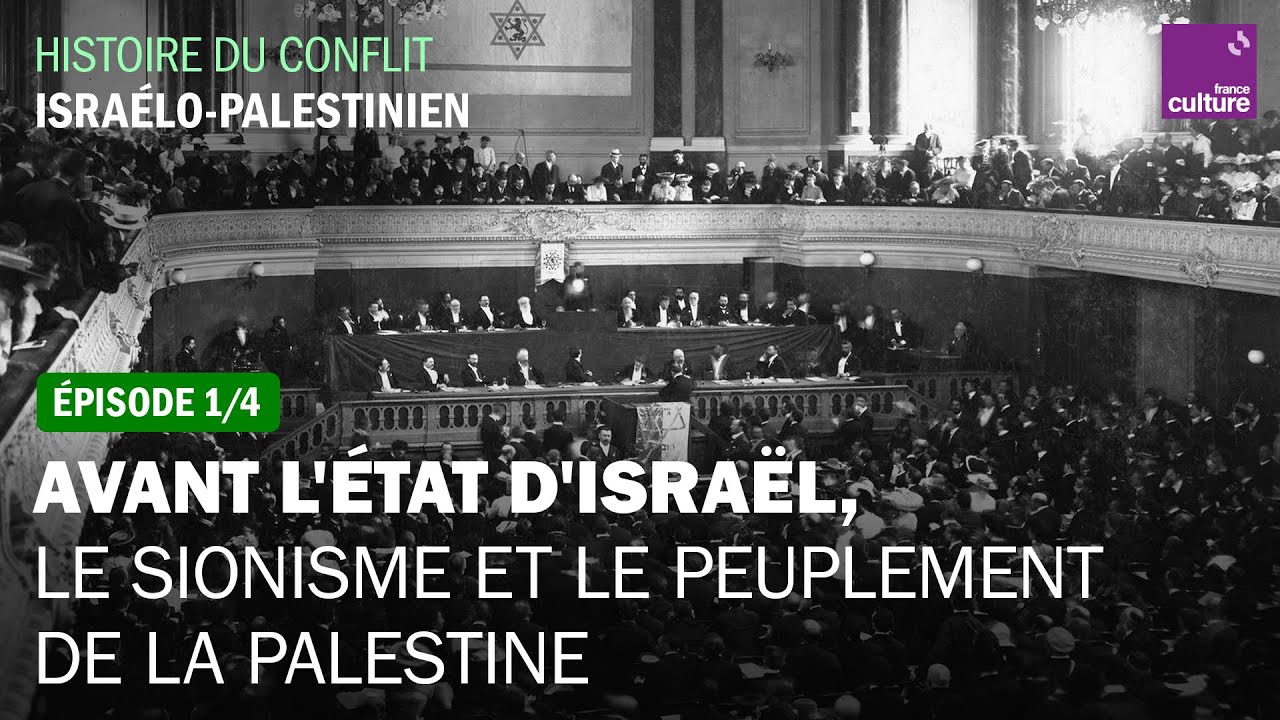
" collection a history of the origins of the Arab-Israeli conflict from 1870 to 1950. Before going any further into the book, a word must be said about these two dates. It may come as a surprise, 1870, because the conflict is usually traced back to the first Zionist aliyah, i.
e. 1882. There's an essential reason why I've chosen 1860/1870 as the date.
In fact, it was during these years, in the middle of the 19th century, that within the old Sephardic Jewish community of Palestine, emerged a veritable Hebrew revival that was to become a sort of embryo of a national revival. And from there, a certain number of institutions were put in place. This is particularly true of several newspapers, as the Hebrew press did not begin in the Diaspora.
The Hebrew press began in Palestine with "Halevanon" in 1863 and "Havatzelet" in 1870. The Hebrew Language Committee was founded in 1890, seven years before the first Zionist Congress. It was from Palestine itself that the embryo of a national movement was born, which the outside Zionists will join with the first and especially the second aliyah from 1904.
-It's as if there were a national movement similar to those which happened in Europe at the same time. -It's a general movement of nationalities, you're right to say, which is linked to 1848, to the people's springtime. In Palestine, which at the time belonged to the Ottoman Empire, we witnessed the birth of a Jewish national question, just as there were a Kurdish question, an Armenian question, a Greek question, etc.
Why stop the book in 1950? Simply because it was the first Arab-Israeli war. after the Israeli-Palestinian war.
Why didn't it stop at the Armistice Agreement of 1949? Because we have to include the consequences of the 1948 war, what the Palestinians call the Nakba, which is both the exodus of part of their population and the creation of the State of Israel, as well as the establishment of UN structures, especially UNRWA, which will take charge of the vast majority of these Palestinian refugees. -1870-1950, you offer us a gripping, if factual, account of these 80 years of history.
and you give us a real sense of continuity. In conclusion, you say that the conflict pits two national aspirations, two legitimacies deeply rooted in different timeframes but claiming the same space. So we can see that from this birth of nationalism, let's say, even before the successive alyiot, there was already this national aspiration within Palestine, which means that the idea that we're dealing with a colonial-style conflict is obsolete, or at least no longer works.
Yes, it's obviously a pattern that's been around for a long, long time. . .
of a colonial creation, the latest colonialist offshoot of the West, when in fact, we are dealing with a national movement born of Palestine itself, of this old Jewish community. which has never ceased to exist in Palestine, through the Hebrew language. Because Hebrew is the common language of all Jews, wherever they may be in the world.
And because Hebrew is the language of the Bible, and because the Bible is the very backbone of this people. So, ultimately, the backbone of this people is both the Bible and Hebrew, i. e.
the language of the Bible. So that's where the national revival comes from. There's nothing colonial about it, because if you look at the different alyiot, the immigrants who arrive in the land of Palestine, that's what we'll end up calling it, they may not speak Hebrew, but they feel a deep attachment to this land.
They feel inhabited by this land, whereas in a classic colonial scheme, there is not the least cultural link between a a Frenchman and the land of Algeria on which he would land and set up his colony. The same could be said of the link between a Portuguese and the land of Mozambique, and so on. Here, we have a carnal bond and a strong sense of identity.
And thirdly, and this is where we get into the details of the history of Zionism, the colonial scheme would have been the purchase of land and the exploitation of Arab labor by Jewish landowners. This is the pattern followed by the first aliyah. However, the people of the second aliyah, starting in 1904, laid the foundations for the State of Israel, Ben-Gurion, Katznelson, Brenner, and others, broke with this colonial pattern and decided to farm the land themselves.
This led to the creation of the first kibbutz in 1913 and the beginnings of a truly national movement. rooted in this land. So that makes two companies that will appear almost together, but who don't live in the same culture, or in the same time frame, and that's fundamental.
-Yes, that's fundamental. -How does this conflict work, and with what fuel, if I may put it that way? What are the differences between these societies?
-A real chasm separates them. We're dealing with a Palestinian society, whose members don't even call themselves Palestinian but Syrians. When asked to specify which Syria they mean, they speak of Suriya al-Janubiyya, i.
e. Southern Syria. As you well know, Palestine is a concept that dates back to Roman times, and more specifically the end of the Bar Kochba revolt.
The Romans imposed the name Palestine to dejudaize the province. And in reality, the name Palestine will only be used by Westerners. Westerners have invented Palestine just as they have invented the Holy Land.
But the Jews speak of Eretz Israel and the Arabs speak of Suriya, i. e. Syria.
What territories are included in this Syria? Present-day Lebanon, present-day Syria, present-day Israel, present-day Jordan, and present-day Palestinian territories. It's a vast ensemble.
Palestine is indistinguishable from the rest. This society -let's call it Palestinian for convenience's sake - is a rural society, and very archaic in the way it operates, in the sense that agriculture is lagging far behind. It's a predominantly clannish society, which doesn't meet the standards of a Western society at all.
It's a vertical society that functions by belonging to the family, the village, the clan, and, ultimately not to the fatherland (a notion that means nothing to them), but to the Ummah, the community of believers. So you're going to object that there are Christian Arabs too. Yes, but the vast majority of the Palestinian population -88% to 90%- is Sunni Muslim.
So it's a clannish, very traditionalist society, which has absolutely nothing to do with Enlightenment modernity and is totally alien to the Western world. On the other hand, you have a society that will be nourished by these Western contributions, these different aliyot that have come in, mostly from Europe. We're talking about a modern, Western society, increasingly technically advanced, and over the years, especially in the 30s and 40s, we've seen a confrontation between a society very traditional, very archaic at heart, and whose mentalities are very much based on old patterns of thought and a modern society that resonates with thought patterns inherited from the Enlightenment.
It was this confrontation that led to the victory of the State of Israel in 1948. -This disparity further reinforced the perception of the conflict as fundamentally colonial in nature. You're absolutely right.
It was this disparity that gave the impression of a colonial confrontation, when in fact it's a different kind of confrontation. Perhaps we should also point out the difference in timing. The two societies do not live in the same history.
-Absolutely. Basically, Arab-Muslim temporality doesn't exist. That is, what has been is and what is will be.
There's something that is not at play, e. i. that time is duration, and that duration profoundly alters the order of the world.
The Jewish society is largely shaped by the West. As Blumenfeld, the prominent German Zionist remarked: "Zionism is a gift from Europe to the Jews. " Zionist society is largely a Westernized society based on Western patterns in which time and duration have completely different functions.
Time is invested with a mission of change, driven by an ideology of progress that considers that we're always moving towards an improvement in humanity, while. . .
-Except that the West also borrowed this idea from the Jews. . .
. whereas, in the Muslim time frame, there's no improvement to be expected. Destiny means that we have, we are registered for an evolution.
. . -.
. . that is extremely delayed.
-Exactly. -OK, so that's the general backdrop that puts things into perspective in their rightful place. Then there are the stages.
Your book is divided into ten or so chapters in chronological order. The two world wars acted as a catalyst for the conflict we're talking about. But I'm struck by a certain continuity when I read this book.
At no point, from the mid-19th century to the present day, and until 1950 anyway, has a possibility of peaceful coexistence between these two societies emerged. There were attempts, but the bottom line is that from 1870/1880, because there were incidents as early as the 1870s, when the Alliance purchased the Mikvei Israel estate, south of today's Tel Aviv, there are already incidents, but they are not yet national in nature. Incidents of a national nature came at the beginning of the 20th century.
But from the end of the 19th century onwards, there was constant tension between the communities which means we're always between two periods of violence, and these are always intervals, pauses, but no real, lasting lulls. In reality, we're dealing with a refusal, an Arab refusal, the reasons for which we can understand and analyze. A constant refusal, practically speaking, from 1880-1890 until the last year of the period covered by my book, e.
i. 1950. -Over the past 80 years, have there been any changes?
-Yes. First of all, there are attempts, despite everything, at dialogue. Attempts that were all aborted, and most of the time initiated by the Jews, but always by a minority of Jews, often intellectuals of German origin.
I'm thinking of Gershom Scholem, Buber, who was still living in Germany at that time, and many others, of the Hebrew University of Jerusalem. These attempts led, for example, to the creation of the Brith Shalom Association in 1925, which advocates a bi-national State insofar as the confrontation is a bloody one, with no end in sight, . Eventually, the association disbanded in 1933, as it had no Arab interlocutors to deal with.
A much more interesting attempt is the Swiss-style cantonization, i. e. the creation of Arab- or Jewish-majority cantons, headed by a federal State.
And in the end, it never came to anything, because it never won the support of the Arab majority, nor the Jewish majority, not least on the Jewish side, because Zionists didn't want to give up on the idea of national sovereignty. Because in this federation, Jews would have remained a minority, there would still have been no real independence. - And has the nature of the conflict changed?
-Yes, the nature of the conflict has evolved. -Then you asked me if there were any big breaks. The nature of the conflict has evolved, because -in the period I'm interested in, i.
e. 1870-1950-, there was a major break in the 1920s. The 1920s were the years when the Palestinian national movement really took shape, where the word "Palestine" started to be used and the word "Syria" was dropped altogether.
because these Palestinian nationalists, who wanted to be Syrian nationalists, could no longer associate themselves with Syria. Actually, Syria was arbitrarily detached from Palestine by the Sykes-Picot agreements and placed under French mandate, resulting in 1920 in the expulsion of King Emir Feysal, who had seized power in Damascus. The Palestinians now find themselves orphaned by Syria, and forced to withdraw to this small territory called Palestine.
From 1921 onwards, they will thus call themselves Palestinians. That's not to say that the word Palestine wasn't used before. It was already in use before the 1914 war, and there's even an Arabic newspaper called Philastin, but it was still marginal.
Most of the nationalists claimed to be Syrian nationalists. From the 1920s onwards, things changed. But that's not where the real change lies.
The real change is the Islamization of the conflict. In other words, the man whom the British appointed to the post of Mufti of Jerusalem in 1921 -for political and cynical reasons, insofar as Amin al-Husseini, barely 26 years old, did not have the required theological diplomas and only came fourth in the internal elections. But the English, defying the vote and completely exceeding their powers, decided to appoint Amin al-Husseini appointed Mufti of Jerusalem.
Because they need the support of the Husseini family. As I said earlier, it's a clannish society based on the domination of a few large families. There are six major Palestinian families, including the Husseinis, whose fiefdom essentially covers the Jerusalem region.
The Hussenis are perhaps the most powerful of the Palestinian families. The English have a very simple, if not simplistic, idea-they hope that with the Hussenis, they'll be able to maintain order. So they appoint the Mufti.
But they are dealing with a remarkably pragmatic and highly intelligent character who understands that he won't mobilize the Palestinian rural mass, because 90% of Palestinians are rural, and a majority of these rural people are farmers, fellahs, many of them. . .
let's say the vast majority, are illiterate. He won't mobilize them around the Western notion of nation, which means nothing. He'll mobilize them around Islam, around the Ummah.
So he's going to Islamize the fight, and he's going to do it from Jerusalem. In other words, he will crystallize the battle over Jerusalem and especially over the Wall. The Kotel, what Westerners call "the Wailing Wall.
" We know that this wall is not a Temple wall, but what remains of the Temple enclosure wall, which adjoins what the Arabs call "the Esplanade of the Mosques" and the Jews "the Temple Mount". The Jews had been allowed to pray there for decades, provided the status quo remained unchanged. And this authorization to pray was within a very narrow perimeter 4 meters deep, placed in the middle of a passageway used by donkeys, horses, travelers, Arab traders, etc.
So it's a very noisy place, a dirty place, a place overrun with filth, and it's only within this small perimeter that they can pray, with a ban on changing the status quo, which means, for example, installing a curtain separating the men from the women. And the mufti will scrutinize the Jews in the years 25, 26, 27, 28, to see if they change the status quo in any way. For example, if they hang a curtain, if they place two or three stools for the elderly, he immediately ran to warn the mandatory authorities that the Jews were changing the status quo.
Why? Because, he believes, it's the first step towards the re-conquest of the Esplanade of the Mosques by the Jews. to build what the Jews call the Third Temple.
-We're in the news. And of course, he will mobilize the faithful, the believers, around this conviction. and his fiery preaching led to the worst results in terms of pogromist violence in August 1929 in Jerusalem.
But I think he succeeded in this battle, around Jerusalem and around what we call the holy places. Husseini Islamized the combat, giving the conflict a religious nature. It's all the more paradoxical, moreover, that the Zionist movement, as we tend to forget today because we are absorbed by current events, the Zionist movement from its origins, and this is true right up to 1948, and especially on the ground,i.
e. in Palestine, is deeply secularized. It's a profane movement that was however set up and supported from the outset by men and women who were steeped in biblical culture, steeped in the Torah, and even, for many of them, in the Talmud.
Many of them studied in yeshiva, but then made a complete break with Jewish practice, with the mitzvot, with respect for kashrut, Shabbat, etc. So it's a Judaism that's profoundly national, not liturgical. And this secularized society, which is the Jewish society, is going to face a deeply religious, Islamist society.
It's an extremely serious culture clash with, at the end of the day, an element that is rarely taken into account, but which seems to me, and to others, fundamental. I'm not the only one who thinks so, but many historians miss this point. By confronting the Jews, the Arab-Palestinian population, the majority of whom are Muslim, confronts the dhimmis, i.
e. protected but inferior subjects. And as an inferior subject, they don't have to rebel against their condition; they don't have to claim autonomy and even less so at independence, a fortiori in a land considered Muslim from all eternity.
So there's a cultural dimension of rebellion against the dhimmi revolt that is Zionism, which makes the idea of Jewish autonomy or independence, let alone a Jewish State, an aberration. for a Muslim consciousness in the 1930s. -Does something like this still resonate today?
Whether this question of the beginning of the so-to-speak "instrumentalization" of the Temple Mount and the famous status quo which we will discuss in a little while. You're right, on the Temple Mount today, once again, we can see that the conflict is crystallizing, But beyond the current quarrel, there is, I'm afraid, a cultural dimension that has not been eliminated, i. e.
that the idea of Jewish independence cannot be accepted in a Muslim consciousness today let alone on this earth. And that's an infinitely greater cultural obstacle than Jerusalem, the settlements, the refugees, the Nakba, etc. -So that's it for the context.
Maybe we can say now one more word about this whole attitude thing. Western powers, notably England and other Arab countries, Finally, we see that Western policy, starting with England, since the Balfour Declaration has obviously played a central role, and fluctuated greatly according to the powers' interests. There wasn't that much clear-cut support.
-No, no, there was no real support from the Western world. We often believe that this is the way it was after 1945, persuading ourselves that the Western world. .
. penetrated by an intense guilt linked to the Shoah, would have helped create the State of Israel. That's wishful thinking, it's a fiction, Let's just say it's an angelic tale, which is hugely reassuring because it washes the West of its guilt.
It's a story that, historically, doesn't stand up to scrutiny. England is seeking to gain a foothold in the Middle East on the ruins of the Turkish Empire. As soon as 1915-1916 indeed, the British had the intuition that the Ottoman army could not withstand the shock and that this empire was about to collapse.
Hence the secret Sykes-Picot agreements of 1916. England took Palestine, that strategic crossroads, and Iraq, with its sights set on oil, because oil has been discovered in the Middle East since 1908. Next thing you know, the French will be taking over Syria and Lebanon.
The English wanted to gain a foothold in Palestine because it was a strategic crossroads on the route to India, their main colonial possession. Moreover, this region borders on the Suez Canal, whose strategic depth they want to ensure in terms of defense. The British have controlled the Suez Canal since 1882, from the moment they gained a foothold in Egypt, and Palestine was the hinterland of this shipping lane they view as essential.
These are the two reasons why they want to gain a foothold in Palestine. So they're going to instrumentalize Zionism. They will make use of the Zionists' desire to build a Jewish national home in Palestine.
to gain a foothold in Palestine. Hence the Balfour Declaration. With this naive idea, which is a pure product of Western anti-Semitism, that Jews have an immense influence on world affairs.
Thus, they convince themselves -we are in 1917, and Russia is poised to break away from the Allies-, that the Jewish community from which most Zionists making aliyah originate, in return for a philosemite declaration will be able to influence the Russian government to stay on the Allied side of the war. -Well, it didn't work out in the end. -Not really, no.
-So that's from the Western side of things, this initial interest in surfing on the part of the English, on Zionism and, at the same time, to treat the Muslims, or at least the Palestinian population, with care. -Absolutely, of course. This means turning off the tap on immigration, etc.
, as the situation demands, in order to maintain this balance. -You're right. -That's on the Western side, but if we also look at the Arab world, the Arab countries, Here, too, support fluctuates.
would like to add one very important thing about the Western world, and that's the support of the United States. That is to say, in today's doxa, for mainstream opinion, the United States is Israel's unwavering ally. It's obvious that they're allies today, but we wrongly assume they've always been.
Actually, between 1945 and 1948, the Americans did nothing to help create the State of Israel. On the contrary, they put the brakes on to prevent the creation of this State. General Marshall, who headed the State Department during this period, did everything in his power to convince Truman, Roosevelt's successor, not to come out in favor of the Jewish State.
He had his reasons for doing so. You can't just blame anti-Semitism, it's more complex. -Oil interests in particular.
- Very largely oil interests, alliance interests in the Middle East, with this idea too -at a time when the Cold War is looming-, that if the US comes out in favor of a Jewish State, they'll alienate the Arab world, and so help the Soviet Union to get access to warm-water ports. So the Americans have a very clear strategy. It was much later that they came out in favor of the State of Israel, even if they recognized the State right away and voted "yes" at the UN in 1947.
But even so, between 1947 and 1948, they ensure that the State of Israel does not declare its independence. Let's turn to the Arab countries. The support of Arab countries is also part of the great mythology.
In reality, alas, for them, the Palestinians were not supported. They have even been deeply betrayed. And betrayed by whom?
First and foremost by the Emirate of Transjordan. Actually, the Emir of Transjordan, that is, the principality artificially created by the British in 1922 by separating eastern Palestine from its western part, on either side of the Jordan River, while Palestine, historically, encompasses the two banks of the Jordan, according to the Bible. Of the 12 tribes of Israel, three camped on the East Bank.
So, historically, Palestine is on both sides. The British separated Palestine from Transjordan to provide a sort of consolation token to. .
. to Emir Abdallah, son of Sherrif Hussein of Mecca. All this takes us back to the origins of the Arab revolt.
The English naively thought that by offering 4/5ths of Palestine to some kind of Arab kingdom to honor a promise made in 1915-1916, they would get rid of the Palestinian problem. But the populated part of Palestine is the West Bank, extending from the sea to the Jordan River. Therefore, Palestinian Arabs were not satisfied at all with this solution.
The result will be an Emirate of Transjordan, an artificial State, which will constantly have an eye on the Arab territories of Palestine. The UN, just like the Brits, will consider the idea of splitting the country in two, since they are unable to find a better solution, . In reality, Emir Abdallah of Transjordan has absolutely no plans for an independent Palestine.
He planned to get his hands on the territories of Arab Palestine, which he did in 47-48, with Israeli approval. But even without the Israelis, his war aim was to seize all the territories that the UN had allocated to the Arab State of Palestine. That's a major betrayal.
Here again, people wonder why Emir Abdallah was assassinated two years later. And by whom? By a Palestinian.
The Palestinians feel deeply, and it's not just a feeling, that they have been betrayed. But they were also betrayed by others, notably the Egyptians, who had no intention of accepting an independent Palestine and who immediately put their hands on Gaza. They would have seized the Negev as well, had the Israelis not won the military victory.
-So there you have it, Georges Bensoussan, the backdrop to this conflict. How has the world reacted according to its interests, to put it quickly? Today, we seem to be following the logic of this ongoing story.
Despite the creation of the Jewish State, the state of affairs hasn't much changed. . .
-Today, the conflict has returned more to its source, i. e. the Israeli-Palestinian conflict.
That's what it was at the outset. Between these two peoples, two equally legitimate national aspirations, for the same very narrow land. You must never lose sight of distances.
There are 70 to 80 kilometers between the sea and the Jordan River. It's approximately Rhode Island, no more. 10 million inhabitants crowding into this small territory.
The conflict is becoming Israeli-Palestinian again. That's not to say there isn't an Arab-Israeli and even Muslim-Israeli dimension, alas, because it's much more serious. And we have the feeling that today we're back to a continuation of the 1948 war, that the 1948 war is still not over.
And that's why it's important to understand the origins of the conflict, is to understand the reasons why it drags on. After all, it's been going on for 140 years, and these reasons explain why we can't find a way out. There's not even the slightest prospect of getting out?
-Very low. -What also emerges over time is that Israel, by definition, has always been existential threatened. Even after the creation of the State, and even today although it has undoubtedly become considerably stronger in every respect, clouds still hang over its survival, especially this year.
In particular, we have the impression that the Iranian threat remains strong. -Yes, you're right. On a large-scale geostrategic level, the Iranian threat is existential.
But even on a much more local, macro-geographical level, the threat also exists. because Israel, the great power, the start-up nation, is a colossus with feet of clay. It gives off an impression of power, when in reality, it's a very fragile power.
Certainly, it's one of the world's best armies, one of the world's most brilliant technologies, it's all perfectly true. However, it's demographics and land use that really define a nation's influence. You're familiar with Bonaparte's phrase-"The politics of a state is in its geography.
" Geographically speaking, Israel did not necessarily win the war. -And yet, with a high birth rate and. .
. -Yes, but once again, look at the map, it's the territorial grip that counts. -And to understand our situation today, Georges Ben Soussan's book "Les origines du conflit israélo-arabe 1870-1850" [The origins of the Arab-Israeli conflict"] is a must-read.
Published by "Que sais-je? ", it's 120 pages long, but you promised us, Georges Ben Soussan, let's say in two years' time, a thicker book on the same subject, with obviously many more elements. So I'm sure we'll meet up again in two years' time, but I hope to be able to talk about current events with you well before that date.
-I hope so too. Thank you all very much for your attention.