Good morning good afternoon and good evening welcome to all participants from around the world joining us today for our happy School simp posum my name is satano and then alongside my colleague Juliet Norman Smith we are the coordinating team of the global happy School initiatives which we stare from the UNESCO headquarters in Paris we will be your masters of ceremony for today's 2hour happy School Symposium and the launch of the global report this Symposium has a simultaneous interpretation in Spanish and French all you need to do is to pick language Channel below the glob you
can see below we will be also joining by Speaker from Vietnam which cannot be translated into Spanish and French so if you want to listen to her listen to her please do choose the English Channel so that then you can hear the simultaneous interpretation with that then it is our Honor to invite unesco's assistant director general for for Education Miss Stefan janini to give her opening remarks thank you d thank you thank you very much Satan good morning good afternoon good evening wherever you are and thank you so much distinguished participants and speakers and colleagues
for joining us today in our happy schools Symposium which is the fourth installment of our webinar series happiness in and for Learning as you maybe remember 10 years ago UNESCO launched this amazing initiative happy School happy happy schools initiative as a regional project from our office in Bangkok and since then Happy schools has grown into let's say now a global movement which is very much needed in today's trouble world as we all hear uh uh about uh today more UNESCO has developed a global framework to support happy holistic approaches to Quality learning through four pillars
Very simple pillars crucial pillars process people places and principles the framework uh covers everything from health and spatial design to a balance curriculum that helps the school Community as a whole develop the knowledge values skills to take on today's challenges our two previous webinars in this series Focus on the process pillar which is about curriculum pedagog and assessment and the people one about of course um social Relationships well-being Behavior attitudes and attributes of all School Community uh actors today's discussion is specifically dedicated to the principles pillar which is a very important one which is all
about the core values the content and it's very much let's say uh going around the three key wordss uh key wordss for us at UNESCO and I'm sure you share this Vision inclusion trust and empowerment they are very much all of all of them uh Inter interconnected and that's the ground uh of UNESCO vision of happy learning environment what actually happy learning means we will discuss also the findings uh of our Global report on why the world needs a happy schools which came out one one week ago today on the International Day of Happiness we
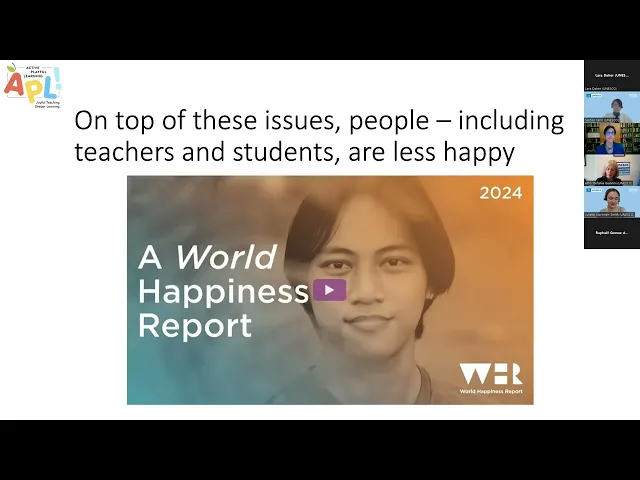
know that every parent wants their child to learn Thrive and be happy at schoool it's normal it's it's a right let's say and the duty at The same time yet many young people unfortunately spend much of their time in school uh being stressed even bullied or board globally one in one one in three students are bullied at school every month which is a tremendous uh figures digital devices are making students feel anxious and distracted at school moreover teachers are facing Rising workloads like burnout and stress leading to high attrition rates we know that the word
needs data from our very Recent release uh report on the teacher shortage well the world needs to hire an additional 44 million qualified teachers to fill the Gap to achieve SG4 many students see school as let's say a burden a court they have to do or an obstacle along the pathway towards a happy Odo life after graduating and securing a job but we do think ladies and gentlemen that we need to stop the belief that achievement Excellence uh you know regor in schools Cannot exist with joy and relationships with the human touch happiness and learning
achievement can coexist must coexist and in and indeed if you are to address the current crisis in both learning and well-being we must really keep this uh holistic approach where happiness is a is a very meaningful word moreover as our Global report shows the link between learning and happiness can be understood from philosophical P perspectives International normative Foundations and most importantly let's say scientific evidence research from Neuroscience cognitive psychology comparative education as well shows us that joyful School environments that Foster engaging pedagogies and supportive relationships can enhance teaching and learning experiences which leads to better
outcomes our keynot speaker very Renown professor of psychology Dr Katy H pasic will be giving us more uh valuable insights uh To this uh focusing on the importance of active playful learning for joyful teaching and deeper learning and thank you very much much for being with us today above all UNESCO sees the happy schools initiative as a transformative approach to education policy there are many inspiring School level practices happening around the world already including from some our speakers today from Bhutan Portugal Vietnam and Bulgaria however many education policies Uh prioritize still academic performance over all
else which makes these practices impossible to put at scale our new report uses policy makers to recognize this virtuous link between happiness and learning and to Center happiness flourishing well-being in education policy as both a means to and a goal of quality education because overall let me say really to conclude we believe that happy healthy Learners will learn better and keep learning and happy Healthy teachers will teach better and keep teaching and that's actually our common objective and beyond that we also believe that schools can and should be happy places in themselves spaces where every
member of the school Community can engage positively with themselves with others and consequently with the world around them once again I wish to thank you for joining us today and I wish you a very fruitful seminar and conversation back to you Talk thank you thank you very much Madame janini for framing our discussion today which will be divided into three themes evidence policy and practice and we're beginning with the evidence because much of our Global report is dedicated to unpacking the research on this Nexus between happiness and learning and so to talk a little bit
about the kinds of pedagogical approaches and learning spaces that support joyful meaningful active Teaching and learning I'm delighted to welcome as Madame gianini mentioned already Professor Kathy HS pek to give today's first keynote address a professor of psychology at Temple University Pro Professor HH pek is a senior fellow at the Brookings Institute and was declared a scientific entrepreneur from the American Association of psychology she has written 17 books in over 250 Publications her newest book making Schools work was published in November 2022 and it's the first education book co-written with teachers administrators and scientists in
2021 she was elected a member of the National Academy of Education her initiative playful learning Landscapes reimagines cities and public spaces as places with science infused designs that enhance academic and social opportunities co-founder of the Global Learning science exchange Fellowship she Brings together scientists journalists policy makers and entertainers to put learning science in the hands of Educators so without any further Ado Kathy over to you thank you so much and I just want to thank UNESCO for all the amazing work that you are doing to try to bring the happy schools movement to teachers parents
children who so desperately need it I'm going to share my screen right now and start by telling you a little Bit about what the science has to say through active playful learning we started um many years ago with a factory Industrial Revolution kind of education and you all know Harari wrote in 2018 that it bequeathed us to production line theory of Education that everyone today seems to agree no matter how great it was in the past it's now bankrupt now what we did to try to make schools better over the past few years Whether in
US England Austria Iceland Germany Greece around the world is we thought it was a brilliant idea to take what the 12-year-old used to learn and then shove it down to 10-year-olds and what the 10-year-old used to learn and put it in the six-year-old's hands it was developmentally inappropriate the children aren't learning but what it did do is make schools places where kids were more anxious and where teachers didn't want to teach and you already Heard about the report that was released last week but people seriously are not happy they're not happy in schools the teachers
are leaving there's a lot of absenteeism and kids are very anxious we have to do something so I thank again UNESCO for launching the happy schools movement it is so needed in today's world so the question then becomes what can we do to make schools happier and I'd like to share with you my lead from the science Of learning and this may sound shocking but I think one trick would be to teach in the way that human brains actually learn so for our approach my team has spent the last decade asking what do we know
in the sence sence that we could distill to help make schools happier and to really explain how human brains learn what could we put into schools that were both joyful and would enhance learning we came up with a three-part equation and as you've already heard it's really Important that we think of school not as independent of its Community but as nested in a community that has cultural values and beliefs already and if we comport those beliefs and values into the school and from the school to the community we're going to have a richer conversation so
the first part of our equation is cultural values the second part is this dis distilled Suite of skills about the how children learn and what we learned in our science is that The very same skills to be active to be engaging to make it meaningful socially Interactive those skills overlap with what we do when we're playing so we call our model active playful learning and then we need to think or rethink what's the outcome as you just heard it's not just a matter of memorizing the content in reading and math there's so much more to
a well-educated person today and we'll go into each of these real Quickly when we start our work in our science we start in the community by trying to understand the beliefs and the cultural values that we want to share with schools and back from schools to the community we then move to supporting the active playful learning or what we call guided play on top of those values to build a richer pedagogical and curricular structure we know that children learn best when they are active Not when they're sitting there getting information thrown at them we know
they learn best when they're engaged rather than distracted when information is Meaningful not disconnected when they're social working with other children and having discussions in class not solo when it's iterative and they hear things again just a little bit change so they learn it better and finally and importantly for the happy schools movement when it's joyful now notice in All of these cases it's important to have a strong learning goal you have to have a curricular place that you're moving toward and that has to be well defined but pedagogically we can teach it in a
different way another way to look at our guided play or active playful learning is to suggest that there are some things that are initiated by a child and then directed by a child that's free play when a child builts a fort in your living room when it's Initiated by a child and the adult takes over children don't learn so well and it doesn't become fun anymore The Sweet Spot is when something can be initiated by an adult who sets up the environment but the child is the Explorer and the discoverer who goes in to help
get that information in an active Hands-On way and that tends to work better than when the adult initiates and the adult directs which is what is going on in most of the schools Around the world today then look at a consensus view of what we need to learn and at Brooking we call this the breadth of skills approach in our own instantiation of that I call it the six C's which probably only works when you're speaking English but it starts at the very same place the happy schools movement starts relationships relationships among teachers and students
among teachers and parents and among students and students only when we Have strong collaboration skills will we get strong communication skills in language and writing in listening a lost art and those then permit us to learn content content not merely in reading and math but content in learning to learn in social studies and science as well then comes critical thinking which is built on content creative Innovation which is built on content and finally the confidence to try even if you might fail we learn through failure we learn Grit and perseverance and we gain a growth
mindset thus far our preliminary work in schools in the United States and one school in Japan has been very exciting and promising we have seen increases in teacher enjoyment we have seen a rise in some of the standardized tests and we have seen growth in collaboration and in communication and even in creativity right now we are expanding our model in a large scientific study Across four states in the United States that is generously funded by the Lego Foundation we're looking for joyful teaching and deeper learning our goal is to move classrooms from being primarily direct
instruction classrooms where it's passive learning and we are delivering information to a more guided play classroom where the children are more involved and they are agents and empowered in their own learning how do you do that well we use the three-part Equation we apply the principles of how children best learn and we're making simple changes in the classroom in the hopes that it will be bring big changes in teacher enjoyment and student learning just to give you a short sense of that for active learning well how do we give children more choice and voice how
do we Empower them in a classroom how do we create small not whole group learning opportunities so that it's more engaging for the student it's more Hands-On and Minds on how do we increase student conversations teacher question asking making the learning more meaningful for the challenges that they solve and yes how do we make the school more happy and more joyful we're creating teaching manuals for this approach and I'm happy to say we'll share them with anybody and importantly these active playful learning principles that are founded in the science of learning maap directly Onto the
happy schools framework collaboration well that goes right into supportive and collaborative relationships our APL framework well that's Criterion five joyful and engaging pedagogies or as you heard earlier what we can do in the principles pillar and to be active and engaged means you're empowering the students as they move on so you might ask what are we doing for the fourth pillar of place we're extending that three-part equation To joyful learning out of the school setting did you know that most countries around the world children only spend 20% of their waking time in schools which gets
us to ask what's going on with the other 80% of the time that they're awake and not in schools so we invented the initiative called playful learning Landscapes where we are literally building the cognitive science using the three-part equation and putting it into the built environment in Places where people wait in supermarkets we put up signage just to spark conversations and when we did we found out the parent child and caregiver child interactions grew by 33% and we can twist that to make it stem learning literacy learning science learning we then went to bus stops
if children are doing puzzles at bus stops you can build in the learning and that builds later math skills and finally even in a library setting we built a Climbing wall all out of letters and all of a sudden the kids wanted to build words so you can do this in the built environment it's all about the three-part equation the work that I just showed you is supported by an extensive research base so visit us at active playful learning.com because while I am the spokes person I want you to know that the team of researchers
behind me is extensive and you can see all of them at activplay learning.com you can also Get to learn what we're doing in the in the built environment at playful learning landscapes.com and as you see by the front cover of our web page I think what you're doing is a breakthrough from the old to the new I'm so excited to be part of the happy schools movement thanks again for inviting me and I just want to thank all of our funders who have made this work possible along with the families the communities and amazing Students
thanks thank you thank you so much Kathy what an insightful and interesting and informative presentation um really appreciate as well how you mapped the active playful learning principles onto the happy school's framework and to see that they cut across all four of the dimensions is really exciting um to continue this discussion about that vital principles Dimension which was added in this new Global iteration of The framework we can zoom in on those empowerment trust and inclusion principles and so I think that's a perfect segue to our next presenter so it's my pleasure Now to turn
to Allison posie as an international leader for implementation of Universal Design for Learning Allison works at cast where she collaborates Ates to apply current understandings from Brain Research into instu instructional practices cast is a nonprofit education research and Development organization that created the Universal Design for Learning framework and udl guidelines which is now used all over the world to make learning more inclusive prior to cast Allison herself was a life science teacher Allison the floor is yours thank you so much and I again want to thank UNESCO and um I'm honored to be here today
as you mentioned I work at cast and our mission at cast is to lead Inspire um and convene a global Community to design Equitable inclusive learning experiences through our Universal Design for Learning framework and The more I've gotten to learn about happy schools the more I am seeing the overlap and connection so I'm hoping through this introduction today we're able to continue this conversation uh cast was started back in 1984 in association with Harvard un univiversity and Massachusetts General Hospital and the practitioners were working with one Student at a time using the latest technology to
support the different learning needs um both for high and low in incidents disabilities and there's a picture on the screen that some of you may recognize of one of the old Apple 2E computers which was one of the latest technology tools at the time cast was founded that they were using to really try to support learning in an engaging and we tend to use the word engaging but I I the word joyful and the word happy All Al line here um and what these researchers came to understand from their work was that um when the
tools were in place to support learning students were incredibly skilled and Incredibly abled in the learning and in fact the people the students were not broken broken but it was the learning designed it was the inflexible environments that were actually the barrier to the robust learning cast also had some neuroscientists on Their staff and so in in addition to the advances in technology the foundations of cast and Universal Design for Learning included connections to the exciting brain research that's been going on over the past several decades and it was really showing this brain research that
there's no average learner there's no one kind of learner each brain is as unique as our fingerprints and this variability can actually be predictable designed for from the outset And so that led to this development of our Universal Design for Learning framework it's really based on a very simplified model of the brain that includes three brain networks and the first Network to consider and to think about is the affective or the engagement Network and this is where we see an unbelie we are so thrilled to be thinking about joy and happiness in schools because without
activation of that engagement Network we recognize Learning just doesn't happen so there's strong Synergy there for us uh we also think about um in addition to the affective um and emotions and that interest and self-regulation we also think about recognition networks which are largely in the back part of the brain that are involved in how we perceive and how we build our understandings and then we think about strategic networks which again this is a broad generalization but Are involved in those executive functions those plannings those physical actions that we take um and so again if
you are not engaged if you do not feel safe if you are not happy then that recognition and that strategic networks they just don't work in the same way so from this Neuroscience we developed the udl guidelines and this is just a tool it's it's a set of strategies to really help Educators at all levels and in all environments think about how we can Design Flex ibly from the outset to meet the variability of our Learners to make sure that they're engaged to make sure that they're able to be active in their learning and to
make sure that they're able to build collaboration and meaning um so they become lifelong Learners the vision of udl is that this framework supports us to be able to learn about our own learning so students and parents and Educators so we can advocate for what we need um based on what we know uh We can do it's a really it's an asset-based approach to thinking about reducing barriers in the environment so um you may notice that we have our three um broad neural networks that we're thinking about engagement representation and action and expression and we
have nine different dimensions that we think about when we look to reduce those barriers and from those we have a lot of different checkpoints just to spark ideas um for where Educators and parents Tutors um uh children themselves you we've seen young children use these guidelines and this language for learning to really support them to get what they need so um I we are uh launching an update to our udl guidelines this July and I'm actually so thrilled to be able to share that Joy is included as one of the um one of the checkpoints
in that so again looking for additional ways that our our different Frameworks can come together and Collaborate we consider we're when we're thinking about Universal Design for Learning and thinking about designing our learning environments from the outset to meet the variability of our Learners we recognize that there could be barriers in the materials in the methods in the assessments and this aligns with the process pillar of the happy schools we think about uh the curriculum and the environment we think about the spatial design the place again That aligns so well with the happy schools approach
so you can see see that the you the use of the udl guidelines really helps us analyze for example our R our our readings our videos our discussions our investigations whether we're online or we're working face Toof face our protocols um our physical spaces all of these are are areas in which we can apply udl to reduce barriers to make sure all Learners are included and able to get what they need Implementation of udl will be unique to each site just as each individual is unique so is each site um the the materials the methods
the assessments will differ the communities uh the humans will differ as they should so whether you have high resources or low resources udl helps support a mindset for inclusion a mindset that brings the strengths and assets of each learner to that environment um and this connection to happiness is absolutely critical in Order to ensure that there's that engagement in learning so we invite you to join our conversations we're so thrilled to be part of this discussion to really think about how we can research support the practice support inclusion for all um and our website is
at just www.c.org and thank you again for the opportunity to collaborate with you all this morning Thank yes evening thank thank you thank you so much Alison I think we definitely very very much look forward to the July launch and then also udlc so we stay tuned and thank you also very much it's really exciting to see that both uh the udl and then then active pray for learning they're really converging and then also the happy schools and thank you very much for also for mapping the IDE framework into the happy schools and then I
think it seems like a science is Telling us that it is the school the education that needs to be changed not the not the children or teachers so with that background we let's dive further into what the data tells us so with that um our next uh speaker um Mario pantini if I apologize for my pronunciation no it's correct than you thank you very much is a senior analyst in the program for international student assessment you know the name of the Pizza better at the OCD and an expert in in measurement Mario needs leads the
work on Pizza Innovative assessments including project that aim to expand the metrics we use to define successful education systems on that note today Mario will be showing us the piece of data on well-being and its relationship with performance giving us insights into the is also a current effort to create a dashboard to visualize key and wellbeing indicators from p with start then Mario Please you have the floor thank you thank thank you very much I want I wanted to thank UNESCO for uh for inviting me to present uh to present today I I really appreciate
the work you are doing with the appy School initiative I appreciate it as a as a researcher but I also appreciate it very much as a as a parent value like happiness and wellbeing above uh everything else um Can can you confirm that you can see my Slides yes we can it's not full screen okay there we go it should it should be full screen right now so yes my objective today is to to give you a quick overview in 10 minutes of of some of the data on student well-being we have we have collected
in Pisa 2022 and that we have published quite recently last last December uh just a few word on on Pisa I guess most of you know what Pisa is is the the largest International uh large scale assessment it focuses on Evaluating uh students ability to use their knowledge in Reading Science and Mathematics to solve uh real life uh in each cycle it includes an Innovative domain and we will be soon publishing results for the 2022 Innovative domain that is creative thinking um and the main uh objective of Pisa is really to provide uh provide evidence
to inform educational policy so I will be give you giving showing you some uh some numbers some that compare education systems Across the world uh on different metrics including several metrics that relate to uh to well to well-being these numbers of course don't provide a solution to the problem it's a initiative like the school that uh really lead to uh to Solutions and Improvement however they are useful to get the temperature of where the students are in terms of their of their wellbeing and what progress countries are making to uh to improve happiness in schools
uh the Piza 2022 Cycle was a relatively like unique cycle because of course it came uh just after the the global pandemic so it gives us an opportunity to to explore across over 81 countries uh whether the psychological wellbeing in particular students has been affected by the uh by the covid crisis in terms of the work on on on well-being in p as I said like it was not the primary uh focus of of Piza as it started it became increasingly silent And and um it got more more attentions over the years I had the
the pleasure the honor of like writing the first pieza report on wellbeing it was already eight years ago we then developed an optional well-being questioner that goes uh quite in depth in asking like questions for example on on themes like uh body Images uh time time time use relationship with uh with parents and peers unfortunately like several of these question were perceived as quite Sensitive uh by participating countries so we didn't have a like a a high participation in this uh in in this questioner um it was mentioned in the presentation that we are also
currently working to to organize and uh disseminate more all the data we have in wellbeing and that I presented you to you today in a in a dashboard again this is uh this is work in progress and I hope I will have the opportunity to show you uh the dashboard soon So uh coming to the data uh what we are observing one of the metrics of psychological well-being that we use is a scale of Life satisfaction uh whose value range between zero uh zero and 10 uh with 10 indicating like very satisfied what we see
in terms of like Trends is that overall life satisfaction has been decreasing in the population of 15 year old students on average across the world and it has been and this change has been mostly driven by the Extreme like an increase in the percentage of students who report they are not satisfied with their life and a decrease in the percentage of of students who feel very happy very satisfied with their life in what we do is to try to understand examine through correlation analysis what are the drivers of students life satisfactions and and what we
have observed is that the primary driver of like of overall satisfaction With life is whether students feel they belong as school so it's about the quality of the social relationship that they establish as schools both with their peers and with their uh and with their teachers and another indicator I'm not showing here is that quite a lot of students feel that they don't feel safe at school uh particularly in some countries and this is a primary driver of a low sense of belonging uh of course there are other factors such as like uh Anxiety towards
like test and uh and towards mathematics in particular and there are lots of like protective empowering factors so one one of these is like whether students feel confident about about themsel about their capacity to learn uh this contributes to their feeling of uh satisfaction with life uh in terms of like for you to understand what is like various index is mean essentially we ask students in the questionnaire to respond whether they Agree or disagree agree with different statements uh this is the index of sense of belonging and uh I'm showing here how how we change
it between 2018 and 2022 uh the change was mixed it was an overall slight decrease uh at the average but we have seen like in several countries it has been improving and in several countries uh decreasing what we observe is that there is a there is like a modest but Significant relationship between uh the at the system level between the sense of belonging of students at school and the and the performance of educational system ER but as I say this relationship is quite is quite mixed we have a we have education system that are high
performance for example like in this chart like uh Singapore maau and Hong Kong which students perceive a relatively low and so belonging in school and at the same time there are Like high performers such as Japan Korea Switzerland Austria Finland and Denmark where students manag to bring the two things together like a sense of belonging in school and ey performance in the Pisa core disciplinary domains of course like one of them when we talk about sense of belonging and relationship as schools we know that one of the main uh causes of psychological distress and lack
of uh social Well-being at school is uh is is bullying uh we have seen a slight decrease in the incidence of bullying between 2018 and 2022 however the phenomenon remains pervasive and what is you know interesting and troubling to observe is that across all countries we have an high incidence of bullying so about 20% of students report that they have been bullied at least a few times a month and this is like enough to cause like serious psychological distress and And of course there are like various type of bullying what you observed is an increase
in the in the in the frequency of like of what verbal or psychological bullying uh and and a big increase in bullying that is like mediated through digital technology like uh chat um uh digital chats in terms of uh in terms of the impact of bullying it's not surprised that it has a very big impact on on negative impact on life satisfaction belonging in schools but Also in uh students think of themselves for example in their confidence to learn in an autonomous way it has a very strong effect on on on performance students who are
victim of bullying like tend to perform significantly less they basically disconnect from schools and they and they yeah they tend to to engage less with the with learning in the disciplinary domains uh what we know is that uh is That it's not just about experience it's also like wellbeing it's also a factor of students capabilities so so in terms of like uh developing wellbeing means developing uh a strong set of complementary emotional skills uh we see in our data that uh we have several indexes several measures of social emotional skills like curiosity persistence emotional control
and what we observe is that all these skills are strongly related with uh with Mathematics performance so again this uh this confirm like the the approach the philosophy the principle of the of the appy School initiative that there has to be a synergic effort to uh cultivate like holistic holistic skills and social emotional skills in particular and this would also bring towards better results in um in core knowledge domains uh in terms of what we see in our analysis that drives like Iger Wellbeing the the main factor that I I've observed across all Cycles is
uh there is a strong relationship between a perceived relationship with teachers and U and students wellbeing in general what we observe is that most um it's a positive news in in the middle of all these like negative and worry results is that most students feel supported by uh by their teacher but there is a significant um percentage of students will feel they don't they can't connect With their teachers and and we see this percentages increase across dis advantag groups or or the Immigrant population and again uh this like positive relationship with teachers have a strong
relationship with several well-being indicators uh for closing my short presentation I wanted to refer to other initiative that we have at the OCD on uh on on wellbeing one is how is life that is more at the macro level at the country level it's not just about Students but it's about uh how countries are doing on average and it's one of the most visible product of our work to go beyond uh GDP as a single metric of um of um economic progress and then our colleagues have also developed an extensive uh data portal containing many
indicators that uh merge like data from Pisa with data on policies for example on social policies and family and F family po policies this is the child well-being data portal that I invite you Uh to visit uh my colleagues at the education directorate also are quite engaged in producing research on uh what we can do so going beyond the the piece of data and trying to understand what are the practical changes that we can uh make in education system and in society uh recently this work has been mostly focused on uh on something that was
mentioned in in previous presentation on the importance of of um fostering Student participation and giving student a voice in decision-making process that happen at the school level or at the OR at more at the policy level at the societal level it's a it's a way of increasing sense of belonging and increasing pleasure and meaning of children in schools but it's also a basic way of of respecting uh children as human beings that have uh that have human rights that need to be respected and have a voice and it brings a lot of Actually Improvement uh
in uh in society Beyond schools in terms of social cohesion so uh this is what I wanted to share with you briefly of course you find more data but I also invite you to to reach out directly if you want to know a little bit about our work uh thanks again for this opportunity and and for doing the work you're doing thank you thank you so much Mario I mean Pizza is such a treasure box the data and then insight and then you might Want to know that then 10 years ago in UNESCO NAIA Pacific
of Bureau the one of the sort of the triggers that then started thinking about the happy schools was actually Piza when pza started asking the questions around happiness wellbeing that sort of started us also thinking so what is happening all this seemingly High performing kind systems but I'm pleased that we posi yes students but then yes yes that's definitely I think that's what it does It really facilitates the policy dialogue so thank you very much for that and then it's really um encouraging to see like latest data also support what we have been saying with
happy schools and then has more more evidence it's being gathered but then also thank you very much for also mentioning the the sensitivity of asking questions around happiness so I think that's something that poses some some challenges on the measuring happiness wellbe I think That's something all of us can can feel um can agree so uh so with that and now that then we had all these great presentations and evidence about the informing the Nexus of happiness and learning I'd now like to give the floor to my director Boren chak and the director of the
the division of policy and lifelong Learning Systems so Boren was The Guiding voice around the production of the happy school's Global report and then scale And then he will tell us a little more about the rational for GL Global relevance of the initiative and then why the world need happy schools and with that then B and for your thank you thank you thank you satoko very good morning good afternoon good evening to all colleagues uh I know that we have several languages as well uh and I hope that all colleagues can understand and see uh
what we are discussing today let me thank uh first of all Kathy Ellison And Mario I think they have framed in an excellent manner the uh our agenda today the issues but also what are the direction that we need to take I think that's already very good basis for our um dialogue today and for presenting uh the global report that we we have published last week and I'm sure that many of the colleagues who are joining us today have had the time and I hope they have had time to look at at the report let
me um a bit start Presentation by saying that I think we we have to frame our debate today within a broader context and and how our societies are in a multiple transition some people might say a multiple crisis but I think we need to take it as a a crisis but also opportunities and that's the way we need to look at uh those issues but obviously discussion about uh uh School happiness learning uh learning and well-being has to be framed within a broader agenda of how we are looking at The uh transition from uh to
Green economies to address the climate change challenges uh the labor market shifts and particularly the impact of uh um uh technology the impact of covid on labor market but also we know in many economies informal economy remains uh the the most important part of the economy that has implications of course on how people engage in society's work life and and uh broader feeling of happiness or not the technological Change is impacting our life today uh artificial intelligence is becoming part of the way human and machine interact but also it is impacting our way of looking
at the world and sometimes of our anxiety about how it will impact jobs how it impact our life how it will impact our relationship to each other uh and of course the democra Transitions and we know that in different economies the situation is different some Asian population in other parts of the world Very Youth and and growing population and this has again an implication on how we see uh our uh engagement in society our well-being our happiness and how we see learning and education in this context last and not least that I think is very
important also to highlight is we see unfortunately Rising extremism polar ization of uh societies we see that in the elections in the result of the elections and we see that also in growing conflicts displaced persons and A situation of polarization of the International Community itself and this again we have to shape and the discussion around these broader macro uh challenges and and factors that affect our wellbeing affect uh how we understand education and how we understand uh the movement of happy School so but having said that of course um we are also uh in way
we see that schools and we when we Zoom to schools we see Them as a symptom of systemwide issues just to give some figures that are important unfortunately the result and the education performance of education system today and I think Kathy was was mentioning and quoting um youal on on that is bankrupt I I think it's maybe it's a very radical term but it's it's an an a reflection of what we see as as data uh uh Mario just mentioned some of the uh results from Pisa but obviously when we look at our own statistic
from UNESCO Institute for statistic today we have around 250 million children that out out of school that means that they should be and that their right to education is not respected we know from our data and we published the report few weeks ago from our team we estimated around 44 million teachers that are needed to fill the Gap and to achieve sdg4 we know from different data sources that teachers and Learners are stressed burnout among teachers attrition leading To attrition and uh in some countries the rate of attrition of of teachers is around 9% this
a quite High attrition rate heavy workloads uh high stakes exams rigid learning Pathways and feeling that learning is not conducive for further learning is something that we see and uh just Mario mentioned violence and bullying our own data shows also that bullying is is a phenomena that is becoming almost part of the uh education and schooling and life in Schools and that's something that uh obviously is a matter of concern but that reflects again the societal issues we have today around 763 million illiterate adults two3 of them are women we know that we have a
major challenge of jobs and skills mismatch and in reality in some in some contexts in economies we have uh jobs that are not filled and and shortages and others we have an a situation where youth unemployment is as high as 30% and Sometimes even higher declining mental health and well-being uh I mentioned the technology I mentioned also uh the extremism and polarization of society so in a way school is a vitrine or is a symptom of the system and of societal challenges and that's lead us to uh looking at what does it mean for us
today what is a happy individual today and and how we take that into account and I think some of the research that were presented but Also our own work in the report see that happiness leads to Better Learning better teaching Better Health better productivity in the workplace better relationship and Mario was mentioning that also K in the beginning capability for resilience that we we are uh looking to develop in education in in system in schools and among teachers and Learners and I think uh uh the Secretary General gues in his uh statement on the transforming
education Summit was Absolutely right to say that the schools of the future whether formal or informal physical or virtual must Evol to become more inclusive safe healthy and stimulating learning places and let me just his his statement in a happy school that's what uh if it captures the different points that uh Mr gues was mentioning in his in his statement but what does do mean uh for us and how we can cultivate happy schools today what what are the action that we need to take What are the areas that we need to cover and let
me say that uh our movement on Happy school is uh is not new it it takes roots in into a regional initiative that we launched in Pacific many years ago which focused on three pillars people place process and around 22 criteria that was a I would say a part of an initiative that we implemented in in Asia Pacific but today in based on uh new analysis that we have conducted research that is emerging and Some of them we have listened to also uh part of uh the debate that we are having in education system we
have reshaped uh slightly the uh the framework to focus on four pillars people place process and principles and 12 criteria that we think are critical to advance happy schools in real term and in in in terms of implementation so if I can uh take the uh what we uh consider as a element that support this Nexus of happiness and learning and way what makes happiness Interacted and Inter in in interplay with learning first I think many of the research and pH philosophical perspective has have focused on on happiness and the importance of happiness for learning
across time and locations philosophers uh identify happiness as a core purpose of life and education as well and most of us have read du and and other philosophers that are of importance in this case but that holistic Learning and Development of the Person uh uh and the whole person development go hand in hand when I take a normative instrument and looking at UNESCO un resolutions for example we have focus it and again the UN resolution do refer to um the happiness if I if I can take for example uh the uh the un uh fundamental
uh human goals and and uh the the 65 3009 um resolution of the United Nation General Assembly does refer and is entitled it happiness towards a holistic approach to Development our UNESCO uh teachers recommendation the 1966 which uh also again focus on the importance of well-being and importance of the uh the teachers our uh 2023 recommendation we adopted last last year which focuses on education for peace for sustainable development and for Intercultural dialogue are all normative instrument that uh emphasize the importance and the uh the Nexus between happiness well-being and and learning But also the
sdgs as a system do uh focus on on those aspect if we take in particular sdg4 and sdg3 those are um sdg that also uh do promote this Nexus of happiness and learning do look at the Nexus of happiness and learning but obviously I think what is very important for us is also the scientific evidence and we have uh listened to uh colleagues Who provided us already with some robust um evidence but in our report we do focus on uh aspect related to how human Brain learns and uh that we and I think Kathy was
very clear on that it's about engagement is about active engagement it's about uh relationship and socially interactive approach it's about a joyful pedagogies that can fulfill uh uh Learners with with capacities with capabilities also that empirical studies that we have mapped and are referenced in the report do indicate positive relationship between happiness and uh education Achievements I think Mario was referring to that as well let me uh finish with was saying that the global happy School framework covers those different aspect and I mentioned them the uh the the the four pillars so on people process
on uh place but also on principles we also uh refer to the 12 Criterion that are of importance if we are to uh take the the framework to implementation the first one is about uh supportive and collaborative relationship and in the Discussion earlier we have uh heard a lot about the importance of the relationship the physical and social emotional well-being and that's part of the the sense of belonging positive attitude and attribute balance it curricula which can uh help the the learning and the pedagogical process joyful pedagogies holistic and flexible assessments safe healthy and uh
accessible and sustainable infrastructure and and Facilities Functional and inclusive special uh design Community hubs trust inclusion and empowerment and those last point do also Echo what Mario was mentioning for example regarding the relationship between Learners students and and teachers and and how they see that interplate so those are colleagues uh the framework that we have developed much of uh the analysis and the reference is in uh in the report that I uh that we we published last week so Basically if there is if there is a question today and I'm sure this is something that
you would like to know is how you like to engage and and how to be part of this um happy School movement first of all uh we do support uh national uh Happy school projects and uh based on uh demand from from m we work with governments schools and partners uh uh LED happy school projects so we do contribute to some of the initiatives and we like to hear from you We are putting a quite important advocacy agenda to ensure that the perspective and the the framework of happy school is included in the debate we
refer to this in the G20 meeting in the G7 as well and in the um education uh meetings and of course we would like to have more evidence based engagement with happy schools so that the learning the data the evidence is coming from the experiment we can share it at at wider scale and we can leverage that potential For evidence to promote to argument for happy School uh initiatives and for happy School movement as we are engaged in it all of us so um I would like uh to say that we are really uh pleased
and honored to have you with us today uh we will be having quite interesting discussion in in the followup but we remain engaged with you and engaged with all the stakeholders to collaborate in this very important agenda that we would like to take forward thank you very Much thank you very much for an um a really great overview of the report and uh again we are not able to share in the chat the link to it but if you search it now why the world needs happy schools it should be the the number one result
we really hope that you check it out um as Boren mentioned um although UNESCO is presenting a global framework we know that there are many Regional and National Frameworks and policy Frameworks that are focusing on this Whole of school uh approach to school Success and one such example comes from the European Union and it's my pleasure to welcome Anna Maria janap pulo Deputy head of unit for schools and multilingualism at the E European commission's directorate general for Education youth sport and culture Anna Maria will speak about two initiatives developed by the European commission's expert group
on supportive learning environments for groups at risk of Underachievement and for supporting well-being at school over to you Anna Maria thanks very much Juliet and um hello greetings from Brussels to all of you so I'm very happy first of all to be with you today in the virtual realm uh and a warm thank you to UNESCO team for organizing the series of webinars around happy schools Network this is a topic that is very close to our hearts and so important as it sets the very Foundation towards achieving success at school for All we heard before
in the previous presentation from oecd the dropping student performance in the last few years often associated with socioeconomic background which is a great concern to all of us and also about the various factors playing a role in learning among which of particular relevance for the topic today the sense of belonging that school can generate which is closely related to school safety and social and emotional skills So the Pisa 2022 results did not come as a total surprise as we have been seeing a decline in basic skills across Europe for the past decade so from the
very onset of the pandemic we saw the potential hit on education coming and that is why the commission immediately acted and launched several actions together with member states to try to tackle the negative effects of the pandemic on education in particular the commission tabled a propos proposal for A comprehensive policy approach to improve educational outcomes for all Learners regardless of their potential of their personal situations and uh socioeconomic background so this resulted in the adoption in November 2022 of the council recommendation on Pathways to school Success so the pathways to school Success is now a
key instrument in the European education areas building blocks aiming to level the playing field and boost quality and Excellence in education while at the same time fully acknowledging uh the inseparability between the well-being and the school Success so Pathways to school Success provides a clear evidence-based advocating for comprehensive systemic approaches to improve educational outcomes and these are supported by solid data collection and monitoring systems so it outlines a policy framework based on a balanced mix of prevention Intervention uh measures uh and compensation measures but we put strong emphasis on preventive actions and a combination of
universal and targeted interventions to cater for all Learners needs so Pathways to school Success has the ambition to inspire reforms and investment at National level so as the focus of our discussion today is around the principles pillar of the happy schools framework trust inclusion and empowerment so let me start by giving You a short Glimpse on how these uh are embedded in Pathways to school Success initiative so I will conclude afterwards with a short overview of where we are in terms of the implementation of Pathways in particular the work of our expert group on promoting
well-being at schools so let's start with inclusion so uh for us the inclusion is the foundation of Happiness so at its core inclusion and equity in education recognizes the value and potential of every student so Equity Means that every child regardless of their background abilities or socioeconomic status receives the support and opportunities needed to succeed in practice this involves creating inclusive classrooms and school environments that acknowledge and celebrate diversity it means adapting resources and teaching methods to meet the unique needs of each learner ensuring that the ladder of opportunity stands sturdy for everyone so Pathways
To school Success via the combination of measures at Universal targeted and individualized levels combined with its high focus on prevention but also looking at intervention and compensation measures guides EU member states in building truly Equitable uh education systems next uh to our uh list of principles is the empowerment the wings of learning so empowerment translates to giving voice and choice to both students and teachers for students it means Involving them in decisionmaking processes from setting learning goals to shaping the rules and culture of their classrooms this approach Fosters a sense of ownership and responsibility towards
their Learning Journey making education more relevant and engaging for teachers empowerment means recognizing them as rep professionals with invaluable expertise and insights it means providing teachers with the autonomy to design and Implement curricula that Ignite uh curiosity and passion in their students by investing in professional development and creating a culture of trust schools can unleash the full potential of their Educators allowing Innovation and creativity to flourish in the classroom again measures for stronger children voices and participation in education processes and at school are fully embedded in Pathways in line with the rights of the child
approach but more than this colleagues In the youth field in the directorate general of Justice are Paving the way for stronger involvement of the young Generations in the EU policymaking process in line with the EU strategy on the rights of the child so the 2022 European year of Youth that launch uh of the children participation platform in 2023 and the preparation of the commission recommendation on integrated Child Protection mechanisms are examples for concrete uh measures in this Direction and last but not least we have trust trust is the glue that binds so trust is perhaps
the most crucial element to make this approach possible it is a belief uh in the good intentions and capabilities of others be it students teachers School leaders parents trust is built through transparent communication shared goals mutual respect it requires school leaders to listen actively admit mistakes and involve others in decision making but How do we create happy schools it starts with prioritizing well-being actors at all levels need to acknowledge that education is not just about academic achievement but it's about nurturing the whole child this means provid providing adequate support for students mental health and emotional
development it means creating a positive School climate where bullying and discrimination are not tolerated at European level with the launch of the commission informal expert Group on wellbeing at school last year as a building block of Pathways to school Success initiative we aim to go one step further in helping schools and policy makers Advance on this path so the expert group work reaches the end U and the set of guidelines on supporting well-being and mental health at school are expected to be published before the end of spring uh this year so from the different exchanges
we're having today it is clear that we share the same Vision for education and that our different actions go into the same direction happiness and success at school are two sides of the same coin that mutually reinforce each other thank you very much thank you thank you so much Anna Maria really really clear and thank you for focusing on on again that that principles pillar and those uh values really of empowerment inclusion and Trust to show the importance of Nurturing uh the whole child um I think you know it's been really exciting as well to
be a part of the the working group on schools from the European commission and we look forward to seeing those guidelines on well-being let's go now from the regional to the National it's my pleasure to introduce Natalia Mata Deputy minister of education and Science in Bulgaria Natalia could you tell us a little bit about your vision for that whole of school whole child um Approach to that Nexus of happiness and learning and how do you think such holistic approaches could um could benefit Bulgaria and your education development Vision uh well good afternoon everyone or good
morning uh depending on where in the world you are it is a pleasure to be part of this panel and thank you so much for the invitation uh while I present the uh case study or or use case of Bulgaria it will be quite clear why Countries need uh Frameworks on Happy schools uh and uh resources to develop in fact uh the different facets of happiness at the school level um I what I can talk about in terms of Bulgarian I'll show us uh show you a couple of slides in just a second uh you
it will become clearer uh that we do not have efficient resources or tools at the national level to measure happiness and necessarily to support that so this is why this Global initiative uh Spearheaded by UNESCO is so important uh but we do realize that certain um uh certain uh changes are necessary to move in that direction so with uh no further Ado I'm going to uh start showing you some slides and take you through our sort of a thought process um as to what can really be done at the national level to get to happier
schools so just to give you a perspective uh on the uh size and scale of the Bulgarian educational system we Have just over two 2,300 schools and uh just over 700,000 students um 83,000 teachers and uh below average expenditure on education relative to other countries in the European Union and as you can see from this slide that we borrowed from our oecd colleagues with their permission based on the level of funding Bulgaria is not as efficient in spending its funding in terms of uh achievement it's below the OBD average at that level of Funding here
you can see some key figures in terms of teachers in the educational system um and you'll notice that the bulk of our teachers are in the Middle Ages in the middle age cohorts uh with a uh below 30% I'm sorry 28% over 55 years and only 20% under the 35 year uh uh range and you can see already that that is one of the main challenges in terms of how we adopt uh new methodologies of teaching and new Innovations uh in the System uh you know keeping the pace with what's new in terms of tools
that we use one main challenge we have is that 90% of our new teachers drop out after three years of teaching um and we're studying this phenomenon right now but one of the main factors for that is that teachers are not being able to make a difference so here we come back to how do we support them in really uh implementing the vision that they come into school with um so that they stay in the Profession a lot of us of course at the national level in government uh uh focus on learning outcomes um and
uh here you see that Bulgaria has quite a few challenges in that respect while we have a lot of high Achievers the bulk the of our students are not performing uh um based on um uh on what we on the expectations so so the top two figures will show you in our national assessments where we stand in terms of a math and language uh and and the results Are not satisfactory and the bottom number shows you our pza results which basically means that more than half of our 15year olds are not doing well on Pisa
this chart is also based on the Pisa 2022 uh Global assessment um there's a general decline of about 15 percentage points across the o uh relative to the 2018 uh results however for Bulgaria what you also see on top of it is that while we maintain The share of high Achievers we have expanded the share of low Achievers meaning that we're unfortunately seeing an increase in the achievement Gap um uh among our uh 15 year olds one important facet of that is the performance variation between schools Bulgaria is basically top three in the statistic uh
in terms of the highest performance variation between schools what that means is that we have some very competitive schools specifically after The seventh grade level at which point they split into the high schools that are highest performing or you know uh the seventh grade assessment uh test is incredibly important in determining the trajectory of each student so that creates a lot of stress and anxiety in the system uh students develop a lot of disorders related to the stress that is initiated at that point and families suffer quite a bit so one thing we can really
do is decrease the performance Variation between schools and make every school a good school so that this stress is eliminated or at least minimized an added and very interesting metric also bored by the pza 2022 is the time spent on devices the uh the top green bars show that the amount of time spent on devices at uh for leisure at school SCH and the bottom are is the time spent on devices for Learning and um what you want to see is if you're spending time on devices at School that it is for learning but Bulgaria
again you know number three from the right is spending an enormous amount of time uh on devices for leisure and P is also showing that that is negatively correlated to uh math performance and highly correlated with anxiety and low s self-esteem so basic basically the more students use cell phones for leisure at school the more stressed and anxious they are and the lower they Perform so while we we were took the P results quite seriously and we reflected on what that means for our educational system what we need to transition and change to make the
educational system more Equitable uh and more successful and while we don't have a measure of happiness I think we can definitely incorporate that in our vision going forward so first of all obviously we need to um shift towards skills for life and more practical education because Clearly a theoretical model does not work very well for today's students um provide additional support for well performing schools 40% of Bulgarian schools do not meet B basic standards um we see an evolving role of teachers as mentors coaches coaches and even social workers and that is where we need
to support them so that everyone at school feels more uh satisfied fulfilled and finds meaning in their experience at school and of course in terms of the Digital world we need to provide more time for engaging and efficient Technologies for learning versus uh Leisure one of the uh achievements we've had so far is in this transition toward more practical education is that every fifth student has participated in an extracurricular or out of school uh or in fact uh curricular activity related to coding digital skills or stem here you can see the facet of that the
the sort of pictures from from those Activities and to be quite honest we're going to be using this uh stem initiative that we're launching a large scale Nationwide stem investment to really transition uh the mindsets of teachers uh and uh Educators toward a more project in problem based learning uh and toward developing competences and skills versus uh delivering Road knowledge so for us the stem initiative is not about stem or Ste only it's about changing mindsets some key challenges Related to our conversations today um one of the directions we're going is improving student problem solving
skills cognitive social emotional competences as well as media and financial literacy the combination of the fact that we really need to transition to toward uh skills development um and the fact that our students are generally quite anxious and feel unsafe at school is not a great place to be so we really need to make an effort to move the slider toward prepare Preparing students better for the Contemporary world and helping them feel safer and better at school there's also a strong correlation in Bulgaria between socioeconomic status and achievement unfortunately basically in simple terms it means
that poverty is still a Destiny and we need to address that in in a variety of ways in terms of what teachers and Educators can actually do we can we need to shift from a lecture based format to methods that address Individual student needs and that is when uh the each learner can really Thrive and of course improve school capacity for goal setting data based decision making and so on um and one of the things we're really keen on is adapting the happy schools framework to be used at the school level for policies um uh
at the school level for strategies and for really increasing and enriching the to kit Educators have to support their Learners um so basically if we can sum up our main challenge it is changing the teaching and learning Paradigm from a very traditional system which ours is to A system that is better adapted to the needs of each individual learner and along uh alongside learning outcomes we want to be able to support uh facets of uh well-being for each and every student so another couple of challenges here um that I can um um that I can
present um and they were mentioned Earlier by the previous speakers um while globally we do see some numbers of cyber crimes against students may be declining in Bulgaria they've doubled between 2022 and 2023 so we have an actual and real challenge in terms of controlling uh what happens in the digital world in terms of access screen time but also even sexual crimes and bullying in the digital space and and and really what I find critical is that the number one reason students miss School do not attend school is that they feel bored you know they
basically have no meaning so the variety of policies and and and Transformations and reforms we're undertaking are really meant to bring back the meaning of schooling for each and every learner so I can speak here about several opportunities and reforms that we have lined up we have a a unique opportunity to leverage National and EU funding through a variety of instruments to help support The the measures toward uh more Equitable higher quality uh teaching and learning across the board we have also a window of opportunity where a lot of our School principles are retiring so
a quarter of our School principles are retiring as we're speaking so about 600 new school leaders are coming into the job while it's a challenge to manage that transition it's a great opportunity to start a new and build in a new vision for our schools with we also have Innovative schools that we cultivated over the past six or seven years and at this point 25% of all schools are developing or adopting some sort of a of an innovation and those are our early adopters of any change uh or any sort of transformation of the learning
teaching and learning Paradigm so this is where we're going to start and we can leverage expert knowledge through a variety of collaborations with organizations such as UNESCO the OCD and the World Bank um some opportunities we see here is uh as I just briefly mentioned uh the large scale funding and program we have uh uh we have started for stem learning environments which comes goes along with encouraging practical project and problem based learning and an inquiry based approach and for us for us the funding is the carrot toward an actual transformation of the entire uh
student experience at the school so so this program includes technology transformed Learning spaces pedagogy as as well as leadership and new roles at the school level and we really place a lot of Hope in managing this program well so that it can really transition and and change mindsets toward a better environment for Learners overall um and here you see uh Andrea Scher and visit to Bulgaria we're very thankful for the support of the oecd community thank you guys that we're here today and in the we also see Technologies and the digital world as a great
amplifier of opportunity uh while there are some risks associated with technology and AI we really want to use uh the the new capabilities as an amplifier of opportunity to individualize learning so we're uh we worked actively with key experts from the business sector and academic sector uh to uh to see how we can leap frog in terms of efficiencies by leveraging AI so um we we don't need to be taking baby Steps things are changing quite quickly and um at the pace at which the world is going uh our Educators really need to uh to
be helped and and supported in a in a much more rigorous way so we believe Ai and in general digital can can really support that um so we also are aiming at closing the achievement Gap by curating content and a tech tools that can support our Bulgarian Educators in catering to each student I I I forgot to mention that Bulgaria is an unequally Populated country with a demographic challenge so we have Learners that come from very small communities and some from very large Urban schools and those needs are very very different so to address all
of that we just created and released what you see on the left in Bulgarian language the first guidelines very detailed guidelines to the school systems on on our school system on using AI in class and at the school level and there are some very specific examples as To how the teacher can save time on admin work and increase the time that they spend and interfacing with students and we're working on guidelines on digital well-being which includes how we address screen time from a very early age behavior of parents uh teachers and uh students uh in
the digital world how we can protect ourselves what is great uh what what is behavior that can uh protect the student but also help them maximize the time spent on screens Without having to spend more time um on a device than necessary last this is these are sort of the reforms under way that are supporting that whole transition I will just briefly mention the titles we're working on a standard of quality for Education which includes for the very first time in our history a component on social emotional learning uh we are advocating for increased School
autonomy and accountability uh where um uh there can Be more targeted targeted support for language Learners those that do not speak the the Lang the national language at home targeted teacher training that can uh really take into account uh individual needs but also social emotional and and and well-being of students um the change and the the the change in school leadership which we perceive as an opportunity and now we need to make sure we cultivate those new school leaders uh in a direction that Can support a quality uh education in each School in Bulgaria and
last but not least we're undergoing a large scale curriculum assessment reform to where we can uh move from just content delivery and assessing content to to skills to competences to solving real world problems and individualizing the learning trajectory for for each and every student currently in Bulgaria there's very little if if any flexibility and opportunity for teachers To design C the curriculum at the local level we want to be able to open up some space for for teachers to be curriculum designers um based on the needs of their own Learners so this is where we
are uh and I really want to thank you for uh for this opportunity and I look forward uh to a closer collaboration um with the unesco's happy schools uh we be very happy for buger to be one of your uh new uh countries uh that um pilots and in fact implements um this uh framework at The national level and we look forward to showcases some evidences of impact in the future thank you thank you very very much Natalia we are also very happy to be working with you and then also it was very very encouraging
to hear that there is this High very high level of commitment political commitment from Bulgaria and to recognize the happiness as a key liver of learning and then also the the relevance of happy schools Framework because I think I I agree with Anamaria that then the real systemic changes starts with the the prioritizing the happiness in education so with that and uh and also also we like to also thank you for highlighting the importance of digital Technologies and happiness and wellbeing that's we we gave a lot of thought um to that Dimension and then the
the new report and then also the global framework does have the major uh portion dedicated to The the technology so very much looking forward to have further discussing with you and then with that and I'd like to now introduce um um turn to another very inspiring country bhan the pioneer of prioritizing happiness as we all know so with that then I'd like to introduce Miss tasi L from the ministry of education and skills development Tashi was a chief program officer of the teacher Development Division until 2023 currently she Chang she is the she Moved to
the Bhutan higher education quality Council where she ensures the provision of quality higher education across the country she was also part of the development and of the she was behind the development of the ban education blueprint and together with UNESCO is such an honor to be working with you that time and then with that then then we can start with a small question to you Tashi so could you please tell us About B educating for gross national happiness policy initiative and then subsequent Green School framework work on teacher training program that you have been engaging
so thank you very much with that then Cas you have the floor okay yeah thank you uh thank you and greetings from bhan uh it's uh it's 8:00 in Bhutan uh 8:00 pm I don't know what your time is there maybe morning there and some of your your countries there okay uh Sato so um uh my uh my Title for the presentation is my green school but I will uh you know uh later uh present to you how this is related to the uh happiness concept which unisco is promoting advocating yes uh so uh I
hope I'll be able to answer satoko as I make my presentation is it okay sat yes it's great okay so uh so uh like uh satoko mentioned uh Bhutan is the country which uh you know uh initiated this particular term saying that cross National happiness uh is uh is more Important than the gross Doom national product you know so it was our fourth King the uh his majesty JM sing Wu who declared that gross national happiness is more important than the gross national product this happened somewhere in 1972 and ever since you know in Bhutan
g& gross national happiness has become the development philosophy of Bhutan and I'm giving just a brief background about all the this concept and uh uh gross National happiness to measure that we have four pillars and the four pillars are sustainable and Equitable socioeconomic development environment preservation promotion and preservation of culture and good governance okay so these are the four pillars to measure the gross national h and this four four pillars is further divided into nine domains okay and the nine domains are uh so under sustainable Equitable social economic development we have the Standard of standard
of living as one of the domain then health is important then education is important under environment uh preservation uh pillar we have ecological literacy uh very important again a component of uh you know s sustainable development of happiness and promotion and preservation of culture is important use of time use uh psychological wellbeing Community Vitality cultural diversity and the last uh pillar good governance is the pillar As well as is the domain so in total we have nine domains of gross national happiness so in Bhutan whatever development uh takes place whatever project we have it has
to be screened through this four domain uh four uh pillars and nine domains of gross national happiness uh and to go further uh you know uh the first uh democratically elected uh uh uh uh elected first Dem uh uh was that democratically elected uh Government came into power in 2018 okay uh sorry 2008 so what happened there this government uh uh in 2009 this government uh initiated a program uh named as educating for g& gross national happiness because uh g& is the development philosophy so how do we connect this in education so then the then
the whole education Ministry initiated this program called educating for g& so what is happening in educating for g& in educating for g& we try to you Know uh Infuse the g& values and uh principls into the school curriculum that's why all the teachers and principls in the country were trained on this how do we make our school g& school cross National happiness school you know happy school so this happened somewhere in 200 N it started I was also one of the trainer so it went on about three years it took about three years to train
all the teachers and principls and and through this initiative we adopted a uh We adopted green school for green Bhutan okay and today I'm uh going to stress more on this green school for green Bhutan so uh if we have green school for green Bhutan then we have happiness okay and uh uh during those uh days our the the the minister of Education Mr takun Sing Podell he is a literature literature student so I have taken out his words very uh I didn't want to you know distort his words so I have uh uh I
took his words but I'm not going to read All although you might look you might find it quite bulky but I'll try to re paraphrase those uh uh yes paragraphs okay so so through this educating for g& we came up with this concept on green school for green Bhutan so my green school has eight elements okay and the first element is natural Greenery The Greenery the colors of life so what does green mean green is the color of nature green is color of life so what uh what we trying to say is when we go
to a School we must feel the physical Ambience must be so conducive see so what he says our former Minister he says you know it must be eyes eyes Feast on the blessing of Mother Nature you know there's trees flowers and all those see and it's very speak and span you know very clean environment you know and and there's joy to look at the classroom hostels you know offices are very clean and a green School uh makes you uh teaches us to be more humble and Respectful so these are some values if we have this
then this is a green school so the first uh element of green school is natural Greenery the second one is social Greenery so what does social Greenery means so it means living together learning together you know that's Harmony friendship understanding you know uh these are there and we honor each other we support each other you know we support to grow to succeed to Bloom and Blossom see these are all very uh literary uh figures no figurative speech uh figurative language he used to we value and protect the sanctity of each members in the uh in
the community in the school and uh and then he says we bless our school our teachers our friends and receive Their Blessings in return so see we are living in a there's a inclusion that's what uh the inclusion is there social Greenery as I am so is my friend so is my school so is my Nation and later um our former Minister he wrote a book called as I am so is my nation so see it's so important the important message he gives to us is that you know everybody is very important so you know
uh as a trainer those days you know we were so mindful of our Behavior you know so our how we talk to people so in fact we were uh so much carried away and then we could see the things changing in the schools the whole environment so social Greener is the Second element of a green School the third Greenery is cultural Greenery the way we are see so like we said we have different uh we have people coming from different backgrounds so refinement in in our thoughts and action you know speech and action we are
appreciating each other you know that we come from different culture but we you know we are sensitive to their culture we respect each other uh uh so there is see an interesting thing what I I would Like to read out is there is sincerity in the school not fair uh not fear you know self-discipline not Reg ation fair play cooperation not Cutthroat competition so earlier what happened was during our time you know we could never get the opportunity to play because we are not good in playing games you know especially me I was more into
you know reading and into academics but after this uh initiative we met every children play and find out where they are Interested in you know so that you have to win that uh thinking was taken out so we could see that uh you know uh School giving more uh opportunity to children who are shy you know to come up and then there were more cultural shows happening so to you know uh to revive this culture Greenery okay and yes very sorry to interrupt you but we we have to wrap up in just one minute so
if you could take us through number four through eight as quickly as you can Very very sorry thank you so much so so so the third one is cultural Greenery the fourth one is intellectual Greenery now in intellectual Greenery talks about the mind of my school so the the quality of mind you have the positive thinking so these are all to do with values you know uh constructive dialogue meaningful action you know so there there's a story you know two men looked out of the prison bar one saw the mud the others saw the Stars
so we wanted our children To see the stars not the mud you know so this is the uh the intellectual Greenery the academic Greener learning is fun how do we make learning fun in schools so in Green School you know children will be given the opportunity to find out the hidden uh meaning of uh in each discipline so and teachers are triangle Noble what does that mean teachers love children they have passion for Learning and they have conviction for the power of education so teachers if teachers Love uh children and if they have passion for
Learning and there's conviction a conviction of the power of education then you know teaching and learning would be fun this is the fifth uh fifth Greenery then the sixth Greener is athetic greenery a matter of taste you know to love what is good uh and you know to have the aesthetic uh sense so this is the sixth Greener uh the seventh Greener is the spiritual Greener so during our training we uh we also the First first module was on mindful could they be better you know the spiritual greenary and the last one is moral Greener
so a question of right and wrong you know good children should be able to you know differentiate between good from bad right from wrong true from uh uh true from uh untrue you know so build upright and clean and Corruption free okay love what is true and good and beautiful and moral act and Act of Faith so it so all these eight elements would Uh make a school a green school and uh green school if you have a green school then there's a happy school there so uh in the first few years of uh the
initiative we impact study and we found that now students enjoyed the classes where g& based curriculum was taught you know and we could see that the physical and psychosocial climate of the school has also improved and in the first few years of uh the implementation we could see the leadership uh in the school has Improved uh children's Behavior has also improved and especially with regard to they also you know regard the culture and tradition of the um colleagues and Friends okay so this is the Green School mandala it starts with the you know um uh
it starts with uh uh the first uh green natural Greenery and all the so if we have eight uh greeneries then we have a happy school so this is what this is the end of my presentation thank you thank you thank you so much Sashi Sorry for rushing you and it was very very fascinating so for all the participants who are wondering we will share all these presentations so you will see and you will have time to understand and then to digest more and then thank you once again take this opportunity to take all the
speakers for far and for their great presentations and connections that made between the regional National and the Global Research and policy initiatives and the Happy schools framework so with that and I believe that then we all agree that the happiness is important for education and for society but then we may be wondering how it can be done especially when we are we are facing so many challenges at different front and then with that then let's to shift to how the happy School Frameworks has is being actually implemented in countries with vetnam and then Portugal so
uh now that so so we do hope That these cases will inspire you all today to take up your own happy schools training and programs school policies national movement and research programs in new context so with that in the fast it's my pleasure to introduce this in another difficult time to correctly pronounce your name but let me try M M M hook who will present the happy schools program from the Department of Education and Training of of hin city in Vietnam and then also congratulations to hin City which has been recently become a member of
the unesco's global global network of learning cities M will will be speaking in Vietnamese so for those who are listening to either English or Spanish French or Spanish interpretation please do switch to the English Channel so that then you can hear the uh simultaneous interpretation so with Miss with that M you have the floor thank you very much ladies and gentlemen greetings uh To all my name is and currently the head of the division of ideology and and politics of Hing I'm assigned to to uh take care of the uh um building a school Happ
School framework in uh for jiming City with that I would like to present the following the first is is U uh the process for the development of criteria happy schools in Hing City two the uh and criteria and and three impation plan for happy schools in the city In 2019 the mo Ministry of Education training on moad has uh assigned the uh education Union to ensure conditions for teachers uh staff uh in education sector and the union has therefore issued the plan and and the moad uh has uh implemented the plan uh to um all
countries and in the conference in 20 uh 22 to reflect on the implementation of task the chairman of the Hing City PPC uh assigned at the task to the the theet To uh take initiative to build the school happies uh in the city uh in terms of the process for uh building uh the happy schools the city um has taken uh three rounds of consultation first is to uh consult the doets divisions and the do experts Scholars researchers and the third is school leader teachers so basically this is the first uh consultation um we can
see here uh on the screen and also we have the second Uh uh consultation um we have different uh uh stakeholders in the city um including uh researchers uh policy makers planners to discuss and and also we we had the third consultation uh prior to issuance and we based on three pillars people process and place with 22 criteria from UNESCO okay thank you and then in Hing City we uh developed uh we adapted uh to uh 18 Criteria based on people process uh principles and places or environment uh and with those numbers on the screen
you can see in so um the uh in terms of assessment of IAL it's it's it's to be assessed based on the perceptions of students on three levels in terms of the uh criteria on people we have six criteria um first of all is basically for example uh we build on the actual conditions and also adapted from the UNESCO uh guiding framework and again uh similarly for for teaching learning and educational activities uh uh we have uh a few uh criteria like for example the learning Fair learning task and positive methods in teaching and learning
promoting Spirit of teamwork and cooperation in the sense of achievement and belonging and the next um is experiential extra extracurriculars uh activities and teamwork and clubs The next is to uh uh build the school health and student well-being friendly safe learning environment free violence bullying and positive discipline and green uh standards as well uh next uh is about the physical environment uh uh uh and as I said it's a it's the green School standards and the vision and Leadership of school are in line with the the the the orientation of development of of of uh
of the City so in terms of invitation plan on Happy schools in the city uh um we uh we set a time frame for two years um with the scope covering preschools primary schools uh and including also uh public and non-public um uh uh sub sectors in the city so uh in the economic year 2023 and 2024 uh we organized a conference uh on implementation issuing the criteria and and and implementation plan and from uh from 2024 to 20 20 uh 25 onward we Continue to implement and replicate model and uh also continue to study
and adjust the relevant elements of the model oh and in terms of implementation plan in the city we uh implement the plan across the schools in the city based on principles of human happiness experience connecting with the self connecting with others connecting with the natural world to stand quality and and and build a safe and healthy and friendly education environment um we Clearly Define responsibilities of relevant authorities and agencies and also so uh the must be coherent and consistent with the conditions on the ground instead of to M formality and uh we also strengthen uh
the capacity and awareness of managers teachers staff students and we coordinate uh uh effectively relationships among famili school and Society we also Carri effectively Commendation and reward praise work uh And also we uh organized the study visits and exchange activities so this is the summary of what we have been doing in terms of happy School in Hing city thank you very much for your attention thank you so much Miss cow really really exciting to see such a practical application of the happy schools framework and to see how you adapted it for the context of coim
City Looking at which criteria were the most relevant and then really forward as well to seeing how you're taking this forward in 2024 2025 and following that process finally we turn to our final presentation of today's Symposium uh to another sort of case study of how this has been applied in a city uh this city is Carta Kart show I believe it's pronounced in Portugal uh so it's my pleasure to turn to professors Patricia gaso and George duka who will present Their research study uh from kesho and their findings of their Citywide implementation of the
the happy schools framework so Patricia over to you so thank you Juliet everyone in this incredible incredible team we we started by analy asking what was a happy school to Portuguese uh parents and students and we find some we found some similarities and differences slight difference from the unesco's fra happy School framework we've publ Our results uh last year and we kept on St now we are on phase two of our project and um it's time to confirm what we have found um and to do so we are taking this case study in kacho it's
a a town hall on happiness on Happy schools in in Portuguese we call it PR Vala um and uh we are also doing to disseminate this happy School uh concept taking a study with a pit Lan in Cape Town South Africa and gor will will Speak about it uh for in the presentation and we are also training teachers at University and in schools to to disseminate this happiness concept uh throughout uh schools and now in phase three we are going to relate happiest schools with students better performance and less drop out and uh a thing
for us that is really important is the benefits that happy schools bring to this to the society we are going to base This studies on uh our models we created H in case studies uh looking for cor correlations between the happiest schools and the students drop out uh we all all also going to apply the social return on investment to monetize the estimated gains for the society on reducing students Dropout so what are the the the the income for the society uh throughout the investment on Happy schools we will disseminate the Our uh findings in
papers and uh and taking new cases because our uh our case study now is his a little bit a little bit large it has 19 schools from kashu we applied our happy happy schools questionaries to students teachers parents and staff and the diagnostic results were analyzed by the students based on our findings uh are all School stakeholders discussed best practices Solutions and contents so they can co-create a happy School strategic plan the the main idea is this co-creation because when all of the stakeholders are involved in the the creation of a process the uh the
better they will go on uh implementing it so St students are having classes on data analysis and multimedia content uh development from uh autonoma University professors the the results will be presented in a town hall um uh To the community on May 3d uh with the presence of the city mayor the counselors uh School teachers parents uh staff students and students will be uh the main piece of all this because they will be present the they will present results they will show a radio television and Internet initiative all made by Dan and now I'm going
back to gor so he will tell you uh about our findings okay so thanks a lot Patricia So just following was was mentioning so it's just is an example of some find that we can get from this project so the idea is is that we can have Matrix for anything that we can measure and so by now but on on the answer that we have get so we can me level happiness among each stakeholders so mean students parents student staff we can see that in this case student parents are those who have low level of
happiness but who can measure that that's that's really key And then also could be able to to to understand by applying the models that we have been developed based on Unis framework which are the the key subjects to work with and Al and also how much are related with he we' be happy so having this m will be able to focus on what really is necessary to be done and what is more important to be done also we can also cross cross all the cross all this data with with the principle of empowerment Trust inclusion
because we know based also on the framework and our models on how much each uh item could contribute for each principle and how much is the average happiness with that yet and how much is related with happiness so having metrics will be much easier for the school to proceed for happy plan and do what is really important then I would like to to just to show you another case that we have been developing this in South AF captown South Africa we are doing that for breadline that is a om working with in Africa we have
been doing this project with relatives a local partner and we find this project really interesting because it's a bit a different way but it's a Next Step that want to proceed how to monetize the well-being being produced in school so in South Africa cap Town some of the school they don't have toilets they have just pit routines and so the project was was to to create Like to put to to install toilets on those type of schools and they we were asked how to how to measure the impact of this this action in the society
and that's that's really key because once we are are able to monetize the well-being that a happy school May create of course the project May create some much more visibility and understand what is really the benefit of all these all these projects and so just to have a Very very quick quick look at the project so to estimate the social investment we first have measure the cost of the project itself then we went to the benefits that can get to society has less diseases due to water born like diarrhea Etc but also was very interesting
because we were able to find out the the Rel on rotation and also from teachers and students and of course is related with drop out of course and at the end we can see that by each R This is in rans that to invest on on this project Society gains the 19 ranks back so we believe that it's really interesting to measure on this way because gives a different visil to all projects and just to finish I think that with this project we have three main lessons to take first that the the happy School models
needs to be adjusted for Regions even we have we have a base framework from makes all sense the base factors are the same but it's important To adjust for each region because in fact it's very specifically I need to look at that second that in this case on South Africa the students will be more happy if they have toilets it has B has that and so it's very important to to to to go into that that specific and ready to withw called and third is that is possible to monetize so to to understand how much
the benefit of happy schools can be for society in terms of money and because That gives another visibility for the projects and so basically this thank you very much for for listening and thanks a lot for for sharing thank you very much thank you thank you so much Gan Patricia I think it's a really interesting two cases that you've brought forward and I absolutely agree with the the three takeaways um that you've stamped especially that first one around the idea that the global framework is intentionally high level so that it can Be adapted to National
and Regional contexts as you've rightfully said and your cases especially ju deposed with um what we saw from Vietnam and hoi Min City uh just illustrate the the the bread um and the diversity of different applications and use cases of the happy schools framework so thank you so much with that we're one minute over time but I would love to pass the floor for some final closing remarks from uh our chief of section chief of uh section of Education policy Guang Cho Chang the floor is yours yeah thank you um thank you very much uh
julo for bringing us all together uh it was two hours but I didn't know I didn't realiz that high time uh passed so quickly and uh also people uh still staying there uh to learn from uh across geographies and income levels and um so I think uh we also understand that happy schools is a movement uh that could be known under Different names and brandings and we all heard and learn from uh uh excellent initiatives that are taking place across the different countries and regions and uh also uh the uh research and findings that are
all encouraging so uh since uh there is not much time left uh or even though I we are over time now I think um um I think uh uh the bottom line we understand that um how difficult it is to actually make it happen in different context with the different P perception Of What happiness means and how to implement it with different policy agendas imperatives having to reconcile um learning and also being good in health and so on but at the same time uh uh parents want their children uh to to to learn to thrive
and to be happy in at school and in life so there is no tradeoff I think um this is what what the stania Ed of UNESCO say that um uh uh that um uh there is no Trad of between uh Happiness and learning uh and uh leveraging both ends uh we can make our learning more meaningful and relevant and also ultimately we are all happier so I think uh from that perspective uh we should continue uh communicating exchanging the our respective experiences and also from uh learning from Lessons Learned and also uh achievements across uh
different countries and context uh so you should collaborate and also uh from that Perspective we are aiming at organizing more um uh inperson meetings in the future so that we can engage uh in more interactions uh to learn from each other so uh this is what I would like to say and uh thank you very much everybody so we are all looking forward to meeting you again in the near future uh from so thank you again very much uh from UNESCO side over to you I think that's it GC thank you so much if all
of the panelists who are With us can turn their cameras on very quickly we can take a quick screenshot um wishing you all a very wonderful rest of your day evening afternoon and hope to see you again soon we have one more webinar planned obviously in our series we haven't yet gotten to the place pillar we will get there in the coming months um and hope to see you all there again thank you very much thank you thank you J thank you very much Bye thank you hello thank you very much Julet and others thank
you thank you thank you bye bye byebye Bye by bye bye bye byebye for