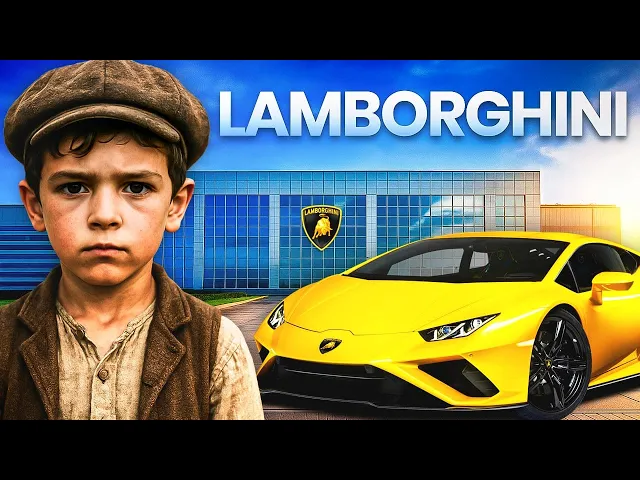
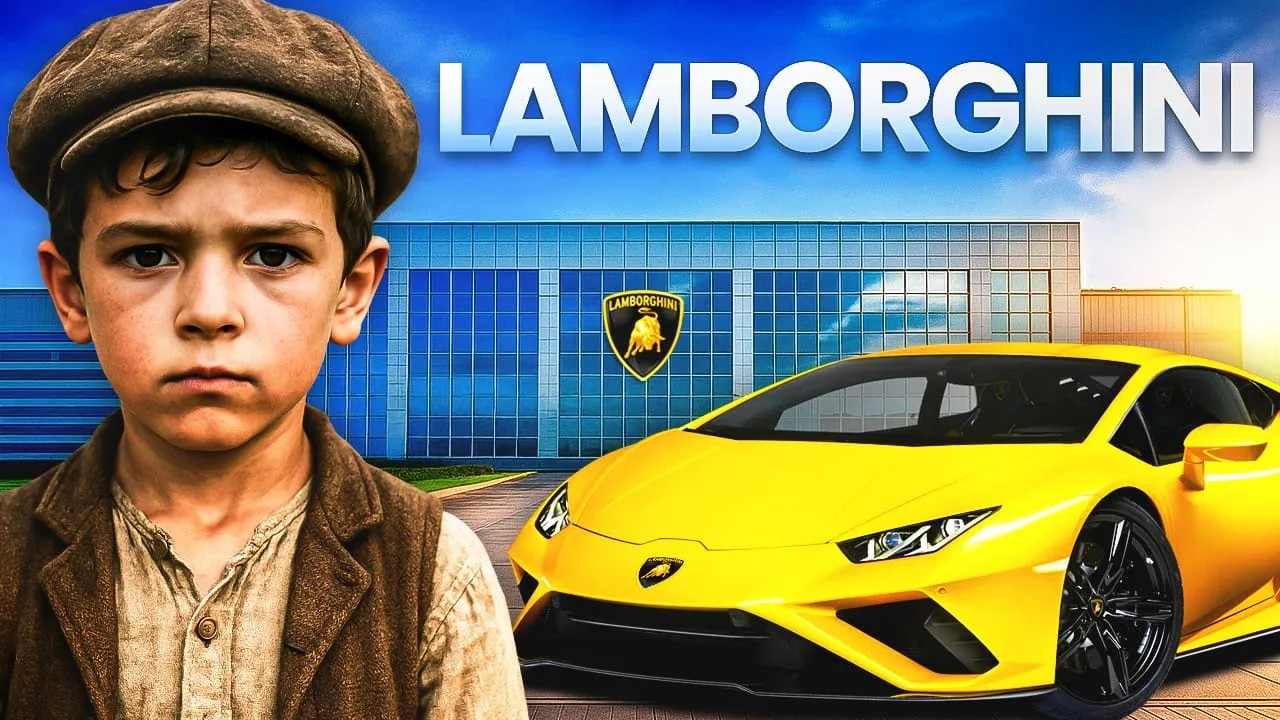
Lamborghini makes some of the most exotic and expensive sports cars in the world, boasting annual revenues of over $2 billion. And yet, despite its cars being purchased by wealthy and famous people, the company was founded by a humble farm boy whose father bered him for tinkering with tractors instead of working on the farm. After serving in the army and being taken as prisoner of war, he used everything he learned to open a small workshop and build his own tractors using old and reused war equipment.
Nobody could have guessed that these humble beginnings would lead him to build one of the largest tractor manufacturers in Italy and later the inventor of one of the world's most iconic and luxury sports cars, Lamborghini. Fucho Lamborghini was born on April 28th, 1916 in a quiet village from northern Italy called Renazo. Italy at the time was embroiled in the First World War.
And so by the time the warfare ended in 1918, the country's economy was on its knees. There were food shortages, civil unrest, and poverty widespread across Italy. But despite all the chaos, the Lamborghini family managed to live a modest and stable life.
Fucho's father, Antonio, owned a small vineyard that provided a steady supply of grapes and wine, which helped the family stay afloat. For Antonio, the farm wasn't just a livelihood. It was the family's legacy.
And so, Fucho would have spent most of his childhood working with his father on the vineyard from morning to dusk. But then, one day, everything changed. Antonio brought home an old tractor, which quickly became a gamecher in the family's life.
It significantly reduced the amount of manual labor required on the farm and allowed the family to maintain their vineyard with fewer resources. The major flaw, though, was that the tractor was too old, noisy, and unreliable. And yet, Fucho found it captivating and unlike anything he'd ever seen before.
He would spend hours tinkering with the machine, taking it apart and piecing it back together to learn how it worked. And soon, what began as a child's curiosity quickly turned into an obsession. At first, Antonio didn't think much of it.
He assumed his son's new obsession was just a temporary hobby on the side. But as Furucho got older, his obsession with mechanics only grew stronger. This meant by the time young Lamborghini finished school, he had a big decision to make.
Fucho didn't want to be a grape farmer anymore. He yearned for a life where he could tinker with engines and explore different machines. But asking his father for permission to study engineering was no easy task.
The vineyard had been passed down in the Lamborghini family for generations. And as the oldest son of five children, Fucho knew it was his duty to carry on that heritage. Finally, one evening, he summoned up the courage and approached his father to ask for his blessings.
At first, Antonio sat there in silence, but after an awkward and tense conversation, he realized there was no changing his son's mind. And so, Antonio reluctantly gave him his blessings. The next morning, the young Lamborghini left Renazo and set off to Bolognia to study at the Fertelli Tadia Technical Institute.
After graduating with a degree in industrial design, he started training with a master blacksmith who shared all of his ironwork and welding secrets. These training sessions are what helped Furucho find work at the most important factory in the city, Cavayi Riki. At the time, the factory was commissioned to maintain the Italian army's vehicles, and Fucho picked up valuable skills and insights that would later define his life and career.
By the time he turned 18, Fucho returned to his hometown, Renazo, and partnered with a close friend to open their own mechanical workshop. For the next few years, he lived a carefully life doing what he loved, fixing tractors and other machines that were brought to the shop. In his spare time, he would buy and fix old vehicles for the sole purpose of cruising on the country roads for pleasure.
However, 5 years later, the world was once again plunged into chaos. World War II had erupted, but this time, Fucha wouldn't be watching it from the safety of his father's vineyard. Instead, he would now be in the middle of it.
[Music] With the outbreak of the Second World War, Fucha was drafted into the Royal Italian Air Force in 1940. However, instead of sending him into the front line, the army recognized his mechanical talents and sent Fucho to the Italian garrison at the Greek island of roads, where he spent the next 3 years repairing and maintaining the army's tractors and diesel trucks. By the time Italy surrendered in 1943, Fucho had transformed from a skilled mechanic into a master of his craft.
Unfortunately though, Hitler had anticipated Italy's betrayal. And immediately after they surrendered, the Germans seized control of the island of roads and most of Italy before falling into the hands of the Allied forces. All of the Italian troops on the island were then expelled by the Nazis.
But instead of leaving, Furucho convinced the Germans to let him stay and open his own mechanical workshop on the island. However, as the war continued and the Nazis were being defeated, the Allied forces ultimately took control of roads in 1945. Fucha was captured and imprisoned just like everyone else on the island.
But once again, his technical aptitude was recognized by the Allied forces and was tasked with fixing and maintaining their vehicles instead. A year later, he was eventually released and allowed to return home to Italy. However, Fucho's early years back home were far from blissful.
Due to the war, the Italian currency had collapsed, leading to a shattered economy with a bleak future ahead. Despite the situation though, Furucho took advantage of his skills and set up a small workshop, repairing whatever pre-war vehicles, lorries, and tractors he could get his hands on. He soon married a young woman from roads whom he'd fallen in love with during the war, Kalia Monty.
And for the first time in years, life seemed to give him something good to fight for. By 1947, his wife gave birth to their first son, Tanino. When the doctor delivered the news, Fucho felt a surge of joy unlike anything he'd ever experienced before.
Unfortunately, although that joy was short-lived when he asked about his wife, the doctor's expression changed, and that's when Fucho knew something terrible had happened. His wife, Cleia, had died during childbirth, leaving Furucho alone to raise their newborn son. Furucho couldn't believe it.
He felt like he was having a terrible nightmare. But it wasn't a nightmare. This was his reality now.
Understandably, Lamborghini fell into a deep depression and buried himself at work, hoping to use it as a distraction to drown out his grief. Then one day, Furu received a brief but urgent message from his father that would eventually pull him out of his sorrow and alter the course of his life. Apart from dealing with the loss of his wife, Fucha was battling with another problem.
Money. Business was slow. And now that he was a father himself, Fucha wanted to give his son the life he never got to have.
But fixing old lorries and tractors wasn't going to provide him with the kind of life he dreamt of. He needed something bigger. And then in the most unexpected way, the answer came to him.
One afternoon, an urgent message arrived from his father. The vineyard tractor had broken down and his father needed help. So he dropped everything and rushed to his father's farm.
As Fucho worked on the tractor, he listened to Antonio's frustrations. Fuel costs were unbearable. His tractors were unreliable.
And replacing the parts was extremely expensive. And that's exactly when it hit. It wasn't just his father who was struggling.
Thousands of farmers across Italy were trapped in the same situation. You see, Italy at the time desperately needed to increase its agriculture production to rebuild their economy. But modernizing farms required tractors, and tractors had become very expensive after the war due to the increased cost of engines from the steel and manufacturing parts in the country.
To make matters worse, fuel prices had also skyrocketed due to post-war prohibitions, making it nearly impossible for farmers to even afford to run their machines. Identifying these problems, Furucho believed he could tackle some of the issues and set out to design an entirely new tractor, one that would be both affordable and much more fuelefficient than anything else on the market. At the time, the Italian government was auctioning off its huge stockpile of military equipment left over from the war to help rebuild the country.
And so, Furucho jumped at the opportunity. His experience with both Allied and Axis vehicles gave him a unique edge over these equipment. So he quickly gathered his savings and went straight to the auction where he purchased an old British Morris engine for a fraction of the price of a new one.
When Furo returned to his workshop, he modified and improved the engine by installing a fuel atomizer. This was a brilliant innovation as it allowed his tractor to start with gasoline and then switch to the much cheaper diesel fuel once it started running. To keep costs even lower, he used a smaller frame and repurposed salvage parts from other military vehicles available.
Piece by piece, the machine began to take shape. And after months of restless nights, the karaoke tractor was finally completed. The first to test it was his father.
At first, he was skeptical about the machine. But after firing it up and taking a spin on the vineyard, all of his doubts had vanished. The tractor was efficient, powerful, and most importantly, economical.
Excited, Antonio began showing it off to his neighbors, boasting about his son's invention. Word spread like wildfire and within weeks farmers from nearby villages who were knocking on Fucho's door, eager to get their hands on one of his revolutionary tractors. What started as a desperate attempt to solve his father's problems had now turned into something much bigger.
Lamborghini was now in business. At first, Fucha was satisfied with building one tractor a week, but his tractors were so efficient and affordable that he soon began receiving a new order every single day. This surge in demand might not have been a problem if Furucho hadn't been working entirely on his own.
and with limited equipment, no additional manpower, he soon found himself overwhelmed. So he went to the bank and asked for a loan. Unfortunately, the bank rejected him as they were very conservative, especially at a time when the country's economy was still reeling from the war.
Meanwhile, back at home, orders continued pouring in. Customers were growing impatient, and the pressure was piling up on Fucho. One morning, Antonio stopped by Fucho's workshop and immediately noticed the immense stress reflected in his son's eyes.
After hearing about the situation, Antonio immediately offered to help and put down the family's farm as a collateral, which Furucho used to finally secure the loan. This was a huge gamble because if Fucho failed to repay the loan on time, his family would lose their farm, a loss he knew his father might never recover from. So, he immediately got to work.
He hired a small team, purchased a thousand Morris engines, and expanded into a larger production facility for his newly formed company, Lamborghini Tratori. With his new workforce, Lamborghini was able to improve his machine and release a range of new models that slowly allowed him to break into the tractor market. Eventually, Fucho began working on designing his own engine, and by 1952, Lamborghini Trtori was selling tractors and crawlers entirely produced by the company using their own diesel-made engines.
These new engines proved to be more powerful, efficient, and cheaper to manufacture, allowing Furucho to lower its price and make his tractors even more competitive than before. This also ended up being perfect timing for Furucho. Because only a year later, the Italian government began offering loans for Italian farmers who were purchasing Italian-made machinery.
And since Fucho was now using his own engines, his tractors qualified for the program. This was a huge turning point for the company. Profits soared, production skyrocketed, and Lamborghini Trtorii became one of the biggest agricultural manufacturers in Italy, selling thousands of units every year by the late 50s.
It also helped that Italy was experiencing an economic boom during the same period, and Fucho would seize the opportunity even further by expanding into the heating and air conditioning business in 1960, which quickly became another huge and lucrative venture on its own. With two thriving businesses, Fuucho Lamborghini was now one of the wealthiest men in his country, and his name began to be known all over Italy. Little did anyone know, he was on the verge of making his name even more famous, and in a way no one could have ever predicted.
Now that he was wealthy, Fucho celebrated his success with fine wine, good food, and fast cars, especially the luxury grand touring models. His collection of cars had grown to include the likes of Mercedes, Jaguars, Maseratis, Alfa Romeos, and Ferraris. But no matter what vehicle he bought, there was always just one minor flaw that prevented him from fully enjoying it.
However, no car frustrated him more than his Ferrari 250 GT. This vehicle was the most prized and expensive from his collection. And yet, it was also the one with the most problems, as the clutch would constantly break down at high speeds.
After having his clutch fixed multiple times with Ferrari, Fuchu decided he had enough. So, he brought the car to his tractor factory and had one of his mechanics dismantle it to uncover the root of the problem. That's when they discovered that the clutch used in his Ferrari was identical to the one fitted in his Lamborghini tractors.
This did not sit well for Furucho since he would pay €10 for the clutch his tractors used and paid Ferrari €1,000 for the same part. Disappointed, Froo improved the clutch himself and decided to visit Ferrari to share his findings about their cars. In truth, he had no intention of causing a fight.
As an engineer himself, Lamborghini simply wanted to help Ferrari improve his cars and genuinely thought he was doing him a favor. But Enzo was not an easy man to deal with. Known for his quick temper and arrogance, he had little patience for criticism, especially from someone he considered to be a mere tractor manufacturer.
When Fucha pointed out the flaws in Ferrari's design, Enzo dismissed him, claiming that his cars were perfect and that the real issue was him not knowing how to drive them. Finally, Enzo left Furucho with a biting remark. Stick to making tractors and let me make sports cars.
That moment would change everything for Fucho. Instead of being wellreceived for his ideas, he was rejected in the worst way possible. The insult for him was really humiliating, and on his way home, he made a fateful decision.
He was going to build his own sports car and make it much better and more reliable than those of Ferrari. In fact, it was going to be the best luxurious sports car the world has ever seen. And unlike Ferrari, he was going to make sure that their buyers received the best service possible.
So, in 1963, Fuucho founded Automoili Lamborghini and began recruiting the most talented Italian engineers for his project. Among them were Jato Bizarini, Franco Scalion, and Jealo Delora, all of whom who had previously worked for Ferrari. Together, they set out to achieve Furucho's bold dream to create the ultimate sports car.
A machine with high performance capabilities that didn't compromise on reliability, ride quality, or comfort. The main challenge was that Fucho gave his engineers only 4 months to complete the prototype. This feat was considered to be impossible to say the least.
Especially for a car that was looking to compete against the finest grand touring automobiles of the day. The reason why was because Fucha was so eager to beat Ferrari, he wanted to debut the car at the Turin Motor Show that same year, which was only 4 months away. So, Lamborghini and his team worked tirelessly around the clock every day and made good use of the infrastructure available from his tractor factory for his project.
By the time the Turan Auto Show arrived in November 1963, they were able to complete the car, but were hit with a major setback. The engine was not ready yet. However, Furucha refused to let that stop him.
He went through with his plans and instructed his engineers to fill the engine bay with bricks, keeping the car's weight low enough to make it look like the engine was inside. During the show, they made sure the hood remained locked at all times. And luckily for Fucho, the gamble paid off.
The car's sleek design and luxurious interior were so impressive that no one even asked to see the engine. The positive recognition from his prototype gave Froo even greater confidence in his design. And after completing the engine, he quickly ordered the car into production.
5 months later, the Lamborghini 350 GT was born. The 350 GT was a technical masterpiece. It had a V12 engine, 5-speed transmission, four-wheel disc brakes, and four-wheel independent suspension, making it one of the finest sports cars available.
Over the next 2 years, 120 units were produced and sold, giving Lamborghini a respectable start to his venture into the luxury car industry. However, his goal of beating Ferrari was far over. And to make good on his promise, he worked vigorously on improving the car even further, which eventually became the successor to his first model, the 400 GT.
In the meantime, some of his best engineers were working on a side project at night, developing a mid-enine sports car inspired by Formula 1 technology. This would be a radical departure from the traditional grand touring cars of the day since its unique performance and appearance of the car would be something not seen before in any other sports car in history. The turning point here though was that the project was kept from Fucho since he was against the idea of building race cars.
Several years back he had entered the 1948 ML Miglia road race, one of the most popular and difficult races in his country, but ended up crashing against a wall on the side of a restaurant. This experience traumatized Fucho and left a mark in his life that would avert him from entering the racing world again. But Lamborghini's team were so confident their design would disrupt the sports cars market that they continued to work on it in secret.
Luckily for them, after Furucho found out about their prototype, he ultimately forged ahead with their plan. Now, while Furucho remained a bit skeptical about it, he reflected that at least the unique and extravagant design of the car was an opportunity for him to bring more attention to his brand. Never could he have guessed that this car would become the one that would ultimately put his company on the spotlight, the Lamborghini Mura.
When the Mura was released in 1966, it became the fastest production automobile up until that moment, and its innovative design quickly earned its place as the world's first supercar. It wasn't just faster and more advanced than any road car of its time. It became a cultural icon and a fan favorite among celebrities.
Plus, its rear mid-enine layout soon became the standard for all high performance cars during the next decades. This meant Fucho didn't just make good on his promise to surpass Ferrari. He exceeded in spectacular fashion.
On top of that, Fucho also made sure his clients were well treated and satisfied. And unlike Ferrari and other luxury automakers, whenever a Lamborghini broke down, the company would send a mechanic at its own expense, even by plane if necessary, and a letter of apology. This exquisite attention to quality and service gave Lamborghini even more publicity and helped establish the company as one of the best in the luxury car market.
Over the following years, the company continued to introduce some of the most celebrated models of those times such as the Espada, the Isero, the Harama, and the Uraco. The legendary Countach, for example, became the most written about car in history. Everything seemed to be going well for Furucho, and his name had become synonymous with innovation, luxury, and performance.
However, he was about to face the greatest challenge in his life. One that would put at risk everything he had built up to that point. The first major blow came in the early 1970s when Lamborghini Trtori faced an unexpected financial catastrophe.
The Bolivian government had placed a massive order for 5,000 tractors, a deal that would have significantly boosted Fucho's company to new heights. But before the order was completed, Bolivia plunged into political turmoil and the contract was abruptly cancelled. When the news reached Fucho at his estate, he was petrified.
He had taken out a huge sum of loans to ramp up production, expecting a financial windfall. But now he was left deeply in debt with a warehouse full of tractors he couldn't sell. And just to add on, Automobile Lamborghini was also going through their own challenges.
Years of production delays from crucial models such as the Euro and Countach meant that the company was falling behind. While other car makers were quickly launching more competitive models with similar performance, with the mounting pressure of two struggling companies, Fucho saw no better option but to sell a 51% stake of automobile Lamborghini in 1972. In order to repay some of his debts and try to keep his businesses afloat, but still it wasn't enough to recover.
As the situation continued to spiral, he was forced to sell his entire tractor business the following year to a rival company named Same, who had the reserves necessary to save the company from collapse. While Furucho felt devastated for letting his tractor business go, more unfortunate things were coming to him that were completely out of his control. The oil crisis of 1970 caused the global economy to spiral into recession, leaving the automobile industry into immense chaos.
Now gasg guzzling supercars like Lamborghini became the last thing anyone wanted to buy. The likes of Ferrari, Porsche, and Maserati all suffered as well. But Lamborghini, a young company without deep financial reserves, was among the hardest hit.
Fucho fought to keep the company afloat by slashing costs, streamlining his production, and even experimented with fuelefficient designs to adapt to the new market. But still, it wasn't enough. Nobody wanted to buy luxury vehicles in the middle of an economic downturn.
Tired of wrestling against financial problems, Fujo decided to retire early and sold the remaining 49% of his automobile Lamborghini shares in 1974. He had already proven to Ferrari of what he was capable of and could finally lay back knowing he had produced some of the greatest cars in history, even better than those of Ferraris. So he handed over his heating and air conditioning company to his son Tanino and moved to a small town in Italy where he spent his later years out of the public eye going back to his farming roots.
And yet even in his retirement, Fucho saw time to build a successful highquality wine business entirely from scratch. Proving just once more how strong his entrepreneurial spirit was. He passed away in 1993 after suffering from a heart attack, leaving the control of his wine business to his family.
Meanwhile, the new owners of automobile Lamborghini failed to navigate the company through the oil crisis and financial instabilities in the business. And by 1978, the company was forced into liquidation. 3 years later, the Italian government sold the company to two billionaire French brothers for a discounted price of $3 million.
Under their leadership, the French brothers brought some resurgence to the Lamborghini brand and invested heavily in producing new models such as the Yelpa and the company's first SUV, the LM2. Nevertheless, they ran out of money and due to the poor sales and complicated manufacturing process, they decided to flip the company to Chrysler Corporation in 1987 for a sum of $25 million. With greater funds and resources to work with, Chrysler released one of the most famous and reliable cars Lamborghini was able to produce, the Lamborghini Diablo.
The Diablo became a commercial success in the world of supercars and drew the attention of millions of people around the world. It was much more reliable than the famous Count and became the first supercar in the world to surpass the 200 mph mark, turning it into one of the most iconic cars in history. Unfortunately, the early 1990s recession sent shock waves through the entire automotive industry, and the Chrysler Corporation, drowning in financial troubles, had to cut its losses and sell Lamborghini in 1994.
This time to an Indonesian investment group for $40 million. However, this Indonesian conglomerate largely lacked experience in the automobile industry. And after Asia was hit by their own financial crisis in 1997, Lamborghini was once again put up for sale.
This time it would be Audi, a subsidiary of Volkswagen Group that would purchase Lamborghini for a sum of $110 million in 1998. Unlike previous owners, Audi recognized Lamborghini's potential and understood the need to pay greater attention to processing and quality for their cars. With that vision in mind, they modernized their manufacturing system and infused German precision engineering into Lamborghini's Italian craftsmanship.
In 2001, the company released its first model under their parent Volkswagen group, the Mercielago, which instantly earned its place as one of the best looking supercars of the 21st century. Thanks to its high performance and exotic design, the Mercielago became a cultural phenomenon, selling thousands of units across the world and winning a strong foothold in the United States. From that point on, Lamborghini experienced an extraordinary resurgence with the release of widely successful models such as the Gallardo, the Aventador, and the Huracan.
Modern supercars that continued to push performance and technology to new heights. But the game changer would be in 2018 when the company unveiled their bestselling model to date, the Lamborghini Urus. The Urus quickly became popular for being the first SUV to successfully combine the high performance and design aesthetic of a sports car with the practicality and functionality of an SUV.
Due to these reasons, the Urus attracted a new generation of high-end buyers, pushing the company's sales to record heights and redefining what a luxury sports SUV should be. Today, Lamborghini is valued at around 11 billion and sells more than 10,000 vehicles per year with the Urus accounting for more than half of its overall annual production. This is the story of how a grape farmer and prisoner of war created one of the most fascinating and exotic car companies in the world, Lamborghini.