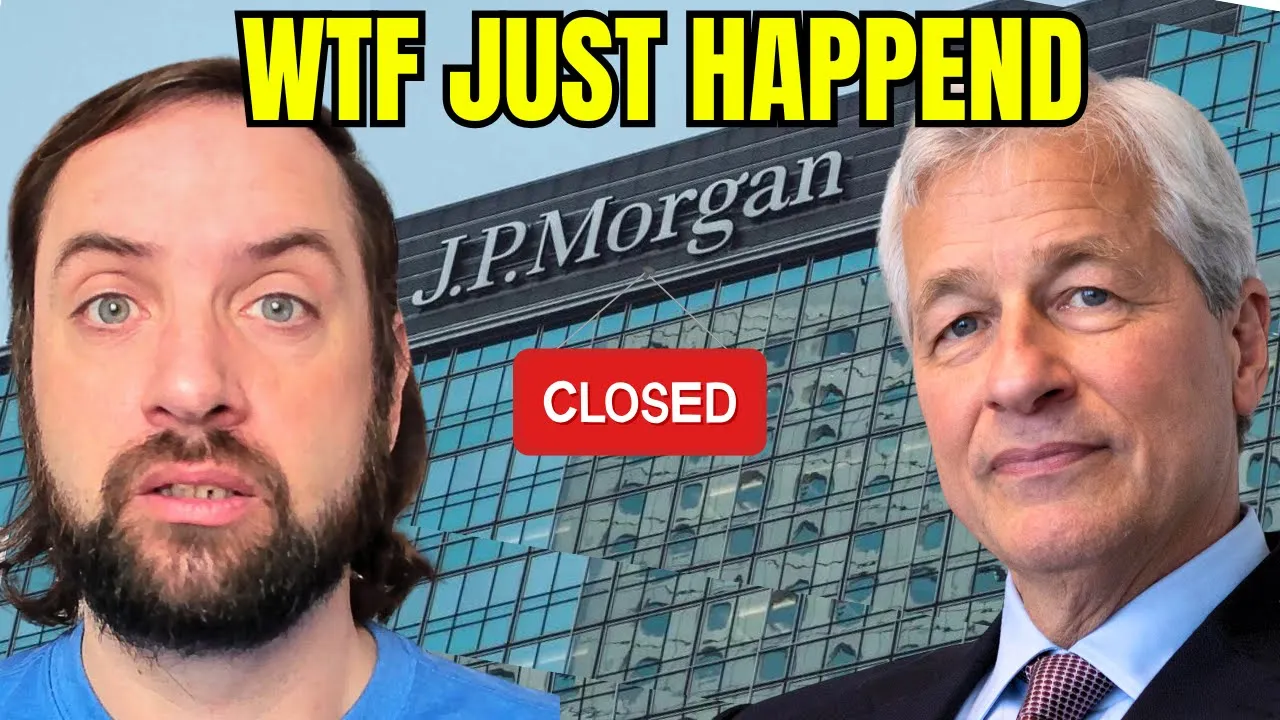
JP Morgan missed on its earnings report today because it failed to sell as many bonds for its customers as it and analysts had been expecting. The bank's CEO Jaime Diamond, he of cockroach fame, went on to acknowledge that the labor market had softened, but then described Goldilock situation anyway. But this is something that's coming up more frequently in other sources, not the Goldilocks part, even though that's the Fed's position.
the bond issuance matter. It is a one it's one of those credit market signals that you need to pay attention to because there's a lot of information contained in it and I'm going to explain to you why and what it really means. It is to begin with a big reason why the yield curve keeps on bull steepening even when longerterm yields like the 30-year bonds are going higher.
So, I'm going to clear up that misconception as well. Now, some of that missing issuance showed up in a busy first week of January. However, that appears to have been a delay even by a couple of weeks in selling bonds on schedule, which then corresponds with the repo market disruptions we were talking about in December to the point it is showing up in JP Morgan's earnings report.
So, there are growing concerns over not just the usual topics that we've been covering like private credit exposure and portfolio quality, also these downstream technical consequences of macroeconomic deterioration that doesn't fit so easily into this Goldilocks narrative. this shifting Goldilocks narrative. There are these things called fallen angels, corporate debtors that have been downgraded and either sit on the precipice of junk status like Oracle for example, or they've taken the plunge into the benevolently named high yield corner of the market already.
As the credit cycle turns, these are the kinds of developments that you should expect. The corporate bond market doesn't shut itself and close all its doors all at once. There's back and forth in everything.
Nothing ever goes in a straight line. So you need to pay attention to the back and especially the fourth because these signals contain information. They tell you something important about the underlying behavior of the system.
What the market is thinking maybe as far as how many fallen angels there might be and how far fallen they might already have become and what to do about everything. And behind all of it, as I said, the Treasury curve, the yield curve, both steepening with its still emphasis on the steepening part, but it's not as steep as maybe it should be or maybe as much as you think. And all of this is related.
So that December hiccup, as I said, showed up in JP Morgan's kickoff of bank earnings and the overall earning season at the stock market. The bank itself reported a 7% drop in profits, which were largely related to a 2 billion charge it took before taking over Apple Card's loan portfolio, which already says something that there there's got to be a huge mess in that thing, which is another kind of related sign of credit deterioration all its own. However, apart from Apple in the future for JP Morgan, the bank's earnings were a lot of what everyone had expected.
Though, there was this one area of concern that does fit with this credit cycle shift. Now, first of all though, company officials were highly complimentary of everything as they always are and we always expect them to be. Revenues were up at the bank.
Earnings apart from Apple beat analyst expectations. Not that that means a whole bunch, but underneath all the Goldilock sentiment, JP Morgan's management did have to acknowledge that there was some flat beverage that was introduced to them unexpectedly. According to Jamie Diamond, quote, "The US economy has remained resilient.
While labor markets have softened, conditions do not appear to be worsening. It's the same moving goalpost that central bankers and the financial media have applied to everything, too, because the financial media gets all their opinions from central bankers or bankers, especially when bankers agree with central bankers. " But contrast that statement with what Mr Diamond had said last year at the same time when he was announcing the results of JP Morgan's fourth quarter 2024 earnings in early January 2025.
Quote, "The US economy has been resilient. " He said, "Unemployment remains relatively low and consumer spending stayed healthy, including during the holiday season. Businesses are more optimistic about the economy and they are encouraged by expectations for a more progrowth agenda and improved collaboration between government and business.
" Yeah, not so much a year later. Now, Diamond says, among all those other things, the US labor market has softened when that wasn't supposed to have happened at all. Don't worry, he says it's not crashing.
It's the same rhetoric and claim as J Powell without acknowledging the shifting comparisons, the moving goalpost. The economy is strong, then it was solid, then it softened, and it's actually softened to losing jobs. And at each and every stage, at each and every point, they say the same thing.
Goldilocks in every single one. So that's the macroeconomic background which we know only too well. Flat beverage and that's Diamond's way of acknowledging flat beverage while also taking Powell's path and saying it doesn't really matter all that much.
But in the one part of JP Morgan's earnings report that does catch our attention is as I said investment banking bond underwriting which was weaker not just the analysts were expecting but weaker than the bank said just a month ago. So this is where it gets interesting. The previous year in the fourth quarter 2024, the bank was all over fixed income.
Trading revenues soared 20% year-over-year. So much for the bank taking Jaime Diamond's inflation statements that we talked about at face value. But Morgan also reported a 49% surge in investment banking fees.
Now this time, a year later, fourth quarter 2025, softer labor market. That's where it was weakest. The entire bank's results were weakest in the fourth quarter in investment banking.
Those fees were down 5% compared to last year. Not only was that below analyst expectations, it was significantly less than the quote low singledigit growth that JP Morgan itself said it was expecting just last month in December. So underwriting fees were down 2% which was a total surprise since analysts were thinking they were going to increase by 20%.
What that means is bond deals the bank thought were going to get completed in December didn't get completed in December. So you can see where this is going in the context of a growing credit cycle shift. It's another key piece of evidence among many others that conditions did tighten enough issuance for JP Morgan's investment bankers at the very least got knocked off its schedule impacting the overall bank's quarterly numbers and leading to at least for one day the stock price taking a hit.
So weak bond issuance in the fourth quarter surprisingly weak as we keep getting all of these signals about credit cycles shifting all these back and forth es and flows everything that's in you know the process that's taking place you got to pay attention to this you got to pay attention to not just the signals and what they're telling us the potential shift from phase one to phase two but also potential opportunities that are involved in that this is why we're going to be talking and focus so much on the credit cycle and other risks to the overall system at Uridal University Live next month, President's Day weekend, February 2026. Join me and Steve Anne Meter, George Gammon, Hugh Henry, Mike Green, Brent Johnson, as we go into all the details, all this wealth of knowledge and experience that's available. Make it available to yourself by joining us next month.
There's a couple VIP slots available. you get a chance to to get in a room with these people and really go really pick their brains about what they're seeing, what they know, what they can tell you. We also have a presentation by a distressed credit fund, what that's all about, why that's a tremendous opportunity.
You don't want to miss this. There's a link in the description of this video to book your call. If you're a serious investor, you cannot afford to miss this.
It's going to be an entire weekend of fun, of entertainment, of education, but also the stuff that's really important to all of us. Again, there's a link in the description of this video has all the details. Really hope to see you there.
Again, President's Day weekend, February 2026. It's going to be really big, really huge, really important. Now, December got to be overall, outside of JP Morgan, let's think more broadly here.
December got overall got to be a little bit tougher for the corporate bond environment, especially when it comes to things like ABS and CLLOs's I'll get to in just a minute. But overall corporate bonds, especially investment grade corporate corporate bonds, saw a pretty sharp decline in issuance, especially during December. According to SIFMA's estimates for bond issuance, only 34.
8 8 billion of investment grade corporate debt was sold during the month. A 23% drop when compared to December of 2024. Now December is not a huge month for corporate bonds in any given year.
So take this for what it's worth. Though it does it is consistent with what JP Morgan said. Beside high yield issuance was up 77% last month compared to the prior December which meant overall corporate bond sales were down only slightly.
But even that can be a mixed signal especially when you think about something like Oracle for example. That company still rated investment grade couple notches above junk from both S&P and Moody's but there are others who have been stuck on that doorstep. And that brings us to something like fallen angels.
Now a lot of that issuance that you know delayed and hit JP Morgan's calendar got pushed into January which is another thing we'll come back to in a second here. Here, let's read it. First of all, quote, "The first full week of the year marked one of the most active periods for US corporate bond issuance on record.
Companies rushed to to tap debt markets early, taking advantage of steady demand and favorable pricing conditions that weren't there in December. Despite the surge in supply, credit spreads remained relatively tight, signaling that investors are still willing to accept relatively low compensation for taking on corporate risk, just not all at once. This confidence however continuing may be masking a growing vulnerability.
According to data from ironically JP Morgan Chase and company the volume of bonds hovering just above junk status climbed sharply last year 2025. These so-called fallen angel candidates who are issuers rated at the lowest wrong of investment grade now represent a larger share of the market than in recent years raising concerns about how resilient the credit landscape really is and why we keep seeing these back and forths. Investment grade bonds are typically viewed as safer holdings especially for institutional investors such as pension funds, insurers and conservative asset managers.
Are any of those left? But when companies sit one downgrade away from high yield status, even modest changes in economic conditions, even under Goldilocks interpretation, can trigger forced selling. A downgrade can push bonds out of investment grade indices, prompting large-scale reallocations that can amplify market stress.
So what we're talking about here is classic risk aversion behavior. In a truly goldilocks credit environment, you don't ask questions, you just buy. J Paul says solid.
take him at his word and reach for the yield. As Wall Street bond dealers like JP Morgan will tell you, buy the BA instead of the A-rated bond because you can pick up a few extra basis points of return without, they say, any additional downside. But when you start thinking outside that Goldilock structure, you begin to care about the riskiest stuff at the margins.
Still have no problem buying single A, but maybe you don't call up JP Morgan looking for the BA like you would have before. And that applies to various other asset classes, not just for individual bond ratings within classes. For example, let me give you an example here.
Let's go back to SIFMA again. Issuances of CDOS and CLOS was up 10% in the fourth quarter over 2024's final three months. Now, these are these securitized and packaged corporate loans that maybe you hear something about.
They're they're big in private credit. We've mentioned them before because a lot of this private credit that we've been focusing on is packaged up into CLL's, CLLOs's and other kinds of ABS. So that 10% increase in issuance last quarter, maybe that sounds good and solid consistent with Goldilocks, but you got to keep in mind issuance had soared 86% in the third quarter, had surged even more by 172% in the second quarter, and was up a whopping 301% in the fourth quarter of 2024 over the fourth quarter of 2023.
So yes, from 300% growth to 10% growth in a year. And what a year, the year of flat beverage. And by the way, in December alone, CLLO issuance was according to SIFMA only 5% more than December of 2024.
So again, like JP Morgan's investment banking numbers, like we saw in repo markets and fails, there was indeed something of a hiccup there in December that was building on conditions moving in that direction for several months before then. As we talked about, remember this cockroach business didn't really break out until really break out into the open until October. That was the big shadow bailout of shadow banks in Europe, the funding commitments from US banks to offshore funds.
Even as hit the tape in September and first brands bankruptcy was at the end of that month, it really wasn't until October until everything was taken more seriously. And then in November, what do we see? We saw UBS shutting down its fund.
We saw Blue Owl's failed merger idea. confirmation all over the landscape of hedge fund withdrawals or what I call phase one of this credit cycle downturn. So what this issuance stuff points to is a sort of fallen angel for the class as a whole.
investors taking a pause, a shortrun pause, wondering if job losses and garbage lending might suddenly be important characteristics that they had previously ignored because Jay Powell and Jaime Diamond both said up until recently the unemployment rate was low and there was no reason to fear the macroeconomy being anything other than solid. Then of course it started to not be solid. So, these are all low-level indications, but yet compelling indications showing that the credit markets around the edges, just around the edges, are facing some degree, some significant degree of erosion, a pause where none had been before.
Concerns about what for years had been taken to be unconcerning. Now, none of this guarantees that this phase one stuff that we're talking about, phase one of the credit cycle downturn, becomes phase two, let alone something like phase three, as I talked about in a recent video. However, it is all consistent and compelling evidence of at least phase one, that something has shifted, something has changed.
Even if it is a shortrun hiccup in credit markets like we saw in funding markets like repo, it is still something to pay attention to and it is consistent with phase one at risk of becoming at higher risk of becoming something like phase 2. I think this is a big reason why you've seen sort of frozen Treasury curve rates, too. There's been remarkably little variation in bond yields since early September when all of this started to erupt.
Both the two-year and 10-year spots on the curve have traded in incredibly narrow ranges, though there are some subtle key subtle differences, but key differences here. Now, the two-year, we've been talking about this for the last year. The two-year had been the focus of bull steepening up until then.
The first stage of curve uninversion. We have to keep that in mind. Always keep that in mind.
That's the underlying condition on the yield curve. no matter what happens in the short run. It had been inverted since, you know, early 2022 and heavily inverted for years before the summer of 2024.
But summer 2024, we began the uninversion process. And what happened? What happened in that initial stage?
Long-term rates rose relative to those at the shorter end. Again, long-term rates were up in that initial phase relative to something like the 2-year, the 10-year, the 30-year. And everyone was confused by this, calling it Treasury rejection, renewed inflation fears, everything else.
But it was steepening. Now, the scope for steepening was limited at the time by the Fed refusing to behave in the way it normally would for conditions like these, owing entirely to its irrational superstitions over inflation. By January 2025, the curve the curve started to ignore most of that completely dismissed tariff inflation and the bull steepening took place in more recognizable fashion.
All throughout the middle of last year, longerterm rates went down nearly keeping up with the lower shorterterm rates like the two-year spot on the yield curve. And the whole time that tariff inflation, dollar debasement, sell America, Treasury rejection, all of that nonsense, they were taking as foregone conclusions in the mainstream, yet the yield curve shut out all of it as and just looked at it as noise, kept on steepening. Anyway, now the one part that was the one part of the yield curve that was left out of that bull steepening in 2025 up until the end was the bills.
The Bills had to wait for the second round of Pringles out of the Fed, which the market was really unsure of in terms of timing given all the tariff inflation ridiculousness. But since the start of the Jay Powell's second helping of Pringles, uninversion has shifted focus to the very front, which has dramatically, I mean dramatically, reshaped the yield curve closer to its normal condition, fully upward sloping, fully uninverted. Not quite there yet.
And just like the year before in that first step toward uninversion which was focused on the twos that focus again last year got narrowly applied in 2024 it was the twos and the three years while the 10 year and 30 years saw the rates go higher steepening from the twos on out in 2025 and now 2026 inversion is now in the bills which has meant steepening keeping the two-year in a narrow range that one that we keep talking about since September but at the lower end of that narrow range. Meanwhile, the 10-year, which is also curiously in a narrow range, but it's at the upper end of that narrow range, at least relatively steeper to the two-year spot. Meanwhile, what is the long bond doing?
The long bond is doing the same thing that it did in 2024. It's all curve steepening given the initial constraints imposed by superstitious Fed officials like Casey Jeff who continued to stand in the way of market yield curve uninversion. that uninversion is and steepening is happening anyway, which means some degree of upward pressure on especially longerdated instruments.
There's your 30-year, there's your 10ear at the upper end of its range. What gets left unaccounted for or at least isn't as easy to appreciate because it's not as visible as the sideways action in the 10ens or the upward trend for the 30-year rate, that's the downward force which has kept the twos and tens in their narrow range. And it's actually limited the rise in the 30s far more than you might really think.
And what are those downward forces reshaping the yield curve as it reshapes itself into uninverted upward sloping? Of course, everything we've been talking about flat beverage, the macroeconomic climate, but also these financial conditions and all these cracks that are showing up in the credit market, cracks that aren't just showing up, cracks that are being confirmed in all these various ways in the credit market cycle. I mean, we got flat beverage job losses that are confirmed themselves by every source, including the establishment survey before even taking to account benchmark revisions.
And those job losses that have been confirmed to have continued all the way through the end of 2025. And then you go on the financial market side, the credit market side, all these signals that tell us about the phase one in the cycle shift, whether they're the more more obvious cockroaches, the less tangible factors of what those represent, the Excel file, all that stuff, Wall Street not doing due diligence, or just the diminishing appetite for fallen angels and CLOS's right now at the margins. maybe a few less who are willing buyers of ABS who are switching over to just buying plain US treasuries if only to wait and see how all this goes in the future.
They're no longer blindly buying Goldilocks, but not giving up entirely on it either. not giving up entirely on reaching for yield, pulling back just enough to be somewhat noticeable in the credit market and treasury curve at the same time in all these different ways, but also happening just enough to show up in even JP Morgan's quarterly earnings report. These things are processes.
They don't take place all at once, not in a straight line, but you pay attention to these signals when they show up, the back and forth, the es and flows. So we see something like issuance get a little bit of a hiccup in December, maybe a little bit more than a little bit of a hiccup in December. That's consistent with the tremendous amount of monetary tightening we talked about in the repo market, plus another bunch of signals beside, including the Treasury yield curve and the steepening there.
More downward pressure on interest rates than maybe you really appreciate. It's all pointing to the same thing at the same time. Even as Jaime Diamond and Jay Powell can only talk in glowing fashion about Goldilocks.
Well, Goldilocks is a narrative, a fairy tale. This is all that's taking place. This is what's taking place in real credit markets, in the real economy.
And at the same time, the economy, the markets become more certain, not more uncertain. We got even more confirmation of phase one of the credit cycle from Canada. real estate funds that are already restricting redemptions.
And I went over the details and the implications in the video link below. As always, thank you very much for joining me. Huge thank you members and subscribers.
Join me next month, President's Day weekend, UR Live. Link in the description for that. And until next time.