What does it mean for an object to be at so many degrees Celsius and what exactly is temperature? Hey Engineering Lovers, throughout last year we had heat waves that made thermometers set temperature records. But an interesting point for debate is what exactly is temperature?
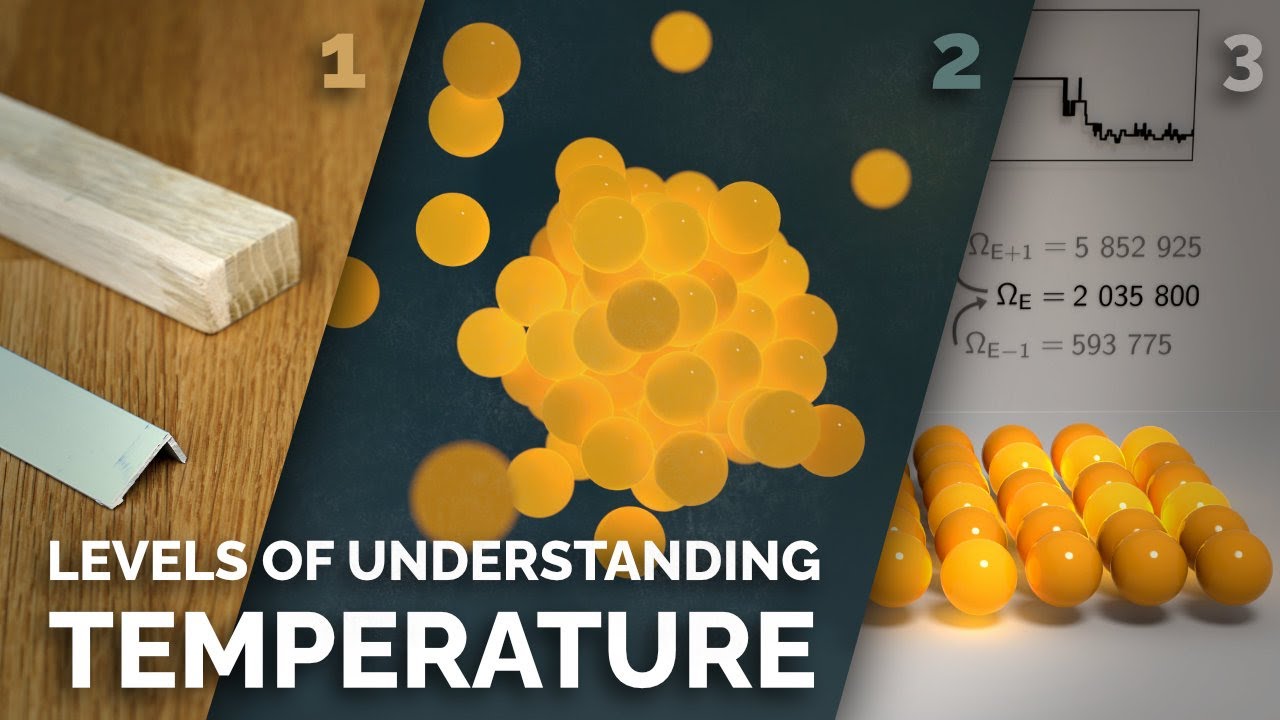
Let's start from the basics. Temperature is a measure of the average kinetic energy of particles in an object or system. In simpler terms, it's a way of describing how hot or cold something is.
When an object's particles move faster, we say it is hotter . When they move slower, we say it's colder. And this kinetic energy of the particles is directly related to temperature.
The standard unit for temperature in the International System of Units is the Kelvin (K), but we also often use the Celsius (°C) and Fahrenheit (°F) units, depending on the context. But let's understand a little better about these units. In Kelvin, we have the definition of what we call absolute zero, which is the point at which all particles stop moving completely.
This is the coldest state we can reach in the universe. This absolute zero, or zero K, is equivalent to -273. 15 degrees Celsius, and this temperature is the coldest state we can reach in the entire universe.
Absolute zero in Fahrenheit is equal to -459. 67 degrees Fahrenheit and the difference between these units is exactly that on the screen. Note that the Kelvin unit reference takes into account the zero point as absolute zero.
As for the unit in Celsius, its zero point reference is the freezing temperature of water. And for the unit in Fahrenheit it is a little more complex. Some say that the zero degree in Fahrenheit was calculated by taking a measurement of the point at which equal parts of mixed salt and ice melt, and others say that the zero point is the value of the most intense cold recorded in the city of Copenhagen.
But the point is that for this unit, the freezing point of water is 32 degrees Fahrenheit. But what do you mean temperature is the movement of particles? Well, the kinetic theory of gases is a model that describes the behavior of gases in terms of the movements and interactions of the molecules that compose them.
According to this theory, gas molecules are in constant motion, moving in random trajectories and colliding with each other and with the walls of the container that contains them. These collisions are elastic, meaning there is no loss of kinetic energy during the collision. Temperature is closely linked to the kinetic energy of gas molecules.
When the temperature increases, molecules gain more kinetic energy and move faster . This results in more frequent and higher energy collisions between the molecules and the walls of the container and consequently, the gas pressure increases. On the other hand, when the temperature decreases, molecules lose kinetic energy and move more slowly.
This leads to less frequent and less energetic collisions with the container walls, resulting in a decrease in pressure. Furthermore, temperature also affects the volume occupied by a gas. At a constant temperature, if the pressure increases, the volume occupied by the gas will decrease and vice versa, according to the Boyle-Mariotte law.
This is because, with increasing pressure, the molecules become closer to each other and occupy a smaller space. And how was this correlation between the movement of molecules and temperature made? When and who thought of this?
The kinetic theory of gases and the relationship between the movement of molecules and temperature were developed over time by several scientists, each contributing important ideas to current understanding. There is no single point of origin, but rather a gradual process of refinement and development over the centuries. However, there are some significant milestones Swiss mathematician Daniel Bernoulli proposed the idea that the pressure exerted by a gas is the result of the collisions of the molecules with the walls of the container.
He also suggested that temperature is related to the kinetic energy of molecules, with faster molecules corresponding to higher temperatures. Scottish physicist James Clerk Maxwell formulated the speed distribution of molecules in a gas, and Austrian physicist Ludwig Boltzmann developed the statistical theory of mechanics, relating the macroscopic properties of a system, such as pressure, volume and temperature, with the microscopic behavior of molecules that compose it and this became known as the Maxwell-Boltzmann distribution. This distribution describes the probability of finding gas molecules with different speeds at a given temperature.
German physicist Rudolf Clausius formulated the second law of thermodynamics, which states that heat will flow spontaneously only from a region of high temperature to a region of low temperature. And how do we measure temperature? Temperature measurement is carried out using instruments called thermometers.
There are several types of thermometers, but they all work based on physical principles that vary with temperature. You must know the famous mercury thermometer and it is one of the most traditional types of thermometers. It consists of a thin glass tube with a small amount of mercury inside.
As the temperature changes, the mercury expands or contracts, moving up or down the tube, and a graduated scale along the tube allows you to read the temperature. We also have the alcohol thermometer which is similar to the mercury thermometer, but instead of mercury, colored alcohol is used. The working principle is the same, where the alcohol expands or contracts with the change in temperature, moving along a graduated scale.
We also have resistance thermometers or thermo resistors. This type of thermometer uses a material whose electrical resistance varies with temperature, such as platinum or nickel. As the temperature changes, the electrical resistance of the material changes too and this can be measured electronically and converted into a temperature reading.
We recently talked about thermostats in a video, and in it we presented the thermocouple where it consists of two wires of different metals that are connected at one end. When this junction is exposed to a different temperature, an electrical potential difference is generated, which can be measured and converted into a temperature reading. And times also the infrared thermometer, and this type of thermometer measures the temperature of an object without physical contact.
It detects the infrared radiation emitted by the object and uses this to determine the temperature. It is very useful for measuring the temperature of hot objects, distant surfaces, or areas where direct measurement would be difficult or dangerous. Each type of thermometer has its own advantages and limitations, and choosing the appropriate thermometer depends on the specific application and environmental conditions.
However, they all work based on the relationship between a measurable physical property and the temperature of the system being measured. If you liked this topic, take the opportunity to subscribe if you are not subscribed, leave your like, and activate the notification bell and if you find our content interesting, consider becoming a member to help us continue producing content here on the platform and be remembered at our videos. So, what is the temperature in your city today?
Did you know about how temperature works? What type of thermometer do you have in your house? Leave it here in the comments and I want to know.
There are two video options that you might like and that are worth checking out to expand your knowledge. And if you want to contribute to us, leave your like, subscribe to the channel, activate the bell and consider becoming a member of the channel.