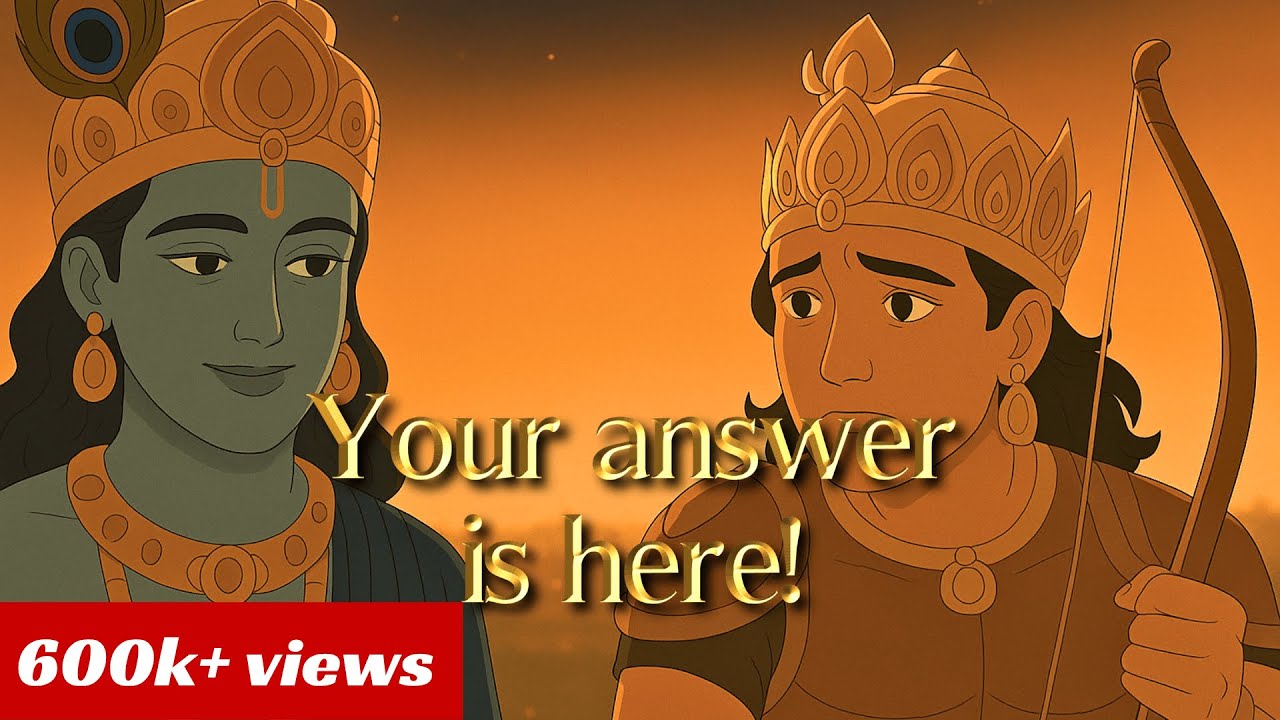
Three lessons from Bhavad Gita that will empower your mental health. I'm sharing this because this is very close to my heart and has changed my life. And if you are going through a rough patch, I genuinely hope it helps you too.
So let's set aside the religious or spiritual lens for a moment because the Gita at its core is something more than that. It's a guide book for your mind. Hi, I'm Gaitri Arvind, founder of Abasa Rehab and Wellness.
We offer residential rehabilitation for people suffering with addiction, mental health disorders, eating disorders, and chronic conditions. Over the past 6 years, we have helped over thousands of people reclaim their lives through personalized care. Through this channel, we share practical wisdom to empower your mental health.
Number one, do your duty but don't attach to the results or outcome. Now, this is a very well-known lesson to almost everyone, right? The lesson says, focus on the process, the journey, and not obsess over what you get from it because the outcome is never fully in your hands.
But how does this help your mental health? And it's easy to say, right? But how can you apply it in your daily life when your life itself is at stake?
Uh let's say you've got an interview coming up, a big one. You really want this job. So you begin preparing and in the beginning it feels exciting.
You are focused, determined, motivated. But slowly you can feel the pressure within your head like uh what if I mess up? uh what if uh they ask something I don't know or what if I freeze or uh what if I do everything right and still don't get it.
You are still in the preparation phase but you are tense anxious. That is where the real trouble begins. Your amygdala, the emotional part of the brain runs faster and the logical brain shuts down.
You cannot give your 100% there because half your energy is preparing and the other half is suffering. So you overthink, you lose sleep and you perform from a place of fear. And even if you do get the job, you're exhausted because the journey drained you.
And if you don't get the job, you are disappointed in yourself. This is why the lesson is very important. Let's say the moment when your head said, "What if I fail?
" You pause and remember this lesson and you ask yourself, "What is actually in my control and what is not? I can prepare. I can sleep well.
I can show up on time. I can bring my most present, sincere self into that room. But can I control what the panel thinks?
No. Can I control who else shows up that day? No.
So, you decide to focus on what you can control and everything else you hand it over to God, to the universe, to life, to whatever you believe in. What happens in your brain is your amygdala, the part of your brain that gets hijacked during stress begins to calm down and your prefrontal cortex, the one responsible for logic, clarity, focus, it turns back on. You feel lighter, sharper, you feel like yourself again.
So you will prepare with your 100%. And as a result, you win either way. You stay calm.
You give your best. And when it's over, you walk out proud regardless of what they say. When you practice this every day, this lesson will make you into a whole new kind of person.
You become more stable, more emotionally regulated. You start becoming the kind of person who doesn't break when things don't go your way and uh doesn't get lost when they do. You still want beautiful things.
You still care deeply, but you're no longer controlled by the result. And that is real power. Number two, success and failure should be seen equally.
There is a quote, the strength of a person is in how they remain grounded during success and graceful in failure. Let's be honest, this one is easier said than done, right? Because from the time we were kids, we've been conditioned to chase success and avoid failure like it's a disease.
Win the game, you're celebrated. Fail the exam, you're shamed. Uh we've been taught to tie our entire identity to outcomes.
And that's where the real problem begins. But what no one tells us is success and failure are just emotional energies. They are temporary waves that pass through your nervous system.
One gives you a dopamine high, the other triggers a cortisol crash. But neither one is truth. Neither one is you.
If you don't realize this, you'll ride emotional roller coasters your whole life. When things go well, you feel invincible. But when they don't, you feel worthless.
But when you start seeing both for what they are, just energy, you stop living in reaction. You become emotionally immune. That means you still enjoy your wins.
You still feel the sting of losses, but you're no longer ruled by them. You become the kind of person who walks steady through both applause and silence. And that is real maturity.
Your brain will strengthen when you practice this regularly. It will make you peaceful. You become someone who celebrates success without becoming arrogant and meets failure without collapsing inside.
Number three, your mind can be your best friend or your worst enemy. Imagine you have a horse. wild, fast, powerful.
If you train it, it will take you far. But if you don't, it'll throw you off, run in circles, or maybe even run you off a cliff. That's your mind.
And most of us have never learned to ride the powerful horse because no one taught us how. See, there are two parts of your mind. The conscious mind, the small voice in you that plans, reflects, and makes intentional choices.
And the subconscious mind, the part that runs 90 to 95% of your life without asking for permission. Your habits, your emotional reactions, your beliefs about yourself and the world. Most of it it's subconscious, which means it is old, learned, repeated, not necessarily true.
So when your mind says, "I'm not good enough. People always leave. I'll probably fail again.
" That's not insight. That's programming. And if you never question it and let the horse run or wherever it wants, your mind becomes your enemy.
It will take you out of opportunities, keep you stuck in emotional loops and make you mistake fear for truth. But if you can take the reinss back, you ride the horse, right? And how do you do that?
While there are many ways to start, two of the most powerful tools are already within you. Your breath and your self-t talk. Uh let's begin with breath.
Breath is your anchor, your reign. When your mind goes into fear, threat, confusion, and runs like a wild untamed horse, your amygdala becomes overactive and your stress hormones spike. Here your breath is your rain.
Take a deep slow breath. Inhale, hold and exhale slowly. With this you are activating your parasympathetic nervous system and activating your prefrontal cortex.
You take your horse under control. Now self-t talk. If your mind says I'm such an idiot, don't believe it.
The voice in your head is the result of years of conditioning and it comes from your subconscious. If you believe it, even in a good life, you'll feel like you're failing. But the moment you interrupt that voice, even gently everything changes.
Say to yourself, I made a mistake, but I'm learning. You interrupt that loop. You activate your prefrontal cortex.
You bring compassion into the equation. And every time you do this, every single time you're rewiring your subconscious, you're building trust with the horse and you're teaching your mind to follow your lead. Start with breath.
Start with self-t talk. Start by holding the reins. Because once your mind becomes your friend, there is nothing in this world you cannot face.