Florence in the 15th century, a city shaped by credit, intellect, and invisible rule. At the opening of the 15th century, Florence does not resemble a city destined for dominance. It possesses no royal dynasty, commands no standing army, and governs no empire beyond its immediate territory.
Its political system formally rejects permanent rule. Its institutions rotate authority rapidly and its leaders speak the language of civic equality rather than sovereignty. Yet by the year 1400, Florence has already become one of the most influential cities in Europe.
Its power does not originate in conquest or inherited legitimacy. Instead, it emerges from calculation. Authority here is neither loud nor theatrical.
It is embedded in contracts, obligations, and social memory. Power flows through credit networks, patronage, and reputation, shaping outcomes without appearing to command them. Florence is in name a republic.
In practice, it is a city where influence accumulates quietly beyond official titles. At the center of this transformation stands a single family whose methods redefine governance for the modern world, the Meduchi. Their ascent is gradual and methodical.
They do not overthrow institutions, nor do they openly dominate public office. Instead, they master dependency. Through banking, mediation, and strategic generosity, the Medachi position themselves as the solution to instability, presenting continuity where the republic offers rotation.
Florence in the 1400s is not ruled by decree. It is ruled by necessity. The republic and its limits, power without a crown.
Florence is governed by the Senoria, a council selected from elite guild families whose members serve brief terms before returning to private life. The structure is deliberately unstable. Offices rotate every two months, ensuring that no single individual can consolidate authority.
This system appears egalitarian. In reality, it creates a vacuum because power changes hands so rapidly. Continuity must come from outside official office.
Influence migrates toward those capable of maintaining long-term relationships, financial stability, and political memory. By the early 15th century, the Medachche Bank has become indispensable to Florence's economy. Loans connect merchants, magistrates, and foreign rulers.
Credit ties the city together more effectively than law. The turning point arrives in 1434. That year, Kosimo de Medici, previously exiled by rival factions, returns to Florence.
His return is unaccompanied by soldiers or proclamations. The shift in power unfolds through debt enforcement, political isolation, and the reconfiguration of alliances. Enemies are not imprisoned.
They are ruined. Kosimo assumes no permanent title. He holds no crown, wears no uniform, and delivers no public declaration of authority.
Yet from this moment forward, Florence's political life begins to orbit around his consent. The republic survives intact. Its independence does not.
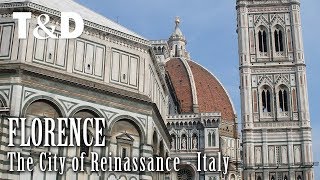
The duomo, intellect made visible, 1418 to 1436. Rising above the dense urban fabric of Florence stands the Cathedral of Santa Maria del Fior. For decades, its unfinished crossing had symbolized ambition without solution.
In 1418, the city announces a competition to resolve the problem of constructing an immense dome without traditional scaffolding. The challenge is technical, but its meaning is ideological. Filippo Brunoleski proposes a solution grounded in geometry, engineering, and empirical observation.
His design rejects medieval conventions, relying instead on calculation and innovation. When the dome is completed in 1436, it transforms the skyline in the city's self-standing. This structure is not merely architectural.
It is philosophical. The dome asserts that human intelligence, disciplined by reason, can overcome limitations once attributed to divine mystery or inherited authority. It rises above every district, visible from all directions, imposing a constant reminder that Florence defines greatness through intellect rather than lineage.
The Medici understand its significance immediately. They support it, finance it, and align themselves with its meaning. Palazzo routine's authority.
Political decisions in Florence are enacted within the Palazzo whose fortress-like exterior conveys stability and restraint. Inside, governance proceeds through councils, votes, and procedures designed to appear collective and impersonal. Florence does not stage power.
It normalizes it. Rituals repeat. Offices rotate.
Language emphasizes civic virtue and shared responsibility. Yet over time, outcomes become increasingly predictable. By midentury, major decisions rarely occur without medi approval, even when their name remains absent from official records.
Authority here is not imposed. It is anticipated. The Palazzo Veio becomes a space where governance feels procedural rather than personal, masking the reality that influence has consolidated elsewhere.
The Medishi Palace, wealth without provocation, circa 1444. Completed around 1444, the Palazzo Medici communicates its message through restraint. Its exterior avoids ostentation.
Constructed from massive stone blocks arranged with calculated regularity, it neither provokes resentment nor invites fear. Inside, the atmosphere changes. Artists, scholars, diplomats, and merchants circulate through rooms designed for conversation and cultivation.
Philosophy is debated. Art is commissioned. Alliances are formed over hospitality.
This is not aristocratic excess. It is strategic generosity. By transforming wealth into patronage, the Meduchi convert economic capital into loyalty.
Culture becomes governance by other means. Eritan humanism, order through vision. Florentine art of the 15th century does not seek emotional excess.
It organizes perception. Perspective is refined, anatomy studied, space rationalized. The human figure gains weight, dignity, and presence.
Artists such as Maceio and Donatello contribute to a visual language that emphasizes balance, proportion, and intelligibility. These images do not challenge authority. They clarify it.
Humanism in Florence does not undermine order. It systematizes it. Classical philosophy is revived not to question hierarchy but to give it intellectual coherence.
The Council of Florence knowledge under supervision 1,439. In 1439, Florence hosts the Council of Florence convened to reconcile the Eastern and Western churches. Byzantine scholars arrived with Greek manuscripts reintroducing ancient texts to Western Europe.
The intellectual impact is profound yet controlled. Learning circulates within institutions shaped by patronage and oversight. Knowledge expands but disruption is contained.
Florence absorbs ideas selectively. Nothing enters without purpose. Daily life discipline prosperity.
Florence is a working city. Wool production dominates its economy. Guild regulations, structure, labor, and markets operate under close supervision.
Clothing communicates status instantly, governed by fabric, color, and cut. Public life unfolds in piazas and churches, while private life remains contained within family structures. Excess is viewed with suspicion.
Stability is prized above novelty. Life in Florence is not lavish. It is calculated.
Florence in the 15th century. Florence in the 15th century is not defined by spectacle or conquest. Its influence emerges from systems that bind finance, culture, and governance into a single coherent order.
From this city comes a new model of power, indirect, cultivated, and enduring. Florence does not rule by command. It governs by making itself indispensable.