hey guys welcome back to coach hall writes in today's video we're going to be talking about how to write a rhetorical analysis essay for the a peeling exam before we get started i wanted to take a quick second to let you guys know about a top secret project i've been working on behind the scenes i've been working on a rhetorical analysis ebook to help teachers and students master rhetorical analysis because quite frankly rhetorical analysis is my jam so if you want more information about this ebook be sure to check out the description box below it's
really important to understand the task you need to know what a rhetorical analysis essay is before you actually try to write one so basically for a rhetorical analysis essay you're looking at a non-fiction passage it could be an article a speech a letter or even an excerpt of a non-fiction text so what you're going to be doing is looking for how the writer makes rhetorical choices to develop an argument achieve a purpose or convey a message now if you just heard the term rhetorical choices and you're like wait a minute coach hall i don't know
what that is let me try to break it down for you guys so first of all a rhetorical choice is usually conveyed through a verb it's something that the writer does now there are some really common rhetorical choices like repetition so the author might repeat a certain word or maybe they contrast things in a meaningful way or compare things so those are all choices however sometimes the choices are actually a little bit more broad or maybe they're just like a little bit less common so it could be that they're creating an enemy or maybe they're
flattering their audience or criticizing their audience or maybe they're trying to justify something so those are all choices as well so it's really important to try to use active verbs to convey what the writer is doing when you start thinking about the body paragraphs of a rhetorical analysis essay you're going to need to plan to have evidence and commentary this actually amounts to four of a possible six points on the appealing rubric so evidence can come in a couple different forms it can be a direct quote which means that you directly quote from the passage
in this case you want to embed these quotes don't just drop them in work them into a sentence you also want to make sure that it's a shorter quote it doesn't even have to be a complete sentence because you can weave it into a sentence of your own sometimes i think students choose longer quotes because they think it's going to make their essay look longer and therefore better but that's actually counterproductive in addition to embedding a short quote into a sentence of your own you can also include evidence by using a paraphrase so basically when
you paraphrase something you take the writer's words and you put them into your own words although evidence is really important because you do need to engage with the text you want to limit your evidence just a little bit because you want more commentary than evidence so commentary is going to be your analysis it's how you explain the significance of the evidence to help prove your thesis it's basically your insight into the text your own original thoughts and so for commentary there are a couple tips you want to really think about why the writer made that
choice so whatever it is you're analyzing think about why the author did that so why did they make that choice for that audience on that occasion if you're trying to develop your commentary just keep asking yourself why and how really dig into the effect of that choice and the intentions behind it also think about the structure so why did they make that choice at that particular point in the passage because writers do things with intention so we want to really examine why they're doing what they're doing when you approach the prompt itself you want to
slow down the prompt is usually pretty short it looks like a couple sentences so sometimes i think students gloss over it because they're ready to tackle the passage however if you read the prompt too quickly you're likely going to miss valuable information the prompt likely tells you multiple elements of the rhetorical situation so it's going to tell you who the writer or speaker is it might even give you their credentials also it's going to tell you who the audience is especially if it's a letter or a speech because those are usually directed at a very
concrete group of people now if it's an article there might not be as much of an obvious audience in the prompt but they might tell you where the article was published and sometimes you can make some inferences about audience for that again it might tell you the passage type you need to know what you're about to read so is it a letter a speech an article what type of speech is it or is it the introduction of something the conclusion of something or is it an excerpt all these little details matter as you approach the
passage you should also look for details about the context and or the exigence so context i like to think of it as historical context so when was this written and then what do you know about that period of time also the exigence is kind of like the catalyst it's what prompted the writer to write or the speaker to speak so were they invited to speak are they speaking because a certain event happened are they responding to a letter that they received these could all be the exigence lastly they might include a hint about the purpose
the message or the argument now i say hint because they might give you something like her message of perseverance now that gives you a clue but you need to actually dig deeper as you read the passage to figure out more about why that's her message and like what her message truly means since we just talked about looking for elements of the rhetorical situation in the prompt itself i thought i would give you guys a quick example of how you could break down a prompt so this is actually a prompt that i created for my own
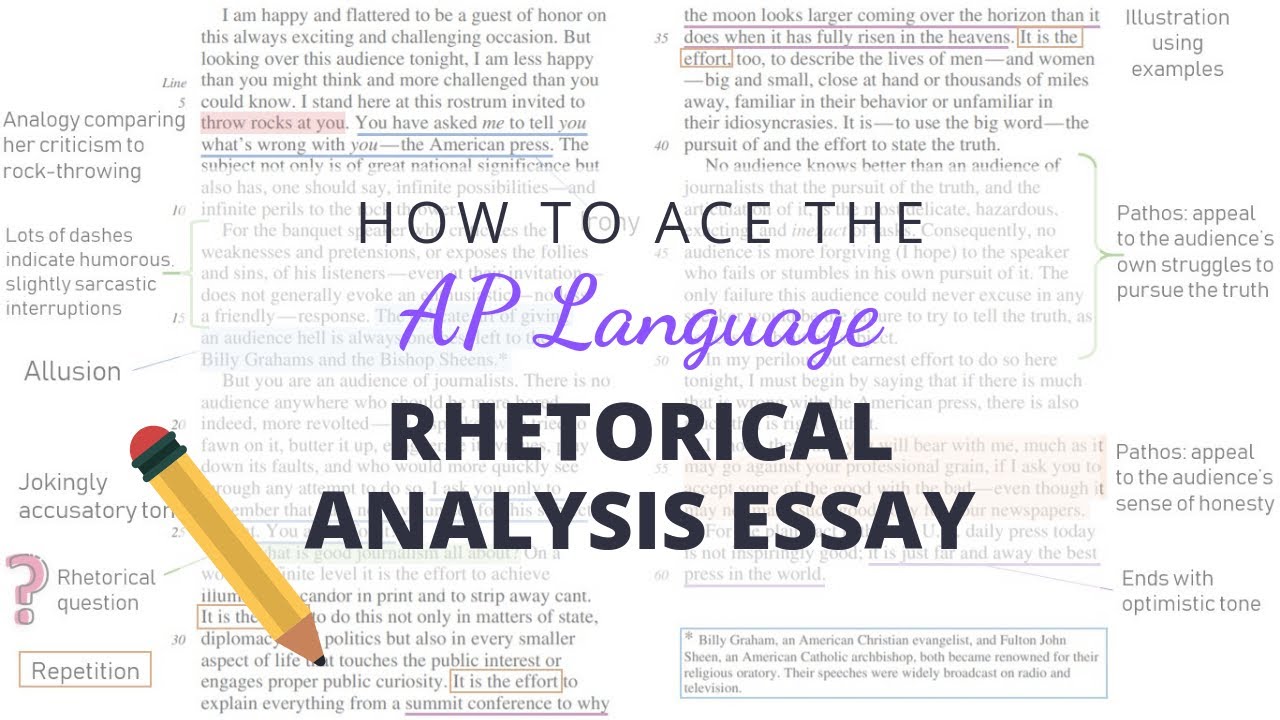
students but if you want to take a second to pause the video and read it you're welcome to so we have the prompt here in blue and then on the side i just noted different elements of the rhetorical situation after you've read the prompt you need to move on to the passage and you want to actively read the passage which means that you should be annotating the passage as you read now you might be wondering okay but what am i looking for i recommend looking for rhetorical choices remember that's what the writer is doing and
with your annotations it can be helpful to note the actual choice either in the margin or in the comments depending on if you're doing it by hand or digitally find a system that works for you as you start to note major rhetorical choices you also want to be thinking about the purpose of that choice so basically ask yourself why did the writer make this choice really also think about the structure as well so how are these choices working together to help the author achieve his purpose or convey his message or develop his argument now as
you read you also might want to start looking for evidence because you know you need evidence in your essay anyway however i would caution you not to over underline things because sometimes that gets really sloppy and if everything is underlined then it's really hard to figure out okay where was that one quote that i liked so be a little bit more sparing with that type of annotations words in the margin sometimes are a bit more helpful also if it's something super important that you want to remember maybe put a star by it or something that
way it draws your attention to it later i wanted to show you guys a couple ways to implement the tips that i just gave you now please keep in mind that for the purposes of this demonstration i have the paragraph with the annotations underneath it now i know that's not really realistic for the college boards format because they have their passage in two columns but you guys get the idea so here i was looking at the word choice he used in the first paragraph so i have the word yesterday and i put a note that
says emphasizes the recent nature of the attack so i'm trying to use strong verbs as i ask myself okay why did he use this word also we've got the phrase suddenly and deliberately attacked so this time i said that it implies the u.s could not have prevented this attack fdr begins to establish japan as the enemy now if i was doing this in a timed setting i would probably use a bit more shorthand but you get the idea you want to identify what he's doing in this case why he's using those words and really use
the opportunity to put strong verbs in your annotations because then it actually makes writing your essay a lot easier i also want to draw your attention to the final bullet point on this slide and that's because one of the goals of rhetorical analysis is to examine a rhetorical choice in relation to the rhetorical situation so in this case i want to think about purpose i know that his ultimate goal is to ask congress to declare war so i'm using that in that sentence there to really be thinking about why is he starting the speech this
way given that he wants them to declare war why is he making this choice of creating an enemy at the very beginning of the speech another tip for you is to follow the line of reasoning so the line of reasoning is basically the logical progression of ideas a writer needs to be convincing and because of that they're going to structure their speech or their letter or their article in a very particular way so that pertains to choices as well one of the tips i give my students is to divide the passage into chunks or sections
so you might be wondering okay well how do i know where one section begins and another one ends well quite frankly you're looking for different shifts perhaps it's a change in topic a change in choice a change in tone so even if you're getting stuck think about the beginning middle and end see if you could divide up the passage that way so when you do that you are following the author's line of reasoning so if we do it that way it becomes less of a scavenger hunt sometimes i see students trying to write a rhetorical
analysis essay and they're like oh i see repetition it's in the beginning the middle and the end and then they write a whole paragraph about repetition and while this isn't necessarily wrong if you actually look at the line of reasoning and figure out how does the author start how do they continue and how do they conclude that can lead to a stronger essay it doesn't mean that you can't reference the repetition but you want to look at things chronologically as opposed to just kind of searching for different choices so after you annotate the prompt and
then the passage and divide it into sections for me the next step is to create an outline now i know sometimes students are like but coach hall i've only got like 40 minutes to write this essay that's a waste of time however i can say from personal experience because i did take a mock exam with my students that if you have an outline and you really plan your ideas in advance it leads to a stronger essay so this might take a little bit of time but if you're able to write the essay more quickly because
you have a sense of direction that's going to help you in the long run i've listed on the slide here some elements that you could include in your outline now if you're pressed for time or if you just get more comfortable with this you might not need to be as detailed but i do recommend thinking about your thesis so what are you trying to prove and also the main idea of each of your body paragraphs because that's going to help you figure out what are you trying to focus on and how does it connect to
your thesis i also recommend planning your evidence and commentary you can shorthand the notes a little bit but you really need to think about what you're going to say to prove your point another tip is to create layers of evidence and commentary so if you remember on the previous slide it said evidence commentary evidence commentary i encourage my students to aim for at least two layers though technically you can do more and that's because if you just have one layer of evidence and commentary it's not very convincing and remember there is an element of argument
to rhetorical analysis you're trying to prove something you're trying to prove your thesis so you want to be able to develop your ideas oftentimes if a paragraph only has one layer it's quite underdeveloped so really focus on how you can use evidence and commentary to truly prove your point one of the biggest struggles students tend to have when they divide a passage into sections is they're like i don't know how to write about three or four different choices all at once like that's really hard so what you want to remember is that choices don't operate
in isolation they work together so first ask yourself okay what choices do i notice so in the first section or portion of fdr's speech i noticed that he had some aggressive word choice he was also listing different places that were attacked and there was repetition so he repeated the word attacked he also repeated the word deliberate so those are my major choices that's what i want to talk about so then i have to ask myself okay what is he doing by making these choices well more broadly all of these things point to him trying to
create a common enemy so that's going to become my main idea so instead of focusing on just repetition or just the list i'm gonna focus on trying to prove that he begins his speech by creating a common enemy so once i've settled on my main idea then i need evidence and commentary to prove it so i have two layers here in the first layer we have the evidence of sudden and deliberate so that's the word choice i want to analyze and then the commentary is my analysis of why he makes that word choice then my
second layer of evidence is that he lists different locations in order to prove that japan was guilty that it was premeditated so that's another choice he makes in order to create a common enemy and i have my commentary for that too you're welcome to pause the video if you want to read this a little bit more carefully i'm going to be really honest the more i've taught ap lang the more i've changed my mind about how i want my students to write an intro so when i first started i gave my students the advice that
i was given as a high school student think about the introduction as an inverted triangle start broad funnel down to specific so i would tell my students okay if you can try to come up with a hook a universal truth that starts your essay not a rhetorical question not some kind of quote not a shocking fact just a universal truth then include some context and your thesis but my students quickly pointed out that a hook is really hard to come up with when you've only got 40 minutes to write so i've since decided that my
best advice is to at least try to give a bit of context because quite frankly you really just need your thesis you get one point for that but when i've read essays that just start with a thesis it's kind of like we're diving in right in the moment and it feels really abrupt so if possible use the information in the prompt or the passage or just your outside knowledge to write one or two sentences of context before that thesis that leads to a much smoother introduction now let's talk about the thesis statement so in order
to be defensible you need to have a claim that you can prove defensible does not mean sophisticated so there's a whole range of what constitutes defensible so at the bare minimum students will sometimes say the author uses repetition and detail in order to and then they'll tell the purpose that's defensible we have two choices there we have a purpose however there are better ways to phrase it with some practice so really think about including rhetorical choices or rhetorically accurate verbs and then really think about the true purpose message or argument of the actual passage one
of the ways that i have found to help students write a thesis statement more quickly is to give them a sentence frame so basically a sentence frame is where you plug in your own ideas now i will admit this might seem a bit formulaic but it's a way for students to quickly express their own ideas as my students get more comfortable with the sentence frame then they start to write their own thesis statement that doesn't have a frame at all but at least if they have the frame memorized they're able to write something quickly under
pressure because some people might be unfamiliar with how to use a sentence frame i decided to include one of the sentence frames that i give my students here that way you can see the frame and also an example of how to fill in the blanks part of the reason that i want my students to be able to write an introduction rather quickly is because the body paragraphs are the most important part of the essay in my opinion because that's where you have your evidence and commentary and remember that makes up to a possible four points
out of the six points on the apling rubric so make sure that your body paragraph has a clear point or focus you need to be trying to prove something in relation to your thesis you also want to begin to analyze why the writer makes that choice in relation to the rhetorical situation so why is that choice appropriate for the audience and the occasion how does the choice help the writer develop their argument and also why is the choice effective these are questions you can ask yourself in order to develop your body paragraph another tip i
give my students is to make sure that they specify what the message argument or purpose is because it can be really easy to just say this helps the author to develop their argument but you want to actually say what the argument is because otherwise it doesn't seem like you really understood the passage so sometimes students will ask but what if i already said what the argument is earlier on can i just say argument then and i tend to lean toward no i suppose there's always exceptions but phrase it differently perhaps but really be as specific
as possible to prove to the person reading your essay that you understood the passage the same concept applies to the word audience so if you know who the audience is let's say it's a specific person or group of people then use that term or maybe it's implied so maybe it's parents the audience is not really going to be everyone so be specific but just saying audience is kind of vague also you don't need to refer to them as the speaker or the writer use their actual name so the first time you reference the person it's
good to use their full name but then after that you can just call them by their last name you don't need to say mrs so and so you also don't want to call them by their first name because that kind of seems like you all are besties and you're not so don't say writer or speaker or audience either be specific we talked about how to follow the writer's line of reasoning earlier on in this video so now you need to recognize that when you're writing an essay you become the writer so you need to create
a line of reasoning so one way to do this is to include transitions in between the layers of evidence in a paragraph that's going to help your essay flow better you also can use your topic sentences of your second body paragraph or possibly second and third body paragraphs if you go for three body paragraphs to create a line of reasoning as well so think of it as like a bridge between your paragraphs we want to avoid phrasing like another choice the writer makes is so instead we want to try to perhaps refer back to the
previous main idea and then introduce the new idea so you could say having already established that and then include the previous main idea the writer but use their last name then does and then talk about the next choice you're going to analyze so really create those connections to have a smoother essay because students only have 40 minutes to write a rhetorical analysis essay on the ap lang exam students often wonder do i need a conclusion paragraph so my answer is it depends because i don't think there's one answer that fits everybody so what does it
depend on first of all if you have let's say five minutes left and you are still working on your body paragraph please finish that body paragraph because that body paragraph is going to have evidence and commentary and there's points for that in the rubric there is nothing in the rubric that says you need a conclusion why because quite frankly these essays for the national exam at least are viewed as a rough draft so you don't technically need a conclusion but there are times when it could help your essay so let's say that you do have
time to write one even if it's only a couple minutes what can you do the first thing you want to do is ask yourself do i have a defensible thesis personally i like to see the thesis in the intro but if it's not there the next place i look is the conclusion so if you're worried that your thesis wasn't defensible the first time rewrite your thesis so don't copy it word for word from your intro but rewrite it to try to make it defensible if you're looking to develop your conclusion even more something that you
might try to do is to situate the issue in a broader context so i tried to give you guys an example of that here so i started by asking myself was the speech effective now because this is a historical speech i know that it was effective because we entered world war ii in fact all the members of congress except one voted for war so clearly what roosevelt did was effective but then i was thinking about it more broadly while there are other times that we've gone to war after being attacked most notably 9 11. so
i wanted to kind of situate this in the broader context of did that possibly have any influence on future events now let's say the passage isn't necessarily tied to a key moment in history you could still situate it in a broader context by asking yourself about the implications of the message so what would happen if the audience does listen to the message what would happen if they don't also you could ask yourself how does this message relate to society today so just kind of try to zoom out a little bit and figure out the deeper
significance of the passage itself you guys found this video helpful please do me a huge favor and hit that like button that genuinely helps my channel grow which helps me help more teachers and students like you also if you're looking for more information about my upcoming ebook please be sure to check out the description box below until next time guys happy writing