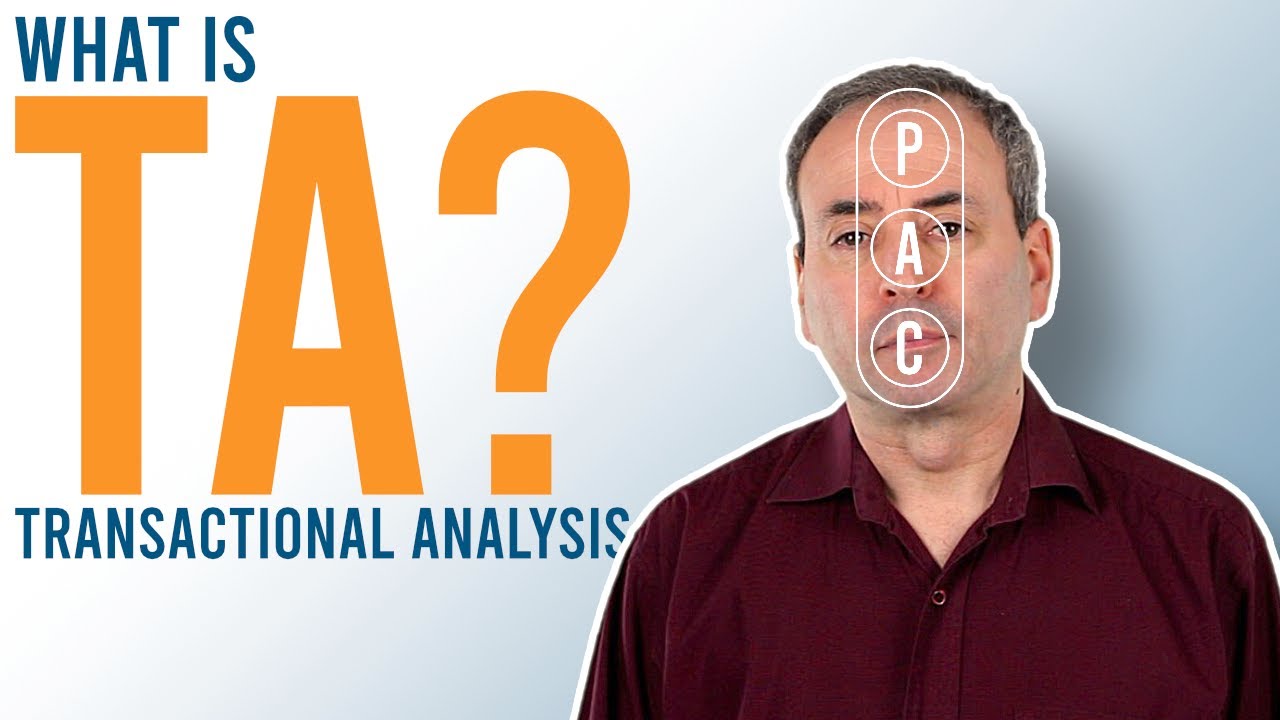
Transactional Analysis or TA is an evidence-based model of psychotherapy developed by Eric Berne, a key assumption behind this model is that you are made up of three different parts known as Parent, Adult and Child. In TA we call these parts ego states. Now each ego state consists of a set of behaviours, thoughts and feelings and reflects a different way interact with the world and those around you for example when you're in your Parent ego state you are behaving, thinking and feeling in ways copied from your parents or parental figures.
When you're in your Child ego stage you are behaving, thinking and feeling as you did when you were a child. And when you are in your Adult ego state you're behaving, thinking and feeling in ways which are direct here and now responds to events around, you using all of your abilities as a grown-up. Now in TA practice we simply say, 'I'm in my Parent, "I'm in my Child' or 'I'm in my Adult'.
So let's look at what the ego states look like in the real world. Let's imagine I'm driving my car in crowded traffic, I'm observing the speed limit, looking out for road signs and I'm controlling my car in response to what's going on around me here and now, I'm therefore in my Adult ego state. Now another driver cuts me up and I shake my head and I point my finger and I shout, and at that moment I've moved to my Parent ego state.
I then notice I'm running late for work and my heart sinks and I feel panic-stricken, I've shifted to my Child ego state. So you can see that you're actually moving in and out of your Parent, Adult and Child ego states all the time and no ego state is considered good or bad, we need all of them to be in balance, so it's about having the psychological flexibility to move between each ego state as needed. Let's take a deeper look at each ego state starting with the Parent.
From the diagram you can see that both the Parent and Child ego states are divided and the Adult is not divided. So starting with the Parent you can see there's a Controlling Parent which is often called the Critical Parent and also a Nurturing Parent. When the Nurturing Parent is expressed positively you are caring, supportive, protective and loving.
When expressed negatively you may be overprotective, smothering and overbearing. Now when the Controlling Parent is expressed positively you'll be motivated to provide safe boundaries and limits with the intention to protect but when expressed negatively you may be controlling, judgmental, critical and authoritarian. The Child ego state.
The Child ego state expresses itself through feelings and instinctive reactions, it it functions in two distinct modes, the Adapted Child and the Free Child. When the Free Child is expressed positively you'll be creative, spontaneous and playful and when expressed negatively you may act in socially on constrained ways such as belching loudly at a dinner party or driving 100 miles an hour down a country road. Now when you are in your Adapted Child you are responding on the basis of internalised social learning so you will behave in ways which conform to your parental, cultural or societal standards.
There are many rules we all follow about how to live life and be accepted in the world, so before I cross the road I look left and right as my mother taught me and when my husband asks if I'd like a cup of tea I say 'please'. So by replaying these rule following behaviours you usually get what you want comfortably for yourself and others that you care about. Now by contrast when you're in your negative Adapted Child you replay childhood patterns of behaviour that are no longer appropriate to your life as a grown-up.
For example as a young person you may have learned to sulk or manipulate to get attention or to get what you want and then as a grown-up you may sulk or manipulate and hope that you get attention or get what you want. The Adult ego state. The Adult ego state is not subdivided, we class any behaviour as Adult that is in response to the here and now situation using all of your resources as a grown-up.
The Adult is the ego state of rationality and reason, it functions to mediate between the Parent and Child. The Adult checks your external world and brings realism and rationality to your internal wiew. When you are in your Adult you will be assertive, logical and concerned with facts and data.
Now let's take a deeper look at the ego states in action by looking at transactions. Now a transaction takes place where you or another person offers some kind of communication, so I say 'hi there' and you reply 'hi', we've just completed a transaction. Within TA the formal language for the opening communication is the stimulus and the reply is the response.
In my example the stimulus came from my Adult ego state and the response also came from the Adult ego state. The transaction arrows or vectors are aligned which means it's a complementary transaction. Let's look at another example of a complementary transaction, we're going to look at Anne and John.
John is late for work and Ann shouts, 'You're later again this just will not do'. John mutters. 'Sorry I'll try not to do it again'.
You can see the vectors are parallel, this also fits a description of a complementary transaction. According to Eric Berne the first rule of communication is: "So long as transactions remain complementary communication can proceed indefinitely". A complementary transaction has the quality of expectation about it, Ann expected an Adapted Child apology and John did indeed provide an apology from his Adapted Child ego state.
Crossed transactions. Let's run the scene of Ann and John again, Ann shouts, 'You're later again this just will not do'. This time John moves to Adult and states, 'I hear you're angry, I understand why you may feel this way, let's go to the meeting room and talk about it'.
John crossed Anne's Controlling Parent to Adapted Child stimulus with an Adult to Adult response. You can see the vectors are crossed, the response cuts across the flow of communication that had been expected from Ann. A key quality of a cross-transaction is one in which the ego state addressed is not the one that responds.
When a transaction is crossed a break in communication results on one or both individuals will need to shift ego states for communication to be re-established. According to Eric Berne the second rule of communication is: "When a transaction is crossed a break in communication results and one or both individuals will need to shift ego states in order for communication to be re-established. With reference to the second rule of communication let's re-run Anne and John.
Ann shouts, 'You're late again this will not do'. John moves to Adult and states, 'I hear you're angry, I understand why you may feel this way, let's go to the meeting room and talk about it'. Ann responds, 'I am angry and I shouldn't have spoken to you like that I'm sorry, we do need to discuss this lateness, yes let's go to the meeting room and have a private talk about this.
So Ann moved to the Adult position which John had actually invited, communication has now moved to a complementary transaction. So we can see that when a transaction is crossed if one individual shifts ego states then a complementary transaction can be re-established. Ulterior transactions.
During an ulterior transaction two messages are conveyed at the same time, one of these is a social level message and the other is a hidden or psychological message. Let's look at an example, Peter: 'What did you do with my shorts? ' Mary: 'I put them in your drawer'.
Now just by looking at the words on the screen you would say this is an Adult to Adult complementary transaction and it is at the social level. Let's rerun the same scene again but this is what it actually sounded like. Peter (shouting): 'What did you do with my shorts?
Mary: (nervous) ''Uh I put them in your drawer'. The social level message is Adult to Adult but the hidden psychological level is Controlling Parent to Adapted Child, Adapted Child to Controlling Parent. With ulterior transactions a social level message is often Adult to Adult but the psychological level messages are usually either Parent to Child or Child to Parent.
You can see the social level stimulus and responses as orange vectors and the blue vectors illustrate the psychological level stimulus and response. According to Eric Berne the third rule of communication is: "The behaviorral outcome of an ulterior transaction is determined at the psychological and not the social level'. So when people communicate on two levels what actually happens is always the outcome of the psychological message.
So if you really want to understand behavior then you must pay attention to the psychological level of communication which means observing non-verbal cues, gestures, posture, facial expression, tone of voice, breathing and muscle tension. If you'd like to learn how to balance your ego states for better psychological health please click on the video on the screen now and I look forward to seeing you soon.