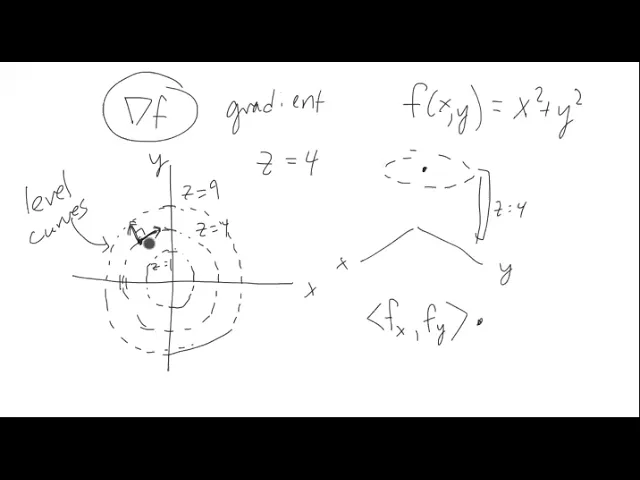
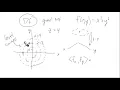
welcome to a lesson with dr powell let's take a look at del f or the gradient vector and we're going to just think about functions of two variables f x y okay in fact let's take a look at one specifically why don't we do x squared plus y squared now for different values of z this represents a circle of a different of a certain radius for instance when z is equal to 4 then we have then it looks like we're drawing a circle of radius 2 but at the height at z equals four okay so
z equals four to get up there and then we have a circle of radius two centered about the origin but kind of raised above the actual x y plane now we can actually if we wanted to we could do this we could draw a picture just in the x y plane just in the inputs and we think okay when z is equal to 4 we're going to have we can draw just a circle of radius 2. and we can just put right here z is equal to 4. when z is equal to one actually we
have a circle of radius one we call this z equals one looks almost like a like a contour map um for you know like with different altitudes this is a line that represents an altitude of one this line that represents an altitude of four and um if you get this one this would be one at z equals nine then you'd have a circle of radius three okay so these are called these contour lines are called level curves because whether a projection of the actual curve at a certain level or the surface being cut at a
certain level at a certain level it's going to that's kind of what when z is equal to nine then you're gonna then you would see that's what you would see that cross cut of the surface so you can kind of get a visual for what the surface is going to look like if you just look at in the x y plane where all the inputs are okay now something interesting let's talk about how the gradient pops in and how it interacts with these level curves well it's true that if you're moving along what happens if
you move right in the direction what if your input the change of input is right on one of these curves or kind of in the direction tangent to one of these curves well then you can expect that the z value won't be changing it'll be staying at the same height but what happens if you go this way going up this way perpendicular to that you actually can expect to grow a lot like let's kind of think about that idea for a minute f x f y as a vector can be thought of as the derivative
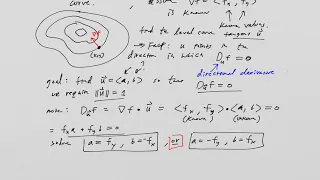
and if we dot it to or if we think of it now as a let's think of it as a matrix though because let's try to compute the idea of rise given a certain input what if our are given a certain run so what if our run was tangent to the levels to the level curve here tangent to the level curve so um i'll just make something up like u1 and u2 suppose that this right here represents a vector u1 comma u2 which is tangent at some point to the level curve then you can expect
since you're saying tangent on it so you're kind of staying on the local curve the z value the height isn't changing so the rise you can expect the rise to be zero so you can expect this dot product to be zero but what does dot product zero mean dot product dot product equals zero means perpendicular so that wow that actually tells you that the gradient is perpendicular to the level curve so this the direction right here that we're traveling is actually in line in the same direction as the gradient fx fy i guess we could
just label it as del f so we're going to be using that too later in order to solve different types of problems kind of a fun fact that if you have a level curve if you have your level curves for whatever your surface is your derivative thought of as a vector as a gradient vector is always going to be perpendicular in the plane to your level curve thanks for watching