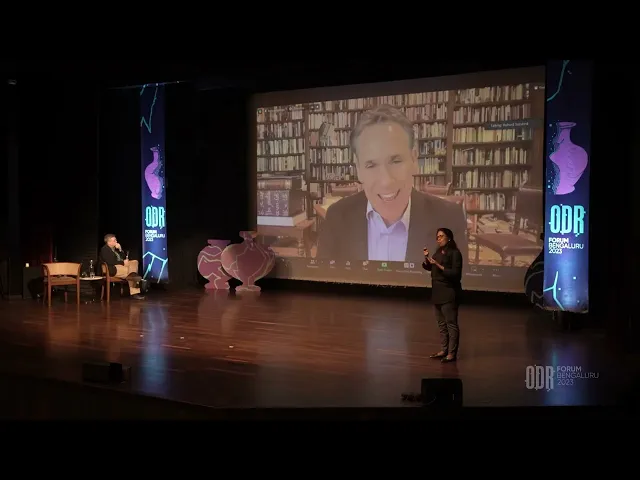
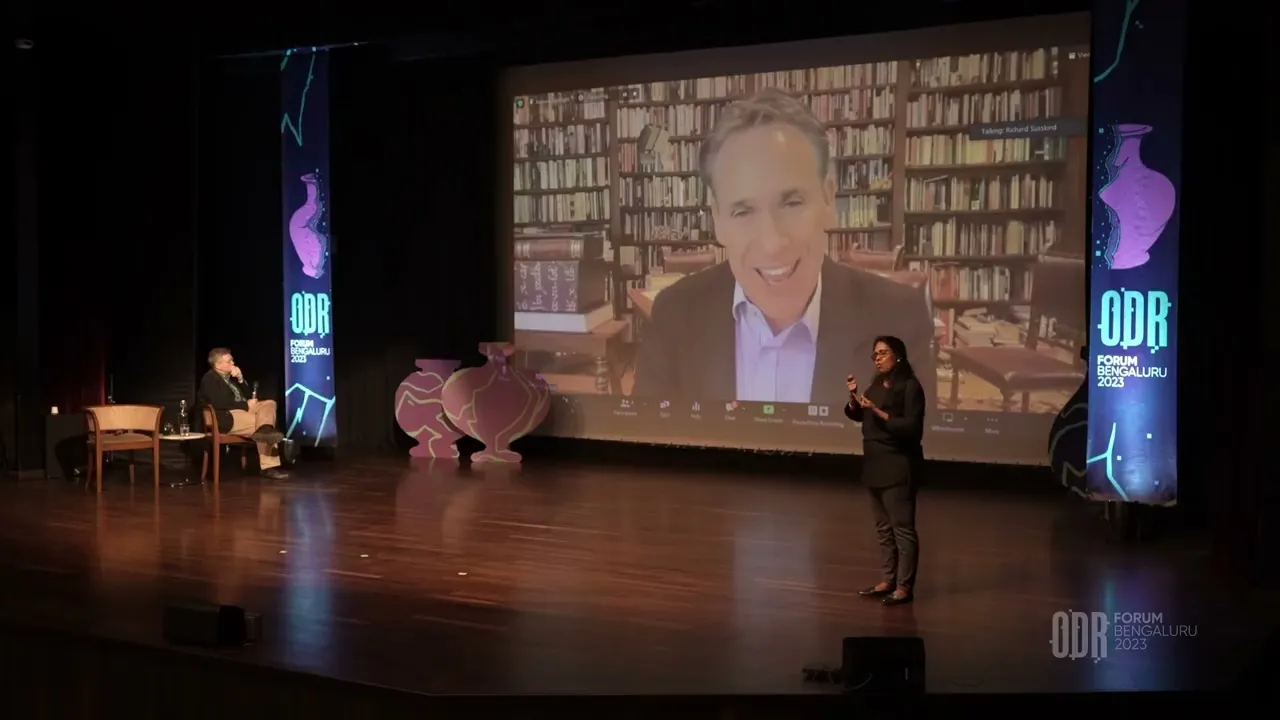
well thank you very much for that more than generous introduction Colin coming as it does from you one of the undoubted leading experts in odr it's very well received indeed I want to talk today about online courts and do so under five headings I want to say something about the problem I think our court systems face around the world I want to suggest the mindset we need to have in thinking about the future I want to reflect briefly on the lessons we learned from covert and then I'll lay out what I think are the three
key components of the future of our court service and I'll finish by saying something about Justice because of course increasing access to Justice increasing the quality of justice has to be our Guiding Light so what problem do we face well that way we Face two problems one problem is that even in the most Advanced legal systems around the world if you look for example at civil disputes to resolve them in our current court system takes too long the process costs too much it's too competitive it's not intelligible unless you're a lawyer and increasingly it's feeling
out of Step In A Digital Society the second problem of course is the backlog in our court systems which of course was exacerbated by covert chat GPT tells me this morning that the backlog of cases in the Indian court system lie somewhere between 30 and 45 million cases in Brazil 70 to 80 million cases the oecd tell us that only 46 percent of human beings live under the protection of law the law or half of the people on our planet totally have access to lawyers in the court system so we need a new mindset and
the question I've been asking since the 1990s is this is Court a service or a place do we really need physically to congregate together to resolve all our differences or might there be in a digital Society entirely new ways of solving legal disputes the second mindset issue I think is relating to how we think about technology we should think about technology not simply as a way of automating how we've always worked and frankly that was the story of the first 60 years of core technology we should also think of a technology in its more Innovative
capacity and by that I mean the use of technology to allow us to deliver court and dispute resolution services that were not possible in the past so we have to open our minds and ask whether or not Court as a service or a place and think about how technology can enable us to deliver entirely new forms of dispute resolution service what did we learn from covert well if you look at remote courts worldwide a site I set up in March 2020 you'll see that more than 170 jurisdictions around the world move rapidly from resolving disputes
in courts essentially to resolving disputes by video hearings and I think most people would say two things they would say that video hearings do not work for all cases but when they do work they work far better than most people had anticipated I believe that covid-19 actually accelerated and decelerated technological change it accelerated the use of video hearing technology but decelerated or more advanced thinking about technology now hopefully that the viral storm has passed we're back to thinking about more ambitious uses of Technology Ai and so forth it would be wrong to see as many
lawyers of Red Sea in later video hearings that the future has now arrived cross referring to Colin's introduction the reality is dropping hearings into Zoom is not a shift in Paradigm because the people the rules the processes and the problems that I identified still remain if you're sitting in your laptop as opposed to sitting in the courtroom so for me the future looks rather different I outlined that future in my book online courts and the future of Justice which was first published in November 2019 of course with no expectation at all of what was about
to befall us but in the broadest of terms I see the future of Courts as a public service as a blend a blend of physical hearing or video hearing of audio hearing of pop-up course of hearings even in virtual reality of hybrids covering all these but also and I think increasingly importantly of what I call the online Court and the online court for me there's three important aspects this is what I call asynchronous online judging this is what I call Extended court services and there is the role in relevance of artificial intelligence and remember my
focal point here is largely the public court system when I was invited in 2014 to lead a group that recommended the use of online courts in England and Wales the premise in many ways was how can we use odr techniques to take to take cases out to the court system to some extent that of course makes sense but we made another observation if odr techniques are working well beyond the court system shouldn't we be thinking of using them within the court system it doesn't make sense to continue delivering Court service in the manner of the
19th century where there are techniques out there that can enable our public service to be improved so firstly then asynchronous hearing communication is synchronous when parties communicating need to be present at the same time a phone call a video conversation even a face-to-face meeting you need to be there available at the same time to communicate but in life just now we communicate often asynchronously where we don't need to be available at the same time a text message an email a WhatsApp message we communicate send receive Communications at our own convenience now traditional judging and Court
work is synchronous everyone needs to assemble not just at the same point in time but actually in the same point in space the idea of asynchronous online judging is that there's still human judges involved but the parties do not appear in a physical courtroom they don't appear in a video hearing there is no oral evidence at all there is no hearing the evidence the arguments are submitted in electronic form huge oversimplification just like an exchange of emails there's some kind of discussion mediated by the judge and the judge comes to his or her conclusion in
the same form that's the idea of online judging and we argue and I continue to believe that for many of the low value cases that are providing bottlenecks in our court system that is a more convenient a more proportionate and less costly a more intelligible a less forbidding way of resolving disputes not the only way of resolving disputes but we need to embrace it seems to be online judging however and this leads to my second Point simply making online court services available to non-lawyers is not so that enough in fact judging is not enough it
may be the primary function of our court service but lay Court users will need help the only way to resolve the access to Justice problem realistically as public funds dwindle in our world is to enable people to represent themselves but they need help they need help to understand their entitlements they need help to understand the options available to them you need help to organize their evidence to build their arguments they also surely should have facilities and this is the essence of your event I suspect facilities online that allow people to resolve their differences without resorting
to not just to a physical court and judge but actually to a third party so the idea of the extended court services to provide this help that lay people need was two implementation options here you can either provide the extended court services a state funded and run service and that's part of the court system and that's what I originally recommended but I as I see funding dwiddling I think the second option is better that we have some kind of public private collaboration and this is what we're doing in England and Wales we're planning to do
we're encouraging private sector organizations to provide a kind of front end an online dispute resolution front end to the court service allowing parties before the court to the court system at two perhaps resolve their their problems in the spirit of ADR now our plan is to have these Services accredited Some Kind of Blue Tick so that the favorite services have a couple of advantages one that if the dispute is not resolved in the front end there's some kind of fast track through to the traditional court system and secondly that their determinations of this front end
should surely be binding as court orders so we have the first idea of online judging the second of building a Hall's set of satellites around the court system a set of front ends which help people manage and drive forward their own cases and help them in due course if they need to Drive their cases through the physical court system but also provide some resources in the spirit of online ADR to resolve their disputes before going fully into the court system artificial intelligence there are two forms of AI there's the rule-based expert systems that I worked
on in the 80s and the second generation of AI the machine Learning Systems which come as predictive systems and generative systems the predictive systems like Lex Machina that predict the outcome of disputes degenerative systems that essentially graph documents do much more than this and of course we're absolutely The Cutting Edge of this just now as we observe the GPT family emerging I'm not talking here when I talk about the role of AI about somehow replicating judges neurophysiology logically and neuropsychologically our systems are nowhere near the sophistication of human judges nor do our AI systems really
at this stage are they able to provide decisions with reasons which is what judges do but I see three broad roles for AI in the judicial process first to provide online legal guidance diagnostic systems rule-based systems of the first generation as well as second generation systems the generative AI systems secondly I see huge potential for a form of early neutral evaluation by the predictive systems using second generation Ai and thirdly I see what I call predictions determinations in cases of countries where there's a huge buildup of cases I think we can invite parties in the
future to the following proposition we can see in your case we cannot resolve the dispute through the court system but we have a system that can predict the likelihood of the outcome in your case would you accept that prediction uh as a binding determination of say the level of confidence of the system is 95 or higher I think we can do that and I call this predictions as determinations finally therefore I've said something by online judging about the extended Court service number AI Justice whether physical or online whatever political persuasion you are we need seven
outcomes from our court systems we need substantive Justice Fair decisions we need procedural Justice for your process we need open Justice conspiracy we need distributive justice a service that's accessible to all we need proportionate justice so that the the cost and degree of combativeness is somehow proportionate to the nature of the dispute we need enforceable justice so the determinations are backed by the state and we need sustainable Justice that our services are sufficiently resourced I believe the online courts in terms of access to Justice and quality of justice for low value disputes at least are
already outperforming our physical court system so I commend this new enabling technology to you I wish you well what is I'm sure a wonderful event I do wish I was with you but our past will cross physically very soon no doubt thank you for listening foreign