Unauthorized modifications of copyrighted works implicate two distinct interests on the part of copyright owners. The first of those interests we considered in lecture number two. Modifications of copyrighted works can threaten the owner's moral rights, specifically their rights for integrity.
Recall in this connection von Gerkan's "Berlin Train Station" or Snow's "Canadian Geese. " When those works were modified, the authors experienced pain and anger, and sued successfully to stop the modifications. The legal rules underlying their lawsuits, we've already discussed.
The second of the interests is economic, rather than moral and character. Making or licensing modifications of their works is one of the ways that copyright owners earn money. If they could not prevent unauthorized modifications, they would earn less.
The economic rights related to modifications will be the focus of this last segment of today's lecture. To many copyright owners, this source of revenue is very important. Here's an example.
J. K. Rowling, the author of the Harry Potter series of stories, of course earns royalties when her books are reproduced and sold.
But she also collects license fees from people who translate her books into other languages, and more importantly, in studios that wish to make motion picture adaptations of her stories. The studios, in turn, not only earn money by distributing copies of the films through the myriad channels I described in lecture number three, but also when subtitled versions are released, and when various paraphernalia based upon the stories is manufactured and sold-- dolls, glasses, Quidditch pads, and so forth. The expectation of those ancillary revenue streams increases the license fees the studios are able and willing to pay to Rowling.
These and other sources of income growing out of the novels made Rowling, at least at one point, a billionaire. Rowling's capacity to control these various offshoots of her novels finds apparent support in Section 106(2) of the Copyright Statute. That section provides, as you can see, that a copyright owner has the exclusive right "to prepare derivative works based upon the copyrighted work.
" So what's a derivative work? Section 101 tells us, quote, "A derivative work is a work based upon one or more preexisting works, such as a translation, musical arrangement, dramatization, fictionalization, motion picture version, sound recording, art reproduction, abridgment, condensation, or any other form in which a work may be recast, transformed, or adapted. " In view of the growing importance of the revenue streams associated with such adaptations, you might expect that there would be a great deal of case law interpreting and applying Section 106(2).
Interestingly, there's not. The main reason is that the reproduction right-- which, as we've seen, is shielded by Section 106(1)-- is now construed so broadly that it encompasses almost all of the territory that you would expect to be covered by 106(2). Indeed, the scope of 106(2) is most often defined by 106(1).
If a defendant's work does not incorporate enough of the plaintiff's work to violate the rules that we considered in the previous segment of this lecture, it does not constitute a derivative work and, thus, does not violate 106(2). A good illustration of the way in which the derivative work right is now overshadowed by the reproduction right can be found in the case of Castle Rock Entertainment versus Carol Publishing. The plaintiff owned the copyright in the well-known Seinfeld television series.
The defendant prepared what are called a, quote, "trivia book," which posed questions of varying levels of difficulty concerning what happened in the television show. For example, one question asked readers to match the names on the left with the characteristics listed on the right of this slide. When the defendant first released the trivia book, the Seinfeld copyright owners appeared to have been amused, rather than angry.
Indeed, NBC, which broadcast the show, initially asked the defendants for free copies of the book, which it then distributed with promotions of the show. Note how sharply this casual response contrasts with the anger expressed by von Gerkan and Snow when their works were adapted. In any event, it eventually occurred to the copyright owners in Seinfeld that the trivia book encroached on their rights.
They brought a copyright infringement suit and prevailed. It's not at all obvious that the plaintiff should have won. Is it really the case that the creator of a work of fiction can prevent others from writing a separate work that asked questions concerning the plot?
If a high school English teacher assigns a novel and then creates a multiple choice quiz that requires students to answer questions concerning what happened in the book, is she engaged in copyright infringement? What if she sells compilations of her quizzes to other teachers? I leave that to you.
For the moment, we're concerned only with the statutory basis of the court's ruling. At the very beginning of the Court of Appeal's analysis in the Castle Rock case, it seems that the key issue will be whether the trivia book constitutes a, quote, "derivative work," an adaptation that will bring it within the statutory definition of derivative work. So the first sentence of the pertinent section in the court's opinion is, quote, "The Copyright Act of 1976 grants copyright owners a bundle of exclusive rights, including the rights to reproduce the copyrighted work in copies and to prepare derivative works based upon a copyrighted work.
" But in the second sentence of the opinion, the court shifts to the now familiar language of reproduction. Quote, "Copyright infringement is established when the owner of a valid copyright demonstrates unauthorized copying. " Section 106(2) then plays no further role in the court's opinion.
In this respect, the Castle Rock opinion is typical. Rarely does a copyright owner's right under Section 106(2)-- to control derivative works-- give him power greater than he already enjoys under 106(1). But every once in awhile, the difference between the two provisions matters.
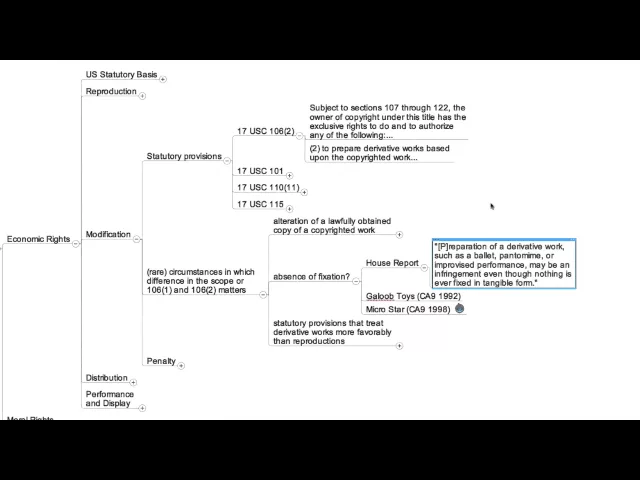
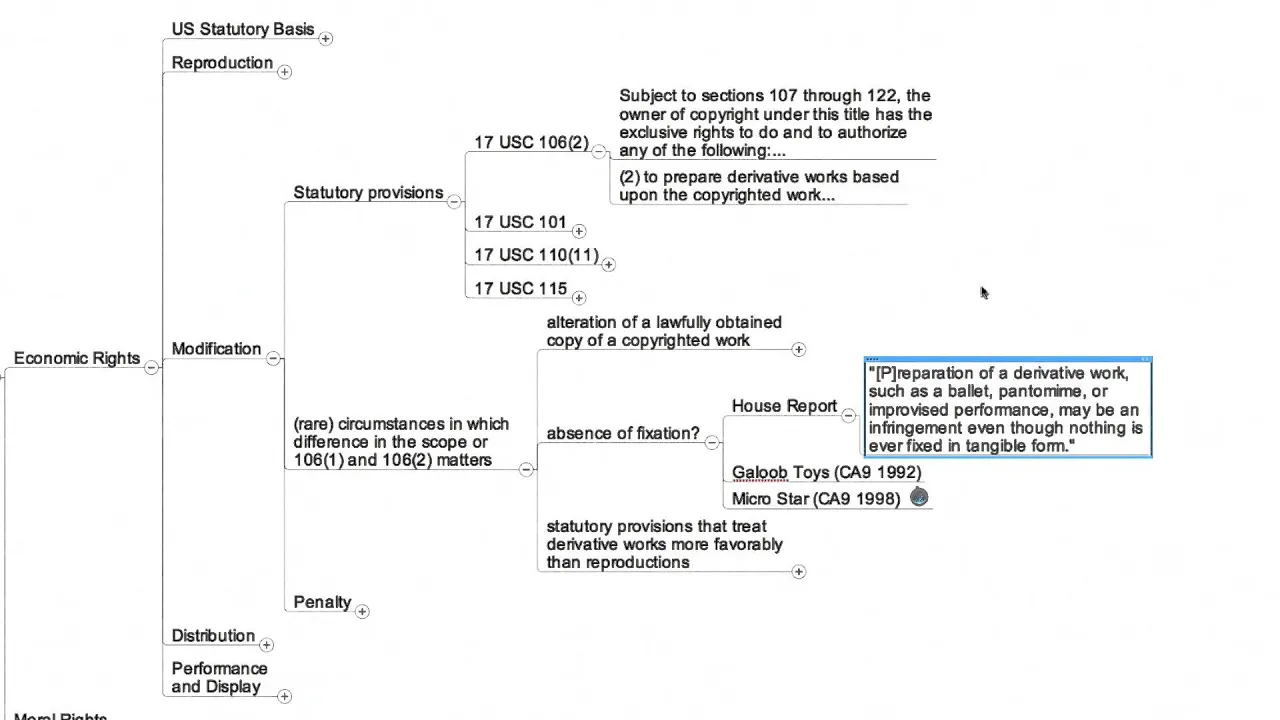
The principal examples are listed in the map in front of you. First, a defendant will sometimes purchase an authorized copy of a copyrighted work and then physically alter it or integrate it with another work. In such a case, the defendant has not violated 106(1) because he's not made a copy.
He's bought one. Thus, he can be liable, if at all, only for preparing a derivative work. Two cases of this sort involving very similar facts are notorious.
In each one, the defendant purchased books containing copies of the plaintiff's copyrighted artwork, cut out individual images from those books, glued the pictures onto tiles, and then sold the tiles. In one of the cases, the Ninth Circuit concluded that section 106(2) had been violated. Quote, "By borrowing and mounting the pre-existing copyrighted individual art images without the consent of the copyright proprietors, appellant has prepared a derivative work and infringed the subject copyrights.
" Close quote. In the other case, the Seventh Circuit, dismayed by the implications of the Ninth Circuit's ruling concerning the status of many common and innocuous habits, like marking up copies of case books, took the opposite position. As you might expect, such disputes don't arise often.
The second context in which 106(1) and 106(2) might diverge concerns the requirement of fixation. As we discussed in the previous section of this lecture, to establish a violation of the right of reproduction, plaintiff must show, among other things, the defendant made a copy of the plaintiff's work. And that, in turn, requires that the thing the defendant produced be fixed for more than a transitory duration.
Notice that the language of 106(2) is different. It makes no mention of copies or phonorecords. Instead, it refers to, quote, "preparing" close quote derivative works.
That seems to leave open the possibility that 106(2) could be violated without making anything firm. One passage in the pertinent legislative history lends support to that possibility. The House of Representatives report that companies the 1976 statutory reform contained this sentence.
Quote, "Preparation of a derivative work, such as a ballet, pantomime, or improvised performance, may be an infringement even though nothing is ever fixed in tangible form. " Close quote. Despite the apparent clarity of this statement, the courts have been very reluctant to accept violations of 106(2) in the absence of some kind of fixation.
For example, the Ninth Circuit has ruled that, quote, "To narrow the statute to a manageable level, we have developed certain criteria the work must satisfy in order to qualify as a derivative work, one of which is that it must exist in a concrete or permanent form. " Close quote. Finally, a few odd statutory provisions treat parties who make derivative works more favorably than those who merely make copies.
One such provision is Section 104A(d)(3), which governed the rights and obligations of a person who has prepared a derivative work based upon an underlying work that used to be in the public domain in the United States because of a failure to comply with US formalities, but has now been restored to copyright protection because of the TRIPS Agreement. The statute permits such a person to keep on exploiting his derivative work, provided that he pays the owner of the restored copyright a reasonable compensation. To avail himself of this option, he must show that his product is a derivative work, not just a copy of the original.
How much must he have changed the original work to qualify? In the judgment of the Third Circuit, not much. Changes that embody, quote, "some minimal degree of creativity" close quote, suffice.
One last aspect of Section 106(2) merits reiteration. What happens when you prepare a derivative work without permission? Well, you expose yourself to the various remedies for copyright infringement that we'll consider in detail in the last lecture in this series.
But something else happens that's perhaps less obvious. You forfeit whatever copyrights you might otherwise have enjoyed in your derivative work. The relevant statutory provision is Section 103(a), which provides the subject matter of copyright, as specified by Section 102, includes compilations and derivative works, but protection for a work employing pre-existing material in which copyright subsists does not extend to any part of the work in which such material has been used unlawfully.
A nuance lurks in this language. Some courts have held that a person who, without permission, makes a derivative work forfeits protection only in the portion of the derivative work that is, quote, "pervaded" by the underlying work. In other words, you may still claim a copyright in a portion of the derivative work that is entirely untainted.
Putting that nuance to one side, the main point is that, in this context, an infringer doesn't get copyright protection, even for his own creative material. In lecture three, I discuss this principle briefly in connection with the Sylvester Stallone Rocky case. Here's another, even more odd illustration.
At one point in his career, the artist sometimes known as Prince adopted as his name the image shown on your screen. During this period, a guitar maker and Prince fan by the name of Ferdinand Pickett made a guitar that incorporated most of this shape and allegedly showed the guitar to Prince. Pickett apparently hoped that Prince would buy the guitar, and thus enhance Pickett's reputation.
Prince did not do so, but instead commissioned another guitar maker to fabricate guitars incorporating his symbol and played them in concerts. Enraged, Pickett brought a pro se copyright infringement suit against Prince. Pickett acknowledged that Prince held a valid copyright in the image he had selected as his name, and that Pickett's guitar was a derivative work based upon that copyrighted image.
Nevertheless, he contended that Prince could not make a copy of Pickett's guitar without Pickett's permission. Seven years later, the Court of Appeals for the Seventh Circuit finally resolved the dispute in Prince's favor. Judge Posner, writing for the court, expressed doubt that Pickett's guitar embodied sufficient originality to warrant a copyright in the first place.
But in any event, Posner ruled, its status as an unauthorized derivative work meant that Pickett had no copyright protection for it. Thus, even if Prince had seen and copied Pickett's guitar, he would not be liable. The trial judge's comment on the case seems apt.
Quote, "Defendant may as well have had in mind this protracted litigation when he asked, 'Why do we scream at each other? This is what it sounds like when doves cry. '" As Mark Lemley has observed, patent law works quite differently.
A person who, without permission, makes an improvement on a patented invention may obtain a patent for his improvement. This creates a situation of so-called blocking patents. Neither the holder of the patent on the original invention nor the holder of the patent on the improvement may practice the improvement without the permission of the other.
So is the net result that the improvement never gets manufactured and used? Sometimes. But what usually occurs is that the two parties negotiate a deal by which they divide in some way the benefits of the now improved invention.
In Lemley's view, this setup creates a more efficient pattern of incentives for both primary and secondary innovators than the copyright system. You might ask yourself, what would have happened in the Stallone and Prince cases if a system of blocking copyrights, analogous to the system of blocking patents, had been in place? This concludes our analysis of the rights of reproduction and modification.
Next week, we'll take up the distribution and public performance rights. Thank you.