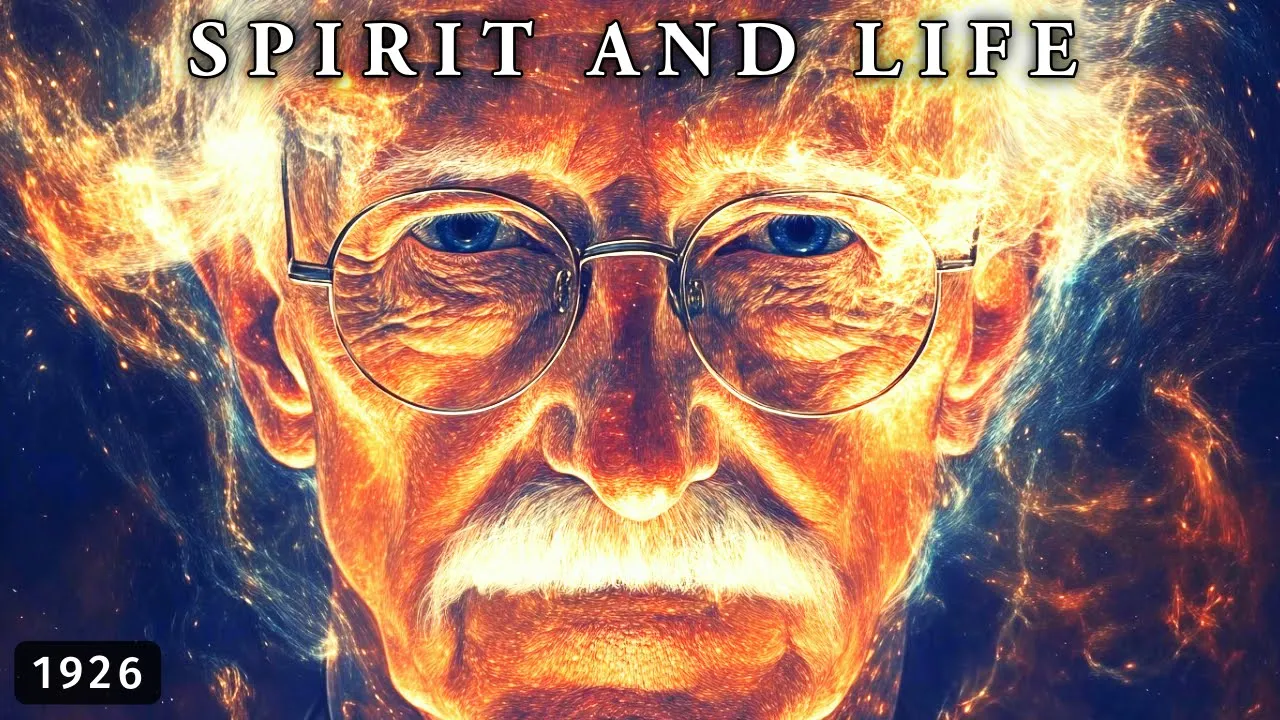
In "Spirit and Life" from 1926, Carl Jung makes the observation that "spirit" is the "quintessence of the life of the mind". He explains that spirit refers to the ideas that inspire us, as they emanate from the affective quality of unconscious complexes. To be influenced by spirit, is for our minds to emotionally resonate with such latent ideas.
The essay is collected in Volume 8 of Jung’s Collected Works, and we proceed now with a simplified abridgement of the text. The relationship between spirit and life is complex, and we must be cautious to avoid being ensnared by the very words we use to describe these concepts. While "spirit" and "life" are familiar words, their meanings are often ambiguous and multifaceted.
The term "spirit" can refer to a transcendental idea, the mind, courage, or a ghost; and it can also denote unconscious phenomena or the prevailing attitude of a social group. Additionally, it has material connotations, such as alcoholic beverages. This linguistic richness complicates our communication about these fundamental concepts.
Thus, we must critically examine what "spirit" truly signifies in relation to "life. " The challenge lies in articulating these profound ideas without being hindered by the limitations of language, which can obscure, rather than clarify, our thoughts. As an empiricist, I believe that experience should guide our understanding.
I admit that I do not fully grasp what "spirit" or "life" is in an abstract sense; I only know "life" through the living body. Therefore, I prefer to discuss the living body and psychic factors rather than abstract concepts. The living body is a tangible reality—a self-contained system of material units that enables life.
It is a purposeful arrangement of matter, and is distinct from the concept of a "living being. " This distinction highlights that the body, while prepared for life, cannot exist without the addition of a psychic factor. Our experiences of ourselves and others, as well as scientific studies of higher vertebrates, suggest that this psychic element is essential for life, and it likely exists in lower organisms and plants as well.
Thus, understanding the interplay between the body and spirit is crucial for grasping the essence of life. We can consider the "living being" as equivalent to the psychic factor in human consciousness, potentially reinstating the duality of mind and body. This raises the question of whether the psyche should be viewed as a purposive system of living processes, rather than merely an arrangement of matter.
This perspective may challenge our conventional understanding of the mind-body unity. Our experiences suggest that psychic processes depend on the nervous system. Disturbances in specific brain areas lead to corresponding psychic defects.
The spinal cord and brain function through interconnections between sensory and motor pathways, known as reflex arcs. For instance, touching a hot object stimulates nerve endings, triggering a rapid response that withdraws the hand before conscious pain is perceived. This automatic reaction is later interpreted by the conscious mind.
In more complex scenarios, such as hearing an indistinct sound, the auditory stimulus generates a series of associated images—acoustic, visual, and emotional. These images represent conscious content, reflecting underlying brain processes. Thus, all conscious experiences can be understood as images, representing the dynamic workings of the psyche.
The psyche consists of reflected mental images formed from sensory stimuli, which, when associated with the ego, gain the quality of consciousness. Without this association, they remain unconscious, akin to objects in darkness that exist but are unseen. Consciousness can be viewed as a state linked to the ego, which, despite its apparent unity, is a composite of sensory images and past experiences.
This complexity requires a cohesive force, which is consciousness itself. However, consciousness cannot exist without the ego, creating a paradox where both are interdependent. The ego, as a composite of psychic elements, does not represent the entirety of the human being; it forgets far more than it retains.
It is unaware of many thoughts and the significant regulatory functions of the sympathetic nervous system. Thus, the ego is merely a fragmentary complex, and its cohesion does not fully encapsulate consciousness. Ego-consciousness emerges as a synthesis of diverse sensory experiences, unified under the ego.
A broader consciousness may exist that includes the ego as an objective content, similar to how seeing is an object of consciousness. This broader consciousness could be envisioned as a larger circle containing the smaller circle of ego-consciousness. Just as sensory activities create images related to the ego, it is plausible that all psychic activities produce images of themselves, forming a unified total image of the individual.
Returning to the mind-body question, the psyche fundamentally consists of meaningful images that reflect vital activities. The psyche requires a living body to manifest its images, while the body needs the psyche to be animated. Mind and body represent two aspects of a single, unknowable entity, often described as the union of soul and body.
This duality may simply be a conceptual tool for understanding a singular reality, rather than indicating independent existence. Science has yet to unravel the mystery of life, leaving us to seek the essence of the "living being" beyond our experience, a pursuit that challenges our understanding of both physiology and psychology. The concepts of "spirit" and "living being" may represent the essence of mental and physical life, respectively, existing in a realm of indistinguishability.
This raises the question of whether these concepts are necessary, or if we can simply accept the mind-body contrast. While science might halt at this distinction, a psychological perspective encourages us to explore beyond it. From a psychological standpoint, our understanding of reality, including matter, is mediated by the mind, which creates images that shape our experiences.
This suggests that our perception of reality is clouded by a complex structure of mental images, leading to skepticism about absolute truths. We exist primarily in a world of images, and the validity of psychic phenomena cannot be easily subjected to scientific scrutiny. Instead, we must ask whether a conscious content is present; if it is, it holds validity in itself.
For instance, while science has not proven the existence of God, the experience of God is a valid psychic fact that requires no external validation. Similarly, experiences of ghosts or being bewitched, though often dismissed, are genuine psychic phenomena that reflect a shared understanding of such experiences. Thus, these subjective experiences must be acknowledged as real, regardless of their empirical verification.
Returning to the concept of "spirit," it represents a psychic experience that cannot be empirically proven or rationally understood, similar to the notion of God. By moving beyond the bias that requires concepts to relate to external objects or rational categories, we can explore the enigmatic nature of spirit. The etymology of the word "spirit" reveals its roots in Old High German and Anglo-Saxon, where it referred to a supernatural being distinct from the body.
This connection suggests that spirit may embody personified emotions or affects, as seen in expressions like "beside oneself with rage," indicating possession by a spirit. This primitive understanding of spirit persists in our psyche, often surfacing in modern spiritualism. If we accept that spirit reflects an autonomous affect, we can see how emotions can act independently, akin to a spirit.
The term "spirit" also encompasses broader meanings, such as embodying the essence of a deceased person or representing a collective attitude, like a "guiding spirit" of a group. Moreover, attitudes can be influenced by external factors, often spreading contagiously within social environments. A negative attitude can poison a group dynamic, while a positive one can uplift it.
Thus, attitudes, whether consciously chosen or not, can significantly impact collective experiences, akin to the influence of spirits. Attitudes can emerge from both internal and external influences, similar to affects, and can be expressed through comparable language. While attitudes may seem more complex than affects, they often stem from underlying maxims or ideals, which can be traced back to specific sources.
Sometimes, these attitudes are encapsulated in a revered personality that individuals emulate. Educators leverage these psychological insights to instil desirable attitudes through maxims and ideals, which can become lifelong guiding principles, much like spirits that possess individuals. This understanding of "spirit" transcends mere animism, as proverbs and aphorisms encapsulate profound life experiences and insights.
When a guiding principle becomes dominant, it can lead to a life "ruled by the spirit," where the idea takes on the nature of an autonomous complex that influences the ego. However, these maxims are not absolute; they require an emotional resonance within the individual to gain power. Without this emotional connection, ideas remain mere concepts without influence.
Autonomous attitudes arise not from conscious choice but from an unconscious readiness to embrace them, suggesting that fate plays a significant role in which principles govern our attitudes. While some may believe they exercise free will in choosing their attitudes, true autonomy is elusive, as all individuals are inherently limited. Our conscious mind represents only a fraction of our human nature, and there may exist a broader consciousness that the ego finds unsettling.
For instance, if our visual system had its own consciousness, it might perceive disturbances when external stimuli, like sounds, disrupt its focus, illustrating the potential disconnect between different aspects of consciousness. If a wider consciousness exists, it may manifest as disturbances beyond our control, affecting our moods, energy levels, and memories. These disruptions can occur in both normal individuals and neurotics, where symptoms arise without any identifiable organic cause.
Medical psychology attributes these disturbances to unconscious processes, suggesting that they are not unintelligent but can surpass conscious insights in complexity. The concept of the unconscious serves as a useful framework for understanding these phenomena, but it may be more accurate to refer to this broader consciousness as a "higher" consciousness, given its perceived superiority over ego-consciousness. This spirit can manifest as an autonomous complex that influences our lives, often without our conscious awareness.
When a compelling idea emerges from this deeper consciousness, it can exert a powerful influence on our actions and decisions. Spirit, in its most profound form, transcends mere maxims or ideas, often requiring symbolic representation to convey its essence. Symbols capture the elusive nature of spirit, pointing to meanings that elude direct expression.
The effectiveness of Christian symbols, for example, illustrates how spirit can profoundly impact human experience and history. However, this spirit is not inherently good; it can be both light and dark. A spirit that disconnects individuals from life can be detrimental, leading to a hollow existence.
While a life guided by spirit is richer than one driven solely by ego, it must align with life’s demands. Ultimately, the truth of spirit is measured by its relationship to life; a spirit that seeks fulfillment only in itself is false, and individuals must choose whether to surrender to such a spirit. Life and spirit are two powers or necessities between which man is placed.
Spirit gives meaning to his life, and the possibility of its greatest development. But life is essential to spirit, since its truth is nothing if it cannot live. And that brings us to the end of “Spirit and Life” by Carl Jung.
In the coming videos, we shall explore how the concept of spirit can be applied to society at large, and how this allows Jung to diagnose the collective neurosis of the spirit of the time. Please remember to subscribe to the channel to be notified of the next instalment. Thank you very much for listening.