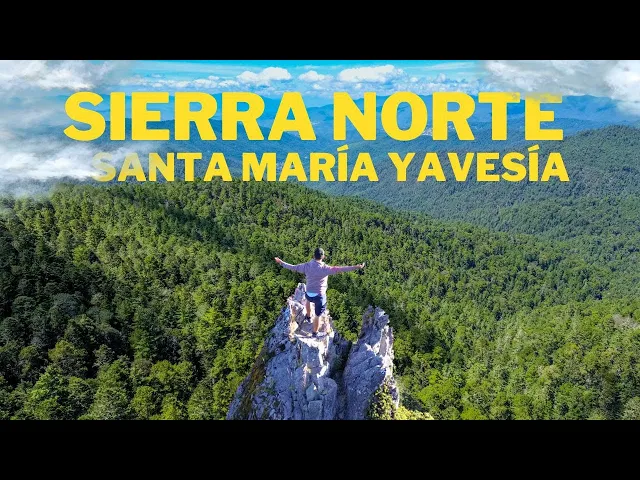
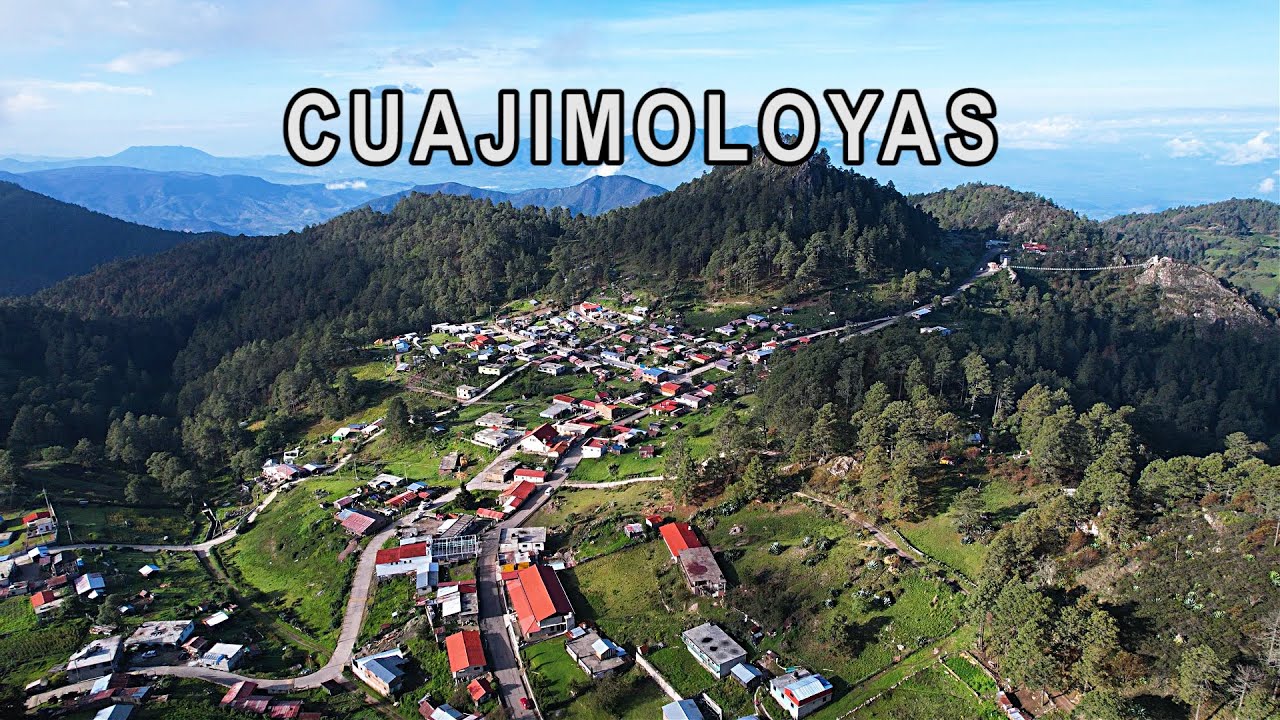
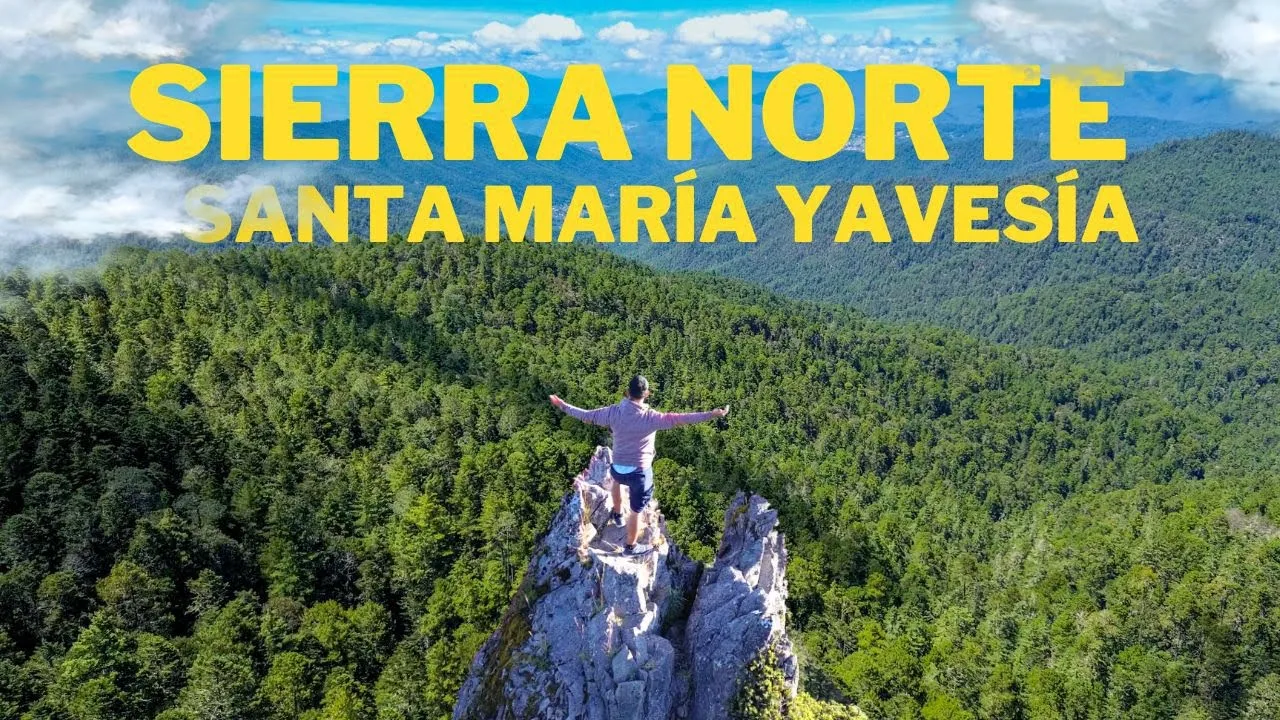
In the Sierra Norte of Oaxaca, there is the majestic forest of Santa María Yavesía. YavesÍa, Santa María de Yavesía is the place for you to live. Here there are 9,200 hectares of forest and there has always been a tradition of defending this forest, no one has come to cut down here. The Sierra Norte of Oaxaca, for those who do not know it, is a part of the Sierra Madre that crosses this State, the home of many native cultures. I had never seen a forest, so indescribable, so incomparably beautiful. The forest and water are the pillars,
for the Zapotec community of Santa María Yavesía this is where the longest arm of the Papaloapan River begins, which bathes its fertile mountains. A different lifestyle, totally different, to what we are used to in the city. Most families grow their own food, lettuce, carrots. Welcome to Santa María Yavesía , a town where we still plant the fields, I have a lot of love and affection for everything I plant, I am the one who talks to the cornfield, with the flowers, even with the animals, my parents taught us, they taught us They instilled a lot in
the field, it makes me happy when you plant it and see the results, like right now, look I see the corn, you are going to see good results this year. Santa María Yavesía is located just 2 and a half hours north of the capital of Oaxaca in the Sierra de Juárez. The territory has been inhabited since time immemorial by the Zapotecs, who have fought to defend their communal territory, to conserve and protect their most valuable resource, the forest, because without it there would be no water, we left very early from the city of Oaxaca, to
reach dawn, in one of the most captivating natural viewpoints in the State. I've been there for about 5 minutes, this is already the most beautiful forest I've ever been in, I see why it is so famous, among the biologists guild, the Sierra Norte of Oaxaca, in terms of the atmosphere, in terms of the vegetation, the aromas of the forest, the sounds of songs in the morning, I mean if this is what it looks like right now, I don't want to imagine what it will look like at dawn. From the Piedra Larga viewpoint, the greatness of
the forest can be seen. The community has opposed exploitation, as a development model, a battle that worsened in the early 80s, due to the so-called community forest management, it was intended to extract more than 500 thousand m³ of round wood with the construction of approximately 30 km of gaps, for the extraction of wood the community members and citizens of Yavesía dedicated more than 2,500 tequios which are community services, to monitor their territory and prevent damage to the forest, they were successful in the defense, however this has led to a permanent conflict with the neighboring towns
that continue cutting down trees. That is a magical moment, it is the beginning of a new dawn, the Sun is rising as it has done for 5 billion years, the source of energy that gives life to our planet, the Sun is a star, if it were not for He would not be here, look at the precipice that I have here, it intimidates, it gives respect to the immensity that there is, I understand that Mexico is one of the most biodiverse countries in the world and especially in the conifers, these forests that are at risk of
disappearing. , due to climate change, and well, now without words to enjoy this sunrise, we arrived thanks to Tierra Viajera, go to the most remote places in Oaxaca and see the light, wow. Nothing could compare with the view we have here, everything is so wide, we can see the forest to the horizon, we are seeing the sea of clouds, how these incredible rock formations appear, next to large conifers in an ecosystem, so profoundly beautiful . As this is, I think that if you decide to visit this place, you will understand why it is so difficult
for me to find original words to describe it. I was asking you, What is the process of bureaucratic procedures like, to be able to stay and live here, this is a place where you could die happy even at my age. This morning we are here in Piedra Larga, always in Piedra Larga there is a reason to live intensely, there is always a reason to bare the soul to permeate ourselves with everything that nature and the universe offers us, without any cost among the clouds, between the horizon, between the canopies of the trees, that wonderful green
that gives peace, that gives calm, I think the heart receives a pumping of blood beyond the limits because the amazement here really keeps us in suspense, keeps us with adrenaline, the abyss and the height, we are always in an abyss, life is an abyss, you have to know how to climb it, and you have to know how to descend it, so it seems to me that all the conditions are here, to live this is where everything starts, said John Muir who Any trip to the universe passes through a virgin forest and here is that phrase,
he was the creator of the John Muir national parks in the United States. See how the first rays of the Sun are not illuminating, in the Sierra Norte of Oaxaca, which is one of the eight regions that exist in this State that for me is as if it were a country in itself, it is so large, so biodiverse, More than 570 municipalities make it the State, with more towns in the country in the sky in the firmament we can find the two stars, the Moon and the Sun, so I invite everyone to come, to the
Sierra Norte of Oaxaca to go out of your comfort zone Oaxaca is more than the capital, more than its beaches, Oaxaca has the mountains, go ahead and get to know the mountains of Oaxaca, which I believe are among the most beautiful in Mexico, due to its orography, so capricious, curls that They form their mountains, see how the Sun is caressing the forest and that sea of clouds that is behind my back, it is beautiful, become travelers, in Oaxaca in your own country. Hello, do you like to see the sunrise? Since I saw the rock that
is right here, behind us, I knew that I would climb there, knowing that there is a well-defined path to get there, it was something that gave me a lot of confidence, even so, being there, observing the fall that you have, this space of rock away from you, it makes a lot of impression of what that rock means for the fauna that lives here, that is the place where the puma known as the mountain lion prostrates , devouring deer and so on, so think about the The fact that I am in the place of the second
largest felid in North America, well, it is something great. These are the sites that are not heard in the rest of the country, that do not have the diffusion they should. The truth is that I am very excited to share that experience that we constantly experience is very wonderful for us. He is an excellent drone operator, photographer, he loves being behind the camera, recording, the editing they handle, the content they upload about Oaxaca, it is unique, they are incredible images, photographs and they are from places that are not on the map. Something that I really
liked about being at the top of the mountain, it gives us the opportunity to observe many species of birds, that glide, that move over very long distances, and not only go from branch to branch, one of the first species that we saw when we arrived here was the American kestrel, which was flying guarding its territory, the American kestrel, it is one of my favorite birds of prey, it is a falcon that is even smaller than a pigeon, it is a tiny falcon, the coloration of its plumage, the decoration of its plumage, is quite beautiful after
a very short time, a crow also flew over here, a corvus corax, a common crow, which due to its size is very easy to confuse with eagles, they really are animals very big, He spent his time vocalizing as if marking territory, that this land is mine, this can of course serve to attract a female that is walking around, one would think that in order to observe interesting fauna we would have to be lifting stones and logs, and being at the level of the ground, but even when we get above the ecosystem we can still observe
many very interesting species like these. After the viewpoint we took the opportunity to explore the forest floor, which houses a microcosm under each stone, unsuspected beings for our reality. Check out what's below, see this, it's a very interesting thing, in English-speaking countries, they refer to this as slime mold , gelatinous mold, slimy mold, we can refer to this thing as dog vomit, because it really is so strange. , so strange, so apparently alien, a species of protozoan, a protozoan is like a kind of primitive animal, microscopic organisms that appear to have behavior and that have
many characteristics in common with animals, this is like a kind of colony or community The organism itself is truly unicellular, there are a lot of cells that we are seeing here, that come together and transmit information, they are working as if they were one, it travels, it expands, it stretches until it finds a source of energy. food, then it is always finding the most effective route, to get from one point to another, this is where things get interesting, some scientists in Japan even did an experiment in which they took a petri dish, which is In
a laboratory container, on which the samples are deposited, the organism was in the center of the petri dish and in the surrounding area, but in strategic positions they placed oat grains, which are a source of food that they apparently love. , a little less than 24 hours passed, there were a lot of lines as if they were roots, which are looking for where to go, it turns out that the researchers had something planned, the center where they put the organism represents geographically, the center of the city of Tokyo and The grains of oats, in the
surrounding area, represent each of the subway stations around Tokyo, which is a gigantic city. In less than 24 hours, this thing, which has no brain, which has no nervous system, managed to design a subway system, much more effective, than the one that took Japanese engineers more than 100 years to make, so this is something fascinating, of course it doesn't have a nervous system, it doesn't have a brain like ours, I wouldn't say it has the same type of intelligence but it is like an alien, it is as if it had fallen from a meteorite, truly,
one of the most fascinating organisms that exist and I feel very privileged to have found it here, you can find it in many humid ecosystems. This is an area known for having very striking birds such as the red warbler, the multicolored hummingbird, which are quite typical of this pine forest ecosystem. Just a while ago we saw a western warbler and then we were behind a hummingbird but we lost it the trail, I hope we have better luck in a while. Mexico occupies first place in North America, with 1,107 species of birds. It is also the
country where more than half of North America's migratory birds spend between 6 and 8 months of the year. Within the guild of bird watchers, the word birding is used. , as a translation of birding, which is simply going around a place in search of birds, what a difference from activities such as, for example, walking after reptiles or amphibians, or mammals bird watching is quite easy, I mean, of course to find certain species, you have to go to very specific places, sometimes pay too much attention to the surroundings, in general it is a fairly accessible hobby,
I started simply observing, observing the species that I saw around me. The walk is beautiful and right now, what we are doing is birding , a pastime and a hobby, which can be done by children up to 80 years old, there is a very important tourism from other countries, who come to Mexico to photograph the birds, to our birds. No scientific training is needed, but little by little you become interested and learn a little more about the biology of these species. It also has a very great sense of community, practically anywhere in the world you
go, you will find a group of observers. of birds, which go out to very beautiful places, you can even have a nemesis as we call it in the guild, which is a bird that no matter how much you look for it, it does not come out, and by the time you finally find it, it is a wonderful eureka moment. What has been your top three species that you have captured with your lens? The elegant eagle, let's put it at once, one that fascinates me is the dark-faced owl, I photographed it in the Reserva del Cielo
in Tamaulipas, one of the most enigmatic birds that is difficult to see, to date it is not well known, Where it spends its days in Heaven is distributed as far as South America, but, without a doubt, the bird that I feel most satisfied with having been able to photograph is the cinnamon tinamou of the species Cryptorellus cinamomos. The tinamou are known as the most difficult to find . to see and photograph, after two years of much insistence and on my second day in a row of lying on my chest with the camera waiting for 2
hours I finally had the opportunity to photograph it, if you want to see photos of the bugs that I upload, you can follow a page called Marco Arturo Wildlife, I have between 300 and 400 species of birds registered so far. We're going to have breakfast, we've already prepared the coffee, the tea, dear God. You have to hug Gema. See what I have for breakfast with the heat of the firewood around the forest, I'm going to eat a quesadilla of: quinoa, avocado, pumpkins and cheese. Then it was time to ask Mother Nature for permission to go
deeper into the forest. Here in the community of Yavesía, it is the respect towards Mother Earth towards the spirits that inhabit, that take care of our forests, respect that the grandparents and great-grandparents have shown and this heritage that has been brought from pre-Hispanic times, before we Let us enter this forest, so immense, so important in Yavesía, we do this ritual to ask permission, oh great spirit, listen to me, I am small and weak, one of your many children and a worshiper of your greatness, let me walk and enjoy your beauty , allow my eyes, may
they enjoy the red and purple of the sunrise and sunset, oh great spirit, make my hands respect the many things that you have created. Thank you God. For the nature of Oaxaca, for the forests of Mexico, that we continue to maintain that diversity of pines, we are one of the countries with the greatest biodiversity of pines, I pour out the mezcal. I want to be grateful that we are here again in this beautiful forest, it is one of my favorite forests, especially for the great community that we have created here in this space to continue
discovering Oaxaca. Pouring mezcal onto the earth is a tradition spread throughout Oaxaca, Now we were ready to look for the natural source of the water. We are going to go to another very beautiful space, called Piedra Ventana, the view is spectacular and before Piedra Ventana, we are going to go to a waterfall called Bridal Veil Because the water opens and you can see the white foam on a rock, it is beautiful, I think that the elves and fairies bathe there. In the middle of the coniferous forest, we find species like the pine and also fir,
see here we have the fir, which are that type of leaves, they form a kind of cross and see here we have the pine, see how pointed it is, this is the Unlike the pine and the fir, the pine is more pointed and this forms a cross and we already hear the sound of the water, how the water flows between the mountain and the aroma that is breathed here is delicious, the air is fresh, we are about 15 °C, perfect pine smell, delicious. Being in such a temperate and pleasant climate is something very beautiful, especially
when the landscape contains scenes like the one we are witnessing, the famous Bridal Veil waterfall, as they call it, it is very relaxing to be here, all the sounds that the produced by water specifically are quite pleasant to the human ear, which forms the water as it falls, all the hits it makes against the rocks, all the splashes of drops, all the bubbles, the arrangement of the bubbles when they fall into the water, every millisecond It is different from the previous one and is never repeated, for example, if a fish starts swimming, starts flapping its
wings, that already alters the order of the water molecules so the direction changes, there is a chaos that is really very ordered, it is always there. constantly changing, it keeps reinventing itself, so I highly recommend going to waterfalls and being totally hypnotized watching them for as long as necessary, it's almost therapeutic. It seems to me to be a very energetic place, here in this town there are many beautiful places, about 1 km up is the aguaje, that is, it is beautiful there to feel where the Papaloapan River is born, the river of butterflies, in the
Zapotec culture, of the yellow butterflies, revered by the cultures here, the sacred river, it seems to me that the State of Oaxaca is a State that has almost everything, I believe that it does not need anything, it has a jungle, it has extraordinary beaches, it is the State that more indigenous languages are spoken. The Papaloapan River is the second most important water basin in Mexico , which is why the residents of Santa María Yavesía are known as Bene Shoora, the people who live where the river is born, the water resource and its steep geography, give
many microclimates to Oaxaca. that favors the diversity of living beings. In terms of biological diversity, obviously it is not going to be left behind, Oaxaca will probably be at number one, it is the most diverse State in Mexico, in terms of practically any category to know, virgin ecosystems so precious and so important for conservation of nature in Mexico, because it is a privilege for which I feel enormously grateful to the traveling land team and of course to the audience of Jorge's videos, who until now have not implored him to stop inviting me, so while That
doesn't happen, I'll be happy. This is one of the most preserved parts of the Yavesía forest, we can feel the humidity, see the green color of the moss and, above all, the pure air. See, we were able to go down and see the fall of the bridal veil, they say that when it rains, it brings a lot of water and we have to take care of our rivers, there is a figure that impressed me a lot, 60% of the drinking water we consume comes from fresh water . of rivers, it is very important to keep
them clean and the good thing is that in the Sierra Norte de Oxaca we hope that they never lack water because they have many mountains, where crystal clear water flows like here. On the surface of the river water, we see a fierce competition. We are seeing gigantic hemipteran insects, walking on the water, feeding on a grasshopper, that is the way they survive, they spend their time on the surface of the water, without breaking the surface tension. If a grasshopper makes a bad jump and falls into the water, it is immediately received by the hemipterans ,
they do not have a digestive system inside, they cannot digest food inside , so with one of those tubes, they inject a cocktail of enzymes that digest the animal outside, it is something very crazy and very brutal, with that tube they inject and then the The one on one side is used to suck, it is used like a straw, what it is sucking is like this little toy of nutrients, already from an insect, already digested, I have never seen them fight so much, they fight a lot, they compete among themselves, I imagine that in such
a small space, the resources are somewhat limited, another thing is that they need to be eating all the time, they are making a constant effort, fighting against the current, that wears them out a lot and therefore they need to be constantly consuming, The insects there fall into the water, so it is to be expected that they will fight as soon as an insect falls and one catches it, everyone else tries to take it away, then he goes to hide and it is a very bizarre spectacle. I start to think that I would be very afraid
of being tiny and being prey to them, I imagine that the flies cannot come out to drink water here or lay their eggs because these serial killers eat them, they are warriors and they fight to survive. How scary to be a small animal, that everything is trying to eat you all the time and it is correct that animals that live 70 years, really, there are very few of us, and animals like these that have thousands and thousands of babies, well imagine that each of these offspring would have a thousand offspring, only in about 10 generations,
we would already have more insects like this than atoms on the planet, so this is logically impossible, what happens is that they are all eliminated, only enough remain. to replace, the figures of their parents in the next generation. Now it was time to get to know the Piedra Ventana miner and along the trail the biologist Marco Zozaya did not miss the opportunity to look for reptiles and amphibians. Well, they told me that this is a good place to find, lizards of the genus Abronia and they are famously known as the most beautiful lizards in Mexico.
They are one of the most emblematic of our country, in fact, because we have the main diversity, in this genus of the anguidae family, the idea is to walk and check the surface of the bark of each of these trees to see if we find a head coming out of one of the holes. If so, it would be an incredible find, because it is a species I have never seen. Well, keep looking for the little heads, lizards are his favorite animal. I also like snakes, arachnids , amphibians, birds, mammals and others. Wow, let's lift logs,
come on, Come on, you will find the other viewpoint, it is a large stone structure and all that remains is to climb it. While they are looking for the lizard, I want to give them this view, what beauty, what beauty and let's go upstairs to see what we find. Inside the cavity, which is formed in the limestone rock of the gigantic Window Stone, we understood, why it received this name, a vastness of forest that looks out of the window. We are right at the viewpoint called Piedra Ventana, because you can see the shape that this
rock has and it exposes us to the country, of all the mountain towns, we have in front the community of Santa Catarina Lachatao and further in the background you can see the community of Capulálpam from Méndez this is one of the most beautiful landscapes that we can observe in the Sierra Norte of Oaxaca. We must have respect for this cave, because you see, the fall, I am on the shore, because of you I have such a beautiful job, which consists of knowing the most hidden and beautiful places in our country, so please I ask you
to leave comments , your like, this helps a lot for the YouTube algorithm to recommend my work more and these beautiful places in Mexico reach thousands of people. Don't you like being up there? Not at all. Gema loves the mountains and walking here on the trail. What a cool landscape we have in the back, this is offered to us by the community of Santa María Yavesía, we are in one of the most conserved forests in Oaxaca and the entire Sierra North since this community decided to protect all its natural wealth , especially one of the
most important resources for life, which is water, in the area where we are traveling, it is practically the reserve of the entire community and there are people in charge in coming to watch over this whole part and in the part of the town the same, the majority of the families grow their own food, lettuce, carrots, many also have businesses that invite local consumption, apples, pears, loquats, this is one of the communities, which I like to give as an example, that in the Sierra Norte you can find a totally different lifestyle at a different pace. I'm
looking for a place to spend my old age, where to die in peace in Mexico and I think Oaxaca is somewhere there... Well, here there are 9,200 hectares of forest and there has always been a tradition of defending this forest, here no one has come to felling, knowing the history of Yavesía is very important, because it is a story of dignity, of defense of nature. Approximately 60, 70 years ago this municipality began with the protection of natural resources, a fight even to defend the wood, many companies wanted to, however, the grandparents ruled in a general
assembly that it had to be preserved, that it had to be inherited for the next generations, from there we have begun to carry out various activities, both sports, cultural, and social so that we raise more awareness about the importance of resources, we work on it from schools, from preschool, primary, secondary, because it is a fight that has been difficult, but we want it to spread more. We have also participated in other communities, to carry that message that the grandparents left and we want more and more people to join in this fight and this love over
everything for nature When we descended we had a lucky encounter with some salamanders that allowed us to photograph. Here we see Marco, his search was a success, he found two salamanders, this place is ideal to find salamanders and let's remember that these salamanders are amphibians, they are very sensitive to the skin, they need to have moisturized skin and here in the forest Thanks to the rain and humidity and the streams that we already saw, they can live peacefully, they are posing, they are very calm, with a slow metabolism, they are generally nocturnal and hunters and
it is important to keep the forest clean, because through their skin they share information with the outside, Mexico is number five, in diversity of amphibians in the world, just as we are in the top five, we have to take care of them, respect them and that there are more young people like Marco who classify more amphibians, so that some day let's be number 1, Marco, together we have already traveled through jungle, forest, mesophile, semi-desert. And several mesophilic forests, several semi-deserts, in Heaven alone there were about four. Four ecosystems. As a gift, the forest of the
Sierra Norte of Oaxaca showed us one of its smallest inhabitants, the little red warbler bird. I am very excited because, finally after so long wanting, I have just photographed one of the most beautiful birds in our country, it is the red warbler, scientific name cardelina rubra, it is a bird impossible to confuse with any other, It has an intense red color, like I have never seen in a bird in my life, I mean I have seen cardinals, I have seen trogons but something this intense, it is something that stands out quite a bit, among vegetation
as green as this, quite special for us. the Mexicans, because it is an endemic bird, it can only be found within Mexican territory and it prefers places like these, very high forests, especially coniferous forests, then we are in the paradise of this animal, for now with this, I I can now return to Tamaulipas very happy. With the sunset we ended up in the town of Santa María Yavesía, where we would spend the night next to a river, in a very green area. We have already arrived at the town of Santa María Yavesía, here we are
going to stay the night, it is very beautiful, see we have to cross this river. Santa María Yavesía is from the capital city of Oaxaca de Juárez, approximately two hours, 90 km away and we want to invite friends to visit us, we want to share with you and for you to also share your culture with us, we have activities from festivals of the community, we want to start a project on glamping, the intention is for visitors to have accommodation that is as comfortable as possible and that at the same time are natural spaces, on the
banks of the river, that if you want it in the mountains, imagine waking up and having it around you. so much nature, we want all that energy from the forest to be contagious. We spent a peaceful night with the sound of the river and woke up to the singing of birds. Good morning, we slept very well, with the sound of the river, the flow of water, among flowers and a scent of the forest, the climate is also deliciously temperate, which makes you have the perfect temperature. I'm going to have some bananas for breakfast and continue
enjoying this town of Santa María Yavesía, in the Sierra Norte of Oaxaca. Now we are here at the spring, in Santa María de Yavesía, we have a perpetual water source in front of a stele that was brought from the area there, which is approximately 700 years old, this is surrounded by: apples, peaches, cempasúchil and in front we have a wonderful river, the Choat River, here the possibility of staying in tents is being developed, so that they come to live, to receive the blessing of the sabino of these trees that always grow next to the springs,
It is a very beautiful place to contemplate, to be at peace, to know ourselves. See how much wealth exists in these mountains, that they found this stele and now it decorates this site, here they preserve it, they take care of it and it is truly beautiful, imagine all the secrets that the Sierra Norte of Oaxaca keeps. Biologist Marcos Zozaya had woken up earlier to go out birding and captured some beautiful photographs of hummingbirds. I just captured the white-browed hummingbird for the first time, it was perched right there and it gave me the opportunity to take
some photos of it before it left, I also captured a little earlier this female Archilochus colubris, which is known as the ruby-throated hummingbird. Then we went out to explore the Zapotec town of Santa María Yavesía. It's going to slip... Santa María Yavesía is a community that makes you fall in love from the moment you enter, fall in love with you from the moment you breathe, fall in love with you from the moment you drink its water, nestled here in the Sierra North of Oaxaca, the Sierra de Juárez At an altitude of more or less 2,200
meters above sea level, it has unimaginable natural treasures from its springs, its streams, it is a very important natural reserve at the state level, at the national level, what we do as part of the ecotourism committee is to invite the people to visit us more, know and share with us all the wealth we have, that tourism of conscience, continue conserving, continue spreading spaces like these, Yavesía in its original Zapotec, means tree or eagle stick, Yabbedia is tree or palo de eagle, it is a large population that still speaks Zapotec and we want to share it
to greet each other and find each other is: Padiuxh la xhi which means: Good morning brother. What is the origin and strength of the residents of Santa María Yavesía to protect their natural environment? The management of its watershed, its territory, and its forest is framed in living together, not as an agglomeration but as a living organism, the people organize themselves to elect their authorities and collective work or tequio in service to the community. community. Many of the towns of Oaxaca do not have political parties, they have been governed by the system of uses and customs
for centuries. Yes, it is uses and customs, the tequio which is working voluntarily for the community and positions, it starts from the police and ends up as president, none of those have economic compensation, that is, it is a service that you give to your community, if you have a job you have to leave it to serve your people, it is an honor but also a responsibility and it is service public at its best. Here there was a female president, a nurse, who had the wonderful idea of filling all of Yavesía with these messages and if
you can see, there are some green buckets that are placed for people to throw away their garbage. Her name is Mrs. Olivia and I think that We are going to meet her, so that you can interview this wonderful lady, the affection they have for the forest, for the water resources, it is a spectacular viewpoint at 3,300 meters high, all children and adults have a relationship with music They play an instrument, they have a sporting discipline here, basketball, the festivals, they love their town, it is a healthy town, a clean town. You've already heard his accent
a little, a very sweet accent, he was born in Colombia, in Bogotá. And well, I am grateful to Yavesía who has accepted, as the first foreigner who has lived like this. He says that he is the only migrant who lives in Yavesía and that literally not even we, as Mexicans, know these treasures, which are found in the Sierra Norte of Oaxaca. You have to come, you have to visit it, you have to investigate it, really coming to Yavesía is being with ourselves and having emotional peace. And look, some of the messages are in Zapotec, which
is one of the original languages that we have in Oaxaca, how good, I think we should implement this system in many of the cities. Neda cover. Neda cover. Four Paths, one, two, three and four Neda Roo Vaa. Neda Roo Vaa. Way to the pantheon. Neda Roo Vaa. Neda Roo Vaa. Wow, do you speak Zapotec? Yes, my parents spoke, Zapotec, pure Zapotec we speak, I understand everything. Say hello to the camera here. Hey lady, do you like it here in Santa María Yavesía? Yes, this is my little town and it hasn't left here. Hasn't he left
here? No, because it's quiet for a year, a month, my husband just went to Mexico, he was working there, I left for a month and I couldn't be found. No. People don't sleep there, at night buckets come ringing, they ring who knows how much, at dawn they are already ringing again. What do these do? I tell my husband that they don't sleep, I'm going to town, I like to carry firewood, I go for my firewood, I go for my fertilizer, I raise my chickens, I make tortillas and that's where my day ends. Here only the
sound of the roosters waking up. Ah yes the roosters, the birds, the donkeys And the river running. It's good that we saw each other. That's all, thank you very much. I mean, I hope they come back later. This is the hospitality of the town of Santa María Yavesía. Here in Santa María, everyone is welcomed with open arms. That's all! Santa María Yavesía is a Catholic town like many, the majority of Mexico is a Catholic town, see, that is like a small chapel that is in the town and outside, we find more flowers and the cornfield,
beautiful. We immediately spoke with the former mayor of Santa María Yavesía, who told us about the experience, about what it is like to provide service to the community. My name is Olivia Basilia Pérez Hernández. We are amazed. Did you come up with the phrases? Yes, you don't have garbage, take responsibility for your health, teach people what they should do, for example, it says there: always look at the beautiful side of life. And what does it feel like to serve your community? In 2010, the assembly was held, they proposed to me and here is who you
vote for, who you vote for, who you vote for, Olivia, Olivia, Olivia, the citizens said, and I said, oh my God, I couldn't imagine, because I had not had a presidential position, if I refuse, how are they going to propose to the other citizens later, for them I am going to face it, all the citizens supported me, I was there almost 24 hours a day, I arrived at 10 at 11 at night, fortunately we all work well, each community is different, at least here I never thought they would accept a woman and they did. To
you. Me. What Mrs. Olivia said was interesting here because you are president because you have a public position, you do not receive a salary, this is a service to the people, a tequio as they also know it in Oaxaca, it is the basis of living in a community, giving yourself to your community for a year, They still have adobe houses, I imagine how cool it must be to sleep there, a peace that is breathed in this town. Something that I love about this town is the amount of flowers there are, there are too many flowers,
of all colors, the climate lends itself. For lunch, the Ramírez family invited us to try authentic Oaxacan cuisine full of traditional flavors that will delight your senses. They served us a delicious ranch chicken broth. The broth is delicious, very good, I'm really going for the second dish , they are serving us quite well, we feel very grateful. What I like most about coming to these towns is eating their Creole chicken soup, it is chicken that grew here in the countryside, nothing to do with what we buy in the supermarket, this is much healthier because they
give it corn that they plant On earth, it's delicious. I think one of the best signs of love is to be greeted with freshly made chicken broth. In Yavesía they are characterized by a lot of solidarity among themselves, at any table in Santa María de Yavesía, you can live together like this. In this town it is so cool and the climate is temperate, that the cultivation of pears and apples is allowed, there are many trees around the community and I am trying a pure apple juice, it is delicious, it is thick and sweet like Oaxacan
hearts. Mrs. Ana invited us to see the cornfield, which she has planted on a plot of land in the town. Santa María Yavesía is crossed by a river that forms a canyon and the community is around the river and we are going up one of the slopes of the mountain, because it is surrounded by mountains to a cornfield, we are going to learn how they work in the field Here people are dedicated to that in the cornfield, see, I want you to see this cornfield, it has here like a kind of I don't know if
it is a very natural watermelon, watermelon or pumpkin, it grows like a vine, around the cornfield. Welcome to Santa María Yavesía, a town where we still plant the fields, here I have planted corn, well I'm just in charge of it, I have a lot of love and affection for everything I plant, because if we don't have that, then so does the land, you also feel it, I am the one who speaks with the cornfield, with the flowers, even with the animals, my parents taught us, they instilled in us a lot about the countryside, since I
was little, from the age of 6, 7. It makes me happy when you plant it and see the results, like right now I see the corn, now it is 100% organic, because it is not transgenic corn that comes from outside and well, to have good health, you have to consume what is planted here, that's what we live on here in the community of Santa María Yavesía, yellow corn is planted on this land, look. This motivates me more to continue planting, there is not a cornfield that does not have it, look, everyone has it, that one
only has one or two, but what is certain is that they all produce. Try it because now it does have more nutrients than cooked. So let's try the raw corn. Wow, how pretty it is. Try it. Let's see, it's very good and it's soft. It's just at its point right now. It is delicious, I have never tasted corn like this, in the Sierra Norte it is available. 100% natural. Leafy. Well here we eat corn, corn tortilla, corn atole, corn flan, corn bread. That is, many products. The more solid it is, the more sweet it is,
this smaller one is more tender, you can feel the sweetness, but it is more intense in a more solid grain. Here you are a woman working in the fields, generally in the rest of the country, we think that it is more men, it is a man's job. No, we are just from the home, we are not from the pure house, here we women also work in the fields, I have brought down a ton and a half of corn, well I am giving a kilo for 25 pesos, it does seem that it is going to have
a good harvest. We are crossing the cornfield, yes you realize here in Santa María Yavesía, there are many women who are the ones who work the cornfield, and why does this happen because their husbands go to the United States to work and raise the family, so they assume the role of working in the fields, well guys, and this trip to the bowels of the corn, of the milpa, we did with Tierra Viajera. You can find us on all social networks as Tierra Viajera, we are a totally Oaxacan enterprise and we love bringing people, like Jorge
de León, who love culture, nature, to connect with people in the communities, so if you want to live these types of experiences, well, you know, we are available. And what better than to do it with trained guides, as a 100% Oaxacan Gema we have the real Oaxaca behind us, thank you Gema for showing this. Thank you Jorge for trusting us and also for loving Mexico so much, the truth is that people like you encourage us to continue with what we do and we love taking them to these types of places to discover that you can
travel to another rhythm a rhythm, where you can try the dishes they offer us, the smells, breathe fresh air and, above all, explore yourself and nature. And in peace, in security, because you go with the best, Gema, you have a very beautiful job, showing Mexico to many people, so I hope you continue doing this, and I want to ask you to hire me, please, as a guide. And I want him to hire me as an assistant. I promise you that I will learn Zapotec. Hired then. We have just found a beautiful hummingbird nest, the eggs
are very small, the hummingbird is a bird that only exists in the American continent, that is why it was so important for our Mesoamerican cultures, the nest and the eggs are very small that is why I compared it with the finger of my hand so you can see how small it is, there are many hummingbirds here, we hear them sing and flutter around the cornfields, they feed on the nectar of the flowers, we can appreciate the organic matter from which the hummingbird builds its nest. The weather has changed a lot, it is no longer like
previous years when all the weather was water, it is getting more difficult, the heavy rains were in May, June, July, August and September, they were water time, but now with the years have already gone down a lot. The cornfields are suffering a lot, they are irrigated but forces want from above because the cornfield changes when it rains, that is why almost the majority no longer sow, for the same reason that it is also a strong investment for the farmers, yes it is a little laborious, but for that it also has to cost us, to obtain
good results. I am so happy to know the milpa process, how corn is produced and as Mexicans we must make an effort to maintain this tradition, to continue planting corn because we are children of corn. In Mesoamerica the main dish is the basis of the diet, it is not possible that now we have to import corn from other countries like the United States, they are now the first exporter worldwide and Mexico, the United States has to buy from them, so let's support the field that does not die, because without corn, there is no country. Mrs.
Ana is also preparing for the Day of the Dead. I planted marigolds to have the flowers, to now put on the altar, to put them on the graves of relatives. In addition to marigold flowers, he also plants pumpkins. This is pumpkin flower, there are the other guides, for some quesadillas with epazote That is a pumpkin. Wiche. A wich These are the ones I have here, look, separately. That one is big. This is eaten with panela, it is solid, this is eaten with panela, these solid ones that are already there and the tender ones, those are
already eaten as in a chicken broth, a pork backbone broth. We asked Mrs. Ana what are the values that a farmer should have. Have a lot of strength and the desire to do it, because here we have to sunbathe, we don't eat at the time we have to eat, so put up with it or sometimes the animals say what they call the weasel, the fox, the badger, the squirrel too. He eats the corn and he also eats the nuts and the only thing that was the solution is my dogs and I have four and they
already know what their job is. It is also a good help, on the part of the dogs that take care of the harvest. In the cornfields we find the fascinating tiger flower, tigrilla Pavonia, native to Mexico and Central America. Its flowers are ephemeral, since each flower lasts only one day, opening at dawn and closing at dusk. Look, this is our lady's husband who is showing us in the cornfield, you live part of your time in the United States, right? He is going to work there. More than anything in the field. In the countryside, and what
do you feel when you spend so many months away from Mexico? Not a nostalgia. But you are lucky enough to be able to come, return whenever you want and meet your wife, your family and your beautiful town waiting for you. Yes, that's why we didn't stay there. Send a message to all the countrymen who are there working hard, that you know. Oh, well, let them get excited and save up so they can come now. Now we are going to go see Mrs. Ana's trees, which are apple and peach trees, it will be a good experience,
I am a volunteer taught to plant corn, cempasuchil, I live here in eternal gratitude, both to the people and to nature. We harvest apples, peaches, avocados, pears, peas, avas, cuarenteno, beans, and walnuts are also harvested. The cornfield has received the love that Sotelo and Ana live. How long have they been married? 23 years old with three beautiful daughters. I think that is the key to the success of this cornfield, the love that exists between you, the family union, has helped you make all of this grow. Can I give you a hug too? Here we know
the land of the apple orchard, there are the lines of apple orchard, this apple orchard was planted in 2000, these are the offspring that they have here that continue to bear fruit, I have golden and the striped apple, the Chata apple and the red one, there are more than seven types of apples that I have here, last year in this apple orchard, there were about 20 crates, good production and the ones they are asking for have a good price, I am already selling them by the crate. And here I realized that taking apples from the
tree is an art, because those apples cannot fall to the ground, because if they fall to the ground they cannot be sold later, they get bruised, it is a loving, delicate act and that is why it is so important, let's see if we can take down an apple, here we have to be very careful, bend them a little and there is a person downstairs who receives it, we are at the end of the harvest, because this tree was full of apples, also the apples Here they are huge, they are very big, something that surprised me
a lot was that it takes almost a day to get the apples from a single tree, that is, it is hard work, filling the crates, lowering the crates, to where they are transported, all the time. The world should know and understand how an apple on a table has a very great human value, and harvesting it, transporting it and giving love to that fruit, so I think it is very important for people to know. Let's try an apple, my favorite color is yellow by the way, exquisite. The first ones that flower in December, January you begin
to gradually cut the first yellow ones, April and May are the first ones that begin to mature. How is it? Very tasty. It is so sweet, very sweet and I like how this union between the cornfield and the apple is, that is, in the same crop field, I love knowing the process behind so that this reaches your table, look at the tree. We are cutting some loquats, we are starting the month of October and well, we Oaxacans, when the loquat and the mandarin begin to grow, the fields begin to turn yellow due to the cempasuchil
or the flower of the dead, we say that it already smells like that season. , when the air of the dead is coming, is one of my favorite seasons. They are very acidic, acidic, but at the same time deliciously sweet. Oaxaca still has a lot to show, thank you for joining us on this journey through the Sierra Norte.