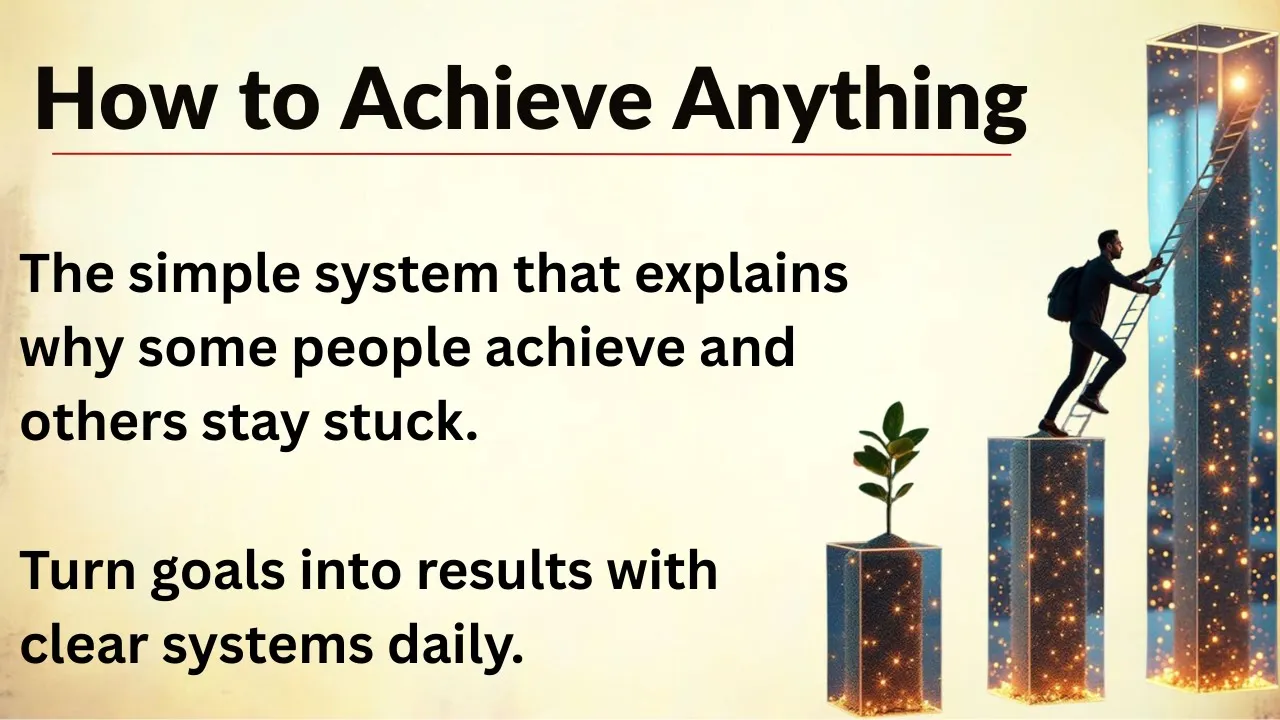
Welcome to my channel. Today I want to ask you a question that changed my entire life. Why do some people achieve anything they want while others stay stuck in the same place for years?
We all have goals. We all have dreams. We all have moments when we look in the mirror and say, "I want more.
I can do better. " And yet for most people, nothing changes. Days pass, months pass, and sometimes years pass while the goal stays in the mind but never becomes reality.
I remember feeling that confusion deeply. I had ambition. I had desire, but I didn't have a system.
I didn't have a manual. Nobody in school, nobody at home, nobody in society ever explained how achievement actually works. They just said work hard, stay motivated.
But that never answered the real question. How do you actually achieve something in life? Not just think about it, not just talk about it, but truly build it.
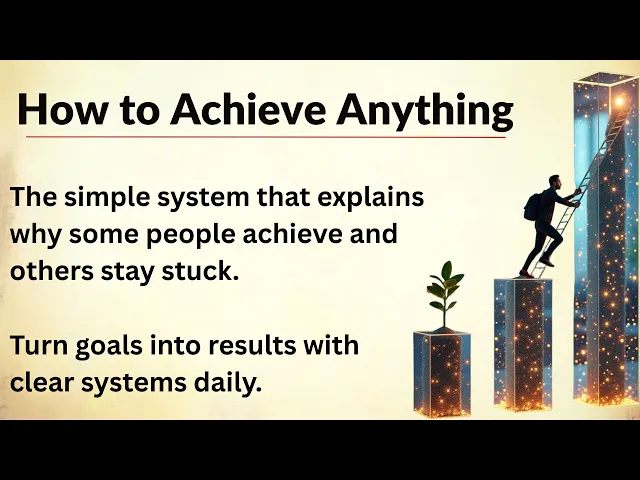
After years of searching, testing, failing, and learning, I finally discovered that achievement is not magic, and it's not luck. It's a process with four steps. And in this video, I will share them with you.
If you watch until the end, you will understand how to achieve anything and turn goals into results. And the best part, this video is also perfect for your English listening practice. So you learn two skills at the same time.
So stay with me because what you're about to learn is the manual you never got in school, the blueprint you were never given, and the system that can change everything. Let's begin. Chapter one, the mind.
Before the journey. Before you can achieve anything in the external world, you must first understand the world inside your own head. This is the invisible battlefield where dreams are either born or destroyed long before reality ever sees them.
When I began studying achievement, I made a mistake that almost everyone makes. I believed success was about effort, intelligence, and motivation. I assumed that the people who achieved great things simply worked harder or were born different.
But the more I observed, the more confused I became. Some people worked incredibly hard and still stayed stuck while others seemed to move quickly and effortlessly. So I started looking deeper into psychology, neuroscience, and behavior.
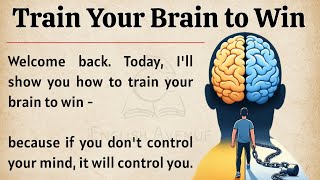
And what I found completely changed how I look at success forever. To achieve anything meaningful, you must first confront a simple truth. Your brain is designed for survival, not achievement.
The human brain evolved to keep you safe, not to make your dreams come true. Safety for the brain means predictability, familiarity, and comfort. Even when comfort is destroying your potential.
This is why when you try to start something new, you often feel fear, doubt, or hesitation. Your brain is constantly scanning for danger and it interprets any change as a possible threat. Want to start a business?
The brain imagines failure. Want to speak in English? The brain imagines embarrassment.
Want to go to the gym? The brain imagines discomfort. So before any external battle begins, there is an internal negotiation between the version of you who wants to grow and the version that wants to stay safe.
Most people lose the battle before it even properly begins. And they don't even realize there was a battle happening. The enemy is invisible.
So they think they are lazy, weak or broken. In reality, they are simply untrained. The brain uses clever strategies to block progress, not because it hates you, but because it thinks it's protecting you.
The first strategy is comfort addiction. The brain loves routines and familiar experiences. Even negative routines are preferred over uncertain ones.
For example, scrolling social media feels safer than starting a challenging project. Studying English for 20 minutes feels like work. But watching English Tik Toks feels like entertainment.
The brain chooses the comfortable option automatically unless you become aware of the pattern. The second invisible obstacle is self-doubt. The brain constantly asks, "What if I fail?
What if I look stupid? What if I'm not good enough? " These questions create emotional pressure that stops action before it starts.
The brain's goal here is not to hurt you, but to protect you from shame and rejection, two of the deepest human fears. The third obstacle is identity limits. This is one of the most powerful yet least discussed elements of achievement.
You can only achieve according to who you believe you are. If your identity says I'm not a business person, you will not build a business. If your identity says I'm bad at languages, you will not speak confidently.
The identity always wins against the outcome. This is why so many people can want a result but still never take action toward it. Their identity rejects the outcome.
Finally, there is past conditioning. The quiet influence of past experiences, family expectations, culture, and childhood patterns. Many people don't realize they are still acting according to rules they never chose.
For example, maybe you were told not to take risks or that success is for other people or that you should avoid failure at all costs. These ideas become mental software that runs automatically in adulthood. Now let's make it practical for a moment.
Think about three things you wanted to do in the last year but didn't do. Maybe going to the gym, improving your English, building a side income, waking up early, writing a book, or learning a skill. Notice something.
The reason you didn't do them is not because you didn't want them. Wanting was never the problem. The problem was the internal resistance that existed in the mind before any action could happen.
Once you see this, something important becomes clear. You're not broken. You're untrained.
No one taught you how to negotiate with your brain. No one taught you how to overcome survival instincts. No one taught you the psychology of achievement.
Not in school, not at home, not in society. Achievement at its core begins in the brain before it happens in reality. If the brain rejects the goal, the body will never act.
If the identity rejects the outcome, the habits will never align. If the comfort system wins, the dreams lose. This is why understanding your inner world is not optional.
It is the starting point of all success. Chapter 2. The system of clarity.
How can you achieve something if you don't know exactly what it is? This is the first real challenge of achievement that almost nobody talks about. Most people assume they know what they want.
They say things like, "I want success. I want more money. I want to improve.
I want to be happier. I want to change my life. " These statements sound motivating, but they are not real goals.
They are wishes floating in the air. A wish is not a decision. A decision has shape, direction, and definition.
Without clarity, the brain cannot guide you. And without guidance, you cannot move. We currently live in what I call a confusion culture.
We consume motivational videos, self-help books, and inspirational quotes, but we rarely translate desires into specifics. People want success, but they don't define what success means for them personally. They want to get in shape, but they never decide what body, weight, or habit that means.
They want to learn English, but they don't decide how much, for what purpose, or by when. Confusion feels safe because it allows dreaming without accountability. No decision means no failure, no embarrassment, and no responsibility.
But confusion also means no progress. Here's a rule that changed my life. Life rewards the decided.
The moment you make a clear decision, reality begins to reorganize around it. A decided person notices opportunities that a confused person would never see. A decided person takes action that a wishful thinker postpones forever.
The brain loves clarity. It needs clarity. The brain cannot build behavior around vague desires.
It can only build behavior around specific instructions. So, how do we turn dreams into decisions? First, we define goals using simple, concrete language.
Forget complicated frameworks for now. Forget perfection. Clarity is about removing fog, not writing a perfect business plan.
For English learners especially, simplicity is power. Here are examples across different areas of life. Fitness, not I want to get fit, but I want to go to the gym three times per week for 45 minutes.
Financial, not I want more money, but I want to earn an extra $300 per month from online work. learning, not I want to improve my English, but I want to speak English for 15 minutes every day. Discipline, not I want to be more productive, but I want to wake up at 7 a.
m. on weekdays. Notice how the brain immediately knows what to do with the second version.
There is no mystery. There is no fog. There is only instruction.
Now, let's make this chapter interactive for you. Take a moment and do this small exercise. Write one goal for the next 30 days in one sentence.
You don't need to show it to anyone. You don't need to make it perfect. Just write it.
Here's a simple template you can use. For the next 30 days, I will pause for a moment and actually do it because this chapter isn't about information. It's about transformation.
Something powerful happens when you write a goal. Many people don't know this, but the brain treats written decisions more seriously than spoken or imagined ones. When a goal leaves your mind and enters the physical world, even through ink or typing, it becomes more real.
It shifts from fantasy toward commitment. This is the moment where identity begins to change. You are no longer just someone who wants.
You become someone who decides. To understand this better, imagine two characters, the dreamer and the decider. The dreamer is full of imagination.
They have ideas, plans, hopes, and energy. They talk about changing their life one day. They feel inspired often, but almost nothing in reality changes.
The decider on the other hand may not even be as inspired but they make decisions. They say I will do X by Y. The decider writes things down, breaks goals into actions and moves forward imperfectly.
After 6 months, the dreamer still has dreams while the decider has results. It might surprise you, but many people procrastinate not because they are lazy, but because they are unclear. The brain cannot begin what it cannot define.
When there is no clarity, procrastination becomes automatic. This is why one of the most powerful sentences in this chapter is clarity destroys procrastination. Once you know exactly what you want, the next steps begin to appear almost naturally.
By now, you should start to feel a shift. The first chapter explained why achievement fails before action. This chapter showed how achievement begins with clear direction.
Now you have the foundation. The next question becomes, how do we turn clarity into movement? How do we convert goals into behavior, habits, and visible progress?
Chapter 3. The architecture of action. There is a quiet difference between dreamers and achievers that most people never notice.
Dramers talk about outcomes. the body they want, the business they imagine, the language they hope to speak, the life they wish to live. Achievers talk about inputs, the workouts, the hours, the practice, the repetitions, the daily steps.
Dramers live in results. Achievers live in processes. This is why the achiever moves forward even when motivation disappears.
They are not waiting for inspiration because they already have a system. Achievement is not magic. It is architecture.
It is something you build layer by layer, brick by brick. Once you have clarity about what you want, the next step is translating that clarity into consistent action. Here is where most people collapse.
They know what they want. They feel motivated for a moment and they even make promises to themselves, but their daily life never changes. Why?
Because goals happen in the brain but results happen in the calendar. If the goal does not enter time, it does not enter reality. So we need a structure.
Let's start with a simple idea. I call the input tracking method. Instead of tracking outcomes, you track behaviors.
Instead of asking, "Did I lose weight? " you ask, "Did I exercise today? " Instead of asking, "Did my English improve?
" you ask, "Did I speak English today? " Outcomes are slow and unpredictable. Inputs are immediate and controllable.
A business does not grow every day, but working on it can happen every day. Your body does not change every day but training can happen every day. A language does not transform every day but practicing can happen every day.
Inputs are where power lives. Now let's talk about time. Every human receives the same 24 hours per day.
Billionaires do not get 26. Olympic athletes do not get 30. Students, workers, artists, entrepreneurs, all receive 24.
The difference isn't time itself. It's how time is divided. From studying high performers across fields, I noticed that life can be divided into four time zones.
One, build time. Time spent creating the future you want. Projects, business, training, content, investment, practicing.
Two, learn time. Time spent expanding skills and knowledge, reading, courses, language learning, research, mentoring. Three, maintain time.
Time spent keeping life functioning. Work, cleaning, cooking, errands, communication. Four, kill time.
Time lost to pure dopamine and distraction, scrolling, gossip, random entertainment, pointless browsing. Most people spend their life in maintain time and kill time, working to survive and escaping to avoid discomfort. Achievers shift their life toward build time and learn time.
It is not about working harder. It is about redirecting hours. If you take just 90 minutes per day from kill time and move it into build time, your life will look completely different in one year.
Distraction is the silent killer of modern achievement. The brain is designed to chase dopamine and the digital world gives infinite dopamine with zero effort. Scrolling replaces thinking.
Notifications replace intentions. Entertainment replaces creation. The brain begins to prefer easy rewards over meaningful challenges because the easy rewards are available in seconds.
If you feel guilty about distraction, stop. Your brain is simply doing what it was trained to do. But understand this, the world will happily consume your attention for profit if you do not protect it for your goals.
This is where the idea of deep work becomes essential. Deep work is focused, uninterrupted time dedicated to a meaningful task. No switching, no checking, no multitasking.
Most real achievement happens during deep work. The book chapters, the business plans, the workout sessions, the studying, the building. 1 hour of deep work can produce more progress than 5 hours of scattered activity.
If you protect even 60 minutes of deep work each day, you will outperform almost everyone. To see how powerful time division is, imagine two people with the same 24 hours. Person A wakes up, scrolls for 40 minutes, goes to work, comes home tired, watches videos during dinner, scrolls in bed, and wonders why life feels stuck.
Person B wakes up, protects 1 hour of deep work before work, listens to learning content on the commute, dedicates 30 minutes to skill practice in the evening, and relaxes later with intention, not escape. Same 24 hours, same life conditions, completely different outputs. Achievement is not only about ability.
It is about allocation. Now let's make this practical. Take one of your goals from chapter 2 and do three things today.
One, define the input. The daily or weekly behavior that creates the result. Two, schedule the input.
Decide when it happens. If it is not in time, it does not exist. Three, track the input.
Mark it done. Do not trust memory. This simple system can change your life faster than motivation ever could because motivation fades, but systems survive.
Here's the motivational spike of this chapter. Your 24 hours decide everything. Not your talent, not your background, not your intelligence, your 24 hours.
You are not competing against other people. You are competing against your own allocation of time. Chapter 4.
The final barrier. Belief, persistence, and identity. Most people don't fail at action.
They fail at belief. They start something with excitement, take action for a few days or weeks, and then slowly collapse back into old patterns. When you ask them why, they often say things like, "I lost motivation," or, "Life got busy," or, "I just couldn't stay consistent.
" But beneath those surface level explanations lives the real reason. They did not believe they could become the person who succeeds. Without belief, action has no root, no stability, no protection.
Action might begin the journey, but belief decides whether the journey continues. We need to understand something important. Belief is not a mysterious emotion you are born with.
Belief is a skill. And like any skill, it can be trained. Professional athletes aren't confident because they are special.
They are confident because they have evidence. A musician who practices every day believes in themselves because they have seen improvement. A language learner who speaks daily begins to believe because they hear progress.
Belief is built from evidence, not imagination. If you try to build confidence without evidence, it crumbles. If you build evidence without confidence, it eventually grows.
The order matters. Evidence, however, is built through repetition. Not one day of repetition, not one week, but boring repetition.
The quiet, unexciting, unglamorous kind. This is the part nobody wants to talk about. Mastery is not fireworks.
Mastery is routine. You don't learn a language by feeling inspired. You learn it by repeating vocabulary when it feels boring.
You don't build a business through excitement. You build it through refining offers, answering messages, sending emails, and showing up on days where nothing seems to work. You don't transform your body in the first three gym sessions.
You transform it in the sessions where you don't want to go but go anyway. This is why belief is so tied to persistence. The world tells a romantic version of achievement as if success happens suddenly or because of talent or because of passion.
But if you ever study real achievers, athletes, creators, entrepreneurs, inventors, scientists, you notice a pattern. They kept going after everyone else stopped. Their genius wasn't intensity.
It was continuation. Let me tell you a simple story. Imagine two musicians beginning their journey at the same time.
Both are talented, both are motivated, both love music. For the first month, they practice every day. Their progress is similar.
But in month two, life becomes normal again. Music isn't new anymore. Motivation drops.
Music now requires discipline. The first musician quietly fades away. They still love music, but they only play when they feel inspired.
The second musician continues, "No drama, no big announcement, no new year, new me, just repetition. After 3 months, they are slightly better. After 6 months, noticeably better.
After one year, they are on a different planet. " People say, "Wow, they are so talented. " But talent wasn't the difference.
Persistence was. There is a powerful concept here. Build in silence.
Show in results. Not everything needs to be posted, shared, or announced. When you constantly tell people your plans, you trick your brain into feeling progress before progress happens.
It gives you dopamine without action. Protect your dream. You don't need approval at the start.
Approval comes at the end. Silence protects belief because it keeps the pressure low and the focus internal. The final transformation of achievement is identity.
You must shift from being the person who talks about change to being the person who builds change. From I want to I am becoming. Identity is the engine behind consistency.
When you identify as someone who practices, you don't need motivation to practice. When you identify as someone who builds, you don't need inspiration to continue building. When identity and action align, life becomes much simpler.
And here is the empowerment moment of this chapter. You do not need permission. You do not need perfect conditions.
You do not need talent. You need persistence. The world eventually respects the person who continues.
Now let's close the ark of this entire system. Chapter 1. Taught that achievement begins in the brain.
Battling comfort, fear, identity, and survival instincts. Chapter 2 taught that clarity turns dreams into decisions. Chapter three taught that systems and time transform decisions into action.
And this chapter taught that belief and identity ensure action continues long enough to become reality. If you felt something shift while watching this, then don't keep it to yourself. Like, comment, and subscribe so you stay connected and so this message reaches more people like you.
People who are ready to build instead of just dream. I make videos for English learners who want to improve their mind, their discipline, their habits, and their life. If you want more content about achievement, mindset, success, psychology, and language learning, you're in the right place.
Join this community of builders, people who take the system and actually apply it. Your journey doesn't have to be lonely, and it doesn't have to be confusing. Thank you for spending this time with me.
I'll see you in the next video.