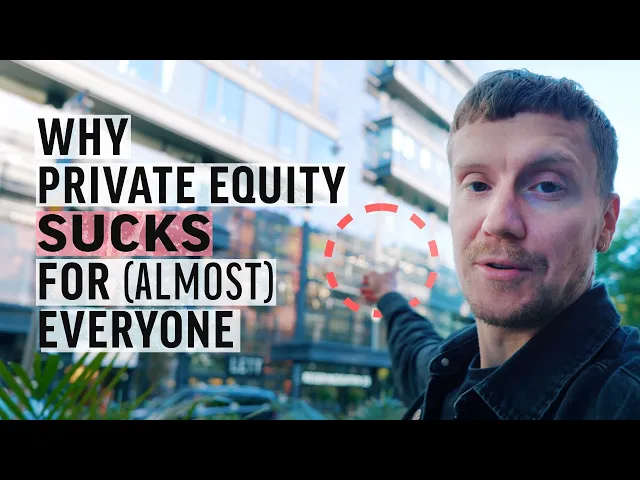
The Private Equity company that sits in that office building right over there, has created almost as many dollar billionaires as the whole country of Finland. Private equity firms are everywhere. Almost everything we consume has been touched by private equity at some point in the value chain.
Despite that, very few people in the public even know what private equity is. In this building right over here, there used to be a for-profit school called John Bauer. John Bauer belonged to a corporate school group that in 2008 was acquired by Danish private equity firm Axcel in a so-called leveraged buyout.
And five years later, the school filed for bankruptcy, leaving 1,000 teachers without a job and 11,000 students without a school. Private equity has been described as capitalism on steroids and has attracted a lot of criticism over the years. After the John Bauer bankruptcy, even the somewhat neoliberal Swedish finance minister Anders Borg criticized private equity.
But despite criticism and scandals, private equity is today more powerful than ever and continues to shape our society. So let's talk about private equity. If you use the term "private equity", you could technically be talking about many different things.
But what I will talk about in this video, and what most people refer to when they say "private equity" is so-called leveraged buyouts or LBO's that are made by private equity funds. Let me explain what that means. The private equity firm knocks on the door of wealthy investors with a lot of money.
For example, sovereign wealth funds, pension funds, universities, etc. And then they convince these investors that the private equity firm can give better returns on their money than other investments, such as public stocks. And to create better returns, the private equity firm takes investors money, then borrows even more money from a bank, and then uses all of this money to buy out a "target company" that the private equity firm believes hasn't achieved its full potential.
And once the private equity firm has acquired the target company, the magic starts. The private equity firm puts some of its "magic PE sauce" on the company and et voilà: after five years or so, it will be able to sell the target company to a much higher price, making the investors, but most of all themselves, very rich. So what is inside this magic PE sauce.
How does a private equity firm extract value from the companies that they buy out? Well, each separate private equity firm has its own secret recipe, but normally they can be boiled down to three main ingredients. Ingredient number ONE: life changing rewards.
To add sweetness to the sauce, the private equity firm promises the company's management and themselves life changing bonuses if they meet certain thresholds. This ensures that the bosses will work extremely hard to extract value from the target company. Ingredient number TWO: back breaking debts.
To add some bitterness to the sauce, the private equity firm makes the target company responsible for all of the back breaking bank debt. Ingredient number THREE: full control. To provide texture to the sauce, the private equity firm takes control of the target company to impose super smart management techniques.
Let's try to understand these three ingredients of the magic PE sauce a little bit better. And let's try to think about the consequences of these ingredients. Right now I'm walking in what some people would call the true epicenter of Swedish finance.
Behind that building, we have the Swedish Central Bank. A bit further down there, we have the headquarters of Spotify. Close to that, we have the law firm where I used to work, but more importantly, in that office building right over there, we have the headquarters of private equity giant, EQT.
EQT is, by some measures, the world's fourth largest private equity firm. It's so immensely successful that it has, since its IPO created 4 (possibly 7) dollar billionaires. Just as a reference, the whole country of Finland has 7 million billionaires and just this company has 4 (possibly 7) of them.
And to get a sense of how much money a dollar billionaire has, if you earn an average Swedish salary, you'd have to work 23,000 years to earn $1 billion. How come a handful of people who are partners of private equity firms get so immensely wealthy? The answer to that is simple.
As the recipe prescribes, the magic PE sauce must include life changing incentives, which means that the fees that private equity firms charge must be out of this world. First, the private equity firm charges an annual management fee, usually 2% of the money that the investors put into the fund. This is a fee that they get irrespective of how the fund performs.
Second, the private equity firms also charge a performance based fee, which is for some reason called a carried interest. This performance based fee is usually 20% of the profits that the funds make. And in addition to the management fees and their carried interest, many private equity firms also charge the target companies that they buy various fees with creative names such as deal fees, service fees and advisory fees.
As if all of those fees to the private equity firm wasn't enough, there's a lot more that the investors have to pay for. Leveraged buyouts (LBO's) are really complex transactions, and private equity firms don't know how to do them. So they take in hordes of extremely expensive consultants to do the transaction for them.
Lawyers, management, consultants, bankers, accountants, etc. all billing handsomely by the hour. If you average out all of these fees that the investors have to cover, you'll find that investors have to pay between six and 7% to invest in private equity.
To compare, hedge fund investments cost around 4%. Active mutual funds are on 2% of passive mutual funds, less than 1%. If you have capital to deploy, private equity is an extremely expensive way to do it.
So why do investors such as our pension funds, still invest in private equity? Why do they accept that so much of their money goes into the pockets of a few private equity partners and all of their consultants when there are cheaper investment options. Surely that must be because private equity clearly outperforms everything else that is out there?
And for sure, the private equity firms and their lobby organizations such as the AIC and the SVCA will tell you that, yes, private equity does outperform other investments and that the life-changing fees private equity firms are charging are not only worth it, they are a key reason for why private equity firms perform so well. Also the consultants who bill by the hour to enable the buyouts, i. e.
the lawyers, the bankers, the accountants, the management consultants etc. will gladly attest to how much value private equity firms can create. But many independent experts are quite certain that private equity does not clearly outperform all other asset classes.
The University of Oxford Professor of Finance, Ludovic Phalipou and several others makes the case that private equity funds do not clearly outperform other asset classes. Instead, private equity has given investors performance that more or less matches the public stock market indexes. And if that is true, then anyone who invests in private equity will pay around 7% per year when they could have paid below 1% per year for a similar return.
But even if private equity would clearly outperform other asset classes, I still find it difficult to accept that these fee levels are necessary. Should we really believe that private equity partners wouldn't go to work unless the investors, i. e.
our pension funds, give them billions of dollars in fees? Clearly, there is something foul about the incentive ingredient in the magic sauce. But unfortunately, also the other two ingredients smell a bit funky.
When private equity firm Axcel bought the John Bauer School Group. They loaded it up with a mountain of debt. Immediately after the acquisition, John Bauer had to start paying huge sums in interest to service this debt.
And as long as John Bauer kept expanding as much as Axcel had expected and projected, everything was fine. But when John Bauer no longer was able to attract as many students and failed to increase revenues, things got tough. John Bauer had to start cutting costs to afford its interest payments, and scandals soon started piling up.
And in 2013, John Bauer had to file for bankruptcy. Remember that back breaking debt is a key ingredient in the magic PE sauce. The private equity firm borrows around 80% of what it costs to buy a company and makes the company responsible for that debt.
And why do they do that? Well, this debt or leverage increases the private equity firm's potential return on investment. In other words, how much profits they can make.
But the debt also serves other purposes. First, it lowers the target company's tax liability. Second, it supposedly makes the target company more disciplined.
The company must keep its costs low and revenues high in order to afford the debts. Otherwise, it fails. But this debt that the private equity firms load onto its target companies also makes the target companies much more vulnerable, increasing the risk of failure, which is what happened to the John Bauer School Group.
The beautiful thing for private equity firms is that when that happens, i. e. when the target companies that they've bought out succumb to their debt obligations, it's not the private equity firms responsibility to repay any of that debt.
When their investments do well, the private equity firms reap astronomical gains. But when their target companies fail, the true losses fall mainly on other stakeholders. The company's employees, its customers, its suppliers, its creditors and the community at large.
A fate that John Bauer's teachers and students had to experience firsthand. The third ingredient in the magic PE sauce is that the brilliant private equity partners take full control of the target company so it can unlock value thanks to the private equity firm's superior management skills. But it should go without saying that a private equity partner with little or no experience from a particular industry cannot improve the actual products or actual services of a target company.
All this private equity partner, this glorified financial intermediary, can do for its target company is to deploy the bluntest instruments that capitalism has to offer. The private equity firm helps the target company cut costs through layoffs, offshoring, and asset stripping. And, the private equity firm helps the target company increase revenues by deploying state of the art methods for pricing increases.
In other words, what private equity firms do is to help target companies focus more on financial engineering and consumer exploitation and less on improving the company's products and services. Or, as author Matt Stoller has expressed it: private equity firms act as disease vectors for price gouging and legal arbitrage. But to extract value from the target companies.
Some private equity firms are not satisfied with only firing people and raising prices. Some private equity firms have bigger plans for the target companies. Market domination.
This is Ryds Bilglas, a Swedish car glas repair chain. This chain was founded in the 50s and was in 2016 acquired by the private equity firm Nordic Capital in a leveraged buyout. Immediately after the acquisition, Ryds Bilglas initiated its strategy of market domination.
When a private equity firm acquires a company on a fragmented market, i. e. a market where there is a lot of competition, then the private equity firm will inevitably try to destroy as much of that competition as it can, so that it can start raising prices.
After Nordic Capital took over at its big loss, it initiated a wild shopping spree, acquiring on average one new company per month. In theory, our competition and antitrust laws should prevent the private equity companies from going too far in their attempts to destroy competition. But in practice, the private equity companies can often get around the competition authorities with the help of "stealth consolidation", as the University of Chicago professor Thomas woman has called it.
"Stealth consolidation" is possible when each separate acquisition is small enough to fly under the competition authorities radar. Either the authorities are clueless as to what's going on, or they lack the weapons to defend - something that is particularly common in the retail sector. The private equity firms have also with some help from their lawyers, built a whole nomenclature to obfuscate the true purpose of their consolidation strategies.
Private equity doesn't monopolize, it acquires a platform and then makes add-ons and bolt-ons and tuck-ins. Private equity doesn't destroy competition. It makes the market more efficient.
And private equity doesn't do price increases. It does margin expansions. If and when the competition authorities finally wake up to what private equity has been doing below its radar, it's often already too late.
After a few years of extremely aggressive consolidation, in Nordic Capital last year floated Ryds Bilglas in an IPO. And in the IPO prospectus, Ryds Bilglas even brags about its successful stealth consolidation and how it has created market entry barriers that will make it difficult for small competitors to stay relevant on the market. The car glas industry is just one example, but the same dynamic of aggressive private equity consolidation is playing out across a multitude of industries right under the nose of our competition regulators.
While many competition authorities, including the Swedish Competition Authority, show little or no interest in seriously scrutinizing aggressive private equity consolidation, a seismic shift actually take place right now in the United States, of all places. Jonathan Kanter, head of the competition department at the U. S.
Department of Justice, has said in an interview that the private equity firms' business model of rolling up industries often is very much at odds with the law and very much at odds with the competition we're trying to protect. Also, Lina Kahn, who leads the U. S.
Federal Trade Commission, has signaled a readiness to take on anti-competitive practices by private equity firms. During the last 30 years or so, we've let glorified financial intermediaries spread its magic PE sauce all over our society, and it's getting clearer and clearer, at least to me, that the ingredients of this magic PE sauce are pretty foul. Full disclosure: during my career as a lawyer, I've worked for law firms that obviously represent the private equity industry that I lament in this video.
And some of my best friends still work for the private equity industry, directly or indirectly. The funny thing is that the people I know who work for private equity, are the most brilliant and hardworking people that I know. And I believe that this is actually a problem.
It is a problem that the most brilliant and hardworking people in our society wants to work for financial intermediaries that shuffle companies and money around, instead of creating something new. But given the money in private equity, who can blame anyone for wanting to work for that industry? Thank you very much for watching my video about private equity.
To be honest, criticizing private equity is probably not the best business decision I've ever made. But, my goal with The Market Exit is not to get private equity sponsors but to do independent videos that speak truth to power. If you want to help me stay independent and help me make more videos like this you can become a Patreon at patreon.
com/themarketexit To the Patreons that I already have: thank you for believing in this channel even though I just got started. Your support means a lot to me. If you want to know more about private equity, I would recommend Ludovic Phallipou's book "Private Equity Laid Bare".
A really good book that's actually fun to read. And I would also recommend the podcast "Capitalisn't", hosted by Luigi Zingales and Bethany McLean. It's probably one of the best podcasts on economics out there.
And they have some solid episodes about private equity. That was it for this video, see you in the next one. Bye Bye.