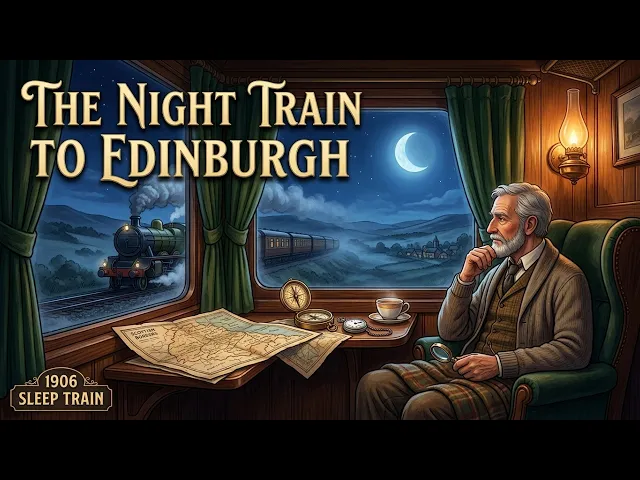
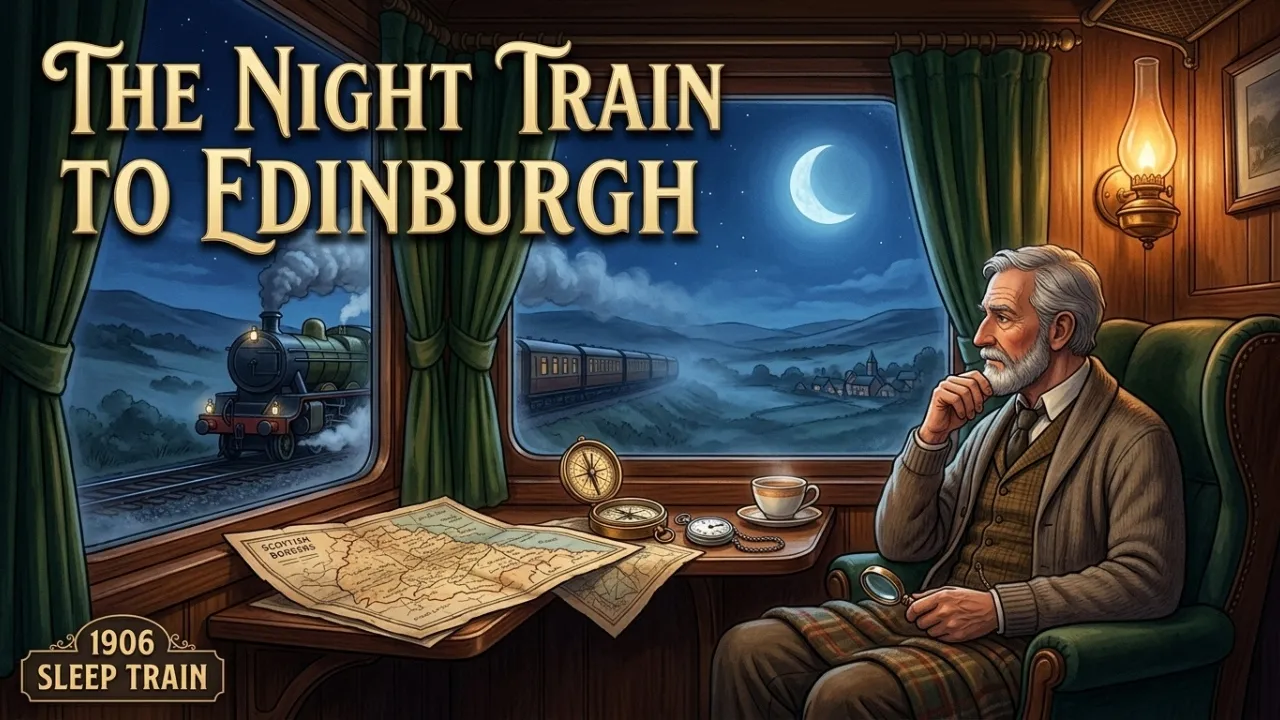
Welcome to Edwardian Sleep Stories. Before tonight's journey begins, let me know where you're listening from. Now, settle in. Let your shoulders soften. Let your breathing slow and allow the day to drift quietly away. Tonight we travel to London in November of 1906 to King's Cross Station where gas lamps glow beneath the great iron roof and a sleeper train waits in the steam, ready to carry its [music] passengers north Through the dark. Among them is Arthur Pembbury, a retired ctographer of 64, traveling to Edinburgh with one leather bag, one brass compass, and a heart still learning
how to find its bearings. He expects only the quiet comfort of a sleeping compartment, the rhythm of the rails, and the long darkness between London and Scotland. But somewhere after midnight, beneath a sky newly filled with stars, he meets Claraara Mossley, an astronomer traveling north with her Own maps of light. This is the story of Arthur Pembbury and of one winter night on the Edinburgh Sleeper when a man who spent his life mapping the land discovers that some of the most real places [music] cannot be measured, named, or drawn. So close your eyes, breathe gently,
and let the train carry you north through steam, starlight, and sleep. The last light of the afternoon had already failed by the time Arthur Pembbury arrived at King's Cross. It was 4 on a Friday in the second week of November 196, and London had spent the day under a sky the color of old puter, a low, heavy, featureless sky that had never quite managed to produce rain, but had succeeded with characteristic English determination in making everything beneath it feel damp. The gas lamps along Houston Road had been lit since 3:00, and they cast their amber
circles Onto the wet pavement, where the reflections trembled in the film of water like small, uncertain flames, struggling to stay alive. King's Cross Station rose before him, its great arched facade of yellow London brick darkened by decades of soot. its twin round windows glowing faintly from within like the eyes of an enormous patient creature watching the city go about its business. Handsome cabs and motor cars jostled at the entrance. The Old world and the new, Arthur thought, still negotiating the terms of their coexistence. And porters in dark uniforms moved through the crowd with the practice
efficiency of men who had learned to carry other people's burdens without comment. Arthur paid his cabman, collected his single piece of luggage, a leather gladstone bag of considerable age and modest size, its brass class polished to a dull gleam, and walked Through the entrance into the station. He was 64 years old, a man of medium height and lean build with a face that had been weathered by years of outdoor work into something that resembled in its lines and contours one of the maps he had spent his life making. His hair, once dark, was now entirely
white, cut short and brushed back from a high forehead. His eyes were gray, a clear, observant gray that missed very little. And behind a pair of wire rimmed Spectacles, they carried the particular expression of a man who had spent decades looking at things very carefully, and had developed, as a consequence, the habit of seeing more than most people saw. He wore a dark charcoal wool overcoat over a three-piece suit of navy blue surge, a white cotton shirt with a stiff turned down collar, and a burgundy silk neck tie knotted with the precise unshowy competence of
a man who had been tying The same knot for 40 years. On his head, a dark gray felt Hamburgg hat. on his feet, black leather Oxford shoes that had been resold twice and polished that morning. In his left hand, the Gladstone bag. In his right hand, a mahogany walking stick with a brass fereral carried not out of infirmity, but out of habit. It had been his father's, and before that, his grandfathers. And Arthur Pembbury was a man who believed that some things should be carried Forward. He had retired 18 months ago from the Ordinance Survey
where he had served for 41 years, the last 12 as principal cgrapher for the northern counties. In that time he had walked more than 15,000 m of English, Scottish, and Welsh countryside, measuring, triangulating, sketching, and recording the shape of the land with an accuracy that left no hedro uncharted, no stream unnamed, no contour line misplaced by more than the width of a pencil stroke. The interior of King's Cross was vast and echoing, a cathedral of iron and glass and steam. The great arched roof soared overhead, its ribs of rot iron curving upward into the gloom
where the gas lamps could not quite reach. And between the ribs, the glass panels, many of them grimy with the accumulated soot of half a century of locomotive smoke, let in what remained of the November daylight, which was very little indeed. Below this roof, the platforms stretched Away in parallel lines, each one a river of activity. Passengers hurrying toward their trains. Porters wheeling trolley stacked with luggage. Newspaper boys calling out the evening editions. And everywhere threading through the human noise like a bass note beneath a melody. The sound of steam. The hissing sighing breathing sound
of engines at rest. Their boilers ticking. Their pistons still. their great iron bodies gathering strength for The journeys ahead. Arthur consulted the departure board, the 915 night express to Edinburgh, calling at Peterbr, Grandantham, [clears throat] York, Darlington, Newcastle, and Beric upon Tweed would depart from platform 3. The sleeping car was at the rear of the train. He had 40 minutes. He bought a newspaper, the Times, as he did every Day without variation, and a small paper bag of peppermints from the kiosk beside the ticket office. And then he walked without hurry along the platform toward
the rear of the train. The locomotive was a Sterling single. Or perhaps not, Arthur corrected himself. The Great Northern Railway had moved on from Sterling's designs, and this engine with its larger boiler and more modern lines was likely one of Ivat's Atlantics, a class of engine that Arthur admired for Its clean proportions and quiet efficiency, much as he admired the same qualities in a well-drawn map. The engine stood at the head of the platform, breathing softly. a thin column of white steam rising from its safety valve into the cold November air. Its paintwork, the deep
green of the Great Northern Railway, lined out in gold, gleamed under the platform lamps, and the brass fittings on the smokebox door and the handrails caught the light And threw it back in small, warm sparks. Arthur paused to look at the engine as he always paused to look at engines. Not because he was a railway enthusiast in any systematic sense, but because he believed that any machine capable of carrying human beings through the night at 60 mph across 390 m of countryside deserved a moment of respectful attention. He noted the number on the cabside, 251,
and filed it away in the part of his Memory that stored such things, the part that also contained the heights of mountains, the lengths of rivers, and the precise location of every trigonometric station in Northland. Then he turned and walked along the platform toward the sleeping car. The sleeping car was a 12-w wheeled vehicle built by the Northeastern Railways workshops at York, and it was, Arthur thought, as he approached it, a rather handsome thing. Its body was panled in Teak, varnished to a rich dark brown that glowed warmly under the platform lamps, and its sides
were lined with windows, small square windows, each one curtained in dark green fabric that gave it the appearance of a very long, very narrow country house lying on its side. The roof was a smooth curve of painted canvas, and the running boards below the doors were edged in brass, and the destination board mounted above the nearest door red in cream letters on a Chocolate brown background. King's Cross, Edinburgh, Waverly. Sleeping car. A sleeping car attendant stood beside the door. a tall, thin man of perhaps 50, immaculate in a dark navy uniform with brass buttons, a
peaked cap, and white cotton gloves. He held a clipboard in one hand and a lantern in the other. And he greeted Arthur with the particular blend of difference and authority that is the mark of a man who understands that his role is to make Other people comfortable while maintaining at all times complete control of his domain. Good evening sir. Name please. Pembry Arthur Pembrey compartment 6. The attendant consulted his clipboard, made a small, precise tick with his pencil, and stepped aside. Compartment 6. Yes, sir. Third door on your left. I'll bring your tea at 7,
unless you'd prefer earlier. 7 will be perfect, Arthur said. Thank You. The corridor of the sleeping car was narrow, barely wide enough for two people to pass without turning sideways, and it was panled like the exterior in dark polished wood, though here the wood was mahogany rather than teak, and it had been finished to a high shine that reflected the gas light from the small brass fittings on the walls. The floor was carpeted in a deep maroon, thick enough to absorb footsteps, and The air smelled of furniture polish, clean linen, and the faint, pervasive, not
unpleasant, smell of coal smoke that permeated every railway carriage in England. Arthur found compartment 6 and opened the door. The compartment was small, 6 ft long, and perhaps 4 ft wide, but it contained everything a person might need for a night's journey. There was a bed already made up, running lengthwise against the outer wall, covered in white linen sheets and a dark Green wool blanket. There was a pillow, plump and freshly cased. There was a small fold down shelf beneath the window on which sat the carff of water and a glass. There was a brass
hook on the back of the door for hanging clothes and a small mahogany cabinet beside the bed with a mirror mounted on its inside door. The window, which looked out onto the platform, was fitted with a green curtain on a brass rail, and beside it, At the head of the bed, was a small gas lamp with an adjustable flame mounted in a brass gimbal so that it would remain level regardless of the motion of the train. Arthur set his Gladstone bag on the bed, removed his Hamburgg hat, and hung it on the brass hook, and
sat down. The compartment, despite its dimensions, did not feel cramped. It felt, Arthur thought, like a well-designed cabin on a ship, compact, efficient, every surface serving a purpose, every fitting placed With care. He had slept in many such compartments over the years during his long career with the Ordinance Survey when the work of mapping the northern counties had required frequent journeys between London and the field offices in York, Newcastle, and Edinburgh. He knew the particular comfort of a sleeping car. The way it enclosed you, wrapped you in its narrow warmth, rocked you with the rhythm
of the rails, and carried you through the night while you Slept, so that you woke in the morning in a different place, a different landscape, as though the hours of darkness had been not merely time, but distance, not merely rest, but transformation. He opened the Gladston bag and unpacked with the methodical care of a man who had packed and unpacked the same bag a thousand times. His night shirt, white cotton, plain, folded with military precision. His shaving kit, a leather Roll containing a razor, a brush, a cake of soap, and a small hand mirror. His
slippers, brown leather, soft sold, a book. This evening, it was Stevenson's kidnapped, which Arthur was rereading for the fourth time because he believed that a good book, like a good map, revealed new details with each reading. And finally, wrapped in a square of oil cloth at the bottom of the bag, a brass compass, not a surveyor's instrument, but a simple pocket compass, its needle Trembling faintly under its glass. pointing north. Always pointing north. He placed it on the fold down shelf beside the water carff as he always did when he traveled. A small ritual, a
way of knowing where he was, even in the dark. He changed out of his overcoat and suit jacket, hanging them carefully on the brass hook, and sat on the edge of the bed in his waist coat and shirt sleeves. The compartment was warm. The heating Pipes that ran along the base of the wall were already doing their work. And the warmth, combined with the snugness of the space and the soft gas light from the little brass lamp created an atmosphere of enclosure and safety that Arthur found deeply, almost childishly comforting. It was, he reflected, one
of the paradoxes of travel, that movement could feel like stillness, that the act of being carried through the night in a metal box on wheels, could produce a Sensation of peace, more profound than any he felt in his own house in Highgate, where the rooms were large and the bed was stationary, and the silence was the silence of a man alone. He had been alone since the death of his wife Catherine four years ago. They had been married for 36 years. And in that time, Catherine had been. He searched for the right word as he
always searched for the right word with the precision of a man who believed that language like Cgraphy should be accurate. Catherine had been his cardinal point, his north, the fixed reference from which all other directions were measured. Without her, the compass of his daily life still functioned, but it had lost somehow the certainty of its readings. He navigated by habit now, by memory, by the accumulated momentum of decades of routine. He was not unhappy. He was simply unmapped, Living in territory that he had not yet learned to chart. A whistle blew somewhere along the platform,
a sharp, clear note that cut through the ambient noise of the station like a penstroke across a blank page. Arthur heard doors closing one after another, a sequence of solid metallic sounds that moved along the length of the train like a wave. Each one slightly different in pitch and resonance. Each one sealing another compartment, another Passenger, another life into the body of the train. Then a pause, a held breath, and then the first movement. It was barely perceptible at first, less a movement than a suggestion of movement. A faint tremor in the woodwork, a slight
shifting of the water in the car, a barely audible change in the quality of the silence. And then the platform began to slide. Slowly, almost Imperceptibly, the lamps and the pillars and the faces of the people who had come to see the train off began to move backward as though the station itself were departing, and the train was standing still. Arthur watched through the window as King's Cross withdrew around him. the platform, the roof, the great arched facade. And then the train was out, emerging into the open air into the November Night, into the vast,
dark sprawl of London, and the gaslit streets and terrace houses, and factory chimneys began to flow past the window in a slow, continuous scroll, like a map unrolling. The rhythm established itself within minutes. The steady rocking hypnotic rhythm of a train at speed. A rhythm composed of a 100 small sounds woven together into a single continuous pulse. The wheels on the rails a paired beat. A double heartbeat. Da d d d d d d d d d d D d d d d d d d d dum dum. Regular as breathing, predictable as the tide.
The slight creek of the woodwork as the carriage swayed on its springs. The faint rattle of the water carff against the glass on the fold down shelf. The whisper of air passing along the outside of the train and beneath everything felt rather than heard the deep steady vibration of the locomotive ahead pulling its load of carriages and sleeping passengers through the night With the tireless mechanical patience of a creature that does not need to rest. Arthur sat by the window with the green curtain drawn back watching London thin and fade. The terrace houses gave way
to villas, the villas to a lotments, the allotments to open fields. And then quite suddenly the city was gone, replaced by darkness. A deep rural darkness unpunctuated by street lamps, broken only by the occasional cluster of lights that marked a village or a Farmstead. Each cluster appearing and vanishing in a matter of seconds. like a brief bright thought in a mind that was slowly drifting towards sleep. He unwrapped a peppermint and placed it in his cheek and opened his Stevenson and read by the light of the little brass lamp and the train carried him north.
At 10, there was a gentle knock on his compartment door. Yes. The door opened 6 in and the sleeping car attendant appeared in the gap. The same tall, thin Man who had greeted him on the platform, still immaculate, still gloved, his expression one of professional solicitude. We'll be stopping at Peterbr in approximately 15 minutes, sir. Would you care for anything from the refreshment room? A pot of tea perhaps or a sandwich. Tea would be welcome, Arthur said. And if there's a biscuit to be had, I wouldn't refuse one. Very good, sir. Milk and sugar. Just
milk. Thank you. I'm sorry I didn't catch your name. Fenton, sir. Thomas Fenton. Thank you, Fenton. The door closed with a soft click, and Arthur returned to his book, though he found that his attention was drifting from the page to the window, where the darkness had acquired a new quality, a faint luminescence in the east. That might have been the moon rising behind the clouds or might have been the distant glow of Peterbr or Might have been nothing at all. Just the eyes attempt to find light where there was none. The train slowed as it
approached Peterbr, the rhythm changing from the steady pulse of speed to the longer, more deliberate cadence of deceleration. The wheels seemed to sigh as they eased against the rails, and the carriage settled into a gentle rocking drift, like a boat coming into harbor. Through the window, Arthur watched the signal Lights appear, red and green jewels suspended in the darkness, and then the first platform lamps casting their amber glow across the wet stones, and then the station itself. A long low building of Greystone with a canopy of iron and glass almost deserted at this hour. The
train stopped. The silence after the hours of rhythmic motion was startling. A sudden absolute silence that felt paradoxically louder than the noise it replaced. Arthur could hear for the first time the small sounds of the sleeping car, a cough from a neighboring compartment, the creek of a bed, the footsteps of Fenton moving along the corridor, the distant hiss of the engine releasing steam, a few passengers boarded. He heard their footsteps on the platform, their muffled voices, the click and thud of doors opening and closing. And then from the compartment Next to his compartment 5, he
heard the sound of someone settling in, the rustle of a coat being removed, the click of a bag being set down, the soft exhale of a person sitting down on a bed for the first time, testing its g. Fenton arrived with the tea. A small brown teapot on a brass tray, a white china cup and saucer, a tiny jug of milk, and two shortbread biscuits wrapped in waxed paper. He set the tray on the fold down shelf with the practiced ease of a man Who had served tea on moving trains for years and had learned
to account for the slight angles and unexpected tilts of a vehicle that was never quite level. The lady in compartment 5 has also requested tea, Fenton mentioned as he poured Arthur's cup. She boarded at Peterbr and Miss Mossley traveling to Edinburgh. Arthur noted this piece of information without particular interest. He was not an unsociable man, but neither was he the sort who sought out Conversation with strangers on trains. He had learned over the years that the sleeping car was a place of private rituals. Each passenger enclosed in their compartment like a letter in an envelope,
sealed and self-contained, moving through the night toward their individual destinations. He thanked Fenton, drank his tea slowly. It was strong and hot and exactly right, and ate his biscuits with a deliberate, Unhurried attention of a man who understood that small pleasures attended to properly are not small at all. The train departed Peterbr, and the rhythm resumed. Da dum, da dum, da dam. And Arthur felt the familiar, irresistible pull of the motion. The way the rocking of the carriage seemed to synchronize with something deep in the body, something ancient and preverbal, the memory of being held
and rocked as a child. He set aside his book, turned Down the gas lamp until the flame was a small blue gold bead behind the glass, and lay back on the pillow, intending to rest his eyes for a moment. The train passed through Huntington without stopping, and the night beyond the window was very dark. the flat open darkness of the Cambridge chaffens, a landscape that Arthur knew well from his years of survey work. A landscape without contour or feature, where the sky and the earth merged at an invisible Horizon, and the only vertical elements were
the church towers and the windmills, standing like sentinels in the enormous emptiness. He did not sleep. He rested in that territory between waking and sleeping where the mind releases its hold on the day's concerns and drifts untethered among thoughts that are not quite thoughts, impressions, images, fragments of memory that surface and dissolve like bubbles in slow water. Catherine's face. The Smell of heather on a hillside in Northland. the sound of a curu calling across a mand at dusk, the particular blue of the ink he had used for 40 years to draw the coastline on his
maps. At Grantham, the train stopped again, briefly, no more than 5 minutes, and Arthur, who had not quite slept, opened his eyes and looked out at the platform. A single lamp burned at the far end, and beneath it, a porter sat on a wooden bench with a newspaper spread across his Knees, motionless, as though he were a fixture of the station rather than a person, as though he had been sitting there since the station was built and would continue sitting there until it was pulled down. The train moved on, and the flat lands of Lincolnshire
gave way gradually to the gentle rolls and swells of the countryside north of Grandanthm, where the land begins to lift itself out of the fence, and to develop the first tentative undulations that will become 200 m further north, the hills and mountains of Scotland. Arthur felt this change in the land through the motion of the train, a subtle alteration in the rhythm, a slight increase in the effort of the engine, a barely perceptible tilting of the carriage as the track rose and fell with the contours. He knew this landscape intimately. He had mapped every mile
of it, every field boundary and footpath and stream. He could close his eyes and draw it from memory. The Shape of the ridges, the curve of the rivers, the way the villages clustered in the valleys and the farms scattered themselves across the higher ground. But knowing a landscape and seeing it are different things. And seeing it from her train at night as a sequence of dark shapes and half glimpsed forms was different again. A way of knowing that was less precise but somehow more true. The way a poem is less precise but somehow more true
than A survey. It was somewhere between Grandanthm and Newark that Arthur heard the sound from the corridor. Not a troubling sound, nothing alarming or unusual, just the quiet click of a compartment door opening and closing, followed by soft footsteps in the corridor, moving toward the rear of the train. He thought nothing of it. Passengers moved about on night trains to use the lavatory at the end of the carriage or to stretch their Legs or simply because sleep would not come and the confines of the compartment had become for the moment too close. But a few
minutes later there was a second sound. The door at the end of the carriage, the one that led to the small open vestibule between carriages, opening and closing with a brief gust of cold air that Arthur felt even through the closed door of his compartment. Someone had stepped out onto the vestibule. The open platform between carriages, where the night air rushed past, and the ground was visible through the gap between the coupling, a place where the train's speed became suddenly, viscerally real. Arthur sat up. It was not his business, of course, but it was nearly
midnight, and the vestibule was cold and loud, and not a place where a person would stand without reason. And the cgrapher in him, the man who had spent his life noticing things that Other people overlooked, was curious. He put on his slippers, opened his compartment door, and stepped into the corridor. She was standing at the open vestibule door, leaning on the iron railing, looking out at the night. The wind pulled at her hair and her coat and the noise of the train, the full unfiltered roar of wheels and wind and engine, rushed past her in
a torrent of sound that made speech impossible and thought difficult, and the body aware With every nerve that it was moving through space at extraordinary speed. Arthur stood in the corridor doorway and observed her for a moment. She was young, late 20s perhaps, and she was dressed in a manner that he found practical rather than fashionable. A dark green wool traveling coat, well- cut but not new, buttoned high against the cold, and beneath it the hem of a plain gray wool skirt. Her hair was dark brown, almost black, pinned up, but Coming loose in the
wind, strands of it whipping across her face. Her boots were brown leather, sturdy, the kind worn by people who walk on uneven ground. She was not distressed. Her posture was not that of a person in trouble, but of a person in thought. Her weight settled on the railing. Her face turned toward the rushing darkness. Her eyes open and focused on something that was either very far away or very close. The way people look when they are Thinking about something that matters. He cleared his throat and she turned. "Forgive me," Arthur said, raising his voice above
the noise of the train. I only wanted to be sure you were quite all right. She looked at him with dark eyes, brown, almost black, bright with intelligence, and he thought a trace of amusement at his concern. Perfectly all right, thank you. I was looking for the Pleaides. I beg your pardon. The Pletes, the star Cluster in Taurus. They should be visible tonight. The cloud cover broke north of Grandanthm, and the seeing should be excellent this far from London, but the vibration of the train makes it rather difficult to hold a steady gaze. She paused
and then added with a directness that Arthur found both startling and refreshing. I am an astronomer. I look at stars. It is what I do. She extended her hand, an unusual gesture from a woman, but performed with Such natural confidence that it did not seem unusual at all. Claraara Mosley, I work at the Kilder Observatory in Northland. Well, I say work. I am the only woman on the staff, which means I do the work of two people, and I'm paid for the work of half of one. But the stars don't mind who's looking at them,
so it evens out. Arthur shook her hand. It was cold from the night air, but firm and introduced himself. Arthur Pembbury, retired Ctographer, ordinance survey. I drew maps for 41 years, and now I am attempting to discover what one does when one stops. And what have you discovered? That one takes the night train to Edinburgh. For no particularly urgent reason, apparently. Claraara Mossley laughed, a short surprised laugh that the wind snatched away almost before it was heard. And Arthur felt for the first time in a long time the particular satisfaction of having made a stranger
laugh, which is a different and in some ways superior satisfaction to making a friend laugh because it carries with it the element of discovery. Shall we go inside? He suggested. The dining car may still be open, and I suspect we could both benefit from something warm that is not the wind. Claraara looked once more at the sky. And Arthur, following her gaze, saw for the first time the stars, which had indeed appeared through a break in the clouds, a scattering of bright points against the velvet dark. And then she nodded and they went inside and
the heavy vestibule door closed behind them and the roar of the night was replaced by the muffled rhythmic cradling sound of the train. The dining car was three carriages ahead, and they walked through the connecting corridors together, Passing through the gentle swaying transitions between carriages where the floor shifted beneath their feet, and the coupling chains rattled softly, and the cold air leaked in through the gaps in the bellows. The corridors of the other carriages were dark and quiet. Most of the passengers had retired for the night, and the compartment doors were closed, and the only
light came from the small gas jets mounted at intervals along the ceiling, turned down To a dim blue flame that gave just enough illumination to navigate by. The dining car, when they reached it, was nearly empty. It was a beautiful space, longer than the sleeping compartments, with tables set along both sides beneath wide windows. Each table laid with a white linen cloth, a small vase containing a single artificial flower, and a shaded table lamp with a cream silk shade that cast a warm intimate circle of light. The walls were panled In walnut, and the ceiling
was painted cream. and the brass luggage racks above the windows gleamed softly. And the overall effect was of a very good, very small restaurant that happened to be traveling through the English countryside at 50 m an hour in the dark. A steward appeared, a young man with red hair and a serious expression, and seated them at a table near the center of the car. He produced two menus, though the offerings at this hour were Limited. Tea or cocoa, sandwiches, coal pie, and biscuits. Tea, please, Claraara said. And a sandwich if there's one to be had.
The same, Arthur said. Thank you. They sat across from each other at the lamplit table, and the train rocked them gently, and the darkness flowed past the windows on either side like water. And Claraara Mosley told Arthur Pembbury about stars. She told him about the observatory at Kilda, which was not, she acknowledged, one of the great Observatories of the world. Not Greenwich, not Jodreil, not the great telescopes of the American West, but which had one advantage that none of those famous institutions could match. Darkness. The forests of North Thumberland were the darkest place in England.
She said the nearest town of any size was 20 m away, and the nearest city, Newcastle, was 40. And on a clear night, standing at the dome of the small observatory above the treeine, you could See the Milky Way as a river of light running from horizon to horizon. And the stars were so numerous and so bright that they seemed not distant at all, but close, close enough to hear. If only you knew how to listen. Arthur watched her face as she spoke, and he saw in it the same thing he had seen in his
own face years ago, reflected in the brass plate of a Theodolite on a hilltop in the Chevats. The look of a person who has found the thing they were meant to do And who cannot quite believe their luck. "You said you were traveling to Edinburgh," Arthur said as the steward brought their tea. A large brown teapot, two white china cups, a plate of ham sandwiches cut into triangles. For work, for a meeting at the Royal Observatory on Blackford Hill, I have been invited to present my observations on variable stars. Stars whose brightness changes over time.
It is considered rather niche even among Astronomers but is my particular passion. I have been recording brightness variations in a set of stars in KNUS for three years now and I believe though the senior astronomers at the Royal Society are not yet convinced that the variations follow a predictable pattern that can be used to calculate distances. She paused and poured the tea with the confident, slightly impatient movements of a person whose mind works faster than Her hands. The problem, she continued, is that no one takes the measurements of a woman particularly seriously, regardless of how
accurate they are. I have been told in the most courteous possible language that my observations are interesting and worthy of further study, which is what men say when they mean, "We will wait for a man to confirm this before we believe it." She said this without bitterness, with a kind of weary clarity That suggested she had long ago accepted the landscape of her profession and had decided to map it rather than complain about it. I know something about mapping difficult terrain, Arthur said, and he meant it in more ways than one. He told her about
the ordinance survey, about the long days of fieldwork, walking the hills and valleys with a theodolite and a chain, measuring the distance between points and the angles between lines of sight, building up triangle by triangle, A picture of the land so precise that a stranger could use it to walk from one end of the country to the other without getting lost. He told her about the particular satisfaction of [clears throat] completing a map, of seeing the landscape reduced to lines and symbols on a page, the chaos of the real world ordered and clarified, every feature
in its proper place. But there is a cost to that precision, he said, turning his Teacup slowly in his hands. A map is always a simplification. Every map leaves something out. The sound of the wind in the grass. The color of the light at sunset. The way a valley feels when you stand at the top of the ridge and look down into it. These things are real. As real as the contour lines and the triangulation points, but they cannot be measured. And what cannot be measured cannot be mapped. and what cannot be mapped in the
World of the ordinance survey does not officially exist. He paused and took a sip of his tea and looked out at the darkness beyond the window. I spent 41 years mapping the things that can be measured, he said. And now I find myself rather more interested in the things that cannot. Claraara leaned back in her chair and regarded him with an expression that combined interest and recognition. The look of someone who has heard their own thoughts expressed by Another person in words they would not have chosen but which are nonetheless exactly right. You know she
said there is a word in astronomy for what you are describing. We call it seeing. Not seeing in the ordinary sense, not the act of looking with your eyes, but a technical term for the quality of the atmosphere on a given night. Good seeing means the air is steady, the stars are sharp, the images in the telescope are clear. Bad seeing Means turbulence. The air is moving. The stars shimmer and blur. and no matter how fine your instrument, the images are distorted. She wrapped her hands around her teacup. The interesting thing is that seeing is
not a property of the stars. It is a property of the air between you and [clears throat] the stars. The stars themselves are perfectly steady. It is the medium through which we observe them that introduces the distortion. And I sometimes think that the same is true of everything we try to understand. The thing itself is clear. It is we, our instruments, our assumptions, our expectations who make it blurry. The train slowed again, and through the dining car windows, Arthur saw the light of a station approaching. York, he judged by the time and the distance. The
great curve of the platform appeared and the train drew alongside it with a long gradual exhalation of break and Steam. The station was almost entirely deserted. A single porter on the platform, a cat sitting on a luggage trolley, the grand iron and glass roof arching overhead like the rib cage of some enormous sleeping creature. York, Arthur said. the halfway point. We have been traveling for what, 3 hours, and we have three more ahead. Edinburgh by 6 if the schedule holds. Do you know York? Claraara asked, looking out at the empty platform. I know its coordinates,
Arthur said. 53° 57 minutes north. 1°ree 5 minutes west. I know the height of the minster tower 235 ft because I used it as a triangulation point in 1901. I know the width of the ooze at Lendel Bridge and the depth of the city walls and the precise angle at which Stonegate meets St. Helen Square. But do I know York? He paused. I know everything about it that can be written down, which is, I suspect, not the same thing at all. The train stood at York for 8 minutes. Arthur timed it by the brass clock
mounted above the dining car door. And during that time, the young red-haired steward cleared their plates, refreshed the teapot, and brought unasked a small Plate of shortbread that he placed between them with a conspiratorial nod, as though the shortbread were a secret that the three of them now shared. He likes us, Claraara said when the steward had retreated to the far end of the car. Or he pies us. One of the two. Two people drinking tea in a dining car at midnight. We are either very interesting or very sad. Perhaps both, Arthur said. The two
are not mutually exclusive. Claraara smiled at this, a slow, thoughtful smile that Arthur found he liked very much, and the train began to move again, pulling out of York with a series of gentle, progressive lurches, each one a little longer and a little faster than the last, until the rhythm reestablished itself. Daam, da dam, da dam. And the dark countryside of the veil of York spread itself around them, flat and open and moonlit. And Arthur could see far away to the west the long Dark line of the penines rising against the sky like the spine
of a sleeping animal. Tell me about your maps, Claraara said. Not the measurements. Tell me about the beautiful parts. Arthur considered this. It was not a question he had been asked before. People asked him about accuracy, about technique, about the mathematical methods of triangulation and the practical challenges of surveying in bad Weather. No one had ever asked him about beauty. There is a moment, he said slowly, at the beginning of a new map when you have the blank sheet in front of you and the landscape in front of you and you must decide where to
make the first mark. It is I cannot describe it adequately. It is a moment of extraordinary intimacy. You are about to translate something vast and complex and alive into Something flat and silent and still. You are about to commit an act of profound simplification. And in that moment before the pencil touches the paper, you understand that everything you draw will be both true and false. True because it corresponds to what is there. false because it leaves out everything that makes what is there worth seeing. He paused and the train rocked gently and the lamplight swayed.
The most beautiful part of any map is the coastline, he said. Because the coastline is where certainty ends. The land is fixed. You can measure it. You can triangulate it. You can pin it down. But the sea moves, the tide comes in and goes out, and the boundary between land and water shifts twice a day. And the cgrapher must draw a line that represents something that is in truth never still. The coastline on a map is an agreement between the cgrapher [clears throat] and the ocean, a compromise. And I have always found that very beautiful.
An agreement between the cgrapher and the ocean, Claraara repeated softly. That is a lovely way to think about it. She reached into the pocket of her dark green traveling coat, which she had draped over the back of her chair and produced a small leather notebook, well wororn, its cover soft from handling, its pages thick with writing. She opened It and showed him a page filled with columns of numbers, dates, times, and a series of measurements expressed in decimal fractions arranged with the meticulous precision of someone for whom accuracy was not a professional requirement but a
moral imperative. These are my observations of Delta Tephe. She said a variable star in the constellation Sephiius. Its brightness changes over a period of 5 days, 8 hours, and 47 minutes, rising to a peak, Falling to a trough, and rising again as regular as a heartbeat. I have been recording these changes for 2 years and I can now predict to within a few minutes when the star will reach its maximum brightness on any given night. Arthur looked at the columns of numbers and he felt something stir in him, a recognition, a kinship. These numbers were
in their way a map, a map of light, a record of something Distant and incomprehensible, rendered into marks on a page, ordered, measured, made legible. We are in the same business, he said. You and I, we are both trying to draw the world. North of York, the landscape changed. Arthur felt it in the motion of the train. the slight increase in effort, the longer, more labored breathing of the locomotive as the track began to climb. They were entering the foothills of the North York Moors, and the flat veil was giving way To rolling country, the
fields rising and falling in long, gentle waves, broken by patches of dark woodland, and the occasional glint of a stream catching the moonlight. The moon had emerged fully now, sailing clear of the clouds in a sky that was deepening from gray to black. And the countryside was illuminated in its cold silver light. A landscape of shadows and highlights of shapes without color like a photograph or like one of the old Copper plate engravings that Arthur remembered from the maps of his grandfather's era. Look, Claraara said, and pointed out the window. Arthur looked and saw low
on the northern horizon a bright star, brighter than the others, steady and unwinking, burning with a faint golden light. Capella, Claraara said, Alpha Or, the sixth brightest star in the sky, 42 light years away. The light you are Seeing left that star in 1864. It has been traveling through space for 42 years and it arrives here tonight at this window at this moment for us. They sat in silence for a time after that, watching the stars through the dining car window. The train rocked them gently, and the tea grew cold in their cups, and the
young red-haired steward had retreated to the far end of the car, and was polishing glasses with the slow, repetitive movements of a man who was Fighting, sleep, and losing. The other tables were empty, the lamps on them extinguished, so that the only light in the car came from their own table lamp and from the stars beyond the glass. The warm amber human light and the cold white ancient light meeting at the window. Arthur found that he did not want to break the silence. It was a good silence, the kind that exists between two people who
have discovered that they do not need to speak in order to Communicate, who have found in the space of a few hours and a pot of tea, a shared frequency, a common language that is not made of words, but of attention, of the quality of looking, of the willingness to be still and to notice. He thought of Catherine. She had understood silence. She had been a woman who could sit beside him for an entire evening, reading her book while he worked on his maps. And the silence between them had been not empty, but Full, full
of presents, full of the unspoken knowledge of each other that accumulates over decades of shared life. like sediment on a riverbed, invisible but deep. At Darlington, the train stopped for 6 minutes. Arthur and Claraara remained in the dining car, and Claraara told him about the night sky in winter, how the great constellation of Orion dominated the southern sky from November to March. How the three stars of Orion's belt pointed downward to Sirius, the brightest star in the entire sky, and upward to Alderon, the red eye of Taurus, the bull. She traced the patterns on the
condensation that had formed on the inside of the dining car window, drawing the stars with her fingertip on the cold wet glass. Beetlejuice here, Riel there, the playes, a smudged cluster in the upper right. And Arthur watched her finger move across the glass and thought that she was in her way, making a map, the Most temporary and the most beautiful map he had ever seen. A map drawn in water on glass that would evaporate before the train reached Newcastle. The ancients thought the stars were fixed, Claraara said, her finger still resting on the glass where
she had placed the pleades. Immovable, eternal, the fixed stars they called them. And they are, from our perspective, a human lifetime is too short to see them move. But they do Move. Every star in the sky is in motion, rotating, orbiting, drifting through space. And in a 100,000 years, the constellations we know will be unrecognizable. Orion will dissolve. The plow will scatter. The patterns we see are temporary. Accidents of perspective of our particular position in space at this particular moment in time. She Withdrew her hand from the glass and the star map glistened for a
moment in the lamplight and then began to fade. "Everything is temporary," she said. "But that does not make it less real." The train climbed through County Durham, and Arthur, who knew this country well, who had spent 3 years surveying its hills and valleys, its coal fields, and its river gorges, felt the familiar tug of recognition that a landscape exerts on a person who Has walked it and mapped it and carried it ever since in the contours of their memory. I mapped this stretch, he said, gesturing toward the dark window through which nothing was visible now
but the faint reflection of their own lampit table floating in the blackness. In 1892, the country between Darlington and Durham, it took three months, and it rained for most of them, and I wore out Two pairs of boots and broke a Theodolite and was charged by a bull in a field near a cliff. Charged by a bull, Claraara said with evident interest. A short horn, very large, very determined. I abandoned the theodolite and climbed a dry stone wall with a speed that I have never since been able to replicate. The Theodolite survived. I was required
to write a formal report explaining the damage to my trousers. It was, I believe, the most Carefully worded document I have ever produced. Claraara laughed. That short surprise laugh again caught and held for a moment before it was absorbed by the rhythm of the train and Arthur felt again that small unexpected warmth. North of Durham. The steward approached their table with an apologetic expression and informed them that the dining car would be closing in 15 minutes as the kitchen was required to prepare for the morning breakfast Service. Of course, Arthur said, we have trespassed on
your hospitality long enough. Thank you. The tea was excellent and the shortbread was inspired. The steward, whose name Claraara had discovered during one of Arthur's visits to the lavatory, was William, and who was 19 years old and saving money to study medicine in Edinburgh, blushed and retreated, and Arthur and Claraara gathered themselves to return to their Compartments. Arthur placed his napkin on the table with the neat folded precision that characterized all his actions. Claraara tucked her leather notebook back into her coat pocket. They stood and the train swayed beneath them and for a moment they
both reached for the same brass handrail and their hands met. briefly, accidentally, a contact that lasted less than a second, but that Arthur registered with the Heightened sensitivity of a man for whom human touch had become in recent years an uncommon event. "Shall we?" he said. And they walked back through the swaying corridors, past the darkened compartments, past the sleeping passengers, through the cold connecting vestibules, toward the sleeping car at the rear of the train. They reached the sleeping car corridor and stood between their compartment doors. Arthur's compartment six on the right, Claraara's compartment five
on the left. And the narrowness of the corridor meant that they stood very close together, closer than either would have stood in a drawing room or a street, and the intimacy of this proximity was both accidental and Arthur thought, not entirely unwelcome. Thank you for the evening. Claraara said, "It is rare to find someone who understands that looking at things Carefully is not a hobby but a vocation." "Thank you for showing me the play," Arthur said. "I have looked at the night sky a thousand times and never properly seen it. I saw distances but not
light, coordinates but not beauty. It is a significant oversight for a cgrapher. Claraara smiled. And I have walked across maps my entire life without ever thinking about the person who drew the lines. We are perhaps complimentary Forms of blindness. Complimentary forms of blindness. Arthur repeated. That is very good. I shall remember that. Good night, Mr. Pembbury. Good night, Miss Mossley. Arthur closed the door of compartment 6 and stood for a moment in the small, warm, lamplit space. The bed was as he had left it, the white sheets turned down, the green blanket folded at the
foot, the pillow still bearing the faint impression of His earlier rest. His gladstone bag sat on the shelf. His brass compass pointed north. The little gas lamp burned low, its flame a steady blue gold bead. He changed into his night [clears throat] shirt, white cotton, plain, familiar as his own skin, and hung his waist coat and shirt on the brass hook beside his overcoat and jacket. He folded his trousers along the crease and placed them in the gladstone bag. He set his Wire rimmed spectacles on the shelf beside the compass and the water carff. He
wound his pocket watch, a silver hunter that Catherine had given him on their 20th anniversary, engraved on the back with the words true north, and noted the time 20 1. He placed the watch beside the spectacles and the small collection of objects on the shelf, compass, watch, spectacles, water, formed a still life of quiet domesticity, a portable version of the Mantelpiece at home. He pulled the green blanket up to his chest, turned on his side to face the window, and drew back the curtain. The world outside was moonlit and silver and vast. The train was
crossing the high country south of Newcastle. The rough open mand where the hills rolled away in long dark waves and the sky was enormous. a great dome of black and silver in which the stars burned with a clarity that Arthur had never seen from London, never seen From anywhere except the hills of the north, where the air was clean and the darkness was real and the sky seemed to begin not far overhead, but at the horizon, so that you felt not beneath it, but inside it, enclosed by it, held by it. He watched the landscape
flow past. The dark shapes of hills, the silver threads of streams, the occasional farmhouse with a single light burning in a window, a sign that someone else was awake in the vast sleeping Countryside. The train's rhythm was slower now. the long steady pull of an engine climbing a gradient. And the rocking was gentler, and the sound was softer, muffled by the blanket and the pillow and the warm enclosed air of the compartment. He thought about maps. He thought about stars. He thought about the woman in compartment five who drew constellations on cold glass and spoke
about light the way he spoke about coastlines. He thought about Catherine and for the first time in a long time thinking about Catherine did not feel like standing at the edge of something empty. It felt instead like looking at a map of a place he had loved, a place that was real and detailed and fully explored, a place that existed now only in memory, but that was no less real for that. No less mapped, no less his. Sleep came the way the countryside came gradually in stages as one thing giving way to the next. First
the thoughts thinned like the lights of the villages growing fewer and further apart. Then the body settled, sinking deeper into the mattress, the muscles releasing their hold on the day, the breath lengthening and slowing until it matched almost exactly the rhythm of the wheels on the rails. Then the border between inside and outside blurred. The sound of the train became the sound of the blood in his ears. The rocking of the carriage became the rocking of his Own chest. And the darkness beyond the window. and the darkness behind his closed eyes merged into a single
continuous velvet darkness in which there was no train, no compartment, no window, no distinction between the traveler and the journey. The train passed through Newcastle without waking him. It crossed the tine on the high bridge, and the river gleamed far below in the moonlight, like a line drawn in silver ink on a dark page, and the city Spread itself along the banks in a scattering of gaslit streets and dark rooftops, and Arthur slept through all of it, deeply, steadily, rocked by the motion, carried by the engine, traveling north. The country north of Newcastle was wilder.
The train followed the coast for a time. Arthur, had he been awake, would have sensed the change in the air, the faint salt tang that crept through the seals of the window, the different quality of darkness that comes when the Land ends and the sea begins. The moon laid a path of silver across the North Sea, a shimmering road that led from the shore to the horizon, and the waves moved beneath it in slow, heavy rolls, and the cliffs stood black and sharp against the luminous water. Then the line turned inland, and the countryside closed
in again. the rolling farmland of North umberland, the dark patches of forest, the stone walls that divided the fields into a patchwork of Gray and black. And somewhere out there beyond the hills to the west in the deep forests above Kilda water, Claraara Mosley's observatory stood among the trees, its dome pointed at the sky, its telescope waiting for her return. The train pressed on steady and shore through Almouth and Beric upon Tweed, where it crossed the border into Scotland, though no one on the train was awake to notice. And the border itself, That invisible line
drawn on a map by cgraphers long dead, made no mark on the landscape, no sound on the rails, no difference to the darkness. Arthur woke once briefly somewhere in the borders. He did not open his eyes. He did not need to. He knew where he was by the sound, the particular rhythm of the track, the longer intervals between the rail joints that told him the train was on the newer, heavier rails of the North British Railway. And by the feel of the air, which was colder now, the heating pipes having lost some of their warmth
in the hours since the last stop, and by a quality in the darkness itself, the deeper, blacker, more absolute darkness of Scotland in November, where the night seems to have a weight and a texture that the English knight, for all its charms, cannot quite match. He pulled the green blanket higher around his shoulders. The compass on the shelf Caught a faint reflection from the window. A tiny point of light on the brass case. The pocket watch ticked softly. The train rocked him like a cradle. And then he slept again, and the last miles passed beneath
him. The farmlands of East Lotheian, the fth of forth shining in the distance like a silver lake, the first cold, dark suburbs of Edinburgh beginning to gather along the line, and the sky in the east began to change so gradually that no Single moment could be called the beginning. From black to the deepest blue. From the deepest blue to indigo. From indigo to the first pale tentative gray of a November dawn. He woke to the sound of a knock. Three gentle taps on the compartment door. And Fenton's voice, quiet and professional. 7:00, sir. Edinburgh Waverly
in 20 minutes. I have your tea. Arthur opened his eyes. The compartment was filled with a soft gray light. The Light of a Scottish morning in November filtered through the green curtain, gentle and cool and entirely unlike the amber gaslight of the night before. He sat up, put on his spectacles, and drew back the curtain, and there was Edinburgh, the castle on its rock, dark and solid against the gray sky, and the spires of the old town rising in a jagged line along the ridge, and the broad sweep of Prince's street gardens falling away below
the railway line, the Grass silver with frost, the trees bare, the city waking slowly into its own cold magn magnificent beauty. Fenton brought the tea, strong, hot, served in the same white china cup, and Arthur drank it, sitting on the edge of his bed, looking out at Edinburgh, and the tea was very good, and the city was very beautiful, and the night was over. He dressed carefully. The charcoal overcoat, the navy surge suit, the white shirt, the burgundy necktie, the dark gray Hberg, The black Oxford shoes. He packed his Gladstone bag with the same methodical
precision with which he had unpacked it. night shirt, shaving kit, slippers, Stevenson, and the brass compass wrapped again in its square of oil cloth, its needle still pointing north. He checked the compartment, the shelf, the cabinet, the hook on the door, with the thoroughess of a man who has never left anything [clears throat] behind in a hotel room or a railway carriage. Because leaving things behind is, in a cgrapher's world, the same as leaving a feature off a map, an error, however small, is still an error. The train slowed, and the platform appeared, and the
great glass roof of Waverly Station arched overhead, and the brakes sighed, and the wheels fell silent, and the journey was done. Arthur stepped down onto the platform, and the Edinburgh air met him, cold, sharp, smelling of cold smoke and frost, and the distant salt of The fur. And he stood for a moment, his Gladston bag in one hand and his walking stick in the other, breathing it in. Mr. Pembbury, he turned. Claraara Mossley stood on the platform behind him, her dark green traveling coat buttoned high, her dark brown hair pinned neatly, all the windblown strands
of the night before tidied and tamed, her leather notebook visible in her coat pocket, her face bright in the cold morning light. Miss Mossley, good morning. I wanted to say she paused and then smiled and the smile was warm and certain and unhurried. I wanted to say that I have never met a ctographer before and I think I think the maps are luckier than they know. Arthur looked at her and he felt something that he had not felt in a long time. Not since Catherine. Not since the last morning. He had stood on a hilltop
With a Theodolite and an unmarked sheet and the whole landscape before him waiting to be drawn. He felt the beginning of something. The first mark on a blank page, the pencil touching the paper. "And I have never met an astronomer," he said. "And I think the stars are in very good hands." They stood for a moment on the platform at Waverly, and the train breathed behind them, and the steam rose into the glass roof and dispersed, and Edinburgh waited Beyond the station walls, cold and gray and beautiful. I take the 715 back to London on
Sunday evening, Arthur said. the sleeping car. If you should happen to be on the same train. Compartment 5, Claraara said, I shall ask for compartment 5. And then she turned and walked toward the station exit. And the crowd swallowed her. and Arthur Pembbury stood on the platform at Edinburgh Waverly with his Gladstone bag in one hand and his grandfather's Walking stick in the other and the brass compass in his bag pointing north. And he thought, "There are places on the map that you discover not by looking for them, but by arriving at them unexpectedly, in
the dark, on a train, in the company of a stranger who draws stars on cold glass with her fingertip and speaks about light the way you speak about coastlines. And these places, these unmapped, unmeasurable, uncharted places Are the most real places of all. And then he put on his hat and picked up his bag and walked out into Edinburgh, into the cold, bright, frostsharp morning of a new day.