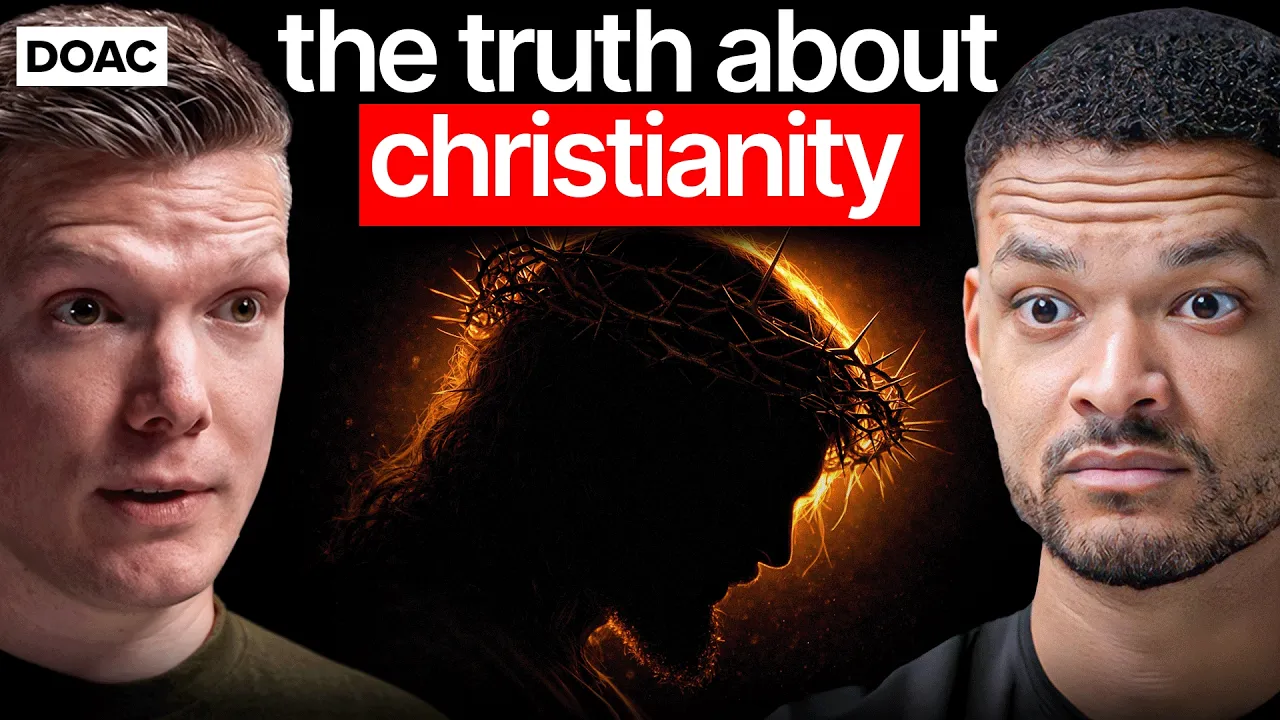
Am I going to hell? >> Yes. But here's the thing. Everybody is going to hell. And it's not because they don't believe in God. And look, I'm a historian and a theologian. So, I study ancient biblical manuscripts. And if you truly understand what this book is saying, I don't want you to experience that. >> This is not a place I want to go. So, what do I do about that? >> It's not about trying to earn my way into heaven. It's not about checking off. I read the Bible as many times. I didn't lie. I
didn't steal. I didn't cheat. Like, it's none of that. But here's the problem. Unfortunately, we bought the lie that we are the sum of our actions, where we're chasing after things that aren't going to give us what we actually need. Which is also why we live in a world that is lacking in purpose and meaning. >> But the part that I've always struggled with is that the answer being religion as an antidote to that feeling because I require a really high standard of evidence because of the way that I am. >> Well, I think not
only can it provide an antidote, it can provide the antidote. And I'll explain why. like how can we trust human accounts of these things and then how do you take people who agree that there's clearly something missing to believing that what's written in the Bible is the thing that should guide my life also do you have any doubt oh especially when there are times of struggle and pain and suffering like the whole Epstein thing right now we are seeing examples of true evil so there are moments where I think how could there be a good
god however from my investigation I am convinced beyond a reasonable doubt that there's actual evidence for the existence of God the historical reliability of the Bible and The philosophical explanations for meaning and purpose. >> And what is that? >> First, we have >> that is some of the most persuasive evidence one can receive. >> Guys, I've got a quick favor to ask you. We're approaching a significant subscriber milestone on this show. And roughly 69% of you that listen and love this show haven't yet subscribed for whatever reason. If there was ever a Time for you
to do us a favor, if we've ever done anything for you, given you value in any way, it is simply hitting that subscribe button. And it means so much to myself, but also to my team because when we hit these milestones, we go away as a team and celebrate. And it's the thing, the simple, free, easy thing you can do to help make this show a little bit better every single week. So, that's a favor I would ask you. And um if you do hit the subscribe button, I Won't let you down and we'll continue
to find small ways to make this whole production better. Thank you so much for being part of this journey. Means the world. And uh yeah, let's do this. Wesley, I have this fascinating uh graph in front of me here and it shows several things that I find to be really really interesting. One of them is that as of 2024, the decline of religion has started to level off and actually increase a little Bit. And now 63% of US adults identify as Christian, which is roughly 160 million people. In 2025, Bible sales hit a 21-year high
in the United States with 19 million units sold. Weekly Bible reading amongst US adults has increased to 42%, which is up 12% since 2024. And in 2024, Christian and gospel music streams in the US increased by roughly 20% according to the Washington Times. Wesley, what is going on in society? If we zoom out, >> I think we're in a unique bubble where we found ourselves in a time frame where we're connected more than ever. We've kind of come out of a period of time where the new atheism is very, very popular. You had Dawkins, Daniel,
uh, Daniel Dennett, Sam Harris, Christopher Hitchens, and they made a big impact in the early 2000s. >> I think we should probably just give some color to what new atheism is. >> Sure. Yeah. >> I've actually got a graph here, which I'll throw up on the screen, which shows the rise and then the the fall of new atheism, but I was pulled in by new atheism. >> And that meant that I, and again, I should probably preface my beliefs because people are going to want to know what my bias is when I'm asking questions. I
grew up in a very Christian household up until the age of 18. I then became agnostic/ atheist when I started Consuming a lot of this stuff from Richard Dawkins and Sam Harris and all of these people. And then I find myself at a point now where I'm just open-minded and curious, >> but I have lots of questions. Yeah, you had these individuals who are writing these very influential works. But I sometimes wonder whether the new atheism movement worked a lot more effectively in print than it did in actual real life. Like in terms of the
practicality Of the application of the things that were being talked about, especially in regards to meaning, if you apply ideas like you being a product of time plus matter plus chance, what does that actually give you in terms of the ultimate identity questions? And so I think I think that's true in a lot of circumstances where you have these seeds that are planted and they grow and they produce trees that produce fruit that are kind of hard to digest in their Actual application. And along with that, we have a world that's very complex. We're more
connected than we ever have been. I don't know if we're truly we were ever truly meant to know as much information as we do, especially about things that are going on around the world and things that are hard to to comprehend. And so what I think that all kind of adds up to is people asking questions about, okay, I'm here. I'm right now trying to figure out what's Going on. How do I actually find out the answers to a lot of these questions that just go beyond the here and the now that I'm experiencing? This
is what um individuals like James K. Smith called the dynamics of disenchantment where people are struggling with these transcendent questions, questions that are metaphysical that go beyond just the here and the now in the world. Why is the three pounds of gray matter in my brain able to comprehend the Complexities of the universe? How do I how do I come up with a solution to that problem? So, I think that's part of it. I think it's kind of moving on in a world that just is probably more messy than it's ever been. A lot of
countries, the UK, Europe, Canada, America, all of these western countries, they they were founded on these Judeo-Christian ethics of foundations that come from the Old and the New Testaments, what we call the Bible. And A lot of people kind of attempted to divorce the religious aspect from the societies. And societies became less and less overtly religious in those natures. And then a lot of people saw that their parents were no longer going to church. Like the Bible wasn't part of kind of the household any longer. And I talked to a lot of young people who
look at that and they say in almost like a rebellion against their parents, they're now interested in that. Their parents Rebelled by disassociating from religion. And now I wonder if there's part of a rebellion in kind of looking back and trying to reclaim some of that religious stuff. I think in part as well this younger generation, Gen Z's and I guess to some extent also millennials have been told to live more individualistic lives and that's really been glamorized like be your own boss and now we work remotely and stand on your own two feet and
we're even seeing People getting into sort of relationships later and later in their lives and having less children. So they're more it appears people are more unanchored than they've ever been and that was to some degree glamorized. Um but it also appears that when we are unanch anchored when we don't have responsibilities or we're not part of something mental health issues um are quick quick to follow >> and for this generation they're Suffering the most with those types of mental health issues and then one would assert that they would therefore be searching more for >>
answers to some of these existential questions >> expressive individualism I think it rose that's the kind of the terminology in soc in the sociological literature that they refer to it but I I think you touched on a good point in that like as we've removed God, part of the Intellectual light enlightenment was that we would move away from the shackles of religiosity and the concept of a creator and that would lead us into a utopia. And I think the more and more we've removed that from society that hasn't decreased our levels of anxiety and depression
and meaning. I I think it's increased it. >> Yeah. And especially celebrity worship, social media, building a following of your own like sort of low-key Narcissism. >> Yeah. >> Has made us more and more and more and more important. And that seems to correlate with worse and worse and worse mental health when you start to become more individualistic and think more and more about yourself >> and self-importance >> versus others and a bigger picture. >> Mhm. I think we were created for community. I think we are as human Beings a creature that is created for
community ultimately like cards on the table as a Christian because I believe we are created in the image of a God who exists in a set of living loving relationships like that's what the trinity is when we talk about that idea within Christian theology. God exists in father son and holy spirit. And so being created in the image of God, part of that is you are created for relationship. And so in a society that's Continually removing us, you know, you need to be an influencer. You're influencing everybody else. >> When I think we're not created
to be lone wolves or lone rangers. We're created to live amongst community and have that be something that likewise gives us fulfillment. It's not that people who are leaders are, you know, rise to the top are wrong by any stretch, but in a society where we're alone together because We are sitting behind computer screens >> and we're talking to hundreds of thousands if not millions of people in some cases, but but we're secluded. >> I think that that does something to our souls because we were made to be in relationship with other people. I agree
with everything you've said as it relates to the sort of crisis of meaning in society and I also agree with many of your reasons as to why that's occurred. >> The part that I've always struggled with Is then the answer being Christianity or any other religion. >> Sure. I agree with, you know, so many of the things you've said, but then I my brain has, I think, especially after the age of 18 when I started reading about all this new atheist stuff and these questions of evil and am I going to hell and all these
other things, I've not been able to get there. >> But I'm having this conversation with you today because I am open-minded and Although I've got like difficult questions to ask, I'm in pursuit of the truth, not any particular ideology or answer. So, how do you take someone like me who agrees that there's clearly something missing, who believes that there's something transcendent? Like, it'd be a crazy thing to assume that this is it. I I think >> Yeah. >> How do you take them from this position to >> believing that what's written in this book in
front of me, the Bible, >> Yeah. >> is the thing that should guide my life, >> right? >> Because I I like, again, I say I'm going to say this again, that like >> I think I require a really high standard of evidence because of the way that I am. >> Yeah. You know, I think there's a historical case for it which I'm very Much invested in because my training formerly is in historioggraphy. I study ancient biblical manuscripts and their kind of reliability and fidelity over the last couple of millennia. So looking at some of
those manuscripts that actually can trace back to the actual time frame of Jesus and answering questions like is what we have now what the original authors wrote back then? So, I think there's a historical question to it. And I in my own personal Investigation genuinely think that the evidence, the publicly available evidence gets us back to not only the time frame of Jesus, but to early eyewitness testimony that proclaims that this first century Jewish itinerate rabbi who was walking the dusty streets of first century made these claims and then there is sufficient evidence to say
that he predicted his own death and resurrection and did it. How do I know Jesus Christ was real? And then how do I Know what's written in that book is real versus just some guys thousands of years ago made a book? >> Yeah. So that is a question of historical reliability. So there are a couple different ways we could go about it. First, we have four biographical accounts of Jesus's life, which is very unusual. So we call them the Gospels, Matthew, Mark, Luke, and John. Um those aren't actually our earliest source material for the life
of Jesus. that Comes in the person of Paul. Paul is actually writing before the gospel accounts and he is uh someone who was hostile originally to the Christian message and he's persecuting Christians. He comes along and he has this radical conversion experience when he's traveling to Damascus where he says he's he's literally thrown off a horse. He hears God's voice and it's Jesus and he says, "Paul, why are you persecuting me?" And then he writes these things About his experience and and then ultimately goes and connects with the individuals who are who we call the
disciples who are like this this close Jesus community and connects with them. So he's our earliest source but then you have these gospel accounts these these biographies and the gospels are interesting because they fit within the historical framework of ancient Greco Roman biography. So let me give you an example. The most well-known person in Jesus's day was the emperor. His name is Tiberius. Tiberius has four biographical accounts that are written about him. Valasculus, Casiodio, Sutonius, and Tacitus. >> So, these are the four guys. Okay. >> And what's interesting in sort of a comparative analysis of
Jesus and those people is that they're all writing around the same time period. So the biographies are coming from the first century for Jesus. They're coming in This time period where you have an early eyewitness testimony for the emperor for the most well-known person in the ancient world. All of the sources except for uh Valas Peterculus are coming from the second century. >> Val Petculus is coming from the first century. He's very close to the source, but he's a paid propagandist. So even though he's the earliest, he's the least reliable. And for the gospels that
comes around to the 4th century. So there's a Comparison with the source material for someone like Jesus even though we really shouldn't have anything about him because he's he's kind of a nobody from nowhere >> in terms of the Roman Empire and the grand scheme of things. >> But we have a phenomenal amount of source information for his life. I mean, this is one of the things I discovered when I went through that new atheist phase was that really everybody kind of Agrees that there was a guy called Jesus from Nazareth and that he was
a real historical person. >> I guess the part in dispute was whether things like his resurrection actually happened or whether he was just a spiritual leader back then like we have spiritual leaders today. And I think one of the one of the things that I got really stuck on when I was reading about Jesus and the Bible was there appears to be quite a significant gap between his Life, his death, and then the writings that go into the Bible. And for me in my head, I was like, well, if you know, >> if something happened
in my life 50 years ago, I mean, I'm only 33, but if something happened 50 years ago, I would not be able to recount it. Frankly, I can't recount what happened last week accurately, >> right? >> Let alone like decades ago. You've you must have heard this argument before. >> Yes. >> What how do you how do you square the circle here? >> So, there are a few things going on. First, we live in a hyperiterate culture. We are writing everything down. The ancient world was far less of a literate culture. They were an oral
culture. These stories would have been passed in large groups at at at time frames, especially if we're talking about the biographical material of Jesus Is actually written in a closer time frame than the majority of anyone else. >> What was that gap? >> It's it's about 40 to 60 years. >> So, I really want to I imagine there's some people listening that have probably never read the Bible. And I really want to explain to them like what this book is in the simplest terms. Can I I can open your Bible. >> Yeah, of course. Yeah.
>> So, is there is there like chapters in Here? >> Yeah. So, the Bible is though we now have it in one book is 66 books written over a period of about 1600 years on three different continents by close to 40 different authors in three different languages. >> So, I've just opened your Bible. Y >> and there's one section that says the Old Testament. There's another section section that says the New Testament. M what am I looking at? Like is this God's Words? Is this a bunch of people's stories that have been compiled together? What
is the Old Testament? What's the New Testament? What's the difference? >> Yeah. So the Old Testament is the Hebrew scriptures. So that's the scriptures of the Jewish people. >> Okay. >> So that is uh you know it starts in what's referred to as the Torah, which are the first five books or the five Books of Moses. And then that goes in a time frame all the way up to the period of the Persians. >> So that's a certain time frame. Yes. And they've gone and collected books from that time frame or writings from that time
frame. >> Yeah. So the ancient Jewish people had and remember all of these books they would have circulated as independent writings. >> Okay. >> So we start to see things like this happen in the 4th century. Prior to that everything's in independent scrolls. So there's an understanding when even you get them all sort of put in one unit that would have contained the scriptures, the word of God more so than like this is the word of God. >> The reason why I am unapologetic and very open about my total naivity is because often in these
conversations >> you end up kind of preaching to the Choir. >> Sure. >> If you know what I mean. And there's a huge amount of people, especially younger people that went through that new atheist movement, were maybe born in the 2000s that are now 26 years old, >> that have never read the Bible, have never even opened one, have no idea what it is. They just think it's this kind of like book of stories. Yeah. >> But these the first um you call these Books, I was thinking of them like chapters. >> The first one
in the Old Testament is Genesis. >> Who wrote Genesis? Was that a guy or was that God? So the idea is in Christianity the terminology is what's called verbal plenary inspiration. So verbal it's spoken plenary it's like written down and then inspired. So there are human authors to all these books. >> Okay. So humans wrote these chapters but They were inspired by God. >> So yes. So the understanding so in the Bible itself Peter says that men spoke as they were carried along by the Holy Spirit. So there's a there's a historical context to all
of these like the history of this period of time of the nation of Israel as they were being led by particular rulers. >> And where does Jesus show up? >> Jesus is the New Testament. >> If someone's never read the Old Testament, what is that about? It's just describing the time. >> It's a bunch of different things. So different things. It's there's a whole bunch of genres of literature. So, some of it is history, some of it is poetry, some of it is what's called wisdom literature. >> And who decided that these it looks like
there's I don't know, it looks like there's about 40 books in the Old Testament. >> Mhm. 39 books that are in the Old Testament. >> Who decided that those were going to be part of the Old Testament because I'm sure that there was lots of other writings at the time that could have been included. >> Yeah. So, by the time that Jesus is around, there's approximately an agreement of what is considered scripture >> by who? by the Jews themselves. >> So the Jews decided which 38 books to put in. >> Yes. So you have conversations
by individuals like there's a guy named Josephus who is writing at the end of the first century. Part of what he argues is that the Jewish people don't have kind of an innumerable number of religious texts like the Greeks do. They have a specific number and he uses this terminology that they were laid up in the temple. So the idea is that you know These are the books they're housed in the temple and they're a set number and he gives the number of the same number of letters in the Hebrew alphabet 22. So you usually
see this 22 or 23 number, but they group them differently. And he gives an argument that one of the reasons that there we can find a timeline for what the Jews consider scripture is he says there's nothing written before Moses and there's not nothing written after the time of Artis Xerxes, which is the Persian Empire. So the book of Esther in the Bible is is that time period. So though there are writings after that there's this agreement that the voice of God in say the prophets giving a thus sayaith the Lord statement like communicating messages
to the people of Israel has ceased but the Jewish cannon though there's like a closing of it there's a soft closing there's an idea that there's going to be A new covenant God is make going to make new pro promises with his people and so there are going to be more writings. >> Okay. So my understanding of that is that he made the case that God is no longer communicating with people to write these books >> at least that there was a stop point at Malachi. So it's sometimes referred to as the 400 years of
silence for that reason >> from the point of Jesus's death. >> Mhm. >> What book from the New Testament is written last and how big is that gap? >> That's a debate. >> Okay. What's the debate? So the debate so the the there's it's a question if John's gospel >> is written before 70 AD or after 70 AD and if it's written after 70 AD it's written in the '9s. So it's written pretty far afterwards. >> How many years? >> So if Jesus dies in 33. >> Okay. So about 60. >> Yeah. >> Okay. Fine.
>> Yeah. So, so at minimum I I think like 99% of historians, biblical scholars, classicists would argue that the 27 books of the New Testament are written in the first century. And so in that sense, they're in the lifetime of the eyewitnesses to a certain degree. >> Mhm. >> And there's evidence even within some of the gospels where you have these names thrown out kind of randomly. And part of the thinking of that is that this is like citing your sources. At one point when Jesus is carrying the cross to Galatha, >> he kind of
stumbles and they get another person to carry his cross for a little bit. >> And that person is Joseph of Arythea. Well, one of the gospels names one of Joseph of Arythea's son by name. And the thinking is that this is probably someone who's well known within the early Jesus community. And the purpose of naming that person randomly is to say he's actually well known. Go ask him. >> I mean logically there's quite a risk of Chinese whispers to some degree. >> As you were speaking I was trying to think about things that I experienced
when I was younger like with my like grandmother before she passed away and I Was trying to like accurately recount those memories. >> Yeah. >> I was thinking of like going to her house and then >> I remember one day she gave me some money but I can't remember what she gave it to me for and I can't remember how much she gave me. I know she put it in a card and this was only like hm 20 years ago. >> Yeah. >> And so if I was to write about that today, I would be
filling in some some gaps, especially especially this is the other thing that I always struggled with is like especially in a world where we didn't understand science. Now my grandmother like put it in a card and it was like I opened it and the way she did it was often as a surprise. So in a world where I like didn't understand physics or science, I might have concluded that my mother, my grandmother Did something like magical, >> you know, at a time when we didn't understand anything about like really much about the nature of the
universe and planets and the solar system and physics. >> So is that a risk that some of the things that have been transmuted by God into this book in front of me are prone to Chinese whispers and or just like a lack of understanding about the nature of the world like the resurrection for Example. >> Yeah. So this is uh this is in my field referred to as mythological drift. So how do we factor in making sure that mythological drift doesn't happen? I think there are a couple things related to what you said. First off,
I think I would be careful in trying to ascribe the ancient world as being pres-scientific and therefore largely say ignorant. I mean, even when the angel comes to Mary in the gospel story And says, "You're going to be with child." Mary's objection to the angel is a scientific one. I haven't met the minimum requirements of how babies are made, therefore I can't be pregnant, right? So, she's not dumb, right? She's not just at face value accepting that, you know, well, I believe in angels and so, you know, this kind of magic thing can happen. she's
still objecting scientifically even though she might not have the terminology to understand like The complexities of child birth and embryology and all of that. So I would say you know this is what uh the writer CS Lewis calls chronological snobbery that he says you know we need to be careful of not to ascribe the ancient world as being more ignorant and stupid than than you know just because we are a product of the enlightenment and we understand scientific things. Yeah. The second thing is I think the the Chinese whispers or the telephone game or Whatever
you call it is a good is a good kind of case study. I think where it falls short is that if you play the telephone game, if you play Chinese whispers, there are rules in order to corrupt the message. So you have to whisper, you can only say it once. You have to do it one person to one person. In an oral culture, you would have been hearing these stories constantly. So when some of these stories are told, they're being told within a lifetime Where there could have been individuals who say the story of the
feeding of the 5000, that's a lot of people. So there's a lot of witnesses to this particular event. So if you're writing this down, there's an aspect of there are people out there who could verify what is being said, at least orally, not necessarily like literarily. Likewise, what we have in the gospel accounts, particularly after Jesus's death, when the disciples proclaiming his Resurrection, they go back to Jerusalem, which is the scene of the crime. So, they go back to the exact place where Jesus was crucified and start telling people he was risen from the dead.
If there is some aspect of say disingenuousness and making up a story, don't go back to the place where everybody could have seen that thing happen to that degree. Right? So in in one sense, Chinese whispers is is a faulty analogy in that it's less like One person whispering into another's ear and more like a 100 people in a room all saying communicating the thing verbally and then getting the other people to repeat it back to them and then corroborating with the other individuals of what's going on. Now I think there I think your point
in in the story of your your grandmother and you know the the the letter and is a good one. You know how do we remember things? Do you remember 9/11? >> Yes, I do. Yes. And I was in the the UK at the time. >> Could you tell me a little bit more vividly what what you were doing on 911 compared to your grandmother and the letter? >> Yes, I could. Yeah. I remember coming home from school and like watching it on the screen and my and my dad having it on the screen and usual
just looking at the screen. >> Yeah, me too. So whereas I couldn't tell You much of what else happened during an average day in that year, I could tell you what happened on September 11th, 2001. And that's because of the nature of what was going on. And I think when we're talking about the gospel stories in particular, first you have what I genuinely believe are eyewitness accounts from at least the source information coming from a group who would have heard Jesus be preaching these things multiple times in multiple Different settings. Like it's it's probably likely
myself as an itinerate I have given the same talk on a particular subject quite a few times. Yeah. And I joke with my wife that she could give my talk on the historical reliability of the Bible herself. You know, if I'm sick, I'll just send my wife, right? Cuz she's heard it so many times. I think that's the case that's going on with the disciples. >> There's an aspect of they would have Heard say the biatitudes. >> Yeah. >> That Jesus most likely more than once is the case because that's just the nature of not
just itinerate speaking but even traveling rabbis in in the ancient world. And then you have this event that is kind of earthshattering in terms of their narrative of who they are. They've been traveling with this rabbi for 3 years straight. They've been hearing his teaching. They've been seeing miracles At least that are recorded in the gospels. Pretty phenomenal things. And then he gets taken and he's murdered publicly. And they think it's over. They think, you know, there are other messianic movements in the ancient world. most of which you and I aren't hearing on a regular
basis because when those individuals die, their movement dies with them. And so that's what they think is happening, right? So they think, "Okay, we're done." So the story is they're hiding in this upper room and they're scared. In fact, it's the women who take on the responsibility of like going and figuring things out, which in terms of the time period is actually an embarrassing fact because of the kind of cultural dynamics of what's going on. And so you have the disciples who think it's over. What is it that has 11 scared Disciples because one of
them Judas goes and he kills himself. 11 scared disciples hiding in an upper room thinking that's it. We're done. We might as well, you know, Peter, James, and John might as well just go back to being fishermen cuz that's all she wrote. to then having the boldness to go out and actually proclaim this message ultimately to the level of persecution and hardship that they endure for the rest of their Lives. Well, it's that their rabbi then shows up alive again. And so, at minimum, I think what we can say is that this is a pretty
drastic event that takes place in their life. It's a comparative to a 9/11 event for them. And so in terms of like the memory imprint that they are experiencing for the murder of their rabbi of their teacher and then something happening where they then go for the rest of their lives. The Martyrdom stories are a little bit tricky in terms of their historical reliability. I think a few of them we can say did happen. a lot of them is kind of up in the air but at minimum they suffered persecution. >> So the story in
the Bible is that he was killed on the cross, murdered on the cross and then he was put into a tomb >> and then who saw him come out of the tomb. >> So nobody physically sees him come out of the tomb. But the women go to the tomb in the morning and on the third day and the tomb is empty. And so there are four accounts, right? And I think it's interesting also that we have four accounts that kind of give different angles on the stories. They're not it's not as if they got together
and they corroborated and all gave the same story. The fact is that we have four accounts that kind of capitalize on Different angles, which the differentiation in detail, I think, actually gives credibility to the the reliability of it. Because if they were all telling the same thing, you could argue that they got together and they colluded. They don't do that. In fact, they they touch on different aspects of the story. >> Are these people saying that they saw him walk out? Are they saying that they just saw it empty? What is the claims Being made
about his resurrection from these witnesses? >> Yeah. So, the tomb is empty. >> The tomb is empty. >> And so, it's interesting in in one of the accounts, um, Mary's at the tomb, and she actually talks to Jesus, but she confuses him with a gardener. Now, I think it's it's interesting that she doesn't confuse the gardener with Jesus. She confuses Jesus with the gardener. Like, she thinks that that this person She's talking to isn't Jesus. She doesn't recognize him at first. And she she asks him, you know, what happened? Why is the tomb opened? Where
did the body go? And then there's also an account of an angel appearing and saying, why are you looking for the living among the dead? He's not here. He's risen. And then they go back to the disciples who are, you know, hiding in this upper room. Mary says, you know, I I've I met the tomb's empty. I've met Jesus. Jesus is not in the the tomb. He's risen. And some of them don't even believe her. They think she's crazy. Now, we don't have like an eyewitness account of the tomb being open. And this is actually
an embarrassing fact in the ancient world. So some of those other gospels that I mentioned earlier that are written later on, Gospel of Thomas, Judas, Mary, Peter, there's one of them, the Gospel of Peter, which is actually trying to remedy this fact that women Are the first eyewitnesses to the empty tomb, which is a which is an embarrassing fact in the ancient world. If that's not true, if they made it up, it seems very unlikely that they would have done that because women are not considered good eyewitnesses in either Greco Roman or unfortunately Jewish society
in this time period. So the gospel of Peter tries to remedy the situation by having all of the right people in the right place at the right Time. It has the Jewish and the Roman officials camping out in front of the tomb when it actually happens. And then has this recounted the story of the the literally the stone moving, Jesus coming out, all these things. Now, we know it's not historically reliable. We know that because of when it was written. We also know that on the eve of Passover, the priests would not be camping out
in front of a dead body. It's just historically um anacronistic. But it is an account of a literary source later on that is embarrassed by what we find in here about the biographical information of the empty tomb. >> So is it just two women that said they met Jesus in some form after his death? Mary being one of them which was his mother. >> No. >> Who's Mary? >> Mary. So there are a number of Marys in In the New Testament. Um this was Mary Magdalene. >> Okay. >> Yeah. who who was like a close
associate. >> Okay. Like a friend. >> Yeah. >> Okay. So, a friend. And then was there is it just her that says she saw him >> in there was a group of them. >> A group of them. >> Yeah. Of the women. >> Okay. And they were separate when they saw him. They weren't they were on their own. >> They were together. So, one of the gospel only mentions Mary. >> I believe it's the Gospel of John. But like I said before, it implies that there are more because she says we don't know where they
put the body. >> Okay. So though that account only has her recounting it, it implies that there are Others and then the other gospels have more women that are going to the tomb. >> As a percentage, what degree of certainty do you have that he was resurrected and that um he was who he said he was? Cuz I agree with you that this character clearly existed like Jesus clearly existed. I personally believe that he was he was killed >> probably on a cross. >> But then you get to this point of resurrection which you have
to then Believe in something supernatural. >> Yeah. >> So what's the probability you'd assign to it? >> I I >> if it was like likely, unlikely, very likely. >> They're all likely because I think that what the gospel authors are doing is communicating truth. And I don't ultimately see an overabundance of reason why they would write what they Wrote other than actually recounting a story of what took place. >> I grew up in a place called Plymouth in the UK. I was born in Africa and in my local park there was this big poster on
the wall about the white lady. I'll put it up on the screen. It's like a big legend in our city. It's this park and everybody says that they see this white lady in the park that was killed. And actually, there's a big board explaining her life, but it's all just accounts of People that say they've seen her. >> You have things like the Loch Ness monster in Scotland as well, where there's been 1,500 sightings of this big monster in the river. And even up until recent times, 2025, there was a surge of sightings of the
Loch Ness monster called the Black Mass in in in the bay. >> Um, and that started in 565 AD. So, one of the things that I've always sort of struggled with when I think about humans saying they saw something is we still Today have sightings of UFOs and Loch Ness monsters and white ladies in parks that become legend. And actually with the Loch Ness monster, it's pretty interesting that even today there are sightings all the time of this monster that lives in the river. Now, I think maybe me and you both agree that there's no
monster in the river, >> but there's something going on. There's something in human nature where we do have like a proclivity to engage in Supernatural sightings and then once we've heard it once, we then reinforce that we've seen it too. And even as like a young man, I mean, maybe you believe this, but like I believe that there was a woman that would stand on the landing of my home and it would like wake me up and I would run and and tell my parents that the lady stood on the landing. Again, there's people watching
this that think that there was actually a lady. Probably maybe there was. But I you know What I'm getting at is like how do how can we trust human accounts of these things when clearly humans have an ability to make make things up that aren't real in some situations. >> Sure. Part of the answer to the question is one of the evidences for Jesus's resurrection is the fact that you and I are still talking about it almost 2,000 years later. >> My friend said this to me. I was telling you before about my Christian friend.
He Was like why are we still talking about it? Well I we can't prove it. >> It wasn't it didn't happen. So we're always going to talk about it. there's there's never going to be I mean unless >> something happens >> right the difference is that there are these other messianic movements that happened in the ancient world >> and so uh like uh Simon Barora the reason why we're not talking about Simon Barora as a messianic figure is because He died and his movement died with him >> and his disciples didn't go out and then
proclaim his continued message until like to their own detriment so I would say a few things I would say liars make poor martyrs in that you will die for something you believe is true, but the chances of you dying for something you know is not true >> are less likely. So if we're talking about the disciples and especially if what they're getting for this particular Proclamation is they're being ostracized from their own communities, pagan gentile communities and the Jewish communities because remember there was persecution on both sides because it was at a certain point in
time continuing to say that Jesus was the Messiah and on top of that that he was God himself was not very popular Within the early Jesus communities, there's a complexity to the fact that people usually lie. You look at cultic Figures, right? Right. Cult leaders usually do things for prominence or money or sex or influence. The interesting thing about the early disciples is they get none of that. In fact, they almost get the complete opposite of that in that Jesus says, "You're going to be persecuted. you're going to be put in front of tri tribunals
and you're going to be interrogated. And that's exactly what happens. And they know that there is There's a danger to this because we have in the book of Acts, which is the book after the gospels, we have a recounting of the first martyr of Steven. >> I think of like someone like Martin Luther King or Gandhi as being, you know, leaders from history that appeared to be from what I've understood very selfless and actually realized that they were all going to die. I'll never forget the speech actually where Martin Luther King says, "I've been to
the mountain Top." He was a very religious man, very Christian man, and says, "I've been to the mountain top. You guys get there, but I don't get there with you." >> Right? >> And then from the information I had, he died very, very shortly thereafter. And as he's saying, "I don't get there with you." He's he's emotional in his face. You see him crying. The video is was very con persuasive of the Christianity, by the way. >> Um, and then he's pulled off stage and then he's shot thereafter. feels like a man that knew he
wasn't going to live much longer but was willing to put his cause ahead of um his own mortality and um I guess Jesus was doing the same >> in a certain regard in terms of the disciples though I think like if they know this isn't true if they know that there's this kind of this has been mythological drift if things have been exaggerated Why then especially experiencing that persecution seeing their friends die in that kind of setting do they continue to go on and do it. >> I think they definitely believed it was true. >>
Yes. I think at minimum whatever is going on they like you you look at some of these uh secular historians and they look at the data and they say whatever's going on the disciples believe something happened that they saw something >> and so the I just think that the explanations of the alternatives of that actually happening are insufficient in so far as how they actually explain the data. Do you have any doubt? >> Oh, of course. >> Okay. So, you have at least even 1% doubt. >> Oh, definitely. And I think especially when there are
times of things that are far more existential than historical, When times of like struggle and pain and suffering, and I look at the world and I look at how messy it is, the children who die young, people who are abused, all of these things, I there are moments where I think, how how could there be a good God? I mean, I'm not immune to doubt. Um, and and the interesting thing that I find about the Bible is that the Bible is very open to the God of the Bible being open to us coming to him
with our doubts. >> Mhm. >> You know, onethird of the book of Psalms, which is like right in the middle of the Bible, this kind of poetic literature, if you want to call it that, are sometimes referred to as the lament or the complaint psalms. It's things like Psalm 22, my God, my God, why have you forsaken me? Why are you so far from me? I like I cry out by day and I hear no answer. And I think what's interesting that I find with the Bible Is its transparency in saying we're going to struggle.
You know, there's this really great story in the Gospel of John. Well, this is in a couple of the instances of the Gospels where John the Baptist who's like Jesus's cousin and good friend, he's been in prison because he's been speaking out against Herod. He's been being a little bit too verbal politically. And so he gets taken and he's in prison. And though he's the one that baptized Jesus and said, you know, Behold the lamb of God who takes away the sin of the world. When he's in prison, he doubts and he sends his disciples
over to Jesus to ask, are you the Messiah? Are you the one we're waiting for? Or should we we be waiting for another? Now, in that interaction, Jesus actually says, John the Baptist is the greatest of all men born of women, which is basically everybody, right? And yet in that very same setting, John the Baptist is doubting That Jesus is who he says he is because he's experiencing pain and suffering. >> On that point of um you seeing you know horrific things happening in the world and then having doubts. I think for me that was
one of the persuasive arguments of the like new atheist movement that I became a part of when I was like 18 years old which was I think Richard Dawkins had said about you know if God is all loving >> then why would he let a 2-year-old kid In Africa have their eyeball eaten out from the inside by a parasite. >> Yeah. >> Like if if if I could intervene with that because you know the assertion is that God is omnipotent or powerful and omnisient or present. >> Yeah. If I could intervene with that as a
human, I would stop that. And so if God is omnipower, omnipotent, sorry, all powerful and omnipresent, knows everything and is everywhere, then why Wouldn't he intervene with the baby having its eyeball eaten out from the inside? >> Yeah, it's it's a good point. And I think if there is an objection that is truly impactful on Christianity on in the atheist corner, it is the problem of evil and always has been because it's far more of an emotional and existential question than it is an intellectual question. Now, part of the problem with it is that if
we're talking about evil With a capital E, we're implying that there's a good with a capital G. And so I think we do run into an issue when saying that evil exists or implying that good exists. And if we're implying that good exists, we're implying that there's a moral law to adhere to to call the good good and the evil evil. And if there's a moral law, then there has to be a moral lawgiver. And that's where we come into issues with is this subjective or is this objective. I think the Atheist movement would argue
that that moral good is virtue of what helps me to survive. So like watching a small child suffer in such a way. >> If I didn't feel anything bad about that, >> yeah, >> then I wouldn't have the wiring for survival because I wouldn't have the proclivity to defend a suffering child. If I don't have that, then I probably don't reproduce and I don't pass on my Genes and then I'm selected out of existence. So that pain I feel when I see a child suffering is a function of my evolutionary mechanics that make me more
likely to survive and anyone that didn't have that wouldn't have survived and wouldn't be here now. >> Sure. >> So evolution therefore is the answer. >> I think that might suffice in certain instances. However, it's still sort of smuggling in moral categories into a Biological explanation. So part of I mean you read Richard Dawkins, you read you read River Out of Eden and he has that section where he talks about you know we shouldn't expect to see any rhyme or reason good or bad you know DNA neither knows nor cares. DNA just is and we
dance to its music. And there's an aspect of Dawkins himself in that volume at least at that time when he wrote it articulating that at the end of it all there is no such thing as actually you Can't call that parasite in that that boy's eye evil. You can say I don't like it, but to to import this moral category of evil is actually to import an idea. And this is actually what Dawkins was criticized by by individuals like John Gray, the philosopher who taught at the London School of Economics. And he says, you know,
you're a really great biologist, but then you want to impart actual intrinsic value to people. And if you're Looking at a simple selfish DNA perspective, you can't actually ascribe that because your DNA, your selfish DNA exists to carry on its selfish DNA. And so in one sense, that child has no bearing on you. Now, it might have like a a protective mechanism where you want to figure out why the child got the parasite, and so you try to avoid that in order to not get the parasite yourself. But science can't actually give you an explanation
For what the moral implications are in that instance. Let me give you an example. >> I think I understand the point there. Um it's essentially asserting that like why does that child matter to me? Because my DNA should just be trying to take care of itself. >> Um I guess in biology there's um I don't always know who my child is. But also from an evolutionary perspective, if we were raised in communities and tribes, We took care of all of our the children. >> Sure. >> In in the surroundings, I would take care of my
brother's children and he would take care of mine, therefore. >> Yep. Yeah. >> And again, that goes back to the point of survival, which means that I'm more likely to survive if I take care of like my community sort of. You you read something like uh the origin of species though like like uh Darwin himself When he's articulating the survival of the fittest there is an aspect of you shouldn't take care of those people because they're actually bringing the genetic gene pool down. So we see even in like the eugenics movement pulling a lot from
individuals like Darwin in order to validate the fact that in order to carry on your selfish DNA, this idea of taking care of the marginalized and those with on the fringes of society and those who are the the lesser than is is Not evolutionary advantageous because survival of the fittest implies that the fittest should survive and these are obviously not the fittest. It's actually a Judeo-Christian ethic in the understanding of everybody having equal value that we should be taking care of people because they have intrinsic value, not exttrinsic value. That allows us to then even
import an idea of taking care of those who are not necessarily specifically related to me and mine. And It comes back to okay, where are we grounding this objectivity in? cuz there have been societies that have attempted to do it in like a might is right aspect and and you ground the objectivity of what we say is right in a society that says this is better for the most amount of individuals within a particular community. I think about um Yevel Noah Harrari Harari in his book Sapiens where he says that the real defining trait of
>> our species versus other species was our Ability to collaborate and basically scratch each other's backs >> and that that meant that we had um evolutionary advantages because if we could work together in a big group and we could believe in stories and we believe in money and prison and governments etc. we could band together and take on the lion or band together and take on the elephant or whatever. And it's actually that in part there you have like I need to take care of you, You need to take care of me and we're going
to reciprocate that altruism uh and increase our survival chances. So again that might explain why I care about that kid um because the species that didn't >> Uhhuh. >> they would never have been able to band together and take on the elephant. >> Yes. I think it's largely our modern perspective living in a society where we are uh starting on second base already With our moral perspectives, right? We have inherited all of these moral categories because of our Judeo-Christian ethic. If you look at basically every society prior to this or even societies in the east,
that's not a given, right? That's not an assumption. Especially in societies that have say uh understandings of karmic cycles whether that's in like Buddhism or Hinduism the idea of altruism is actually can be categorized as an evil because in the Cycle of samsara of birth life death and rebirth you are actually the your lot in this life is due to your wrongdoing in the last life. So in helping someone like that you are actually inhibiting them from being reincarnated better on the other side. So an idea like altruism doesn't exist within that eastern society. And
if you look in the ancient world, let's pick on the Babylonians. The Babylonians, if they were to read Dawkins' River out of Eden, would Basically say, "Yeah, exactly." Right. So they have this creation story. It's called the Inumalish, and it's this big battle of the gods, and it's uh it's an origin story, an attempt to explain why everything is here. But the conclusion of it is basically you are a product of a big battle and a mistake, right? The one god loses and you, everything around you, the earth, the sky, it's just the remains of
the gods that lost. So meaning, value, purpose, not really Ultimately. You're just the product of time plus matter plus chance as well. It's just framed within a religious perspective. whereas Dawkins frames it in a natural materialistic perspective. So where do we get the categories to even say that we should be taking care of people in communities outside of our specific community because in some cultures they have the ethic of love thy neighbor but in others it's eat thy neighbor and so the Question is which society do you want to pick? And you're saying that that
came from Judeo-Christian values. >> Yes, >> I would agree. Yeah, I would agree that. I think I'm trying to understand if it's innate in us from a God what's good and evil or whether it's, you know, we we all subscribe to a culture that was, you know, the foundation of that was these Christian values and um yeah, which one is it? >> Yeah. Well, was I born with a good and evil or was 2,000 or 3,000 years ago when Jesus came to be and we had these books? Did that just influence them? >> Yeah. Well,
I think ultimately there's an aspect of our conscience that's imprinted on us that we we understand ethics to some degree or another, but the framework to actually find the objectivity of that ethic is found in the revelation of specific revelation in scripture. >> Do you believe in evolution? >> I don't. >> You don't believe it's true? >> No. I am open to the fact that I don't think that a belief in evolution undermines Christianity in any way. However, I'm and prefacing this by saying I'm not a scientist. I'm an advocate for intelligent design and I
would basically punt the complex conversations of evolutionary biology to individuals who are far more studied Than me like Steven Meyer and Jonathan Mcclache and John Tours and Douglas Axe and those individuals who have studied it. At the exact same time though it also depends on what you mean by evolution, right? So like adaptation genetically is a thing >> I guess. So I'm saying do you believe that we evolved from very simple organisms to become a human that you see today? >> No. >> And the argument for that would be you know I share 98% of
the same DNA as like a chimpanzeee and we have these fossil records which seem to show a progression over time. >> You don't believe that's true? >> No I don't. But at the exact same time, I think, you know, there are individuals within the Christian faith, intelligent people who do and have no problem with understanding of a theistic evolutionary model. However, I think in the effort of Survival of the fittest, I still think that you're starting a few miles down the road in answering the question of the arrival of the fittest. How do minds come
from mindless matter? How does everything come from nothing? How do how do we answer those questions? And I think that's why you can use the evolutionary model as an explanation of how God has actually created right the biology of the situation. But I think the bigger question is the cosmological Questions. How did this all get going? You know, the big bang, what was the big banger? How did that first ball get rolling? And then why can you and I, Stephen, sit here and like I said before, have the three lbs of gray matter in my
head kind of uh ruminate over these very complex questions. >> You know, I I think it was on the Galapicus Islands. I'm probably going to butcher this, but I'll I'll do my very Best. They, you know, the sailors went to an island, they left a bird there, they came back 50 years later, the bird's beak had grown to be very, very long >> because the prey on that island that it was eating were in in hole. So, they needed longer beaks. So, it kind of shows us that if you leave an animal in an environment,
it will adapt and it's, you know, it will select out the the short beak birds for the long beak Birds. And just in that short period of time, you can see that it's like, you know, it's becoming a different type of animal. And if you extrapolate that out over a long long period of time, almost an inconceivable amount of time, you know, maybe hundreds of millions of years, >> one can understand why like me and a chimpanzeee, there are similarities in how we look. Um, and there are 99% similar like 98% Similarities in my DNA
and a chimp chimpanzeee's DNA. So, one would argue that we are we have a common ancestor. Yeah, >> it's like very compelling evidence to me. >> Sure. I mean, it's the transitions going from as the chimpanzeee type thing, right? Because we're obviously not arguing that that we were a chimpanzeee, a chimpanzeee exist today, but that yeah, that homminid, whatever that Homminid was, >> what is the transitionary fossil explanation whatever that goes from the monkey to the human being? And I don't really think we have an answer for that in terms of consciousness questions like why
what makes our ability to reason and think and contemplate different than all of the other species in the animal kingdom. And how do we go if we're arguing that, you know, everything comes from Single-sellled organisms? I guess you could have a if you want to call it a time of the gaps explanation, you know, just just add lots of millions of years and it solves this issue. I don't know if I am completely satisfied with that answer if cuz obviously there's adaptation but you know if you're looking at whether there's the dodo bird example or
Darwin's finches right where the beaks are different um you're still getting beaked birds and We've never seen one species turn into a completely different species >> the thing that I filled the gap with is that it's just a matter of time so you know with the birds example it's like 50 years or something or decades But when we think about Earth being like 5 billion years old, >> I think it's almost inconceivable what can happen over such a long period of time like it's conceivable that if me and you went to different parts of Planet
Earth and lived in two completely different environments and then we came back 5 billion years later and there was no medicine and no factors helping us to survive that you know we would have branched gone in two different directions completely and you you know your ancestors who were living in the jungle might 9 foot and actually what was useful for survival where I lived in some cave was being 2t tall, >> right? >> And then we wouldn't be able to reproduce which kind of makes us different species now. Like that's I mean that's sounds conceivable
for me over four like 4.5 billion years. Seems conceivable that like we both agree on adaptation. >> Mhm. >> Like small adaptations. But then if you expand the time horizon, those small adaptations become massive. >> Yeah. I mean ultimately no matter which way you want to swing it, I think the adding millions of years as the explanation is a little bit too convenient. >> But I think at the end of the day, you're still looking at the complexity in nature that points to a design of something that is is amazing. And the the question of
okay, how do we Dawkins is, you know, famous for saying that that it it has the illusion of Design to it, right? There's not not actually a design to it. It's just the illusion of design. But I think, you know, if we actually look at when Darwin was writing, they thought the smaller you got, the simpler it got. And now we know that the smaller you get, in fact, the more complex you get. >> As in the more you zoom into the design, like the more you zoom into the brain or >> Yeah. Our understanding
of science has grown exponentially even from Darwin's Day. And there's an aspect of like Darwinian evolution that is is has moved on into what we would now call like neodyarwinian evolutionary theory. And you look at um individuals like I mentioned Steven Meyer before and he even uh has questioned some of these things about the explanations that are working as givens for evolutionary theory. I still don't think it gets us back to, okay, then why do we have purpose? >> I've had so many founders speak to me and say, why didn't this particular ad that I
ran on this platform work for me? Maybe the copy wasn't good, the creative wasn't strong, but usually the problem is they're not having the right conversation because that ad never reached the right person. And if you're in B2B marketing, that is much of the game. And this is where LinkedIn ads solves that problem for you. Their targeting is ridiculously specific. You Can target by job title, seniority, company size, industry, and even someone's skill set. And their network includes over a billion professionals. About 130 million of them are decision makers. So when you use LinkedIn ads,
you're putting your brand in front of the right people. And LinkedIn ads also drive the highest B2B return on ad spend across all ad networks in my experience. If you want to give them a try, head over to linkedin.com/diary. And when you spend $250 on your first LinkedIn ads campaign, you'll get an extra $250 credit from me for the next one. That's linkedin.com/diary. Terms and conditions apply. Every time I've tried to improve something in my life, like my businesses, my health, my relationships, I've noticed that the biggest shifts have come from being better informed. And
when it comes to our health, most of us know very, very little. So when our Team was approached about partnering with Function Health, it felt very much aligned. Their team has developed a way of giving you a full 360deree view of your health, many of the things that are going on in your body in the form of different tests. You do one blood draw and it gives you access to over 160 lab results, hormones, heart health, inflammation, stress, toxins, the whole picture. I use it and so have many of my team members. >> You sign
up and you schedule your test and once you're done, you get a little report like the one I have here. I can see my inrange results, my out of range results, and there's a little AI function, too. So, if I have any questions about my out of range results, I can just go in there and ask it any question I want. And these tests are backed by doctors and thousands of hours of research. >> It's $365 for a yearly membership. Go to Functionhealth.com/doac and use the code DOAC25 for $25 off your membership. Where do you
think we came from? Like, where do you think I came from or my ancestors came from? Do you think they were put on Earth as humans? Do you believe in the Adam and Eve story? Do you think there was some kind of evolution? And when did you think this when do you think this happened? >> So I know that the world is at least 35 Years old. >> Uh I don't think it's an answer that the Bible is actually attempting to address in terms of the age of the earth. >> Billions of years old. I
don't see any reason not to because I don't think that the creation story in Genesis chapter 1 is necessarily an attempt to reveal the mechanisms of how God did that exactly >> cuz the sort of scientific consensus says that it's roughly 4.5 billion years Old the earth. >> Yeah. >> And microbes and single cellled organisms are estimated to have appeared 3.5 to 4 billion years ago almost as soon as Earth. Cold enough to have liquid water. >> Sure. Yeah. And and I'm I'm fine with that actually. I don't I don't think I have to adhere
to neo neodyarwinian evolution in order to actually believe that the world is old. I think I would Adhere to an intelligent design thesis. But >> what does that mean? >> So essentially that the the world around us is intelligently designed. Not necessarily in that it it came through processes of evolution. Once again, I'm not a scientist, right? I'm a historian. I I genuinely do believe that there was a historical Adam and Eve and that those were the first people. >> Okay. >> Now, what did they look like? I don't know. I think they they probably
lived a long long time ago. And I don't know if the breakdown of Genesis chapter 1 and the like seven days of creation are actually attempting to articulate seven 24-hour days. They could be. >> Yeah. >> I just don't think that's the point. But you do believe that humans were put here as humans >> and you believe that the other animals Were put here in their in some kind of early form. >> Yes. >> And then you also believe in adaptation of those species. Fine. Okay. Fine. >> And going back to like talking about trying
to explain these things scientifically. I always find like we can explore the answers scientifically, but that's only going to get us so far, especially when we're discussing meaning and purpose questions. So, let me give You uh a little bit of a story that a friend of mine, Glenn Scrier, uh likes to articulate in uh this parable that he tells that he calls Betty the botist. So, you have Betty the botist and she's been uh looking at a plant sample in her lab. She's been spending all weekend looking at this plant sample. She's been uh you
know, investigating it and doing all of these tests on it all weekend. And Jerry, the lab assistant, comes in on Monday. And Betty looks at Jerry and says, "Jerry, thank you for the botanic botanical specimen that you left me on the weekend. Thank you for this botanical specimen. I've been doing all of these tests. I've been looking at the components of it and the complexity of the biology and there are pharmacological implications that I've extrapolated from its various biological components and we can use these to cure diseases. There's so many things. Thank You so much
for the botanical specimen. And Jerry says, "Betty, it was February 14th on the weekend. That was a long stem rose. >> Do you know what I left for you? Do you know what the implication of the botanical specimen, as you're calling it, was for what I was trying to communicate to you?" Now, did Betty the Botnist understand the long stem rose? In one way, she understood it more than Most because she had done all of the tests and run through all of the different ways that she could extrapolate what that thing was. But what Jerry
was trying to actually illustrate was something that went beyond that. It was a love gift. He was trying to communicate something that went beyond the simple biology. and and Betty could very simply say, "Well, I couldn't get that from the data. I I couldn't have extrapolated the Implications of it being a love gift." And in that so far as it being a parable, we can look at all of the scientific explanations, but there's something that goes beyond the simple data in terms of meaning and purpose and desire, identity questions that go far beyond that, right?
Like we can look, I could tell you the different chemical components that make up the page and the ink and like the size of the paper and It transparency and all of that. I could say, you know, Stephen, what is this? And you could go into all of this explanation about how paper is made and the pulp and how we extrapolated and eventually put it together and the binding and and I could say, okay, yeah, but this is a Bible. This is meant to communicate something to you. you know, what is the explanation for this?
One explanation could be the chemical and and you know, scientific components that Make up the Bible. Another explanation could be this is a religious text that's actually trying to communicate something to you. And so I think in the scientific data, all of that is obviously important, right? Like there's this great quote by C. Lewis where he says that men were scientific because they expected laws in nature and so they looked for the legislator and you look you read individuals like Francis Bacon who came up with the the scientific method and they're inherently religious right they
almost articulate what they're doing in their scientific endeavor as an act of worship because if the exploration of the creative world points to a creator then that can be an act of understanding who and why we're here. In terms of the scientific questions, I'm very interested in them, especially as a non-scientist. They fascinate me. But in terms of the Meaning questions, I think I would air on the side of caution of attempting to be Betty the botist and sometimes I read individuals like Dawkins and I'm I'm hearing Betty the Botnist extrapolate and define the botanical
specimen. I think part of the reason why the new atheist movement that I again was captured by was not sufficient is because as you say it didn't it didn't fill some kind of gap >> and and much of the gap I think for a lot of people is okay so if if I believe in the science and and that argument and the atheist argument or I believe in the Bible I still need a an answer to like yeah but so what like what's the point of this even in the example of evolution I yeah but
why am I evolving Why? Why am I trying to survive? >> Yeah. >> A means to what end? Okay, I'm trying to have more kids, but then why are my kids Trying to have more kids? What's the point? >> And you just keep hitting this wall of like, okay, but what's the point? What's the point? Am I meant to do something? Is it is there a mission for me? >> Right? >> And I think that question is one that I think about uh sometimes, which is >> no matter what I believe, like what is the
point? And I think that's why the Bible is such an amazing explanation for That. Because in a world that tells you ultimately that you're a product of time plus matters chance, the Bible looks at you, Stephen, and says you're created with meaning and purpose and intention. You bear the image of God. So there's something that is actually screaming from your biology about who you are that goes beyond the fact that you're not just a physical specimen sitting in front of me. Right? You have a mind and that mind is maybe Your brain or we're not
even sure about that. Right? >> So what makes Steven Steven? You're not not your body. And that's why I mean there's this inherent conversation within Christianity about the fact that our hope is not a spiritual one. The end result is the resurrection, right? The reason why Jesus rose from the dead is scripture calls him the first fruit. So we're all going to be resurrected. There's going to be a new heaven and a New earth. And that's the promise of Christianity, is it? >> So, so that's the point. >> Yes. >> The point of this life
according to the Bible is that I get to go to this place called heaven. >> No. So it's a both and. So when g when Jesus's disciples ask him how to pray, he says, you know, he gives them the Lord's prayer. Our father, who art in heaven, hallowed be thy name. Thy Kingdom come, thy will be done on earth as it is in heaven. So it's not just about, you know, I'm going to die and my spirit's going to go to somewhere else. And you know, that's the whole goal. It's to bring heaven here as
well. What we do matters because you're a human being. You're not a human doing. And so what you do here and who you are here actually has an implication >> to to who and what >> to everything. So we're put here to be Stewards of creation of each other to be examples of imagebearers of God. Like your life has intrinsic meaning. >> Internal meaning. Yeah. >> Internal meaning more than just what you can contribute. Right. Right. So that would be exttrinsic your ability to give back to society your ability to uh contribute to the advancement
of scientific technological you know fill in the gap you have value that goes beyond that right this is why we fight For people everywhere and that's I think why injustice something like injustice bothers us so much and why evil bothers us so much. >> You know the chimpanzeee that has like 98% the same DNA as me. Yeah. >> Do they have the same intrinsic meaning? You know, even my dog, I'm like, does my dog have that same intrinsic meaning? And is my dog going to go to heaven? >> I think scripture tells us what we
need to know, not always what we want to Know. There have been individuals throughout church history who have articulated that. I mean, St. Francis of Aisi was big on animals going to heaven. Uh C. Lewis was big on animals going to heaven. Um, in fact, when he wrote the last battle, you know, the last series in his line, the witch in the wardrobe books, uh, there are animals in heaven. I mean, if there's a new Earth, I think there are going to be animals. I don't know if they're going to be the same Animals that
existed on this side, but I also I have no idea. But I think there's something different because I think you have a soul. >> And you think my dog doesn't have a soul? >> I don't know. But I don't think he has the same kind of spiritual component that you are endowed with in the same way. >> How do we know? Like, how do we how do I know that? You know, these chimpanzees, They're pretty smart. I was watching one touch a touchcreen the other day and solving problems and I was thinking is it is
there not like an element of I don't know human arrogance to think that these other creatures like the big the whales they're so unbelievably smart they don't have a soul they work together in packs they love they have kids they seem to pursue things yeah I mean I think that's a testimony to kind of the general reflection of God's good Creation at the same time we describe when you're just repeating something we we use adjectives like aping We understand that there's an aspect of like if you train the monkey to push the button, it's going
to push the button. If you give the elephant the paintbrush and kind of, you know, convince it to paint itself, it's going to paint itself. But if you if you can train the elephant to paint the Mona Lisa, is it really going to understand what it's Painted in the same way that Michelangelo understands it? Sorry, Da Vinci, who painted the Mona Lisa. Now I'm getting myself into trouble. Whoever painted the Mona Lisa, Da Vinci, there's something about the value and what is being put in there that is different. >> So do you believe that me
and you are born with a particular mission and meaning on this planet or do you think we have to go and find that particular meaning or mission? >> That's a great question. Uh I think the chief end of man is to know God and glorify him in so far as Jesus is asked what is the greatest commandment in the law. And Jesus uses two examples. He quotes from you know two different passages in the Old Testament and he says love the Lord your God with all of your heart, soul, mind and strength and love your
neighbor as yourself. I mean ultimately I think we always want some sort of a grandiose Purpose and we want the calling of like Moses. We want to go out in the bush or we want to go out in the desert and find a burning bush and have that calling on our lives. I don't think that's wrong. But I think ultimately our purpose is to live a faithful life to who we were created to be in being image bearsers of God and being faithful in loving God with everything that we have. So that like the Jewish
phraseiology of loving God With all of our heart, soul, mind, and strength. It's kind of a standin for your entire being with everything you have. Love God with that by what you do, by what you say, by how you live. Like do unto others as you would have them do unto you, right? That's the golden rule. But if you look at other religions, it's almost always framed in the negative. Don't do unto others what you don't want done to you. So there's a difference between not punching someone in the face And building someone a hospital.
So the meaning of our lives is to love our creator at the most fundamental level >> at the basic level and to understand how that expresses in everyday life. So Martin Luther, the German Protestant reformer, he said the the faithful Christian um shoemaker doesn't glorify God by sewing little crosses into the shoes, but by making really good quality shoes. And so there's an aspect of God has endowed us, Right? We're created in God's image. We create as an aspect of an outpouring of that which we are created to be. And we we do that well.
You know, the proverb says, "Whatever your hand um finds to do, do it with all its might." And the idea is, you know, you have the capability to do incredible things. And the reason why you have that capability is because you bear the image of a creator who like I said before lives in a set of living loving relationships. And so that God actually didn't need to create you me anything. Right? So God is not better off or worse off if we love him or worship him or believe in him. He he really isn't. He
has existed in a in love in relationship. And yet the story of the Bible is that God chooses to create out of an outpouring of his love knowing even that we are going to rebel against him. We are going to sin right do wrong against how he has actually created us to be and Still desires to have that relationship. >> And if we do sin >> Mhm. >> if I sin in my life do I go to hell? You you don't I mean the answer to that is yes and no. But the >> am I
going to hell? >> Are you going to hell? Steven Bartlett. Is Steven Bartlett going to hell? This is the clip that they're going to put online, right? Wes says Stephen Bartlett Is going to hell. I mean, here's the thing. Everybody is going to hell. Everybody. Here's how I've said it in the past, right? The Bible is very clear. All good people go to heaven. But Jesus said, "No one is good but God alone." So if all good people go to heaven and no one is good but God alone, only God is in heaven. >> So
do you believe that there is a a hell and a heaven as we sort of typically Understand it? A place that is great to go to after we die and a place that is very hot. >> Place that is very hot. I mean there's a lot of imagery of um like fire and weeping and nashing of teeth. I think a lot of that uh is kind of reflective and allegorical more than it's like a a physical tangible thing that is you know most of our perceptions of hell are largely shaped by depictions in the Middle
Ages of Dante's Inferno and that Kind of thing right I think it's more so that you will experience the full weight of the separation from God's goodness not necessarily a separation from God because I God's punishment and his wrath are going to be felt there. But if we're talking about like a good place, bad place in the very simplest of terms, yes, but heaven isn't full of good people. Heaven is full of people who understand they Are not good enough. And so I mentioned that like justice mercy thing. Justice is fulfilled on Jesus. So because
justice is fulfilled now, mercy, which is not getting what we do deserve, is able to be given to those who put their trust in Jesus. >> So if I don't believe in Jesus and I don't believe in the Bible, >> but I live a >> good life, I'm nice to people, charitable, try and be kind wherever I Can be. >> Yeah. >> And I don't believe in God, am I going to hell or heaven as it relates to the scriptures? Well, I don't think if you're living your life rejecting God, God is not going to
force you into his presence. >> So, I'm not going to go into he I'm not going to go to heaven then. >> No. >> Where am I going to go? >> Well, you would you would go hell. >> So So if I don't believe in the Bible and Jesus and God, then I'm going to go to hell. >> Yes. In so far as if heaven is a place for those who have submitted their lives to Jesus, who are living the identity of what they're created to be and said, "Your will be done, God." >> Yeah.
>> Hell is a place where God says, "You Rejected me. Your will be done. I'm going to I'm going to give you what you want in that I'm going to remove my grace and mercy from you and you are going to experience truly what you desire in being separated from me and my goodness and my grace. >> And what is that place like according to the scripture? Give me a give me a depiction in my mind of what hell might be like for me. >> Yeah. I mean, it's not a good place. It's not a
nice place. is a place that no matter what's going on, if you are a believer, if you if you truly understand what this book is saying, seriously, I think it should motivate you to want to desire. Steven Bartlett, I desire you to have a personal relationship with your creator because I don't want you to experience whatever hell is. I I I desire for you to be in perfect relationship with your God. Not Necessarily because I want you to get a get out of hell free card, but because I actually think that in living how God
created you to be in accepting living out the image that you bear, you're going to find the meaning and purpose that you ultimately have expressed that you have this innate desire for. I think it's about I think it's according to Gallup it's 18% of Americans don't believe in a god >> now to get into heaven >> as it's described in the Bible do I just need to say I believe in God or do I have to have some sort of active commitment and evidence in my life that I am living my life in line with
God's you know teachings >> I think ultimately salvation right salvation implies you're being saved from something >> right the good news is good news because the bad news is bad. >> And the bad news is very bad. I was Looking at what the Bible says about hell and in um Revelations it says it's a lake of fire. In Mark it says it's unquenchable fire. >> In Matthew it says eternal fire prepared for the devil and his angels. >> Yeah. >> Uh in Matthew again it says outer darkness where there will be weeping and nashing of
teeth. >> Yes. >> They will be shut out from the presence Of the Lord. Weeping and nashing of teeth and torment. Eternal punishment. and the smoke of their torment rises forever. This is not a place I want to go. >> No. No. And I think I think the urgency of the Christian message is the bad news is really bad. And that's what makes the good news so good. Jesus has taken on that hell on your behalf. And it goes beyond simply a believing, right? It's not just about saying the Right words. It's not just a
an incantation. You are not saved by what you do, right? You're saved by works. It's just Jesus's. Jesus lived the life you couldn't and made the sacrifice you can't on your behalf in order to establish that right relationship with God. So that's where grace comes into the picture. Justice is getting what you do deserve. Mercy is not getting what you Do deserve. Grace is getting what you don't deserve. So in so far as Christ on the cross fulfills the justice of his holy law, mercy is enacted and you don't get that punishment by putting your
faith and trust in Jesus as your lord and your savior as your creator. You don't get that punishment and now you get grace which is not what you're owed but you are adopted as a child of the most high. So of the 18% of people that say they don't believe in a god, they are almost certainly going tell according to scripture. >> Well, so James, the book of James in the Bible, who's actually the um the uh halfb brotherther of Jesus um he writes a book and he says, "You believe that God is one." He
says, "Great. So do the demons." So the point is like if anybody knows and believes in God, it's the demons. It's Satan, right? So, so what's the difference there? >> The difference is there is that there's a relational component of when we in in sort of the Christianes Christian terminology when I say Jesus is your Lord and your Savior, what I mean is that he has rescued you. He has saved you from the penalties of sin and death. But then the Lord component is that now you have submitted your life to him in obedience and
repentance. Now repentance Is kind of another religious word that maybe is not always fully understood. Repentance is the changing and understanding of the way you live. You understand that the things that you used to do that are wrong are not the things that are either what you should do or are going to give you fulfillment. And you stop doing those not because God is a cosmic killjoy and he doesn't want you to feel the goodness of those things But because those things are actually harmful to you. They are hurting you and they are creating a
separation of the relationship between you and God. >> There's going to be a very small number of people that actually live in such a way that are fully repented and have accepted the Lord as their savior. Right? there's only rough I think it was 30% of people actually go to church somewhat frequently and uh >> the other sort of 56% seldom will never Go that they're not really really active in their belief. They probably haven't repented. So it would appear to me that a very small percentage of people are actually qualifying for the kingdom of
heaven as it's described in the Bible. >> The miracle of this is that your salvation is received not achieved. And so once again, it's it's not about like brownie points. It's not about checking off, you know, I read the Bible as many times. I went to church as many times. I You know, I didn't lie. I didn't steal. I didn't cheat. I didn't um because we still exist in this beautiful yet broken world. And because we live in a world that is marred by the brokenness of the fall of our first parents, Adam and Eve,
making that decision to rebel against God. And because of that, now the the creation itself has been affected. It's not about trying to earn my way into heaven. So is it a very small Percentage of people who are actually repenting? Maybe. But what of those what of that percentage is attempt who fully understands? It's interesting the word that we translate as repentance is the Greek word metaninoia. It means change your mind. And so there's an aspect of it's not just about the doing. It's an understanding. It's a component of I don't want to do these
things. Even when I do them, I I don't I don't want to lie anymore. Like I see the harm that That causes and the brokenness that it creates. And so even if I'm still breaking the law of God, right? So, in the book of James that I mentioned, uh there's this part where James says if you break one rule in the law, you it's as if you've broken them all. And I've sometimes used this illustration of it's like you're hanging off a cliff uh on a linked chain, right? If you cut any of those links,
you're going to fall, right? It's No longer holding you. That's kind of the the thinking that I think James is getting at when he writes that. So you reference the original sin which is Adam and Eve taking the apple >> or fruit >> or the fruit whatever it might be. God made Adam and Eve. He's omnipotent omniscient. When he made them he knew they were going to take the apple. >> Mhm. >> But he made them anyway. >> Mhm. >> So that sounds like a setup. >> I you could read it as a setup. I
think more so what's going on I think what what's what's the what strikes me as more amazing is that God did it anyways and he didn't hit the restart button >> and then he knew that when he made them that it would result in this thousands and thousands of year years of people worshiping him >> Mhm. I think you'd think I was a bad Person like if I made something knowing that it was going to make a mistake and that mistake would result in people worshiping me for the next forever. >> Sure. >> You you
would say I did this to get you to worship me. Sure. >> And to basically make you live in guilt >> that I appropate like logically that's like hold no. Like what's wrong with that logically? >> Well, I think I think you could read it Like that. Uh I think ultimately and this might sound like a copout to some, but maybe God knows something we don't. >> Yeah, maybe. Yeah. >> And uh that he has reasons for allowing evil that maybe we don't understand and can't comprehend because he is God. There's an interesting thing in
both the book of revelation and in one of the letters of Peter where it basically says from uh before the foundation of the world was laid the lamb was slain. So Jesus was crucified that the cross that whole bringing back people in unity and relationship with God via this act of the only innocent person who ever lived being murdered on a cross. Right? great act of evil accomplishing a lot of good. Once again, not the way I would do it if I was God, right? There's all sorts of things that we think, you know, if
I was God, I'd do it like this. Um, thank goodness I'm not God. Uh, I would get a Whole lot of things wrong. You wouldn't want to live in that world. But I think what's interesting is that the cross was not a contingency plan. The cross was the plan all the way along. And so God is glorified in that act. And I think part of it is what I was saying before. If God is love, if love is the greatest ethic, and the greatest ethic is expressed in the greatest example, which is self-sacrifice, then God
is actually Communicating the greatest ethic in the greatest possible way in what we see in the gospel message of how he accomplishes the unification with his people for the goodness and glory of who he is. And do I understand all the complexities and mysteries that go in conjunction with that? No. But I'm convinced beyond a reasonable doubt that the historical and the philosophical case for the existence of God and then that God specifically Being the God that is articulated in the Bible is true. And on that basis, I am willing to submit my life because
of both the evidence and because I've actually seen my own life change radically. So you're you're a friend, right? You say like you've seen an actual experiential change in that person's life. >> Oh, yeah. No, my so my friend um I talked about him anonymously on here, But he then clipped it, posted on his Instagram and said Stephen's talking about me. Okay. >> And he's he's like doing some interviews and stuff now. So I feel more comfortable talking about him more publicly. But yeah, my friend who was going through a little bit of a crisis
of meaning in his life was living in Dubai in this penthouse apartment, single, kind of alone, remote working, >> all those kinds of, you know, very Individualistic lifestyle, successful in a material sense, >> all of a sudden turned to Christianity, flew to America, got baptized, and is now >> Christian. >> Yeah. >> And would I say he is happier than before? 100%. Would I say I am very glad he became Christian? 100%. Would I say that I believe his future's going to be better because he's now a Christian? 100%. That's a lot of 100%. >>
No, but it's true. It's objectively true. Like I even spoke to we've been friends for decades and all of us feel the same way. We don't even have to agree with what he believes to think actually he's it's helped him. Well, and in that I don't think that I think there's an objectivity to the actual evidence that I evaluate in terms of the historical reliability of the Bible and the philosophical explanations for Meaning and purpose and morality, how we ground those, the scientific data of a universe that looks like it's fine-tuned and has intelligence designed
into it. But the subjectivity of how I understand my life and have seen it change radically and what what you see in your friend is not inconsequential. >> No, it's not. >> And it it it testifies to something. It testifies to a hope that even in scripture in 1 Peter 3, Peter writing to the dispersed church in the ancient world has this in the context of persecution says, "But in your hearts rever Christ as Lord. Always be prepared to give an answer to everyone who asks you to give a reason for the hope that you
have. But do so with gentleness and respect, keeping a clear conscience so that those who speak maliciously against your good behavior in Christ will be ashamed of their slander." And there's this implication That always be prepared to give an answer to everyone who asks you for an argument for the existence of God. No, that's not what he says. He says to give the reason for the hope that you have. Your friend is communicating a hope that you took notice of. And I think that is literally the word to give an answer that we translate as
to give an answer, defense, or reason in many English Bible translations is the Greek word apologia. to give an apologetic to give a defense And scripturally scripture does call us to love the Lord our God with all of our mind and I think there's an aspect of God if I my friend Tim Barnett works for actually stand to reason which is Greg Kokal's organization you had Greg Greg in in in your uh panel discussion recently my friend Tim says if you want to know the mind of God you better start by using your own and
so in that way I think we can worship God through that you know There's a component of God has endowed us with intelligence and we can use that to speak to the things that he has actually created and the evidence for that. But at the exact same time the hope of the life changed of to use you know Jesus's own language in John 3 being born again I think also communicates something that is genuinely profound. I agree and I I would assert that maybe if he had Converted to pretty much any of the major religions,
he would have experienced the same transformative upside. >> And when you look at people that do convert to other religions outside of Christianity, they do experience a greater sense of meaning and community and all the things that come with it that gives them that sense of belonging and maybe calms their anxieties and their worries and their nihilism to a Point where they can live a bit more of a content life. So is it is that evidence of Christianity or is that just evidence that we're all in search of meaning in a world that's increasingly nihilistic
and individualistic and says that there's nothing other than as you say like time space matter etc. >> No that's a great point. I don't think it's arbitrary. I think you know there's an aspect of religiosity that is always going to be a net positive for society No matter what that religion is because I think it's going to give an aspect of purpose and identity to people. At the exact same time, I don't think it's just the subjective point of view. Right? This is why I think it's very dangerous when I go out. So, I used
to work for a a minister organization that worked on university campuses and we would go and we would talk with students and uh I too many times to count would hear a student ask another student, why do you believe In Christianity? And they would then proceed in articulating how they became a Christian. Mhm. >> Well, that's not the answer, right? That's not the actually the question they asked. They asked, "Why do you believe it's true and you answered with how you kind of got into this group if they had ran into a Buddhist, they said,
why do you believe Buddhism is true?" and you say, you know, well, I just met these really great people on campus and They invited me over for, you know, karma discussions and pizza and and it's radically changed my life and I, you know, follow the noble truths and the the the path of the Buddha and it it's changed my life. When you give them that story, now I don't I don't want people to hear me saying that giving your testimony is not a good thing to do. I just think there's a time and a place
where it could have been any situation. It sounds Convenient. You could have run into a Muslim or a Mormon or a Buddhist or a Hindu and just stumbled into those conversations. And that's where I think answering why I believe it's true is more than just that. It's no less than that, but it's more than that because I believe that the multivalent argument for the truthfulness with the capital T of Christianity has a historical backing and a philosophical backing and scientific backing and Psychological backing and all of those things. And I bet your friend would say
it too. >> Oh yeah, >> I bet he would. >> Yeah. >> And in one sense, my goal is to adhere to truth with a capital T even above my allegiance to Jesus. Now, I believe Jesus is the truth with a capital T. So, I I don't think that there's a conflict of interest there. But I I want to Follow what's true because even if it's a convenient lie, it's still a lie and I don't want to live my life for a lie. New year always has a strange energy to it because people start talking
about their goals, fresh starts, and new habits. But the reality is that most people carry the same ideas they had last year into the new year. I'm guilty of that, too. and they still don't end up doing anything with them. And I get why starting something new, especially If it's a business or a project, is overwhelming. Before you start, you're looking for the perfect moment and to be the perfect version of yourself. When really, what matters most is taking that first step. If you've had an idea for a while, a product, a store, something you've
been sitting on, our sponsor, Shopify, makes it easy to get started because you can build your store, sell on socials, take payments, use AI tools, and manage everything all in one place. So, if 2026 is the year you finally back yourself, go to shopify.co.uk/bartlet and start selling. And you can sign up for a $1 per month trial right now, too. Just go to shopify.co.uk/bartlet. I promise you, you don't need to have it all figured out. You just need to start. This is something that I've made for you. I've realized that the direio audience are strivvers.
Whether it's in business or health, we all have big goals that we want to accomplish. And One of the things I've learned is that when you aim at the big big goal, it can feel incredibly psychologically uncomfortable because it's kind of like being stood at the foot of Mount Everest and looking upwards. The way to accomplish your goals is by breaking them down into tiny small steps. And we call this in our team the 1%. And actually this philosophy is highly responsible for much of our success here. So what we've done so that you at
Home can accomplish any big goal that you have is we've made these 1% diaries and we released these last year and they all sold out. So I asked my team over and over again to bring the diaries back but also to introduce some new colors and to make some minor tweaks to the diary. So now we have a better range for you. So, if you have a big goal in mind and you need a framework and a process and some motivation, then I highly recommend you get one of these diaries Before they all sell out
once again. And you can get yours at the diary.com. And if you want the link, the link is in the description below. >> And on that point, one of the things that really convinced me when I was a uh when I was going through my little atheism phase was this this geography argument, which I'm sure you've heard a million times. If I'd been born in Saudi Arabia, I'd probably be a Muslim. If I'd been born in is India, I'd probably be Hindu. So it seems like the religion you believe entirely depends on where you were
born, >> not on necessarily what is true. And therefore, if we go back to this point about hell, I remember thinking at like 19 years old, oh my god, like actually where you're born is determining whether you go to this fiery eternal suffering or not. And that's not fair. So this must all be not true. >> Yeah. I mean, I was born in Pakistan. So I was born in a majority Muslim country and I'm not a Muslim. Now, you could argue my parents weren't Muslims, but I know tons of people who were. My colleague Steve,
who is our Alberta director at Apologetics Canada. He was born in Korea and went to a school setting that was Buddhist. >> But, but I mean, the numbers are the numbers like you're like 95% I don't know what the numbers are, but I know it's over 90% likely to be the religion Of that territory if you take a on a religion at all >> just by where you were born. And that doesn't fit. I remember thinking very clearly at 19 years old, this doesn't feel fair. >> Sure. as a way to determine who gets into
hell or heaven, which is like my parents and where they they conceived me or whatever. >> Sure. I mean, in one sense, you don't want fair because fair is you going to Hell. Um, and the gospel message is not fair, right? So, so the actual gospel message is not about fairness because fairness is I get the just penalty for what I do. Right? And that's where the whole concept of mercy and grace are so they're so central to the Christian message is Buddhism and Hinduism are based on fairness solely based on fairness right the cycle
of samsara of life death birth and Rebirth the karmic cycles that's fair uh in one sense what god does when he intervenes in humanity when he incarnates becomes flesh steps into humanity and actually experiences pain and hurt and suffering and death in a way that makes the God of the Bible unique and actually experiential to what you and I go through when we have those struggles and doubts. He then takes on the punishment that we deserve. And the fairness is not actually what is Then given because the fairness is Wes Huff getting what he actually
deserves for the weight and the penalty of his cosmic rebellion in choosing a life that is is against and away from God. I'm unclear. >> Okay. >> So, if I was if I had Moroccan parents, my probability of being Muslim is like 99%. >> Sure. >> Um, and if I was born in Morocco, that would that would kind of set me up to go to hell theoretically. >> Yes. In so far as you're either you're taking on your sin. >> Yeah. >> And that's the punishment. Or Christ is taking on your sin and then you
are then covered in his intercession. >> Okay. But it's not about believing or not believing. >> Yeah. Which you explained earlier. Yeah. Which was which was useful for me because that that that gave me a new understanding that I didn't have previously. >> Um the other thing I think a lot about or I thought a lot about was prayer. So this was really compelling to me when I was younger, which was, you know, I would I would hear these stories of horrific things that had happened in the world. If you think about what happened in
Nazi Germany and I'd hear that the People there were, you know, very religious and praying and it didn't seem to change the odds of their fate. And when you look at hospital stats of Christians versus non-Christians, generally praying doesn't seem to be impacting outcome. >> So therefore, I concluded as like a 19-year-old that maybe prayer doesn't work and why are people doing it when it doesn't seem to historically have worked? What is the what is your Perspective? Does praying work? If if my child is sick and I start praying, is is that going to help?
>> I mean, it also kind of begs the question of what we think prayer is. Is prayer incantations to plate God? >> What does that mean? >> Like is God a genie? Right. So I say the right prayers and uh he gives me what what I want. >> Yeah. >> Um now there are some religious systems that that is kind of what prayer is is is you know that's all the agricultural deities of the ancient near east. like you you say the right things and you give the right sacrifices and the the the hope is
that you know the gods would accept that and then they then you know in the reciprocal nature of that they give you good crops. I think prayer in Christianity is a give and take in that It's a relational thing. It's God desiring to have communication with you. If you read the psalms, a lot of which are prayers, uh even, you know, I mentioned the lament psalms, like it's David or whoever the psalmist coming to God and saying, "I don't get it. I'm hurting. I'm broken. I'm alone. I don't feel you." There's an aspect of the
relational component of prayer. Now, prayer is not just that, right? prayer Is, you know, asking is is supplications is is committing your desires to God because you believe that God can actually work in the universe and do things. >> And that's kind of what the Bible the Bible says. It says, "Pour out your hearts to him. Call him and and call to me and I will answer you in in Jeremiah." >> Mhm. >> And it also says, "Ask and it will be Given to you in Matthew." >> Yeah. Seek and you will find. Knock and
the door will be opened unto you. I mean, part of those is that the the there's a little bit of a trickiness in quote mining because the context could mean prayer. The context could mean, you know, the the salvific act of God, you know, uh knock and the door shall be opened unto you. Like if if you're actually seeking God and you're doing that with an open heart and an open Mind, God is going to say, you know, yes, I'm I'm entering into your life. I'm doing I'm revealing myself to you. Now, God can answer
yes. God can answer no. And God can answer weight. Those are all answers to prayer. >> Do you think God answers prayers? >> Yes. >> And is there a certain type of prayer he might answer? You know, cuz if I lose my keys, oh, please, you know, help me find my keys. >> I assume he might not answer that one. But is there a certain type of prayer you think God answers? >> I don't think it's I don't think it's a magical formula. >> Okay. I I think you know the thing that we see within
Christianity is that is that prayer is the a relational aspect like there are so when when the disciples I mentioned earlier they asked Jesus how should we pray and he gives the Lord's prayer in Some ways that's less of a prescription you know say these words in the right way because even Jesus says you know don't babble like the pagans do >> um but there's an aspect of our father who art in heaven like a recognition of who God is. Holy be your name, right? Your kingdom come. Your will be done on earth as it
is in heaven. Give us this day our daily bread. Right? There's a, you know, give us the provision that we need. Give us this day our daily bread. And forgive us our our trespasses, our sins as we forgive those who sin against us. That's an interesting one because we're asking God to forgive us like we forgive others, which can be dangerous sometimes, right? Maybe I don't want to pray that all the time. For yours is the kingdom, the power, and the glory forever and ever. Amen. So, in some ways, is that God telling us is
that Jesus telling us how to pray exactly? I don't think that's not a part of it. But I also think that, you know, there's an aspect of it. Recognize who God is. Recognize who you are. Uh, you know, do ask for provision. Do ask for things that you need and you even that you want. And you know recognize that we want this reality as earth on earth as it is in heaven. You know, there's components of what Jesus is saying in that go beyond simply like a wrote prayer in some kind of incantation or you
know list of you say the the right Things in the right way and you know then God is going to you know that that's what ancient Greco Roman paganism was like and prayer even if you aren't religious has a basis in neuroscience that says it's really good for our well-being. Neuroscience research shows that prayer activates brain networks for attention, emotional regulation, and social connection while reducing stress. And when they do brain ECG scans, they find people are more calm and focused When they're in states of prayer, and they have greater resilience over time, which is,
I mean, reason enough to have some form of active prayer. >> Regardless of that, I I'm really interested in how you think about everything that's going on with technology at the moment. >> We're living in a very interesting time. It's kind of like we're trying to summon the gods ourself. We're we're creating this form of intelligence that, you Know, people are developing a relationship with and are speaking to every day and we've made it on silicon chips and using these things called GPUs and it's called artificial intelligence. Are you concerned >> by the direction of
travel in this direction >> that we're now seeking guidance and comfort and all of these things from AI instead of this book in front of us? Hm. I think there's aspects where I have Concerns. I mean, my my colleagues um Andy Stiger and Steve Kim uh are are more invested in these questions, I think, than I am. My my uh colleague Andy, he did his PhD at Aberdine in the question of philosophical anthropology. What does it mean to be human? And he he investigated a lot into the questions of things like AI. and my colleague
Steve is kind of looking into things that relate to transhumanism. So, I mean, these are these are relevant questions To who we are. I'm not convinced that the intelligence part of AI outweighs the artificial. I don't see AI thinking. I see there being an aspect of the coding that AI will regurgitate, but I don't I'm not convinced that AI will ever say become conscious. I think it will fake the touring test in that it will kind of attempt to convince us that it is cogn cognizant of its own existence, but I I don't I don't
know if that's actually possible. And I think There's something about the innateness of of consciousness that we don't really know, right? We don't really know what consciousness is. There's all sorts of weird explanations of why like is your brain your who you are? Not really, right? It's not not we don't really have I think entirely sufficient answers to these questions. But at the exact same time, I think it makes sense that if we are created in God's image, there's an aspect of we Want to create in our image. >> And there's going to be that
outpouring of the creation of something new and amazing and advancing in our understanding and knowledge. This is kind of sets people up for this whole simulation theory argument where they say that if you imagine any rate of improvement on our current reality, >> people are already making virtual reality worlds. If you can go on so many different programs now and type in, I Want to go to the top of Mount Everest and there's a village there. And then you can experience that in three dimensions. You can put on a headset and go to the top
of Mount Everest and there's this rendered village there. M >> if you imagine any rate of improvement even 1% a year in this technology >> eventually whether it's in 500 years or 10,000 years you get to a point where it's almost indistinguishable from this experience that mean you are having Today in the real world and so the simulation theory posits >> that again you just think about how long technology's been here it's like 50 years ago we didn't have computers like this we didn't even have like the iPhone or phones that's just 50 years >>
imagine billions of years and a rate of improvement you get to something indistinguishable from this. And it's conceivable that me and you with computers will run simulations. We'll Make things like The Sims and video games and GTA 6, although that's taking forever. And with an improvement of technology, at any rate, those worlds will feel real theoretically to the characters within them. >> So, simulation theory posits that actually this is what our lives are. There was an a civilization at some point in the cosmic universe that got to that point of technological sophistication. They ran a
bunch of Different simulations on a computer or whatever their technology was. And this is one such world we're living in right now. >> And that is actually our god. It could be some four-year-old alien that had a laptop, >> right? >> 10 gazillion years ago. And the big bang was the day that he started the simulation. >> Yeah. Almost like it was intelligently Designed, right? >> Yeah. Like actually this is like this is I I think there probably is some kind of god. I just don't know what what it is. >> Sure. >> So, I
don't know whether it's the one in in the book that you have in front of me here, whether it's the one that they believe in the Muslim religion or whether it's like a 4-year-old kid on his laptop that was messing around in a technologically sophisticated universe 10 billion years ago, >> right? >> But I think there's something bigger than I am, >> right? And I think, you know, the the simulation theory I don't think really solves the issue because it just kind of punts the can down the road in that it still avoids the question
of what what is that? How did we get here? And what is the ultimate explanation for everything? So probabilistically is in The world around us in what we see with like our relational characteristics and everything is it possible that we live in a simulation? I think it yes it is. I think probabilistically though with how the description of creation and the human condition and what we see within history. I think personally the God of the Bible is the most reasonable explanation especially when we're comparing it to other religious worldviews. I think the simulation Theory is
an interesting one or you know the string theory multiple universes. I just think that those are almost like we're walking around the question. we're circling around the question and it's not actually answering. We still need a god. >> Yeah. And then, you know, even in the example I gave with a four-year-old messing around in his laptop 10 billion years ago in a technologically advanced civilization. I then my brain a few Seconds later asked, well, what was the point of his life? >> Yeah. And who created him? >> And I could say the same about God,
I guess, like the God of the Christian Bible. Like who why is this God? Like who created this God? Did someone create this God or is this just has he always been there? >> Right? I mean, philosophically, it's a category error because all things that are have a beginning have a creator. And Philosophically, the God of the Bible is an entity that ontologically didn't have a beginning. So, if we're talking about an unmoved mover, right, in the kind of arisatilian categories of of philosophy, God didn't have a creator because God is the author of creation.
>> Okay? It's kind of like asking what does blue smell like? >> And God I should think of as like a you know in the Bible in these well not in The Bible but in depictions of God it's like a guy with a beard. >> Yeah. No. >> Or it's like some like mystical force that's kind of like a a white light, >> right? No. I I think I mean those are attempts probably inadequately to express aspects of how we would visually communicate who God is. I think that probably misses the mark more than it
actually gets at what you know what and who God is. I don't know if there's a There's a proper way that could give a physical attribution description of God other than Jesus who is God incarnate, right? Could you think of a a more powerful a more amazing example of of a God than one who actually enters into his creation? I don't know. My fiance says that God is love. >> Yeah, >> she says that a lot. My fiance tends to be right as well. >> Nice. >> So, I I tend to in the first time
she says something that I don't believe, I tend to assume it's not true for a while, but then it tends to be proven to be true within a year. So, when she said to me that God is love, I really thought deeply about it. I thought maybe she's right. Maybe love is God. >> I mean, that's from the Bible. God is love. The thing grammatically that's interesting about that when John writes That in his epistle is grammatically in the Greek it's phrased in a way that God is love but love is not God right so
you can't deify the what love is when I you know when you love your fiance that isn't God that's like an inefficient description of what we know God to be so God is love but love is not God. And in that sense, going back to what I was saying said a few times now, you know What what the Bible is saying when it says God is love is that that is the ultimate character of who God is in that love is this highest value. It is that which we you know hold as the example ethic
of what we want. We want to be loved, right? To be loved and not known is very insufficient. And to be known but not loved is what we all fear. But I think what we find in the Bible is a God who both loves and Knows us. And I think that's where the God who is love, who creates us and calls us to love him with all of our soul, all of our mind, all of our strength, that properly kind of fulfills what I think we mean when we say God is love. >> There is
a a deep crisis of meaning in the world, especially in you know the western world. Three in five American adults between 18 and 25 years old said that their life lacked meaning and Purpose with 50% of the same group saying their poor mental health was linked to not knowing what to do with my life. >> And a lack of purpose is significantly associated with many of the mental health illnesses like depression and anxiety. And as of April 2025, the overall prevalence of depression in US teenagers and adults has increased by 60% over the last decade
according to the C CDC. And tragically, globally, More than almost a million people die due to suicide every year. And it's the third leading cause of death among 15 to 29 year olds according to the World Health Organization. What are we getting wrong? I think we're looking for our purpose and our meaning and things that are ultimately not going to give the value that those things actually require. So it's not a matter of if we worship it's a matter of what we worship and Worship if worship is, you know, giving our all to something. I
think there's a lot of things within society that are going to tell us that our identity is going to be fulfilled in money or it's going to be fulfilled in relationships or accolades or all of these aspects are ultimately going to fall short in giving us actual purpose and meaning and if they're not grounded in actually giving us value. Right? Your friend is a as far as I understand is a Good example of that. Right? You know, we can achieve all of these things. You hear athletes and actors and famous people talk about all the
wealth, all the like celebrity status they could possibly desire and being completely empty, being completely fulfilled. And I think that's because we're we're chasing after things that aren't going to give us what we actually need, right? They're Faximiles and cheap reproductions of what actually can give give us meaning and purpose. And that's because we are created to be in relationship with our God. And that is where we will find our true identity. That's what's going to give us the motivation to actually get up in the morning like your friend you saying you know you couldn't
get up in the morning he finds not just a motivational value in the Christian faith he finds actually Meaning and purpose in the Christian faith that getting up in the morning has a purpose that goes beyond the here and the now and that can affect all of the people around him and now he can pursue his entrepreneurial activities or his relationships or even his finances for the glory of God. And then that gives it an ontological meaning that goes beyond the simple basics of kind of what secular materialism has to offer. >> Young men in
particular are struggling In their own unique ways. >> And is is that in part in your view because they are worshiping the wrong role models in life? >> I think it could be. I think men often find we find our identity in the things that we do right well we we hear about this in that unfortunately we've bought the lie that we are the sum of our actions this is why when people lose their jobs when they get let go of their careers they have identity crisises Because if we believe that we are the sum
of our actions we can put a lot of stock in something that is ultimately going to lead us like empty um same thing with relationships Right? You watch any romcom, what is it almost always about? Lonely guy, lonely girl. They meet each other. They fall in love. At the end, everything works out. And now, now their identity is fulfilled. Well, I mean, all you have to do is to get married to know that that's not Going to fulfill every desire and need you have, right? I love my wife. I love my marriage. It's one of
the best things that I've ever done. But if I put all of my eggs in that basket, it it's it could very well and almost certainly will lead me astray, especially if that falls apart, especially when there are times of hardship and struggle. So, I think you are more than the sum of your actions because you have value that goes beyond That. And it's actually living out that value that can give you the meaning and the purpose you're finding. But men in particular, we find value in what we do. I think women although I don't
want to speak you know too broadly I think speaking in generalities women find a lot of identity in relational values in the relationships that they have with their friends or their significant others. Men often find Value in like what they're able to contribute to physically. And so especially in a world where you know economic crisis is a thing or work complications with with things like technology removing a lot of occupations. I I think that can be a gen genuine hardship. >> Yeah. I was just looking at the some research on PubMed and it says exactly
that. says, "In a recent qualitative Analysis in the United States of suicide notes, majority male sample, the authors identified themes that differed by gender, yeah, such as men more often referring to financial hardship, etc., >> which can imply feelings of failure and worthlessness tied to traditional roles. In contrast, women's notes were more about lowered selfworth and interpersonal relationships." >> Mhm. So if that does hold and and we're implying there that sometimes it's to do With a feeling of worthlessness for men, >> are you saying that Christianity can provide something that is an antidote to that
feeling? >> I think not only can it provide an antidote, it can provide the antidote. >> What would you say to anyone that's listening right now that feels a little bit lost in their life? I would say that you have purpose and you have meaning more than what society tells you is going to give you that meaning and Purpose and that there's a God who loves you and he loves you so much that he stepped out of eternity and into humanity and he lived the perfect life that you couldn't in order to establish and create
the union of the relationship. ship with God that you're actually seeking. >> And what would you tell them step one would be to go in that direction? >> Well, I would say, you know, push into something like read the Bible. I would Say open the Gospel of Matthew, open the Gospel of John and and start reading and find out who this Jesus guy is. You know, investigate that question, why that is significant, why that matters. Because the person and character of Jesus goes beyond simply an historical character. I think Jesus was a genuine historical character.
He's no less than that. But he's also so much more than that. And in discovering who he is in relation to who you are, that's Going to change your life. >> Are you noticing that people are asking you certain questions about Christianity or religion or any of the adjacent subjects more now than they were 10 years ago? like are there certain themes or topics that are more front of mind for people these days? >> Yeah, I think we've we've gone through a shift where when I kind of started in this endeavor of what I'm doing
now, This kind of crescendoed in the last uh year and a bit. Um when I started out, I think people are asking a lot more is God real and is this true? And I think now people are asking is God good? And I think it's because it's part and parcel to this meaning crisis thing. I also think that there have been some major moral issues. I mean the whole Epstein thing right now I think is a testament to that. We are seeing examples of true evil and I think that bothers people and In a world
where we can rationalize subjectivizing evil we understand that is heinous and if that is evil with a capital E where's the G the good with a capital G? you know, C. Lewis, who I've quoted a few times, he said uh in his um the problem of pain and suffering in that book that he wrote that uh one of his objections to God was that there was there was so much evil and chaos in this world. He said, "But what was I Comparing that to? A man does not call a line crooked unless he knows what
a straight line looks like." Right? The reason you understand that there's rot is because you understand what something that's healthy is. And so there's an objective standard that needs to be weighed by these things. And I think more than ever, we're seeing things that really speak to the justice questions in terms of the Meaning questions. And that has really interested me as someone who is I'm a historian, right? So I'm interested in the questions about I do things like read Greek and Coptic most of the time, right? But I've been challenged to think more about
the philosophical questions because I think we live in an age where I'm really encouraged by people looking at injustice. There's a lump in our throat and I think there's a lump in our throat Because Jesus put it there. >> I think um AI is going to have a big impact on your work. >> Yeah. >> And in ways that might not be super obvious. I think one of the ways is that if all these CEOs are true when they say that AI is going to cause massive job displacement and even the CEOs that are building
the technology have sat here and told me that there's going to be massive job displacement there's going To be a crisis of meaning people get huge amount of work from the things that they do in their lives and they're not going to be able to do those things in the same way necessarily and about 60% of Americans say they're they're worried that AI will take away the thing that gives them their meaning. Well, I think we're just at the footsteps of the mean crisis of meaning in this regard. >> Yeah. And that's going to mean
that a lot of people, you know, are going to Struggle a lot. And that concerns me. >> I mean, I think that's what I'm more worried about with AI. I'm not worried about AI taking over the world. I I'm not worried about, you know, um AI replacing us or something like that. Uh if I'm worried about AI, it's that it's the the pain and suffering that it can cause for people who have bought into the lie that the sum of their identity is in what they can contribute and do and how the Christian worldview speaks
Into that. How can I think Christianly about a society where there could very well be mass identity crises because of unemployment or because you know the years ago we were telling truck drivers learn to code. >> Well now coders are being replaced by AI systems right AI can code better than the coders. So >> Spotify said yesterday they none of their engineers have written a line of Code since December. And I thought, "Wow, hell." Like that's Yeah. >> And my car drives itself here in uh in America. I sat here with the other day with
the CEO of Uber and he said to me, "They have 9 million drivers careers and within x number of years they will have none." >> He said the unique thing is the the speed of the the change is going to cause the problems because we had the industrial revolution. We had time to You know transfer to other lines of employment etc. But the speed in which there's going to be a displacement is um is going to cause the issues. And I wonder what's going to happen. I mean, a lot of people are, you know, they're
going to be in search of meaning. And I guess that'll that will push some people towards Christianity and other religions, but not everybody. Cuz you said, you know, as you say, when our identities are pulled away from us in Such a way, some people turn to the bottle, >> right? >> Or um you know, causes mental health situations. I mean, humanity has a very unique knack to pivot >> and figure things out. Now, is there going to be uh you know a a l period in between when that job crisis happens? Maybe. But, uh I
think I think humanity will figure things out. But I just I Just don't know if that will be before all of you know it hits the fan. >> What was the first domino that fell for you that made you go on this this journey of becoming an is it the term Christian apologist? >> Yeah. >> Becoming a what does that even mean? Christian apologist. >> So I mentioned 1 Peter 3:15 right? But in your heart Christ is Lord always be prepared to give an answer. So that is That apologia. So we take the Greek word
apologia and we stick an English suffix on the end and we have this field to study this discipline apologetics. >> What does that mean? You're you're explaining the Bible, >> giving reasons. Yeah. Giving answers. So apologetics is as complicated as uh arguments philosophically and scientifically for the existence of God and the historical reliability of the Bible. And as simple as if someone asked Me why Jesus, that's an apologetic question in so far as it's giving an answer. >> I was looking at some of these photos of you as a young man. I wondered how much
the situation in these photos had an impact on who you came to be and what you came to believe. I'll put these photos on the screen for anybody. >> Yeah. >> But um this is a a young boy in a wheelchair. >> Yep. >> And in a hospital bed that looks to be paralyzed. >> Yep. >> Yeah. When I was 11 years old, I was diagnosed with a rare neurological condition that left me paralyzed from the waist down. >> So you at 10, you were fine. You were normal. >> Yeah. And at 11, suddenly you
were paralyzed from the waist down. >> Yes. So I had the flu and my body's immune system instead of attacking the flu attacked the nerve endings at the base of my spinal cord. So the myelin sheath and caused inflammation cutting off the communication from my brain to my legs. >> And a lot of people that get that disease never walk again. >> It's complicated. Uh so the so is it called acute transverse myelitis? Although I've been told recently that There's a change in the name of the the diagnosis, but essentially transverse myitis is not all
that rare. But acute that acute in in terms of the like quickness of it, I had fallen asleep a nap for probably no more than 30 minutes and when I woke up I was paralyzed. So it was the the quickness of the actual damage that was done to my spinal cord that was the catalyst for in the diagnosis saying that the chances of me walking again were were very low >> but within a month you were walking again. >> Yeah. 1 month to the day. So in fact the anniversary 23 year anniversary was recently cuz
it was in February 8th. Um I woke up on a Saturday morning got out of bed and walked over to my wheelchair. Did this change your perspective on God, Christianity, religion? >> It did in some ways. I mean, I don't I don't know how it couldn't. Uh, it definitely to have medical professionals Tell me you're probably going to be a paraplegic for the rest of your life. Like, this is what you need to kind of accept and and get used to to the exact same medical professionals, you know, the um pediatric neurologists saying we don't
know why you're walking. that had to have an impact on me in that I think I I truly believe I was healed in that it was the doctors who used the word miracle because they said that they They couldn't medically explain why there was no more damage on my spinal cord, why I was walking with like not even any like atrophy or anything. However, I still needed to figure some of the more intellectual questions out of my head when I was a teenager. So, it wasn't just that this happened and explained a lot because I
was open to the possibility of this being a fluke of there being a completely randomness to this. >> Mhm. And so when I was a teenager, I investigated a lot, you know, to the best of my ability as a 17-year-old in trying to answer some of the more meaning questions about I know what my parents raised me to believe, but if I believe it simply because they told me to, it's not the worst reason, but it's also not the best reason. So that's is the first time that I uh read the Quran cover to cover.
I was looking into things like the Book of Mormon and the Bakabita. I was just curious. That's when you know reading Richard Dawkins, Sam Harris, Daniel Dennett, not in any type of crisis, faith crisis way, but I was I was investigating. >> So you believe in the supernatural? >> Mhm. >> Do you believe that we can speak to the dead? >> No. >> You don't believe that? >> No. >> So when people >> Well, I should I should preface that. It depends what you mean by speaking to the dead. I think it's I think it's
possible. We have examples of it in the Bible. Um, Saul gets a medium to call up the spirit of Samuel. >> So, do you believe mediums are telling the truth when they say that they're contacting people in the afterlife? I Think that there's a possibility of engaging the supernatural world, which is dangerous. And I think there's a very fuzzy line between mediums who are con artists and people who are act engaged in something that is dabbling in the supernatural. >> I say this in part because I I've heard people say that, you know, their partner's
passed away and then they've seen signs, their partner has left them signs. Hm. >> Do do you believe in this kind of thing? >> I don't think so. Not in those ways. I I think when people are dead, they're dead. Um, but I think there are aspects of the supernatural world and a world that's going on behind the scenes that's articulated within scripture that have an impact on this world in a way that if people can be distracted and misled to think that they are contacting dead relatives, then that is otherwise going to uh prevent
them from pursuing what They should be as image bearsers of God. So you think it's demonic in some some capacity? >> I think it can be. I don't think it's always. I think in emotionally vulnerable states, we are willing to adhere to all sorts of things. >> Mhm. >> And there's a um there's a sensitivity that I want to communicate around that. >> Mh. Because I think people especially in the in the periods of the deaths of Loved ones often want to look for validation in their passed away loved ones leaving something or communicating or
>> and also that we all want to believe when we lose people we love that they are somewhere better that they are in a good place and this is one of the the things that I struggled with earlier when we were talking about hell which is if such a small percentage of people are making it to hell by whatever measure of Acceptance one believes, then that would mean that like my grandmother who wasn't necessarily a devout religious person or a Christian or she hadn't repented is currently in hell. And that's a hard thought to take
that she is in such a awful place now. >> Yeah. And this will this this would obviously make people not want to experience that dissonance and therefore reject religion and say, "Well, no, my if I accept the Bible, then I have to Accept my grandmother's currently burning in hell, >> right? >> And so I'm going to reject the Bible. It's much easier than accepting that my grandmother's suffering right now, >> right? I mean, ultimately that's a um I I wouldn't do it that way. Therefore, it's not true." >> Sorry. What you mean? Well, I don't
think that God should send my grandmother to hell. >> Yeah. >> Therefore, I'm going to conclude that it's not true based on that type of Now, at the end of the day, does God communicate with people in ways that go beyond my understanding? I've talked to enough Muslims in the Muslim world who've had dreams about Jesus to know that something goes on. like I don't understand sometimes what what happens on the deathbed between an individual and their maker. So it's not My place to say that they are burning in hell or whatever you know descriptive
language you want to use >> cuz I it's that's between them and God at the exact same time apart from the saving work of Christ I'm going to hell. So, and I I genuinely believe that is that apart from the inbreaking of God into my life in part and parcel by things like this, but also by like showing me and allowing me to investigate these things and wrestle Through questions and putting people in places in my life that have formed me and shaped me and allowed me to look at the evidence and have conversations and
be honest and transparent. And those are the things that have led me down a road to say, you know, I'm convinced. I'm convinced that this is true experientially, that it is intellectually robust, and that it is experientially profound For me and for so many other people, your friend included. >> What's the most important thing that we haven't talked about that we should have talked about, Wesley? For the people that are listening, you know, I would assume they're very curious people. Some of them are religious, some of them aren't. What is the most important thing that
we should close on in your view? >> Part of my academic study is that I do what's called paparology and Paleography. So I make faximiles of manuscripts, ancient manuscripts, um particularly biblical manuscripts. So this is a biblical manuscript, right? P46. It's a late second or third century page from a collection of Paul's epistles. So >> Paul from the Bible. >> Paul from the Bible. He wrote this. >> Well, so he wrote that and then a scribe in the second century copied it down. So this is I made this. So this is genuine Papyrus. I'm only
wrote on one side so you could see kind of how the papyrus is put together. And then I got you a I got you a nice Bible. >> Oh, >> but I have put a bookmark in the page where that passage is. >> Why why did you pick that particular passage? >> Well, why don't you open it up and read it? So it's it's on the little inscription note that I have there. uh Romans 12. So you can see on the bottom there that there's the title. >> Oh yeah. 12 112. >> So it says,
"Rejoice in hope. Be patient in tribulation. Be constant in prayer. Contribute to the needs of the saints and seek to show hospitality. Bless those who persecute you. Bless and do not curse them. Rejoice with those who rejoice. Weep with those who weep. Live in harmony with one another. Do not be haughty, but associate with the lowly. Never be wise in your own sight. Repay no one evil for evil, but give thought to do what is honorable in the sight of all. If possible, so far as it depends on you, live peacefully with all. Beloved, never
avenge yourselves, but leave it to the wrath of God. For it is written, "Vengeance is mine. I will repay, says the Lord. To the contrary, if your enemy is hungry, feed him. If he is thirsty, give him something to drink. For by so doing, you will heat burning Coals on his head. Do not be overcome by evil, but overcome evil with good. >> So hopefully that's a good passage to >> beautiful >> remember, think about, and then that's the box for it. >> Thank you so much. This is so beautiful. Wesley, we have a closing
tradition on this podcast where the last guest leaves a question for the next not knowing who they're leaving it for. And the question left for you is, "What is one risk that You should be taking in your life but aren't currently?" where I am in my life, I feel like so many things have happened so quickly that there's like an aspect of unpredictability and I I'm just a little bit My wife and I were talking last night and it was like we need to embrace what's happening right now, but from a year from now if
it's all gone that's totally okay. >> Mhm. and and and we're fine with that whether that's you know financially or With social media or or opportunity or and maybe the risk is pushing into that and and and saying like you know maybe there's an aspect of that yes I think it's wise to keep that in calibration and understand that if this goes away tomorrow I'm content because this is beyond what I have I'm in a room sitting with Steven Bartlett >> I'm in a room sat with So there's an there's an aspect of that which
is is completely mind-blowing to me, Especially Wes Huff from a year ago. But maybe not selling myself short and thinking that, you know, these opportunities are opportunities to invest in others in ways that people have invested in me over this last year. >> What do you mean by that? You mean >> with some of the things that I've I've been very uh graciously able to experience and in giving other people opportunity to maybe push into trying to make an impact in their space. >> Oh, okay. >> And encouraging them, >> pulling people up the ladder
>> that you've been able to climb. >> Yeah. >> Paying it forward to or paying it downward, I guess. >> Yeah. >> This is so so cool. Well, I'm I'm very thankful for you willing to have me on. So, thank you for >> No, thank you. You're such a great Communicator and um you're so finely balanced in in your ability to deeply understand everything you're talking about from a historical perspective to be in the pursuit of truth as you kind of said irrespective of where that one might lead somebody but then you have the gift
of yeah the gift of communication incredibly engaging person good intentions good man so I was very very you know very very glad we had this conversation and very much looking Forward to it for a very long time so I'm glad you said yes I was asking my team for maybe I don't know maybe nine months to to get in contact with you. >> Well, I apologize cuz I hit no a few times. >> No, it's okay. It's okay. But um I'm really really appreciative of it, Wesley, and I hope to have this conversation again sometime
soon. >> Yeah, that'd be great. >> Thank you. YouTube have this new crazy Algorithm where they know exactly what video you would like to watch next based on AI and all of your viewing behavior. And the algorithm says that this video is the perfect video for you. It's different for everybody looking right now. Check this video out and I bet you you might love it.