The discourses of the buddha read by jason espada part 1 the life of the buddha the one who was to become the buddha was born the son of a king in lumbini in what is now nepal he was named siddhartha which means fulfiller of wishes before his birth a wise man visited the king and told him that his son would Either be a great ruler or a supreme sage this upset the king since he wanted his son to continue his legacy after siddhartha was born the king made sure that everything was perfect around him he
was to see no signs of decay or sorrow grounds were kept neat and trimmed always delightful to see and youth abundance and happiness were To surround the young prince at all times eventually though the young siddhartha began to learn the truth as is told in the story that has come down to us that is known as the four messengers setting out with his charioteer on four different occasions the prince first saw an old person then one who was sick then one who was dead and finally a spiritual seeker One with a serene countenance disillusioned and
moved by what he saw and by the possibility of finding freedom from all sorrow at the age of 29 siddhartha left his home in search of liberating truth the night of the buddha's enlightenment after siddhartha left his home he sought out the most highly respected teachers of his day after studying with them and mastering Their practices he was still not satisfied that he had reached liberation he then set out with five fellow seekers and they practiced together supporting and encouraging one another after undergoing austerities and not finding liberation through those practices the story of the
buddha's enlightenment is as follows i thought i recall once when my father the sakyan was working and i was sitting in the Cool shade of a rose apple tree then quite withdrawn from sensuality withdrawn from unskillful mental qualities i entered and remained in the first jhana rapture and pleasure born from withdrawal accompanied by directed thought and evaluation could that be the path to awakening Then following on that memory came the realization that is the path to awakening i thought so why am i afraid of that pleasure that has nothing to do with sensuality nothing to
do with unskillful mental qualities i thought i am no longer afraid of that pleasure that has nothing to do with sensuality nothing to do with unskillful mental Qualities the buddha then accepted solid food and regained his strength his fellow seekers left him at that point and he continued practicing on the night of the buddha's enlightenment he would later recall when the mind was thus concentrated purified bright unblemished rid of defilement pliant malleable steady and attained to imperturbability I directed it to the knowledge of recollecting my past lives this was the first knowledge i attained in
the first watch of the night when the mind was thus concentrated purified bright unblemished rid of defilement pliant malleable steady and attained to imperturbability i directed it to the knowledge of the passing away and reappearance of beings this was the second knowledge i attained In the second watch of the night when the mind was thus concentrated purified bright unblemished rid of defilement pliant malleable steady and attained to imperturbability i directed it to the knowledge of the ending of the afflictions i discerned as it was actually present that this is suffering this is the origin of
Suffering this is the cessation of suffering this is the way leading to the cessation of suffering these are the afflictions this is the origination of the afflictions this is the cessation of the afflictions this is the way leading to the cessation of the afflictions my heart thus knowing thus seeing was released from the afflictions related to Sensuality released from the afflictions related to becoming and released from the afflictions related to ignorance with release there was the knowledge released i discerned that birth has ended the holy life fulfilled the task done there is nothing further for
this world this was the third knowledge i attained In the third watch of the night ignorance was destroyed knowledge rose darkness was destroyed light arose as happens in one who is heedful ardent and resolute the request when the blessed one was newly self-awakened he was staying at uruvella on the bank of the naranjara river At the foot of the goat herd's banyan tree then while he was alone and in seclusion this line of thinking arose in his awareness this drama that i have attained is deep hard to see hard to realize it is peaceful refined
beyond the scope of conjecture subtle and to be experienced by the wise but this generation delights in Attachment is excited by attachment enjoys attachment for generation delighting and attachment excited by attachment enjoying attachment this that conditionality and dependent goal rising are hard to see this state too is hard to see the resolution of all fabrications the relinquishment of all acquisitions the ending of craving Dispassion cessation unbinding and if i were to teach the dhamma and if others would not understand me that would be tiresome for me it would be troublesome for me just then these
verses unspoken in the past unheard before occurred to the blessed one enough now with teaching what only with difficulty i reached this drama is not easily realized by those overcome with aversion and passion What is abstruse subtle deep hard to see going against the flow those delighting in passion cloaked in the mass of darkness won't see as the blessed one reflected thus his mind inclined to dwelling at ease and to not teaching the dhamma then brahma sahampati having known with his own awareness the line of thinking in the blessed one's Awareness thought ah the world
is lost the world is destroyed the mind of the tatakata the arahant the rightly self-awakened one inclines to dwelling at ease into not teaching the dhamma then just the strong man might extend his flexed arm or flex his extended arm brahma sahampati disappeared from the brahma world and reappeared in front of The blessed one arranging his upper robe over one shoulder he knelt down with his right knee on the ground saluted the blessed one with his hands before his heart and said to him lord let the blessed one teach the dhamma let the well-gone one
teach the dhamma there are beings with little dust in their eyes who are falling away because they do not hear the dhamma there will Be those who will understand the dhamma that is what brahma sahampati said having said that he further said this in the past there appeared among the bhagadans an impure dahmer devised by the stained throw open the door to the deathless let them hear the dhamma realized by the stainless one just as one standing on a rocky crag might see people all around below So a wise one with all-around vision ascend the
palace fashioned of the dhamma free from sorrow behold the people submerged in sorrow oppressed by birth and aging rise up o hero victor in battle o teacher wander without debt in the world teach the dhamma o blessed one there will be those who will understand then the blessed one having understood Brahma's plea out of compassion for beings surveyed the world with the eye of an awakened one as he did so he saw beings with little dust in their eyes and those with much those with keen faculties and those with dull those with good attributes and
those with bad those easy to teach and those hard some of them seeing disgrace and danger In the other world having seen this he answered brahma sahampati in verse open are the doors to the deathless to those with ears let them show their conviction then brahma sahampati thinking the blessed one has given his consent to teach the dharma bow down to the blessed one and circling him on the right disappeared right there [Music] The meeting at rishipatana having decided to proclaim his doctrine got to my first thought of telling his two former teachers but a
deity informed him that arada kalama had died a week before and udraka ramaputra the previous night the buddha confirmed this with his super knowledge he then thought of the five fellow seekers who had been with him during the period of his austerities With his divine eye he saw that they were staying near benaras and so he set out to teach them the way to awakening the realized one after walking through the various states approached the great city of varanasi and after approaching dressing at the right time picking up his bowl and robe he entered the
great city of varanasi for alms after walking for alms there when he was Returning from the alms round after the meal he approached the deer park in rishipatana and the auspicious group of five the auspicious group of five saw the realized one coming from afar and after seeing him they stopped what they were doing and said oh that ascetic gautama who is coming friends is loose he is given to luxury He has forsaken the striving even when formerly living an austere life he was not able to experience for himself a state beyond ordinary human beings
a distinction of what is truly noble knowledge and insight so how now when he lives with devotion and clinging to bringing in food for the gross material body it is unsuitable he is loose and given to luxury No one should go out to meet him or rise up for him or take his bowl and robes or give him a seat or give him a drink or set up a footstool but after putting out extra seats he should be told know that these are extra seats friend gautama if you wish you can sit down venerable adjania
caldenya though could not endure what he felt but neither could he oppose his friends And as the realized one was approaching the auspicious group of five took no delight on being on their seats and they all had a desire to rise just as a bird inside a cage when the bottom of the cage is consumed by fire wishes to rise up quickly and wishes to escape the heat of the fire just so as the realized one was approaching near to the auspicious group of five they took no delight on being on their Seats and had
a desire to rise why is that there is no being in the various classes of beings who having seen the realized one does not rise from their seat in this way as the realized one was approaching the auspicious group of five they were unable to bear the glory and majesty of the realized one trembling they rose from their seats having broken their agreement And rising someone went out to meet him someone rose up for him and took his bowl and robes someone offered him a seat someone set up a footstool someone set water for washing
his feet and they said welcome to you friend galtima welcome to you friend gautama please sit down on the prepared seat the realized one then sat down on the prepared seat The auspicious group of five exchanged with the realized one some polite and pleasing talk while seated and while sitting on one side they said this to the realized one your faculty's friend gautama are very clear purified is your skin and bright the complexion of your face is pure have you friend gautama experienced for yourself a state beyond ordinary human beings A distinction of what is
truly noble knowledge and insight after that was said the realized one said this do not monks address the realized one by the word friend that will not be for your welfare benefit and happiness for a long time the deathless has been experienced by me and the path to the deathless i am an awakened one all knowing all seeing One who has cooled off without pollutants i have power over all things and i teach the doctrine you should come listen undertake and give an ear i am advising and instructing having been properly instructed by me properly
trained you will be free from the pollutants freed in mind freed through wisdom And in this very life having seen directly having attained you will be able to say destroyed is rebirth for us accomplished is the spiritual life done is what ought to be done there is no more of this mundane state this we know then the realized one in the first watch of the night kept silent in the middle watch of the night he took delight in what was to be Said and in the last watch of the night he addressed the auspicious group
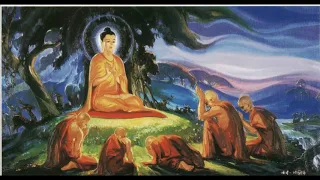
of five part two his teachings turning the wheel of the dharma the buddha said please listen my friends i have found the great way and i will show it to you you will be the first to hear my teaching This dharma is not the result of thinking it is the fruit of direct experience listen serenely with all your awareness the buddha's voice was filled with such spiritual authority that his five friends joined their palms and looked up at him spoke for them all please show us compassion and teach us the way the buddha began serenely
My brothers there are two extremes that a person on the path should avoid one is to plunge oneself into sensual pleasures and the other is to practice austerities which deprive the body of its needs both of these extremes lead to failure the path i have discovered is the middle way which avoids both extremes and has the capacity to lead one to Understanding liberation and peace it is the noble eightfold path of right understanding right thought right speech right action right livelihood right effort right mindfulness and right concentration i have followed this noble eightfold path and
have realized understanding Liberation and peace brothers why do i call this path the right path i call it the right path because it does not avoid or deny suffering but allows for a direct confrontation with suffering as the means to overcome it the noble eightfold path is the path of living and awareness mindfulness is the foundation by practicing mindfulness you can Develop concentration which enables you to attain understanding thanks to right concentration you realize right awareness thoughts speech action livelihood and effort the understanding which develops can liberate you from every shackle of suffering and give
birth to true peace and joy brothers there are four truths the existence of suffering the cause of suffering The cessation of suffering and the path which leads to the cessation of suffering i call these the four noble truths the first is the existence of suffering birth old age sickness and death are suffering sadness anger jealousy worry anxiety fear and despair are suffering separation from loved ones is suffering association with those you hate is Suffering desire attachment and clinging to the five aggregates are suffering brothers the second truth is the cause of suffering because of ignorance
people cannot see the truth about life and they become caught in the flames of desire anger jealousy grief worry fear and despair brothers the third truth is the cessation of suffering Understanding the truth of life brings about the cessation of every grief and sorrow and gives rise to peace and joy brothers the fourth truth is the path which leads to the cessation of suffering it is the noble eightfold path which i have just explained the noble eightfold path is nourished by living mindfully mindfulness leads to concentration and understanding which liberates you from Every pain and
sorrow and leads to peace and joy i will guide you along this path of realization while siddhartha was explaining the four noble truths kodana suddenly felt a great light shining within his own heart he could taste the liberation he had sought for so long his face beamed with joy the buddha pointed at him and cried Kodana you've got it you've got it kodana joined his palms and bowed before the buddha with deepest respect he spoke venerable gautama please accept me as your disciple i know that under your guidance i will attain the great awakening the
other four monks also bowed at the buddha's feet joined their palms and asked to be Received as disciples the buddha motioned his friends to rise the buddha smiled at them and said please brothers practice with an open and intelligent spirit and in three months you will have attained the fruit of liberation and the devas rejoiced and when the blessed one had set the wheel of dhamma in motion the earth devas cried out in jubilation ah At varanasi at the game refuge at isipatana the blessed one has set in motion the unexcelled wheel of dhamma that
cannot be stopped by any contemplative or deva or mara or god or by anyone in the cosmos on hearing the earth david's rejoicing the devas of the four kings heaven understood what they said and also took up the cry celebrating and this was followed by the devas of The 33 and the yamadevas and the toshita devas all the way up even to the devas of brahma's rechnu rejoicing they all proclaimed with one mighty voice aa varanasi at the game refuge at isipatana the blessed one has set in motion the unexcelled wheel of dhamma that cannot
be stopped by any contemplative or deva or mara or god or by anyone in the Cosmos thus this joyful song of praise traveled up even to the realm of the highest divinities and this system of ten thousand worlds trembled and quaked and shook and a boundless sublime radiance surpassing the glory of all the devas appeared in the world the story of shariputra and mugalana as found in the vinaya pitaka from the great disciples of the buddha By nayana punaka thera the power of the dhamma to ignite realization of ultimate truth is proportional to the receptivity
and earnestness of the disciple for those who have long trained themselves in the disciplines of contemplation and renunciation who have reflected deeply upon the impermanent and the deathless and who are ready to relinquish everything for the sake of final Deliverance even a concise four-line stanza can reveal more truth than volumes of systematic exposition among the first 61 arahants whom the master had sent forth to proclaim the message of deliverance to the world was an elder named assaji asajji had belonged to the group of five ascetics who had attended upon the bodhisattva when he was engaged
in his Ascetic practices and he was also one of the first five disciples one morning when asajji was walking on alms round in rajakaha upatissa later named sharipucha saw him calmly wending his way from door to door with his bowl in hand struck by asajji's dignified and serene appearance upatissa thought Never before have i seen such a monk he must be one of those who are arahants or who are on the way to our handship should i not approach him and question him but then he considered it is not the proper time now for putting
questions to this monk as he is going for alms through the streets i had better follow behind him after the manner of supplicants and he did so Then when the elder had finished his arms round and was seeking a quiet place to eat his meal upatissa spread out his own sitting cloth and offered the seat to the elder the elder asajji sat down and took his meal after which upatissa served him with water from his own water container and in this way performed towards asajji the duties of a pupil to a teacher After they had
exchanged the usual courteous greetings upatissa said serene are your features friend pure and bright is your complexion under whom have you gone forth as an ascetic who is your teacher and whose doctrine do you profess asajji replied there is friend a great recluse a scion of the sakyas who has gone forth from the sakya clan I have gone forth under him the blessed one that blessed one is my teacher and it is his dhamma that i profess what does the venerable one's master teach what does he proclaim question thus the elder asajji thought to himself
these wandering ascetics are opposed to the buddha's teaching i shall show him how profound this Teaching is so he said i am but new to the training friend it is not long since i went forth from home and i came but recently to this doctrine and discipline i cannot explain the dhamma in detail to you the wanderer replied i am called upatissa friend please tell me according to your ability Be it much or little it will be my task to penetrate its meaning by way of a hundred or a thousand methods and he added be
it little or much that you can tell the meaning only please proclaim to me to know the meaning is my soul desire of no use to me are many words in response the elder assad uttered this stanza of those things that arise from a cause The tatakata has told the cause and also what their cessation is this is the doctrine of the great recluse upon hearing the first two lines they arose in the wanderer upatissa the dust-free stainless vision of the dhamma the first glimpse of the deathless the path of stream entry and to the
ending of the last two lines he already listened as a stream enterer at once he knew Here is the means of deliverance to be found and he said to the elder do not enlarge upon this exposition of the dhamma venerable sir this much will suffice but where does our master live in the bamboo grove wanderer then please go ahead venerable sir i have a friend with whom i have made an agreement to share the dhamma i shall inform him And together we shall follow you and come into the master's presence upatissa then prostrated himself at
the elder's feet and went back to the park of the wanderers kolita later named bogalana saw him approaching and immediately knew today my friend's appearance is quite changed surely he must have found the deathless and when he acquired upatissa replied Yes friend the deathless has been found he told him all about his meeting with the elder assaji and when he recited the stanza he had heard kolita ii was established in the fruit of stream entry selections from the sutas on the gratification the danger and the escape before my enlightenment before my enlightenment o monks While
i was still a bodhisattva it occurred to me to ask what is the gratification in the world what is the danger in the world and what is the escape from the world then it occurred to me whatever pleasure and joy there is in the world this is the gratification in the world that the world is impermanent bound up with suffering and subject to change this is the danger in the world The removal and abandoning of craving and attachment for the world this is the escape from the world as long monks as i did not directly
know as they really are the gratification in the world as gratification its danger as danger and the escape from the world as escape for so long i did not claim to have awakened to the unsurpassed perfect enlightenment in this world with its devas mara and brahma In this population with its ascetics and brahmanas its davis and humans but when i directly knew all this then i claimed to have awakened to the unsurpassed perfect enlightenment in this world with its devas and humans the knowledge and vision arose in me unshakable is the liberation of my mind
this is my last birth there is now no renewed existence i set out seeking O monks i set out seeking the gratification in the world whatever gratification there is in the world that i have found i have clearly seen with wisdom just how far the gratification in the world extends i set out to understand the danger in the world whatever danger there is in the world that i have understood and i have clearly seen with wisdom just How far the danger in the world extends i set out seeking an escape from the world whatever escape
there is from the world that i have found i have clearly seen with wisdom just how far the escape from the world extends if there were no gratification if monks there were no gratification in the world beings would not become enamored with the world but because there is gratification in The world beings become enamored with it if there were no understanding of the danger in the world beings would not become disenchanted with the world but because there is an understanding of the danger in the world beings become disenchanted with it if there were no escape
from the world beings could not escape from it but as there is an escape from the world beings can escape from it daily advice to bikus Abstaining from all evil doing what is good cleansing one's mind this is the teaching of all the buddhas patience is the highest practice nibana is supreme say the buddhas a contemplative does not harm others a recluse oppresses no one not insulting not harming restrained according to the moral code moderate when it comes to food dwelling in solitude Engaging in higher mental development this is the teaching of all the buddhas
the three trainings monks these are the three trainings what three the training in ethics the training in meditation and the training in wisdom and what is the training in ethics it is when a person is ethical restrained in the code of conduct with good behavior and supporters seeing danger in the slightest fault They keep the rules they've undertaken this is called the training in ethics and what is the training in meditation it is when a person quite secluded from sensual pleasures secluded from unskillful qualities enters into and remains in the first jhana the second third
and fourth jhana this is called the training in meditation and what is the training in wisdom It is when a person realizes the undefiled freedom of heart and freedom by wisdom in this very life they live having realized through their own insight the ending of defilements this is called the training in wisdom these are the three trainings the fruits of an immoral and immoral life thereupon the blessed one addressed the devotees of pataligama thus the immoral man householders By falling away from virtue encounters five perils great loss of wealth through heedlessness and evil reputation a
timid and troubled demeanor in every society be it that of nobles brahmanas householders or ascetics death in bewilderment and at the breaking up of the body after death rebirth in a realm of misery in an Unhappy state in the netherworld in hell five blessings householders accrued to the righteous man through his practice of virtue great increase of wealth through his diligence a favorable reputation a confident deportment without timidity in every society be it that of nobles brahmanas Householders or ascetics a serene death and at the breaking up of the body after death rebirth in a
happy state in a heavenly world the sutra on the white clad disciple translated by tiknot on i heard these words of the buddha one time when he was staying at the monastery in the jetta grove near Savasti that had been donated by the layman nattapindika on that day anatha anathapentica came with 500 other lay students of the buddha to the hut where sharipucha resided they all bowed their heads in reference to shariputra and sat down respectfully to one side venerable sharipucha offered them skillful teachings Bringing them joy and confidence in the three jewels and the
practice of the true dharma then shariputra and the 500 laymen and women went together to the hut of the buddha where shariputra anatapindaga and the other 500 laymen and women prostrated at the buddha's feet and sat down to one side when he saw that everyone was seated the buddha addressed shariputra saying Shariputra if lay students of the buddha those who wear white robes study and practice the five precepts and the four contemplations they will realize without hardship the capacity to abide happily in the present moment they know they will not fall into the realms of
hell hungry ghosts animals and other suffering paths Such men and women will have attained the fruit of stream enterer and they will have no fear of descending into dark paths they are on the way of right awakening they will only need to return to the world of gods or men seven more times before attaining perfect liberation in the end of suffering shariputra how do lay students of the buddha Those who wear white robes study and practice the five precepts and the four contemplations they students of the buddha move away from killing put an end to
killing themselves of all weapons learn humility before others learn humility in themselves practice love and compassion and protect all living beings even the smallest insects They uproot from within themselves any tendency to kill in this way they students of the buddha study and practice the first of the five precepts they students of the buddha move away from taking what has not been given put an end to taking what has not been given they find joy in being generous without expecting anything in return their minds are not obscured by greed or Craving they constantly guard their
own honesty and uproot from within themselves any tendency to take what has not been given in this way lay students of the buddha study and practice the second of the five precepts late students of the buddha move away from sexual misconduct put an end to sexual misconduct and protect everyone those under the care of their father Mother or both father and mother their elder sister or elder brother their parents in law or other in-laws those of the same gender or other gender the wife daughter husband or son of another and those who have been raped
assaulted or sexually abused or who have been or who are prostitutes lay students of the buddha uproot from within themselves Any tendency to commit sexual misconduct in this way lay students of the buddha study and practice the third of the five precepts they students of the buddha move away from saying what is not true put an end to saying what is not true they only say what is true and they find great joy in saying what is true they always abide in truth and are completely reliable never deceiving others They have uprooted from within themselves
any tendency to say what is not true in this way lay students of the buddha study and practice the fourth of the five precepts they students of the buddha move away from taking intoxicants put an end to taking intoxicants they uproot from within themselves the habit of taking intoxicants in this way They students of the buddha study and practice the fifth of the five precepts shari putra how do lay students of the buddha attain the four contemplations and abide happily in the present moment with ease and without hardship they practice being aware of the buddha
as one who is truly and fully awakened and who is without any attachments as one whose understanding and practice are perfect As the well-gone one as one who knows and fully understands the world as one who has attained the very highest as one who has tamed what needs to be tamed as a teacher of humans and devas as an awakened one and as a world-honored one when they meditate in this way all unwholesome desires come to an end an impure sorrowful or anxious elements No longer arise in their hearts as a result of contemplating the
buddha their thoughts are clear they feel joy and they arrive at the first of the four contemplations abiding happily in the present moment with ease and without hardships shariputra the lay students of the buddha practice being aware of the dharma meditating as follows The dharma is taught by the lord buddha with great skill it can lead to complete liberation it can lead to a state of no afflictions there is not the pain of heat in it instead it is cool and refreshing its value is timeless when they students of the buddha meditate on and observe
the dharma in this way all unwholesome desires come to an end and impure sorrowful or anxious elements No longer arise in their hearts as a result of contemplating the dharma their thoughts are clear they feel joy and they arrive at the second of the four contemplations abiding happily in the present moment with ease and without any hardship shariputra the lay students of the buddha practice being aware of the sangha meditating as follows the noble community of the chatakata is Advancing in a good direction it is on an upright path a path of righteousness it is
oriented toward the dharma and lives the teachings in the way they are meant to be lived in that community there are the four pairs and the eight grades realized arhats and those who are realizing the fruit of our hot ship non-returners and those who are Realizing the fruit of non-returning once returners and those who are realizing the fruit of once returning and stream enterers and those who are realizing the fruit of stream entry the noble community of the tatagata has successfully realized the practice of the precepts sila the practice of concentration samadhi and the practice
of insight Prajna it has liberation and liberated vision it is worthy of respect honor service and offerings it is a beautiful field of merit for everyone as a result of contemplating the sangha their thoughts are clear they feel joy and they arrive at the third of the four contemplations Abiding happily in the present moment with ease and without any hardship shariputra delays students of the buddha practice being mindful of the precepts meditating as follows the precepts have no drawbacks flaws impurities or unsound points they help us abide in the pure land of the tatagata the
precepts are not of the nature to deceive they are always praised accepted Practiced and guarded by the holy ones as a result of contemplating these precepts the students thoughts are clear they feel joy and they arrive at the fourth of the four contemplations abiding happily in the present moment with ease and without any hardship shariputra remember that white-clad disciples of the buddha who practice in this way will not descend into hell Realms hungry ghost realms animal realms or any other realms of suffering they have experienced the fruit of stream entry which means not falling into
paths of hardship or wrongdoing having entered the stream they cannot help but go more and more in the direction of right awakening they will only need to return to the world of gods or humans seven more times before they arrive at complete liberation and the end of sorrow At that time the lord the world honored one pronounced these verses an intelligent man or woman who lives a family life and realizes how fearful the hell realms are is encouraged to receive and practice the right teachings and put an end to paths of suffering she studies and
learns to deepen the practice not killing living beings speaking of things as they really are And not taking what is not given he is faithful to his spouse moving away from the habit of sexual misconduct determined not to ingest intoxicants keeping his mind frenzy free and free of further obscurations she is always aware of the buddha the dharma and the sangha contemplating the mindfulness trainings her mind arrives at peace joy and freedom [Music] if he wants to practice generosity in order to cultivate the garden of happiness then his guideline is learning the path of liberation
and awakening shari putra listened carefully with regard to this point look carefully at the herd of oxen over there some oxen are both white and yellow some are black and red Some are brown with yellow spots while others are gray like pigeons whatever their color or place of origin they value lies to us in their ability to transport healthy and strong ones who pull carts vigorously can make many journeys and are most useful in our human world there are brahmanas warriors scholars tradesmen and artisans but the truly virtuous men and women are those who practice
the wonderful Precepts and are able to realize liberation like the well-gone one they live in true freedom there is no need to discriminate according to family or caste race gender or nationality to realize the greatest happiness is to make offerings to those who are truly virtuous a person who lacks virtue or who is poor in insight cannot light The way for others to make offerings to such a one bears little fruit sons and daughters of buddha who practice the way of insight have their minds directed to buddha have strong stable roots and are reborn only
to be happy returning to the world of gods and humans no more than seven times they eventually realized nirvana transforming all their suffering into Joy and purity thus spoke the buddha then venerable shariputra the other monks and nuns the layman anatapindika and the other 500 laymen and lay women heard these words and were delighted and put them into practice suta's on right effort and what is right effort there are four To guard and prevent to relinquish to cultivate and to maintain and increase the effort to guard and protect is when a person generates enthusiasm and
makes efforts so that harmful states that have not arisen do not arise the effort to relinquish is when a person generates enthusiasm and makes efforts so that harmful states that have arisen are given up Abandoned relinquished the effort to cultivate is when a person generates enthusiasm and makes efforts so that beneficial skillful qualities that have not yet arisen do arise and the effort to maintain and increase is when a person generates enthusiasm and makes efforts so that beneficial skillful qualities that have arisen remain and are not lost but increase mature and are fulfilled by Development
this is called right effort on the nature of right effort there are these four right efforts the effort to guard and prevent the effort to abandon the effort to develop and the effort to maintain and increase and what is the right effort to guard and prevent this is where a person on seeing a form with the eye does not grasp at any sign By which if he were to dwell without restraint over the faculty of the eye harmful unskillful states such as craving might develop he practices restraint and protects himself by guarding the eye and
similarly with the ear nose tongue body and mind this is called the right effort to guard and prevent and what is the right effort to abandon This is where a person does not accept for example a thought of attachment that has arisen in him he lets go of it right away abandons it destroys it dispels it wipes it out of existence neither does he accept any thought of anger or any harmful states that have arisen in him he lets go of them right away abandons them destroys them dispels them wipes them out of existence This
is called the right effort to abandon and what is the right effort to develop this is where a person awakens in himself a clear intention and begins to develop positive beneficial qualities this is called the right effort to develop and what is the right effort to maintain and increase this is where a person maintains these positive beneficial qualities he has Begun to cultivate he keeps them going develops and increases them and brings them to fulfillment this is called the right effort to maintain and increase selections on guarding the sense bases from the path of awakening
by pietan the right effort to prevent the hindrances or to mitigate even remove them is that of sense restraint this is given in a well-known stock passage that essentially instructs us to At once turn our attention away from the source of destruction that is any sight sound smell taste touch or thought saying we should grasp neither its sign nor its detail the sign here is our very first glimpse of an object signified by thinking or first thought while the details refer to our pondering or examining it this is our frontline defense against Mental distractions from
eight mindful steps to happiness by bante gunaratana the buddha advised his disciples not to notice the signs and features of any external stimulus that might give rise to unwholesome mind states sign refers to the hook the thing that catches your eye and makes you want to observe something more closely in order to rouse up some unwholesome state Feature refers to specific qualities of the object of your attention that may further stir up the unwholesome state if you are able to maintain continuous mindfulness nothing will upset you from the noble eightfold path by bhikkhu bodhi since
an uncontrolled response to sensory input stimulates the latent defilements what is evidently needed to prevent them from arising is control over the senses Thus the buddha teaches as the discipline for keeping the hindrances in check an exercise called restraint of the sense faculties when he perceives a form with the eye a sound with the ear an order with the nose a taste with the tongue an impression with the body or an object with the mind he apprehends neither the sign nor the Particulars and he strives to ward off that through which evil and unwholesome states
greed and sorrow would arise if he remained with unguarded senses and he watches over his senses restrains his senses restraint of the senses does not mean denial of the senses retreating into a total withdrawal from the sensory world this is impossible and even if it could be achieved The real problem would still not be solved for the defilements lie in the mind not in the sense organs or objects the key to sense control is indicated by the phrase not apprehending the sign or the particulars the sign is the object's general appearance insofar as this appearance
is grasped as the basis for defiled thoughts The particulars are its less conspicuous features if sense control is lacking the mind roams recklessly over the sense fields first it grasps the sign which sets the defilements into motion then it explores the particulars which permits them to multiply and thrive to restrain the census requires that mindfulness and clear understanding be Applied to the encounter with the sense fields three governing principles there are these three governing principles which three having the self as a governing principle having those with higher perceptions as a governing principle and having the
dharma as a governing principle and what is it to have the self as a Governing principle there is the case where a person having gone to a wilderness or to the foot of a tree or to an empty dwelling reflects in this way ah it is not for the sake of simple clothing that i study reflect and meditate it is not merely for the sake of food or lodgings or for the sake of this or that state in the future Rather it is simply because i am beset by birth aging and death by sorrow lamentation
pain distress and despair and that i aim to put an end to this entire mass of suffering now if i were to seek the same sort of sensual pleasures as before that would not be fitting for me so he reflects my persistence will be awakened and will be strong my mindfulness established and not Confused my body calm and not agitated my mind collected and gathered into one having made himself his governing principle he abandons what is harmful develops what is positive and beneficial and looks after himself well this is called having the self as a
governing principle and what is it to have those with higher perceptions as a governing principle this is the case where a person having Gone to a wilderness to the foot of a tree or to an empty dwelling reflects as before and that great is the community of this cosmos and in this great community there are contemplatives and brahmanas endowed with psychic power clairvoyant skilled in reading the minds of others they can see even from afar with their awareness they know the minds Of others and if i were to go in the wrong direction they would
know this of me and say look my friends at this person who although he has set forth remains overcome by harmful states and so he reflects as before my persistence will be awakened and will be strong my mindfulness established and not confused my body calm and not agitated my mind Concentrated and gathered into one having made those with higher perceptions his governing principle he abandons what is harmful develops what is positive and beneficial and looks after himself well this is called having those with higher perceptions as a governing principle and what is it to have
the dhamma as a governing principle there is the case where a person having gone to a wilderness To the foot of a tree or to an empty dwelling reflects in this way ah it is not for the sake of simple clothing that i study reflect and meditate it is not merely for the sake of food or lodgings or for the sake of this or that state in the future rather it is simply because i am beset by birth aging and death by sorrow lamentation pain distress and Despair and that i aim to put an end
to this entire mass of suffering now the dharma is well taught by the blessed one it is to be seen here and now it is timeless inviting all to come and see it is relevant now and is to be seen by the wise each for themselves there are fellow practitioners of the chaste life who dwell knowing and seeing The dhamma if i having gone forth in this well-taught dhamma and vinaya were to remain lazy and heedless that would not be fitting for me and so he reflects my persistence will be awakened and will be strong
my mindfulness established and not confused my body calm and not agitated my mind concentrated and gathered into One having made the dhamma his governing principle he abandons what is harmful develops what is positive and beneficial and looks after himself well this is called the dhamma as a governing principle these are the three governing principles the two bright dhammas that guard the world monks these two bright dhammas guard the world Which too having an awakened conscience and knowing the standards of the wise the frontier fortress just as the royal frontier fortress has a moat both deep
and wide for the protection of those within and to ward off those without in the same way the disciple of the noble ones has an awakened conscience he would feel embarrassment at even the Thought of engaging in harmful actions of body speech or mind with an awakened conscience as his moat the disciple of the noble ones abandons what is harmful develops what is positive and beneficial and looks after himself well just as the royal frontier fortress has an encircling wall both high and wide for the protection of those within and to ward off those without
In the same way the disciple of the noble ones is protected by knowing the standards of the wise he cherishes in his heart the ethical guidelines entrusted to him by tradition by his parents wise teachers elders and respected members of his community and aiming to uphold these standards he abandons what is harmful develops what is positive and beneficial and looks after himself well Just as the royal frontier fortress has a large army stationed within for the protection of those within and to ward off those without in the same way a disciple of the noble ones
with an awakened conscience and who knows the standards of the wise practices continually to guard against what is harmful he cultivates what is positive and beneficial and looks after himself well The bamboo acrobat on one occasion the blessed one was dwelling among the sumbas where there was a town called zedaka there the blessed one addressed the bikus thus bikus once in the past an acrobat set up his bamboo pole and addressed his apprentice thus come dear medacathalika climb the bamboo pole and stand on my Shoulders having replied yes teacher the apprentice climbed up the bamboo
pole and stood on the teacher's shoulders the acrobat then said to his apprentice you protect me dear medacathalika and i'll protect you thus guarded by one another protected by one another we'll display our skills collect our fee and get down safely from the bamboo pole When this was said the apprentice replied that's not the way to do it teacher you protect yourself teacher and i'll protect myself thus each self-guarded and self-protected will display our skills collect our fee and get down safely from the bamboo pole that's the method there the blessed one said it's just
as the apprentice said to the Teacher i will protect myself because thus should mindfulness be practiced i will protect others because thus should mindfulness be practiced protecting oneself one protects others protecting others one protects oneself and how is it because that by protecting oneself one protects others by the pursuit development and cultivation of mindfulness and by right effort It is in such a way that by protecting oneself one protects others and how is it pikus that by protecting others one protects oneself by patience harmlessness loving kindness and sympathy it is in such a way that
by protecting others one protects oneself i will protect myself because thus should mindfulness be practiced i will protect others because Thus should mindfulness be practiced protecting oneself one protects others protecting others one protects oneself a verse for one who discerns his own good this is enough to call up diligent effort for one who discerns another's good this is enough to call up diligent effort for one who discerns the good of both this is enough to call up diligent effort Balanced effort the story of sona once there was a monk named sona who was a student
of the buddha he was practicing intensively but not getting free from suffering or making any progress as he thought of giving up the practice and his ordination the buddha went to encourage him the buddha asked sona before you were ordained and practiced The dhamma what did you do sona and sona said i was a musician lord i played the veena a stringed instrument the buddha asked him ah i see tell me now when the strings on the instrument were too loose what was the result there was no sound then the buddha asked and when the
strings were too tight the sound was abrupt and not pleasant Came the reply and how was it when the strings were well tuned the instrument sounded fine then lord and i could offer pleasing music so the buddha said just so it is the same way here your effort in meditation should be neither too loose which would result in laziness and not getting anywhere or too tight which would result in agitation Dispersion and then burnout you should find the balance of effort that is just right for the purpose of meditation it is said that sona clearly
understood the meaning of what the buddha said and was then able to practice and become liberated these greatly fortunate conditions a selection from spiritual urgency sam vega in theravada buddhism according to buddhist teaching It is extremely rare that one is born as a human being and it is also rare to be born when a buddha's teaching is still available in the world in the chigala sutta of the samyta nikaya the buddha gives a simile of a blind turtle who lives on the ocean bed and surfaces once every hundred years a yoke floats on the vast
ocean being blown here and there by the wind The chances of the turtle surfacing at just the right time and in just the right place to be able to put its head through the yoke must be extremely rare it is likewise remarkable and auspicious that one obtains the human state it is also incredible wondrous and rare that a tatakata worthy and rightly self-awakened arises in the world and it is extraordinary that a doctrine and discipline expounded by a tatakata Remains and is available this treasured moment as stated by the buddha in the above discourse using
the simile of a blind turtle it is extremely rare for one to be born as a human being in the nakasika suta of the samyutta nikaya the buddha picked up some soil with one fingernail and asked the monks what was greater the soil beneath his nail or all the soil of the great earth Using this simile the buddha then stated that those who will be reborn as human beings are similar to the soil beneath his nail while the vast majority will be reborn in realms of deprivation it is like this he said and rarer still
is the appearance of a buddha in the world there have been some eons in the history of the world when there have been no awakened ones at All so even if one is born as a human being if it happens during a time when there is no true guide or if his teaching is not available it would be very difficult to be liberated from the endless cycle of birth and death and samsaric suffering we may even be born as a human being when the buddha's doctrine is available but if we are born in a region
of the world Or in conditions where we have no access to the teaching we would be unable to take advantage of it please keep this in mind first 182 of the tamapada is a timely reminder of the rarity of these conditions coming together the appearance of a buddha and our birth as a human rare it is to gain birth as a human being difficult is life in this world Hard it is to hear the sublime truth rare is the appearance of an enlightened one on sam vega and pasada balancing the two qualities of spiritual urgency
and serene inspired faith possessed of two qualities in balance even here and now a person both lives with ease and is wise in his efforts for the destruction of suffering what two they're called samvega Spiritual urgency and pasada which is known as serene faith this is said in the somanasa sutta the discourse on having ease in what evokes some vega spiritual urgency a contemplative should consider wisely and this is to be balanced with pasada serene confidence and joy faith in the buddha dhamma and sangha and in the path of practice when one has faith in
the chatagata Unshakable and well-established and virtuous behavior that is good loved by the noble ones and praised when one has confidence in the sangha and one's view has been straightened out they say that one is not poor that one's life is not lived in vain therefore an intelligent person remembering the buddha's teaching should be intent on faith and virtuous behavior confidence and vision of the dhamma Beyond right effort then a certain deva in the far extreme of the night her radiance lighting up the entirety of jetta's grove went to the blessed one on arrival having
bowed down to him she stood to one side as she was standing there she said to him tell me sir how you crossed over the flood I crossed over the flood without pushing forward and without staying in place but how sir did you cross over the flood without pushing forward and without staying in place when i pushed forward i was whirled about when i stayed in place i sank and so i crossed over the flood without pushing forward and without staying in place the deva at long last i see a brahmana totally Unbound who without
pushing forward and without staying in place has crossed over the entanglements of the world from the serenity suta because a biku who is not skilled in the ways of others minds should train i will be skilled in the ways of my own mind It is in this way that you should train yourselves and how is a biku skilled in the ways of his own mind it is just as if a woman or a man young youthful and fond of ornaments would look at her or his own facial reflection in a clean bright mirror or in
a bowl of clear water if they see any dust or blemish there they will make an effort to remove it But if they do not see any dust or blemish there they will be glad about it and their wish fulfilled they will think how fortunate for me that i'm clean so too because self-examination is very helpful for a biku to grow in wholesome qualities do i gain internal serenity of mind or not do i gain the higher wisdom of insight into phenomena or not If by such self-examination abiku knows i gain internal serenity of mind
but not the higher wisdom of insight into phenomena he should base himself on internal serenity of mind and make an effort to gain the higher wisdom of insight into phenomena then sometime later he gains both internal serenity of mind and the higher wisdom of insight into phenomena But if by such self-examination he knows i gain the higher wisdom of insight into phenomena but not internal serenity of mind he should base himself on the higher wisdom of insight into phenomena and make an effort to gain internal serenity of mind then sometime later he gains both the
higher wisdom of insight into phenomena and the internal serenity of mind But if by such self-examination he knows i gain neither internal serenity of mind nor the higher wisdom of insight into phenomena he should put forth extraordinary desire effort zeal enthusiasm into fatigability mindfulness and clear comprehension to obtain both of those wholesome qualities just as one whose clothes or head had Caught fire would put forth extraordinary desire effort zeal enthusiasm into fatigue ability mindfulness and clear comprehension to extinguish the fire on his clothes or head so that biku should put forth extraordinary desire effort zeal
enthusiasm indeed fatigability mindfulness and clear comprehension To obtain both of those wholesome qualities then some time later he gains both internal serenity of mind and the higher wisdom of insight into phenomena but if by such self-examination he knows i gain both internal serenity of mind and the higher wisdom of insight into phenomena he should base himself on those same wholesome qualities and make a further effort to reach the destruction of the Taints from the rahula vada suta the mirror the buddha asks rahula if he knows what amir is for and rahul replies for reflection sir
the buddha responds in the same way your thoughts words and deeds must be done with constant reflection reflect in this manner rahula Is this thought word or deed skillful will it lead to harm for myself or others or will it lead to release will this thought word or deed bring more suffering for myself or others or will it have a peaceful result if upon reflection your words thoughts and deeds will have peaceful results then this is fit for you and fit for a person developing understanding rahula all those who purify their minds Through continual reflection
mindfulness will do so in just this way rahula you should train yourself in just this way through continual mindfulness of your thoughts words and deeds the meta suta the discourse on love translated by tiknot han he or she who wants to attain peace should practice being upright humble and capable of using loving speech He or she will know how to live simply and happily with senses calmed without being covetous and carried away by the emotions of the majority let him or her not do anything that will be disapproved of by the wise ones and this
is what he or she contemplates may all beings be happy and safe and may their hearts be filled with joy may all living beings live in security and in peace beings who are frail or strong Tall or short big or small visible or not visible near or far away already born or yet to be born may all of them dwell in perfect tranquility let no one do harm to anyone let no one put the life of anyone in danger that no one out of anger or ill will wish anyone any harm Just as a mother
loves and protects her only child at the risk of her own life we should cultivate boundless love to offer to all living beings in the entire cosmos we should let our boundless love pervade the whole universe above below and across our love will know no obstacles our heart will be absolutely free from hatred and enmity whether standing or walking Sitting or lying down as long as we are awake we should maintain this mindfulness of love in our own heart this is the noblest way of living free from wrong views greed and sensual desires living in
beauty and realizing perfect understanding those who practice boundless love will certainly transcend birth and death the cultivation of love and kindness Having seen that like oneself all beings seek for happiness one patiently then cultivates love for all beings may all the precious children of this world be entirely well and at their ease may i be happy healthy and peaceful may i be free from suffering may my family friends neutral ones and all honored guests have every happiness may they be free from all suffering May they be free from all danger and all difficulty within the
boundaries of this town may all beings have happiness likewise those in other places in other cities and countries in all places may they all have happiness health and peace all creatures and all breathing things all persons and all entities men women and children the noble ones The unawake devas and unhappy ones who in the ten directions dwell may all beings be happy and at peace and may their hearts be filled with joy the kawamasuta with the kalamaz of kisamutta so i've heard at one time the buddha was wandering in the land of the kasalans together
with a large sangha of mendicants when he arrived at a town of The kalamaz named kisamutta the kalamas of kesamuta heard it seems the ascetic gautama a sakyan gone forth from asakin family has arrived at kesamuta he has this good reputation that blessed one is perfected a fully awakened buddha it is good to see such perfected ones then the kalamas went up to the buddha before sitting down to one side some bowed Some exchanged greetings and polite conversation some held their joined palms toward the buddha some announced their name and clan while some kept silent
seated to one side the kalamas said to the buddha there are sir some ascetics and brahmanas who come to kiss ammuta they explain and promote only their own doctrine While they attack bad mouth disparage and smear the doctrine of others then some other ascetics and brahmanas come to kisamutta they too explain and promote only their own doctrine while they attack badmouth disparage and smear the doctrine of others so sir we're doubting and uncertain i wonder who of these respected ascetics and brahmanas speaks the truth And who speaks falsehood it is enough columns for you to
be doubting and uncertain doubt has come up in you about an uncertain matter please columas don't go by oral transmission don't go by lineage don't go by testament don't go by canonical authority don't rely on logic don't rely on inference don't go by reason contemplation Don't go by the acceptance of a view after consideration don't go by the appearance of competence and don't think the aesthetic is our respected teacher but when you know for yourselves these things are unskillful blameworthy criticized by sensible people and when you undertake them they lead to harm and suffering then
you should give them up What do you think kalamaz does greed come up in a person for their welfare or harm harm sir a greedy individual overcome by greed kills living creatures steals commits adultery lies and encourages others to do the same is that for their lasting harm and suffering yes sir What do you think columns does hate come up for a person for their welfare or harm harm sir a hateful individual overcome by hate kills living creatures steals commits adultery lies and encourages others to do the same is that for their lasting harm and
suffering yes sir What do you think columns does delusion come up in a person for their welfare or harm harm sir a deluded individual overcome by delusion kills living creatures steals commits adultery lies and encourages others to do the same is that for their lasting harm and suffering yes sir what do you think columbus are these Things skillful or unskillful unskillful sir blameworthy or blameless blameworthy sir criticized or praised by sensible people criticized by sensible people sir when you undertake them do they lead to harm and suffering or not or how do you see this
when you undertake them they lead to harm and suffering that's how we see it so columnars when i said Please don't go by oral transmission don't go by lineage don't go by testament don't go by canonical authority don't rely on logic don't rely on inference don't go by reason contemplation don't go by the acceptance of a view after consideration don't go by the appearance of competence and don't think the ascetic is our respected teacher But when you know for yourselves these things are unskillful blameworthy criticized by sensible people and when you undertake them they lead
to harm and suffering then you should give them up that's what i said and this is why i said it please columns don't go by oral transmission don't go by lineage don't go by Testament don't go by canonical authority don't rely on logic don't rely on inference don't go by reason to contemplation don't go by the acceptance of a view after consideration don't go by the appearance of competence and don't think the ascetic is our respected teacher but when you know for yourselves these things are skillful Blameless praised by sensible people and when you undertake
them they lead to welfare and happiness then you should acquire them and keep them what do you think columns does contentment come up for a person for their welfare or harm welfare sir an individual who is content not overcome by greed doesn't kill Living creatures steal commit adultery lie or encourage others to do the same is that for their lasting welfare and happiness yes sir what do you think columns does love come up for a person for their welfare or harm does understanding come up for a person for their welfare or harm is that for
their lasting welfare and happiness Yes sir what do you think columns are these things skillful or unskillful skillful sir blameworthy or blameless blameless sir criticized or praised by sensible people praised by sensible people sir when you undertake them do they lead to welfare and happiness or not or how do you see this when you undertake them they lead to Welfare and happiness that's how we see it so columnist when i said please don't go by oral transmission don't go by lineage don't go by testament don't go by canonical authority don't rely on logic don't rely
on inference don't go by reason contemplation don't go by the acceptance of a view after consideration Don't go by the appearance of competence and don't think the ascetic is our respected teacher but when you know for yourselves these things are skillful blameless praised by sensible people and when you undertake them they lead to welfare and happiness then you should acquire them and keep them that's what i said and this is why i Said it then that noble disciple is rid of desire rid of ill will unconfused aware and mindful they meditate spreading a heart full
of love to one direction and to the second and to the third and to the fourth in the same way above below across everywhere all around they spread a heart full of love to the whole world abundant expansive limitless Free of enmity and ill will they meditate spreading a heart full of compassion to one direction and to the second and to the third and to the fourth in the same way above below across everywhere all around they spread a heart full of compassion to the whole world abundant expansive limitless free of enmity and ill will
they meditate spreading a heart full of Rejoicing to one direction and to the second and to the third and to the fourth in the same way above below across everywhere all around they spread a heart full of rejoicing to the whole world abundant expansive limitless free of enmity and ill will they meditate spreading a heart full of equanimity to one direction and to the second and to the third and to the Fourth in the same way above below across everywhere all around they spread a heart full of equanimity to the whole world abundant expansive limitless
free of enmity and ill will when that noble disciple has a mind that's free of enmity and ill-will uncorrupted and purified they've won four consolations in the Present life if it turns out there is another world and good and bad deeds have a result then when the body breaks up after death i'll be reborn in a good place a heavenly realm this is the first consolation they've won if it turns out there is no other world and good and bad deeds don't have a result Then in the present life i'll keep myself free of enmity
and ill will untroubled and happy this is the second consolation they've won if it turns out that bad things happen to people who do bad things then since i have no bad intentions and since i'm not doing anything bad how can suffering touch me this is the third consolation they've won If it turns out that bad things don't happen to people who do bad things then i still see myself pure on both sides this is the fourth consolation they've won when that noble disciple has a mind that's free of enmity and ill will undefiled and
purified they've won these four consolations in the present life that's so true blessed one that's so True holy one when that noble disciple has a mind that's free of enmity and ill will undefiled and purified they've won these four consolations in the present life excellent sir excellent we go for refuge to the master gautama to the teaching and to the mendicant sangha from this day forth may the buddha remember us as lay followers who have gone for refuge for life The discourse on knowing the better way to live alone i heard these words of the
buddha one time when the lord was staying at the monastery in the jetta grove in the town of savathi he called all the monks to him and instructed them pikus and the bekus replied we are here the blessed one taught i will teach you what is meant by knowing the better way To live alone i will begin with an outline of the teaching and then i will give a detailed explanation because please listen carefully blessed one we are listening the buddha taught do not pursue the past do not lose yourself in the future the past
no longer is the future has not yet come looking deeply at life as it is in the Very here and now the practitioner dwells in stability and freedom we must be diligent today to wait till tomorrow is too late death comes unexpectedly how can we bargain with it the sage calls a person who dwells in mindfulness night and day the one who knows the better way to live alone because what do we mean by pursuing the Past when you consider the way your body was in the past the way your feelings were in the past
the way your perceptions were in the past the way your mental formations were in the past and the way your consciousness was in the past when you consider these things and your mind is burdened by and attached to These things which belong to the past then you are pursuing the past because what is meant by not pursuing the past when you consider the way your body was in the past the way your feelings were in the past the way your perceptions were in the past the way your mental formations were in the past and the
way your consciousness was in the past when you consider these Things but your mind is neither enslaved by nor attached to these things which belong to the past then you are not pursuing the past because what is meant by losing yourself in the future when you consider the way your body will be in the future the way your feelings will be in the future the way your perceptions will be in the Future the way your mental formations will be in the future and the way your consciousness will be in the future when you consider these
things and your mind is burdened by and daydreaming about these things which belong to the future then you are losing yourself in the future because what is meant by not losing yourself in the future when you consider the way your body will Be in the future the way your feelings will be in the future the way your perceptions will be in the future the way your mental formations will be in the future and the way your consciousness will be in the future when you consider these things but your mind is not burdened by or daydreaming
about these things which belong to the future then you are not losing yourself in the future Because what is meant by being swept away by the present when someone does not study or learn anything about the awakened one or the teachings of love and understanding or the community that lives in harmony and awareness when that person knows nothing about the noble teachers and their teachings and does not practice these teachings and thinks this body is myself i am this Body these feelings are myself i am these feelings this perception is myself i am this perception
this mental formation is myself i am this mental formation and this consciousness is myself i am this consciousness then that person is being swept away by the present because what is meant by not being swept away by The present when someone studies and learns about the awakened one the teachings of love and understanding and the community that lives in harmony and awareness when that person knows about noble teachers and their teachings practices these teachings and does not think this body is myself i am this body these feelings are myself i am these Feelings this perception
is myself i am this perception this mental formation is myself i am this mental formation and this consciousness is myself i am this consciousness then that person is not being swept away by the present because i presented the outline and the detailed explanation of knowing the better way to live alone Thus the buddha taught and the bhikkhus were delighted to put his teachings into practice the discourse on the four establishments of mindfulness [Music] preface from old path white clouds by tiknot han in the spring of the following year the buddha delivered the sati patana sutta
the sutra on the four establishments of Mindfulness to a gathering of more than 300 bikus in kama sadama which was the capital of guru this was a sutra fundamental for the practice of meditation the buddha referred to it as the path which could help every person attain peace of body and mind overcome all sorrows and lamentations destroy suffering and grief and attain highest understanding and total Emancipation later venerable sharia putra told the community that this was one of the most important sutras the buddha had ever given he encouraged every bhikkhu and bikuni to study memorize
and practice it venerable ananda repeated every word of the sutra later that night afterwards during a drama discussion venerable asajji reminded the community that this was not the first time the Buddha had taught the four establishments of mindfulness he had in fact spoken about them on several occasions but this was the first time he had compiled all of his previous teachings on the subject in so complete and thorough away asaji agreed with shariputra that this suture should be memorized recited and practiced by every biku and bukuni the discourse on the four establishments Of mindfulness i
heard these words of the buddha one time when he was living at kamasadama a market town of the kuru people the buddha addressed the bhikkhus obikus and the bikus replied venerable lord the buddha said because there is a most wonderful way to help living beings realize purification overcome directly grief and sorrow End pain and anxiety travel the right path and realize nirvana this way is the four establishments of mindfulness what are the four establishments a practitioner remains established in the observation of the body in the body diligent with clear understanding mindful having abandoned every craving
and every distaste for this life He remains established in the observation of the feelings in the feelings diligent with clear understanding mindful having abandoned every craving and every distaste for this life he remains established in the observation of the mind in the mind diligent with clear understanding mindful having abandoned every craving and every Distaste for this life he remains established in the observation of the objects of the mind in the objects of the mind diligent with clear understanding mindful having abandoned every craving and every distaste for this life and how does a practitioner remain established
in the observation of the body in the body she goes to the forest To the foot of a tree or to an empty room sits down cross-legged in the lotus position holds her body straight and establishes mindfulness in front of her she breathes in aware that she is breathing in she breathes out aware that she is breathing out when she breathes in a long breath she knows I am breathing in a long breath when she breathes out a long breath she knows i am breathing out a long breath when she breathes in a short breath
she knows i am breathing in a short breath when she breathes out a short breath she knows i am breathing out a short breath she uses the following practice breathing in i am aware of my whole body breathing out i am aware of my whole body Breathing in i calm my body breathing out i calm my body just as a skilled potter knows when he makes a long turn on the wheel i am making a long turn and knows when he makes a short turn i am making a short turn so a practitioner when she
breathes in a long breath knows i am breathing in a long breath and when she breathes in a short breath she knows i am breathing in a short Breath when she breathes out a long breath she knows i am breathing out a long breath and when she breathes out a short breath she knows i am breathing out a short breath she uses the following practice breathing in i am aware of my whole body breathing out i am aware of my whole body breathing in i calm my body breathing out i calm my body Moreover when
a practitioner walks he is aware i am walking when he is standing he is aware i am standing when he is sitting he is aware i am sitting when he is lying down he is aware i am lying down in whatever position his body happens to be he is aware of the position of his body When the practitioner is going forward or backward he applies full awareness to his going forward or backward when he looks in front or looks behind bends down or stands up he also applies full awareness to what he is doing he
applies full awareness to wearing the sangati robe or carrying the alms bowl when he eats or drinks chews or savors the food he applies full awareness to all this When passing excrement or urinating he applies full awareness to this when he walks stands lies down sits sleeps or wakes up speaks or is silent he shines his awareness on all this further the practitioner meditates on her very own body from the soles of the feet upwards and then from the hair on top of the head downwards a body contained inside the skin and full of all
the impurities which belong To the body here is the hair of the head the hairs on the body the nails teeth skin flesh sinews bone bone marrow kidneys heart liver diaphragm spleen lungs intestines bowels excrement bile phlegm pus blood sweat fat tears grease saliva mucus synovial fluid Urine because imagine a sac which can be opened at both ends containing a variety of grains brown rice wild rice mung beans kidney beans sesame white rice when someone with good eyesight opens the bags he will review it like this this is brown rice this is wild rice these
are mung beans these are kidney beans these are sesame seeds this is White rice just so the practitioner passes in review the whole of his body from the soles of the feet to the hair on top of the head a body enclosed in a layer of skin and full of all the impurities which belong to the body here's the hair of the head the hairs on the body nails teeth skin flesh sinews bones bone marrow kidneys Heart liver diaphragm spleen lungs intestines bowels excrement bile phlegm pus blood sweat fat tears grease saliva mucous synovial fluid
urine further in whichever position her body happens to be the practitioner passes in review the elements which constitute the body in this body is the earth element the water element The fire element and the air element as a skilled butcher or an apprentice butcher having killed a cow might sit at the crossroads to divide the cow into many parts the practitioner passes in review the elements which comprise her very own body here in this body are the earth element the water element the fire element and the air element Further the practitioner compares his own body
with the corpse which he visualizes thrown onto a charnel ground and lying there for one two or three days bloated blue in color and festering and he observes this body of mind is of the same nature it will end up in the same way there is no way it can avoid that state further the practitioner compares his own body with a corpse which he Visualizes thrown onto a charnel ground pecked at by crows eaten by hawks vultures and jackals and infested with maggots and worms then it is just a skeleton with a little flesh and
blood sticking to it and the bones are held together by the ligaments then it is just a skeleton no longer adhered to by any flesh but still smeared by a Little blood the bones still held together by the ligaments then it is just a skeleton no longer adhered to by any flesh nor smeared by any blood but the bones are still held together by the ligaments then all that is left is a collection of bones scattered here and there in one place a hand bone in another a Shin bone a thigh bone a pelvis a
spinal column a skull then all that is left is a collection of bleached bones the color of shells then it has been lying there for more than one year and all that is left is a collection of dried bones then all that is left is the dust which comes from the rotted bones and he observes This body of mind is of the same nature it will end up in the same way there is no way it can avoid that state this is how the practitioner remains established in the observation of the body in the body
observation of the body from within or from without or both from within or from without he remains established in the observation of the process of coming to be in the body or the process of Dissolution in the body or both in the process of coming to be and the process of dissolution or he is mindful of the fact there is a body here until understanding and full awareness come about he remains established in the observation free not caught in any worldly consideration that is how to practice observation of The body in the body obikus how
does a practitioner remain established in the observation of the feelings in the feelings whenever the practitioner has a pleasant feeling she is aware i am experiencing a pleasant feeling the practitioner practices like this for all the feelings whether they are pleasant painful or neutral observing when they belong to the body And when they belong to the mind this is how the practitioner remains established in the observation of the feelings in the feelings observation of the feelings from within or from without or observation of the feelings both from within and from without she remains established in
the observation of the process of coming to be in the feelings or the process of dissolution in the Feelings or both in the process of coming to be and the process of dissolution or she is mindful of the fact there is feeling here until understanding and full awareness come about she remains established in the observation free not caught in any worldly consideration that is how to practice observation of The feelings in the feelings obikus because how does a practitioner remain established in the observation of the mind in the mind when his mind is desiring the
practitioner is aware my mind is desiring when his mind is not desiring he is aware my mind is not desiring he is aware in the same way concerning a Hating mind a confused mind a collected mind a dispersed mind an expansive mind a narrow mind the highest mind and a concentrated and liberated mind this is how the practitioner remains established in the observation of the mind in the mind observation of the mind from within or from without or observation of the mind both from within and from without He remains in the observation of the process
of coming to be in the mind or the process of dissolution in the mind or both in the process of coming to be and the process of dissolution or he is mindful of the fact there is mind here until understanding and full awareness come about he remains established in the observation Free not caught in any worldly consideration this is how to practice observation of the mind in the mind obikuz because how does the practitioner remain established in the observation of the objects of mind in the objects of mind first of all she observes the objects
of mind in the objects of mind with regard to the five hindrances how does she observe this When sensual desire is present in her she is aware sensual desire is present in me or when sensual desire is not present in her she is aware sensual desire is not present in me when sensual desire begins to arise she is aware of it when sensual desire that is already arisen is abandoned she is aware of it when sensual desire that has already been abandoned will not arise again in The future she is aware of it she practices
in the same way concerning anger dullness and drowsiness agitation and remorse and doubt further the practitioner observes the objects of mind in the objects of mind with regard to the five aggregates of clinging how does she observe this she observes like this such is form Such as the arising of form such as the disappearance of form such is feeling such as the arising of feeling such as the disappearance of feeling such is perception such as the arising of perception such as the disappearance of perception such are mental formations such as the arising of mental formations
such as the disappearance of mental formations Such as consciousness such is the arising of consciousness such is the disappearance of consciousness further because the practitioner observes the objects of mind in the objects of mind with regard to the sixth sense organs and the sixth sense objects how does she observe this she is aware of the eyes and aware of form And she is aware of the internal formations which are produced independent on these two things she is aware of the birth of a new internal formation and is aware of abandoning an already produced internal formation
and she is aware when an already abandoned internal formation will not arise again she is aware in the same way of the ears and sound The nose and smell the tongue and taste the body and touch the mind and objects of mind further because the practitioner remains established in the observation of the objects of mind in the objects of mind with regard to the seven factors of awakening how does he remain established in the practice of observation of the seven factors of awakening when the factor of awakening mindfulness Is present in him he is aware
mindfulness is present in me when mindfulness is not present in him he is aware mindfulness is not present in me he is aware when not yet born mindfulness is being born and when already born mindfulness is perfectly developed in the same way he is aware of the factors of investigation diligence Joy ease concentration and equanimity further because a practitioner remains established in the observation of objects of mind in the objects of mind with regard to the four noble truths how because does the practitioner remain established in the observation of the four noble truths a practitioner
is aware this is suffering as it arises she is aware this is the cause of the suffering as it arises She is aware this is the end of suffering as it arises she is aware this is the path which leads to the end of suffering as it arises this is how the practitioner remains established in the observation of the objects of mind in the objects of mind either from within or from without or both from within and from without she remains established in the observation of the process of coming to Be in any of the
objects of mind or the process of dissolution in the objects of mind or both in the process of coming to be and the process of dissolution or she is mindful of the fact there is an object of mind here until understanding and full awareness come about she remains established in the observation free not caught in any worldly consideration That is how to practice observation of the objects of mind in the objects of mine obikus because he who practices the four establishments of mindfulness for seven years can expect one of two fruits the highest understanding in
this very life or if there remains some residue of affliction he can attain the fruit of no return Let alone seven years because whoever practices the four establishments of mindfulness for six five four three two years or one year for seven six five four three or two months one month or half a month can also expect one of two fruits either the highest understanding in this very life or if there remains some residue of affliction He can attain the fruit of no return that is why we said that this path the path of the four
grounds for the establishment of mindfulness is the most wonderful path which helps beings realize purification transcend grief and sorrow destroy pain and anxiety travel the right path and realize nirvana the pekus were delighted to hear the teaching of the buddha they took it to heart and began to put It into practice the discourse on the full awareness of breathing preface from old path white clouds by tiknot on sometimes the buddha or one of his senior disciples gave a dharma talk at the bakuni's monastery once a month the bikunis also attended dharma discourses at chetavana or
eastern park One year thanks to a suggestion made by venerable shariputra the buddha extended the retreat session an extra month shariputra knew that by extending the retreat one month many bhikkhus and bukunis from distant centers would be able to travel to savathi for direct teaching from the buddha after they had concluded the retreats at their own centers and indeed many came Laypersons sudata visaka and malika used all the means at their disposal to provide food and dwelling for nearly three thousand monks and nuns the pavarana ceremony held at the end of each rainy season retreat
fell on the full moon day of the month of kattika that year rather than asa yuja when the full moon day of kattika arrived kumundi flowers were blooming everywhere Because the community a white lotus always blossomed at the same time each year the full moon day of katika was called kamundi day that evening the buddha and his three thousand disciples sat beneath the radiant full moon the delicate fragrance of lotus flowers drifted up from the lake the bikus and bukunis sat silently as the buddha looked out over the community And praised them for their diligence
the buddha used this special occasion to deliver the sutra on the full awareness of breathing that evening under the full moon the buddha delivered the sutra on the full awareness of breathing to three thousand disciples of course every biku and bikuni present had been taught the method of awareness of breathing but this was the first time that most of them had an opportunity to Hear this teaching directly from the buddha this was also the first time the buddha compiled and summarized all his previous teachings on the awareness of breathing venerable ananda listened intently knowing that
this sutra would be an important one to transmit to all the sangha the discourse on the full awareness of breathing i heard these words of the buddha one Time when he was staying in savathi in the eastern park with many well-known and accomplished disciples including shariputra baha mogalana maha kasipa anuradha revata and ananda the senior bikus in the community were diligently instructing bikus who were new to the practice some instructing 10 buckles some 20 some 30 and some 40. in this way the bikus who were new to the practice gradually made great progress that night
the moon was full and the pavarana ceremony was held to mark the end of the rainy season retreat lord buddha the awakened one was sitting in the open air and his disciples were gathered around him looking over the assembly he began to Speak o because i am pleased to observe the fruit you have attained in your practice yet i know you can make even more progress what you have not yet attained you can attain what you have not yet realized you can realize perfectly to encourage your efforts i will remain here until the next full
moon day when they heard that the lord buddha was Going to remain in savathi for another month pikus throughout the country began traveling there to study with him the senior bikus continued teaching the bikus new to the practice even more ardently some were instructing 10 bikus some 20 some 30 and some forty with this help the new urbikus were able little by little to continue their progress in understanding When the next full moon day arrived the buddha seated under the open sky looked over the assembly of bikus and began to speak obikuz our community is
pure and good at its heart it is without useless and boastful talk and therefore it deserves to receive offerings and be considered a field of merit such a community is rare and any pilgrim who seeks it no matter how far he must Travel will find it worthy opikus there are bikus in this assembly who have realized the fruit of our hot ship destroyed every route of affliction laid aside every burden and attained right understanding and emancipation there are also bikus who have cut off the first five internal knots and realized the fruit of never returning
to the cycle of birth and death there are those who have thrown off the first three internal nuts And realized the fruit of returning once more they have cut off the roots of greed hatred and ignorance and will only need to return to the cycle of birth and death one more time there are those who have thrown off the three internal knots and attained the fruit of stream enter coursing steadily to the awakened state there are those who practice the four establishments of mindfulness Awareness of the body and the body awareness of the feelings in
the feelings awareness of the mind in the mind and awareness of the objects of the mind in the objects of the mind there are those who practice the four right efforts not to allow any occasion for wrongdoing to arise once it has arisen to find a means to put an end to it To cause right action to arise when it has not already arisen and to find ways to develop right action and make it lasting once it has arisen and those who practice the four bases of success of diligence energy full awareness and penetration there
are those who practice the five faculties of faith energy mindfulness concentration and wisdom and those who Practice these as the five powers there are those who practice the seven factors of awakening of full attention the investigation of dharmas energy joy ease concentration and letting go or equanimity and those who practice the noble eightfold path there are those who practice loving-kindness those who practice compassion Those who practice joy and those who practice equanimity there are those who practice the nine cemetery contemplations the practice of contemplation on the nine stages of disintegration of a corpse from the
time it swells up to the time it becomes dust and those who practice the observation of impermanence there are also bikus who are already Practicing full awareness of breathing obikus the full awareness of breathing if developed and practiced continuously will be rewarding and bring great advantages it will lead to success in practicing the four establishments of mindfulness if the method of the four establishments of mindfulness is developed and practiced continuously it will lead to success in the practice of the seven factors of awakening The seven factors of awakening if developed and practiced continuously will give
rise to understanding and liberation of the mind what is the way to develop and practice continuously the method of full awareness of breathing so that the practice will be rewarding and offer a great benefit it is like this because the practitioner goes into the forest or to the foot of a tree Or to any deserted place sits stably in the lotus position holding his or her body quite straight and practices like this breathing in i know i am breathing in breathing out i know i am breathing out breathing in a long breath i know i
am breathing in a long breath breathing out a long breath i know i am breathing out a long breath breathing in a short breath i know i am breathing in a short breath Breathing out a short breath i know i am breathing out a short breath breathing in i am aware of my whole body breathing out i am aware of my whole body he or she practices like this breathing in i calm my whole body breathing out i calm my whole body he or she practices like this breathing in i feel joyful breathing out i
feel joyful he or she practices like this Breathing in i feel happy breathing out i feel happy he or she practices like this breathing in i am aware of my mental formations breathing out i am aware of my mental formations he or she practices like this breathing in i calm my mental formations breathing out i calm my mental formations he or she practices like this Breathing in i'm aware of my mind breathing out i am aware of my mind he or she practices like this in i make my mind happy breathing out i make my
mind happy he or she practices like this breathing in i concentrate my mind breathing out i concentrate my mind he or she practices like this breathing in i liberate my mind breathing out i liberate my mind he or she practices like this Breathing in i observe the impermanent nature of all dharmas breathing out i observe the impermanent nature of all dharmas he or she practices like this breathing in i observe the disappearance of desire breathing out i observe the disappearance of desire he or she practices like this breathing in i observe the no birth no
death nature of all phenomena Breathing out i observe the no birth no death nature of all phenomena he or she practices like this breathing in i observe letting go breathing out i observe letting go he or she practices like this the full awareness of breathing if developed and practiced continuously according to these instructions will be rewarding and of great benefit in what way does one develop and continuously practice the full awareness Of breathing in order to succeed in the practice of the four establishments of mindfulness when the practitioner breathes in or out a long or
short breath aware of his breath or his whole body or aware that he is making his whole body calm and at peace he abides peacefully in the observation of the body in the body persevering fully awake clearly understanding his state Gone beyond all attachment and aversion to this life these exercises of breathing with full awareness belong to the first establishment of mindfulness the body when the practitioner breathes in or out aware of joy or happiness of the mental formations or to make the mental formations peaceful he abides peacefully in the observation of the feelings in
the feelings persevering fully awake Clearly understanding his state gone beyond all attachment and aversion to this life these exercises of breathing with full awareness belong to the second establishment of mindfulness the feelings when the practitioner breathes in or out with the awareness of the mind or to make the mind happy to collect the mind in concentration or to free and liberate the mind He abides peacefully in the observation of the mind in the mind persevering fully awake clearly understanding his state gone beyond all attachment and aversion to this life these exercises of breathing with full
awareness belong to the third establishment of mindfulness the mind without full awareness of breathing there can be no development of meditative stability and understanding When the practitioner breathes in or breathes out and contemplates the essential impermanence or the essential disappearance of desire or the no birth no death nature of all phenomena or letting go he abides peacefully in the observation of the objects of mind in the objects of mind persevering fully awake clearly understanding his state Gone beyond all attachment and aversion to this life these exercises of breathing with full awareness belong to the fourth
establishment of mindfulness the objects of mind the practice of full awareness of breathing if developed and practiced continuously will lead to perfect accomplishment of the four establishments of mindfulness Moreover if they are developed and continuously practiced the four establishments of mindfulness will lead to perfect abiding in the seven factors of awakening how is this so when the practitioner can maintain without distraction the practice of observing the body in the body the feelings in the feelings the mind in the mind and the objects of mind in the objects of mind persevering Fully awake clearly understanding her
state gone beyond all attachment and aversion to this life with unwavering steadfast imperturbable meditative stability she will attain the first factor of awakening namely mindfulness when this factor is developed it will come to perfection when the practitioner can abide in meditative stability without being Distracted and can investigate every dharma every object of mind that arises then the second factor of awakening will be born and developed in her the factor of investigating dharmas when this factor is developed it will come to perfection when the practitioner can observe and investigate every dharma in a sustained persevering and
steadfast way without being distracted The third factor of awakening will be born and developed in her the factor of energy when this factor is developed it will come to perfection when the practitioner has reached a stable imperturbable abiding in the stream of practice the fourth factor of awakening will be born and developed in her the factor of joy when this factor is developed it will come to perfection When the practitioner can abide undistractedly in the state of joy she will feel her body and mind light and at peace at this point the fifth factor of
awakening will be born and developed the factor of ease when this factor is developed it will come to perfection when both body and mind are at ease the practitioner can easily enter into concentration At this point the sixth factor of awakening will be born and developed in her a factor of concentration when this factor is developed it will come to perfection when the practitioner is abiding in concentration with deep calm she will cease discriminating and comparing at this point the seventh factor of awakening is released born and developed In her the factor of letting go
when this factor is developed it will come to perfection this is how the four establishments of mindfulness if developed and practiced continuously will lead to perfect abiding in the seven factors of awakening how will the seven factors of awakening if developed and practiced continuously lead to the perfect accomplishment of true understanding and complete Liberation if the practitioner follows the path of the seven factors of awakening living in quiet seclusion observing and contemplating the disappearance of desire he will develop the capacity of letting go this will be a result of following the path of the seven
factors of awakening and will lead to the perfect accomplishment of true understanding and Complete liberation this is what the lord the awakened one said and everyone in the assembly felt gratitude and delight at having heard his teachings from old path white clouds venerable savasti had already heard the sutra on the four establishments of mindfulness he now felt that thanks to this sutra on the full awareness of breathing he could More deeply penetrate the four establishments he saw how these two sutras complemented one another and how fundamental they both were to the practice of meditation three
thousand bikus and bhikkhunis joyously received the buddha's teaching that night beneath the light of the full moon savasti's heart filled with gratitude to venerable shariputra for having made this night possible The luminous mind because this mind is luminous but it is defiled by adventitious defilements the uninstructed whirling does not understand this as it really is therefore i say that for the uninstructed whirling there is no development of the mind because this mind is luminous and it can be freed from adventitious defilements the instructed noble disciple Understands this as it really is therefore i say that
for the instructed noble disciple there is development of the mind from the simile of the cloth thus i've heard once the blessed one was staying at savathi in judges grove at anathependika's monastery there he addressed the monks thus monks venerable sir they replied The blessed one said this monks suppose a cloth were stained and dirty and to die or dipped it in some dye or other whether blue or yellow or red or pink it would take the dye badly and be impure in color and why is that because the cloth was not clean so too
monks when the mine is defiled an unhappy destination in a future Existence may be expected monks suppose a cloth were clean and bright and a dyer dipped it in some dye or other whether blue or yellow or red or pink it would take the dye well and be pure in color and why is that because the cloth was clean so too monks when the mind is undefiled a happy destination in a future existence may be expected And what monks are the defilements of the mind covetousness and greed ill will and anger hostility denigration being domineering
envy jealousy hypocrisy fraud obstinacy presumption conceit arrogance vanity and negligence are the defilements of the mind knowing these to be defilements of the mind the monk abandons them Having abandoned them he thereupon gains unwavering confidence in the buddha thinking thus indeed is the blessed one he is accomplished fully enlightened endowed with clear vision and virtuous conduct sublime nor of the worlds the incomparable guide for those who are able to learn the teacher of gods and men Enlightened and blessed he gains unwavering confidence in the dhamma thinking well proclaimed by the blessed one is the dharma
realizable here and now possessed of immediate result bidding you come and see accessible and knowable individually by the wise and he gains unwavering confidence in the sangha thinking The sangha of the blessed ones disciples has entered on the good way has entered on the straight way has entered on the true way has entered on the proper way that is to say the four pairs of men the eight types of persons this sangha of the blessed one's disciples is worthy of gifts worthy of hospitality worthy of offerings worthy of referential salutation The incomparable field of merit
for the world when he has given up renounced let go abandoned and relinquished the defilements in part he knows i am endowed with unwavering confidence in the buddha in the dhamma and in the sangha and he gains enthusiasm for the goal gains enthusiasm for the dhamma gains gladness connected with the dhamma when he is gladdened joy is born in him Being joyous in mind his body becomes tranquil his body being tranquil he feels happiness and the mind of him who is happy becomes concentrated just as cloth that is stained and dirty becomes clean and bright
with the help of pure water or just as gold becomes clean and bright with the help of a furnace so too it may be said of a monk of such Virtue such concentration and such wisdom his mind becomes clean and bright then he abides having suffused with a mind of loving kindness towards one direction of the world likewise the second likewise the third likewise the fourth and so above below around and everywhere and to all as to himself he abides suffusing the entire universe with loving kindness with a mind grown Great lofty boundless and free
from enmity and ill will he abides having suffused with a mind of compassion of sympathetic joy of equanimity towards one direction of the world likewise the second likewise the third likewise the fourth and so above below around and everywhere and to all as to himself he abides Suffusing the entire universe with equanimity with a mind grown great lofty boundless and free from enmity and ill will he understands what exists what is low what is excellent and what escape there is from this whole of samsara when he knows and sees in this way his mind becomes
liberated from the afflictions related to sense desire liberated from the afflictions related to becoming And liberated from the afflictions related to ignorance when liberated there is knowledge it is liberated and he knows birth is exhausted the life of purity has been lived the task is done there is no more of this to come such a monk is called one bathe with the inner bathing thoroughly purified and resplendent The hindrances to mental development two texts the sangha rava suta on the hindrances at savathi the brahmana sagaratha asked the buddha why is it good gautama how does
it come about that sometimes the sacred words i have long studied are not clear to me not to mention those i have not studied and how is it too that sometimes other Sacred words that i have not so studied are clear to me not to mention those i have studied well brahman when a man dwells with his heart possessed and overwhelmed by sense desires and does not know as it really is the way of escape from those sense desires that have arisen then he cannot know or see as it really is what is to his
own prophet Nor can he know and see what is to the prophet of others or of both himself and others and even sacred words he has long studied are not clear to him not to mention those he has not studied imagine brahman a bowl of water mixed with red yellow blue or crimson dye if a man with good eyesight were to look at the reflection of his own face in it he would not know or see it as it really Was in the same way brahman when a man dwells with his heart possessed and overwhelmed
by sense desires then he cannot know or see as it really is what is to his own prophet to the prophet of others to the prophet of both and even sacred words he has long studied are not clear to him not to mention those he has not studied Again brahman when a man dwells with his heart possessed and overwhelmed with anger then he cannot know or see imagine a bowl of water heated on a fire boiling up and bubbling over if a man with good eyesight were to look at the reflection of his own face
in it he would not know or see it as it really was again brahman when a man dwells with his heart possessed and overwhelmed by Dullness and drowsiness then he cannot know or see imagine a bowl of water covered over with slimy moss and water plants if a man with good eyesight were to look at the reflection of his own face in it he would not know or see it as it really was again brahman when a man dwells with his heart possessed and overwhelmed by restlessness and worry then he cannot know or see Imagine
a bowl of water ruffled by the wind so that the water trembled eddied and rippled if a man with good eyesight were to look at the reflection of his own face in it he would not know or see it as it really was again brahman when a man dwells with his heart possessed and overwhelmed by doubt and wavering he cannot know or see Imagine a bowl of water agitated stirred up muddied put in a dark place if a man with good eyesight were to look at the reflection of his own face in it he would
not know or see it as it really was in the same way brahman when a man dwells with his heart possessed and overwhelmed by doubt and wavering then he cannot know or see as it really is What is to his own prophet to the prophet of others to the prophet of both and even sacred words he has long studied are not clear to him not to mention those he has not studied but brahman when a man dwells with his heart not possessed not overwhelmed by sense desires anger dullness and drowsiness Restlessness and worry or doubt
and wavering not as previously described but is like water that is clear limped and set out in the open then he knows and sees as it really is what is to his own prophet to the prophet of others to the prophet of both himself and others and even sacred words he has not long studied are clear to him Not to mention those he has studied the refinement of the mind there are amongst gross impurities in gold such as earth and sand gravel and grit now the goldsmith or his apprentice first pours the gold into a
trough and washes rinses and cleans it thoroughly when he has done this there still remain moderate impurities in the gold such as fine grit and coarse sand Then the goldsmith or his apprentice washes rinses and cleans it again when he has done this there still remain minute impurities in the gold such as fine sand and black dust now the goldsmith or his apprentice repeats the washing and thereafter only the gold dust remains he now pours the gold into a melting pot smelts it and melts it together but he does not yet take it out from
the Vessel as the dross has not yet been entirely removed and the gold is not yet quite pliant workable and bright it is still brittle and does not yet lend itself easily to molding but a time comes when the goldsmith or his apprentice repeats the melding thoroughly so that the flaws are entirely removed the gold is now quite pliant workable and bright And it lends itself easily to molding whatever ornament the goldsmith now wishes to make of it be it a diadem earrings a necklace or a gold chain the gold can now be used for
that purpose it is similar monks when a monk devoted to the training in the higher mind there are in him gross impurities namely bad conduct of body speech and mind such conduct an earnest capable monk Abandons dispels eliminates and abolishes when he has abandoned these there are still impurities of moderate degree that cling to him namely sensual thoughts thoughts of ill will and thoughts of harming such thoughts an earnest capable monk abandons dispels eliminates and abolishes when he has abandoned these there are still some subtle impurities that cling To him namely thoughts about his relatives
his home country and his reputation such thoughts and earnest capable monk abandons dispels eliminates and abolishes when he has abandoned these there still remain thoughts about the teaching that concentration is not yet peaceful and sublime it is not attained to full tranquility Nor has it achieved mental unification it is maintained by strenuous suppression of the defilements but there comes a time when his mind becomes inwardly steadied composed unified and concentrated that concentration is then calm and refined it has attained to full tranquility and achieved mental unification it is not maintained by strenuous Suppression of the
defilements then to whatever mental state realizable by direct knowledge he directs his mind he achieves the capacity of realizing that state by direct knowledge whenever the necessary conditions obtained the removal of distracting thoughts thus have i heard on one occasion the blessed one was living at savathi in jetta's grove and At the pentagon's park there he addressed the bhikkhus thus pikus venerable sir they replied the blessed one said this because when abiku is pursuing the higher mind from time to time he should give attention to five signs what are the five here pikus when a
biku is giving attention to some sign and owing to that sign there arise In him evil unwholesome thoughts connected with desire with hate and with delusion then he should give attention to some other sign connected with what is wholesome when he gives attention to some other sign connected with what is wholesome then any evil unwholesome thoughts connected with desire with hate and with delusion are abandoned in him and subside With the abandoning of them his mind becomes steady internally brought to singleness and concentrated just as a skilled carpenter or his apprentice might knock out remove
and extract a coarse peg by means of a fine one so too when abiku gives attention to some other sign connected with what is wholesome his mind becomes steadied internally quieted Brought to singleness and concentrated if while he is giving attention to some other sign connected with what is wholesome there still arise in him evil unwholesome thoughts connected with desire with hate and with delusion then he should examine the danger in those thoughts thus these thoughts are unwholesome they are reprehensible they result in Suffering when he examines the danger in those thoughts then any evil
unwholesome thoughts connected with desire with hate and with delusion are abandoned in him and subside with the abandoning of them his mind becomes steadied internally quieted brought to singleness and concentrated just as a man or a woman young youthful and fond of ornaments Would be horrified humiliated and disgusted if the carcass of a snake or a dog or a human being were hung around his or her neck so too when abiku examines the danger in those thoughts his mind becomes steadied internally quieted brought to singleness and concentrated if while he is examining the danger in
those thoughts there is still a rise in him evil unwholesome thoughts connected With desire with hate and with delusion then he should try to forget those thoughts and should not give attention to them when he tries to forget those thoughts and does not give attention to them then any evil unwholesome thoughts connected with desire with hate and with delusion are abandoned in him and subside with the abandoning of them his mind becomes steadied internally Quieted brought to singleness and concentrated just as a man with good eyes who did not want to see forms that had
come within range of sight would either shut his eyes or look away so too when a biku tries to forget those thoughts and does not give attention to them his mind becomes steadied internally quieted brought to singleness and concentrated If while he is trying to forget those thoughts and is not giving attention to them there still arise in him evil unwholesome thoughts connected with desire with hate and with delusion then he should give attention to stilling the thought formation of those thoughts when he gives attention to stilling the thought formation of those thoughts then any
evil unwholesome thoughts Connected with desire with hate and with delusion are abandoned in him and subside with the abandoning of them his mind becomes steadied internally quieted brought to singleness and concentrated just as a man walking fast might consider why am i walking fast what if i walk slowly and he would walk slowly Then he might consider why am i walking slowly what if i stand and he would stand then he might consider why am i standing what if i sit and he would sit then he might consider why am i sitting what if i
lie down and he would lie down by doing so he would substitute for each grosser posture one that was subtler so too when a biku gives attention to stilling the thought formation of those Thoughts his mind becomes steadied internally quieted brought to singleness and concentrated if while he is giving attention to stilling the thought formation of those thoughts there still arise in him evil unwholesome thoughts connected with desire with hate and with delusion then with his teeth clenched and his tongue pressed against the roof of his mouth He should beat down constrain and crush mind
with mind when with his teeth clenched and his tongue pressed against the roof of his mouth he beats down constrains and crushes mind with mind then any evil unwholesome thoughts connected with desire with hate and with delusion are abandoned in him and subside with the abandoning of them his mind Becomes steadied internally quieted brought to singleness and concentrated pikus when abiku is giving attention to some sign and owing to that sign there arise in him evil unwholesome thoughts connected with desire with hate and with delusion then when he gives attention to some other sign connected
with what is wholesome any such evil and wholesome thoughts are abandoned in him and Subside and with the abandoning of them his mind becomes steadied internally quieted brought to singleness and concentrated when he examines the danger in those thoughts when he tries to forget those thoughts and does not give attention to them when he gives attention to stilling the thought formation of those thoughts and when with his teeth clenched and his tongue pressed against the roof of his Mouth he beats down constrains and crushes mind with mind any such evil unwholesome thoughts are abandoned in
him and his mind becomes steadied internally quieted brought to singleness and concentrated this biku is then called a master of the courses of thought he will think whatever thought he wishes to think and he will not think any thought that he does not wish to think He has severed craving flung off the fetters and with the complete penetration of conceit he has made an end to suffering that is what the blessed one said the beakus were satisfied and delighted in the blessed one's words the discourse on the five ways of putting an end to anger
i heard these words of the buddha one time when he was staying in the anathapindika monastery in the jetta Grove near the town of shravasti one day the venerable shariputra said to the monks friends today i want to share with you five ways of putting an end to anger please listen carefully and put into practice what i teach the pictures agreed and listened carefully the venerable shariputra then said What are these five ways of putting an end to anger this is the first way my friends if there is someone whose bodily actions are not kind
but whose words are kind if you feel anger toward that person but you are wise you will know how to meditate in order to put an end to your anger my friends say there is a big shoe practicing asceticism who wears a Patchwork robe one day he is going past a garbage pile filled with excrement urine mucus and many other filthy things and he sees in the pile one piece of cloth still intact using his left hand he picks up the piece of cloth and he takes the other end and stretches it out with his
right hand he observes that this piece of cloth is not torn And has not been stained by excrement urine sputum or other kinds of filth so he folds it and puts it away to take home wash and sow into his patchwork robe my friends if we are wise when someone's bodily actions are not kind but his words are kind we should not pay attention to his unkind bodily actions but only be attentive to his kind words this will help us put an end to our anger My friends this is the second method if you become
angry with someone whose words are not kind but whose bodily actions are kind if you are wise you will know how to meditate in order to put an end to your anger my friends say that not far from the village there is a deep lake and the surface of that lake is covered with algae and grass there is someone who comes near that Lake who is very thirsty suffering greatly from the heat he takes off his clothes jumps into the water and using his hands to clear away the algae and grass enjoys bathing and drinking
the cool water of the lake it is the same way my friends with someone whose words are not kind but whose bodily actions are kind do not pay attention to that person's words Only be attentive to his bodily actions in order to be able to put an end to your anger someone who is wise should practice in this way here is the third method my friends if there is someone whose bodily actions and words are not kind but who still has a little kindness in his heart if you feel anger toward that person and are
wise you will know how to meditate to put an End to your anger my friends say there is someone going to a crossroads she is weak thirsty poor hot deprived and filled with sorrow when she arrives at the crossroads she sees a buffalo's footprint with a little stagnant rainwater in it she thinks to herself there is very little water in this buffalo's footprint if i use my hand or a leaf to scoop it Up i will stir it up and it will become muddy and undrinkable therefore i will have to kneel down with my arms
and knees on the earth put my lips right to the water and drink it directly straight away she does just that my friends when you see someone whose bodily actions and words are not kind but where there is still a little kindness in her heart Do not pay attention to her actions and words but to the little kindness that is in her heart so that you may put an end to your anger someone who is wise should practice in that way this is the fourth method my friends if there is someone whose words and bodily
actions are not kind and in whose heart there is nothing that can be called kindness if you are angry with that person and You are wise you will know how to meditate in order to put an end to your anger my friends suppose there is someone on a long journey who falls sick he is alone completely exhausted and not near any village he falls into despair knowing that he will die before completing his journey if at that point someone comes along and sees this man's situation She immediately takes the man's hand and leads him to
the next village where she takes care of him treats his illness and makes sure he has everything he needs by way of clothes medicine and food because of this compassion and loving kindness the man's life is saved just so my friends when you see someone whose words and bodily actions are not kind and in whose Heart there is nothing that can be called kindness give rise to this thought someone whose words and bodily actions are not kind and in whose heart is nothing that can be called kindness is someone who is undergoing great suffering unless
he meets a good spiritual friend there will be no chance for him to transform and go to realms of happiness thinking like this you will be able to Open your heart with love and compassion toward that person you will be able to put an end to your anger and help that person someone who is wise should practice like this my friends this is the fifth method if there is someone whose bodily actions are kind whose words are kind and whose mind is also kind if you are angry with that person and you are wise You
will know how to meditate in order to put an end to your anger my friends suppose that not far from the village there is a very beautiful lake the water in the lake is clear and sweet the bed of the lake is even the banks of the lake are lush with green grass and all around the lake beautiful fresh trees give shade someone who is thirsty suffering from heat Whose body is covered in sweat comes down to the lake takes off his clothes leaves them on the shore jumps down into the water and finds great
comfort and enjoyment in drinking and bathing in the pure water his heat thirst and suffering disappear immediately in the same way my friends when you see someone whose bodily actions are kind whose words are kind And whose mind is also kind give your attention to all his kindness of body speech and mind and do not allow anger or jealousy to overwhelm you if you do not know how to live happily with someone who is as fresh as that you cannot be called someone who has wisdom my friends i have shared with you the five ways
of putting an end to anger when the big truths heard the venerable shariputra's words they were happy to Receive them and put them into practice the cave that man who was greatly attached to the cave of the body and sunk in delusion such a one is far from detachment sensual pleasures are not easy to abandon in this world those who are bound to worldly pleasures conditioned by craving are difficult to liberate they cannot be liberated by others Perceiving their past and possible future indulgence they long for more those who are greedy engage in and are
entranced by sensual pleasures those who remain caught in their miserable state then cry out what will happen to us after death therefore a person should train himself in this immediate present if he knows that the world is engaging in all sorts of harmful deluded actions he should not go the same way Life is short say the wise i observe these trembling beings of the world given to desire for various states of becoming they are the wretched who cringe at the thought of death not being free from craving for repeated birth look at those who struggle
after their desires there like a fish in a stream that is fast drying up Seeing this let one fare without attachment in this life and thereby cease to worry about future states overcoming desire for sense enjoyments by clearly comprehending sense impressions the gratification their danger and the escape and no longer craving not going against one's conscience or the standards of the wise A person is not caught by what he sees or hears or thinks about keeping the larger view in mind and having realized the nature of grasping thoughts this person is no longer attached to
worldly objects having pulled out the dart of passion and faring heedfully he does not crave in this world or the next from the absolute truth sutra don't let yourself be caught in any of the entanglements of life We must know how to let go of them if you can let go of wrong desires you can overcome all suffering practitioners must transcend the cycle of suffering in order to realize their career of liberation a real practitioner must have a sincere mind he doesn't do anything based on wrong perception he just walks straight on his path he
must know how to extinguish the fire Of anger and hatred he must know how to break through the greed for sense desires in him if he knows how to free himself from the net of afflictions he will start to see the shore of liberation we should let go of pride we shouldn't sleep too much nor let ourselves fall into indolence we should know how to live and not let ourselves be carried away by the emotions of the majority Let us not be caught by any dazzling appearance and let us know how to walk away unfazed
let us always contemplate the empty transparent nature of all appearances to our mind in order to attain the quiet of nirvana don't let yourself be pulled by and attached to deceiving appearances don't lose yourself in entertainments and forget that the goal of our practice is to help ourselves and others to get Out of suffering what belongs to the past we don't think about anymore what belongs to the future we don't dream about we should recognize what is happening in the present moment and not get caught in it this way we walk with ease on the
five vast continents i say sensual desire is the force that causes the most destruction The flood that engulfs the whole world only by seeing that clearly can we master all doubts when we wholeheartedly contemplate dependent origination we will see that if we are not free from sense desire it will be difficult for us to end suffering throughout the ages among any great number of people very few have the capacity to let go of desires But once a practitioner can release them that flood subsides all by itself depending on the clarity and strength of his understanding
the wise person crosses to the other shore thanks to his understanding he doesn't worry anymore and feels protected birth death disasters and jealousy cannot affect him anymore because of his energy and diligence he attains genuine peace See how it is upon emancipation from craving and detachment suffering dissipates the practitioner contemplates the selfless nature of all things and is thereby not caught by anything the practitioner does not hold on to the idea that this body is me he understands that self is by nature ungraspable and that it doesn't really exist independently as it appears to the
mind When this ignorance is completely uprooted and new sprouts of ignorance are given no chance to grow the practitioner no longer grasps at anything no longer caught in the concepts of mind and material objects as self-existent realities independent of each other or any other concept not seeing anything at all to grasp there Nothing in this world can trouble him having completely transcended all concepts there is not a single practice we do not achieve having studied practiced and eloquently taught the teachings even if someone comes to ask questions he won't be shy or hesitant in responding
attained understanding he is no longer dependent on anyone because he no longer yearns for anything Or feels aversion he attains tranquility and peace and realizes nirvana looking down the muni doesn't feel proud looking up he doesn't feel afraid he is not caught in any view at that time all conflicts have stopped and even though he is abiding free he has no pride and from the jarasuta a practitioner must live with the truth Do not lose mindfulness this realization and heedfulness pure as a lotus which has grown from the mud but is untainted by the mud
a wise person is like this and everything that has been seen and heard is also like everything that has never been seen or heard the higher stages of training having abandoned these five hindrances defilements of the mind that weaken wisdom Secluded from sensual pleasures secluded from unwholesome states he enters and dwells in the first jhana which is accompanied by thought and examination with rapture and happiness born of seclusion he makes the rapture and happiness born of seclusion drench steep fill and pervade this body so that there is no part of his whole body that is
not pervaded by the rapture and happiness Born of seclusion just as a skilled bath man or a bath man's apprentice heaps bath powder in a metal basin and sprinkling it gradually with water needs it until the moisture wets his ball of bath powder soaks it and pervades it inside and out yet the ball itself does not ooze so too a monk makes the rapture and happiness born of seclusion drench steep fill and pervade this body so that there is no part of his whole Body that is not pervaded by the rapture and happiness born of
seclusion again monks with the subsiding of thought and examination he enters and dwells in the second genre which has internal confidence and unification of mind is without thought and examination and has rapture and happiness born of concentration he makes the rapture and happiness born of concentration drench steep fill and pervade this body So that there is no part of his whole body that is not pervaded by the rapture and happiness born of concentration just as though there were a lake whose waters welled up from below and it had no inflow from east west north or
south and would not be replenished from time to time by showers of rain then the cool fount of water welling up in the lake would make the cool water drench steep fill and pervade the lake So that there would be no part of the whole lake that is not pervaded by cool water so too a monk makes the rapture and happiness born of concentration drench steep fill and pervade this body so that there is no part of his whole body that is not pervaded by the rapture and happiness born of concentration again monks with the
fading away as well of rapture he dwells equanimous and mindful and Clearly comprehending he experiences happiness with the body he enters and dwells in the third genre of which the noble ones declare he is equanimous mindful one who dwells happily he makes the happiness divested of rapture drench steep fill and pervade this body so that there is no part of his whole body that is not pervaded by the Happiness divested of rapture just as in a pond of blue or red or white lotuses some lotuses that are born and grow in the water thrive immersed
in the water without rising out of it and cool water drenches steeps fills and pervades them to their tips and their roots so that there is no part of all those lotuses that is not pervaded by cool water So too a monk makes the happiness divested of rapture drench steep fill and pervade this body so that there is no part of his whole body that is not pervaded by the happiness divested of rapture again monks with the abandoning of pleasure and pain and with the previous disappearance of joy and dejection a monk enters upon and
dwells in the fourth jhana Which has neither pain nor pleasure and purity of mindfulness due to equanimity he sits pervading this body with a pure bright mind so that there is no part of his whole body that is not pervaded by the pure bright mind just as though a man were sitting covered from the head down with a white cloth so that there would be no part of his whole body that is not pervaded by the White cloth so too a monk sits pervading this body with a pure bright mind so that there is no
part of his whole body that is not pervaded by the pure bright mind when his mind is thus concentrated purified bright unblemished rid of defilements malleable wieldy steady and attained to imperturbability he directs it to the Knowledge of the recollection of past lives he recollects his manifold past lives that is one birth two births thus with their aspects and particulars he recollects his manifold past lives just as a man might go from his own village to another village and then back again to his own village he might think i went from my own village to
that village and there i stood in such a way Sat in such a way spoke in such a way kept silent in such a way and from that village i went to that other village and there i stood in such a way sat in such a way spoke in such a way kept silent in such a way and from that village i came back again to my own village so too a monk recollects his manifold past lives Thus with their aspects and particulars he recollects his manifold past lives when his mind is thus concentrated purified
bright unblemished rid of defilements malleable wieldy steady and attained to imperturbability he directs it to the knowledge of the passing away and rebirth of beings thus with the divine eye which is purified and surpasses the human he sees beings passing away and being Reborn inferior and superior fair and ugly fortunate and unfortunate and he understands how beings pass on according to their actions just as though there were two houses with doors and a man with good sight standing there between them saw people entering the houses and coming out and passing to and fro So too
with the divine eye which is purified and surpasses the human among seas beings passing away and being reborn and he understands how beings pass on according to their actions when his mind is thus concentrated purified bright unblemished rid of defilements malleable wieldy steady and attained to imperturbability he directs it to the knowledge of the Destruction of the defilements just as if there were a lake in a mountain recess clear limpet and undisturbed so that a man with good sight standing on the bank could see shells gravel and pebbles and also shoals of fish swimming about
and resting he might think there is this lake clear limpet and undisturbed and there are these shells gravel and pebbles and also these shoals Of fish swimming about and resting so too a monk understands as it actually is this is suffering this is the cause of suffering this is the cessation of suffering and this is the path leading to the cessation of suffering he understands birth is destroyed the holy life has been lived and what had to be done has been done there is no more coming back to any State of being happiness and joy
possessing six qualities one will experience happiness and joy in this present life and also lay the foundation for happiness in the future due to ending the defilements what are the six here one delights in the dhamma delights in meditation delights in letting go Delights in solitude delights in kindness and delights in non-proliferation possessing these six qualities one will experience happiness and joy in this present life and also lay the foundation for happiness in the future due to ending the defilements the apomata suta heedfulness then when the night had advanced a certain deity of stunning beauty
Illuminating the entire judge's grove approached the blessed one paid homage to him stood to one side and said to the blessed one bante there are these seven qualities that lead to the non-decline of apiku what seven reverence for the teacher reverence for the dhamma reverence for the sangha reverence for the training Reverence for concentration reverence for heedfulness and reference for hospitality these seven qualities lead to the non-decline of abiku this is what the deity said the teacher agreed then that deity thinking the teacher agrees with me paid homage to the blessed one circumambulated him keeping
the right side toward him and disappeared right There then when the night had passed the blessed one addressed the bekus last night because when the night had advanced a certain deity of stunning beauty illuminating the entire judge's grove approached me paid homage to me stood to one side and said to me bonte there are these seven qualities that lead to the non-decline of abiku what seven reverence for the teacher Reverence for the dhamma reverence for the sangha reverence for the training reverence for concentration reverence for heedfulness and reverence for hospitality these seven qualities lead to
the non-decline of abiku this is what that deity said then that deity paid homage to me circumambulated me keeping the right side toward me and disappeared right There respectful toward the teacher respectful toward the dhamma deeply revering the sangha respectful toward concentration ardent deeply respectful toward the training respectful toward heedfulness holding hospitality and reverence this biku cannot fall away but is close to nirvana the heartwood of the spiritual life thus have i heard On one occasion the blessed one was living at raja gaha on mount vulture peak it was soon after devadatta had left there
referring to devadatta the blessed one addressed the monks thus monks here some klansman goes forth out of faith from the household life into homelessness considering i am a victim of birth aging and death of sorrow lamentation Pain dejection and despair i am a victim of suffering prey to suffering surely an ending of this whole mass of suffering can be known when he has gone forth thus he acquires gain honor and renown he is pleased with that gain honor and renown and his intention is fulfilled on account of it he lauds himself and disparages others thus
i obtain gain and renown but these other monks are unknown Of no account he becomes intoxicated with that gain honor and renown grows negligent falls into negligence and being negligent he lives in suffering suppose a man needing heartwood seeking heartwood wandering in search of heartwood came to a great tree standing possessed of heartwood passing over its heartwood its sapwood its inner bark and its outer bark he Would cut off its twigs and leaves and take them away thinking they were heartwood then a man with good sight seeing him might say this good man did not
know the heartwood the sapwood the inner bark the outer bark or the twigs and leaves thus while kneading heartwood seeking heartwood wandering in search of heartwood he came to a great tree standing possessed of heartwood And passing over its heartwood its sapwood its inner bark and its outer bark he cut off its twigs and leaves and took them away thinking they were heartwood whatever it was this good man had to make with heartwood his purpose will not be served so too it is with this monk who becomes intoxicated with that gain honor and renown this
monk is called one who has taken The twigs and leaves of the spiritual life and stopped short with that here monks some klansmen goes forth out of faith from the household life into homelessness when he has gone forth thus he acquires gain honor and renown he is not pleased with that gain honor and renown and his intention is not fulfilled he does not on account of it lord himself and disparage others He does not become intoxicated with that gain honor and renown he does not grow negligent and fall into negligence being diligent he achieves the
attainment of moral discipline he is pleased with that attainment of moral discipline and his intention is fulfilled on account of it he lauds himself and disparages others thus i have moral discipline i am of good character But these other monks are immoral of bad character he becomes intoxicated with that attainment of moral discipline grows negligent falls into negligence and being negligent he lives in suffering suppose a man needing heartwood seeking heartwood wandering in search of heartwood came to a great tree standing possessed of hardwood passing over its heartwood its sapwood and its inner bark He
would cut off its outer bark and take it away thinking it was heartwood then a man with good sight seeing him might say this good man did not know the heartwood thus while needing heartwood he cut off its outer bark and took it away thinking it was heartwood whatever it was this good man had to make with heartwood his purpose will not be served so too is it with this monk who has Become intoxicated with that attainment of moral discipline this monk is called one who has taken the outer bark of the spiritual life and
stopped short with that here monks some klansmen goes forth out of faith from the household life into homelessness when he has gone forth thus he acquires gain honor and renown he is not pleased with that gain honor and renown and his intention is not Fulfilled being diligent he achieves the attainment of moral discipline he is pleased with that attainment of moral discipline but his intention is not fulfilled he does not on account of it loud himself and disparage others he does not become intoxicated with that attainment of moral discipline he does not grow negligent and
fall into negligence Being diligent he achieves the attainment of concentration he is pleased with that attainment of concentration and his intention is fulfilled on account of it he louds himself and disparages others thus i am concentrated my mind is unified but these other monks are scatter-minded with their minds astray he becomes intoxicated with that attainment of concentration grows Negligent falls into negligence and being negligent he lives in suffering suppose a man needing heartwood seeking heartwood wandering in search of heartwood came to a great tree standing possessed of heartwood passing over its heartwood and its sapwood
he would cut off its inner bark and take it away thinking it was heartwood then a man with good sight seeing him might say this good man did not know the Heartwood thus while kneading heartwood he cut off its inner bark and took it away thinking it was heartwood whatever it was this good man had to make with heartwood his purpose will not be served so too is it with this monk who becomes intoxicated with that attainment of concentration this monk is called one who has taken the inner bark of the spiritual life and Stopped
short with that here monks some klansmen goes forth out of faith from the household life into homelessness when he has gone forth thus he acquires gain honor and renown he is not pleased with that gain honor and renown and his intention is not fulfilled being diligent he achieves the attainment of moral discipline he is pleased with that attainment of Moral discipline but his intention is not fulfilled being diligent he achieves the attainment of concentration he is pleased with that attainment of concentration but his intention is not fulfilled he does not on account of it lord
himself and disparage others he does not become intoxicated with that attainment of concentration he does not grow negligent and fall into Negligence being diligent he achieves knowledge and vision he is pleased with that knowledge and vision and his intention is fulfilled on account of it he lauds himself and disparages others thus i live knowing and seeing but these other monks live unknowing and unseeing he becomes intoxicated with that knowledge and vision grows negligent falls into negligence and being Negligent he lives in suffering suppose a man needing heartwood seeking heartwood wandering in search of heartwood came
to a great tree standing possessed of heartwood passing over its heartwood he would cut off its sapwood and take it away thinking it was heartwood then a man with good sight seeing him might say this good man did not know the heartwood thus while needing hardwood he cut off Its sapwood and took it away thinking it was heartwood whatever it was this good man had to make with heartwood his purpose will not be served so too is it with this monk who has become intoxicated with that knowledge and vision this monk is called one who
has taken the sapwood of the spiritual life and stopped short with that here monks some klansmen goes forth out Of faith from the household life into homelessness when he has gone forth thus he acquires gain honor and renown he is not pleased with that gain honor and renown and his intention is not fulfilled when he is diligent he achieves the attainment of moral discipline he is pleased with that attainment of moral discipline but his intention is not fulfilled When he is diligent he achieves the attainment of concentration he is pleased with that attainment of concentration
but his intention is not fulfilled when he is diligent he achieves knowledge and vision he is pleased with that knowledge and vision but his intention is not fulfilled he does not on account of it loud himself and disparage others he does not become intoxicated with that Knowledge and vision he does not grow negligent and fall into negligence being diligent he attains perpetual emancipation and it is impossible for that monk to fall away from that perpetual liberation suppose a man needing heartwood seeking heartwood wandering in search of heartwood came to a great tree standing possessed of
heartwood And cutting off only its heartwood he would take it away knowing it was heartwood then a man with good sight seeing him might say this good man knew the heartwood the sapwood the inner bark the outer bark and the twigs and leaves thus while kneading heartwood seeking heartwood wandering in search of heartwood he came to a great tree standing possessed of heartwood and Cutting off only its heartwood he took it away knowing it was heartwood whatever it was this good man had to make with heartwood his purpose will be served so too is it
with this monk who attains perpetual liberation so this spiritual life monks does not have gain honor and renown for its benefit or the attainment of moral discipline for its benefit Or the attainment of concentration for its benefit or knowledge and vision for its benefit but it is this unshakeable liberation of mind that is the goal of this spiritual life its heartwood and its end that is what the blessed one said the monks were satisfied and delighted in the blessed one's words the anuruda sutra on one occasion the blessed one was Dwelling among the bhagas in
sum sumaragira in the deer park at besakala grove now on that occasion the venerable anaruda dwelled among the setis in the eastern bamboo park while the venerable anarudo was alone in seclusion a course of thought arose in his mind thus this dhamma is for one with few desires not for one with strong desires This dharma is for one who is content not for one who is discontent this drama is for one who resorts to solitude not for one who delights in company this dhamma is for one who is energetic not for one who is lazy
this dharma is for one with mindfulness established not for one who is forgetful and muddle-minded this dharma is for one who is Concentrated not for one who is unconcentrated and this dharma is for one who is wise not for one who is unwise the blessed one knew with his own mind the course of thought in the venerable anuruddha's mind then just as a strong man might extend his drawn in arm or draw in his extended arm the blessed one disappeared from among The bhaga's atsum sumaragira in the deer park at pesacala grove and reappeared before
the venerable anuruddha among the setis in the eastern bamboo park the blessed one sat down on the seat prepared for him the venerable anuruddha then paid homage to him and sat down to one side and the blessed one said to him well done anaruda well done it is good that you have reflected on These seven thoughts of a great person now an aruda you should also reflect on this eighth thought of a great person this dharma is for one who delights in non-proliferation not for one who delights in proliferation when anuruddha you reflect on these
eight thoughts of a great person then as much as you wish secluded from sensual pleasures secluded From unwholesome states you will enter and dwell in the first jhana which consists of the joy and ease born of seclusion accompanied by the initial application of the mind and the effort made to continue awareness when you reflect on these eight thoughts of a great person then as much as you wish with the subsiding of the initial Application of mind and the effort made to continue being aware you will enter and dwell in the second genre which has peace
and the unification of mind along with the joy and ease born of concentration when you reflect on these eight thoughts of a great person then as much as you wish with the fading away as well of the more exuberant joy you will dwell equanimous Mindful and clearly comprehending you will experience pleasure with the body and you will enter and dwell in the third jhana of which the noble ones declare he is equanimous mindful and one who dwells happily when you reflect upon these eight thoughts of a great person then as much as you wish with
the abandoning of pleasure and pain and with the previous passing away of Joy and sadness you will enter and dwell in the fourth jhana neither painful nor pleasant which has purification of mindfulness by equanimity therefore anaruda you should also spend the next reigns residence right here among the setis in the eastern bamboo park yes ponte the venerable anaroota replied thereupon the venerable anurudas spent The next reigns residence right there among the setis in the eastern bamboo park dwelling alone withdrawn heedful ardent and resolute in no long time the venerable anaruda realized for himself with direct
knowledge in this very life that unsurpassed consummation of the spiritual life for the sake of which klansmen rightly Go forth from the household life into homelessness and having entered upon it he dwelled in it he directly knew birth is destroyed the spiritual life has been lived what had to be done has been done there is no more coming back to any state of being and the venerable naruto became one of the arhats on that occasion when he had attained arhat ship the venerable anuruddha spoke These verses having understood my thoughts the unsurpassed teacher in the
world came to me by psychic potency in a mind-made body he taught me more than my thoughts contained the buddha delighting in non-proliferation instructed me in non-proliferation having learned this dharma i delighted in his teaching I have gained the three true knowledges the knowledge of past lives the knowledge of the arising and passing away of beings and the knowledge of the end of the defilements the buddha's teaching has been accomplished the parable of the simsappa leaves on one occasion the blessed one was dwelling at kosambi in a simsappa grove Then the blessed one took up
a few simsappa leaves in his hand and addressed the bhikkhus thus what do you think pikus which are more numerous these few simsappa leaves that i have taken up in my hand or those in this whole simsappa grove venerable sir the sim super leaves that the blessed one has taken up in his hand are few but those in this whole simsappa grove Are numerous so too because the things i have directly known but have not taught you are numerous while the things i have taught you are few and why because have i not taught those
many things because they are unbeneficial to know or irrelevant to the fundamentals of the holy life and do not lead to letting go to cessation to peace To direct knowledge to enlightenment to nirvana therefore i have not taught them and what beku's have i taught i have taught just this this is suffering this is the origin of suffering this is the cessation of suffering and this is the way leading to the cessation of suffering and why because have i taught this because this is beneficial to know relevant to the fundamentals of the holy Life and
leads to letting go to cessation to peace to direct knowledge to enlightenment to nibana therefore because an exertion should be made to understand and to practice just what is essential the simile of the arrow the buddha had given the example of the simsappa leaves because at that time There were many bhikkhus who tended to lose themselves in philosophical speculation bhikkhu malum kyaputa had been especially advised by the buddha not to entangle himself in esoteric questions that were not essential for the practice this was because malunkya putta had a habit of asking about such things as
the existence of the buddha after death and whether the universe was finite or infinite temporal or eternal The buddha always refused to answer such questions one day malukyaputa felt he could no longer endure the buddha's silence he resolved that he would ask the buddha his questions one last time and if the buddha still refused to answer him he would ask to be relieved of his vows as a peku he found the buddha and said teacher if you will agree to answer my questions i will continue to follow you If you refuse i will abandon the
sangha tell me does the buddha exist after death and tell me is the universe finite or infinite is it temporal or eternal if you don't know the answer to these then just say so the buddha looked at malukya putta and said when you asked to be ordained did i promise to answer such questions did i Say come along become a beku and i will solve all your metaphysical problems no lord you did not then why do you demand me to do so now malunkyoputa it is like this suppose there is a person who has been
shot with a poisoned arrow and whose family summons the doctor to have the arrow removed and the man given an antidote but now suppose the man refuses to let The doctor do anything before certain questions can be answered the wounded man demands to know who shot the arrow and what his cast and job is and why he shot him he wants to know what kind of bow the man used and what kind of feather and on and on malinki putta such a man would die before getting the answers to his questions it is no different
for one who follows the way I teach only those things that are necessary to realize the way things which are not helpful or necessary i do not teach you whether the buddha exists after death or whether the universe is finite or infinite or whether it is temporal or eternal there are these truths of the presence of suffering and that suffering has causes which can Be illuminated in order to be removed the things that i teach will help you to attain letting go peace and liberation i refuse to speak about all those things which are not
helpful in realizing the way feeling embarrassed malunki putta asked the buddha to forgive him for making such a foolish demand and return to his hermitage the buddha then encouraged all the bhikkhus to focus on their practice and To avoid useless philosophical speculation and debate from the tanonata suta four types of people there are these four types of people to be found existing in the world which four one in darkness who is headed for darkness one in darkness who is headed for light one in light who is headed for darkness and one in light who is
headed for light And how is one the type of person in darkness who is headed for darkness there is the case where a person is born into a lowly family the family of a scavenger a hunter a basket weaver a wheel right or a sweeper a family that is poor with little food or drink living in hardship where food and clothing are hard to come by he is ugly misshapen Stunted and sickly half or deformed or lame or crippled he doesn't receive any gifts of food drink clothing or vehicles garlands perfumes or ointments bedding shelter
or lamps he engages in bodily misconduct verbal misconduct and mental misconduct having engaged in bodily misconduct verbal misconduct and mental misconduct he on the breakup of the body after Death reappears in a plane of deprivation a bad destination in a lower realm in hell this is the type of person in darkness who is headed for darkness and how is one the type of person in darkness who is headed for light there is the case where a person is born into a lower class family he engages in good bodily conduct good verbal conduct and good mental
conduct Having engaged in good bodily conduct good verbal conduct and good mental conduct he on the breakup of the body after death reappears in a good destination in a heavenly world this is the type of person in darkness who is headed for light and how is one the type of person in light who is headed for darkness there is the case where a person is born into an upper-class family A noble warrior family a priestly family a prosperous householder family a family that is rich with much wealth with many possessions with a great deal of
money a great many accoutrements of wealth a great many commodities he is well built handsome extremely inspiring endowed with lotus-like complexion he receives gifts of food drink clothing and vehicles Garland's perfumes and ointments bedding shelter and lamps he engages in bodily misconduct verbal misconduct and mental misconduct having engaged in bodily misconduct verbal misconduct and mental misconduct he on the breakup of the body after death reappears in a plane of deprivation a bad destination in a lower realm in hell this is the type of person in light who Is headed for darkness and how is one
the type of person in light who is headed for light there is the case where a person is born into an upper-class family and he engages in good bodily conduct good verbal conduct and good mental conduct having engaged in good bodily conduct good verbal conduct and good mental conduct he on the breakup of the body after Death reappears in a good destination in a heavenly world this is the type of person in light who is headed for light there are these four types of people to be found existing in the world the origin of the
sharing of merit in buddhism as found in the tirokuda sutta introduction the buddhist ritual of sharing of merits was first established with the story of King bimbisara after the buddha taught the discourse on turning the wheel of the dhamma to the five ascetics they became his first disciples then the buddha went to gaia and converted the three ascetic brothers and their one thousand followers then while proceeding to raja gaha king binbisara went to visit him with thousands of brahmanas king bimbisara was established in the Fruit of stream entry on that very day and he invited
the buddha to a meal in the palace the following day during the alms giving prettys who were the departed next of kin of king bimbasara stood outside the walls of the palace thinking the king will dedicate the merits of the alms giving to us however after the almsgiving king bimbasara did not dedicate the merits to the pratas who were his next of kin But instead his mind was thinking about where to build the vihara for the buddha not receiving the merits these pretties made dreadful cries and wailings outside the palace walls in the dead of
night the king heard these unearthly noises and became very frightened at daybreak the king told the buddha about his dreadful experience and asked him about what had happened the buddha explained to the king Former relatives of yours who have been reborn as pretties have been going around for an immeasurably long time expecting to be released from their suffering they had expected you to dedicate the alms giving done yesterday to them but you did not they were extremely distressed by this and lamented their lost hope the king said O blessed one would they receive the merits
if i gave alms today and dedicated the merits to them the buddha said yes they would then let the blessed one accept my invitation of alms giving today the blessed one consented during the alms giving to the buddha and his order of the arya sangha further strange things happened the buddha using his supernormal powers caused the prettiest from outside the Walls of the palace to be clearly seen by the king as the king gave the gift of water saying let this be for my relatives at that moment lotus ponds appeared around the pretas the prettiest
bathed in them and their weariness and thirst was delayed and their bodies became the color of gold the king then gave rice gruel and both hard and soft food and dedicated the Action all at once the prettiest had food to eat and their faculties were refreshed the king gave robes and lodging and dedicated these actions and instantly the pretties were richly adorned and they had well-furnished palaces to live in when he saw the effects of this the king was extremely delighted and when the blessed one had finished His meal he expounded this tirokuta sutta outside
the walls they stand and at crossroads at doorposts they stand returning to their old homes but when a meal with plentiful food and drink is served no one remembers them such is the comma of living beings thus those who feel sympathy for their past over relatives give timely donations of proper food and Drink exquisite and clean thinking may this be for our relatives may our relatives be happy then those who have gathered there the assembled shades of the relatives with appreciation give their blessing for the plentiful food and drink may our relatives live long we
have been honored and may the donors have a good reward for in their realm there is no farming no herding of cattle No commerce no trading with money they live on what is given here hungry shades whose time here is done as water raining on a hill flows down to the valley even so what is given here benefits those who have departed from this world as rivers full of water fill the ocean even so does what is given here benefit those who have passed on in this way he gave to me she acted on my
behalf These were my relatives and companions and friends offerings should be made for those who have passed over when one remembers our relations in the past for no weeping no sorrowing and no other lamentation benefits those who have passed on but when this offering is given well placed in the sangha they profit immediately and it works for their long-term benefit The proper duty to relatives has been shown great honor has been done for the departed loved ones monks have been given strength and the merit you have acquired is great the story of kiso gotami seeing
things as they really are in the time of the buddha many people came to seek his advice for mundane matters as well as spiritual one story of a lay person who sought out The buddha has survived over the centuries and that is the tale of kiso gotami thus i have heard one day a woman carrying a child came to the place where the buddha was staying with his sangha of monks lay seekers and attendants she was granted an audience with the buddha and clearly in considerable distress told him how she needed medicine for her Baby
son who had fallen into a deep sleep and would not wake up the buddha asked the woman named kiso gotami to pass the child to him so that he could see what he could do the buddha was no physician but was willing to do anything he could to relieve suffering in anyone be they his friend enemy or a complete stranger upon receiving the child into his arms though it was obvious to him that the Child was dead and had been so for some days it was also obvious that to break this news to kisa gotami
would have a devastating effect on her mind the buddha told kiesa that he could help her but that he would need for her to leave her son with him while she got a special ingredient which he needed to prepare medicine close followers of the buddha were surprised at this as they could see that The child was long beyond the help of even the most skilled medical man however the buddha went on to explain to kisa that she would need to get some mustard seed from one of the nearby houses and bring it to him kiesa
was expecting to be asked to find something very rare to use as medicine so was surprised and delighted that the buddha had only requested that she obtained something as commonly used as mustard seeds which were part of Everyone's store cupboard this was however not all the buddha said that the mustard seeds must come from a very particular house one that had never experienced death still kisa thought that this would not be such a hard task although many houses would have suffered the loss of a family member surely many had been untouched by this so with
a lighter heart she set off to begin her quest for mustard seeds Kesa approached the first house in the town and knocked at the door a woman answered kiesa explained that she needed some mustard seed to help her sick son and since mustard seeds were commonly used in home remedies in india at the time the woman simply nodded and went into the kitchen to fetch some coming back with a small jar containing the seeds kisa suddenly remembered the Second part of the buddha's request and asked the woman if anyone had died in her house if
this was a strange thing to ask the woman of the house did not let on but told keiser that her elderly father had died upstairs over the last winter kesa was sad but took the seeds anyway surely she would have better luck at the next house oh but this was not to be the case she went to every single house in the Town but at each door was told the same story no house had escaped the touch of death sometimes it was a child who had died more often an elderly parent or aunt occasionally a
husband or wife taken unexpectedly in the night kiesa grew more and more despondent as she continued her search and finally made her way back to the buddha long after the sun had set the moon however was full and reflecting Light allowed her to see the way to where the buddha's sangha were staying the buddha was seated in meditation still holding keisha's child and kesa waited for him to finish not wanting to interrupt his contemplation he soon opened his eyes and looked at her my son is dead isn't he giza asked yes the buddha replied will
you help me to bury him The buddha ascended and the two of them found a peaceful spot under a tree in which to enter keisa's child she was upset by the knowledge that her son was dead and not merely sleeping but now at least could face the reality of her grief on her own terms the next morning she asked the buddha if she could become one of his followers and he agreed the simile of the mountain at sabathi Then in the middle of the day king pasandi of kosovo approached the blessed one the blessed one
said to him as he was sitting to one side now where are you coming from great king in the middle of the day just now venerable sir i have been engaged in those affairs of kingship typical forehead anointed katya kings who are intoxicated with the intoxication of sovereignty Who are obsessed by greed for sensual pleasures who have attained stable control in their country and who rule having conquered a great sphere of territory on earth what do you think great king here a man would come to you from the east one who is trustworthy and reliable
having approached he would tell you for sure great king you should know this I am coming from the east and there i saw a great mountain high as the clouds coming this way crushing all living beings do whatever you think should be done great king then a second man would come to you from the west then a third man would come to you from the north then a fourth man would come to you from the south One who is trustworthy and reliable having approached he would tell you for sure great king you should know this
i am coming from the south and there i saw a great mountain high as the clouds coming this way crushing all living beings do whatever you think should be done great king if great king such a great peril should arise such a terrible destruction of human life the human state being so Difficult to obtain what should be done if venerable sir such a great peril should arise such a terrible destruction of human life the human state being so difficult to obtain what else should be done but to live by the dhamma to live righteously and
to do wholesome and meritorious deeds i inform you great king i announce to you great king aging and death are rolling in on you When ageing and death are rolling in on you great king what should be done as aging and death are rolling in on me venerable sir what else should be done but to live by the dhamma to live righteously and to do wholesome and meritorious deeds there are venerable sir elephant battles fought by head anointed katya kings who are intoxicated with the intoxication of sovereignty Who are obsessed by greed for sensual pleasures
who have attained stable control in their country and who rule having conquered a great sphere of territory on earth but there is no place for those elephant battles no scope for them when aging and death are rolling in there are venerable sir cavalry battles fought by head anointed katya kings there are chariot battles Infantry battles but there is no place for those infantry battles no scope for them when aging and death are rolling in in this royal court venerable sir there are councilors who when the enemies arrive are capable of dividing them by subterfuge but
there is no place for those battles of subterfuge no scope for them when aging and death are rolling in in this royal court venerable sir there Exists abundant bullion and gold stored in vaults and depositories and with such wealth we are capable of mollifying the enemies when they come but there is no place for those battles of wealth no scope for them when aging and death are rolling in as aging and death are rolling in on me venerable sir what else should be done but to live by the dhamma to live righteously and to do
wholesome and meritorious deeds So it is great king so it is great king as aging and death are rolling in on you what else should be done but to live by the dhamma to live righteously and to do wholesome and meritorious deeds this is what the blessed one said having said this the fortunate one the teacher further said this just as mountains of solid rock massive reaching to the sky might draw together from all sides crushing all in the four quarters So aging and death come rolling over living beings katya's brahmanas vesas sudas kandalas and
scavengers they spare none along the way but come crushing everything there's no ground there for elephant troops or chariot troops and infantry one can't defeat them by subterfuge or by them off by means of wealth therefore a person of wisdom here Out of regard for his own good steadfast should settle faith in the buddha dhamma and sangha when one conducts oneself by dhamma with body speech and mind they praise one here in the present life and after death one rejoices in heaven aging and death at savathi sitting to one side king pasaniti of kosova said
to the blessed one Venerable sir for one who has taken birth is there anything other to expect than aging and death for one who has taken birth great king there is nothing other to expect than aging and death even in the case of those affluent katyas rich with great wealth and property with abundant gold and silver abundant treasures and commodities abundant wealth and grain Because they have taken birth there is nothing other to expect than aging and death even in the case of those affluent brahmanas affluent householders rich with abundant wealth and grain because they
have taken birth there is nothing other to expect than aging and death even in the case of those bhikkhus who are arhats whose defilements are Destroyed who have lived the holy life done what had to be done lay down the burden reached their own goal utterly destroyed the fetters of existence and are completely liberated through final knowledge even for them this body is subject to breaking up subject to being laid down the beautiful chariots of kings wear out this body too undergoes decay But the dharma of the good does not decay so the good proclaim
along with the good five subjects for frequent recollection i am of the nature to age i have not gone beyond aging i am of the nature to sicken i have not gone beyond sickness i am of the nature to die i have not gone beyond dying all that is mine beloved and pleasing will become otherwise will become Separated from me i am the owner of my comma heir to my comma born of my comma related to my comma abide supported by my comma whatever comma i shall do for good or for ill of that i
will be the heir thus we should frequently recollect 10 subjects for frequent recollection by one who has gone forth because there are 10 dharmas which should be reflected upon again and again By one who has gone forth what are these ten i am no longer living according to worldly aims and values this should be reflected upon again and again by one who has gone forth my very life is sustained through the generosity of others this should be reflected upon again and again by one who has gone forth i should strive to abandon my former habits
This should be reflected upon again and again by one who has gone forth does regret over my conduct arise in my mind this should be reflected upon again and again by one who has gone forth could my spiritual companions find fault with my conduct this should be reflected upon again and again by one who has gone forth all that is mine beloved and pleasing will become otherwise will become Separated from me this should be reflected upon again and again by one who has gone forth i am the owner of my comma heir to my comma
born of my comma related to my comma abide supported by my comma whatever comma i shall do for good or for ill of that i will be the heir this should be reflected upon again and again by one who has gone forth The days and nights are relentlessly passing how well am i spending my time this should be reflected upon again and again by one who has gone forth do i delight in solitude or not this should be reflected upon again and again by one who has gone forth has my practice born fruit with freedom
or insight so that at the end of my life i need not feel ashamed when questioned by my spiritual companions This should be reflected upon again and again by one who has gone forth because these are the ten dhammas to be reflected upon again and again by one who has gone forth on stream entry from the island by ajahn amaro and ajahn pasano although nibana is the highest and most worthy goal for one practicing the buddha's teachings the thought of ever attaining the Sublime nature of that goal can appear daunting so to show the point
of access to that goal it is often a useful exercise to contemplate the first level of realization stream entry this helps to provide a clearer sense of what needs to be done in the first stage of the practice and to provide a reminder of the practice's positive and attainable Fruits exploring the various facets and aspects of stream entry should be a fruitful endeavor as there tends to be little talk about or discussion of this quote lowly attainment which often lives in the shadow of complete realization nibana arhan ship particularly in a modern western culture Inundated
by advertising and the overstimulation of the consumption ethic the mind can be constantly searching for anything with a superlative prefacing it the ultimate the perfect the refined the exquisite if this is the case in our spiritual aspirations we will tend to overlook the foundations when trying to reach the ultimate too quickly this impatience can easily lead to Frustration and a feeling that the goal is impossible to attain so reflecting on stream entry can play a very important role especially in that it allows us to see what can be incorporated into our daily lives and practice
a sotapanna is one who has reached the first stage of liberation stream entry sotapati the early commentators emphasized that The stream enter had a first taste of nibana and the motivation arising from that initial realization would without a doubt provide the impetus that would carry the aspirant on to the final goal after one has realized stream entry one's full awakening is assured in not more than seven lifetimes this is nothing to be looked down upon stream enterers will not be reborn in any of the lower realms they will at least be born in the human
Realm or higher this is a great blessing although some people may be quicker than others in reaching the goal the structure of the unfolding insight is common to all the most familiar description of the stages of realization contains four levels the stream enterer sotapana once returner sakadagami non-returner onigami and one fully enlightened are hunt These levels are differentiated according to the fetters samyojana that a liberated person relinquishes at each stage asuta reads because there are these five lower fetters what five identity view doubt the mistaken grasp of rites and rituals Sensual desire and ill will
these are the five lower fetters and because there are these five higher fetters what five desire for form desire for the formless conceit restlessness and ignorance these are the five higher fetters a stream enterer is someone who is free from self-view from doubt about the teachings and from Mistaken attachment to rights and rituals a once returner in addition to these has greatly lessened sensual desire and aggression a non-returner has relinquished these five lower fetters and an arahant is free from all ten of the fetters may all beings completely realize the path that leads to freedom
from all suffering In the pali canon the qualities of a stream enter are described in the following way those who have abandoned the first three fetters are all stream winners they are steadfast never again destined for states of woe they are headed for awakening a few inferences can be drawn from the brief introduction to this next suta one is that the attainments are not so Formidable and daunting that lay people living within society were not able to become non-returners once returners and stream enterers then the venerable sariputta approached the blessed one paid homage to him
and sat down to one side the blessed one then said to him sariputta this is said a factor for stream entry a factor for stream entry what now or sariputta are the factors For stream entry association with superior persons hearing the true dhamma careful attention and practice in accordance with the dhamma these are the factors for stream entry these four factors for stream entry are an extremely useful framework for our investigation one who desires to experience the stream of truth would need to develop these factors They form the foundation for what is wholesome and are
conjoined with understanding the buddha also described various ways in which the precepts bring benefit such as being a source of merit for those who give support relinquishing unwholesome mental qualities entering the jhanas and many other higher attainments including this if a biku should wish May i with the destruction of the first three fetters become a stream enter no longer subject to perdition bound for deliverance headed for enlightenment let him fulfill the precepts be devoted to internal serenity of mind not neglect meditation be possessed of insight and dwell in empty huts the stages of stream enter
once returner non-returner and arhat Are attainments of increasing refinement according to the fetters relinquished and each are meaningful it is said that thus monks one who is partly accomplished achieves partial success one who is fully accomplished achieves full success but these training rules are not barren i declare a partial accomplishment in concentration and wisdom is still enough To take one to a clear vision of the dhamma even a partial attainment that is stream entry is sufficient to lay the foundation for understanding the true nature of things and to begin to realize the transcendent fruits of
practice all the different aspects of the sotapana these and more referenced in the island are worthy of much reflection As human beings we have the opportunity to experience a breakthrough from the stream of the world to the stream of truth the discussion of this possibility is not just an idle philosophical pastime but a practical guide as to how the heart can be set free being attentive to this initial stage of awakening we can recognize more clearly what needs to be relinquished and what needs to be Cultivated in the immediate present so that we can taste
this freedom ourselves most significantly all these teachings show us that by entering the noble path and embodying the various qualities of the stream enter we could attain welfare and happiness for a long time both for ourselves and for those around us The mirror of the dhamma truly ananda it is nothing strange that human beings should die but if each time it happens should come to the titakata and ask him about their destination indeed it would be troublesome to him therefore ananda i will give you the teaching called the mirror of the dhamma possessing which the
noble disciple should he so desire can declare of himself There is no more rebirth for me in hell nor as an animal or ghost nor in any realm of woe a stream enter am i safe from falling into states of misery assured i am and bound for enlightenment and what ananda is that teaching called the mirror of dhamma possessing which the noble disciple may thus declare of himself in this case ananda the noble disciple possesses unwavering faith in the buddha Thus the blessed one is an arhat the fully enlightened one perfect in knowledge and conduct
the happy one the nor of the world the paramount trainer of beings the teacher of gods and men the enlightened one the blessed one he possesses unwavering faith in the dhamma thus well propounded by the blessed one is The dharma evident timeless inviting investigation leading to emancipation to be comprehended by the wise each for himself he possesses unwavering faith in the blessed ones order of disciples thus well-faring is the blessed one's order of disciples righteously wisely and dutifully that is to say the four pairs of men the Eight classes of persons the blessed ones order
of disciples is worthy of honor of hospitality of offerings of veneration they are the supreme field for meritorious deeds in the world and he possesses virtues that are dear to the noble ones complete and perfect spotless and pure which are liberating praised by the wise uninfluenced by worldly concerns and favorable to the concentration of Mind this ananda is the teaching called the mirror of the dhamma whereby the noble disciple may thus know of himself there is no more rebirth for me in hell nor as an animal or ghost nor in any realm of woe a
stream enter am i safe from falling into states of misery assured i am and bound for enlightenment the six recollections on one occasion the blessed one was Dwelling at kapilavatu in the banyan tree monastery then mahanama the sakyan approached the blessed one paid homage to him sat down to one side and said venerable sir in what way does a noble disciple often dwell when he has arrived at the fruit and understood the teaching when mahanama a noble disciple has arrived at the fruit and understood the teaching He often dwells in such a way as this
here a noble disciple recollects the chitagata thus the blessed one is an arahant perfectly enlightened accomplished in true knowledge and conduct fortunate a knower of the world an unsurpassed leader of persons to be tamed a teacher of devas and humans the enlightened one the blessed one When a noble disciple recollects the tatakata thus on that occasion his mind is not obsessed by lust hatred or delusion his mind is straight with the chatagata as his object a noble disciple whose mind is straight gains the inspiration of the meaning the inspiration of the dhamma gains gladness connected
with the dharma when he is gladdened joy arises for one uplifted by joy the body becomes Calm one calm and body feels happy for one who is happy the mind becomes concentrated this is called the noble disciple who dwells evenly amid an uneven population who dwells without affliction amid an afflicted population who is entered upon the stream of the dhamma and develops recollection of the buddha further mahanama a noble disciple Recollects the dhamma thus the dhamma is well expounded by the blessed one it is directly visible immediate inviting one to come and see it is
worthy of application to be personally experienced by the wise when a noble disciple recollects the dhamma thus on that occasion his mind is not obsessed by lust hatred or delusion His mind is straight with the dharma as its object this is called a noble disciple who dwells evenly amid an uneven population who dwells without affliction amid an afflicted population who is entered upon the stream of the dhamma and develops recollection of the dhamma further mahanama a noble disciple recollects the sangha thus The sangha of the blessed one's disciples is practicing the good way practicing the
straight way practicing the true way practicing the proper way that is the four pairs of persons the eight types of individuals this sangha of the blessed one's disciples is worthy of gifts worthy of hospitality worthy of offerings worthy of reverential salutation They are the unsurpassed field of merit for the world when a noble disciple recollects the sangha thus on that occasion his mind is not obsessed by lust hatred or delusion his mind is straight with the sangha as its object this is called the noble disciple who dwells evenly amid an uneven population who dwells without
affliction amid an afflicted population who is entered upon the stream of the Dhamma and develops recollection of the sangha further mahanama a noble disciple recollects his own moral discipline thus i possess the moral virtues dear to the noble ones unbroken untorn unblemished unmottled freeing praised by the wise ungrasped leading to concentration when a noble disciple recollects his own moral discipline thus On that occasion his mind is not obsessed by lust hatred or delusion his mind is straight with the virtue as its object further mahanama a noble disciple recollects his own generosity thus it is again
for me that in a population obsessed by the stain of stinginess i dwell at home with the mind devoid of the stain of stinginess Freely generous open-handed delighting in relinquishment as one devoted to charity delighting and giving and sharing when a noble disciple recollects his own generosity thus on that occasion his mind is not obsessed by lust hatred or delusion his mind is straight with generosity as its object further mahanama a noble disciple develops the recollection of the devas Thus there are devas in the various heavenly realms and there is found in me such faith
moral discipline learning generosity and wisdom as those devas possessed because of which when they passed away from this world they were reborn there when a noble disciple recollects his own faith moral discipline learning generosity and wisdom as well as those of the devas On that occasion his mind is not obsessed by lust hatred or delusion his mind is straight with the davis as its object this is called the noble disciple who dwells evenly amid an uneven population who dwells without affliction amid an afflicted population who is entered upon the stream of the dhamma a noble
disciple mahanama who has arrived at the fruit and understood the Teaching often dwells in just this way all the defilements i have heard that at one time the blessed one was staying near savathi in judges grove and at the pentagon's monastery there he addressed the monks monks yes ponte the monks replied to him the blessed one said monks i will teach you about the different ways of removing all the Defilements of the mind listen and pay close attention and i will speak yes ponte there are defilements that are to be removed by seeing with wise
attention those that are to be removed by guarding those to be removed by correctly using those to be removed by enduring those to be removed by wisely avoiding those to be removed by cutting off and those to be removed by developing And what are the defilements that are to be removed by seeing with wise attention monks it is in one who knows and sees with wise attention that all the defilements of the mind are ended not for one who is unseeing and unknowing when a monk pays attention unwisely defilements arise and grow but when a
monk pays attention wisely defilements do not arise and grow further And those that are already there are weakened and given up for good here in one case you have an untrained person an uncultivated untaught person he or she has no respect for wise people does not know their teaching and is not disciplined in their teaching they do not know the right way to think and the wrong way to think their attention is directed to the wrong things and they do not pay attention to What they should what are the wrong things they pay attention to
whatever ideas thoughts qualities or intentions lead to harmful states and wrongdoing arising and increasing those that lead to continued rebirth and that lead to ignorance arising and increasing what are the things they should pay attention to but do not whatever ideas thoughts qualities or Intentions lead to harmful states and wrongdoing not arising or decreasing if they are already there those that lead toward the end of birth those that lead toward the end of ignorance in some fashion for them then the view of self arises and this is called wrong view the labyrinth of views the
desert of views the trickery of views the cheating of views the chain of views Here a person who is chained by views is not freed from rebirth old age and death from sorrow lamentation pain sadness and distress they are not freed from suffering i say by comparison the well-taught student of the noble ones one who has respect for noble ones who knows well their teaching and is well disciplined in their teaching knows the right way to think and the Wrong way to think he or she gives attention where they should and they do not give
attention to what they should not and what are the wrong things to which they do not give attention whatever ideas thoughts qualities or intentions lead to harmful states and wrongdoing arising and increasing those that lead to birth arising and continuing And those that lead to ignorance arising and increasing and what are the things worthy of attention to which they do pay attention whatever ideas thoughts qualities or intentions lead to harmful states and wrongdoing not arising or decreasing if they are already there those that lead toward the end of birth that lead toward the end of
ignorance because of not giving attention unwisely to what they should not And because of wisely giving attention to what they should defilements weaken and decrease in them wisdom increases and more and more freedom from suffering is experienced this is how he thinks rightly and wisely this is suffering this is the cause of suffering this is the truth that it is possible to end suffering and this is the way to end suffering As he thinks rightly and wisely in this way three barriers are broken in him the view of personal identity doubt in the buddha his
teachings and those who have seen and who are practicing his teachings and the misunderstanding and mistaken application of rules and rituals these are called the defilements that are uprooted by seeing and what are the defilements that are removed by guarding In this monks a monk with wise judgment lives constantly with an observer and guard at the door of the eye the ear the nose the tongue the body and the mind then the harmful and troubling defilements that could be borne of contact when there is no guard are not born this is how defilements are to
be let go of removed and prevented through guarding what are the defilements to be removed By wisely using the requisites in this a monk with good judgment makes wise use of a robe using it only for the sake of protection from heat and cold for protection from flies mosquitoes wind sun and reptiles and for the sake of modesty not for the sake of looking good not for the sake of showing off not as a source of respect from laypeople nor for self-definition Not as a symbol of one's purity and not as a thing one owns
to which one is attached again a monk with good judgment makes wise use of alms food using it in this way this is not for the sake of enjoyment not for indulgence not for appearance but only to maintain the body to avoid sickness and to support practice he sees it in this way with this food i will put an end to Feelings of discomfort from hunger and will not cause new discomfort from overeating and so i will live blamelessly and comfortably further a monk with good judgment makes wise use of lodgings and of medicines and
then the troubling and harmful defilements that could arise in someone who does not use these things properly naturally do not arise and what are the defilements to be Removed by tolerating in this a person tolerates heat cold hunger and thirst with good judgment and wisdom when necessary and when unavoidable they have contentment patience and foresight and are not merely suppressing their unhappiness and then the defilements that could be borne in someone who does not know how to endure such discomforts of course do Not arise and what are the defilements that are to be removed by
wisely avoiding in this a monk through good judgment wisely avoids whatever situations places or associations would be blamed or criticized by a wise practitioners and friends then the defilements that could arise through those conditions of course do not arise and what are the defilements that are to Be removed by cutting off and removing in this a monk with wise judgment does not accept a sensual thought that arises he immediately cuts it off refuses it eliminates it destroys it wipes it out of existence in the same way he does not tolerate at all any thought of
aversion and he does not tolerate any evil that arises in him right away he cuts it off he refuses it eliminates it destroys it wipes it out Of existence then the defilements that could arise by accepting these and by not removing them at once of course do not arise and what are the defilements that are to be removed by developing in this among with wise judgment develops mindfulness discernment and inquiry joy peace collectedness and equanimity as factors of awakening these depend on living in solitude Detachment and renunciation and when brought to maturity they result in
letting go then any defilements that could arise when these are not developed naturally cannot arise now whatever person who by seeing with wisdom by guarding by correctly using by tolerating by avoiding by cutting off and by developing has removed the defilements to be removed by these methods this person is called one who lives Having removed all the defilements of the mind one who has removed craving one who has undone the chains and one who has by full and complete understanding made it end of suffering this is what the blessed one said and the monks delighted
in the blessed one's words the paharada suta like the great ocean on one occasion the ruler of the Ashura's paharada approached the blessed one paid homage to him and stood to one side the blessed one then said to him paharada do the ashuras take to light in the great ocean pante the ashuras do take delight in the great ocean but paharada how many astounding and amazing qualities do the assures see in the great ocean because of which they take delight in it The assures see eight astounding and amazing qualities in the great ocean because of
which they take delight in it what ate the great ocean bonte slants slopes and inclines gradually not dropping off abruptly this is the first astounding and amazing quality that the assures see in the great ocean because of which they take delight in it again the great ocean is stable and does not overflow its boundaries This is the second astounding and amazing quality that the assures see in the great ocean again the great ocean does not associate with a corpse but quickly carries it to the coast and washes it ashore this is the third astounding and
amazing quality that the assures see in the great ocean again when the great rivers reach the great ocean they give up their former Names and designations and are simply called the great ocean this is the fourth astounding and amazing quality that the assures see in the great ocean again whatever streams in the world flow into the great ocean and however much rain falls into it from the sky neither a decrease nor a filling up can be seen in the great ocean This is the fifth astounding and amazing quality that the assures see in the great
ocean again the great ocean has but one taste the taste of salt this is the sixth astounding and amazing quality that the assures see in the great ocean again the great ocean contains many precious substances such as pearls gems coral silver and gold this is the seventh astounding and Amazing quality that the assures see in the great ocean again the great ocean is the abode of many great wondrous beings this is the eighth astounding and amazing quality that the assures see in the great ocean because of which they take delight in it these bonte are
the eight astounding and amazing qualities that they assurers see in the great ocean because of which they Take delight in it but do the bikus take delight in this drama and discipline paha radha the bhikkhus do take delight in this drama and discipline but ponte how many astounding and amazing qualities do the bhikkhus see in this dhamma and discipline because of which they take delight in it the bhikkhus see eight astounding and amazing qualities in this dharma and discipline Because of which they take delight in it what ate just as pajarada the great ocean slants
slopes and inclines gradually not dropping off abruptly so too in this drama and discipline penetration to final knowledge occurs by gradual training by gradual activity and by gradual practice not abruptly this is the first astounding and amazing quality that the bikus see in this Dharma and discipline because of which they take delight in it just as the great ocean is stable and does not overflow its boundaries so too when i have prescribed a training rule for my disciples they will not transgress it even for the sake of their life this is the second astounding and
amazing quality that the bikus see in this dharma and discipline just as the great ocean does not Associate with a corpse but quickly carries it to the coast and washes it ashore so too the sangha does not associate with a person who is immoral of bad character impure of suspect behavior secretive in his actions not an ascetic though claiming to be one not a celibate though claiming to be one inwardly rotten corrupt depraved Rather it quickly assembles and expels him for even though he is seated in the midst of the sangha of bikus yet he
is far from the sangha and the sangha is far from him this is the third astounding and amazing quality that the bikus see in this dharma and discipline just as when the great rivers reach the great ocean they give up their former names and designations and are simply Called the great ocean so too when members of different social classes go forth from the household life into homelessness in the dhamma and discipline proclaimed by the chatagata they give up their former names and glands and are simply called followers of the buddha this is the fourth astounding
and amazing quality that the beku see in this dhamma and discipline just as whatever streams in the world Flow into the great ocean and however much rain falls into it from the sky neither a decrease nor a filling up can be seen in the great ocean so too even if many bikus attain final nibana by way of the nibbana element without residue remaining neither a decrease nor a filling up can be seen in the nibana element this is the fifth astounding and amazing quality that the bikus see in this Dhamma and discipline just as the
great ocean has but one taste the taste of salt so too this drama and discipline has but one taste the taste of liberation this is the sixth astounding and amazing quality that the beku see in this dharma and discipline just as the great ocean contains many precious substances such as pearls gems coral silver and Gold so too this drama and discipline contains many precious elements the four establishments of mindfulness the four right strivings the four bases for psychic potency the five spiritual faculties the five powers the seven factors of enlightenment and the noble eightfold path
this is the seventh astounding and amazing quality that the bikus see in This dharma and discipline just as the great ocean is the abode of many great wondrous beings so too this drama and discipline is the abode of many great wondrous beings all those who are cultivating these paths and their results the stream enter the once returner the non-returner the arhat the bodhisattva and the perfectly enlightened one This is the eighth astounding and amazing quality that the bikus see in this dharma and discipline because of which they take delight in it these paharada are the
eight astounding and amazing qualities that the bekus see in this dharma and discipline because of which they take delight in it the graduated path from in the buddha's words translated by piku bodhi here a tattagata appears in the world An arahant perfectly enlightened perfect in true knowledge and conduct fortunate a knower of the world an unsurpassed leader of persons to be tamed a teacher of devas and humans the enlightened one the blessed one having realized with his own direct knowledge this world with its devas mara and brahma this population with its aesthetics and brahmanas with
its devas and humans He makes it known to others he teaches a dhamma that is good in the beginning good in the middle and good in the end with the right meaning and expression he reveals a holy life that is perfectly complete and purified then a householder or householder's son or one born in some other clan hears that dhamma on hearing the dhamma he acquires faith in the chatagata Possessing that faith he considers thus household life is crowded and dusty life gone forth is wide open it is not easy while living in a home to
live the spiritual life utterly perfect and pure as a polished shell suppose i shave off my hair and beard put on the ochre robe and go forth from the household life into homelessness having thus gone forth and possessing the monks training and way of life abandoning the destruction of life He abstains from the destruction of life with rod and weaponly decide conscientious merciful he dwells compassionate to all living beings abandoning the taking of what is not given he abstains from taking what is not given taking only what is given expecting only what is given by
not stealing he dwells in purity abandoning sexual relations he observes Celibacy living apart refraining from the course practice of sexual intercourse abandoning false speech he abstains from false speech he speaks truth adheres to truth is trustworthy and reliable one who is no deceiver of the world abandoning malicious speech he abstains from malicious speech he does not repeat elsewhere what he has Heard here in order to divide those people from these nor does he repeat to these people what he has heard elsewhere in order to divide these people from those thus he is one who reunites
those who are divided he is a promoter of friendships one who enjoys concord rejoices in concord delights in concord A speaker of words that promote concord abandoning harsh speech he abstains from harsh speech he speaks such words as are gentle pleasing to the ear and lovable as go to the heart are courteous desired by many and agreeable to many abandoning idol chatter he abstains from idol chatter he speaks at the right time speaks what is fact Speaks on what is good speaks on the dharma and the discipline at the right time he speaks such words
as are worth recording reasonable moderate and beneficial he eats only one meal a day abstaining from eating outside the proper time he abstains from singing dancing and unsuitable shows he abstains from wearing garlands and from high and luxurious beds He becomes content with robes to protect his body and with alms food to maintain his stomach and wherever he goes he sets out taking only these with him just as a bird wherever it goes flies with its wings as its only burden so too the monk becomes content with robes to protect his body and with alms
food to maintain his stomach and wherever he goes he sets out taking only these with him Possessing this aggregate of noble moral discipline he experiences within himself the bliss of blamelessness on seeing a form with the eye he does not grasp at its signs and features since if he left the eye faculty unguarded evil unwholesome states of longing and dejection might invade him he practices the way of its restraint he guards the eye faculty he undertakes the Restraint of the eye faculty on hearing a sound with the ear on smelling an odor with the nose
on tasting a flavor with the tongue on feeling a tactile object with the body and on cognizing a mental phenomena with the mind he does not grasp at its signs and features since if he left these faculties unguarded Evil unwholesome states of longing and dejection might invade him he practices the way of their restraint practicing the noble restraint of the sense faculties he experiences within himself an unsullied bliss he becomes one who acts with clear comprehension when going forward and returning when looking ahead and looking away when flexing and extending his limbs when wearing his
robes and carrying his Outer robe and bowl when eating drinking chewing and tasting when defecating and urinating when walking standing sitting falling asleep waking up talking and keeping silent possessing this aggregate of noble moral discipline and this noble restraint of the faculties and possessing this noble mindfulness and clear comprehension He resorts to a secluded resting place the forest the root of a tree a mountain a ravine a hillside cave eternal ground a jungle thicket an open space a heap of straw on returning from his alms round after his meal he sits down folding his legs
crosswide setting his body erect and establishing mindfulness before him abandoning longing for this world he Dwells with the mind free from longing he purifies his mind from longing abandoning ill will and hatred he dwells with the mind free from ill will compassionate for the welfare of all living beings he purifies ill will and hatred from his mind abandoning dullness and drowsiness he dwells free from dullness and drowsiness perceiving light Mindful and clearly comprehending he purifies dullness and drowsiness from his mind abandoning restlessness and remorse he dwells free from agitation with a mind inwardly peaceful he
purifies restless and remorse from his mind and abandoning doubt he dwells having gone beyond doubt clear about wholesome states he purifies doubt from his mind Having thus abandoned these five hindrances the defilements of the mind that obstruct awareness and weaken wisdom secluded from sensual pleasures secluded from unwholesome states he enters and dwells in the first jhana which is accompanied by the necessary initial application of the mind and the effort made to continue awareness with the joy and ease born of seclusion This brahman is called the footprint of the chatagata something marked by the takata but
a noble disciple does not yet come to the conclusion the blessed one is perfectly enlightened the dhamma is well expounded by the blessed one and the sangha is practicing the good way the right way the noble way again with the subsiding of the initial application of the mind and the effort to continue awareness He enters and dwells in the second genre which has internal confidence and unification of mind and has joy and ease born of concentration this too brahman is called the footprint of the tagatha but a noble disciple does not yet come to the
conclusion that the blessed one is perfectly enlightened again with the fading away as well of exuberant joy He dwells equanimous and mindful and clearly comprehending he experiences happiness with the body he enters and dwells in the third genre of which the noble ones declare he is equanimous mindful one who dwells happily this too brahman is called the footprint of the tatagata but a noble disciple does not yet come to the conclusion that the blessed one is perfectly enlightened again with the abandoning of pleasure And pain and with the previous passing away of joy and dejection
he enters and dwells in the fourth jhana which is neither painful nor pleasant and includes the purification of mindfulness by equanimity this too brahman is called a footprint of the tagata but a noble disciple does not yet come to the conclusion that the blessed one is perfectly enlightened When his mind is thus concentrated purified bright unblemished rid of defilement malleable wieldy steady and attained to imperturbability he directs it to the recollection of past lives with their aspects and particulars he recollects his manifold past lives this too brahman is called a footprint of the tatagata But
a noble disciple does not yet come to the conclusion that the blessed one is perfectly enlightened with his mind thus concentrated purified bright unblemished rid of defilement malleable wieldy steady and attained to imperturb ability he directs it to the knowledge of the passing away and rebirth of beings with the divine eye which is purified and which surpasses the human He sees beings passing away and being born here and there inferior and superior fair and ugly fortunate and unfortunate he understands how beings pass on according to their actions this too brahman is called a footprint of
the chatakata but a noble disciple does not yet come to the conclusion that the blessed one is perfectly enlightened with his mind thus concentrated Purified bright unblemished rid of defilement malleable wieldy steady and attained to imperturbability he directs it to the knowledge of the destruction of the defilements he understands as it really is this is suffering this is the origin of suffering this is the cessation of suffering and this is the way leading to the cessation of suffering He understands as it really is these are the defilements this is the origin of the defilements this
is the cessation of the defilements and this is the way leading to the cessation of the defilements this too brahman is called a footprint of the chatukata something marked by the chatagata but a noble disciple still has not yet come to the conclusion that the blessed one is perfectly enlightened the dharma Is well expounded by the blessed one and the sangha is practicing the good way the right way the noble way rather he is in the process of coming to this conclusion when he knows and sees thus his mind is liberated from the suffering associated
with sensual desire with the suffering associated with existence and with the suffering associated with ignorance When it is liberated there comes the knowledge it is liberated he understands birth is destroyed the spiritual life has been lived what had to be done has been done there is no more coming back to any state of being this true brahma is called the footprint of the tatargata something marked by the chatagata And it is at this point that a noble disciple comes to the conclusion the blessed one is perfectly enlightened the dhamma is well expounded by the blessed
one and the sangha is practicing the good way the right way the noble way the discourse on youth and happiness i heard these words of the buddha one time when the lord was staying at the Bamboo forest monastery near the town of rasha grija at that time there was a big shoe who in the very early morning came to the banks of the river took off his upper robe and left it on the bank and went down to the river to bathe after bathing he came out of the river waited until his body was dry
and then put on his upper robe at that time a goddess appeared whose Body surrounded by light lit up the entire bank of the river the goddess said to the big shoe venerable you've recently become a monk your hair is still black you are very young at this time in your life shouldn't you be perfumed with oils adorned with gems and fragrant flowers enjoying the five kinds of sensual desire why have you abandoned your loved ones And turned your back on the worldly life living alone you've shaved your hair and beard donned the monk's robe
and placed your faith in monastic practice why have you abandoned the pleasures of this moment to seek pleasures in some distant future the big tree replied i have not abandoned the present moment to seek pleasures in some distant future I have abandoned the mistaken grasping at such pleasures that are superficial fraught with danger and difficulty deceptive illusory and ephemeral for those that are deeper safe and sure for those that are true and lasting with this better understanding i have now abandoned mistaken grasping at pleasures for the deeper happiness that is available in this present moment
that is reliable and that will last the goddess asked What do you mean and the big tree replied the world honored one has taught in the joy associated with sensual desire there is so little sweetness and the potential for so much bitterness there are such tiny benefits and great potential to lead to disaster now as i dwell in the dharma that is available here and now i've given up the burning fire of afflictions and all that is jeopardous And false the dharma is available here and now it is outside of time and it always invites
us to come and see it is to be realized and experienced by each of us for ourselves that is what is meant by abandoning pleasures that are merely superficial and that can be dangerous that can be deceptive that are momentary only in order to arrive at a happiness that is deeper One that is safe and sure a refuge and true not being of the nature to deceive happiness and peace that is lasting and to be found in the present moment the goddess asked the bikshu again why does the world honored one say that in the
mistaken deluded enjoyment of pleasure of sensual desire there is so little sweetness and the potential for so much bitterness why does he say that its benefit is so Tiny but its potential to lead to disaster is so great why does he say that if we dwell in the dharma that is available here and now we are able to give up the flames of the afflictions that burn us that can be false misleading and degrading why does he say that this dharma belongs to the present moment is outside of time always invites us to come and
see it Is available here and now and is realized and experienced by each of us for ourselves the beaches replied i have only been ordained for two years i do not have the skill to explain to you the true teachings and the wonderful precepts that the world honored one has proclaimed the world-honored one is presently nearby in the bamboo forest Why don't you go to him and ask your questions directly the tagato will offer you the right dharma and you will be able to receive and practice his guidance as you see fit the goddess replied
venerable bikshu at this moment the tatagata is surrounded by powerful and influential gods and goddesses it would be difficult for me to have the chance to approach him and ask about the dharma If you would be willing to ask the tataka to these questions on my behalf i will accompany you the picture replied i will help you the goddess said venerable then i will follow you the bikshu went to the place where the buddha was staying bowed his head and prostrated before the buddha then withdrew a little and sat down to one side he repeated
the conversation he had just Had with the goddess and then said world honored one if this goddess had not spoken sincerely she would not have come here with me at that moment there was a sound from afar venerable monk i am here i am here the world honored one immediately offered this gotham it is this way beings produce wrong perceptions Concerning the objects of their desire that is why they are caught in desire because they do not know the nature of their desire they proceed on the path to death the buddha then asked the goddess
do you understand this gotha if not please say so the goddess addressed the buddha i have not understood world honored one i have not understood well gone one so the buddha recited another gotha for The goddess when you know the true nature of those desires that are superficial that can be dangerous that are illusory and ephemeral momentary only then the desiring mind will not be born and when there is no desire and no perception based on it then at that time no one is able to tempt you then the buddha asked the goddess have You
understood this gather if not please say so the goddess addressed the buddha i have not understood world honored one i have not understood well gone one so the buddha recited another gotha for the goddess if you think you are greater lesser than or equal you cause dissension when those conceits have ended then nothing can agitate your mind then the buddha asked the goddess have You understood this gotha if not please say so the goddess addressed the buddha i have not understood world honored one i have not understood well gone one so the buddha recited another
gotha for the goddess fully understanding the nature of desire seeing its gratification its danger and its escape and having overcome the conceits our mind is settled we have nothing to Long for we lay aside all affliction and sorrow in this life and in lives to come then the buddha asked the goddess have you understood this gather if not please say so the goddess addressed the buddha i have understood world honored one i have understood well gone one the buddha had finished the teaching the goddess was delighted at what she had heard Practicing in accord with
these teachings she disappeared and not a trace of her was to be seen anywhere the discourse on the teachings to be given to the sick i heard these words of the buddha one time when the lord was staying in the monastery in the jetta grove in anathapenticus park near sravasti at that time the householder anathapendika was seriously ill when the venerable shariputra was told This he immediately went to ananda and said brother ananda let us go and visit the layman anatapindika the venerable ananda replied yes let us go now. the venerable ananda put on his
robe took his bowl and went into the town of srivasti with the venerable shariputra to make the alms round ananda walked behind sharipucha stopping at every house until they came To the house of the laymen anathapindika and they went in to visit him after he had sat down the venerable shariputra asked the layman anathependika how was your illness is it getting better or worse is the physical pain easing at all or is it getting greater the householder another pindicker replied venerable monks it does not seem to be getting better The pain is not easing it
is getting greater all the time shari putra said friend and atapindika now is the time to practice the meditation on the three jewels the buddha the dharma and the sangha the buddha has gone to suchness it's fully and truly awakened has perfected understanding and action has arrived at true happiness understands the nature of the world Is unequaled in understanding has conquered the afflictions of human beings is a teacher of gods and humans and is the awakened one the one who liberates the world the dharma is the teaching of love and understanding that the tagatha has
expounded it is deep and lovely worthy of the highest respect and is very precious It is a teaching that cannot be compared to ordinary teachings it is a path of practice for the noble ones the sangha is the community of practice guided by the teachings of the awakened one the community is in harmony and within it all aspects of the practice can be realized the community is respected and is so precious it practices the precepts and Realizes concentration insight and liberation offerings made to the sangha are very beneficial friend anata pindika if you meditate in
this way on the buddha the dharma and the sangha the beneficial effects are beyond measure meditating in this way you can destroy the obstacles of wrong deeds and the afflictions You can harvest the fruit that is as fresh and sweet as the balm of compassion a woman or a man practicing an upright way of life who knows how to meditate on the three jewels will have no chance of falling into the three lower realms but will be reborn as a human or a god friend and anthopentica now is the time to practice the meditation on
the sixth sense bases These eyes are not me i am not caught in these eyes these ears are not me i am not caught in these ears this nose is not me i am not caught in this nose this tongue is not me i am not caught in this tongue this body is not me i am not caught in this body and this mind is not me i am not caught in this mind Now continue your meditation with the sixth sense objects these forms are not me i am not caught in these forms these sounds
smells tastes contacts with the body and thoughts are not me i am not caught in these now continue your meditation on the sixth sense consciousnesses sight is not me i am not caught in sight hearing is not me i am not caught in Hearing consciousness based on the nose tongue body or mind or not me i am not caught in these now continue your meditation on the six elements the earth element is not me i am not caught in the earth element the water element the fire element the air element the space element and the
consciousness Element are not me i am not caught in these now continue your meditation on the five aggregates form feelings perceptions mental formations and consciousness are not me i am not limited by these now continue your meditation on the three times the past present and future are not me I am not limited by these friend and not the pindica everything that arises is due to causes and conditions everything that is has the nature not to be born and not to die not to arrive and not to depart when eyes arise they arise but they do
not come from anywhere when eyes cease to be they cease to be but they do not go to anywhere eyes are neither non-existent before They arise nor are they existent after they arise everything that is comes to be because of a combination of causes and conditions when causes and conditions are sufficient eyes are present when the causes and conditions are not sufficient eyes are absent the same is true of ears nose tongue Body and mind form sound smell taste touch and thought sight hearing and the consciousnesses based on the nose tongue body and mind the
six elements the five aggregates and the three times in the five aggregates there is nothing that we can call i a person or a soul ignorance is the inability to see this truth because there is ignorance there are Mistaken intentions because there are mistaken intentions there is mistaken consciousness because there is mistaken consciousness there is the dualistic distinction between the perceiver and the perceived because there is this mistaken distinction between the perceiver and the perceived there is the mistaken distinction between the six organs and the six objects of sense Because there is this mistaken distinction
between the six organs and the six objects of sense there is misperceived contact feeling thirst grasping being and becoming there are birth death and the subsequent pain and grief friend and not the pentagon you have meditated that everything that arises is due to causes and conditions And does not have a separate self that is called the meditation on emptiness it is the highest and the most profound meditation when he had practiced to this point the layman anatapindika began to cry venerable ananda asked him friend why are you crying has your meditation not been successful do
you have some regret the layman anatopindica replied venerable amanda i do not regret Anything the meditation has been most successful i am crying because i am so deeply moved i have been fortunate to have been able to serve the buddha and his community for many years yet i have never heard a teaching so wonderful and precious as the teaching transmitted by the venerable shariputra today then the venerable ananda said to the layman anathepindaka Do you not know friend that the buddha often gives this teaching to pikshus and bikshunis the layman anatapindika replied venerable ananda please
tell the buddha that there are also laypeople with the capacity to listen understand and put into practice these deep and wonderful teachings after hearing shari putra's instructions and meditating accordingly anata Felt free and at ease the venerables shariputra and ananda then bade him farewell and went back to the monastery and the not the pentagon passed away and was born in the 33rd heaven on dependent origination introduction in his book on dependent origination piadasi thera says the following buddhism teaches that all compounded things come into being Presently exist and cease dependent on conditions and causes compare
the truth of this saying with that oft-quoted verse of the arhat thera-assaji one of the buddha's first five disciples who crystallized the entire teaching of the buddha when answering the question of upatissa who later became known as the arhat thera sariputra upatissa's question was what is your teacher's doctrine What does he proclaim and this was the answer ea dharma hatu prabhava hetun teshwantatakato teshwantayo niroda evam vadhi mahasrimana whatever from a cause proceeds thereof the zatakata has explained the cause it's cessation too he has explained this is the teaching of the supreme sage though brief this
expresses in unequivocal words Dependent origination or conditionality venerable buddhadasa biku taught that ida or conditionality is the natural law the natural truth that everything depends on causes and conditions in all the things that are not self an all naturally changing things the change always changes according to causes and conditions is the fact that with this as cause this exists With this as condition this exists the existence of anything and the change of that existence is always dependent on causes and conditions take away the conditions and this will no longer exist we use the word ida
pakayata to apply to everything the entire universe both physical and mental but when we speak solely about living Things especially the consciousness of living beings we speak in a more specific way we talk of patika pada dependent co-origination due to these and these and these and these and these conditions duga arises we also talk of patika niroda depend in quenching through the quenching of this condition which depends on the quenching of this condition Dukkha is quenched duca ends the understanding of ida pakayata conditionality and patika samu pada dependent co-origination is crucial in understanding the mind
how suffering is produced and how suffering is eliminated and what bekus is dependent origination with birth as condition aging and death comes to be whether there be an arising of the Tagathas or no arising of tatakatas this nature of things still stands the stableness of the dhamma this causal orderliness the relatedness of this to that ida pakayata specific conditionality a tatakata awakens to this and breaks through to it fully enlightened fully understanding he explains it teaches it proclaims it establishes it discloses it Analyzes it elucidates it from the island by ajahn amaro and anjan pasano
the suta on dependent origination thus have i heard on one occasion the blessed one was dwelling at savathi in judges grove and at the pentagon's park there the blessed one addressed the pikus thus pikus Venerable sir those bikus replied the blessed one said this because i will teach you dependent origination listen and attend closely and i will speak yes venerable sir those bikus replied the blessed one said this and what because is dependent origination with ignorance as a condition volitional formations come to be With volitional formations consciousness with consciousness name and form with name and
form the sixth sense spaces with the sixth sense bases contact with contact feeling with feeling craving with graving clinging with clinging existence with existence birth and with birth as a condition aging and death sorrow lamentation pain displeasure and despair come to be Such is the origin of this whole mass of suffering this pikus is called dependent origination now with the remainderless fading away and cessation of ignorance comes cessation of volitional formations with the cessation of volitional formations there is the cessation of consciousness with the cessation of consciousness name and form cease With the cessation of
name and form the sixth sense spaces with the cessation of the sixth sense space's contact with the cessation of contact feeling with the cessation of feeling craving with the cessation of craving clinging with the cessation of clinging existence with the cessation of existence birth [Music] and with the cessation of birth aging and death sorrow lamentation pain Displeasure and despair all cease such is the cessation of this whole mass of suffering this is what the blessed one said elated those bikus delighted in the blessed one's statement on the 12 links of dependent origination from the heart
of the buddha's teaching and old path white clouds by tiknot han when the buddha said ignorance conditions volitional actions he meant that there is a relationship of Cause and effect between ignorance and volitional actions ignorance nourishes volitional actions but volitional actions also nourish ignorance ignorance activates consciousness by producing feelings of discomfort craving boredom intention and aspiration so these feelings are called volitional actions once these feelings are active in consciousness they make ignorance Stronger ignorance is avidya the lack of light vidya is understanding or wisdom the presence of light means the absence of darkness the presence
of day means the absence of night the presence of ignorance means the absence of understanding the buddha said when ignorance comes to an end understanding arises Ignorance leads to volitional actions the will to live when you are angry you want to do something but does understanding lead to the will to die no it leads to the will to live also in understanding there is loving kindness and compassion and when you are compassionate loving and understanding you want to do something to help alleviate suffering Anger hatred and ignorance are forms of energy understanding and compassion are
also forms of energy on one side there are actions for grasping things or satisfying our desires on the other side is the volition to be present in order to help alleviate suffering that is the intention of buddhas bodhisattvas and all people of good will They have love and understanding and therefore the willingness to be present amid suffering in order to bring relief comfort and joy as we can see there is also a positive side to the twelve lengths although buddhist teachers since the time of the buddha seem to have overlooked this we need to find
words to describe the interdependent core rising of positive States of mind and body and not just of negative states the buddha taught that when ignorance ends there is clear understanding he didn't say when ignorance ends there is nothing what does clear understanding condition clarity the absence of ignorance gives rise to the desire to act with love and compassion this is called the great aspiration or the mind of awakening Bodhichitta in mahayana buddhism when you practice the four noble truths you see that you can liberate yourself and other beings and you stop running away from and
destroying yourself the positive side of volitional actions is the motivating energy called the great aspiration that propels us toward the beautiful and the wholesome rather than toward the hell realms just as volitional actions condition consciousness The great aspiration conditions wisdom when our ignorance has been transformed what we have been calling consciousness becomes wisdom we study the 12 links of interdependent co-arising in order to diminish the element of ignorance in us and to increase the element of clarity when our ignorance is diminished craving hatred pride doubt and views are also diminished and love compassion joy and
equanimity Are increased because ignorance underlies all 12 links of the chain of existence thanks to the contemplation on the nature of dependent co-arising we can dispel ignorance in order to transcend all anxieties and sorrows an enlightened person walks over the waves of birth and death and does not drown in them an enlightened person uses the twelve Links of the chain of existence like the wheels of a carriage an enlightened person lives in the very midst of the world but is never submerged by it because do not try to run away from birth and death you
need only rise above them transcending birth and death is the attainment of great beings the anata laka nasuta the discourse on the not-self Characteristic at one time the buddha was staying near banaras in the deer park at isupatana there the buddha addressed the group of five mendicants monks sir they replied the buddha then said this monks form is not self if former self it would not lead to affliction you could compel form May my form be like this may it not be like that but it is not this way see how it is feeling perceptions
mental formations and consciousness also are not self if these were self they wouldn't lead to affliction you could compel them saying may my consciousness be like this may it not be like that but it's not this way What do you think monks are form feeling perceptions mental formations and consciousness permanent or impermanent impermanent sir if they are impermanent is it suffering or happiness suffering sir if they are impermanent suffering and perishable then are they fit to be regarded thus this is mine i am this this is myself No sir so you should truly see all
of the skandas individually and taken together whether past present or future whether internal or external whether course are fine whether inferior or superior know all of these with right understanding this is not mine i am not this this is not myself Seeing this a discerning noble disciple grows disillusioned with form feeling perception mental formations and consciousness being disillusioned desire fades away and when desire fades away they are freed when they are freed they know they are freed they understand rebirth has ended the spiritual journey Has been completed what had to be done has been done
there is no return to any state of existence that is what the buddha said and while this discourse was being spoken the minds of the group of five monks were freed from the defilements by not grasping the discourse on the middle way i heard these words of the buddha one Time when the lord was staying at the guest house in a forest in the district of nala at that time the venerable katyana came to visit him and asked the takata has spoken of right view how would the chatakata describe right view the buddha told the
venerable monk people in the world tend to believe in one of two views the view of being or the view of Non-being that is because they're bound to wrong perception it is wrong perception that leads to the concepts of being and non-being kachayana most people are bound to the internal formations of discrimination and preference grasping and attachment those who are not bound to the internal knots of grasping and attachment no Longer imagine and cling to the idea of a self they understand for example that suffering comes to be when conditions are favorable and that it
fades away when conditions are no longer favorable they no longer have any doubts their understanding has not come to them through others it is their own insight this insight is called right view and this is the way the detective would Describe right view how is this so when a person who has correct insight observes the coming to be of the world the idea of non-being does not arise in her and when she observes the fading way of the world the idea of being does not arise in her mind katyana viewing the world as being is
an extreme Viewing it as non-being is another extreme the tatargata avoids these two extremes and teaches the dharma dwelling in the middle way the middle way says that this is because that is this is not because that is not this is true from ignorance to birth and death and from the fading way of ignorance to the cessation of all suffering After listening to the buddha the venerable katjana was enlightened and liberated from sorrow he was able to untie all of his internal knots and attain our heartship from the discourse on knowing the better way to
catch a snake monks it is important to understand my teachings thoroughly before you put them into practice or teach them if you have not understood the meaning Of any teaching i give please ask me or one of the elder brothers in the dharma or one of the others who is excellent in the practice about it there are always some people who do not understand the letter or the spirit of a teaching and in fact take it the opposite way of what was intended there are always some people who study Only to satisfy their curiosity or
to win arguments and not for the sake of liberation with such a motivation they miss the true spirit of the teaching they may go through much hardship endure difficulties that are not of much benefit and eventually exhaust themselves because a person who studies that way can be compared to a man trying to catch a Poisonous snake in the wild if he reaches out his hand the snake may bite his hand leg or some other part of his body trying to catch a snake that way has no advantages and can only create suffering because understanding my
teaching in the wrong way is the same if you do not practice the dharma correctly you may come to understand it as the Opposite of what was intended but if you practice intelligently you will understand both the letter and the spirit of the teachings and will be able to explain them correctly do not practice just to show off or to argue with others practice to attain liberation and if you do you will have little pain or exhaustion because an intelligent student of the dharma is Like a man who uses a fork stick to catch a
snake when he sees a poisonous snake in the wild he places the stick right below the head of the snake and grabs the snake's neck with his hand even if the snake winds itself around the man's hand leg or another part of his body it will not bite him this is the better way to catch a snake and it will not lead to pain or exhaustion Because a son or daughter of good family who studies the dharma needs to apply the utmost skill to understanding the letter and the spirit of the teachings he or she
should not study with the aim of boasting debating or arguing but only to attain liberation the simile of the raft monks i will explain to you how the teachings are similar to a raft therefore crossing over and not for Holding onto listen and pay close attention and i will speak yes sir they replied and the buddha said this when a mountain stream overflows and becomes a torrent of flood water carrying debris a man or a woman who wants to get across might think what is the safest way to cross this flood water Assessing the situation
he may decide to gather branches and grasses construct a raft and use it to cross to the other side but if after arriving on the other side he thinks i spent a lot of time and energy building this raft it is a prized possession and i will carry it with me as i continue my journey if he puts it on his shoulders or head And carries it with him on land because do you think that would be intelligent the bikus replied no world honored one the buddha said how could he have acted more wisely he
could have thought this raft helped me to get across the water safely now i will leave it at the water's edge for someone else to use in the same way that's what that person should do with The raft in the same way the teachings are similar to a raft they are for crossing over and not for holding onto by understanding this simile of the raft you will see that once you have made use of the teachings and they have accomplished their purpose you can let them go and of course how much more so that which
is not the dharma The discourse on the dharma in brief now a certain monk approached the blessed one saluted him and sat down to one side sitting thus at one side the monk said this to the blessed one it would be good bhante if the blessed one teach me the dhamma in brief having heard the dhamma from the blessed one i would dwell alone aloof diligent making efforts and resolute The buddha said ah it is just this way that some hollow person beseech me but when the dhamma has been spoken they think they should still
follow me around the monk persisted and said may the blessed one bhante teach me the dhamma in brief may the welcome one teach me the dhamma in brief perhaps i would know the meaning of the blessed one's word Perhaps i would be an heir to the blessed one's word in that case speak true said the buddha you should train yourself thus my mind will indeed remain well settled internally no bad unwholesome states that have arisen will remain overwhelming my mind thus you should train yourself when be true your mind remains internally well settled so that
no bad unwholesome states that have arisen will Remain overwhelming your mind then beats you you should train yourself thus through the cultivation of loving-kindness the liberation of mind should be cultivated grown made a vehicle made a basis practiced consolidated and well-engaged thus be true you should train yourself when be true your mind is cultivated well cultivated then be true you should train yourself thus Through the cultivation of compassion the cultivation of joy and the cultivation of equanimity the liberation of mind should be cultivated grown made a vehicle made a basis practiced consolidated and well engaged
thus speaks you you should train yourself when bekshu this samadhi has been well cultivated by you Then you should train yourself thus i will dwell ardent clearly aware and mindful observing the body and the body the feelings in the feelings the mind in the mind and the objects of mind in the objects of mind removing covetousness and displeasure in regard to the world thus speaks you you should train yourself when be true you have well cultivated This samadhi then wherever you walk you will walk with ease wherever you stand you will stand with ease wherever
you sit you will sit with ease and wherever you lie down you will lie down with ease when the blessed one had given him this advice the monk rose from his seat saluted the blessed one and keeping Right wise departed then dwelling alone aloof diligent making efforts and resolute that monk by realizing for himself through direct knowledge in no long time at all in this very life entered and dwelled in that unsurpassed goal of the holy life for the sake of which sons of family rightly go forth from the household life into homelessness He directly
knew birth is destroyed the holy life has been lived done is what had to be done there is no more for this state of being and that monk became one of the arhats verses on the three characteristics impermanent is all that is conditioned when one sees this with wisdom one turns away from grasping and suffering this is the path to purity Unsatisfactory is all that is conditioned when one sees this with wisdom one turns away from grasping and suffering this is the path to purity without self are all dhammas when one sees this with wisdom
one turns away from grasping and suffering this is the path to purity there are few among humans who go to the further shore the rest of them run about Here on this shore but those well established in dhamma those who practice drama are among those who will cross over beyond the realm of death so difficult to escape abandoning the way of darkness cultivating the bright the wise go from home to homelessness which for others is hard to enjoy desiring that rare delight renouncing pleasure Owning nothing of the defilements of the mind the wise person should
cleanse himself those whose minds are well established in the factors of enlightenment relinquish attachments and delight in not clinging they untainted and radiant in this very world attain nibana from the chapter on auspicious signs one day a brahmana came to ask a question What is the greatest auspicious sign and with great empathy the buddha expounded what is essential and true he taught to have faith and to be glad while studying the dharma this is the greatest auspicious sign to choose a good environment and to have practitioners for friends to have the opportunity to do good
deeds to keep a pure and upright heart this is the greatest auspicious sign To abandon the unwholesome ways and to follow the good to abstain from alcohol and to practice self-restraint to not drown in sensual pleasures this is the greatest auspicious sign to be well learned and to uphold the mindfulness trainings to diligently practice the dharma and the vinaya to know how to nourish body and mind and to not get caught up in people's Disputes this is the greatest auspicious sign to be a person with filial piety taking good care of your parents to know
how to care for your family maintaining a harmonious household do not let your family fall into poverty or hunger this is the greatest auspicious sign do not be arrogant do not think of yourself as superior to be content with what you have To be rational to have time to read and recite sutras this is the greatest auspicious sign to be able to listen patiently and deeply to things to rejoice every time you meet a monk or none to receive the dharma wholeheartedly in order to put it into practice this is the greatest auspicious sign to
be a vegetarian to practice right sexual conduct To gather in the company of those who are gentle and virtuous to take refuge in wise people this is the greatest auspicious sign to have faith to lead a spiritual life to have an upright mind to be free from all doubts and suspicions to be determined to stay far away from the three lower realms this is the greatest auspicious sign To give generously without discrimination to serve the enlightened ones to respect those who are worthy of respect in the worlds of both humans and gods this is the
greatest auspicious sign to avoid watering and to transform the seeds of greed craving anger and ignorance to always practice in order to attain right view This is the greatest auspicious sign to abandon unwholesome careers and actions to be capable of applying the dharma in your daily life to pursue a worthy ideal this is the greatest auspicious sign to serve all living beings to cultivate the immeasurable mind of lovingkindness to nourish true love in order to bring peace to the world This is the greatest auspicious sign to be a wise person in this life always putting
into practice these auspicious signs until you yourself attain the highest understanding this is the greatest auspicious sign the buddha's instruction to share the dhamma after his enlightenment the buddha began his teaching with the discourse known as the turning of the Wheel of truth which he gave to the group of five aesthetics at the deer park at isipatana at banaras of modern india then he preached his second discourse the anata laka nasuta the discourse on the not-self characteristic to them after hearing these two sutas these five ascetics attained arhat ship later on yasa his distinguished four
friends And fifty more friends converted to buddhism and they all became arhats as well in this way in only two months since his enlightenment the numbers of arhats had gradually risen to 60 in the world the buddha then said go forth obikus for the good of the many for the happiness of the many out of compassion for the world for the good benefit and happiness of Gods and men let not go two by one way preach obikus the dhamma which is excellent in the beginning excellent in the middle and excellent in the end both in
spirit and letter proclaim the holy life perfect and pure after that day the number of his followers grew larger and larger and since his passing away into nibana at the age of 80 his noble disciples the Sangha have been carrying the message of his truth throughout the world selections from the parinibana suta preface from the buddha and his disciples by venerable s tamika the buddha said i shall not die until the monks the nuns the laymen and the lame women have become deeply learned wise and well trained remembering the teachings Proficient in the lesser and
greater doctrines and virtuous until having learned the teachings themselves they are able to tell it to others teach it make it known establish it open it up explain it and make it clear until they are able to refute false doctrines taught by others and are able to spread the convincing and liberating truth abroad I shall not die until the holy life has become successful prosperous undespised and popular until it has become well proclaimed among both gods and men the buddha's motive in proclaiming the dharma was compassion he said whatever has had to be done by
a teacher out of compassion for the welfare of his disciples i have Done for you from the parinibana sutra be islands unto yourselves now i am frail ananda old aged far gone and years this is my 80th year and my life is spent even as an old cart ananda is held together with much difficulty so the body of the tatagata is kept going only with supports It is ananda only when the tatakata disregarding external objects with the cessation of certain feelings attains to and abides in the signless concentration of mind that his body is more
comfortable therefore ananda be islands unto yourselves refuges unto yourselves seeking no external refuge with the dharma as your island the dhamma as your refuge Seeking no other refuge the last admonition so then ananda let us go to the hall of the gabled house in the great forest and the venerable ananda replied so be it lord then the blessed one with the venerable ananda went to the hall of the gabled house in the great forest and there he spoke to the venerable ananda saying Go now ananda and assemble in the hall of audience all the bhikkhus
who dwell in the neighborhood of vasili so be it lord and the venerable ananda gathered all the pikus who dwelt in the neighborhood of vessels and assembled them in the hall of audience and then respectfully saluting the blessed one and standing at one side he said The community of bhikkhus is assembled lord now let the blessed one do as he wishes thereupon the blessed one entered the hall of audience and taking the seat prepared for him he exhorted the beekus saying now obikus i say to you that these teachings of which i have direct knowledge
and which i have made known to you these you should thoroughly learn Cultivate develop and frequently practice that the life of purity may be established and may long endure for the welfare and happiness of the multitude out of compassion for the world for the benefit well-being and happiness of gods and men and what pikus are these teachings they are the four foundations of mindfulness the four right efforts the four constituents of psychic power The five faculties the five powers the seven factors of enlightenment and the noble eightfold path these pikus are the teachings of which
i have direct knowledge which i have made known to you and which you should thoroughly learn cultivate develop and frequently practice that life of purity may be established and may long endure for the welfare and happiness of the multitude Out of compassion for the world for the benefit well-being and happiness of gods and men then the blessed one said to the bekuz so because i exhort you all compounded things are subject to vanish strive with earnestness the time of the tatakata's pari nirvana is near three months hence the tsutagata will utterly pass away And having
spoken these words the happy one the master spoke again saying my years are now full ripe the lifespan left is short departing i go hence from you relying on myself alone be earnest then obikus be mindful and a virtue pure with firm resolve guard your own mind who so untiringly pursues the dhamma and the discipline shall go beyond the round of births and make an end of suffering Virtue concentration wisdom and emancipation and the blessed one addressed the bikus saying because it is through not realizing through not penetrating four principles that this long course of
birth and death has been passed through and undergone by me as well as by you what are those four they are noble virtue noble concentration noble wisdom and Noble emancipation but now because that these have been realized and penetrated cut off is the craving for existence destroyed is that which leads to renewed becoming and there is no fresh becoming and having spoken these words the happy one the master spoke again saying virtue concentration wisdom and emancipation unsurpassed these are the principles realized by Gautama the renowned and knowing them he the buddha to his monks has
taught the dhamma he the destroyer of suffering the master the seer is at peace and also at bandagama the blessed one often gave counsel to the bekuz such is virtue such is concentration and such is wisdom great becomes the fruit great is the gain of concentration when It is fully developed by virtuous conduct great becomes the fruit great is the gain of wisdom when it is fully developed by concentration utterly freed from the defilements of lust becoming an ignorance is the mind that is fully developed in wisdom the blessed one's final exhortation now the blessed
one spoke to the venerable ananda saying It may be ananda that to some among you the thought will come and it is the word of the master we have a master no longer but it should not ananda be so considered for that which i have proclaimed and made known as the dhamma and the discipline that shall be your master when i am gone and ananda whereas now the bhikkhus address one another as friend Let it not be so when i am gone the senior bikus ananda may address the junior ones by their name their family
name or as friend but the junior bikus should address the senior ones as venerable sir or your reverence if it is desired ananda the sangha may when i am gone abolish the lesser and minor rules then the blessed one addressed the bhikkhus saying It may be because that one of you is in doubt or perplexity as to the buddha the dhamma or the sangha the path or the practice then question pikus do not be given to remorse later on with the thought the master was with us face to face yet face to face we failed
to ask him but when this was said the bikus were silent and yet a second and a third time the Blessed one said to them it may be because that one of you is in doubt or perplexity as to the buddha the dhamma or the sangha the path or the practice then question because do not be given to remorse later on with the thought the master was with us face to face yet face to face we failed to ask him and for a second and a third time the pekus were silent then the blessed one
said to them It may be because out of respect for the master that you ask no questions then because let friend communicate it to friend yet still the bikus were silent and the venerable ananda spoke to the blessed one saying marvelous it is o lord how wonderful it is this faith i have in the community of bhikkhus that not even one biku is in doubt or perplexity as to the buddha the Dhamma or the sangha the path or the practice out of faith ananda you speak thus but here ananda that the tagata knows for certain
that among this community of bikus there is not even one beku who is in doubt or perplexity as to the buddha the dhamma the sangha or the path or the practice for ananda among these 500 bikus even the lowest is a stream enter secure from downfall Assured and bound for enlightenment and the blessed one addressed the bikus saying behold now because i exhort you all compounded things are subject to vanish strive with earnestness this was the last word of the tatakata the world's echo and when the blessed one had passed away simultaneous with his piri
nirvana there came a tremendous earthquake Dreadful and astounding and the thunders rolled across the heavens and when the blessed one had passed away simultaneous with his parinibana brahma-sampati spoke this stanza all must depart all beings that have life must shed their compound forms yea even one a master such as he a peerless being powerful in wisdom the enlightened one has passed away And when the blessed one had passed away simultaneous with his parinibana saka king of the gods spoke this stanza transient are all compounded things subject to arise and vanish having come into existence they
pass away good is the peace when they forever cease and when the blessed one had passed away simultaneous with his power nibana the venerable anaruda spoke this stanza No movement of the breath but with steadfast heart free from desires and tranquil so the sage comes to his end by mortal pangs unshaken his mind like a flame extinguished finds release and when the blessed one had passed away simultaneous with his parry nirvana the venerable ananda spoke this stanza then there was terror and the hair stood up when he the all-accomplished one the Buddha passed away then
when the blessed one had passed away some bekus not yet freed from passion lifted up their arms and wept and some flinging themselves on the ground rolled from side to side and wept lamenting too soon as the blessed one come to his parinibana too soon as the happy one come to his parinirbana Too soon has the eye of the world vanished from sight but the pekus who were freed from passion mindful and clearly comprehending reflected in this way impermanent are all compounded things how could this be otherwise and the venerable anaruda addressed the pikus saying
enough friends do not grieve do not lament For has not the blessed one declared that with all that is dear and beloved there must be change separation and severance of that which is born come into being compounded and subject to decay how can one say may it not come to dissolution the conclusion of the parinibana suta and when the body of the blessed one had been burned water rained down from heaven and extinguished the pyre of the Blessed one and from the solid trees water came forth and the malas of kusinara brought water scented with
many kinds of perfumes and they too extinguished the pyre of the blessed one and the mallards of kusanara laid the relics of the blessed one in their council hall and surrounded them with a latticework of spears and encircled them with a Fence of bows and there for seven days they paid homage to the relics of the blessed one with dance song music flower garlands and perfume and showed respect honor and veneration to the relics of the blessed one and thus it was in the days of old eight portions there were of the relics of him
the all-seeing one the greatest of men seven in jambuddhipa are honored and one In ramagama by kings of the naga race one tooth is honored in the tawatimsa heaven one in the realm of kalinga and one by the naga kings through their brightness this bountiful earth with its most excellent gifts is endowed for thus the relics of the all-seeing one are best honored by those who are worthy of honor by gods and nagas and Lords of men yea by the highest of mankind pay homage with clasped hands for hard indeed it is through hundreds of
ages to meet with an all-enlightened one and the devas rejoiced reprise and when the blessed one had set the wheel of dhamma in motion the earth devas cried out in jubilation ah at varanasi At the game refuge at isupatana the blessed one has set in motion the unexcelled wheel of dhamma that cannot be stopped by any contemplative or deva or mara or god or by anyone in the cosmos on hearing the earth devas rejoicing the davis of the four kings heaven understood what they said and also took up the cry celebrating and this was followed
by the devas of The 33 and the yamadevas and the tushita devas all the way up even to the devas of brahma's retinue rejoicing they all proclaimed with one mighty voice ah at varanasi at the game refuge at isipatana the blessed one has set in motion the unexcelled wheel of dhamma that cannot be stopped by any contemplative or deva or mara or god or by anyone in the cosmos Thus this joyful song of praise traveled up even to the realm of the highest divinities and this system of ten thousand worlds trembled and quaked and shook
and a boundless sublime radiance surpassing the glory of all the devas appeared in the world verses for the sharing of merits may the powerful devas and nagas dwelling in the sky and on earth rejoice in this merit And long protect the sasana may the powerful devas and nagas dwelling in the sky and on earth rejoice in this merit and long protect the teaching may the powerful devas and nagas dwelling in the sky and on earth rejoice in this merit and long protect me and others to the extent that we have acquired any merit may all
devas rejoice in it for achieving all success To the extent that we have acquired any merit may all spirits rejoice in it for achieving all success to the extent that we have acquired any merit may all beings rejoice in it for achieving all success from the peak of existence down as far as avicii hell may all beings reborn in these realms those with form and those without form those with and those without perception may they all be freed from suffering May all attain the peace of nibana the sharing of blessings through the goodness that arises
from our practice may our spiritual teachers and guides of great virtue our mothers fathers and relatives all the leaders of the world the highest gods and evil forces celestial beings guardian spirits of the earth those who are friendly indifferent or Hostile realize beings and ordinary worldly people may they all receive the blessings we have known in our lives may they soon attain the threefold bliss and realize the deathless [Music] through the goodness that arises from our practice and through this act of sharing may all desires and detachments and all Harmful states of mind of myself
and all others quickly cease may we all be completely healed may we all be completely liberated until we realize nibana in every kind of birth may we have upright minds with mindfulness and wisdom austerity and vigor may the forces of delusion not take hold nor weaken our resolve the buddha is our excellent refuge and Guide unsurpassed is the protection of practicing the holy dharma and the noble sangha is our supreme support through the supreme power of these three for myself and for all others may all darkness and delusion be dispelled you