At dawn, in Piazza San Marco, the pier still appears enveloped in a milky fog; your steps echo on the wet pavement and, in front of you, stands a giant of red-golden bricks that has been guarding the lagoon for over a thousand years. Today that giant seems immutable, but one summer morning he disappeared, leaving Venice without his voice and without his shadow. This is the story of the Campanile of San Marco: how it was born on the mud, how it collapsed between prayer and dust, how it rose again "as it was and where it was".
Stay with me: in ten minutes we will fly through ten centuries of engineering, courage and wonder, and in the end you will never look at that bell tower with the same eyes again. THE STONE SENTINEL – HISTORICAL OVERVIEW. For more than nine centuries the bell tower was not just a bell tower: it was a lighthouse for merchants who entered the lagoon at night, a watchtower that spotted Ottoman prisons, a symbol of civil rather than religious power.
The Venetians called it "el Paron de casa" because, with its almost one hundred meters, it dominated the square, the Basilica and the Doge's Palace. Its silhouette, sober in the quadrangular barrel and solemn in the pyramidal crown, became the graphic emblem of the Serenissima: even the Flemish merchants, arriving at night, described the light of the lighthouse "like a golden finger planted in the inky sky". Since the first centuries, the tower embodied the idea of stability of the Republic: if the columns with the lion symbolized victory and divine protection, the bell tower spoke of continuity, the ability to transform the mud of the lagoon into power.
Medieval chronicles report that, already in the 13th century, the lookouts at the top of the tower could spot enemy sails over thirty kilometers away, signaling the imminent danger with flags and signal fires. On foggy nights, a lantern suspended under the belfry worked as a port lighthouse, replaced in the Baroque age by a whale oil lamp that burned tirelessly. The tower soon became a destination for secular pilgrimages: silk merchants returning from the East used to leave votive offerings, small painted tablets, on the steps of the Loggia to thank Saint Mark for having protected them in the open sea.
Building high on the soft clay of the lagoon was, for the chroniclers, clear proof that Venice possessed "the art of making stones float". THE ORIGINS – FROM WOOD TO MASONRY (IX-XII century). The “Chronica Altinate” mentions a primitive wooden lighthouse from the 9th century: a nucleus of squared trunks tied by iron brackets, planted on oak poles and crowned by a brazier that guided the galleys towards Rialto at night.
The impact of lightning and the salty water soon revealed its limits. Thus, in 912, Doge Pietro Tribuno started a first "herringbone" brick cladding; in 976, after the fire that devastated the basilica, a floor in Istrian stone was added, and in 1150 the Doge Domenico Morosini brought the tower to sixty meters with the first belfry. The internal ramp, two meters wide, rose like a ribbon around a solid pillar: a masterpiece of lightness on a plan of just twelve meters on each side.
Under the brick, a network of 12,000 larch poles formed the floating base of the tower. The wood, immersed in an oxygen-free environment, did not rot: on the contrary, it hardened over time. Archaeologists found that the original posts, extracting core samples in 1987, still have a resinous aroma and a density equal to that of teak.
The medieval bricks were fired at 950 °C in the kilns on the island of St. Helena and bore, imprinted in the still fresh clay, the imprint of the "ducal stamp", a guarantee of quality standards. Each load was escorted by officers who checked its weight and dimensions, a primitive quality control that allowed the tower to withstand earthquakes and storm surges for centuries.
RENAISSANCE REBIRTH – THE SANSOVINO TOUCH. The earthquake of 1511 opened vertical cracks and triggered urgent works. Jacopo Sansovino, proto of the Procuratia, built the Loggia in Istrian marble, sculpted and cast in gilded bronze between 1537 and 1549 : a base-casket for the tower.
He inserted iron chains at 40 and 60 meters, invented the "ban stone" for civil proclamations, he covered the cusp with gilded copper and placed the archangel Gabriel, a three-metre tall weathervane, a daytime lantern for sailors. The bronze sculptures represent pagan divinities - Mercury, Apollo, Neptune and Minerva - to symbolize trade, arts, dominion of the seas and wisdom: a full-blown political manifesto. Sansovino also experimented with a plaster based on slaked lime and marble dust that reflected the golden light of the sunset, making the tower a chromatic as well as architectural focal point.
In the same period, a "sundial clock" was installed projected onto the floor of the Loggia: a pinhole let a ray filter through that indicated true midday, allowing the astronomers of the Serenissima to calibrate the city clocks. FIVE BELLS, FIVE VOICES - THE SOUND CODE. The “Marangona” (3.
3 t) woke up the carpenters of the Arsenal; the “Trottiera” started the regattas; the “Ninth” defined midday; the “Pregadi” convened the Senate; the “Renghiera” announced the capital executions. A treatise from 1740 calculates that the combined sound of the five bells could be heard, with a favorable wind, as far as Chioggia, 25 km to the south. The bell-casting artisans of Verona studied the particular Venetian bronze alloy – 78% copper, 22% tin – developing a timbre rich in low harmonics, capable of overcoming the humidity of the salty air.
LIGHTNING, CRACKS AND SETTLEMENTS. Twelve fires caused by lightning between the 15th and 19th centuries, the most ferocious in 1489. In 1776 one of Europe's first lightning rods arrived, but problems also arose from below: sewer excavations (1885-89) emptied the "mattress" of water under the poles, causing the tower to tilt by millimeters a year.
In 1902 the replacement of a beam of the Loggia, with a forty centimeter deep cut in the facing, was the straw that broke the camel's back. Modern geotechnical studies show that the static weight of the tower produced a pressure of 540 kPa on the piles. After the sewer works, that pressure became erratic, peaking at 680 kPa on the west side.
A series of micro-fractures, photographed by the engineer Pietro Saccardo with magnesium plates, revealed a "fishbone" crack pattern typical of yielding torsions. THE SUMMER OF 1902. 7-13 JULY.
Tell‑tales of glass breaking, blocks of brick falling, cracks running the entire height: but the tourist season means not to alarm anyone. On Sunday 13 July a painter notices "a tower that vibrates like a violin string". On 10 July, the newspaper "Gazzetta di Venezia" published a reassuring paragraph: «The situation of the bell tower is under control».
In reality, the workers already detected a decrease of 3 cm in 48 hours. A witness, Countess Grimani, recounted in her memoirs that she had heard "a dark muttering, like a distant organ", coming from the tower during Sunday mass. BLACK MONDAY.
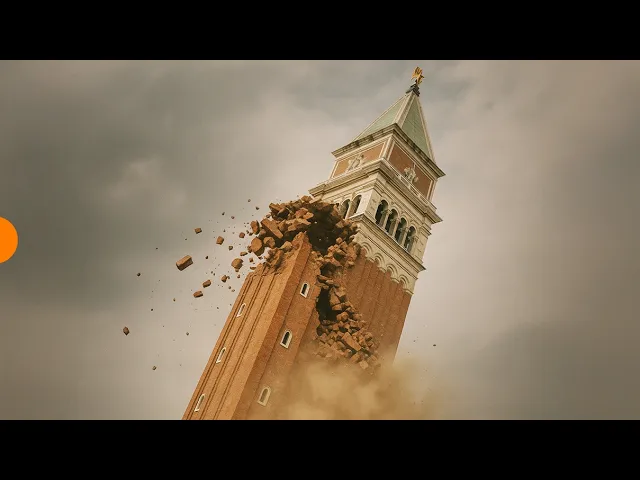
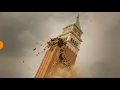
JULY 14, 1902. 9:30-9:53. At 9.
30 the square is evacuated; at 9. 47 the first bricks fall; at 9:53 the bell tower collapses in six seconds. No deaths, except the caretaker's cat.
The roar is heard in Mestre and the Murano glassmakers turn off the furnaces. The engineer Luigi Marangoni, an incredulous spectator, described "a noise like a hundred thousand looms breaking together". The column of dust, forty meters high, obscured the sun for over ten minutes.
The debris, falling, formed an inverted cone that grazed the basilica by only 42 cm, according to measurements taken the following day. SAN MARCO'S SQUARE WITHOUT ITS LIGHTHOUSE. A fifteen meter high cone of debris, the Loggia pulverized, a corner of the Marciana Library severed.
Firemen, sailors, boatmen, even Austro-Hungarian soldiers remove rubble; cafes offer free drinks to rescuers; a chorus improvises «If el Paron falls, el Paron will return». Marco Novello's stereoscopic photographs, sold to tourists on postcards, showed the world a crater of ruins reminiscent of the excavation sites of Troy. Already on July 15 , dozens of engineers sent designs for futuristic iron towers, but the citizens reacted with disdain, defending the tradition.
“WHERE IT WAS and HOW IT WAS” – THE CHOICE. The same evening, unanimous vote of the city council: rebuild identically, on the same point. The motto “where it was and how it was” was born; in two months the pro Campanile Committee collects donations from 28,000 citizens.
The Emperor of Austria sent 50,000 crowns, the President of the United States Theodore Roosevelt sent a telegram of encouragement. Patriarch Giuseppe Sarto, who became Pope Pius X in 1903, promised plenary indulgences to those who contributed with faith. A MODERN CONSTRUCTION SITE (1903-1912) Luca Beltrami designs a reinforced concrete core, 18,000 larch poles, hidden helical lift; each brick numbered, the new ones inside, the old ones outside.
Final cost: 1100,000 lire, also covered by lotteries and commemorative stamps. Beltrami experimented with "vibrated concrete", cutting-edge technology, and ordered Krupp steel pulleys capable of lifting ten-ton blocks. To consolidate the ground, 600 m³ of fluid mortar was injected into the sand, in a precursor to jet-grouting.
The works attracted delegations from Chicago and Tokyo, curious to study the fusion between Venetian Gothic and reinforced concrete. RETURN OF THE PARON – 25 APRIL 1912 At 11 am the Marangona rings twelve, the square explodes in applause. The bell tower weighs 3,000 tonnes more but has a 70 cm lower center of gravity; the statue of Gabriel shines again.
Fireworks, record numbers of tourists, thanksgiving mass by Pope Pius X. The "New York Times" headlined: "Venice raises her fallen tower". A Parisian film company filmed the ceremony on 35 mm film; those images, restored in 2009, are today preserved at the Cinémathèque Française.
FROM THE WARS TO THE NOW Cusp camouflaged in the Great War; BBPR elevator (1962); strain gauge sensors (1993-2000); laser restoration (2007‑13); today vibrations monitored 24 hours a day by a CNR algorithm. The bell tower is a living laboratory where archeology and big data dialogue. In 1966, record high water submerged the Loggia by 127 cm: the elevator's electrical system was replaced with watertight components.
In 2023, a new calibrated spectrum LED system reduced light pollution by 35%, making the night sky “greener”. «The Campanile of San Marco is not just stone: it is a testament to resilience. The symbol of a civilization may collapse, but the will to rebuild it does not collapse.
The next time you are in the square, look up: those bricks are held together by something invisible – the determination of a people. If the story moved you, leave a like, share it and subscribe to the channel: we will return to travel together among the wonders of the world.