From BBC Learning English, this is learning English from the News, our podcast about the news headlines. In this programme, Artemis II takes humans further from Earth than ever before. Hello, I'm Georgie.
And I'm Pippa. In this programme, we look at one big news story and the vocabulary in the headlines that will help you understand it. You can find all the vocabulary and headlines from this episode, as well as a worksheet on our website.
bbclearningenglish. com. OK, Pippa, let's hear more about this story.
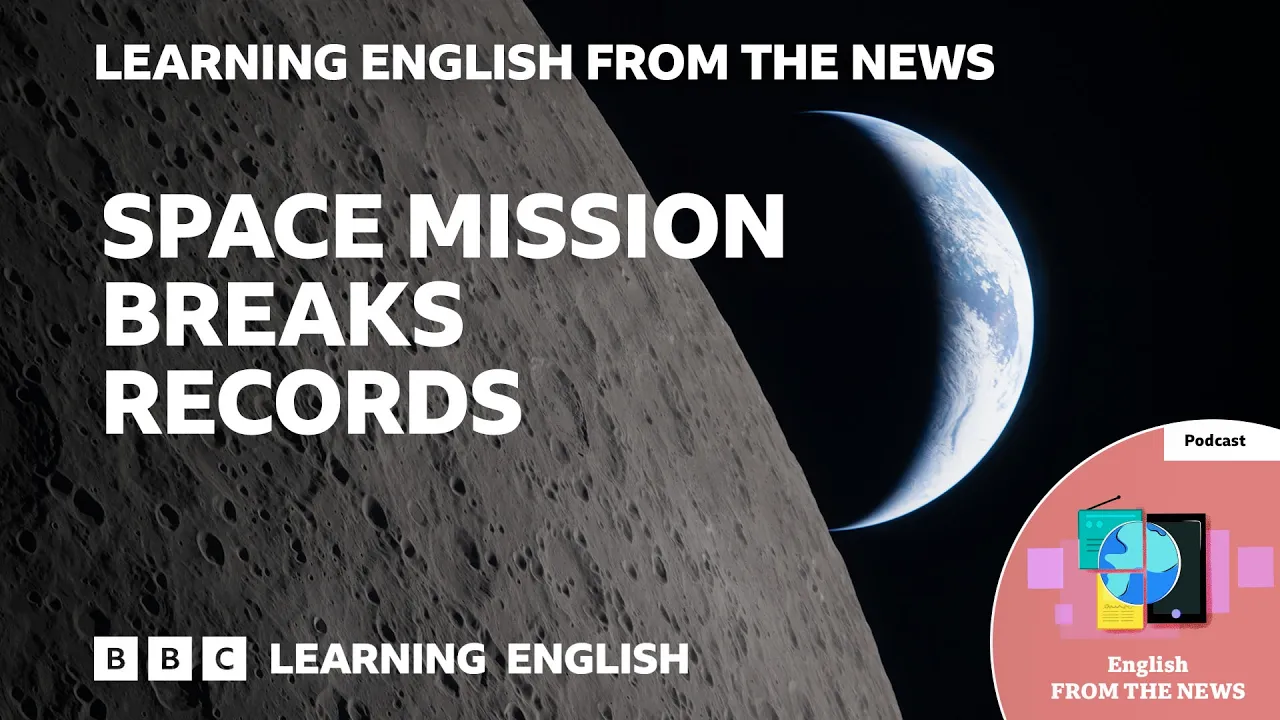
Astronauts on the Nasa spacecraft Artemis II are on their way back to Earth after travelling around the Moon. The spacecraft broke the record for the furthest distance humans have travelled into space, reaching over 400,000 km away from the Earth. While the crew did not land on the Moon.
This is the first time humans have travelled to the Moon since 1972. OK, let's have our first headline. This one is from The Telegraph, a British newspaper.
Why Artemis II's record-breaking journey marks a new dawn in spaceflight. That headline again from The Telegraph, Why Artemis II's record-breaking journey marks a new dawn in spaceflight. OK, so this headline is about the record-breaking trip by the astronauts.
They've travelled further from Earth than humans have ever gone before. And the headline says the journey marks a new dawn. We're interested in this phrase a new dawn.
Yes, dawn is the word for the beginning of the day, when the Sun rises and it becomes light. Yes. And because the dawn is the start of the day, we often use dawn metaphorically to talk about beginnings or to refer to progress and change.
For example, if a company decides to make lots of changes, maybe they get a new leader and decide to sell different products, this could be described as a new dawn for the company. Exactly. The company wants to show that things have changed and something new is beginning.
Yes. So in the headline, it says the astronaut's journey marks a new dawn in spaceflight. This means this is an important moment which shows change and progress.
Remember, humans have never travelled this far into space and had not been to the Moon since 1972. We've had a new dawn, the beginning of a period of time, often meaning progress or change. For example, when the musician played for the first time, it was a new dawn in pop music.
This is Learning English from the News, our podcast about the news headlines. Today we're talking about the Artemis II mission to the Moon. Astronauts left Earth on the 1st of April and travelled around the planet before travelling to the Moon.
While the astronauts have been in space, they've been able to contact Mission Control in Houston, Texas. They've sent images and told people about what they can see from the spacecraft. However, when the astronauts travelled around the Moon, they were unable to contact scientists on Earth for around 40 minutes.
Yes, this is because the radio and laser signals used for communication were blocked by the Moon itself. When the spacecraft was able to contact Earth again, Christina Koch, one of the astronauts, said, "it is so great to hear from Earth again. " OK, let's have our next headline.
This one is from BBC News. The 40 minutes when the Artemis crew loses contact with the Earth. That headline again from BBC news.
The 40 minutes when the Artemis crew loses contact with the Earth. So this headline is about the 40 minutes when astronauts could not communicate with people on Earth. We're interested in this phrase loses contact with.
What can you tell us, Georgie? Well, if you lose contact with someone, you are unable to speak to them. In this story, astronauts lost contact with Earth because the Moon blocked the signals they were using to communicate.
But we can use the phrase lose contact in more ordinary situations, right, Georgie? Yes, you can lose contact with someone, perhaps because you do not have their phone number or can't find them online. That's the literal meaning.
We can also use lose contact to describe a situation where you no longer see or talk with someone that you used to speak to a lot. Yes. For example, I had a childhood friend, but she moved away and now we've lost contact.
We have a very similar phrase to lose touch with someone and it means the same thing. And one final thing: if you are communicating with someone, you can describe this as being in contact with them. For example, I'm still in contact with a few of my school friends.
We meet up every Christmas. We've had lose contact with, be unable to communicate with, or no longer speak to someone you used to speak with often. For example, I've lost contact with a lot of my cousins.
I'm not sure where they live now. This is Learning English from the News from BBC Learning English. We're talking about the astronauts who have travelled around the Moon.
Yes, as we've mentioned, humans have not been to the Moon since 1972. In recent decades, space missions have focussed on getting astronauts to the International Space Station, which is much closer to Earth. The Artemis II mission will collect data, which scientists hope will prepare for even more difficult missions in space in the future.
The astronauts are due to arrive home when they land on the Pacific Ocean off the west coast of the US on Friday evening local time. Let's have another headline. This is from phys.
org, a science news website, 5 reasons why the Artemis II mission is a big deal. And that headline again from phys. org, a science news website.
5 reasons why the Artemis II mission is a big deal. This headline says the Artemis II mission is a big deal, and we're interested in this phrase, a big deal. Yes, if something is a big deal, it means it's important and significant.
The Artemis II mission is described as a big deal because of some of the reasons we've already mentioned. It's a long time since humans have been to the Moon, and also the astronauts have travelled further away from Earth than ever before. We can describe any situation that is important or significant as a big deal.
For example, my friend is getting married this summer, which is a really big deal. We also have a similar common expression in English, no big deal. We say this to mean that something isn't a problem, that it's not important, and we use this a lot in spoken conversation.
Yeah. So for example, Pippa, I'm sorry, I forgot to make you a coffee this morning. Ah, no big deal, Georgie.
I had a cup of tea instead. We've had a big deal, important or significant. For example, my choir sang at a famous concert hall.
It was a really big deal. That's it for this episode of Learning English from the News. We'll be back next week with another news story.
If you've enjoyed this programme, try the series Our World in English, which brings you the best documentaries from the BBC in language you can understand. There's a link in the notes below this programme. Goodbye for now.
Bye.