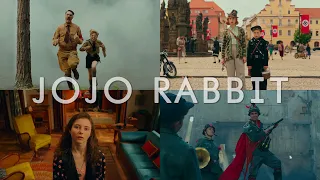
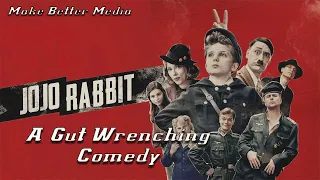
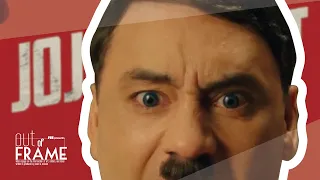
hello my name is adrian and i'm going to try and show you how jojo rabbit can be analyzed focusing on its narrative and its mise-en-scene there will be spoilers here so don't watch this until you've seen the film itself jojo rabbit was released in 2020 and was pretty controversial to say the least even before anyone had seen it one of the first images that taikawatiti released was this one making sure that everyone understood his feelings towards hitler this was not going to be a film that made audiences sympathetic in any way towards hitler or the
nazi ideology things worked out well for tai koititi as well as winning the academy award for best adapted screenplay this is based on a novel called caging skies from 2008 i think um but the film was also nominated for best picture best editing best supporting actress for scarlett johansson best production design and best costume design now we'll get back to those last two areas in a moment as they clearly show how important the mise-en-scene was for this film but first let's concentrate on the narrative how do you tell a story about nazis including a comedic
version of hitler while still keeping the audience confident that by laughing they are not somehow being morally or ideologically compromised although the novel caging skies was the initial inspiration for jojo rabbit there is much that was different first of all the novel covers a period of several years with the main character becoming a young man whereas here the action is confined to a shorter period of time as we approach the end of the war i think it really just takes place over a few months however perhaps the most significant difference is that there was no
imaginary friend in the novel the appearance of hitler here as a sniveling cowardly occasionally bullying ally to jojo was entirely taiko atiti's invention and what does that bring to the film well let's have a look at the narrative first of all it's helpful to identify from whose point of view we are experiencing this film clearly the central focus is jojo and there is barely a scene in the film in which he is not there we as the audience are experiencing this frightening and confusing world entirely from jojo's point of view you'll notice the camera is
very often at jojo's eye level looking up at the world and so as he learns about the world and discovers just what is wrong about what he thought he knew we are there right alongside him having an imaginary friend enables him to vocalize what would otherwise be internal thoughts it's easy in a novel to communicate a character's thoughts but in a film this usually becomes voice over or has to be told through other ways of doing dialogue and exposition but if jojo were to have conversations about his thoughts and feelings who else would it be
with his father is no longer there his sister has also died and he's not able to really open up to his mother about all this stuff yet and he hasn't even met elsa uh you know he has his friend yorkie who is very similar in how he feels to to jojo but he doesn't have any kind of adult figure that he can talk to so in the beginning of the film where he's fully committed to the nazi ideology he's conjured up this version of hitler in his mind who he can talk to and share his
ideas and ambitions with this hitler believes in him and is fully supportive of what jojo believes in but as the film progresses and cracks start to show in jojo's world first through his accident then discovering elsa [Music] then beginning to realize that there was something different about his mother his relationship with this imaginary hitler becomes more and more fractured until he eventually kills him please [ __ ] up hitler if we look at this film using the conventional 3x structure as identified by todderov we can break it down like this the first few scenes of
the film introduce us to jojo's normal world through exposition provided in not only the dialogue but through the misonsen as well the costumes and environment tell us when and where we are jojo's costume indicates how thoroughly he believes in the ideology of the nazi party his imaginary friend also indicates to us that perhaps jojo is a little unstable later we realize this is partly because his father is missing from his life and he's replaced that with a firm belief in the nazi ideology this is what todderof calls the equilibrium there is order to jojo's life
we have rising action in the scenes at the training camp where jojo has his life-changing accident which to a large degree was hitler's fault both the imaginary one and the real one if you think about it you could say that this explosion is todderop's disruption although i would say it comes later when jojo discovers elsa this is a disruption to jojo's belief system here is a jew who does not conform to the gross caricatures that he has been made to believe it is here that he begins to question what is going on around him as
he learns more and more about her and develops confusing feelings towards her the film hurdles towards a conclusion as the war is nearing its end jojo loses his mother the only family he had left and he gradually comes to the realization that elsa is his family now this is his new equilibrium what do we do now he has a new life ahead of him a new normal with elsa as his new family stripped as he is of the nazi ideology and the uniform which was literally taken away from him by his protector captain clenzendorf and
he is now ready to face a new better more hopeful future as i mentioned already the misonsen also plays a large part in telling us about the characters and the story misonsen is just as much a part of the way the narrative is communicated as the dialogue sometimes more so let's have a look at some of the costumes here to see how this works if we start with jojo himself at the beginning of the film he's wearing his uniform given to him as a member of the young volk a nazi organization for pre-teens it is
clean pressed and pristine he wears it proudly and it tells us straight away what kind of young boy jojo is he is committed to the organization and everything he stands for the uniform is dark and we see black used in the clothing of other nazis that jojo has to interact with this can represent the lack of happiness in their lives which are dark soulless and joyless a contrast to this is the clothing of jojo's mother just look at her choices they are colorful and flamboyant her shoes in particular are a recurring motif symbolic of her
rebellious nature she is not going to submit to the nazi ideology although we do not learn just how committed she is to the resistance movement until her death and her clothes told us all her long that she was a rebel similarly take a look at captain klensendorf unlike jojo he has clearly fallen out of love with the nazi regime and he's someone who is just stuck there like a character in the office look at how he wears his uniform it is shabby open and he looks increasingly disheveled like jojo's mother clenzendorf also has a secret
which cannot be admitted as it would result in his imprisonment and death the love between him and his subordinate finkel however through his costume he is able to express what cannot be outwardly stated this comes to a head in the final scene when he dons his specially designed flamboyant costume he knows that the fight is useless and that he will lose but he's determined to be able to finally express his inner feelings in an ultimately futile final battle you can also look at the way in which clenzendorf and finkel are positioned such as in this
shot at the swimming pool or here in jojo's house finkel is buttoned up and very closed whereas clenzendorf is very open and relaxed clensendorf appears to be just going along with everything doing the bare minimum in order to survive finkel perhaps being younger and perhaps being less able to speak about his feelings towards klensendorf is closed and repressed let's think more broadly about the use of color in the film i've already mentioned the color of the uniforms um but that's not the only thing of course you know this the color in this one is very
bold this is not one of those war films where everything is just washed out and desaturated the bright colors could perhaps reflect that this is a child's view of the world although the colors do become more muted towards the end particularly in the final battle and it looks as though all hope is lost but color comes back into the world when everything is all over and elsa finally goes outside look at her bright green jacket similar to the green front door there reinforcing the idea that jojo and elsa are a family now and the clothes
that jojo is now wearing are a complete rejection of his earlier neat repressive uniform so that's it i just wanted to point out a few of my own observations on jojo rabbit i hope this analysis has been helpful in just thinking about how we can study and apply these ideas of narrative and nis onsen what i've done here is something that you could do with any film do you have any other ideas the things that i could have mentioned things that i should have noticed in the costumes or in the design or in anything else
here if you do please let me know in the comments below thank you for watching [Applause] you