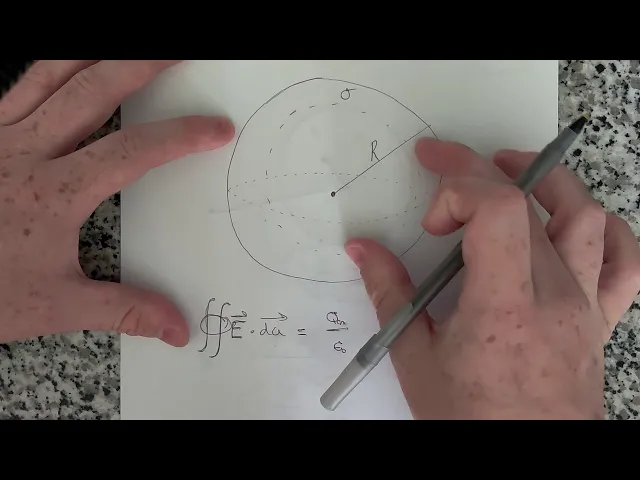
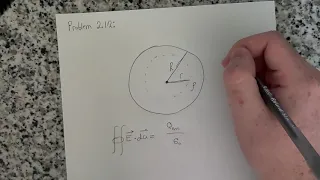
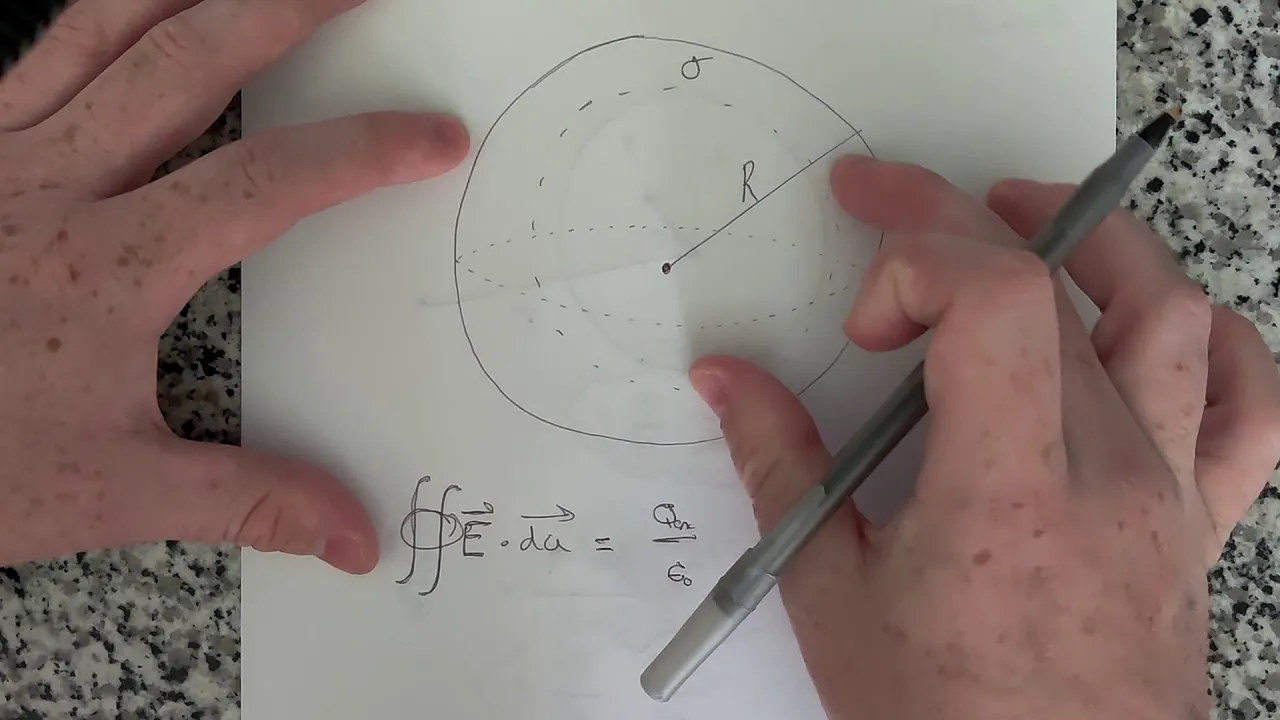
hello everyone welcome to problem 2. 11 david versus electrodynamics let's jump right in so this problem states that we want to use gauss's law to find the electric field inside and outside the spherical shell of radius r that carries a uniform charge density of sigma and to compare our answer to problem 2. 7 so if you remember this setup where we have a spherical hollow shell of uniform charge density of sigma so all the charges contained on the surface of the sphere and the inside of the sphere is hollow this is the exact problem we had for problem 2.
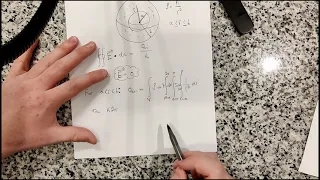
7 and we were you know it wants us to find the electric field and in that case we didn't have gauss's law yet and so we had to solve for the electric field by just direct integration and it was a ridiculously long problem i think that video was like 50 minutes long and so we're going to show that given gallus's law this problem reduces to as it's like a one-liner and it's ridiculous how powerful gauss's law is so gauss's law if we remember states that uh the flux of the electric field through our gaussian surface through our imaginary surfaces by giving me e dot e d a the surface integral i typically write it with one integral sign but sometimes people write it like this whatever works for you is equal to the charge enclosed of your gaussian surface divided by epsilon naught all right so let's find the electric field for the two different regions um actually it wants us to find for this problem yeah once it's a fine inside and outside so for inside of the holosphere if we just imagine a gaussian surface of a a smaller sphere of radius uh little r will say uh so just imagine a smaller sphere contained inside of this hollow sphere and that's going to be of radius a little r that's our gaussian surface we're considering then the flux through that gaussian surface is equal to the charge enclosure over epsilon not so i'm going to say for r less than r well what is the charge enclosed well there is no charging closed all the charge resides on the surface of our of the sphere and so since our gaussian surface is contained within the hollow part there is no charge contained inside of our gaussian surface and therefore the charging closes zero which means the flux is zero which means the electric field therefore has to be zero which is the result that we got from problem 2. 7 and then for our uh greater than big r so now imagine a gaussian surface of a sphere that's bigger than our um our actual sphere here and so the flux of that surface well we know uh i our uh gaussian surface the electric field due to symmetry um we'll just uh have uh it'll be constant at our radius at our gaussian surface so we can pull that out of the integral and then we just integrate over the surface area which just becomes 4 pi r squared so this is the flux through our gaussian surface that's bigger this is equal to the charge enclosed over epsilon not well the charge enclosed is just um the total charge q right so we have that over epsilon not and therefore we have that the electric field which we know we really pointed away is going to be q divided by 4 pi epsilon naught r squared and almost in the r hat direction which is just the field of a point charge it's just as if the all the charge on the surface of our gaussian surface or sorry all the charge on the surface of the sphere was contained at the center um since it's this depends on the distance from the origin uh which is at the center of the sphere squared which is exactly the same answer we got from problem 2. 7 after doing um like six pages of of you know integrals and algebra so this just goes to show that um given uh you know you have symmetric situations like this uh spherical asymmetry um rectangular symmetry cylindrical symmetry that gauss's law proves to be very useful and a very efficient way of finding the electric field in those cases all right so i hope you enjoyed this video and uh yeah i can't wait to see you guys in problem 2.