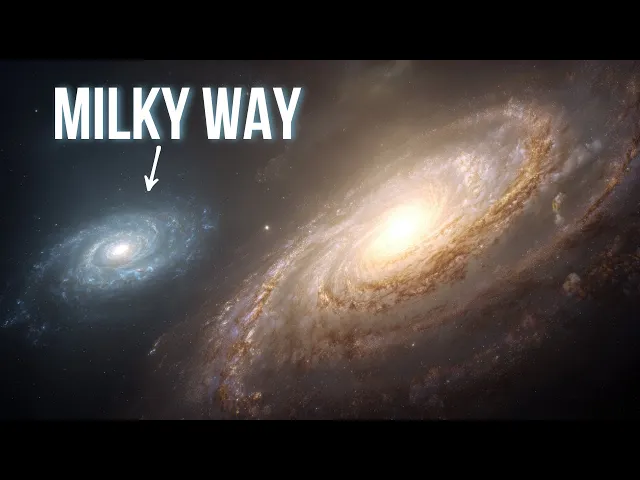
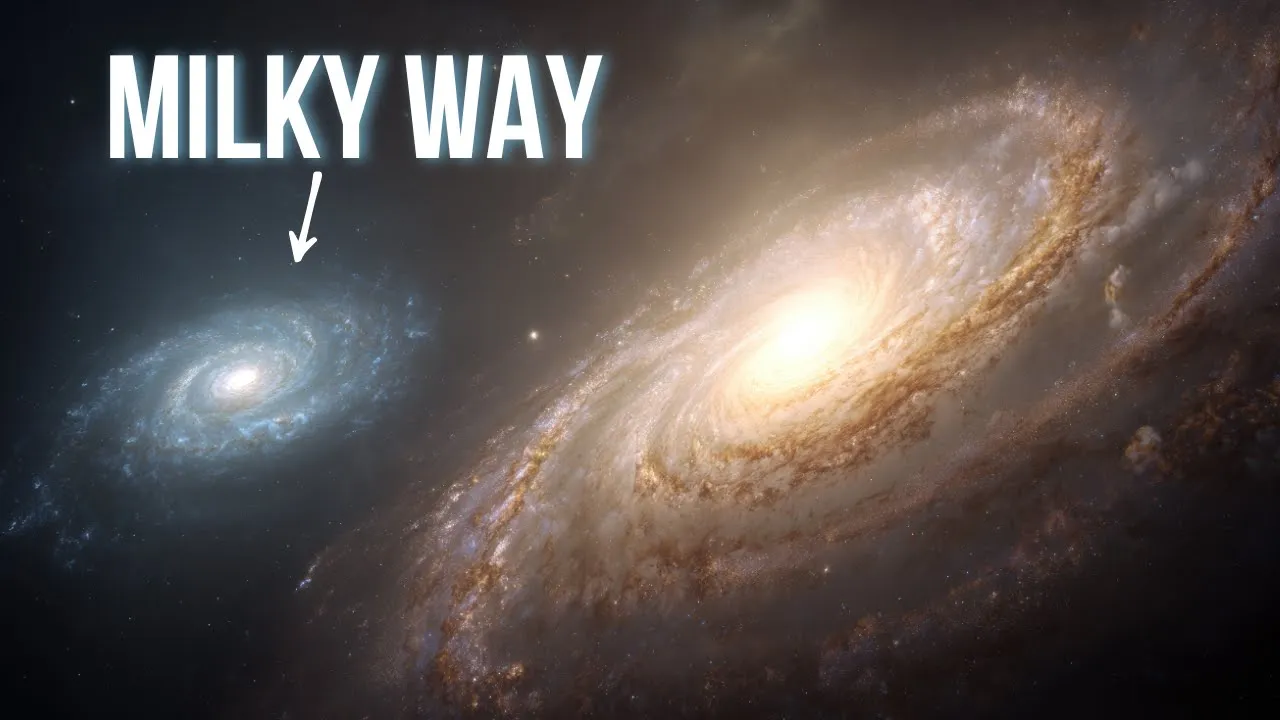
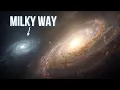
Tonight we are going to explore something that will completely change the way you think about scale. We are going to talk about the largest galaxy that humans have ever discovered. And when I say largest, I do not mean just a little bit bigger than our own Milky Way. I mean something so enormous that it challenges our ability to comprehend it. A galaxy so vast that if you could somehow place it where our galaxy sits Right now, it would swallow up not just us, but our nearest neighboring galaxies as well. Everything we have ever known or
seen in the night sky [music] would be absorbed into this cosmic giant. The galaxy is called IC1101. And by the end of this journey, you are going to understand exactly why it holds the title of the largest galaxy we have found so far. You are going to understand how it grew to such an incredible size, what lies at its heart, And what its existence tells us [music] about the nature of the universe itself. Before we go any further, if you find this kind of deep exploration interesting, a quick like or subscribe really [music] helps the
channel grow. It is a small thing for you, but it makes a huge difference for me. Now, let us dive in. [music] Let us start with something that might seem obvious, but is actually incredibly difficult to wrap your head around. What exactly is a Galaxy? You have probably heard this word thousands of times. You know we live in the Milky Way galaxy. You have seen pictures of galaxies in space. But what actually is a galaxy when you break it down? A galaxy is essentially a massive collection of stars, gas, dust, and something mysterious called dark
matter. All held together by gravity. Think of it like a cosmic city. Just as a city is a collection of buildings and people all existing together in one Area, a galaxy is a collection of stars and planets and everything else all bound together in one enormous structure. The gravity of all that material keeps everything from flying apart [music] into the darkness of intergalactic space. But here is where the analogy breaks down. A city has clear boundaries. You know where downtown ends and the suburbs begin. You can point to the edge of a city on a
map. Galaxies are not like that at all. They fade gradually into the darkness of intergalactic space. There is no sharp boundary, no clear edge. The density of stars just gets lower and lower as you move outward until eventually you are in the vast emptiness between galaxies. This makes measuring the size of a galaxy surprisingly difficult and it is something we will come back to later when we talk about IC 1101. Our own galaxy, the Milky Way, contains somewhere between 200 billion and 400 Billion stars. That is a staggering number. If you could count one star
per [music] second, it would take you somewhere between 6,300 and 12,700 years just to count all the stars in our galaxy. That is longer than recorded human history. Writing was only invented about 5,000 years ago. You could have started counting when humans first began scratching symbols on clay tablets and you still would not be anywhere close to Finished. And the Milky Way is considered a fairly averagesized galaxy. It is not particularly large and it is not particularly small. It is just kind of normal as galaxies go. When astronomers discovered this, it was actually somewhat humbling.
Our galaxy, which seems so vast to us, is just one typical galaxy among billions. The Milky Way stretches about 100,000 light years across. That means if you were traveling at the speed of light, which is about 186,000 m/s, the fastest anything can possibly travel, it would still take you 100,000 years to cross from one side of our galaxy to the other. Light itself, the fastest [music] thing in the universe, needs 100 millennia to make that journey. In miles, our galaxy is roughly 588 trillion miles wide. That is a five followed by 14 zeros. To try
to make that number meaningful, imagine this. If you could drive a car at highway speed, Say 60 mph, without stopping 24 hours a day, 7 days a week, it would take you about 1 trillion 120 billion years to cross our galaxy. The universe is only 13.8 [music] billion years old. You would need to drive for about 81 times the entire age of the universe just across one fairly average galaxy. These numbers are so large that they stop meaning anything to our brains. We simply did not evolve to understand distances like this. But here Is what
makes IC 1101 so remarkable. Our galaxy which is already staggeringly large by any human standard is tiny compared to IC 1101. Absolutely tiny like comparing a single house to an entire country. That is the scale difference we are talking about. IC 1101 has an estimated diameter of around 4 to 6 million lighty years. Let me say that again because it is important. 4 to 6 million light years. [snorts] Our galaxy is 100,000 light years Across. IC11 01 is somewhere between 40 and 60 times larger than the entire Milky Way. In miles that is somewhere between
23 and 35 quadrillion miles across. A quadrillion is a one followed by 15 zeros. If you tried to drive across IC 1101 at highway speed, it would take you roughly 460 quadrillion years. That number is so absurd that there is no meaningful way to comprehend it. It is more years than there are atoms in your Body. It is more years than there have been seconds since the big bang. It is just meaninglessly, impossibly large. But these numbers are real. This galaxy exists. It is out there right [music] now, a colossal structure of stars and gas
and dark matter floating in the darkness of intergalactic space. If you have a large enough telescope and point it in the right direction, you can see it. It appears as a faint fuzzy smudge of light Unremarkable to the casual observer but representing something of staggering scale. To put the size of IC 1101 in perspective, let us think about what would happen if it somehow replaced our galaxy. If the center of IC 1101 was placed where the center of the Milky Way currently sits, its outer edges would extend so far that they would completely engulf [music]
the Andromeda galaxy. Andromeda is our nearest large galactic neighbor. It is about 2.5 million Lightyear away from us. To give you a sense of that distance, the light [music] reaching us from Andromeda tonight left that galaxy when the first members of the genus Homo were just beginning to walk upright on the African savannah. Our ancestors were still using simple stone tools. Modern humans would not appear for another 2 million years. That is how far away Andromeda is. An IC 11101 is so large that if it replaced our galaxy, [music] it would reach out And swallow
Andromeda completely and still have room to spare. The Andromeda galaxy, which appears as a faint smudge to the naked eye on clear dark nights, [snorts] would simply be absorbed into the vast bulk of IC 1101. But IC 1101 would not stop there. It would also engulf the triangulum galaxy. Another significant galaxy in our local neighborhood. The triangulum galaxy is about three million lighty years away. [music] It would be consumed. The large Melanic cloud and the small melanic cloud, two dwarf galaxies that orbit our Milky Way like small moons orbiting a planet would be absorbed. They
are only about 160,000 and [music] 200,000 light years away, respectively. IC1101 would swallow them without noticing. In fact, IC 11101 would also consume most of the other galaxies in our local group. The local group is [music] the collection of galaxies that includes our Milky Way and about 50 other galaxies, all bound together by gravity. It spans about 10 million light years across. IC 1101. A single galaxy is more than half the size of our entire local group of galaxies. Think about that for a moment. A single structure that is larger than a collection of more
than 50 galaxies. That is the scale we are dealing with tonight. Now that we have established just how large IC 1101 is, let us explore [music] where it sits in The cosmos. IC 1101 is located about 1 billion light years away from Earth. That distance is almost as difficult to comprehend as the size of the galaxy itself. 1 billion light years. Light traveling at 186,000 m/s needs 1 billion years to cover that distance. To express this in miles, IC1101 is approximately 5.886illion [music] miles away. That is 5.88 followed by 21 zeros. There is simply no
Way to make this distance feel real through analogy. It is beyond anything that can be compared to everyday experience. We just [music] have to accept it as a number and move on. But what this distance means for observation is fascinating. When we look at IC 11101 through our telescopes, we are not seeing it as it exists right now. We are seeing it as it was 1 billion years ago. The light that reaches our telescopes [music] tonight left IC1 11 01 when the most complex [music] life on Earth was singleled organisms floating in ancient seas. Multisellular
life existed but barely. The Cambrian explosion when complex animal life first appeared on our planet was still about 450 million years in the future. Fish did not exist yet. Land plants did not exist yet. [music] Insects did not exist yet. Dinosaurs would not evolve for another 770 million years. Mammals would not Appear for another 800 million years. Humans would not appear for another 999 million years, give or take. When that light began its journey toward us, Earth would have been unrecognizable to modern eyes. The continents were in completely different positions. The atmosphere had a different
composition. The oceans teamed with primitive life forms that have long since gone extinct. And somewhere in the depths of space, this galaxy was shining light that would Travel for a billion years before finally reaching the telescopes of a species that would not exist for another 999 million years. IC 1101 sits in the direction of the constellation Virgo, although it is also sometimes listed as being in the constellation Serpents since it sits right near the border between these two constellations. The exact boundary between constellations is somewhat arbitrary anyway, just lines Drawn by humans to help us
navigate the sky. The galaxy itself does not care which constellation we assign it to. IC 11101 is far too dim to see with the naked eye. You need a telescope with an aperture of at least 8 to 10 in to spot it. And even then, it just appears as a faint fuzzy blob. It has an apparent magnitude of about 14.7, which is quite dim by astronomical standards. For reference, the dimst [music] stars visible to the naked eye Under perfect conditions have an apparent magnitude of about six. The magnitude scale is logarithmic, which means each step
represents a multiplication rather than an addition. A magnitude 14.7 object is roughly 5,000 times dimmer than the faintest star you can see with your unaded eye. Even if you have access to a large amateur telescope, IC 1101 is not a particularly impressive site. Visually, it appears as a small fuzzy patch of light [music] Barely distinguishable from the background darkness. The stunning images you may have seen of IC 1101 are the result of long exposure photographs taken [music] with professionalgrade equipment, images that accumulate light over many minutes or hours to reveal details invisible to the human
eye. The galaxy was discovered on June 19th, 1790 by the German-born British astronomer William Hershel. Hershel is one of the most important figures [music] in the History of astronomy. He was born in Hanover in what is now Germany, but spent most of his professional life in England. He is the same astronomer who discovered the planet Uranus in 1781, the first planet discovered in modern times. Hershel was a meticulous observer who spent countless hours scanning the night sky with his homemade telescopes. And when I say homemade, I do not mean he bought a kit from a
store. Hershel actually ground his own mirrors by hand. A laborious process that required enormous patience and skill. He would spend hours at a time polishing metal mirrors to the precise curvature needed to focus light from distant stars. His telescopes were among the finest in the world at the time. His largest telescope had a mirror 49 in across and a focal length of 40 ft. It was so large that it became a tourist attraction. King George III of England came [music] to see it. For decades, it was the largest Telescope in the world. With these instruments,
[music] Hershel cataloged thousands of celestial objects, including galaxies, nebuli, and star clusters. He did not know what many of these fuzzy patches of light actually were, but he observed them carefully and recorded their positions. His systematic approach to observing laid the groundwork for modern astronomy. When Hershel spotted IC 1101 in 1790, he had no idea what he was looking at. This was Over a century before we understood that galaxies existed as separate island universes distinct from our own Milky Way. At that time, astronomers believed that these fuzzy patches of light, which they called nebula, from
the Latin word for cloud, were gas clouds or clusters of stars within our own galaxy. The idea that the universe contained billions of other galaxies, each with billions of stars, was still far in the future. Hershel himself believed that some of These nebula might be other systems similar to our own Milky Way, but he could not prove it. The telescopes [music] of his era simply were not powerful enough to resolve the individual stars in distant [music] galaxies. They remained fuzzy patches of light. Their true nature a mystery. This mystery persisted for well over a century,
becoming one of the great unanswered questions in astronomy. By the early 20th century, astronomers had Divided into two camps. One group led by Harlow Shappley believed that the spiral nebula were relatively small gas clouds within our own Milky Way. The other camp championed by Hea Curtis argued that they were island universes, vast stellar systems far beyond our galaxy's boundaries. In April 1920, Shappley and Curtis met [music] for what became known as the Great Debate at the Smithsonian Museum of Natural History in Washington, DC. Each presented evidence for his Position. Shappley pointed to measurements suggesting that
some nove in spiral nebuli were too bright to be at extragalactic distances. Curtis countered with observations of dark dust lanes in edge on spirals similar to what we see in our own galaxy. [music] The debate was inconclusive at the time. Neither astronomer had the decisive evidence needed to settle the question. That evidence would come 4 years later. It was not until the 1920s that Edwin Hubble definitively proved that many of these nebula were actually separate galaxies far beyond the bounds of our own Milky Way. Hubble used the 100in Hooker telescope at Mount Wilson Observatory in
California, then the largest telescope in the world. He used a special type of star called a sephiid variable to measure the distance to the Andromeda nebula. Sephiid variables are stars that pulsate in a regular pattern getting brighter and Dimmer over periods of days or weeks. The important thing about sephiids is that there is a relationship between how long their pulsation cycle is and how intrinsically bright they are. A sephiid with a longer period is intrinsically brighter than one with a shorter period. This means that if you can measure a sephiid's period, you know its true
brightness. And if you compare its true brightness to how bright it appears in the sky, you can calculate how far away It is. In 1924, Hubble found sephiid variable stars in the Andromeda Nebula. His measurements showed that Andromeda was far too distant to be part of our galaxy. It had to be a separate galaxy entirely, about 900,000 lighty years away. His initial distance estimate was actually too low. We now know Andromeda is about 2.5 million light years away. But even his underestimate was enough to prove the point. Andromeda was definitely not part Of the Milky
Way. This discovery changed everything we thought we knew about the universe. Suddenly, the cosmos went from containing a single galaxy to containing countless galaxies spread across unimaginable distances. The universe became vastly larger overnight [music] and we went from being the center of everything to being residents of one ordinary galaxy among billions. It is hard to overstate how revolutionary this was. Imagine waking up one morning and Discovering that what you thought was the entire world, your city, your country, everything you knew was actually just one neighborhood in a city containing billions of other neighborhoods. That is
roughly analogous to what happened to our cosmic world view in the 1920s. Before Hubble's discovery, serious astronomers debated whether anything existed beyond the Milky Way. They knew the universe contained stars, and they Knew the Milky Way was a vast collection of stars. But whether those fuzzy nebuli were part of our galaxy or separate systems entirely was genuinely uncertain. There was a famous debate in 1920, sometimes called the great debate, between astronomers Harlo Shappley and Hea Curtis about whether the spiral nebula were inside or outside our galaxy. Curtis argued they were separate island universes. Shappley argued
they were nearby gas clouds within the Milky Way. Hubble's observations in 1924 settled the debate [music] decisively. The spiral nebula were indeed separate galaxies, incredibly distant, each containing [music] billions of stars. The universe was not one galaxy. It was countless galaxies spread across [music] distances that made even our 100,000 light-year wide Milky Way seem small. And among all those countless galaxies, [music] IC 1101 Stands out as one of the most extreme. A galaxy so large it challenges our ability to comprehend it. Discovered over a century before we even knew galaxies existed. [music] The story of
IC1101's recognition as the largest known galaxy is itself a story of how our technology and understanding have improved over time. When Hershel first observed it, he saw nothing remarkable, just another faint fuzzy patch among thousands. It Was only with the advent of modern telescopes and sophisticated measurement techniques that astronomers could determine its true distance and [music] size. This raises an interesting question. What else is out there that we have not yet recognized? The universe is full of objects we have cataloged but not yet understood. There may be other galaxies even larger than IC 11101 hiding
in plain sight in our Astronomical databases. We simply have not yet measured them carefully enough to know how extraordinary they are. The James Web Space Telescope, launched in 2021, is already revealing details of distant galaxies that were impossible to see before. Its infrared vision can peer through dust that blocks visible light, and its enormous mirror can collect light from incredibly faint sources. As we analyze its observations, we may discover galaxies that rival or exceed IC 1101 in size. Groundbased telescopes are improving as well. The extremely large telescope currently under construction in Chile will have a
mirror 39 m across, more than four times the diameter of any existing optical telescope. It will be able to see objects that are currently too faint to detect and resolve details that current telescopes cannot. The Vera Rubin Observatory, also in [music] Chile, will conduct the legacy survey of space and Time starting in 2025, imaging the entire visible sky every few nights for a decade. This will create the most comprehensive map of the sky ever [music] made, cataloging billions of galaxies and potentially revealing structures we did not know existed. As our technology improves, our understanding of
the universe expands. IC11 01 may be the largest galaxy we have found so far, but the key words are so Far. The universe is vast, and our exploration of it has only just begun. IC11 01 got its name from the index catalog of nebula and star clusters which was published in the late 1800s and early 1900s as a supplement to the earlier new general catalog or NGC. The index catalog was compiled by John Louie Emil Drier a Danish Irish astronomer working at the Armar Observatory in Ireland. The galaxy is listed as the 1,1st Entry in
this catalog. Most well-known galaxies and nebuli are still referred to by their NGC or IC designations to this day. For decades after its discovery, IC 1101 remained just another entry in the astronomical cataloges. It was one fuzzy smudge among thousands. Nobody knew it was special. The technology to measure its true distance and size simply did not exist yet. It was not until astronomers began to measure its true distance and size that They realized just how extraordinary this galaxy really is. In 1964, a study of galaxies with radio sources noted that IC 1101 was among the
diffuse elliptical galaxies being studied and radio emissions were detected from it. Radio emissions from galaxies often indicate the presence of active processes like material falling into super massive black holes. Then in 1978, astronomer Alan Drestler conducted a detailed analysis of 12 very rich galaxy Clusters. One of them was Abel 2029, the cluster that contains IC1. The following year in 1979, Drestler published a paper dedicated specifically to IC 11101, analyzing its dynamics and properties. His work revealed the galaxy's unusual velocity dispersion profile, which provided hints [music] about its massive size and the enormous dark matter halo
surrounding it. Since then, IC1101 has been studied extensively using some Of the most powerful telescopes ever built. The Hubble Space Telescope has captured [music] detailed images of the galaxy's inner regions. The Shandra X-ray Observatory has mapped the hot gas in the cluster surrounding it. Each new observation has revealed more about this extraordinary galaxy and confirmed its status as one of the largest structures in the known universe. Let us talk about what type of galaxy IC1 actually is because this tells us a lot About its history and [music] how it came to be so enormous. Astronomers
classify galaxies into several different types based on their shape and structure. This classification system was first developed by Edwin Hubble in the 1920s and has been refined over the decades since. The first type is spiral galaxies. These are the classic pinwheelshaped galaxies that you have probably seen in photographs. They have a flat disc with Spiral arms winding outward from a central bulge. Our Milky Way is a spiral galaxy, specifically a barred spiral because it has a bar-shaped structure in its center. The Andromeda galaxy is also a spiral, though not a barred one. Spiral galaxies contain
lots of gas and dust and are actively forming new stars, especially in their spiral arms. The spiral structure itself is a density wave, a pattern that moves through the disc and triggers star formation [music] As it goes. The second type is elliptical galaxies. These are more rounded or elongated in shape like a three-dimensional oval or an American football. They can range from nearly spherical to highly elongated. Unlike spiral galaxies, ellipticles contain very little gas and dust. Most of them have stopped forming new stars or form new stars only at very [music] low rates. The stars
in elliptical galaxies are typically older, giving these Galaxies a reddish [music] or yellowish color compared to the bluer spirals. The third type is lenticular galaxies. These are intermediate between spirals and ellipticals. They have a dis like spiral galaxies and they often have a central bulge, but they lack the spiral arm structure. They are sometimes described as spiral galaxies that have lost their arms. Lenticular galaxies are often found in dense environments like galaxy clusters where interactions with other Galaxies and with hot gas may have stripped away the gas needed for star formation and spiral structure. There
are also irregular galaxies which do not fit neatly into any of these categories. They have chaotic shapes with no clear structure. The large and small melanic clouds are examples of irregular galaxies. These are often smaller galaxies that have been distorted by gravitational interactions with larger neighbors or galaxies that are in the Process of merging. There is also a fourth category that some astronomers recognize called peculiar galaxies. These are galaxies with unusual features that set them apart from the normal types. A galaxy might be classified [music] as peculiar if it has distorted spiral arms, unusual jets
emanating from its center, or shells and rings of stars indicating past interactions. Many peculiar galaxies are the result of ongoing or recent galaxy merges. The Classification of galaxies might seem like dry academic categorization, [music] but it actually tells us a lot about galaxy evolution. Different [music] types of galaxies represent different stages in the cosmic life cycle. Spiral galaxies are generally younger with active star formation. Elliptical galaxies are generally older, having evolved past their star forming days. And the giant elliptical galaxies like IC 1101 Represent the extreme end point of galactic evolution. Massive structures built up
through billions of years of mergers and growth. Understanding what type of galaxy I see 1101 is helps us understand its history and its future. It is not just a classification label. It is a window into [music] billions of years of cosmic evolution. IC11 01 is classified as either a super giant elliptical galaxy or a super giant lenticular galaxy. Astronomers are not Entirely certain which classification is more accurate because it sits right on the boundary between these two types. When astronomers classify a galaxy, they use the designation E for elliptical and S0 for lenticular. IC 11101
is classified as E/S0, meaning it could be either. If it is a lenticular galaxy, we might be viewing it from an angle that shows it at its broadest dimensions, making it look more rounded than it actually is. Lenticular Galaxies are flat discs. So if you view them edge on, they look like a line. If you view them face on, they look circular. If you view them at some intermediate angle, they look elliptical. IC 1101 might be a lenticular galaxy that we happen to be viewing face on or nearly face on. What astronomers do agree on
is that IC 1101 is a CD galaxy. This is a specific classification for the most massive galaxies. The lowerase C means it is a Super giant, the largest classification of galaxy size. The capital D means it is surrounded by a large halo of diffuse light extending far beyond its main body. Some astronomers interpret CD as standing for central dominant because these galaxies are almost always found at the centers of galaxy clusters where they dominate their surroundings gravitationally. Others interpret it as the original meaning from the Jüks classification system where C indicates Super giant and D
indicates [music] diffuse halo. Either way, the important point is that CD galaxies are the biggest of the big, the most massive galaxies in the universe. These CD galaxies are typically found at the centers of galaxy clusters, which is exactly where IC1 is located. It sits at the heart of a massive galaxy cluster [music] called Abel 2029. Its position at the cluster center is no accident. It got there and grew to such Enormous size through processes we will explore shortly. The color of a galaxy tells astronomers a lot about what is happening inside it. This is
because different types of stars have different colors. Hot stars, which are typically young and massive, burn blue. Cool stars, which are typically older and smaller, burn red or yellow. Blue tinged galaxies are typically alive with star formation. When new stars form from clouds of gas and dust, [music] the most Massive and hottest of those new stars burn blue. These massive blue stars burn through their fuel quickly, living only millions of years instead of billions. So if you see a lot of blue light from a galaxy, it means new stars are actively being born because the
blue stars do not live long enough to exist unless they were recently formed. Red or yellow tinged galaxies, on the other hand, are typically old and quiet. They have used up most of their gas and dust, so very Few new stars are being born. The remaining stars are older, cooler, and smaller. The massive blue stars that once existed have long since burned out and died. What remains are the smaller, cooler stars that burned for billions of years, [music] giving the galaxy a reddish or yellowish appearance. IC11 has a distinctly yellow red color. This tells us
that it is an old galaxy that has largely stopped forming new stars. It is in a sense dying. Not in any Dramatic or sudden way, but slowly over billions of years as its remaining stars age and eventually burn out without new stars being born to replace them. Astronomers sometimes call galaxies like IC1 01 red and dead, referring to their color and their lack of ongoing star formation. This sounds dramatic, but it is a slow process. The stars currently in IC 1101 will continue shining for trillions of years. But as each star eventually burns out, there
is no new Star being born to take its place. With the scale of IC11 01 established, let us now turn to how this cosmic titan formed. No galaxy is born as a super giant elliptical. These massive galaxies [music] are created over billions of years through a process that astronomers call galactic cannibalism. And understanding this process is key to understanding how IC 1101 grew to become what it is today. Galaxies are not static objects floating Motionless in space. They move through space pulled by the gravity of other galaxies and the large scale structures around them. The
universe is filled with invisible streams and currents of gravity, created by the distribution of matter, both visible and dark. Galaxies flow along these gravitational currents like leaves on a river. When two galaxies get close enough to each other, their mutual gravitational attraction begins to distort them. Tidal forces Stretch the galaxies, pulling stars and gas out of their normal positions. Long streams of material can be pulled from the galaxies, creating structures called tidal tails. These interactions can trigger bursts of star formation as gas clouds are compressed by the gravitational chaos. If the galaxies are moving slowly
enough relative to each other and if they pass close enough they can become gravitationally bound. At this point a merger becomes inevitable. The two galaxies begin an intricate gravitational dance that can last hundreds of millions of years. They swing around each other, pass through each other, swing around again. With each pass, they lose energy to gravitational friction and their orbits decay. Eventually, they merge into a single larger galaxy. When two spiral galaxies collide, the result is typically an elliptical galaxy. The orderly rotation of stars in the spiral Discs gets disrupted by the gravitational chaos. Stars
that were once orbiting in neat circular paths are flung onto chaotic random orbits. Gas clouds collide and either form stars or are heated and ejected from the merging galaxies. The central super massive black holes of the two galaxies spiral toward each other and eventually merge, creating a single more massive black hole. When the dust settles, often literally, what remains is an elliptical Galaxy. The organized spiral structure has been destroyed, replaced by a more chaotic ellypoidal shape. The stars orbit the center of the combined galaxy on random paths, giving the galaxy its rounded appearance. IC 1101
grew to its current size through countless such mergers over billions of years. Astronomers estimate that it has undergone at least 10 major mergers and possibly many more. Each merger added mass to the galaxy, increasing its size And gravitational influence. Each merger also depleted its gas reserves as the collisions either triggered star formation that used up the gas or ejected the gas into intergalactic space. This is why IC1101 is now largely devoid of the gas needed to form new stars. The galaxy sits at the center of the Abel 2029 galaxy cluster which contains thousands of other
galaxies. Being at the center of such a dense region of space is no Accident. Over cosmic time, the most massive object in a cluster tends to sink toward the center, pulled there by a process called dynamical friction. As a massive galaxy moves through the cluster, it gravitationally attracts nearby galaxies and dark matter toward it. This creates a gravitational wake behind the galaxy, like the wake behind a boat. This wake pulls backward on the galaxy, slowing it down. Slower galaxies fall toward the center Of the cluster. So the most massive galaxies tend to end up at
the center regardless of where they started. And once there, they continue to grow by consuming any smaller galaxy that ventures too close. The cluster environment provides a continuous supply of victims. Smaller galaxies that wander into the gravitational grip of the central giant and are torn apart. This process is sometimes called galactic cannibalism for obvious reasons. The Larger galaxy essentially eats the smaller ones, absorbing their stars and dark matter while stripping away their gas. The smaller galaxies are torn apart by tidal forces. Their stars scattered into the halo of the central galaxy. Over billions of years,
the evidence of these individual mergers is erased as the stolen stars settle into new orbits, becoming indistinguishable from the original population of the larger galaxy. IC 1101 has been doing this for Billions of years. Every smaller galaxy that has wandered too close has been consumed, its material added to the growing bulk of IC 1101. This is why the galaxy has such an enormous diffuse halo of stars extending far beyond its core. That halo is made up of stars that once belonged to other galaxies. Galaxies that no longer exist as separate entities because they have been
absorbed into IC1. [music] The smoothness of IC1's Halo tells us something interesting about its history. When a galaxy absorbs another galaxy, the [music] stolen stars initially retain some memory of their previous orbits. They can form streams and shells and other structures that persist for millions or billions of years. But over very long time scales, these structures gradually mix and fade, and the halo becomes smooth. The smoothness of IC 1101's halo suggests that most of this merging activity Happened early in the galaxy's history when the cluster was first forming billions of years ago. There would have
been many more galaxies near the center of the cluster and the merging rate would have been much higher. As IC 1101 consumed more and more of its neighbors, the number of remaining victims decreased. The mergers have been fewer and farther between in more recent cosmic epochs, giving the halo time to settle into its current smooth Distribution. Let us talk about the stellar population of IC 1101 because this gives us another way to appreciate this galaxy. Astronomers estimate that IC 1101 contains [music] approximately 100 trillion stars. That is 100,000 billion stars written out as a number
that is a one followed by 14 zeros. 100 trillion stars. Each one a sun in its own right. Our own Milky Way contains somewhere between 200 billion And 400 billion stars. Using 300 billion as a middle estimate, IC 1101 contains roughly 330 times more stars than our entire galaxy. Remember the counting exercise from earlier? To count IC1 stars at 1/ would take 3.2 million years, more than 10 times longer than our species has existed. Think about what these numbers mean. Every single one of those 100 trillion stars is a sun. Some are larger than our
sun. Some are smaller. Some are hotter and bluer, Burning through their fuel quickly in a blaze of glory. Others are cooler [music] and redder, slowly simmering for trillions of years. Each has its own history, its own evolution, its own eventual [music] fate. Many of these stars are not alone. Binary star systems where two stars orbit each other are common throughout the universe. Triple and even higher order multiple star systems exist as Well. In IC 1101, there may be tens of trillions of binary systems, each a complex gravitational dance that has been playing out for billions
of years. Many of them, probably most of them, have planets orbiting them. We now know from studies of exoplanets that planetary systems are the norm rather than the exception. Most stars have at least one planet, and many have several. If IC 1101 follows this trend, there could be hundreds of trillions of Planets in this single galaxy. Hundreds of trillions of worlds, each with its own geology, its own atmosphere, or lack thereof, its own history stretching back billions of years. Some might be scorched rocks hugging close to their stars. Others might be gas giants like Jupiter
with turbulent atmospheres and dozens of moons. Some might be icy worlds in the outer reaches of their solar systems. And some, perhaps many, might be rocky Worlds in the habitable zones of their stars where liquid water could exist on the surface. Could some of those worlds harbor life? We simply do not know. But statistically with that many stars and that many planets, it seems almost impossible that at least some of them would not have conditions suitable for life as we understand it. [music] The chemistry of life, carbon-based molecules in liquid water, is not particularly exotic.
The ingredients are Common throughout the universe. Given hundreds of trillions of chances, surely some of those worlds would have developed life. Whether that life has developed intelligence is another question entirely. Life on Earth existed for nearly 4 billion years before intelligence emerged. And even then, it took millions of years for intelligence to develop to the [music] point where we could build telescopes and contemplate distant Galaxies. Intelligence might be common in the universe or it might be vanishingly rare. We simply do not know yet. But somewhere in IC 1101 around one of those 100 trillion stars,
there might be beings looking back at us. Beings who have built their own telescopes and discovered their own distant galaxies. Beings who wonder whether they are alone in the universe. The light from our galaxy has been traveling [music] for a billion years. If it reaches them, they Will see us as we were a billion years ago when life on Earth was just beginning to experiment with multisellularity. They will have no way of knowing what we have become since then. At the heart of IC11 lurks something truly [music] extraordinary. Something so massive and so powerful that
it shapes the entire galaxy around it. I am talking about a super massive black hole. And this is not just any Super massive black hole. [music] It is one of the largest black holes ever discovered. A cosmic monster that defies easy comprehension. Black holes are regions of space where gravity is so intense that nothing, not even light itself, can escape. They form when matter is compressed into a small enough space that the gravitational attraction becomes overwhelming. Once you cross the boundary of a black hole called the event horizon, there is no coming back. You fall
inexorably toward the center, stretched and torn by tidal forces, ultimately crushed into the singularity at the heart of the black hole. There are several types [music] of black holes. Stellar mass black holes form when massive stars collapse at the end of their lives. These black holes typically have masses of about 5 to 50 times the mass of our sun. They are common throughout the universe. The remnants of dead stars [music] scattered Through every galaxy. Intermediate mass black holes [music] have masses of hundreds to thousands of solar masses. These are rarer and more mysterious. We do
not fully understand how they form. Some may be the result of stellar mass black holes merging together over time. Others may have formed through different processes entirely. And then there are super massive black holes. These are the giants with masses of millions to billions of times the mass of our sun. They are found at the centers of most large galaxies [music] including our own Milky Way. How they formed is still an active area of research. They may have grown from smaller black holes through merges and accretion over billions of years or they may have formed
through other processes in the early universe that we do not yet fully understand. The black hole at the center of the Milky Way [music] is called Sagittarius A star often abbreviated as Sagittarius A star. It contains about 4 million solar masses, [music] meaning its mass is about 4 million times that of our sun. That sounds enormous. And it is 4 million times the mass of our sun. All concentrated into a region of space smaller than our solar system. [music] But compared to the black hole at the center of IC 1101, Sagittarius A star [music] is
almost insignificant. It is like comparing a marble to a Boulder. The super massive black hole at the center of IC 1101 is estimated [music] to contain somewhere between 40 billion and 100 billion solar masses. Different measurement methods give different results. So there is some uncertainty in the exact value, but even the lower estimates place it among the most massive black holes known. Let us use 60 billion solar masses as a middle estimate. That means the black hole in IC 1101 is roughly 15,000 times more Massive than the black hole at the center of our galaxy.
15,000 times more massive. If Sagittarius a star is impressive, and it is, then the black hole in IC 1101 is almost incomprehensibly so. This black hole is cataloged as PKS1508 plus059, named after its celestial coordinates. It is a bright radio source, meaning it emits significant amounts of radio waves that we can detect with radio Telescopes. These radio emissions come from material falling toward the black hole and being accelerated to tremendous speeds. When matter falls toward a black hole, it does not simply fall straight in. Instead, it spirals inward, forming a dis of material called an
accretion disc. As this material spirals inward, friction heats it to enormous temperatures, causing it to glow across the electromagnetic spectrum. The inner regions of the disc can reach Temperatures of millions of degrees, hot enough to emit X-rays. Some of this material is ejected along the black holes poles in the form of jets. These jets are streams of particles accelerated to nearly the speed of light shooting out into space for thousands or millions of light years. >> [music] >> The mechanism that creates these jets is not fully understood, but it involves the interaction between the black
hole's Intense gravity, [music] its spin, and the magnetic fields threaded through the accretion disc. The black hole at the center of IC 1101 produces [music] two such jets which are visible in radio wavelengths. These jets extend far beyond the visible portion of the galaxy, injecting energy into the surrounding intergalactic medium. They are among the most powerful phenomena in the universe, capable of affecting the gas in entire galaxy clusters. The Relationship between a galaxy's size and its central black hole is well established in astronomy. Larger galaxies tend to have larger central black holes. This correlation is
so consistent that astronomers believe there must be a fundamental connection between how [music] galaxies and their black holes grow. This makes sense when you think about it in terms of galaxy merges. When two galaxies merge, the black holes at their centers eventually Find each other and merge as well. It takes time, perhaps hundreds of millions of years after the galaxies themselves have merged. The black holes spiral together, losing energy through gravitational radiation until they eventually combine into a single more massive black hole. So, as I consumed other galaxies over billions of years, it was also
consuming their central black [music] holes. Each merger added mass not just to the galaxy but to The black hole at its center. The result is a black hole that is commensurate with the enormous size of the galaxy that hosts it. The black hole at the center of IC 1101 is estimated [music] to be accreting or consuming roughly 450 solar masses worth of material every year. That [music] means it is adding the equivalent of 450 suns to its mass annually over billions of years. That adds up to an incredible amount of material. But even this enormous
Accretion rate is just a trickle compared to the mass of the black hole. At this rate, it would take over 100 million years to add just 1% to the black hole's mass. The black hole grew much faster in the past when there was more material available to consume. Today, it is relatively quescent, slowly adding to its already immense bulk. There is something truly humbling about contemplating a black hole of this size. Its event horizon, the boundary beyond Which nothing can escape, is enormous. The size of a black hole's event horizon depends directly on its mass.
A 60 billion solar mass black hole would have an event horizon with a radius of about 177 billion miles. That is more than 1,800 times the distance from the sun to the earth. The entire orbit of Earth around the Sun, all 200 million miles of it, would fit within this black hole's event horizon nearly 900 times over. If this Black hole were placed in our solar system, with its center where the sun is, its event horizon would extend far beyond the orbit of Pluto, Neptune, Uranus, Saturn, Jupiter, Mars, Earth, Venus, Mercury. They would all be
inside the black hole. The entire known solar system would [music] be contained within the black hole's gravitational grip already past the point of no return. The black hole's mass and gravity affect the entire galaxy around it. Stars in the Central regions of IC 1101 orbit this black hole at tremendous speeds [music] held in their orbits by its immense gravitational pull. The velocity dispersion of stars in the galaxy, which is a measure of how fast stars are moving in random directions, increases toward the center as the black hole's gravity becomes dominant. IC1101 also has the largest
galactic core ever measured. [music] The core of a galaxy is the dense central region where stars Are packed most tightly together. In most galaxies, this core is relatively compact, but IC1101's core is different. A study in 2017 using Hubble Space Telescope images found that IC1101's core has a radius of about 4.2 kiloparex, which is roughly 14,000 lightyear. That is larger than many small galaxies in their entirety. The large melanic cloud, a significant dwarf galaxy orbiting our Milky Way, is only About 14,000 lightyears across. IC 1101's core alone is comparable in size to entire galaxies. This
unusually large core is thought to be depleted. When black holes merge during galaxy collisions, the gravitational dynamics can fling stars out of the core region through a process called gravitational slingshot. As two super massive black holes spiral toward each other, they gravitationally interact with nearby stars. These interactions can accelerate Stars to high velocities, kicking them out of the core and into the outer regions of the galaxy. Each merger that IC1 experienced would have ejected stars from its center. Over billions of years and many mergers, a significant fraction of the core's original stellar population has been
scattered into the halo. This is why the core is so large and relatively diffuse compared to other massive elliptical galaxies. [music] The mass deficit in IC1101's Core is estimated at about 490 billion solar masses. That means roughly 490 billion stars worth of material has been ejected from the core over the galaxy's history, scattered into the outer regions of the galaxy or even into intergalactic space [music] entirely. 490 billion solar masses is more than the total mass of many galaxies. IC 11101 has expelled more material from its core [music] than most galaxies contain in total. Let
us zoom out a bit And talk about IC 1101's cosmic neighborhood, the Abel 20129 galaxy cluster. Understanding this cluster helps us understand how IC 11101 grew to such enormous size and what role it plays in the larger cosmic structure. Galaxy clusters are exactly what they sound like. Collections of galaxies held together by mutual gravitational attraction. They are among the largest gravitationally bound structures in the universe. While larger structures exist Like superclusters and cosmic filaments, those larger structures are not gravitationally [music] bound. They are being pulled apart by the expansion of the universe. Galaxy clusters are
large enough that their own gravity can resist this expansion, keeping them coherent over cosmic time. The Abel 2029 cluster contains thousands of individual galaxies all orbiting around a common center of mass. The cluster was first cataloged by George Abel in 1958 as part of his comprehensive catalog of galaxy clusters. Abel used photographs from the Palomar Observatory Sky Survey to identify and classify over 4,000 galaxy clusters, creating a resource that astronomers still use today. The cluster [music] is located about 1 billion lighty years away in the direction of the constellation Virgo. It has a diameter of
somewhere between 5.8 and 8 million lightyear. That is an enormous Structure larger than the distance from our Milky Way to the Andromeda galaxy. The cluster is one of the most massive nearby clusters and has been extensively studied. X-ray observations [music] reveal that it is remarkably relaxed, meaning it has not experienced a major merger with another cluster in recent cosmic history. This relaxed state allows astronomers to make precise measurements of its mass distribution and dark matter content. The total mass Of the Abel 2029 cluster [music] is estimated to be around 100 trillion solar masses [music] with
IC 1101 at its center contributing a significant fraction of that mass. The cluster's galaxies [music] are moving at velocities of up to 1,400 kilometers/s, held in their orbits by the combined gravity of visible matter and dark matter. Observations at multiple wavelengths have built up a detailed Picture of the cluster. Radio telescopes have mapped the jets emanating from IC11's central black hole. Optical telescopes have cataloged the thousands of member galaxies. X-ray satellites have traced the hot intracluster gas and gravitational lensing studies which measure how the clusters mass bends light from more distant galaxies have provided independent
constraints on the dark matter distribution. IC 1101 sits At the very center of this cluster. It is what astronomers call the brightest cluster galaxy or BCG. In any large galaxy cluster, [music] there is typically one dominant galaxy at the center that outshines all the others. This galaxy has usually grown to its massive size by consuming other cluster members over billions of years. IC1101 is the BCG of Abel 2029 and it is an extreme example of how Dominant a central galaxy can become. The cluster is not just filled with galaxies. It is also permeated by an
enormous cloud of hot gas called the intracluster medium. This gas has been heated [music] to temperatures of tens of millions of degrees by gravitational compression [music] as it fell into the cluster over cosmic time. At such extreme temperatures, [music] the gas emits X-rays, which is how astronomers first detected it. NASA's Chandra X-ray Observatory observed the Abel 2029 cluster in 2000 and made some remarkable discoveries. The X-ray images show a smooth nearly spherical distribution of hot gas centered on IC 1101. This gas is held in place primarily by the gravity of dark matter, the invisible matter
that makes up most of the mass in the universe. By measuring the temperature and distribution of this X-ray emitting gas, astronomers were able to map the distribution of dark Matter in the cluster. The temperature of the gas tells you about the gravitational potential it is sitting in. Hotter gas indicates a deeper gravitational well and the distribution of the gas traces the distribution of the matter creating that gravitational well. The observations showed that the density of dark matter increases smoothly all the way into the central galaxy. IC 1101. There was no flattening or leveling off of
the dark matter Density toward the center, which is what some alternative theories of gravity predicted. Instead, the dark matter concentration increased continuously exactly as predicted by cold dark matter models. This was an important result because it helped confirm our standard cosmological model. The behavior of gas in galaxy clusters is one of the key tests of our understanding of dark matter. If dark matter did not exist or if it behave differently than our models Predict, the gas in clusters would be distributed differently. The fact that the observations match our predictions gives us confidence that we are
on the right track. The results from the Chandra observations suggest that [music] if Abel 2029 is a representative sample of the universe, somewhere between 70 and 90% of all the mass in the universe consists of dark matter. This is consistent with other measurements from different methods, Including the cosmic microwave background radiation and the large scale distribution of galaxies. The amount of dark matter in the Abel 2029 cluster is estimated to be equivalent to more than 100 trillion solar masses. That is an almost incomprehensible amount of matter, mostly invisible, holding the cluster together and shaping the
distribution of the visible galaxies and hot gas within it. To put this in perspective, that is equivalent to about 500 Milky Way galaxies worth of mass, all in the form of invisible dark matter. This dark matter forms a vast halo around and through the cluster, providing the gravitational scaffolding that holds everything together. Without it, [music] the galaxies in the cluster would be moving too fast to stay bound. they would fly apart and disperse into intergalactic space. It is the dark matter that keeps them together. [music] The nature of dark matter remains one of The biggest
mysteries in physics. We know it exists because we can measure its gravitational effects. We know it makes up about 85% [music] of all the matter in the universe. We know it does not interact with light, which is why we cannot see [music] it directly. But we do not know what it actually is. The leading candidates are various [music] types of hypothetical subatomic particles that have not yet been detected in laboratory experiments. These particles would have formed in the early universe just moments after the big bang and would have been present ever since, clumping together under
gravity and forming the invisible scaffolding on which galaxies and galaxy clusters would later form. The Abel 2029 cluster with IC 1101 at its center is embedded in one of these enormous dark matter halos. The hot gas we see in X-rays traces the distribution of this dark matter, providing a map of the Invisible structure that dominates the cluster's mass. With IC1101's environment understood, let us address a question that may have occurred to you. If IC 1101 is so enormous, containing 100 trillion stars and spanning millions of light years, why do we not hear about it more
often? Why is it not famous outside of astronomical circles? The answer comes down to two factors. Distance and surface brightness. IC1101 is 1 billion light years away. That is An almost inconceivable distance. Even though the galaxy itself is enormous, that distance makes it appear tiny from our vantage point. It is like how a mountain appears small when you view it from far away. The mountain has not changed size, but it subtends a small angle on your field of view. Because of the distance, the entire galaxy of IC 1101 fits within an angular size of about
1.2x 0.6 ark minutes. An ark minute is 160th Of a degree. For comparison, the full moon has an angular size of about 30 ark minutes, which is half a degree. IC 1101 is about 25 [music] to 50 times smaller than the moon, as seen from Earth, depending on which dimension you measure. Put another way, if you held a dime at arms length, [snorts] it would cover an area of sky several times larger than IC 1101. This enormous galaxy, large enough to swallow our entire local group of Galaxies, appears smaller than a coin held at arms
length. But angular size is not the only factor. There is also surface brightness to consider. Surface brightness refers to how much light an object emits per [music] unit area of sky. A galaxy can be intrinsically very luminous, emitting an enormous amount of total light. But if that light is spread out over a very large area, the surface brightness can be quite low. IC 1101 is indeed intrinsically very luminous. It Is one of the most luminous galaxies known, shining with the light of trillions of stars. But that light is spread across an enormous volume of space.
The result is a galaxy that has a relatively low surface brightness, making it appear dim and fuzzy, even in large telescopes. Think of it like this. Imagine you have a flashlight and a flood light. The flashlight concentrates its light into a narrow beam. Even if the total amount of light is small, the Beam appears bright because all the light is concentrated in one place. The flood light spreads its light over a much wider area. Even if the total amount of light is greater, any particular spot in the illuminated area receives less light, making it appear
dimmer. IC1 01 is like a cosmic flood light. It emits an enormous amount of total light. But that light is spread over such a vast region that any particular part of The galaxy appears relatively dim. The galaxy has an apparent magnitude of about 14.7. As I mentioned earlier, this means it is roughly 5,000 times dimmer than the faintest stars you can see with your unaded eye. You need a telescope with at least 8 to 10 in of aperture to have any chance of spotting IC 1101. And even with such a telescope, under excellent dark sky
conditions, the galaxy does not look particularly impressive. It appears As a faint fuzzy patch of light barely distinguishable from the background darkness. There is no detail visible, no structure, just a slight brightening against the [music] sky. The stunning images of IC 1101 that you may have seen are the result of long exposure photography. When astronomers want to capture faint details in distant galaxies, [music] they do not just point their telescope and snap a photo. They expose the Camera's sensor to the light for minutes or hours, allowing photons to accumulate over time. This reveals details that
would be invisible in a quick snapshot. Professional observatories like the Hubble Space Telescope can take images with exposures lasting many hours combined from multiple individual exposures. These deep images reveal the structure of distant galaxies [music] in exquisite detail, but they represent a much more intensive observation than Simply looking through a telescope for a few seconds. For amateur astronomers who want to observe IC 1101, here is what you need to know. The galaxy is located at right ascension 15 hours [music] 10 minutes 56 seconds and declination plus 5° 44 ark minutes. This places it in the
northern sky visible from most of the northern hemisphere and much of the southern hemisphere. The best time to observe IC 1101 is during the months when Virgo is high in the sky, roughly From March through July in the northern hemisphere. You will need a dark sky far from city lights. Light pollution will wash out the faint glow of the galaxy completely. Even from a moderately dark site, IC 1101 is a challenge. With a 10-in telescope under excellent conditions, you might be able to detect it as a very faint, fuzzy patch. Do not expect to see
any detail. You will not see spiral arms or a bright core or anything like that. [music] You will Just see a slight brightening against the sky, barely distinguishable from the background. But there is something deeply satisfying about knowing that those few photons reaching your eye have traveled for a billion years across distances almost beyond comprehension to reach you. Astrophotographers [music] can capture more detail with long exposures. A dedicated astrophotography setup [music] with a tracking mount and Sensitive camera can reveal the elliptical shape of the galaxy and some of its halo structure. But even then, IC1101
will not be as photogenic as many closer, brighter [music] objects. Its claim to fame is its size, not its visual appeal. Future telescopes will allow us to study IC1101 in greater detail than ever before. The James Web Space Telescope, launched in 2021, can observe in infrared Wavelengths that reveal different aspects of galaxies than visible light does. Infrared observations can penetrate dust that blocks visible light and can reveal the oldest, reddest stars in a galaxy's population. The extremely large telescope, currently under construction in Chile's Atakama Desert, will have a primary mirror 39 m across. When it
comes online in the late 2020s, it will be the largest optical telescope in the world, capable of collecting more Light than any groundbased telescope before it. Observations of distant galaxies like IC 11101 will reveal details currently impossible to see. The Vera C Rubin Observatory, also in Chile, will begin operations soon with a mission to survey the entire visible sky repeatedly. Its legacy survey of space and time will image [music] every accessible part of the sky hundreds of times over 10 years. This will allow astronomers to track changes in galaxies Over time and [music] to discover
transient events like supernovi in distant systems. The Nancy Grace Roman Space Telescope scheduled to launch in the mid 2020s will have a field of view 100 times larger than the Hubble Space Telescope. It will survey vast areas of sky, potentially revealing previously unknown details about the outskirts of massive galaxies like IC 1101. There is something almost paradoxical [music] about this. The largest galaxy in the Known universe, containing 100 trillion stars spanning millions of light years, is invisible to the naked eye and unremarkable even through most amateur telescopes. Now, let us compare IC1101 to some other
well-known galaxies to further appreciate its scale. The Andromeda galaxy is probably the most famous galaxy other than our own Milky Way. It is our nearest large galactic neighbor, visible to the naked eye from dark locations as a faint smudge of Light. It is often held up as an example of a large galaxy, and it is indeed large by most standards. Andromeda has a diameter of about 220,000 lightyear, making it somewhat larger than our Milky Way. It contains roughly 1 trillion stars, perhaps 3 to four times as many as our galaxy. In about 4 and a
half billion years, Andromeda and the Milky Way will collide and eventually merge, forming a larger elliptical galaxy that astronomers have nicknamed Milomeda. But Andromeda is tiny compared to IC 1101. IC 1101 is roughly 20 to 27 times larger in diameter than Andromeda. It contains about 100 times more stars. If Andromeda is a major city, IC 1101 is an entire continent, what about Messier 87, the famous super giant elliptical galaxy at the center of the Virgo cluster? M87, also known as Virgo A, is notable for several reasons. It is one of the nearest massive elliptical galaxies,
only about 53 million light years away. It hosts one of the most powerful jets in the known universe, a stream of particles shooting out from its center at nearly the speed of light. And in 2019, the Event Horizon Telescope collaboration released the first ever direct image of a black hole, capturing the shadow of the super massive black hole at M87's center. [music] M87 is a massive galaxy by any standard. It has a diameter of about 240,000 lightyear and contains several trillion Stars. Its central black hole called M87 star contains about 6.5 billion solar masses. One
of the most massive black holes with a directly imaged event horizon. But even M87 is small compared to IC 1101. IC1 is roughly 17 to 25 times larger in diameter. Its black hole is roughly 10 times more massive. There is simply a different class of object. The Condor Galaxy, also known [music] as NGC6872 in the constellation Pavo, [music] Is one of the largest spiral galaxies known. It has a distinctive stretched shape, the result of a gravitational interaction with a nearby smaller galaxy. From tip to tip, it spans about 522,000 lightyear, making it more than five
times the diameter of the Milky Way. Malin 1 located in the constellation Koma Bonesis is even larger. It is what astronomers call a low surface brightness galaxy meaning its stars are Spread out over such a large area that the galaxy appears dim despite its enormous size. Men 1 spans about 650,000 lightyear making it one of the largest spiral galaxies known. But IC 11101 is still [music] roughly 6 to9 times larger than even these giant spirals. IC1 is to the Condor Galaxy what the Condor Galaxy is to the Milky Way. There is simply nothing else quite
like it [music] in terms of sheer size. Now I Should mention that there is some debate about IC1's exact size. Different measurement methods give different results. And as we discussed earlier, galaxies lack sharp edges, fading gradually into intergalactic space. Astronomers use several different techniques to measure galaxy sizes, each with its own advantages and limitations. The most common is the isopoal method, which measures the size of a galaxy at a Specific surface brightness threshold. The D25 isopteot for example measures the diameter where the surface brightness falls to 25 magnitudes per square arcsec. This provides a standardized
way to compare galaxies. But it can underestimate the true extent of [music] galaxies with extended diffuse halos. Another approach is to trace the stellar mass distribution using infrared observations to [music] detect the cooler, older stars that make Up the bulk of a galaxy's stellar population. This method can reveal faint outer regions that are missed by visible light observations. For galaxies like IC1101 with extensive stellar halos, astronomers sometimes use deep imaging to [music] trace individual stars in the halo out to very large radi. This has revealed that many massive elliptical galaxies extend far beyond their apparent
visible boundaries. The Commonly cited figure of 6 million light years in diameter [music] includes the galaxy's entire halo. the diffuse outer region of stars that extends far beyond the brighter central regions. This halo extends about 2 million lighty years from the galaxy's core, giving a total diameter of 4 million lighty years for the main body plus the halo. Some estimates extend this even further to 6 million lighty years when including the most diffuse outer regions. If you Measure only the brighter inner regions using standard astronomical techniques like the D25 isopteot which measures the size where
the surface brightness falls to a specific threshold, you get a smaller figure of around 400,000 to 550,000 lightyear. This is still enormous, four to five times larger than the Milky Way, but it is not quite as extreme as the 6 million lightyear figure. This is why you might see different size estimates [music] in different sources. It is not that anyone is wrong necessarily. They are just measuring different things. It is like asking how big a city is. Do you measure just the downtown core, the metropolitan area, the entire urban sprawl, including suburbs? Different definitions give
different answers. That said, even the more conservative estimates place IC 1101 among the largest galaxies known. And when you include the full extent of its stellar Halo, it remains unmatched in scale among known elliptical galaxies. I mentioned earlier that IC 11101 is a dying galaxy. Let me explain what that means in more detail because it is an important part of understanding this galaxy's past and future. Stars are born from clouds of gas and dust, primarily hydrogen. In regions of space where the gas becomes dense enough, gravity causes it to collapse inward. As the gas collapses,
it heats up. When the Temperature and pressure at the center become high enough, nuclear fusion ignites. Hydrogen atoms begin fusing into helium, releasing enormous amounts of energy. A star is born. This process requires raw material, specifically hydrogen gas. Without gas, there can be no new stars. A galaxy that has run out of gas or that has had its gas heated to the point where it cannot collapse will stop forming stars. IC 1101 has essentially run out of star forming Material. The countless mergers that built this galaxy also stripped it of the gas needed for star
formation. When two galaxies collide, their gas clouds collide as well. This can trigger intense bursts of star formation as the gas is compressed and shock waves propagate through it. The merging galaxies can light up with new stars shining bright blue with the light of young hot massive stars. But this star formation consumes the gas. Each new Star locks up some of the gas in its fusion fires. And the violent dynamics of galaxy mergers can also eject gas from the system entirely, heating it and throwing it out into intergalactic space where it is lost [music] forever.
After billions of years and many mergers, IC 1101 has used up or lost nearly all of its gas reserves. What little gas remains is too hot and too sparse to collapse and form new stars. The galaxy has essentially shut down [music] its Star formation factories. The central super massive black hole may have also played a role in quenching star formation. When material falls toward a super massive black hole, it heats up and releases enormous amounts of energy. This energy can heat the surrounding gas in the galaxy, preventing it from cooling [music] and collapsing to form
stars. This process called AGN feedback because it involves feedback from an active galactic nucleus is thought to be One of the main ways that massive galaxies shut down their star formation. The jets from IC 1101's black hole are a visible manifestation of this feedback process. They inject energy into the surrounding intracluster medium, [music] heating the gas and potentially preventing it from cooling and falling back onto the galaxy. This creates a regulatory mechanism where the black holes activity limits its own food supply, establishing a kind of cosmic Thermostat [music] that moderates the galaxy's growth. The result
is a galaxy that is no longer producing new [music] stars in any significant quantity. The stars that exist in IC 1101 today are mostly old. They formed billions of years ago, and they are slowly aging and dying. The most massive and brightest stars have already burned out, having lived fast and died young, as massive stars do. What remains are the smaller, cooler, longerlived stars that burn for Billions or trillions of years. This does not mean IC 1101 is about to disappear. The process is incredibly slow by human standards. Stars like our sun live for about
10 billion years. Stars smaller than the sun live even longer. Red dwarf stars, the most common type of star in the universe, can burn for trillions of years, far longer than the current age of the universe. The stars in IC 1101 will continue shining for an unimaginably long time yet. But On cosmic time scales, the galaxy is winding down. Unless it continues to merge with younger gas-rich galaxies that can replenish its star forming material, IC1 will gradually fade over billions and trillions of years. The most massive and brightest stars are already gone. The sunlike stars
will burn out over the next several billion years. Eventually, only the small red dwarf stars will remain, glowing dimly in the darkness. And even these will eventually burn out. Though on time scales of trillions of years that stretch far into the future, the last stars will eventually burn out, leaving behind a dark collection of stellar remnants. White dwarfs, [music] the cooling cores of dead sunlike stars, will slowly fade toward absolute zero over trillions of years. Neutron stars, the collapsed remnants of massive stars, will spin ever slower as they radiate away their energy. Stellar mass black
Holes will drift through the darkness, the final remnants of the most massive stars. And at the center, the super massive black hole will remain slowly evaporating over unimaginably long time scales through a process called Hawking radiation. According to quantum mechanics, black holes are not truly black. They emit a faint glow of radiation due to quantum effects near the event horizon. This radiation is incredibly weak for large black holes. But over time scales of Google years, even the most massive black holes will evaporate. In a sense, IC 1101 represents an end point of galactic evolution. It
is what happens when a galaxy has consumed everything around it, grown to enormous size, and then run out of fresh material. It is a cosmic fossil, a remnant of billions of years of galactic history, now slowly fading into the darkness of an everexpanding universe. Let us talk about what it Would actually be like to exist within IC 1101. This is purely hypothetical, of course. We have no way of traveling there, and the distances involved are so vast that they may be forever beyond human reach. But imagining what it would be like helps bring the scale
of this galaxy into sharper focus. If our solar system were located somewhere within IC 1101, the night sky would look dramatically different from what we see from Earth. For one thing, there would likely be far more stars visible. IC1101 contains roughly 300 times more stars than the Milky Way. All packed into a somewhat larger but still finite volume of space. The average density of stars would be higher, especially in the inner regions of the galaxy. from a planet in the inner regions of IC 1101, relatively close to the galactic center. The night sky might be
ablaze with stars. There could be so many visible stars that the Concept of constellations would become almost meaningless. Instead of recognizable patterns against a mostly dark background, you would see a continuous wash of stellar light, a glowing backdrop against which even more stars would be visible. The combined light of all those stars might make the night sky noticeably brighter than what we experience on Earth. True darkness might be rare, with the galaxy itself providing a constant dim glow even when No nearby star is above the horizon. The view toward the galactic center would be particularly
impressive and somewhat terrifying. The super massive black hole at the center, while not directly visible because black holes do not emit light, would make its presence known through other effects. If the black hole is actively accreting material, [music] which it is in IC 1101, there would be a brilliant accretion disc visible. [music] This disc of superheated material spiraling into the black hole would shine with the light of a trillion suns, possibly appearing as a brilliant point of light at the center of the galaxy. The jets of material being ejected at nearly light speed might be
visible as faint streaks across the sky, glowing in radio wavelengths, even if not particularly bright in visible light. The gravitational effects of the black hole would also be evident in the motion Of nearby stars. Stars close to the galactic center would be moving incredibly fast, whipping around the black hole in orbits that might be completed in years or decades. rather than the hundreds of millions of years it takes the sun to orbit the Milky Way's center. But for all that daily life on a planet within IC11, oh one might not be all that different from
life on Earth, you would still orbit a single star. Your star would Provide light and heat just as our sun does. You would have days and nights as your planet rotated on its axis. You might have seasons if your planet's axis were tilted. You would have weather if your planet had an atmosphere. Consider what such hypothetical observers would see if they turned their telescopes toward us. The Milky Way from a billion light years away [music] would be utterly invisible to the naked eye. Even with sophisticated technology, it would Appear as just another dim smudge among
billions of others. Our entire local group of galaxies [music] would be too small and too faint to attract special attention. If these observers had mapped their region of the universe as thoroughly as we have mapped ours, they might have cataloged the Milky Way in some vast database of distant galaxies. They would measure its red shift and estimate its distance. They would classify it as a medium-sized Barred spiral. It would receive no special designation, no name of its own, just an entry in a coordinate catalog. The light they would receive from us tonight would have left
the Milky Way [music] a billion years ago when our solar system did not yet exist. The sun would not form for another 5 billion years. Earth would not coalesce for another 5 1/2 billion years. Human beings would not appear for another 999 million years. Those hypothetical Observers looking at our galaxy would see a completely different Milky Way than the one we inhabit today. And if they were to somehow detect our galaxy today and wonder about life within it, they would be contemplating a galaxy [music] where complex life had not yet arisen. From their perspective, looking
at light a billion years old, Earth would be home only to single organisms and primitive [music] multisellular life. The vastness of the galaxy would Be an abstract concept, [music] something to contemplate on clear nights, but not something that directly affects whether your crops grow or your children are healthy. The galaxy is so vast that the difference between being in a galaxy of 100 trillion stars versus one of 300 billion stars makes no practical difference to everyday life. You still orbit one star. You still live on one planet. You still see one sky. This is one
of the strange things about Cosmic scale. It is simultaneously all inspiring and irrelevant to daily existence. The 100 trillion stars of IC1 have no bearing on the life of any individual being on any individual planet within it. And yet understanding that scale changes how we think about ourselves and our place in the universe. What does the future hold for IC 1101? Predicting the future of anything over cosmic time scales is inherently uncertain, but we can make some educated Guesses based on our understanding of physics and the evolution of galaxies. IC 1101 will likely continue to
grow, at least for a while. As long as there are smaller galaxies in its vicinity, it will continue to consume them. The Abel 2029 cluster contains many potential victims. Galaxies that will eventually fall into IC1's gravitational embrace and be absorbed. This process of galactic cannibalism will continue for billions of years. Each absorbed galaxy Adds its stars to IC1101's already enormous bulk. Each merger brings more dark matter, increasing the galaxy's gravitational dominance over its surroundings. The rich get richer, as they say. But this growth cannot continue forever. Eventually, IC1101 will run out of galaxies to consume.
The cluster has a finite number of members and as the largest one consumes the smaller ones, fewer and fewer remain. The expansion of the universe also plays A role. The universe is not static. Space itself is expanding, carrying galaxies apart from each other. Galaxies that are currently outside IC1101's gravitational reach will recede farther and farther away [music] over cosmic time. Within the Abel 2029 cluster, the gravity binding everything together is strong enough to resist this expansion. The cluster will remain coherent, its members bound together by mutual gravitational attraction, even as The universe around it expands
and other galaxy clusters recede into the distance. But the galaxies within the cluster are a finite resource. Once they have all been consumed or merged, IC 1101 will have nothing left to eat. It will have reached its final size, as large as any galaxy can possibly grow. Over trillions of years, the stars within IC 1101 will age and die. Without new star formation to replace them, the galaxy Will gradually dim. First, the most massive and brightest stars will burn out as they already have. Then the medium-sized stars like our sun will exhaust their fuel, swelling
into red giants and then collapsing into white dwarfs. Finally, even the small red dwarf stars that can burn for trillions of years will eventually exhaust their hydrogen and fade. What remains will be a dark galaxy, a vast collection [music] of stellar remnants drifting through Space. White dwarfs will slowly cool toward absolute zero, their feeble light fading over trillions of years until they become cold black dwarfs. [music] Neutron stars will spin ever slower, their magnetic fields decaying, their rotation winding down. Stellar mass black holes will drift through the darkness, occasionally absorbing any remnant that wanders too
close. The super massive black hole at the center will remain for far longer. A black hole Of 60 billion solar masses will take an unfathomably long time to evaporate through Hawking radiation. We are talking about time scales of 10 to the power of 100 years or more. Numbers so large that they make the current age of the universe look like the blink of an eye. But even this time scale is finite. Eventually, given enough time, even the most massive black holes will evaporate. [music] The very last remnant of IC1 Will vanish in a final burst
of Hawking radiation, leaving nothing behind but a sparse scattering of fundamental particles drifting through an everexpanding, ever cooling universe. This is the ultimate fate that awaits not just IC 1101 but all galaxies including our own Milky Way. The universe is winding down very slowly toward a final state of maximum entropy where nothing interesting can ever happen again. This Is sometimes called the heat death of the universe, though cold death might be more accurate since the ultimate fate is [music] endless cold rather than heat. The timeline of this cosmic ending stretches beyond comprehension. In about 100
trillion years, the last stars will burn out. The universe will enter what physicists call the degenerate era when the only remaining stellar remnants are white dwarfs, neutron stars, and black holes. Even the Smallest and longest lived red dwarf stars, [music] which can burn for trillions of years, will have exhausted their fuel. In about 10 to the power of 40 years, protons themselves may decay if certain theories of physics are correct. If proton decay occurs, even the white dwarfs and neutron stars will slowly dissolve, leaving behind only black holes and a thin grl of fundamental particles.
The black hole era will last the longest. In about 10 To the power of 100 years, the last super massive black holes will finally evaporate through Hawking radiation. The black hole at the center of what was once I1 will be among the last to go. Its enormous mass [music] taking an almost unimaginably long time to radiate away. After that, there is only the dark era. A universe consisting of nothing but photons, neutrinos, electrons, and posetrons. All growing ever more sparse. As the universe continues to expand, the temperature will approach absolute zero. No stars will shine.
No planets will exist. No life will be possible. The universe will be dead and it will remain dead for eternity. This faristant future should not sadden us. The time scales involved are so vast that they are essentially infinite from any practical perspective. Trillions of years stretch ahead. Time enough for civilizations to Rise and fall, for minds to contemplate the cosmos, for questions to be asked and answered. The universe has a long and interesting future before the final darkness falls. Let me share some final thoughts about IC1101 and what it represents. When I look at images
of this galaxy, this collection of 100 trillion stars a billion light years away, I feel a sense of awe that is hard to put into words. Here is an object that spans millions of light Years. And yet, it is just one galaxy among trillions. The universe is filled with such wonders, most of which we will never see or know about. I see 11.01 challenges us to expand our sense of scale. Most of us go through daily life thinking about distances of feet and miles, times of minutes and years. We rarely contemplate billions of light years
or trillions of stars. But these scales are just as real as the everyday scales we are used to. The universe Operates on all scales simultaneously from quantum particles to galaxy clusters and beyond. When you understand IC1, when you really grasp what it means for a single structure to contain 100 trillion stars, it changes your perspective. Suddenly, your daily problem seems smaller. Not unimportant, but placed in context. The argument you had with a co-worker, the traffic jam on your commute, the bill you forgot to Pay. All of these are real problems that affect your life. But
they exist on a tiny planet orbiting a single star in a galaxy that is dwarfed by [music] structures like IC 11101. This is not meant to trivialize your problems. Your experience is valid [music] regardless of cosmic scale. But perspective can help. When things feel overwhelming, it can be useful to remember that you are a brief spark of consciousness on a small world. and that The universe extends far beyond your immediate concerns. This is not nihilism. [music] It is perspective. IC 11101 is also a reminder of time. This galaxy has been growing for billions of years,
consuming other galaxies and building itself into the Titan it is today. The light we see from it tonight began its journey when life on Earth was still in its infancy. The stars in IC 1101 have been shining since before complex life [music] existed anywhere that we know of. And IC11 01 is a reminder of our own place in the cosmic order or perhaps our lack of a special place. We exist for a cosmically brief moment on a tiny planet in a universe so vast that it [music] takes light billions of years to cross even a
fraction of it. Our concerns and conflicts are invisible from the perspective of the cosmos. And yet here we are able to contemplate these things, Able to measure and understand and wonder. That is something remarkable. I think there is value in contemplating objects [music] like IC1101, even if that contemplation has no practical benefit. Understanding our place in the universe is part of what makes us human. For as long as we have existed, we have looked up at the night sky and wondered what was out there. We have created myths and religions and scientific theories to explain
what we See. This curiosity, this drive to understand is fundamental to who we are. And every piece of knowledge we gain, even knowledge about distant galaxies that we will never visit, adds to our collective understanding of the cosmos. Some people find the vastness of space depressing. I find it liberating. If nothing matters on cosmic scales, then we are free to create our own meaning to define what matters to us. To live our lives according to our own values rather Than some imposed cosmic purpose. The universe does not care what we [music] do. That sounds harsh,
but it also means we get to decide what to care about ourselves. The philosopher Albec Camu wrote about the absurd, the conflict between our human desire for meaning and the universe's apparent indifference. He concluded that we must imagine Seisphus happy, that we find meaning not from the universe but from our own choices and actions. Looking at IC 1101, I think of Kimu. The universe is indifferent. But that does not mean our lives lack meaning. It means we create meaning ourselves and there is something else too. The fact that we can even contemplate objects like IC
1101 is [music] itself meaningful. We are the universe becoming conscious of itself. [music] Atoms arranged in such a way that they can look at other atoms billions of light years away and understand something about them. That is Remarkable. That is worth celebrating. Carl Sean famously said that we are a way for the cosmos to know itself. When you look at IC 1101, you are the universe looking at itself. The photons from that distant galaxy having traveled for a billion years, enter your eye and trigger electrical signals in your brain. And in that moment, the universe
becomes aware of one of its own structures. There is something almost mystical about that. Even if it is Entirely explicable through physics, we are not separate from the universe we study. We are part of it. The atoms in your body were forged in the cores of stars that exploded billions of years ago. The carbon in your cells, the iron in your blood, the calcium in your bones, all of it was created in stellar furnaces and scattered across space by supernova. You are literally made of star stuff as Sean liked to say. When you contemplate IC1,
You are star stuff. Contemplating star stuff. The universe learning about itself. That is a kind of meaning. Even if it is not the kind of cosmic significance we might wish for. At the same time, the existence of structures like IC 11101 reminds us of how much there is to discover, how much we do not know, how much room there is for wonder and curiosity. We live in an age of unprecedented knowledge about the Universe. And yet, every new discovery reveals how much more there is to learn. That is exciting. That is what makes astronomy and
science in general such a thrilling endeavor. So tonight we have journeyed a billion light years from home to visit the largest galaxy humans have ever discovered. We have explored its incredible size spanning 4 to 6 million light years. We have learned about its violent history of galactic mergers and cannibalism. We have Contemplated the terrifying black hole at its heart containing 60 billion solar masses or more. We have examined its cosmic neighborhood, the Abel 20129 cluster. And we have thought about its distant future, the slow fading into darkness over trillions of years. IC 1101. 100 trillion
stars 4 to 6 million lighty years across. 1 billion light years away, a cosmic giant slowly fading into the darkness of an everexpanding Universe. The largest galaxy [music] we have found so far. These facts, these numbers, they only scratch the surface of what IC1 really means. Behind those numbers is a story stretching back billions of years. A story of galactic birth and death, of mergers and collisions, of stars born and stars dying, of black holes growing and matter falling. A story that began before Earth existed and will continue long after Earth is gone. And behind
that story is Something even more profound. The realization that the universe is vast beyond our ability to fully grasp. that structures exist on scales that dwarf anything we can directly experience. That our human perspective, limited as it is to the everyday scales of our lives, captures only a tiny slice of what reality actually [music] contains. This is the gift that astronomy offers. Not just facts and figures, but perspective. A view of our place in the cosmos that is simultaneously humbling and inspiring. Humbling because we are so small, so brief, so limited. Inspiring because we can
understand our smallness, measure our limitations, [music] and still find meaning and wonder in the face of cosmic indifference. The next time you look up at the night sky, try to imagine it. Out there in the direction of the constellation Virgo, invisible to your eyes, but very real Nonetheless, is a galaxy so vast that it could swallow our entire local group of galaxies and still have room to spare. [music] It has been there for billions of years and it will continue for billions more long after our sun has burned out and [music] our solar system has
scattered into the interstellar void. You cannot see IC 1101 with your naked eye. You cannot visit it. You cannot send a message that will ever reach it. But you can know about it. You Can contemplate it. You can let its existence expand your sense of what the universe contains. We are connected to IC11 01 in ways both direct and indirect. The same laws of physics that govern its billions of year history also govern the atoms in your body. The same cosmic processes that built IC1 also built the Milky Way and the Sun and the Earth
and [music] you. We are all part of the same universe. All made of the same stuff, all subject to the same Rules. But we are also separated by a gulf that may never be crossed. IC 1101 is 1 billion light years away. Even if we could travel at the speed of light, [music] which physics tells us is impossible for anything with mass, it would take 1 billion years to get there. The entire history of complex life on Earth from the first multisellular organisms to the present day spans only about 600 million years. To travel to
IC 1101 would take nearly twice as long. More realistically, any spacecraft we might build in the foreseeable future would travel at a tiny fraction of light speed. Our fastest spacecraft, the Parker Solar Probe, reaches speeds of about 430,000 mph near the sun. At that speed, the journey to IC 1101 would take about 1 12 trillion years. That is more than 100 times the current age of the universe. It is for all practical purposes an infinite [music] distance. This raises profound questions About the nature of the universe and our place in it. The cosmos is vast
beyond comprehension, filled with wonders we may never visit. IC 1101 exists. It is real. It contains 100 trillion stars and possibly trillions of planets. There may be life there, perhaps even intelligent life, but we will never know for certain. We will never visit. We will never send a probe to return with data. The distance is simply too great. Some find this depressing. I find it Humbling but not depressing. The universe is not obligated to be accessible to us. Its scale is what it is regardless of human convenience. And there is something beautiful about knowing that
such wonders exist even if we cannot reach them. The universe is grander than we will ever experience directly and that grandeur gives context to our own existence. It is also possible that our understanding of physics is incomplete. Perhaps there are ways to circumvent the speed of light limit that we have not yet discovered. Theoretical physicists have proposed various possibilities from warp drives that contract space itself to wormholes that provide shortcuts through spaceime. None of these are currently practical or even definitively possible. But our physics is still young. We have been doing physics in the modern
sense for only about 400 years. Who knows what we might discover in the Next 400 or 4,000 or 4 million. But even if faster than light travel turns out to be forever impossible, which may well be the case, there is still value in knowing about places like IC 11101. Knowledge has intrinsic value. Understanding the universe is part of what makes us human. We may never visit IC 1101, but we can learn about it, marvel at it, and let it expand our sense of what is possible in the cosmos. In contemplating IC 1101, We are in
a sense contemplating ourselves. Asking what is out there is really asking what are we? Where do we come from? Where are we going? These are [music] ancient questions as old as humanity itself. And while we do not have all the answers, we have more answers than any previous generation of humans. That is something to celebrate. Thank you for joining me on this journey through space and time. If you found this exploration valuable, a like or Subscribe would mean a lot. It helps me keep making these deep explorations of the cosmos. And remember, even though structures
like IC 11101 are unimaginably distant and [music] impossibly vast, they are part of the same universe that you inhabit. Every time you look up at the night sky, you are seeing that universe. You are part of that universe. And the universe, for all its indifference, is yours to explore. Good night. And may you never Look at the stars the same way