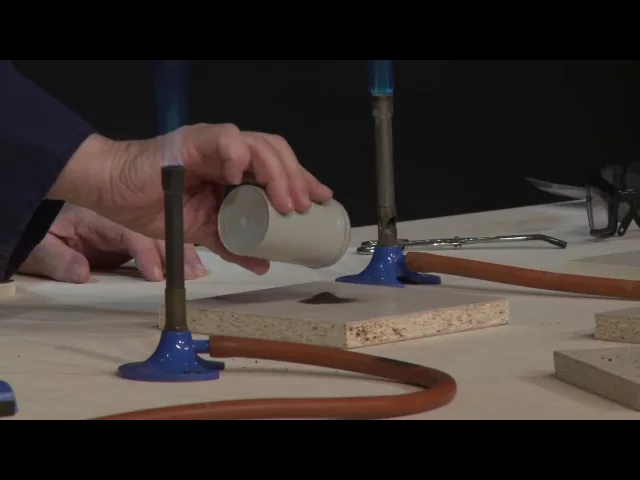
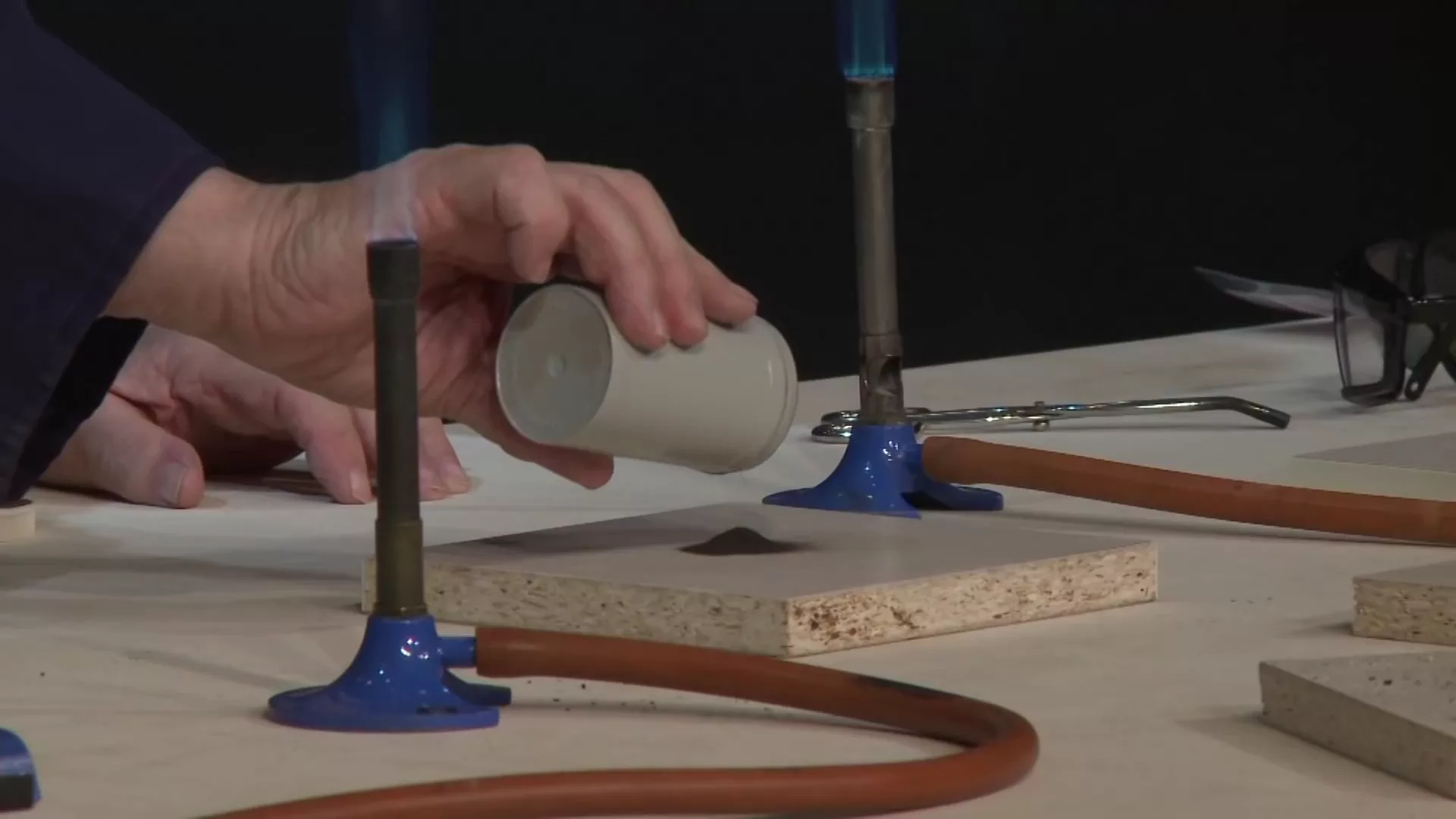
Let me give you an example or two now of the way what gunpowder is like when we burn it and the sort of things that it does. Just get rid of that, in fact, in fact Alastair if you don't mind we'll get rid of these bits on the bench as well, if you don't mind thanks. So let's take a mixture of the potassium nitrate, sulfur and charcoal in the quantities that is normal, just as you might be able to buy them or get them from any source whatsoever and these are not well-made.
They are just mixed together, these powders, and when we burn it you'll see that you would hardly describe it as gunpowder. So here we go. It doesn't light all that easily but you'll notice that it's messy, it's bubbly, there's a lot of residue there and it's left really quite a deposit on the plate.
So in no sense of the word could you call it gunpowder but it is gunpowder in its chemistry. So I'll push that out of the way. So let's take another one now and burning them in this way tells you a good deal about these powders.
So let's now take the same stuff and let's put it through a sieve which has a 120 wires to the inch each way. We've got 120 mesh sieve. Now if you were to measure the aperture between those wires that is one hundred and twenty-fifth of a thousand millimeters.
It's a very fine seive about like fine baker's flour. So the same stuff, light it this time and you'll see it's changed it's character straight away. So obviously the fineness of the material is really quite crucial in this particular case and that's not gunpowder because we've just mixed it together.
So this time let's put the chemicals into a mill and this is an edge runner mill, where you've got two big wheels rolling around on a pan and gradually incorporating the charcoal and the gunpowder and the sulfur and after say a couple of hours milling of that then you end up with a powder that looks like the last one but on the other hand the ignition you might expect to be a bit faster and so really what you've got there is a slight difference in the pattern again and I'm just a little disappointed because the Bunsen burner usually tells you something else but next one might. So let's say now then we're going to make this powder into the kind of powder that will do a piece of work like lifting a show or a roman candle or whatever it might be and so what they do is they compress the powder into an absolutely solid rock cake and then they break it down into grains so that it ends up looking like black sugar. So here we have the gun powder grains, we have them all sizes from about well one millimeter up to about seven millimetres and so here we go, when we light this it may not be all that quicker than that but it is quick and it's put the Bunsen burner out.
Now that's quite significant because you see what is happening is that you've got an explosive front here. You've got an immediate concentration of gas here and what it's done is pushed the Bunsen burner out because of what's happening there. Other explosives are much worse than that.
That's comparatively easygoing stuff. So look at our four plates now and you see the original terrible one here with all that residue left behind. Look how that one hasn't done a lot more than stain the plate.
What you might call a gunpowder burn and then look at this one where the grains have all pushed each other out of the way and this gives you a very clear idea of the burning characteristics, if you like, of those four powders which are absolutely chemically identical and so you can see that there is a lot to learn really from burning chemicals on the ground, if you like, or mixtures and watching them, even smelling what they smell like. Now if we were to mix gunpowder with other things we make some of the most ordinary fireworks that we have. So for example we could have.
. . .
. . because these all look alike I'm not going to actually tell you what they're going to do until they've done it.
<laughs> So let's have a look then and burn one or two of these and we'll get a clue of what's in them. But it's gunpowder mixed with other things. So I imagine that's probably charcoal and probably a bit of metal powder.
You can see the gold of the charcoal and there's a little bit of magnesium/aluminium alloy in there to give it that effect. Let's now try this one That's got titanium mixed in with it. So titanium is the newest metal to be available for fireworks, used to be very expensive but it gives the most beautiful silver sparks and of course it doesn't corrode in the same way that other things do.
Let's take another one and so this time we've got what we call a flitter which is aluminium again in a different form. It's not as fine and it forms those kind of what you can only call flittery effects and this time you'll see that its flittery again but different. So that we call a glitter and that's aluminium again.
A lot of these aluminiums give you different effects but there's antimony in there as well, which gives it that kind of effect. Here's another one which I'm going to be just a bit more wary with and because it's got a coat on the outside of it, a material and what happens is that it sometimes jumps sideways, which isn't too convenient. In fact I've got two of them coming up so I'll be a bit more cautious.
Of course you've got to be very cautious you don't get the whole box on fire but I've had it happen once. So here we go now with this one. Now this is aluminium with a goodly amount of oxygen in the composition making it burn very bright you see.
So the more oxygen there the more the aluminium burns more brightly obviously and then there's this one, which we make quite a lot of and it's quite curious. . .
I'm jumping slightly back because this interesting effect which probably in fairness the Chinese came up with in more recent times. That crackle is made by mixing aluminium and magnesium/aluminium alloy with an oxide of bismuth or even lead or something like that. Lead makes the best results but of course lead isn't as popular as you can imagine.
But there we are. So that's the kind of effects that you get. Aluminium is very interesting when it burns you see with gunpowder because at low temperatures it burns silvery gold but as you notice at high temperatures, with lots of oxygen it burns really very, very bright indeed.