You wake up at 6:47 a. m. 7 minutes before your alarm.
Your body knows. It's been doing this for 4,847 days, almost 13 years, at the same company. You tell yourself it's security, a good salary, benefits, stability.
But as you stare at the ceiling, there's this feeling you can't quite shake. You're making more money than your parents ever dreamed of. and somehow you are more broke than ever.
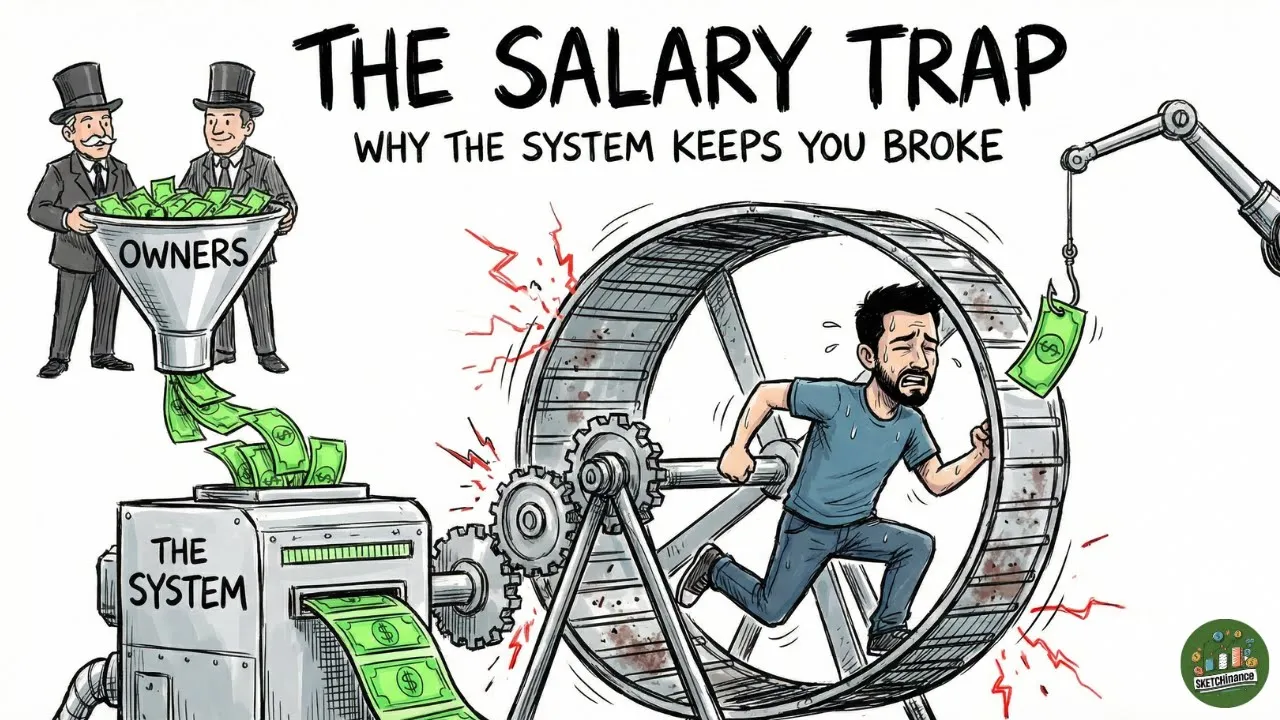
In the next few minutes, I'm going to show you exactly why that's not a coincidence. It's by design. This is the salary chop.
Let me introduce you to Sarah. She's 34, makes $85,000 a year. On paper, she's in the top 20% of earners in her country.
She should feel rich. She doesn't. Sarah gets paid every 2 weeks.
That's $3,21600 before taxes. After taxes, it's 2,458. Now, here's where the trop gets interesting.
The system doesn't present her with a choice. It doesn't say, "Here's your money. Decide what to do with it.
" Instead, it does something far more clever. It fragments her money across invisible channels before she ever sees it. Rent takes $1,200.
That's nearly half of her after tax income. Groceries and dining out 400. Car payment, insurance, and gas 550.
Phone, internet, subscriptions 120. Utilities 140. By the time Sarah actually sees her paychecks implications, she's already spent $2,410 of her $2,458.
She has $48 left for an entire 2 weeks. But here's the psychological genius of it. Sarah doesn't experience it as deprivation.
She has a car. She has a place to live. She's successful.
This system gives you just enough comfort to stop you from asking why you're not building wealth. This is the salary trap's first weapon. The illusion of prosperity through fragmentation.
When money comes in a lump sum and leaves in small pieces, your brain never fully grasps that you're just treading water. You have a lifestyle, not wealth. Now, let's talk about what actually keeps you stuck.
And this is where it gets darker. The entire system is designed to keep you dependent on that paycheck. Think about it.
You're told to get a good education. So, you do. Maybe you go into debt for it.
Now, you're hunting for a job to pay back that investment. You find one. Great salary, maybe $60,000.
But the moment you accept that job, something happens. Your lifestyle automatically inflates to match your income. Economists call this lifestyle inflation, but I call it the system's second trap.
You get the job at $60,000 and suddenly you can afford a nicer apartment, so you get one. Your rent goes from $800 to $1,200. You can afford a nicer car.
You get one. Your payment goes from $200 to $400. Now, you're making 90,000, so you move to an even nicer place, $1,600 in rent.
A better car, a $500 payment. Maybe a vacation. you wouldn't have taken before.
Each increase in salary feels like freedom, but each one actually tightens the muse. Here's why. You're no longer free to leave that job.
Because you need that salary to maintain your lifestyle. You've built a financial life that requires constant paychecks. This is what I call golden handcuffs.
The crulest part, you did this to yourself. The system didn't force you. It just presented the option and human psychology did the rest.
We see progress as moving up, not as actually getting richer. So, we move up into a lifestyle that consumes every penny we earn. A CEO making $500,000 a year can be just as chopped as someone making $50,000 if their lifestyle requires $450,000 ever.
The salary doesn't determine your freedom. The gap between your income and your expenses does. And the system is designed to keep that gap as small as possible.
Let me tell you about my friend David. He worked in tech, made six figures, but he was unhappy. Every time he thought about quitting, his stomach would drop.
Why? Because he'd already committed to a $400,000 house, two car payments, kids in private school. One day, his company offered him a promotion, a $20,000 race.
He felt relieved, grateful. He felt like he'd won. Two weeks later, his landlord raised the rent.
his mortgage adjusted. His oldest needed braces. He got a new car because the old one needed too many repairs.
And just like that, his financial stress didn't decrease. It stayed exactly the same. This is the system's most insidious trick.
You're not building wealth with your salary increases. You're just increasing your obligations faster than your income grows. It's why the person making 30,000 a year and the person making 300,000 a year often report similar levels of financial stress.
The system is engineered so that your required expenses always catch up. And when you're living paycheck to paycheck, even a substantial one, you're predictable, controllable. You need that job.
You can't take risks, can't start a business, can't invest in your own ideas because all your money is already promised to someone else. Your landlord, your bank, the car company, they all benefit from your trapped state. You're a guaranteed revenue stream.
But you don't actually benefit. I want you to imagine something. Imagine you quit your job tomorrow.
You just left. How many months could you survive? Be honest.
If your answer is less than 3 months, you're trapped. And you're not alone. Over 60% of professionals couldn't sustain their lifestyle for more than one month without a paycheck.
Think about that. You are one month away from a financial crisis at all times. That's not security.
That's a very comfortable prison. The salary trap convinces you this is normal. Work, earn, spend.
Work harder or more, spend more. But this isn't inevitable. It's not a law of physics.
It's a choice that's been made for you. The moment you realize your salary isn't keeping you rich, it's keeping you busy enough to not become rich, everything changes. Because once you see it, you can't unsee it.
You start asking different questions. Not how do I make more money, but why does all my money leave? Not how do I get a promotion, but how do I build assets instead of obligations?
This isn't about quitting your job tomorrow. The point is this. Awareness changes behavior.
Once you understand the trap is a system, not a law, you can start to dismantle it. First, stop confusing income with wealth. A $200,000 salary is income.
$50,000 in savings and investments is wealth. One is temporary, the other is permanent. Second, attack the gap.
Intentionally keep your expenses lower than your income. This feels backward, but it's the only mechanism that works. Third, redirect that gap into assets that work for you, not liabilities that work against you.
And most importantly, build optionality. The moment you have 3 to 6 months of expenses and savings, something shifts psychologically. You're no longer trapped.
You can negotiate better. You can take risks. You can leave situations that don't serve you.
The goal isn't just to earn more. The goal is to become independent from the systems requirement that you need that paycheck because the moment you don't need it, you're free. The salary trap is real.
It's sophisticated, but it is not inescapable. The people who break free aren't smarter or luckier than you. They just became aware.
They saw the system for what it is, and they decided that comfort wasn't the same as freedom. You have that same choice. If you found this breakdown valuable and you want to learn the actual mechanics of building wealth instead of just earning income, subscribe to this channel.
We break down the psychology of money, the systems that control your finances, and how to beat them. New videos every week. Each one gets you one step closer to actual financial freedom.

![Rich Dad Poor Dad - Robert Kiyosaki [Complete Summary ]](https://img.youtube.com/vi/jFNdARDCrKA/mqdefault.jpg)