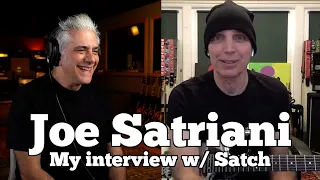
hi this is Joe Satriani and you're watching loud guitars.com hi this is Rick corves and I'm the winner of loud guitars.com private lesson with Joe Satriani time coming 25 years I wanted to meet you and uh the story of you with hris uh this you were like my Hendrick for me um so so I I guess essentially what I would love to I mean it's hard to put 25 years into an hour uh so I think what would be fantastic and fun would be to I guess take some of the you know learn some licks
directly from you from some of my favorite songs to I'm sure they're incorrect or I can't do them anywhere near what you could do uh of course and it would just be fantastic to learn from you instead of all of the inacurate cabs that are out there okay um so this is my first guitar lesson ever so I think it's pretty um so usually if I'm giving a lesson I have to find out what the student can do so what can you do on w not good so far so that's yeah I just that sounds
really good stop there that's great really nervous my pant Feel Like Glue I I don't know what happens but you know just that weird moment of you know your music's fantastic it's inspired me um for years now so I just would love to you know I I guess in a perfect world you know um besides just you know being your full-time student and that stuff but I think you know just learning some certain things like there's a couple of RS that are difficult and and uh a little bit of improvising maybe a little bit of
help I just I feel like because I've been playing by ear my whole life um I understand basic Theory and basic stuff and I understand the shapes but to be honest with you I would just love to know that kind of little missing piece that maybe will help me with my improvising to help me take me that next level you yeah well there's there's lots of little things uh that I think we all pick up along the way um that really go um and take us a distance that that if you if you look at
it on paper you go well that's nothing that's that's a little hint but actually when I sit here and I watch somebody play something that I know very well that I still work on every night I'm always working on S boogi I'm always trying to figure out a better way to do it but when I watch somebody else play it I can see former versions of myself let's say the first time I started writing it I wasn't quite sure I could pull it off if it would sound like a song when I was done uh
which notes I should leave out you know where was it inadequate um where it needed to sit back where it needed to to move forward and what I relied on was all these little things I picked up from playing with other people from playing in front of lots of audiences and getting their reaction um so the first couple of things I noticed right away was that you could have used like 20% more swing sitting on the back feet uh Jeff campelli on the drums man that guy is like the Cadillac of Swing you know he
s he always finds the furthest place in the back to make it very comfortable so when you go to play with him you've got to almost take the position that you're in the trunk right because he's over he's already presenting you with a very sort of like this he doesn't play like this you know he kind of plays like this so for you to sound not kind of nervous you have to figure out to get back there with them right and uh so you're you're leaving your strains way too early you know so instead of
you know you're thinking of I'm going to do this really plain here just that I'm really milking it for everything I can get out of it and that's what I'm instead of trying to slow it down yeah it's really short now I probably can't even play it stiff anymore because I've played it so long swinging it you see I'm really I'm really doing a swing kind of a thing just kind of like a little more groovy like that you just try to make it and bend a little bit more every time you're presented with a
third you kind of you know you play the you you really you're doing a little funny thing with the third that's the that's the blues idiom you know um the other thing would be um the two things that I noticed that were very interesting is that your right hand stayed in the exact same place for every section now if I was writing this out for for uh manuscript I would have a million little indications about what to you put this yeah yeah so my right hand is moving all the time because of the harl sounds
you can get by traveling up towards the neck so I got I'll have to put the gain up for you to hear how different it sounds what I'm doing that so you do have to kind of uh you have to kind of memorize this little section those those hars are so you've got root 3D fifth uh minor 7th root and then major 9 and that little that little section there just is that way oh I see yeah so that's just going in the opposite direction there so you kind of have to think about that as
you're playing uh cuz I always want those harmonics to be very musical I want them to fit absolutely you know yeah um so I would say that the other thing is the ver is a little automatic um I took some bbop lessons from m m trano and he one day he asked me can you just play a note without doing anything to it without any nervous twitch right and I realized that I'd never just hit a note I just never do that I'm always I'm always always shaking it doing something to it and I thought
wow I've all these years I've been playing and I don't I'm not quite sure I know how to just hit a note and make it sound good so that put me on a path for many years where I taught myself how to play without putting any what we used to call English on it you know uh but it's just no ver or any affectation of style and see what it sounds like to just hear the pure note and then after that make an artistic decision that you improvise in the moment what does that note need
does it need shaken fast slow this kind of WR itself almost uh well you you you want to improvise it I think if if you if you adopt that artistic lifestyle of improvising but you don't want it to be automatic to where you say this is my ver and every note I hit always has you can't tell a story instrumentally by having the same message the other thing is that in that particular song you know it's it's basically a blues and a and uh you're playing it in in the same key it was recorded in
I'm going have step down of course but um the the idea was to play around with um the fact that it's sort of it's a blue scale it is sort of a Doran with an added major third and a and an augmented fourth thrown in there um lots of ways to look at it but I do some key changes in there and each time I try um to lean on some other notes that are part of it and that I think is what defines the song from let's say a lot of other Boogie songs and
this is always the problem when you do a blue song so let's say if we were doing a straight ahead blues and we're going to call it the red velvet Blues cuz we're surrounding my red velvet here right so um the only thing that makes it different is that we've called it the red velvet blue and so people will expect us to sing them a story about what what why we're talking about red velvet right so the instrumentalist of course does doesn't have that we don't have any language to use but we do have the
musical language so what's going to make this different musically speaking than when you write something about blue burlap you know or you know orange stone you know if you're doing all blue songs you you you have to say well I've got the scales and the way that I play it and the inflection and am I pushing am I sitting on the beat am I in the back beat you know what's you need to have command of all these teeny little things that maybe the audience doesn't know is going on you know in the mechanics of
you playing but you you as a player have to take total control over it just the way a singer would because a singer could sing red velvet a million different ways and give you a different impression you know they can sing it with anger they can sing it with fear they can sing it with defeat you know what I mean and as we listen to it we say oh wow this you know this guy's sending us an extra message along with those two words so as as players even if we just have an eight bar
solo that's kind of like the challenge is to try to find uh the way that we can communicate these deeper musical meanings to people so and it's all this little stuff is how we pick it do we use all of the pick that's the other thing I noticed you you never change the part of the pick that you use you you had one position so um you know you've got the biggest excuse in the world you know it's just crazy to come show up in front of these cameras and start playing so well I'm just
using you as the as the guinea pig and and you're very brave and courageous subject but let's say if you were in fact uh my regular student right and and you said look Joe I want to be great so come down hard on every week that's what I'd be doing I'd be looking at every little aspect what you're doing which is what I need but this is you know what I've been longing for all this time was to have that uh scrutiny you know and and say hey okay there's these things that you need to
do that I I'm even noticing now that I'm actually forgetting about while I'm doing this you know yeah and it's no isn't that that's also a part of performance because uh we go out to perform every night and uh do every Jitters or your hands or sticky or does any does ever anything well a lot of things happen I mean we're we're human we're we're at the mercy of the environment uh every night it doesn't sound the way you thought it was going to sound and strings feel different or your amp doesn't perform right or
the monitors are funny or they're slapped back or the Risen or the stage is boomy or it's dry or it's bright or the audience is screaming at you while you're trying to find the right pitch and you can't hear your guitar over the people screaming at you um so yeah all sorts of things are happening but I think um uh each time that you go out uh once again you want to control all these little tools that you've learned along the way because ultimately our our job is to lift people and their Spirits in a
performance with our music so we have to deal with all this stuff and say I can deal with it I'm a professional musician I've prepared for these moments when my strap breaks or the amp blows up or whatever you know or someone doesn't show up to the show and we got a cover for him or whatever it might be and uh and you have to plow through and and uh the um your the strength that you build in your musical character is what gets you over that so it's sort of like there I can't say
that well if you practice this you know one thing you know 3 hours a day your hands will be strong and that and therefore you will never be weak that rarely comes into play that's what I find what comes into play is kind of like what you mentioned is just like the odd thing that you never think would ever happen that's what happens and that's what tries to throw you off and it's that sort of you know musical I don't know rock and roll moral fiber that keeps you standing on your two feet saying I
don't care I can keep playing you know this like I can I can you know my job is forward just yeah just go forward you know I've covered a lot of ground so that's really what it is you got to cover a lot of ground so again um without having to use TCH Boogie over and over again I would say that um the obvious thing is to get really in contact with uh each of the the scales that you're using and then keep breaking it down and put you're playing under a microscope and think how
can you get more out of this one note is it where I pick it is how much pick sticks out of my finger ver no ver you know what pickup selection am I going to use you know to a modeling amp is just going to kill everything I mean it takes 50% of what I do and it homogenizes it so we should talk about some other things that I think are more important which are um has something I used to show people all the time here maybe the way to do it is if I take
um like you know what key that is so the fourth mode of the major scale which is a lydian scale Lan now what if I go is it like mix see this is really not fair of me to do this because I've hit upon your weakness immediately that's what I'm here for yeah like that to be honest with you that's what I'm I'm not doing this on purpose but this is what I would do if he was a real student uh what I would do is i' in five minutes I got to figure out what
have you covered before and then I'd say I I'd make a mental note okay your training we got got to do your training we got to really work on it right so obviously you can play and and you've got a really good sense of pitch and your timing is really good so you're you're basically like a really good musician with untapped reserves and so I'm looking for those untapped reserves right I have untapped reserves now I'm a really good musician just FYI yeah just play that over and over again you know so so um this
is what I do when I was in high school uh I was uh benefiting from uh taking uh these music theory classes from a guy a young piano player who magically arrived at this public school um and he taught me basically cuz I didn't have perfect pitch so he said well I'll teach you relative pitch which is call this one everything else you have to learn what this distance is and what that is sure what that is and we'll give it a number one flat 2 one 2 one minor 3rd one major 3r one one
augmented fourth 1/ 15 minor 6 tonally just to be able to pick it out of the air and understand where you are and then he started showing me the modes which uh I'm I started out playing the sing and E because it's just easier for the guitar that's rightone right so the mode is like a musical set of numbers 1 through seven and then it keeps repeating over and over again if we're looking at a piano C to C and it just goes all the way up the 88 keys right but if we start at
D and end at d That's a mode of the same white keys we haven't changed any notes who just started and ended at a different spot that we call Dorian if you start on E it's frian F glidian what I started playing 5 to five mixian 6 to6 is the Natural Minor 7 to7 lochan or anybody uses that one and 1: one or 8 to8 we're back to our octave again so um and that's just the scales without any of the altered notes in it once you start altering every scale basically think it this way
if a scale's got seven notes there are seven ways to do it are seven modes of it so if you start with a harmonic minor then you've got modes of the harmonic minor and so on and so forth that's how we get what we there they're not really they're called they've got sort of artistic names ethnic names Hungarian minor you know FR dominant stuff like that um sometimes you pentatonic scales would be called Ethiopian scales or stuff like that but basically it's just a way that musicians can talk to each other about these scales so
if I start something let's say I'd expect you to hear it and go I know that scale inside and out in every key all over the guitar that's what I would ask you to do as my student okay so the first thing would be I have to teach you what's that M and then do you hear a major third or a minor third so that's your key right there and you go well I have studied the fact that there are only so many scales that have a flat nine and a major third in it and
these are choices yeah here's the other thing that's crazy about this idea of your training is that if I start a song so how many notes have I given you really it's one note but one right so the other six are totally up to you now if I start a song and I go I've given you actually almost I've given you almost the whole scale so when you hear these chords um where's he all those individual notes too sorry about this gain thing here so each one of these chords that has you know six different
notes in it I'd expect you to get to the point where you'd go and you'd say 1 5 1 5 1 six 3 augmented four seven right and and you'd be able to piece the scale together that way so the way you do it would be this is how I did it by Sayang whoa what did I do that is the coolest Tone ever didn't mean to do that sorry all right so I do this one 2 one 3 1 4 1 augmented 4 1 5 1 6 1 flat 7 1 major 7 1 1
I did it in G cuz that was the best vocal range your voal for my limited voice right but it really was the beginning of me being able to hear if you suddenly went and you said let's Jam I'd say I know what that is I've heard that before and I'd think I know six scales that have a flat nine in it and I'd start improvising around it so we have to get you to that point so I would suggest you hit the internet um get some fingerings for scales in two and three octaves eventually
though you have to break from the pattern so you get like a major scale three octaves maybe going up and down in three different you know different ways do the there's a g lydian uh and two octaves that way or keep in mind no one will ever pay us to show them that you know on stage you know so the idea of practicing this a lot to me is worth the idea is you really need to be training the ear part of course you don't want to be playing it like crap you know so just
slow it down but you want to train your ear to understand two things what is the scale and number two very important what do I think about it when will I use it not when does Joe use it or someone else use it when am I going to use it and because as you develop an opinion about every scale that becomes your St you want to see uh when you're practicing how far you can sort of open some new doors to your creativity but the uh I haven't come up with a better phrase than uh
building an opinion about I mean I I found that really works because it's not a technical term a beginner or an advanced player can pretty much understand uh something like that it's almost like if you had a metal player and you went they might say hey man I'm never doing that you know because that's blues and I don't play traditional blues uh so the the the question that a player might ask themselves is why do I hate that you know what rubs me the wrong way about that and what's the alternative what do I want
to give the world that's not that and you have to build that up and as you build up a sort of a vocabulary based on your opinion it becomes the style that people recognize you on so you're practicing uh is building that and I want you to think of it that way and and I would always uh instruct my students not to sit there and play one scale against a metal faster and faster for hours and hours that's a a recipe for repetitive stress injury so you know from being a player for a long time
that you're pretty much going to be as fast as you're going to be in the first couple of years you know the motor skills show up pretty quick um but your quality as a good musician is something that can develop over decades and your brain is sitting there waiting to help you out and your ears are just sitting there waiting for stuff to come in and enhance that whole journey of getting better and better and a better player um I'm practicing to the tracks for me it invokes emotion as opposed to just Mindless scales and
that's why I I don't do Mindless scales that way I just I like to make it a little more musical which may be bad for my practice rine because I end up taking a left turn and then going on this journey when really my whole Focus was okay I got to figure out that scale you know so I I get a little sidetracked you know getting lost in the music but yeah yeah yeah am well let's try um let's try something here I'll do this I'm just going to do something really simple it's G and
I'm just curious to see play any kind of a Melody you want and any kind of a key and then try a totally different one like all right you pedal the G for me so we got just one note basically I start off and I obviously I'm not going to be able to do open string stuff for here I little loud for you here a so I went through about seven or eight different scales out just playing around and I kept a sort of a a jazzy swing on it just to figure out a way
to to keep the same so uh again illustrating that if you just give me one note I have the freedom of the other six pretty much so I think I started with Blues like you you had started blue so I thought okay start with blue so I've got this and then uh lyan and then lydi and Domin and then Fran Domin at one point I did this is two ways of doing it either you can call that's symmetrical or I'm playing a a diminish scale off of a different mode but it's the same thing it's
just half step whole step but this creates even in the the simplest this is almost like an introduction to a song right just something that's starting out I'm creating lots of different mood so if you were once again we go back to the red velvet idea if you were talking about uh what's behind the song ultimately is what's behind the red velvet curtain and what is it it's a beautiful woman or it's an ugly monster that would determine you're saying okay I'm going to you know that sound but so you'd ask yourself what scale is
the ugly monster or what scale is the beautiful woman because my part's got to make this introduce it maybe when the singer starts or you know what I mean or when the main Melody starts uh so uh how does a guitar player learn how to do this you know what I did was if I was near a piano I'd go and I go and I'd sit there and you know and I'd play it and then I'd play the other scale uh if I wasn't I'd use my low string and as I did earlier you know
and I play all these modes and I just try to sing them mhm um then the other thing was I tried to sing them without any instrument around so I'd have to just again if I'm starting with that G and i' I try to go 1 2 3 4 5 6 7 1 and that would be okay that's my major scale and I'd say well what's frigi and dominant I'd have to mentally you know get this one flat two major third four like that and i' I'd be singing like that and the idea is that
your voice vibrating you know is a physical thing it's a visceral lesson you're teaching yourself and so when somebody does you're going to your body's going to remember that you know what I mean it's because you're not going to be doing this especially if you're performing with people you're looking at the camera the audience right and so but if someone in the band suddenly plays something you want to be able to react to it you know um so that means that not only your ear but kind of like you have to have a physical memory
of it this guy I took some lessons from Lenny justana was really big on that he had me memorizing Melodies and solos with my voice I have to come in and bring a record Put the Needle down on the record and sing it along you know with the horn player whatever I'd bring in you know Miles Davis I I would bring in Black Sabbath I brought in everybody you know he didn't discriminate but it really taught me that lesson that instead of learning how to play it and relating to it as a bunch of fingerings
and picking assignments learn it as a piece of music as you would a listener and then the music will come out this way which is he thought that's where it should be coming it should be coming from the inside out that's down that would be down on the piece of paper I would write down uh uh modes or tell you to go out and find some and uh we talk about some fingering and uh but basically the idea is you have to get this ear training thing happening in your head uh so that you understand
when you hear somebody play lydian you go recogniz I know that that's a Litt mode no wonder it's making me feel that way right um yeah the modes for me are like emotions like feelings like you know some are dark and happy Andy and so that's that's but you have to learn them I would say this this is very important you have to as a as a student of music you have to admit to yourself what you don't know just say I cannot play Fring dominant in you know B flat a flat E flat all
over without just doing the fingering I picked off the internet you know what I mean so that puts you on a trajectory of practice that's probably unprecedented in your life but it's so necessary to break out of let's say if this is how you learn the scale to never play that in front of an audience they they will never buy a ticket for that you know what I mean sure but understandable if if it's El lyan and all you do is that's what they're looking for they're just they want you to show that you are
completely free on your instrument to represent music in any and not stuck in a box like just even be able to see them all connected laterally that's that's the thing that I need most yeah you don't want to sound methodical you don't want to sound like you're trying to teach the audience or anything like that right so uh but it's sort of our lot as players to somehow transcend the way that we pick these things up they're very handy you know as we pull lessons from books and things like that but we have to eventually
dissolve the connection between how we learned it and how we use it right um so let's talk about picking though um people always come to me uh wanting to know secrets of picking and um it's really funny you know in this particular band uh I've got a bunch of guitar players who are playing different instruments right Mike cani plays guitar and keyboards he's a master guitar Master guitar and a lot of people don't know that Marco miniman also plays in Guitar incredibly well and they both have very fast right hands they're right-and players but their
hands move very differently from each other you know whereas Marco has a very small wrist movement kind of a thing uh Mike has a more of an arm kind of a thing more like a Puchi kind of a thing um I've seen I've stood right next to guys like inve who play more like this or or uh guys who play like that like Neil right that's that's almost like a hendric kind of a style thing and then Steve I plays like this and it's amazing when we're we're doing the G3 stuff and you you know
you're going across the line whether it's Steve Morris or Steve Luca Steve I any Steve you can find um they can all play just as fast as each other but they're all holding their arms and their wrists in a different place you know so you got to find your own thing so it's like it's a it's a a bit of a disappointment when the students come and they say well what's the secret to playing fast and I said well you got to figure out where you want to hold your hand not where I do it
you know what I mean cuz you know different anat again if we were not rock and roll guitar players and we were in an orchestra let's say we were in the kitchen or Symphony offering or something like that um we would simply be required to have all technique available for the conductor when he says today we're doing Flight of the Bumblebee and we're like oh great you know if you know we're a particular player that's got to handle that on the trumpet or something so uh you know we kind of get a a bit of
a free pass as rock and rollers you know we're allowed to be more expressive and say these are my techniques and I don't use those techniques it's not part of my gig or something like that but once again if we were classical players we sort of would be asked to learn all the techniques wouldn't we because we would be representing hundreds of years of repertoire and we you know the conductor would pull out something from 1700 or 1900 or whatever 1600 we'd be able we'd have to react to this so um you have to eventually
figure out a way to play um with picking mute picking open picking picking where you hear the pick picking where you don't hear the pick because ultimately it sends a a message to the audience uh you know when someone is in a let's say a a hardcore band and they go to play something and the audience doesn't hear the picking the a audience might get up you know let down because that's what they're expecting they want to hear the aggression and the sound of the pick right if you're playing in a different kind of a
band that plays a variety of Music the audience may get let down because the guitar player's always going choa choa choa every time they play something and it's like what that what's that got to do with the song You Know What I Mean So ultimately I think we're we're we can't get off the hook on this thing we have to learn how to play both ways however I think it's important to know when to use it because the sound of the pick is something that the average listener is affected by and the absence of the
sound pick is the same way so when when we do something Legato the the average listener in the audience says wow that sounds so fluid it makes me feel so free and when we pick every note and make sure they hear the scraping of the pick intensity right yeah they feel that intensity you know and depending on the music it may be exhilarating or make them feel uncomfortable or whatever it is we're going for uh so uh that's a long way of saying we've got to do it all um eventually I think like when you
uh you practice picking it should wind up uh yielding something pretty uh as well as things that are pretty aggressive I just always afraid that people who practice um uh picking aggressively will just write extensions of the exercises so I'm I'm a big fan of just learning as many songs as you can that have interesting picking that maybe throws you for a lube and use that as your exercise rather than uh these because you know that these kind of things rot the brain and once again no one will ever pay to see you do that
you know so you might as well uh you know you were talking about playing that you might as well play things that are nice and that have some sort of musical content or write some of your own yeah you know make a point of maybe every two weeks just write something simple it can be very derivative but just something that maybe focuses on something you're having a hard uh time with picking noise do you do any arpeggio stuff like uh these I used to really hate when I was young cuz they focused on things I
wasn't all that good at can't believe I played that right for the cameras but um uh those things I once again you know you you kind of play them and they they kind of if you're looking at the guitar they kind of lay out the major minor diminished and augmented arpeggios for you which I think ultimately was a good way to look at it I think it kind of helped me visually see things um oddly enough I uh I bought a pamphlet from a guitar player named Billy Bower uh when I was uh a teenager
that had all these arpegios in it and I studied them a lot and then uh a couple years later I took a few lessons from the from the bbop Gan player and he was like oh don't you know don't bother playing these arpeggio things you know they just sound terrible you know they sound like a student practicing he said what you should do is play me every version of uh inversion of a chord on on a set of strings that you can so like for d right he had me doing this as far as up
as far down like to go he didn't care about the fingering cuz he was a piano player but everything had to be right and this I found was sort of a better way of being able to sort of think about these arpeggios visualize them too and use them better within cord yeah uh we know as guitar players that you know when you get a chordbook you know it shows the chord like this but you rarely do that as a guitar player you're usually playing little bits of chords and pieces here and connecting it with some
sort of rhythmical uh composition and so breaking the chords up into you know starting with root 3D and 5ifth and then third fifth root and then fifth root third is a great way to always know all your options in terms of those chords you know so I would say that and of course you you want to be able to do the uh the same thing with your minor and you have to do same thing with your diminished and augmented arpeggios great great way to do it um another thing that I would recommend I I do
believe it's still in print uh there's a jazz guitar player named Joe Pass and he wrote a a book called Joe Pass chords and what he did for instance on the first couple of pages he wrote for major chords all these forms will work and he wrote down no chord names so for my case C major he may have had these and he had simple things like that mixed in you all sorts of chords like that you know I think I'm going out of tune here and um uh as a young kid I thought oh
I get it now it's up to you to break up the harmonic suggestion and to improvise how you um how you fill that up how you accompany whatever else is happening so uh in Rock of course it's a little different you know we we approach those spaces in a different way but it's pretty much the same thing and I realized boy you know what I hear p towns and doing is pretty much what I hear Joe Pass suggesting it's just they have a different sound on their guitar and you know when it gets more distorted
the less notes sound a little bit better so you know the the town's approach is a little bit more geometric uh in a in a simplified form but but bigger in sound Joe pass's sound was a little a little bit more condensed but much more complex harmonically uh this helped me get away from this yeah they're only you know you have to know them inside and out you know but and then got me away from this the just the simple bar chord once again major minor 7th 7 sus4 minor 7th minor within the you've got
to know those but then eventually as we said before you have to know how to combine them and then how how to break them up depending on you know what you're trying Eric Johnson does a lot of that yeah of course he's he's a great obviously you know there's it's it's funny if you if you look at the edge from You2 and you look at Eric Johnson they do very much the same thing they just you know use fewer notes I think the edge uses fewer notes but he he creates an environment without saying you
know g at n he just might just do this but it's the same sounds huge though it's the same musical information they're working with you know uh this will always roll back to the ear training thing MH cuz what as you're doing your chords eventually as if we were continuing uh relationship as a student and I said okay improvise a scale over this number one without looking you'd have to be able to go I know what that is I can pick out these notes and play the appropriate scale and then as I would change the
scale I would expect you to be able to change with me you know what I mean like that so uh once again it's this and and you got to feed it and you got to put a name against it if you don't have perfect pitch assign numbers to the notes um extremely important uh so that eventually uh what you've got inside is something that people can recognize as your own style you know and the physical stuff I think will will fall in place I really appreciate all of that advice thank you very very much all
right fantastic it's going to come in a different key for me I can't use my harmonics a oh la oh yeah it's good hard I'm continuing yeah keep going you're doing a great job oh oh n a jazzier bluesier version right thank you so much thank you good playing fantastic did I mention he was a good musician for